METHODS OF JOB DESIGN
• JOB SIMPLIFICATION
• JOB ROTATION
• JOB ENLARGEMENT
• JOB ENRICHMENT
JOB SIMPLIFICATION
The complete Job is broken down into small subparts.
Each part of the work is given to worker, who does the
same task again and again.
JOB SIMPLIFICATION
ADVANTAGE
• worker to gain proficiency and fitness
• Productivity and Profit
• training costs is less
DISADVANTAGE
• repetitive job, workers feel boredom, Absenteeism, mistakes and
accidents.
• Quality and quantity of output gets affected
JOB ROTATION
• It implies shifting of an employee from one job to
another job within a working group.
• Transfer to a job of same level.
JOB ROTATION
ADVANTAGE
• Removes monotony & boredom
• Broaden the knowledge & skills of employees
• Turn specialists into generalists
• Enhanced flexibility among the employees
DISADVANTAGE
• Frequent shifting of employees may causes interruption in the job
routine
• The employees who wants more challenging assignments may still
feel frustrated.
• It may increase costs and decrease productivity
JOB ENLARGEMENT
• It is the process of increasing the scope of job of a
particular employee by adding more tasks to it.
• This is a horizontal expansion in a job.
• Generally, additional task does not require new skills.
JOB ENLARGEMENT
ADVANTAGE
• Reduces boredom and monotony by providing more variety of tasks in
the job.
• Increase interest in work and efficiency.
• Versatile employees
DISADVANTAGE
• Job may become boring to employees after a time as it will results in
monotony
• Herzberg – “job enlargement is simply adding a zero to zero” (A set
boring tasks is added to another boring sets)
JOBENRICHMENT
• Job enrichment consists of designing the job in such a way that the employees
gets greater autonomy for planning and controlling his own performance.
• It implies increasing the contents of a job or the deliberate upgrading of
responsibility, scope and challenge in work.
• It is a motivational technique which emphasizes the need for challenging and
interesting work. – RW Beatty & GE Schneider.
• Job enrichment involves adding motivating factors to job.
• Job enrichment is a vertical expansion of a job by adding more responsibility
and freedom to do it.
• Fredrick Herzberg et.al describe job enrichment as that type of improvement
in the context of the job which may give a worker more of a challenge, more
of a complete task, more responsibility, more opportunity for growth, and
more chance to contribute his ideas.
• Job enrichment increases job depth, which refers to the degree of control
employees have over their work.
JOBENRICHMENT
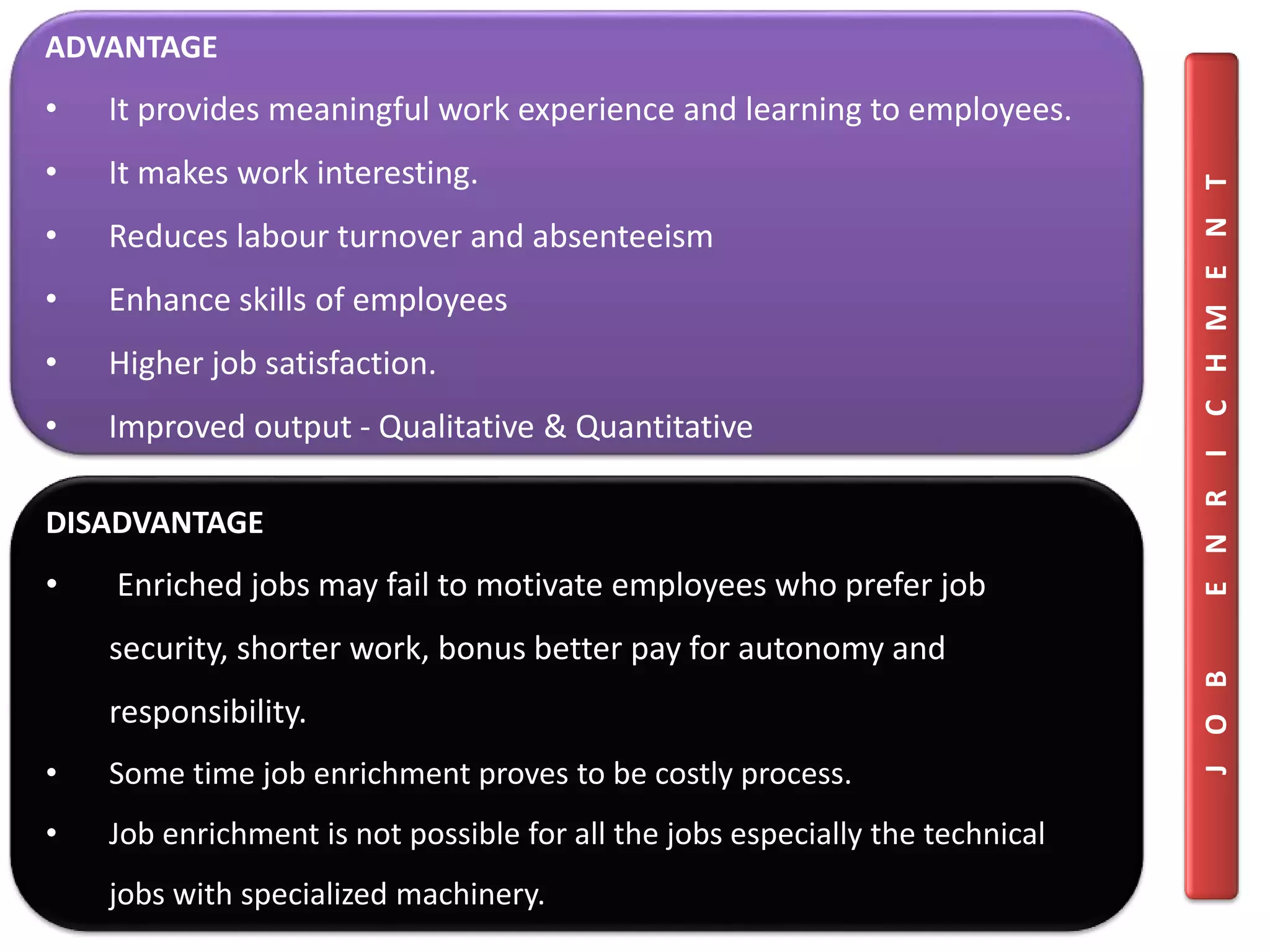
ADVANTAGE
• It provides meaningful work experience and learning to employees.
• It makes work interesting.
• Reduces labour turnover and absenteeism
• Enhance skills of employees
• Higher job satisfaction.
• Improved output - Qualitative & Quantitative
DISADVANTAGE
• Enriched jobs may fail to motivate employees who prefer job
security, shorter work, bonus better pay for autonomy and
responsibility.
• Some time job enrichment proves to be costly process.
• Job enrichment is not possible for all the jobs especially the technical
jobs with specialized machinery.
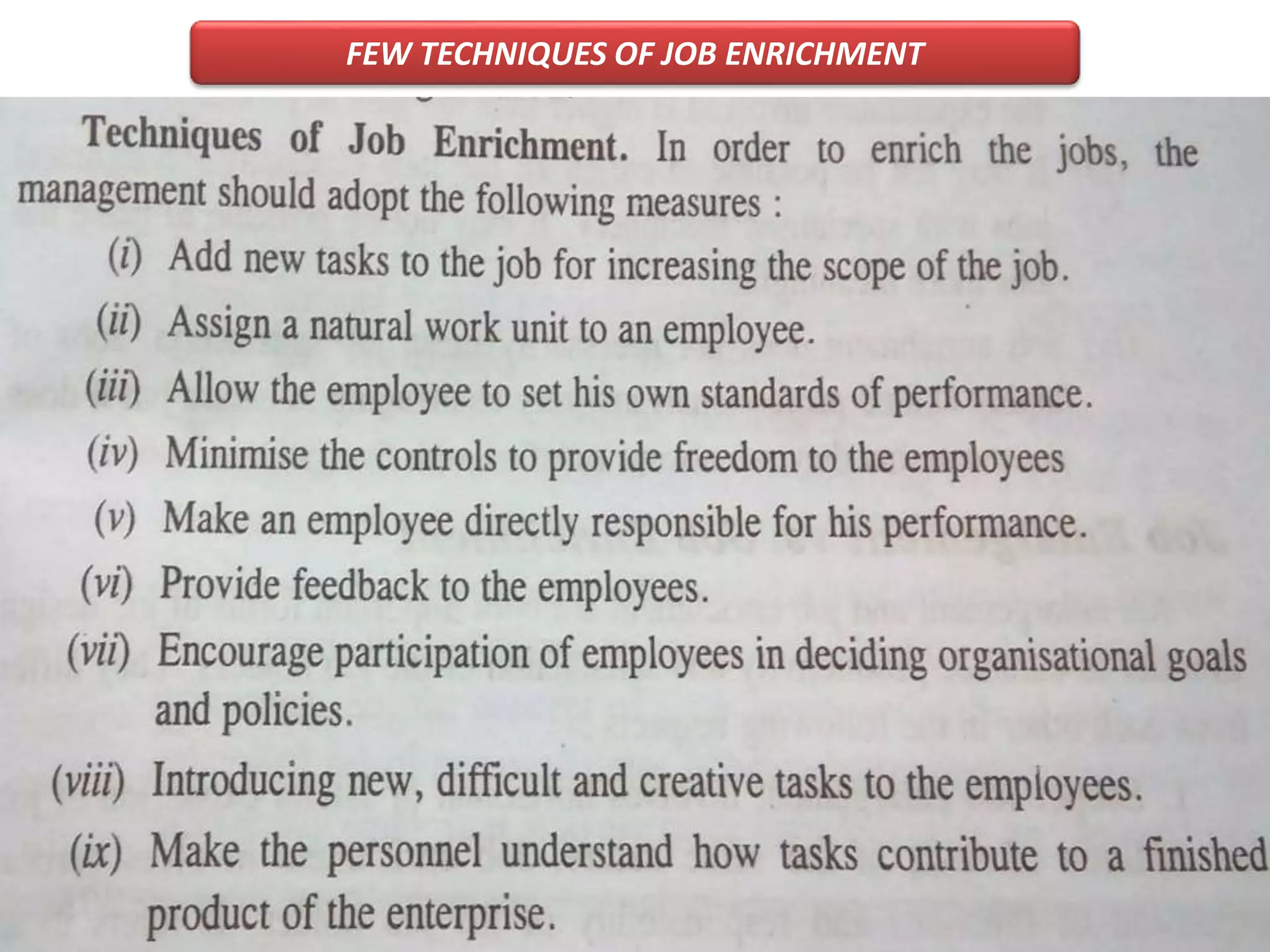
FEW TECHNIQUES OF JOB ENRICHMENT
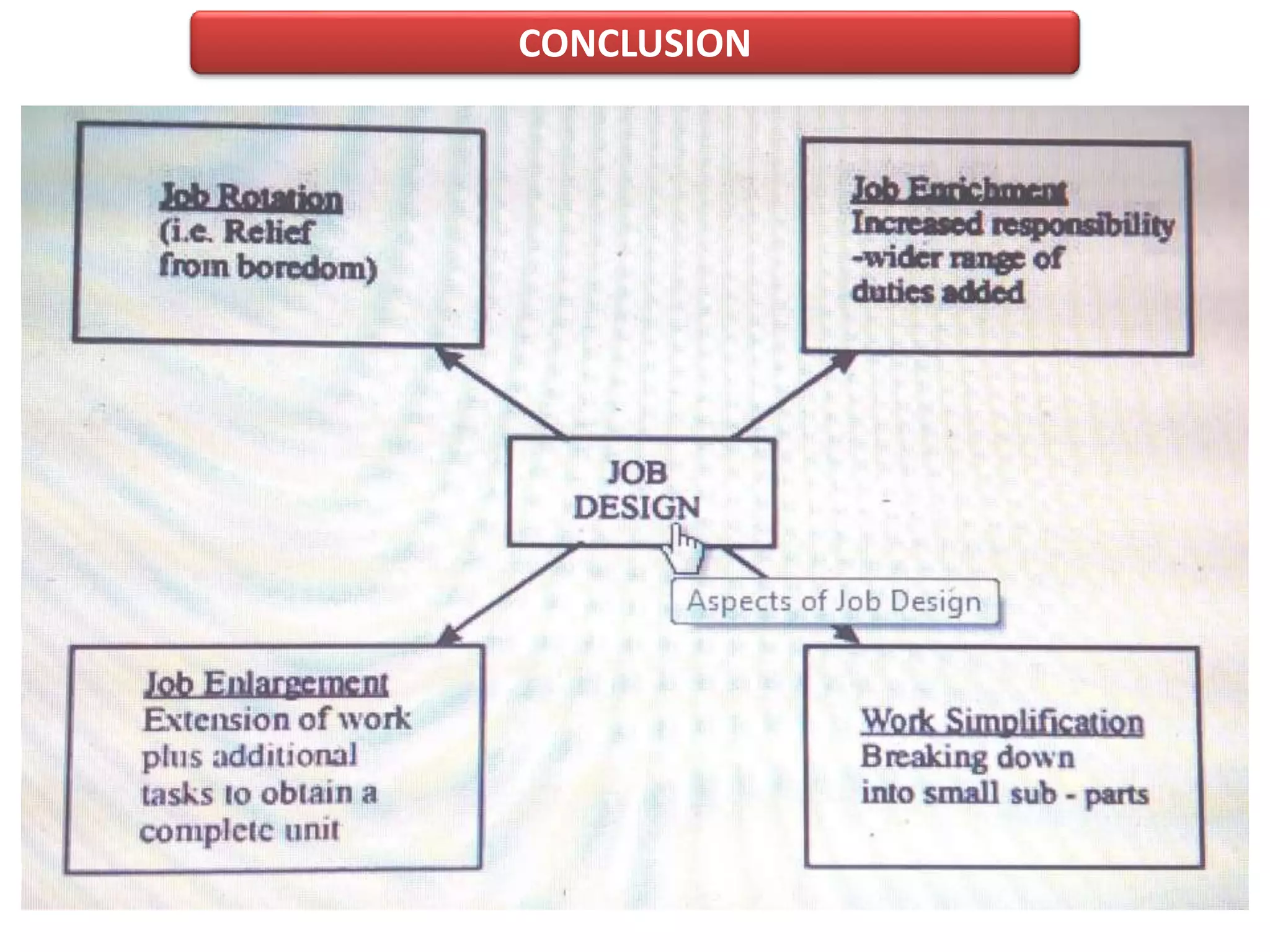
CONCLUSION
Job design; methods

Job design; methods

  • 1.
    METHODS OF JOBDESIGN • JOB SIMPLIFICATION • JOB ROTATION • JOB ENLARGEMENT • JOB ENRICHMENT
  • 2.
    JOB SIMPLIFICATION The completeJob is broken down into small subparts. Each part of the work is given to worker, who does the same task again and again.
  • 3.
    JOB SIMPLIFICATION ADVANTAGE • workerto gain proficiency and fitness • Productivity and Profit • training costs is less DISADVANTAGE • repetitive job, workers feel boredom, Absenteeism, mistakes and accidents. • Quality and quantity of output gets affected
  • 4.
    JOB ROTATION • Itimplies shifting of an employee from one job to another job within a working group. • Transfer to a job of same level.
  • 5.
    JOB ROTATION ADVANTAGE • Removesmonotony & boredom • Broaden the knowledge & skills of employees • Turn specialists into generalists • Enhanced flexibility among the employees DISADVANTAGE • Frequent shifting of employees may causes interruption in the job routine • The employees who wants more challenging assignments may still feel frustrated. • It may increase costs and decrease productivity
  • 6.
    JOB ENLARGEMENT • Itis the process of increasing the scope of job of a particular employee by adding more tasks to it. • This is a horizontal expansion in a job. • Generally, additional task does not require new skills.
  • 7.
    JOB ENLARGEMENT ADVANTAGE • Reducesboredom and monotony by providing more variety of tasks in the job. • Increase interest in work and efficiency. • Versatile employees DISADVANTAGE • Job may become boring to employees after a time as it will results in monotony • Herzberg – “job enlargement is simply adding a zero to zero” (A set boring tasks is added to another boring sets)
  • 8.
    JOBENRICHMENT • Job enrichmentconsists of designing the job in such a way that the employees gets greater autonomy for planning and controlling his own performance. • It implies increasing the contents of a job or the deliberate upgrading of responsibility, scope and challenge in work. • It is a motivational technique which emphasizes the need for challenging and interesting work. – RW Beatty & GE Schneider. • Job enrichment involves adding motivating factors to job. • Job enrichment is a vertical expansion of a job by adding more responsibility and freedom to do it. • Fredrick Herzberg et.al describe job enrichment as that type of improvement in the context of the job which may give a worker more of a challenge, more of a complete task, more responsibility, more opportunity for growth, and more chance to contribute his ideas. • Job enrichment increases job depth, which refers to the degree of control employees have over their work.
  • 9.
    JOBENRICHMENT ADVANTAGE • It providesmeaningful work experience and learning to employees. • It makes work interesting. • Reduces labour turnover and absenteeism • Enhance skills of employees • Higher job satisfaction. • Improved output - Qualitative & Quantitative DISADVANTAGE • Enriched jobs may fail to motivate employees who prefer job security, shorter work, bonus better pay for autonomy and responsibility. • Some time job enrichment proves to be costly process. • Job enrichment is not possible for all the jobs especially the technical jobs with specialized machinery.
  • 10.
    FEW TECHNIQUES OFJOB ENRICHMENT
  • 11.