Job Design
Ashutosh Thareja
Bcom (hons), Sem I
G.D Goenka University
2
A job is a piece of work,
especially a specific task done
as part of the routine of one’s
occupation or for an agreed
price.
A job is the smallest unit into which the
activities of an enterprise are divided. It is the basis
for selecting and training employees, for evaluating
their performance, and for determining the rate of
pay .
3
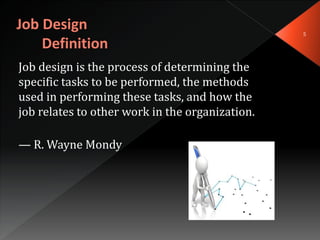
Job design is the process of determining the
specific tasks to be performed, the methods
used in performing these tasks, and how the
job relates to other work in the organization.
— R. Wayne Mondy
5
Job design involves systematic attempt to organize
tasks, duties and responsibilities into a unit of
work to achieve certain objectives. It is a process
by which managers decide individual job tasks
and authority
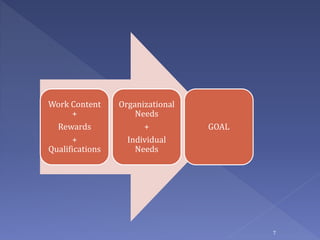
Work Content
+
Rewards
+
Qualifications
Organizational
Needs
+
Individual
Needs
GOAL
7
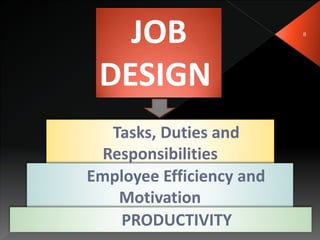
JOB
DESIGN
Tasks, Duties and
Responsibilities
Employee Efficiency and
Motivation
PRODUCTIVITY
8
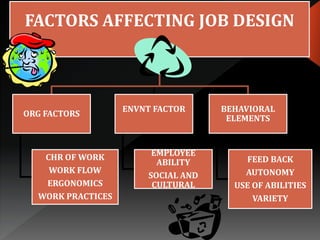
FACTORS AFFECTING JOB DESIGN
ORG FACTORS
CHR OF WORK
WORK FLOW
ERGONOMICS
WORK PRACTICES
ENVNT FACTOR
EMPLOYEE
ABILITY
SOCIAL AND
CULTURAL
BEHAVIORAL
ELEMENTS
FEED BACK
AUTONOMY
USE OF ABILITIES
VARIETY
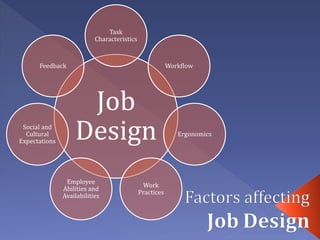
Job
Design
Task
Characteristics
Workflow
Ergonomics
Work
Practices
Employee
Abilities and
Availabilities
Social and
Cultural
Expectations
Feedback
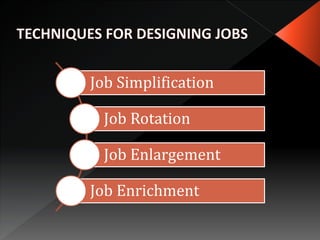
Job Simplification
Job Rotation
Job Enlargement
Job Enrichment
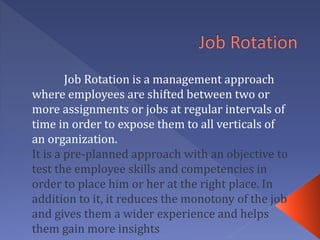
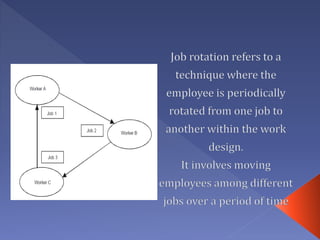
Job Rotation is a management approach
where employees are shifted between two or
more assignments or jobs at regular intervals of
time in order to expose them to all verticals of
an organization.
It is a pre-planned approach with an objective to
test the employee skills and competencies in
order to place him or her at the right place. In
addition to it, it reduces the monotony of the job
and gives them a wider experience and helps
them gain more insights
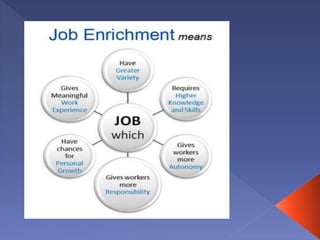
Typically job enrichment involves
combining various existing and new tasks
into one large module of work. The work
is then handed over to an employee,
which means there is an increase in
responsibilities and scope.
This increase in responsibility is often
vertical. The idea is to group various tasks
together such that natural work units are
created.
18
Prevailing practice in Job Design was to focus almost entirely on
simplifying tasks:
Making jobs as specialized as possible.
Why was this a problem?
19
•Involves establishing specific, measurable and
time targeted objectives
It is an effective tool for making progress by
ensuring that participants are clearly aware of
what is expected from them, if an objective is to
be achieved.
On a personal level, setting goals is a process
that allows people to specify then work towards
their own objectives - most commonly with
financial or career-based goals.
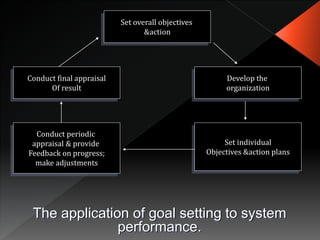
The application of goal setting to system
performance.
Set overall objectives
&action
Develop the
organization
Set individual
Objectives &action plans
Conduct final appraisal
Of result
Conduct periodic
appraisal & provide
Feedback on progress;
make adjustments
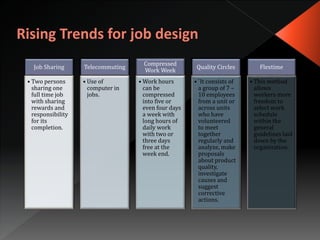
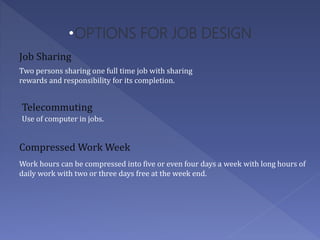
Job Sharing
• Two persons
sharing one
full time job
with sharing
rewards and
responsibility
for its
completion.
Telecommuting
• Use of
computer in
jobs.
Compressed
Work Week
• Work hours
can be
compressed
into five or
even four days
a week with
long hours of
daily work
with two or
three days
free at the
week end.
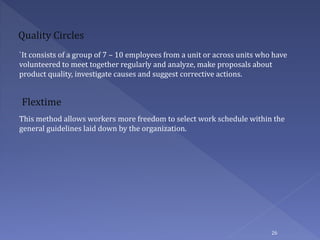
Quality Circles
• `It consists of
a group of 7 –
10 employees
from a unit or
across units
who have
volunteered
to meet
together
regularly and
analyze, make
proposals
about product
quality,
investigate
causes and
suggest
corrective
actions.
Flextime
• This method
allows
workers more
freedom to
select work
schedule
within the
general
guidelines laid
down by the
organization.
•OPTIONS FOR JOB DESIGN
Two persons sharing one full time job with sharing
rewards and responsibility for its completion.
Job Sharing
Telecommuting
Use of computer in jobs.
Work hours can be compressed into five or even four days a week with long hours of
daily work with two or three days free at the week end.
Compressed Work Week
26
`It consists of a group of 7 – 10 employees from a unit or across units who have
volunteered to meet together regularly and analyze, make proposals about
product quality, investigate causes and suggest corrective actions.
Quality Circles
This method allows workers more freedom to select work schedule within the
general guidelines laid down by the organization.
Flextime
27
28

Job Design- Ashutosh Thareja

  • 1.
    Job Design Ashutosh Thareja Bcom(hons), Sem I G.D Goenka University
  • 2.
  • 3.
    A job isa piece of work, especially a specific task done as part of the routine of one’s occupation or for an agreed price. A job is the smallest unit into which the activities of an enterprise are divided. It is the basis for selecting and training employees, for evaluating their performance, and for determining the rate of pay . 3
  • 5.
    Job design isthe process of determining the specific tasks to be performed, the methods used in performing these tasks, and how the job relates to other work in the organization. — R. Wayne Mondy 5
  • 6.
    Job design involvessystematic attempt to organize tasks, duties and responsibilities into a unit of work to achieve certain objectives. It is a process by which managers decide individual job tasks and authority
  • 7.
  • 8.
    JOB DESIGN Tasks, Duties and Responsibilities EmployeeEfficiency and Motivation PRODUCTIVITY 8
  • 9.
    FACTORS AFFECTING JOBDESIGN ORG FACTORS CHR OF WORK WORK FLOW ERGONOMICS WORK PRACTICES ENVNT FACTOR EMPLOYEE ABILITY SOCIAL AND CULTURAL BEHAVIORAL ELEMENTS FEED BACK AUTONOMY USE OF ABILITIES VARIETY
  • 10.
  • 11.
    Job Simplification Job Rotation JobEnlargement Job Enrichment
  • 13.
    Job Rotation isa management approach where employees are shifted between two or more assignments or jobs at regular intervals of time in order to expose them to all verticals of an organization. It is a pre-planned approach with an objective to test the employee skills and competencies in order to place him or her at the right place. In addition to it, it reduces the monotony of the job and gives them a wider experience and helps them gain more insights
  • 15.
    Typically job enrichmentinvolves combining various existing and new tasks into one large module of work. The work is then handed over to an employee, which means there is an increase in responsibilities and scope. This increase in responsibility is often vertical. The idea is to group various tasks together such that natural work units are created.
  • 18.
    18 Prevailing practice inJob Design was to focus almost entirely on simplifying tasks: Making jobs as specialized as possible. Why was this a problem?
  • 19.
    19 •Involves establishing specific,measurable and time targeted objectives It is an effective tool for making progress by ensuring that participants are clearly aware of what is expected from them, if an objective is to be achieved. On a personal level, setting goals is a process that allows people to specify then work towards their own objectives - most commonly with financial or career-based goals.
  • 23.
    The application ofgoal setting to system performance. Set overall objectives &action Develop the organization Set individual Objectives &action plans Conduct final appraisal Of result Conduct periodic appraisal & provide Feedback on progress; make adjustments
  • 24.
    Job Sharing • Twopersons sharing one full time job with sharing rewards and responsibility for its completion. Telecommuting • Use of computer in jobs. Compressed Work Week • Work hours can be compressed into five or even four days a week with long hours of daily work with two or three days free at the week end. Quality Circles • `It consists of a group of 7 – 10 employees from a unit or across units who have volunteered to meet together regularly and analyze, make proposals about product quality, investigate causes and suggest corrective actions. Flextime • This method allows workers more freedom to select work schedule within the general guidelines laid down by the organization.
  • 25.
    •OPTIONS FOR JOBDESIGN Two persons sharing one full time job with sharing rewards and responsibility for its completion. Job Sharing Telecommuting Use of computer in jobs. Work hours can be compressed into five or even four days a week with long hours of daily work with two or three days free at the week end. Compressed Work Week
  • 26.
    26 `It consists ofa group of 7 – 10 employees from a unit or across units who have volunteered to meet together regularly and analyze, make proposals about product quality, investigate causes and suggest corrective actions. Quality Circles This method allows workers more freedom to select work schedule within the general guidelines laid down by the organization. Flextime
  • 27.
  • 28.

Editor's Notes

  • #5 "COMPETITIVE SALARY" We remain competitive by paying less than our competitors.
  • #9 Job design is the process of putting together a range of tasks, duties and responsibilities to create a composite for individuals to undertake in their work and regard as their own. It is crucial not only that it is the basis of employee satisfaction and achievement in the workplace but it is also necessary to get jobs done efficiently, economically, reliably and safely. Based on a principal that when an employee is motivated to do his/her job, he/she performs better which leads to an increased productivity thereby achieving the company’s targets or goals.
  • #14 Job rotation is a well-planned practice to reduce the boredom of doing same type of job everyday and explore the hidden potential of an employee. The process serves the purpose of both the management and the employees. It helps management in discovering the talent of employees and determining what he or she is best at. On the other hand, it gives an individual a chance to explore his or her own interests and gain experience in different fields or operations.
  • #16 Organizations are increasingly facing the heat of attrition, which is not good to health of the same. Lots of time, money and resources are spent into training an individual for a particular job and when he / she leaves the return on that investment equals null. Often it is not for the money that people leave; that may be the reason with the frontline staff but as we move towards the upper levels of organisational hierarchy, other reasons gain prominence. Many of those who quit their jobs complain of their jobs as uninteresting! All this has compelled organisations to think of ways to make the job they offer interesting. Lots of efforts are made to keep monotony at bay; job enrichment is one of them. It is the process of making a job more interesting, challenging and satisfying for the employees. It can either be in the form of up gradation of responsibilities, increase in the range of influence and the challenges. How does an Organisation Enrich a Job Typically job enrichment involves combining various existing and new tasks into one large module of work. The work is then handed over to an employee, which means there is an increase in responsibilities and scope. This increase in responsibility is often vertical. The idea is to group various tasks together such that natural work units are created. In addition expanding jobs vertically also gives employee direct control over works units and employees that were formerly under the jurisdiction of top management only. While on one hand this increases the ownership of the employees in their work, it also relieves the unnecessary burden from the top management. Job enrichment also opens up a feedback channel for the employees. Employees are frequently apprised of their performance. This keeps them on track and helps them know their weak and strong points. Performance standards are set for the employees themselves and future performances are matched against the benchmarks. All this without any serious intervention or involvement of the top management! In a certain bank that dealt with commercial credit letters for import and export trade, the employees processed the documents in a sequence with each employee being specialised for certain aspect of verification. Often it so happened that a mistake at preceding level lead to a series of mistakes at succeeding level. Errors accumulated at each level and this result in huge loss of productivity. The organisation decided to go for job enrichment where each employee or clerk was specialised in all aspects of processing. Each employee was now able to handle a client on his own. After some time it was found out that the transaction volume increased by 100 percent!
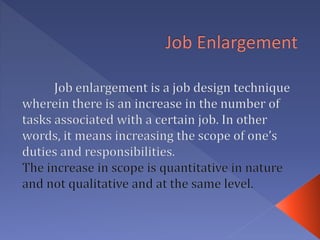
  • #18 Job enlargement is a horizontal restructuring method that aims at increase in the workforce flexibility and at the same time reducing monotony that may creep up over a period of time. It is also known as horizontal loading in that the responsibilities increase at the same level and not vertically. Many believe that since the enlargement is horizontal in nature there is not a great need for training! Contrary to this, job enlargement requires appropriate training especially on time and people management. Task related training is not required much since the person is already aware of the same or doing it for some time.
  • #25 1. Job Sharing two persons sharing one full time job with sharing rewards and responsibility for its completion. This method is suitable for working mothers, doctors, and other professionals who can gainfully utilize their available time. 2. Telecommuting Use of computer in jobs. Eg: Jobs having financial implications like billing, accounting, telemarketing, e-commerce, graphics, media can be done at home for global organizations. This method is also known as flexi place. It isolates employee from team work and personal physical supervision. Managers need attitude change to incorporate such system in organizational setting. 4. Compressed Work Week Work hours can be compressed into five or even four days a week with long hours of daily work with two or three days free at the week end. This system gives worker more leisure and higher productivity. Five days a week is a popular concept in India. This system ensures less absenteeism, more time available for maintenance of machines & equipment. It suffers from a disadvantage of high fatigue and boredom due to extended work days. 5. Quality Circles Quality circles is one of the recent concepts of group job design. It consists of a group of 7 – 10 employees from a unit or across units who have volunteered to meet together regularly and analyse, make proposals about product quality, investigate causes and suggest corrective actions. The recommendations of quality circles are later forwarded tocoordinating or steering committee. Meetings of quality circles are held once in a week or when need arises and are chaired by supervisors or any of the group members. Leaders are encouraged for a high degree participation within the group. Group members are trained in group communication skills, product quality and proble promotes a sense of belonging, boosts employee morale, accords job security and develops‘we’ feeling among group members and enrich organizational culture. m solving techniques. This concept Flexitime This method allows workers more freedom to select work schedule within the general guidelines laid down by the organization. Flextime stipulates that all workers must be present during the core time so that interpersonal and inter departmental activities can take place smoothly From the above figure it will be seen that employees can choose timings of work which are convenient to them. Flexitime method is beneficial to both as individual has freedom to select own time of work and the organization can attract talented workers.
  • #26 1. Job Sharing two persons sharing one full time job with sharing rewards and responsibility for its completion. This method is suitable for working mothers, doctors, and other professionals who can gainfully utilize their available time. 2. Telecommuting Use of computer in jobs. Eg: Jobs having financial implications like billing, accounting, telemarketing, e-commerce, graphics, media can be done at home for global organizations. This method is also known as flexi place. It isolates employee from team work and personal physical supervision. Managers need attitude change to incorporate such system in organizational setting. 4. Compressed Work Week Work hours can be compressed into five or even four days a week with long hours of daily work with two or three days free at the week end. This system gives worker more leisure and higher productivity. Five days a week is a popular concept in India. This system ensures less absenteeism, more time available for maintenance of machines & equipment. It suffers from a disadvantage of high fatigue and boredom due to extended work days. 5. Quality Circles Quality circles is one of the recent concepts of group job design. It consists of a group of 7 – 10 employees from a unit or across units who have volunteered to meet together regularly and analyse, make proposals about product quality, investigate causes and suggest corrective actions. The recommendations of quality circles are later forwarded tocoordinating or steering committee. Meetings of quality circles are held once in a week or when need arises and are chaired by supervisors or any of the group members. Leaders are encouraged for a high degree participation within the group. Group members are trained in group communication skills, product quality and proble promotes a sense of belonging, boosts employee morale, accords job security and develops‘we’ feeling among group members and enrich organizational culture. m solving techniques. This concept Flexitime This method allows workers more freedom to select work schedule within the general guidelines laid down by the organization. Flextime stipulates that all workers must be present during the core time so that interpersonal and inter departmental activities can take place smoothly From the above figure it will be seen that employees can choose timings of work which are convenient to them. Flexitime method is beneficial to both as individual has freedom to select own time of work and the organization can attract talented workers.