SS2016 Modern Neural
Computation
Lecture 1: Single
Neurons
Hirokazu Tanaka
School of Information Science
Japan Institute of Science and Technology
Neuron as a computational unit of the brain.
In this lecture we will learn:
• Basic anatomy and physiology of neuron
- morphology
- membrane properties
• Phenomenological models with subthreshold dynamics
- Integrate-and-fire model, Quadratic-and-fire model,
Resonate-and-fire model
• Biophysical models with spiking mechanism
- Ion channels, master equations
- Hodgkin-Huxley model
• Phase plots and bifurcation analysis
- Saddle-node bifurcation, Andronov-Hopf bifurcation
- FitzHugh-Nagumo model, Hindmarsh-Rose model
• Modern single-neuron models
- Izhikevich model, Adaptive-exponential model
Neurons composed of dendrites, soma and axon.
Figure 3.1, Fundamental Neuroscience, 3rd Edition
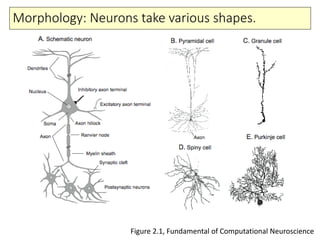
Morphology: Neurons take various shapes.
Figure 2.1, Fundamental of Computational Neuroscience
Cortical neurons receive cortico-cortical and thalamo-
cortical inputs.
Figure 3.2, Fundamental Neuroscience, 3rd Edition
Pyramidal cell in layer II/III
Apical dendrites
Basal dendrites
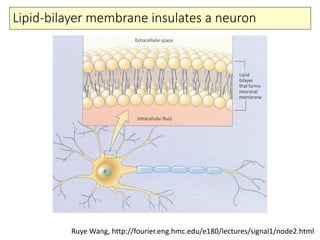
Lipid-bilayer membrane insulates a neuron
Ruye Wang, http://fourier.eng.hmc.edu/e180/lectures/signal1/node2.html
Physiology: Neurons are electrically excitable.
Figure 2.2, Neuroscience 3rd Edition
Physiology: Neurons take various spiking patterns.
Izhikevich (2004) IEEE Neural Networks
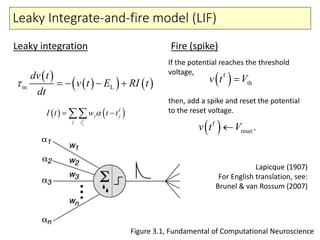
Leaky Integrate-and-fire model (LIF)
( )
( )( ) ( )m L
dv t
v t E RI t
dt
τ =− − +
( ) ( )f
f
j
j j
j t
I t w t tα= −∑∑
( )f
thv t V=
( )f
reset .v t V←
Leaky integration Fire (spike)
If the potential reaches the threshold
voltage,
then, add a spike and reset the potential
to the reset voltage.
Figure 3.1, Fundamental of Computational Neuroscience
Lapicque (1907)
For English translation, see:
Brunel & van Rossum (2007)
Analytical solution of LIF model with constant current.
( )
( )m
dv t
v t RI
dt
τ =− +
( ) ( ) m m
0 1
t t
t
v t v e RI e RIτ τ
− −
→∞
 
= + − → 
 
 
Figure 3.2, Fundamental of Computational Neuroscience
( ) ( )
( ) const.
Lv t v t E
I t I
← −
= =
subtracting the equilibrium potential.
considering a time-invariant current.
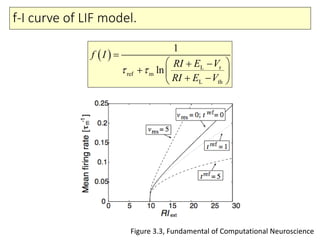
f-I curve of LIF model.
Figure 3.3, Fundamental of Computational Neuroscience
( )
L r
ref m
L th
1
ln
f I
RI E V
RI E V
τ τ
=
 + −
+  
+ − 
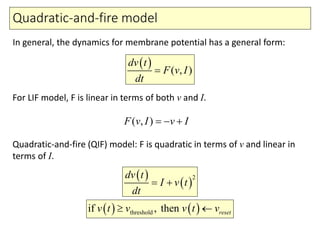
Quadratic-and-fire model
( )
( )
2dv t
I v t
dt
= +
( ) ( )thresholdif , then resetv t v v t v≥ ←
( ) ( , )
dv t
F v I
dt
=
In general, the dynamics for membrane potential has a general form:
Quadratic-and-fire (QIF) model: F is quadratic in terms of v and linear in
terms of I.
For LIF model, F is linear in terms of both v and I.
( , )F v I v I=− +
Quadratic-and-fire model
Figure 3.35, Dynamical Systems in Neuroscience
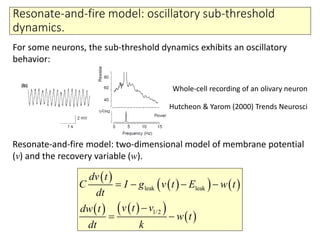
Resonate-and-fire model: oscillatory sub-threshold
dynamics.
( )
( )( ) ( )
( ) ( )( )
( )
leak leak
1/2
dv t
C I g v t E w t
dt
v t vdw t
w t
dt k
=− − −
−
= −
For some neurons, the sub-threshold dynamics exhibits an oscillatory
behavior:
Resonate-and-fire model: two-dimensional model of membrane potential
(v) and the recovery variable (w).
Whole-cell recording of an olivary neuron
Hutcheon & Yarom (2000) Trends Neurosci
Resonate-and-fire model.
Izhikevich (2001) Neural Networks
spike
spikeno spike
no spike
Ion channels: Nernst equation.
Figure 6.3, Fundamental of Computational Neuroscience
[ ]
[ ]
out
ion in out
in
ion
ln
ion
RT
E E E
zF
 
≡ − =   
 
EoutEin Nernst equation
[ ]
[ ]
( )
out
out in
in
out
in
ion
ion
zF
E zFRT E E
RT
zF
E
RT
e
e
e
−
− −
−
 
 = =
 
 
 

in[ ] 140mMK+
= out[ ] 3mMK+
=
[ ]
[ ]
out
in
3
ln 61.5ln 102mV
140
K
KRT
E
F K
 
= = = −  
 
Potassium ion
Ion channels: Goldman-Hodgkin-Katz equation.
Figure 6.3, Fundamental of Computational Neuroscience
K Na Clout out in
m out in
K Na Clin in out
K Na Cl
ln
K Na Cl
p p pRT
V V V
F p p p
+ + −
+ + −
      + +      = − =
      + +      
Goldman-Hodgkin-Katz equation
K Na Cl: : 1.00:0.04:0.45p p p =
Permeability
For T=293K (20°C), the equilibrium potential is
m out in 62mVV V V= − =−
Ion-channel kinetics: voltage-dependent ion channels
:activation variablen
( )( ) ( )1n n
dn
V n V n
dt
α β= − −
Inactive Active
( )n Vα
( )n Vβ
( )activeP n=( )inactive 1P n= −
Master equation
( ) ( )n
dn
V n V n
dt
τ ∞= −
( )
( ) ( )
1
m
n n
V
V V
τ
α β
=
+
( )
( )
( ) ( )
n
n n
V
n V
V V
α
α β∞ =
+
time constant
asymptotic value
Gating equation
Hodgkin-Huxley model: potential and gating dynamics.
( ) ( ) ( )4 3
K K Na Na L L
dV
C g n E V g m h E V g E V I
dt
=− − − − − − +
( ) ( )n
dn
V n V n
dt
τ ∞= −
( ) ( )m
dm
V m V m
dt
τ ∞= −
( ) ( )h
dh
V h V h
dt
τ ∞= −
Membrane-potential dynamics
Gating equations
Figure 5.10, Theoretical Neuroscience
Hodgkin-Huxley model: activation and inactivation
variables.
( ) ( ) ( )4 3
K K Na Na L L
dV
C g n E V g m h E V g E V I
dt
=− − − − − − +
( ) ( )n
dn
V n V n
dt
τ ∞= −
( ) ( )m
dm
V m V m
dt
τ ∞= −
( ) ( )h
dh
V h V h
dt
τ ∞= −
Membrane-potential dynamics
Gating equations m: Na+ activation variable
h: Na+ inactivation variable
n: K+ activation variable
Figure 2.8, Dynamical Systems in Neuroscience
m=0
h=1
m=1
h=1
m=1
h=0
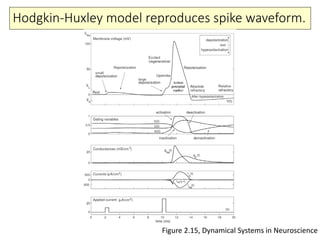
Hodgkin-Huxley model reproduces spike waveform.
Figure 5.10, Theoretical Neuroscience Figure 4.3, Neuroscience 3rd Edition
Hodgkin-Huxley model reproduces spike waveform.
Figure 2.15, Dynamical Systems in Neuroscience
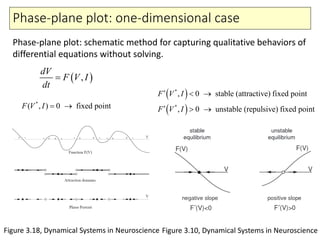
Phase-plane plot: one-dimensional case
( ),
dV
F V I
dt
=
*
( , ) 0 fixed pointF V I= →
( )
( )
*
*
, 0 stable (attractive) fixed point
, 0 unstable (repulsive) fixed point
F V I
F V I
′ < →
′ > →
Figure 3.10, Dynamical Systems in Neuroscience
Phase-plane plot: schematic method for capturing qualitative behaviors of
differential equations without solving.
Figure 3.18, Dynamical Systems in Neuroscience
Bifurcation: Saddle-node bifurcation
( )
dV
F V I
dt
= +
Figure 3.25, Dynamical Systems in Neuroscience
Phase-plane plot: two-dimensional case
( )
( )
,
,
V F V w
w G V w
 =

=


Phase-plane plot: vector field (dV/dt, dw/dt) on the two
dimensional plane.
Figure 4.3, Dynamical Systems in Neuroscience
1, 0x y= =  0, 1x y= = 
,x x y y=− =−  ,x y y x=− =− 
Phase-plane plot: Nullclines
( )
( )
,
,
V F V w
w G V w
 =

=


Nullclines: the curves of F(V,w)=0 and G(V,w)=0.
Figure 4.3, Dynamical Systems in Neuroscience
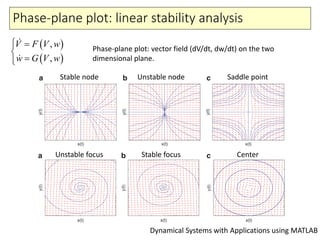
Phase-plane plot: linear stability analysis
( )
( )
,
,
V F V w
w G V w
 =

=


Phase-plane plot: vector field (dV/dt, dw/dt) on the two
dimensional plane.
Dynamical Systems with Applications using MATLAB
Stable node Unstable node Saddle point
Unstable focus Stable focus Center
Phase-plane plot: Separatrix
( )
( )
,
,
V F V w
w G V w
 =

=


Phase-plane plot: vector field (dV/dt, dw/dt) on the two
dimensional plane.
Figure 4.24, Dynamical Systems in Neuroscience
Separatrix: the boundary separating two modes of behaviour in a
differential equation.
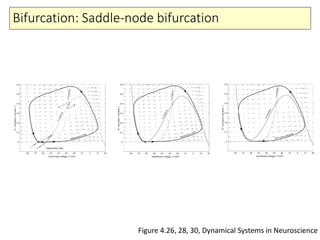
Bifurcation: Saddle-node bifurcation
Figure 4.26, 28, 30, Dynamical Systems in Neuroscience
Bifurcation: (supercritical) Andronov-Hopf bifurcation
Figure 4.26, 28, 30, Dynamical Systems in Neuroscience
Class I and II neurons and bifurcation type
Figure 7.3, Dynamical Systems in Neuroscience
Class I: Continuous F-I curve, Saddle-node bifurcation
Class II: Discontinuous F-I curve, Andronov-Hopf bifurcation
Two-dim. model: FitzHugh-Nagumo model
( )
3
3
0.08 0.8 0.7
v
v v w I
w v w
= − − +
= − +


FitzHugh (1961) Biophysical J; “FitzHugh-Nagumo Model” (2015) Encyclopedia of Comp Neuro
stable unstable
*
I I< *
I I<
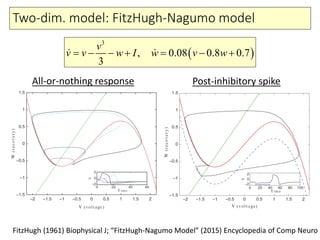
Two-dim. model: FitzHugh-Nagumo model
( )
3
, 0.08 0.8 0.7
3
v
v v w I w v w= − − + = − + 
FitzHugh (1961) Biophysical J; “FitzHugh-Nagumo Model” (2015) Encyclopedia of Comp Neuro
All-or-nothing response Post-inhibitory spike
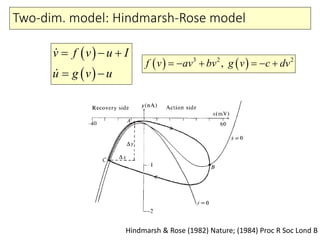
Two-dim. model: Hindmarsh-Rose model
( )
( )
v f v u I
u g v u
= − +
= −


( ) ( )3 2 2
,f v av bv g v c dv=− + =− +
Hindmarsh & Rose (1982) Nature; (1984) Proc R Soc Lond B
Izhikevich model: quadratic and linear nullclines.
thresholdif 1, then and .v v v c u u d≥ = ← ← +
Quadratic v-nullcline and linear u-nullcline can describe both saddle-node
and Andronov-Hopf bifurcations.
Figure 5.23, Dynamical Systems in Neuroscience
( )
2
v v u I
u a bv u
= − +
= −


Izhikevich model reproduces various spiking patterns.
( )
( )
2
0.04 5 140v v v u I t
u a bv u
= + + − +
= −


thresholdif 30, then and .v v v c u u d≥= ← ← +
Izhikevich (2003) IEEE Trans Neural Networks
Izhikevich model reproduces various spiking patterns.
Izhikevich (2003) IEEE Trans Neural Networks
Adaptive-exponential model
( ) ( )
( )
T
T
V V
m L T L T
w L
dV
C g V V g e w I t
dt
dw
a V E w
dt
τ
−
∆
=− − + ∆ − +
= − −
Brette & Gerstner (2005) J Neurophysiol
The adaptive-exponential model are popular to neurophysiologists
because …
- It has a form similar to conventional two-dimensional models
- Its parameters are physiologically interpretable.
What we left out: Neuron morphology (shape) does
influence physiology (function)!
Mainen & Sejnowski (199) Nature
250 μm
100 ms
25 mV
What we left out: Neuron morphology (shape) does
influence physiology (function)!
Branco et al. (2010) Science
Cable equation describes spike propagation.
“Cable Equation” (2015) Encyclopedia of Computational Neuroscience
Rall model reduces to equivalent cylinder model.
“Equivalent Cylinder Model” (2015) Encyclopedia of Computational Neuroscience
With a set of assumptions about the morphological and electrical properties of
dendrites, the complex branching structure of a dendritic tree can be reduced to
a simple conductive cylinder.
2 2
3 3
1 2
2
3
0
GR
d d
d
+
=
If GR=1, then the cylinders 1 and 2
can be reduced to a single cylinder.
Conclusions
- Neurons have a wide range of morphology (shapes) and
physiology (functions).
- Many fundamental properties of subthreshold dynamics
and spiking patterns can be captured by low-dimensional
models.
- Models vary in their complexities: from a simple LIF
model (just integrating and thresholding) to biophysically
detailed Hodgkin-Huxley model.
- Phase-plane and bifurcation analyses are the powerful
tool for understanding qualitative behaviors of a
dynamical system without an explicit solution.
Exercise
1. Read the following paper and derive a low-dimensional
neuron model from a detailed HH-type model by
linearizing around the resting potential.
Richardson et al. (2003) “From subthreshold to firing-rate
resonance,” J Neurophysiol 89, 2538-2554.
2. Examine a qualitative behavior of the Izhikevich model
by plotting a phase portrait:
a=0.02, b=0.2, c=-65, d=6, I=14 (constant).
Then confirm your phase-plane analysis with the
matlab code provided from Izhikevich’s site:
http://www.izhikevich.org/publications/whichmod.htm
#izhikevich
Exercise
1. Simulate an integrate-and-fire model using the Euler
method and evaluate how accurate the solution is. The
Euler method is the simplest numerical integration
method.
Brette, R., Rudolph, M., Carnevale, T., Hines, M., Beeman, D., Bower, J. M., ...
& Zirpe, M. (2007). Simulation of networks of spiking neurons: a review of
tools and strategies. Journal of computational neuroscience, 23(3), 349-398.
2. Simulate the Izhikevich model using standard
parameters. Then plot the phase portraits in two
dimensions.
( ) ( )
( )( )
m
v t RI
v t v t
t
t
τ
− +
+
∆
=∆+
(0.02, 0.2, -65, 8) (0.02, 0.2, -55, 4) (0.02, 0.2, -50, 2) (0.1, 0.2, -65, 2)
(0.02, 0.25, -65, 0.05) (0.02, 0.2, -65, 0.05) (0.1, 0.26, -65, 8) (0.02, 0.25, -65, 2)
% params for RS neuron:
a = 0.02; b = 0.20; c = -65.; d = 8;
dt = 1/1000; % integration time step (s)
T = 50.; % total simulation time (s)
t0 = 0:dt:T; % time steps
%%
v = zeros(length(t0),1); % voltage variable
u = zeros(length(t0),1); % recovery variable
I = zeros(length(t0),1); % input current
I(t0>1000/1000) = 150;
spikes = zeros(length(t0),1); % spike timings
v(1) = -80; % initial voltage
u(1) = 0; % initial recovery
for n=1:length(t0)-1
v(n+1) = v(n) + dt*(0.04*v(n)^2+5*v(n)+140-u(n)+I(n));
% v(n+1) = v(n) + dt/2*(0.04*v(n)^2+5*v(n)+140-u(n)+I(n));
% v(n+1) = v(n+1) + dt/2*(0.04*v(n+1)^2+5*v(n+1)+140-u(n)+I(n));
u(n+1) = u(n) + dt*a*(b*v(n)-u(n));
if v(n+1)>30
v(n+1) = c;
u(n+1) = u(n+1) + d;
spikes(n+1) = 1;
end
end
figure(1); clf;
subplot(211); plot(t0, v, 'k');
subplot(212); plot(t0, u, 'k');
References
• Squire et al. (2008) “Fundamental Neuroscience,” Academic Press.
• Purves et al. (2004) “Neuroscience,” Sinauer Associates.
• Trappenberg (2010) “Fundamentals of Computational
Neuroscience,” Oxford University Press, Chapters 2 & 3.
• Dayan & Abbott (2000) “Theoretical Neuroscience,” MIT Press,
Chapter 5.
• Izhikevich (2007) “Dynamical Systems in Neuroscience,” MIT Press,
Chapters 3 & 4.

JAISTサマースクール2016「脳を知るための理論」講義01 Single neuron models

  • 1.
    SS2016 Modern Neural Computation Lecture1: Single Neurons Hirokazu Tanaka School of Information Science Japan Institute of Science and Technology
  • 2.
    Neuron as acomputational unit of the brain. In this lecture we will learn: • Basic anatomy and physiology of neuron - morphology - membrane properties • Phenomenological models with subthreshold dynamics - Integrate-and-fire model, Quadratic-and-fire model, Resonate-and-fire model • Biophysical models with spiking mechanism - Ion channels, master equations - Hodgkin-Huxley model • Phase plots and bifurcation analysis - Saddle-node bifurcation, Andronov-Hopf bifurcation - FitzHugh-Nagumo model, Hindmarsh-Rose model • Modern single-neuron models - Izhikevich model, Adaptive-exponential model
  • 3.
    Neurons composed ofdendrites, soma and axon. Figure 3.1, Fundamental Neuroscience, 3rd Edition
  • 4.
    Morphology: Neurons takevarious shapes. Figure 2.1, Fundamental of Computational Neuroscience
  • 5.
    Cortical neurons receivecortico-cortical and thalamo- cortical inputs. Figure 3.2, Fundamental Neuroscience, 3rd Edition Pyramidal cell in layer II/III Apical dendrites Basal dendrites
  • 6.
    Lipid-bilayer membrane insulatesa neuron Ruye Wang, http://fourier.eng.hmc.edu/e180/lectures/signal1/node2.html
  • 7.
    Physiology: Neurons areelectrically excitable. Figure 2.2, Neuroscience 3rd Edition
  • 8.
    Physiology: Neurons takevarious spiking patterns. Izhikevich (2004) IEEE Neural Networks
  • 9.
    Leaky Integrate-and-fire model(LIF) ( ) ( )( ) ( )m L dv t v t E RI t dt τ =− − + ( ) ( )f f j j j j t I t w t tα= −∑∑ ( )f thv t V= ( )f reset .v t V← Leaky integration Fire (spike) If the potential reaches the threshold voltage, then, add a spike and reset the potential to the reset voltage. Figure 3.1, Fundamental of Computational Neuroscience Lapicque (1907) For English translation, see: Brunel & van Rossum (2007)
  • 10.
    Analytical solution ofLIF model with constant current. ( ) ( )m dv t v t RI dt τ =− + ( ) ( ) m m 0 1 t t t v t v e RI e RIτ τ − − →∞   = + − →      Figure 3.2, Fundamental of Computational Neuroscience ( ) ( ) ( ) const. Lv t v t E I t I ← − = = subtracting the equilibrium potential. considering a time-invariant current.
  • 11.
    f-I curve ofLIF model. Figure 3.3, Fundamental of Computational Neuroscience ( ) L r ref m L th 1 ln f I RI E V RI E V τ τ =  + − +   + − 
  • 12.
    Quadratic-and-fire model ( ) () 2dv t I v t dt = + ( ) ( )thresholdif , then resetv t v v t v≥ ← ( ) ( , ) dv t F v I dt = In general, the dynamics for membrane potential has a general form: Quadratic-and-fire (QIF) model: F is quadratic in terms of v and linear in terms of I. For LIF model, F is linear in terms of both v and I. ( , )F v I v I=− +
  • 13.
    Quadratic-and-fire model Figure 3.35,Dynamical Systems in Neuroscience
  • 14.
    Resonate-and-fire model: oscillatorysub-threshold dynamics. ( ) ( )( ) ( ) ( ) ( )( ) ( ) leak leak 1/2 dv t C I g v t E w t dt v t vdw t w t dt k =− − − − = − For some neurons, the sub-threshold dynamics exhibits an oscillatory behavior: Resonate-and-fire model: two-dimensional model of membrane potential (v) and the recovery variable (w). Whole-cell recording of an olivary neuron Hutcheon & Yarom (2000) Trends Neurosci
  • 15.
    Resonate-and-fire model. Izhikevich (2001)Neural Networks spike spikeno spike no spike
  • 16.
    Ion channels: Nernstequation. Figure 6.3, Fundamental of Computational Neuroscience [ ] [ ] out ion in out in ion ln ion RT E E E zF   ≡ − =      EoutEin Nernst equation [ ] [ ] ( ) out out in in out in ion ion zF E zFRT E E RT zF E RT e e e − − − −    = =        in[ ] 140mMK+ = out[ ] 3mMK+ = [ ] [ ] out in 3 ln 61.5ln 102mV 140 K KRT E F K   = = = −     Potassium ion
  • 17.
    Ion channels: Goldman-Hodgkin-Katzequation. Figure 6.3, Fundamental of Computational Neuroscience K Na Clout out in m out in K Na Clin in out K Na Cl ln K Na Cl p p pRT V V V F p p p + + − + + −       + +      = − =       + +       Goldman-Hodgkin-Katz equation K Na Cl: : 1.00:0.04:0.45p p p = Permeability For T=293K (20°C), the equilibrium potential is m out in 62mVV V V= − =−
  • 18.
    Ion-channel kinetics: voltage-dependention channels :activation variablen ( )( ) ( )1n n dn V n V n dt α β= − − Inactive Active ( )n Vα ( )n Vβ ( )activeP n=( )inactive 1P n= − Master equation ( ) ( )n dn V n V n dt τ ∞= − ( ) ( ) ( ) 1 m n n V V V τ α β = + ( ) ( ) ( ) ( ) n n n V n V V V α α β∞ = + time constant asymptotic value Gating equation
  • 19.
    Hodgkin-Huxley model: potentialand gating dynamics. ( ) ( ) ( )4 3 K K Na Na L L dV C g n E V g m h E V g E V I dt =− − − − − − + ( ) ( )n dn V n V n dt τ ∞= − ( ) ( )m dm V m V m dt τ ∞= − ( ) ( )h dh V h V h dt τ ∞= − Membrane-potential dynamics Gating equations Figure 5.10, Theoretical Neuroscience
  • 20.
    Hodgkin-Huxley model: activationand inactivation variables. ( ) ( ) ( )4 3 K K Na Na L L dV C g n E V g m h E V g E V I dt =− − − − − − + ( ) ( )n dn V n V n dt τ ∞= − ( ) ( )m dm V m V m dt τ ∞= − ( ) ( )h dh V h V h dt τ ∞= − Membrane-potential dynamics Gating equations m: Na+ activation variable h: Na+ inactivation variable n: K+ activation variable Figure 2.8, Dynamical Systems in Neuroscience m=0 h=1 m=1 h=1 m=1 h=0
  • 21.
    Hodgkin-Huxley model reproducesspike waveform. Figure 5.10, Theoretical Neuroscience Figure 4.3, Neuroscience 3rd Edition
  • 22.
    Hodgkin-Huxley model reproducesspike waveform. Figure 2.15, Dynamical Systems in Neuroscience
  • 23.
    Phase-plane plot: one-dimensionalcase ( ), dV F V I dt = * ( , ) 0 fixed pointF V I= → ( ) ( ) * * , 0 stable (attractive) fixed point , 0 unstable (repulsive) fixed point F V I F V I ′ < → ′ > → Figure 3.10, Dynamical Systems in Neuroscience Phase-plane plot: schematic method for capturing qualitative behaviors of differential equations without solving. Figure 3.18, Dynamical Systems in Neuroscience
  • 24.
    Bifurcation: Saddle-node bifurcation () dV F V I dt = + Figure 3.25, Dynamical Systems in Neuroscience
  • 25.
    Phase-plane plot: two-dimensionalcase ( ) ( ) , , V F V w w G V w  =  =   Phase-plane plot: vector field (dV/dt, dw/dt) on the two dimensional plane. Figure 4.3, Dynamical Systems in Neuroscience 1, 0x y= =  0, 1x y= =  ,x x y y=− =−  ,x y y x=− =− 
  • 26.
    Phase-plane plot: Nullclines () ( ) , , V F V w w G V w  =  =   Nullclines: the curves of F(V,w)=0 and G(V,w)=0. Figure 4.3, Dynamical Systems in Neuroscience
  • 27.
    Phase-plane plot: linearstability analysis ( ) ( ) , , V F V w w G V w  =  =   Phase-plane plot: vector field (dV/dt, dw/dt) on the two dimensional plane. Dynamical Systems with Applications using MATLAB Stable node Unstable node Saddle point Unstable focus Stable focus Center
  • 28.
    Phase-plane plot: Separatrix () ( ) , , V F V w w G V w  =  =   Phase-plane plot: vector field (dV/dt, dw/dt) on the two dimensional plane. Figure 4.24, Dynamical Systems in Neuroscience Separatrix: the boundary separating two modes of behaviour in a differential equation.
  • 29.
    Bifurcation: Saddle-node bifurcation Figure4.26, 28, 30, Dynamical Systems in Neuroscience
  • 30.
    Bifurcation: (supercritical) Andronov-Hopfbifurcation Figure 4.26, 28, 30, Dynamical Systems in Neuroscience
  • 31.
    Class I andII neurons and bifurcation type Figure 7.3, Dynamical Systems in Neuroscience Class I: Continuous F-I curve, Saddle-node bifurcation Class II: Discontinuous F-I curve, Andronov-Hopf bifurcation
  • 32.
    Two-dim. model: FitzHugh-Nagumomodel ( ) 3 3 0.08 0.8 0.7 v v v w I w v w = − − + = − +   FitzHugh (1961) Biophysical J; “FitzHugh-Nagumo Model” (2015) Encyclopedia of Comp Neuro stable unstable * I I< * I I<
  • 33.
    Two-dim. model: FitzHugh-Nagumomodel ( ) 3 , 0.08 0.8 0.7 3 v v v w I w v w= − − + = − +  FitzHugh (1961) Biophysical J; “FitzHugh-Nagumo Model” (2015) Encyclopedia of Comp Neuro All-or-nothing response Post-inhibitory spike
  • 34.
    Two-dim. model: Hindmarsh-Rosemodel ( ) ( ) v f v u I u g v u = − + = −   ( ) ( )3 2 2 ,f v av bv g v c dv=− + =− + Hindmarsh & Rose (1982) Nature; (1984) Proc R Soc Lond B
  • 35.
    Izhikevich model: quadraticand linear nullclines. thresholdif 1, then and .v v v c u u d≥ = ← ← + Quadratic v-nullcline and linear u-nullcline can describe both saddle-node and Andronov-Hopf bifurcations. Figure 5.23, Dynamical Systems in Neuroscience ( ) 2 v v u I u a bv u = − + = −  
  • 36.
    Izhikevich model reproducesvarious spiking patterns. ( ) ( ) 2 0.04 5 140v v v u I t u a bv u = + + − + = −   thresholdif 30, then and .v v v c u u d≥= ← ← + Izhikevich (2003) IEEE Trans Neural Networks
  • 37.
    Izhikevich model reproducesvarious spiking patterns. Izhikevich (2003) IEEE Trans Neural Networks
  • 38.
    Adaptive-exponential model ( )( ) ( ) T T V V m L T L T w L dV C g V V g e w I t dt dw a V E w dt τ − ∆ =− − + ∆ − + = − − Brette & Gerstner (2005) J Neurophysiol The adaptive-exponential model are popular to neurophysiologists because … - It has a form similar to conventional two-dimensional models - Its parameters are physiologically interpretable.
  • 39.
    What we leftout: Neuron morphology (shape) does influence physiology (function)! Mainen & Sejnowski (199) Nature 250 μm 100 ms 25 mV
  • 40.
    What we leftout: Neuron morphology (shape) does influence physiology (function)! Branco et al. (2010) Science
  • 41.
    Cable equation describesspike propagation. “Cable Equation” (2015) Encyclopedia of Computational Neuroscience
  • 42.
    Rall model reducesto equivalent cylinder model. “Equivalent Cylinder Model” (2015) Encyclopedia of Computational Neuroscience With a set of assumptions about the morphological and electrical properties of dendrites, the complex branching structure of a dendritic tree can be reduced to a simple conductive cylinder. 2 2 3 3 1 2 2 3 0 GR d d d + = If GR=1, then the cylinders 1 and 2 can be reduced to a single cylinder.
  • 43.
    Conclusions - Neurons havea wide range of morphology (shapes) and physiology (functions). - Many fundamental properties of subthreshold dynamics and spiking patterns can be captured by low-dimensional models. - Models vary in their complexities: from a simple LIF model (just integrating and thresholding) to biophysically detailed Hodgkin-Huxley model. - Phase-plane and bifurcation analyses are the powerful tool for understanding qualitative behaviors of a dynamical system without an explicit solution.
  • 44.
    Exercise 1. Read thefollowing paper and derive a low-dimensional neuron model from a detailed HH-type model by linearizing around the resting potential. Richardson et al. (2003) “From subthreshold to firing-rate resonance,” J Neurophysiol 89, 2538-2554. 2. Examine a qualitative behavior of the Izhikevich model by plotting a phase portrait: a=0.02, b=0.2, c=-65, d=6, I=14 (constant). Then confirm your phase-plane analysis with the matlab code provided from Izhikevich’s site: http://www.izhikevich.org/publications/whichmod.htm #izhikevich
  • 45.
    Exercise 1. Simulate anintegrate-and-fire model using the Euler method and evaluate how accurate the solution is. The Euler method is the simplest numerical integration method. Brette, R., Rudolph, M., Carnevale, T., Hines, M., Beeman, D., Bower, J. M., ... & Zirpe, M. (2007). Simulation of networks of spiking neurons: a review of tools and strategies. Journal of computational neuroscience, 23(3), 349-398. 2. Simulate the Izhikevich model using standard parameters. Then plot the phase portraits in two dimensions. ( ) ( ) ( )( ) m v t RI v t v t t t τ − + + ∆ =∆+
  • 46.
    (0.02, 0.2, -65,8) (0.02, 0.2, -55, 4) (0.02, 0.2, -50, 2) (0.1, 0.2, -65, 2) (0.02, 0.25, -65, 0.05) (0.02, 0.2, -65, 0.05) (0.1, 0.26, -65, 8) (0.02, 0.25, -65, 2)
  • 47.
    % params forRS neuron: a = 0.02; b = 0.20; c = -65.; d = 8; dt = 1/1000; % integration time step (s) T = 50.; % total simulation time (s) t0 = 0:dt:T; % time steps %% v = zeros(length(t0),1); % voltage variable u = zeros(length(t0),1); % recovery variable I = zeros(length(t0),1); % input current I(t0>1000/1000) = 150; spikes = zeros(length(t0),1); % spike timings v(1) = -80; % initial voltage u(1) = 0; % initial recovery for n=1:length(t0)-1 v(n+1) = v(n) + dt*(0.04*v(n)^2+5*v(n)+140-u(n)+I(n)); % v(n+1) = v(n) + dt/2*(0.04*v(n)^2+5*v(n)+140-u(n)+I(n)); % v(n+1) = v(n+1) + dt/2*(0.04*v(n+1)^2+5*v(n+1)+140-u(n)+I(n)); u(n+1) = u(n) + dt*a*(b*v(n)-u(n)); if v(n+1)>30 v(n+1) = c; u(n+1) = u(n+1) + d; spikes(n+1) = 1; end end figure(1); clf; subplot(211); plot(t0, v, 'k'); subplot(212); plot(t0, u, 'k');
  • 48.
    References • Squire etal. (2008) “Fundamental Neuroscience,” Academic Press. • Purves et al. (2004) “Neuroscience,” Sinauer Associates. • Trappenberg (2010) “Fundamentals of Computational Neuroscience,” Oxford University Press, Chapters 2 & 3. • Dayan & Abbott (2000) “Theoretical Neuroscience,” MIT Press, Chapter 5. • Izhikevich (2007) “Dynamical Systems in Neuroscience,” MIT Press, Chapters 3 & 4.