Presented by –
GEETIKA BARMAN
M.TECH in I.T
CSI15006
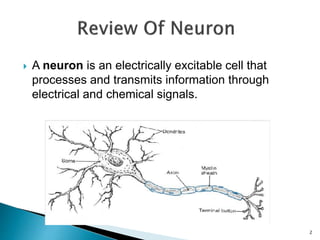
 A neuron is an electrically excitable cell that
processes and transmits information through
electrical and chemical signals.
2
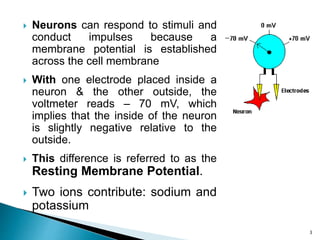
 Neurons can respond to stimuli and
conduct impulses because a
membrane potential is established
across the cell membrane
 With one electrode placed inside a
neuron & the other outside, the
voltmeter reads – 70 mV, which
implies that the inside of the neuron
is slightly negative relative to the
outside.
 This difference is referred to as the
Resting Membrane Potential.
 Two ions contribute: sodium and
potassium
3
4
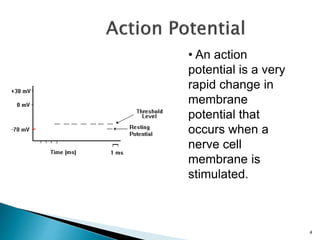
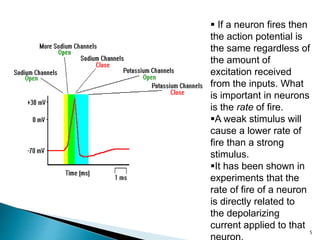
• An action
potential is a very
rapid change in
membrane
potential that
occurs when a
nerve cell
membrane is
stimulated.
5
 If a neuron fires then
the action potential is
the same regardless of
the amount of
excitation received
from the inputs. What
is important in neurons
is the rate of fire.
A weak stimulus will
cause a lower rate of
fire than a strong
stimulus.
It has been shown in
experiments that the
rate of fire of a neuron
is directly related to
the depolarizing
current applied to that
 Biological Neuron Model : mathematical
description of the properties of neurons , designed
to accurately describe and predict biological
processes.
 Artificial neuron model : aims for computational
effectiveness
6
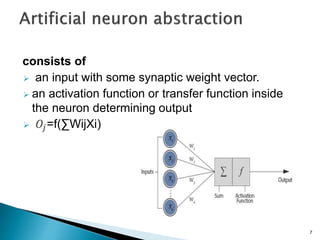
consists of
 an input with some synaptic weight vector.
 an activation function or transfer function inside
the neuron determining output
 𝑂𝑗=f(∑WijXi)
7
In the case of modelling a biological neuron
 physical analogues are used in place of abstractions
such as "weight" and "transfer function“.
 An input to a neuron is an ion current through the cell
membrane described by a physical time dependent
current I(t).
 an insulating cell membrane that determines a
capacitance (𝐶 𝑚).
 a neuron responds to such a signal with a change in
voltage, or an electrical potential energy difference
between the cell and its surroundings, which is
observed to sometimes result in a voltage spike called
an action potential.
8
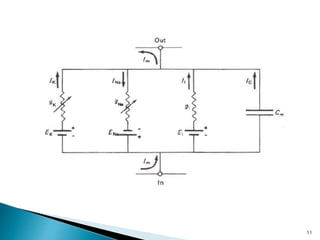
 Conductance based neuron model:
o biophysical representation of an excitable cell
such as neuron.
o protein molecule ion channels are represented
by conductance and its lipid bilayer by a
capacitor.
 Integrate and Fire based neuron model
9
A. Hodgkin and A. Huxley, A Quantitative Description of Membrane Current
and Its Application to Conduction and Excitation in Nerve, JOURNAL OF
PHYSIOLOGY, Vol. 117,
10
11
 because of their intrinsic complexity, H.H models
are usually difficult to analyze and are
computationally expensive in numerical
implementations.
 Restricts it’s use in describing neural network
dynamics.
 simple phenomenological spiking neuron models
such as integrate-and-fire models are introduced.
 used to discuss aspects of neural coding, memory,
or network dynamics
13
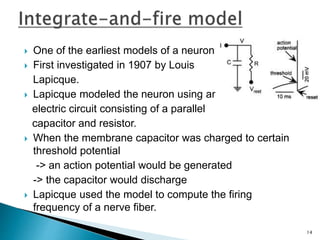
 One of the earliest models of a neuron.
 First investigated in 1907 by Louis
Lapicque.
 Lapicque modeled the neuron using an
electric circuit consisting of a parallel
capacitor and resistor.
 When the membrane capacitor was charged to certain
threshold potential
-> an action potential would be generated
-> the capacitor would discharge
 Lapicque used the model to compute the firing
frequency of a nerve fiber.
14
 In a biologically realistic neural network , a neuron
often takes a number of input signals in order to
propagate a signal .
 Every neuron goes from stable to firing after it
reaches a certain threshold. If it fires the signal is
passed onto the next neuron, which may or may
not fire.
 If the neuron does not fire, its potential will be
raised so that if it receives another input signals
within a certain time frame, it will be more likely
to fire.
15
 If the neuron does fire, then the signal will be
propagated onto the next neuron.
 the just-fired neuron goes into a refractory state,
in which it doesn't respond to or propagate input
signals from other neurons.
 This increased potential to fire starts to dampen
soon after the input is received.
16
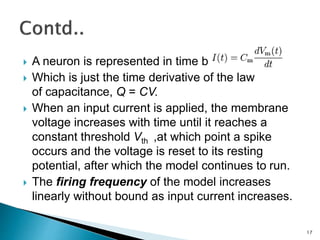
 A neuron is represented in time by,
 Which is just the time derivative of the law
of capacitance, Q = CV.
 When an input current is applied, the membrane
voltage increases with time until it reaches a
constant threshold Vth ,at which point a spike
occurs and the voltage is reset to its resting
potential, after which the model continues to run.
 The firing frequency of the model increases
linearly without bound as input current increases.
17
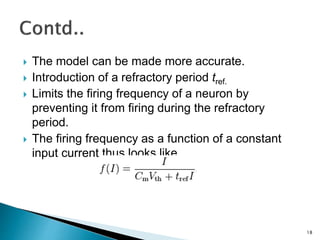
 The model can be made more accurate.
 Introduction of a refractory period tref.
 Limits the firing frequency of a neuron by
preventing it from firing during the refractory
period.
 The firing frequency as a function of a constant
input current thus looks like,
18
 For below-threshold signal, retains the voltage
boost forever until it fires again.
 Accumulates inputs until the total input passes a
threshold.
 Not biologically realistic.
19
http://lcn.epfl.ch/~gerstner/SPNM/node26.html
 In the leaky integrate-and-fire model, the memory
problem is solved by adding a "leak" term to the
membrane potential.
 It reflects the diffusion of ions that occurs through
the membrane when some equilibrium is not
reached in the cell.
21
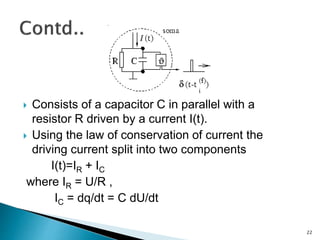
 Consists of a capacitor C in parallel with a
resistor R driven by a current I(t).
 Using the law of conservation of current the
driving current split into two components
I(t)=IR + IC
where IR = U/R ,
IC = dq/dt = C dU/dt
22
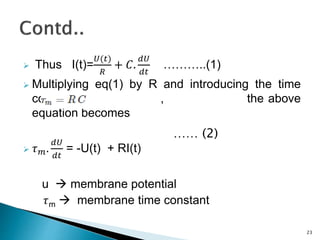
 Thus I(t)=
𝑈(𝑡)
𝑅
+ 𝐶.
𝑑𝑈
𝑑𝑡
………..(1)
 Multiplying eq(1) by R and introducing the time
constant , the above
equation becomes
 𝜏 𝑚.
𝑑𝑈
𝑑𝑡
= -U(t) + RI(t)
u  membrane potential
𝜏m  membrane time constant
23
…… (2)
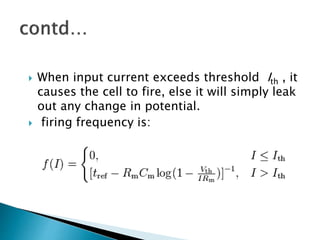
 When input current exceeds threshold Ith , it
causes the cell to fire, else it will simply leak
out any change in potential.
 firing frequency is:
S.roy, T.Ahmed ,J.Dutta,” A simple variant of Integrate-and
Fire model of neuron for application in neuronal area”
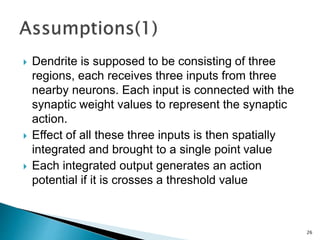
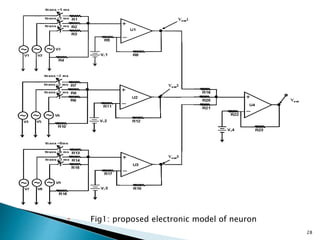
 Dendrite is supposed to be consisting of three
regions, each receives three inputs from three
nearby neurons. Each input is connected with the
synaptic weight values to represent the synaptic
action.
 Effect of all these three inputs is then spatially
integrated and brought to a single point value
 Each integrated output generates an action
potential if it is crosses a threshold value
26
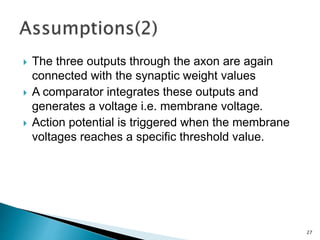
 The three outputs through the axon are again
connected with the synaptic weight values
 A comparator integrates these outputs and
generates a voltage i.e. membrane voltage.
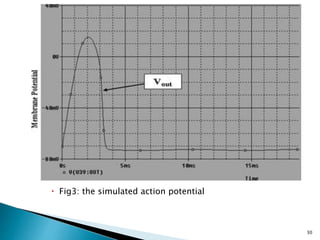
 Action potential is triggered when the membrane
voltages reaches a specific threshold value.
27
28
 Fig1: proposed electronic model of neuron
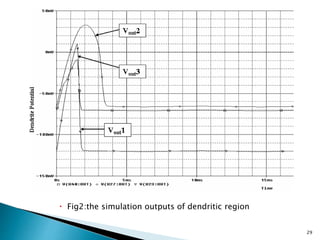
 Fig2:the simulation outputs of dendritic region
29
 Fig3: the simulated action potential
30
 http://neuronaldynamics.epfl.ch/online/
 http://icwww.epfl.ch/~gerstner/SPNM/
 https://en.wikipedia.org/wiki/Biological_neuron_model
 http://www.stat.columbia.edu/~liam/teaching/neurostat-
spr12/papers/Jolivet04-JNP.pdf
 http://people.eku.edu/ritchisong/301notes2.htm
 http://neurotheory.columbia.edu/Larry/AbbottBrResBul99.pdf
31
32

Integrate and Fire based neuron model

  • 1.
    Presented by – GEETIKABARMAN M.TECH in I.T CSI15006
  • 2.
     A neuronis an electrically excitable cell that processes and transmits information through electrical and chemical signals. 2
  • 3.
     Neurons canrespond to stimuli and conduct impulses because a membrane potential is established across the cell membrane  With one electrode placed inside a neuron & the other outside, the voltmeter reads – 70 mV, which implies that the inside of the neuron is slightly negative relative to the outside.  This difference is referred to as the Resting Membrane Potential.  Two ions contribute: sodium and potassium 3
  • 4.
    4 • An action potentialis a very rapid change in membrane potential that occurs when a nerve cell membrane is stimulated.
  • 5.
    5  If aneuron fires then the action potential is the same regardless of the amount of excitation received from the inputs. What is important in neurons is the rate of fire. A weak stimulus will cause a lower rate of fire than a strong stimulus. It has been shown in experiments that the rate of fire of a neuron is directly related to the depolarizing current applied to that
  • 6.
     Biological NeuronModel : mathematical description of the properties of neurons , designed to accurately describe and predict biological processes.  Artificial neuron model : aims for computational effectiveness 6
  • 7.
    consists of  aninput with some synaptic weight vector.  an activation function or transfer function inside the neuron determining output  𝑂𝑗=f(∑WijXi) 7
  • 8.
    In the caseof modelling a biological neuron  physical analogues are used in place of abstractions such as "weight" and "transfer function“.  An input to a neuron is an ion current through the cell membrane described by a physical time dependent current I(t).  an insulating cell membrane that determines a capacitance (𝐶 𝑚).  a neuron responds to such a signal with a change in voltage, or an electrical potential energy difference between the cell and its surroundings, which is observed to sometimes result in a voltage spike called an action potential. 8
  • 9.
     Conductance basedneuron model: o biophysical representation of an excitable cell such as neuron. o protein molecule ion channels are represented by conductance and its lipid bilayer by a capacitor.  Integrate and Fire based neuron model 9
  • 10.
    A. Hodgkin andA. Huxley, A Quantitative Description of Membrane Current and Its Application to Conduction and Excitation in Nerve, JOURNAL OF PHYSIOLOGY, Vol. 117, 10
  • 11.
  • 13.
     because oftheir intrinsic complexity, H.H models are usually difficult to analyze and are computationally expensive in numerical implementations.  Restricts it’s use in describing neural network dynamics.  simple phenomenological spiking neuron models such as integrate-and-fire models are introduced.  used to discuss aspects of neural coding, memory, or network dynamics 13
  • 14.
     One ofthe earliest models of a neuron.  First investigated in 1907 by Louis Lapicque.  Lapicque modeled the neuron using an electric circuit consisting of a parallel capacitor and resistor.  When the membrane capacitor was charged to certain threshold potential -> an action potential would be generated -> the capacitor would discharge  Lapicque used the model to compute the firing frequency of a nerve fiber. 14
  • 15.
     In abiologically realistic neural network , a neuron often takes a number of input signals in order to propagate a signal .  Every neuron goes from stable to firing after it reaches a certain threshold. If it fires the signal is passed onto the next neuron, which may or may not fire.  If the neuron does not fire, its potential will be raised so that if it receives another input signals within a certain time frame, it will be more likely to fire. 15
  • 16.
     If theneuron does fire, then the signal will be propagated onto the next neuron.  the just-fired neuron goes into a refractory state, in which it doesn't respond to or propagate input signals from other neurons.  This increased potential to fire starts to dampen soon after the input is received. 16
  • 17.
     A neuronis represented in time by,  Which is just the time derivative of the law of capacitance, Q = CV.  When an input current is applied, the membrane voltage increases with time until it reaches a constant threshold Vth ,at which point a spike occurs and the voltage is reset to its resting potential, after which the model continues to run.  The firing frequency of the model increases linearly without bound as input current increases. 17
  • 18.
     The modelcan be made more accurate.  Introduction of a refractory period tref.  Limits the firing frequency of a neuron by preventing it from firing during the refractory period.  The firing frequency as a function of a constant input current thus looks like, 18
  • 19.
     For below-thresholdsignal, retains the voltage boost forever until it fires again.  Accumulates inputs until the total input passes a threshold.  Not biologically realistic. 19
  • 20.
  • 21.
     In theleaky integrate-and-fire model, the memory problem is solved by adding a "leak" term to the membrane potential.  It reflects the diffusion of ions that occurs through the membrane when some equilibrium is not reached in the cell. 21
  • 22.
     Consists ofa capacitor C in parallel with a resistor R driven by a current I(t).  Using the law of conservation of current the driving current split into two components I(t)=IR + IC where IR = U/R , IC = dq/dt = C dU/dt 22
  • 23.
     Thus I(t)= 𝑈(𝑡) 𝑅 +𝐶. 𝑑𝑈 𝑑𝑡 ………..(1)  Multiplying eq(1) by R and introducing the time constant , the above equation becomes  𝜏 𝑚. 𝑑𝑈 𝑑𝑡 = -U(t) + RI(t) u  membrane potential 𝜏m  membrane time constant 23 …… (2)
  • 24.
     When inputcurrent exceeds threshold Ith , it causes the cell to fire, else it will simply leak out any change in potential.  firing frequency is:
  • 25.
    S.roy, T.Ahmed ,J.Dutta,”A simple variant of Integrate-and Fire model of neuron for application in neuronal area”
  • 26.
     Dendrite issupposed to be consisting of three regions, each receives three inputs from three nearby neurons. Each input is connected with the synaptic weight values to represent the synaptic action.  Effect of all these three inputs is then spatially integrated and brought to a single point value  Each integrated output generates an action potential if it is crosses a threshold value 26
  • 27.
     The threeoutputs through the axon are again connected with the synaptic weight values  A comparator integrates these outputs and generates a voltage i.e. membrane voltage.  Action potential is triggered when the membrane voltages reaches a specific threshold value. 27
  • 28.
    28  Fig1: proposedelectronic model of neuron
  • 29.
     Fig2:the simulationoutputs of dendritic region 29
  • 30.
     Fig3: thesimulated action potential 30
  • 31.
     http://neuronaldynamics.epfl.ch/online/  http://icwww.epfl.ch/~gerstner/SPNM/ https://en.wikipedia.org/wiki/Biological_neuron_model  http://www.stat.columbia.edu/~liam/teaching/neurostat- spr12/papers/Jolivet04-JNP.pdf  http://people.eku.edu/ritchisong/301notes2.htm  http://neurotheory.columbia.edu/Larry/AbbottBrResBul99.pdf 31
  • 32.