Dynamical neuronal gains produce self-
organized criticality in stochastic spiking
neural networks
Osame Kinouchi
Physics Department - FFCLRP - USP
Departamento de Física - UFSC, Florianópolis - SC, December 19 2016
Scientific Reports 6: 35831 (2016)
2
Collaborators at NEUROMAT
3
Ludmila Brochini
Jorge Stolfi
Ariadne A. Costa
Antônio C. Roque Mauro Copellihttp://neuromat.numec.prp.usp.br/team
Allan Turing (1950)
Computing machinery and intelligence. Mind, 59, 433-460.
Is there a corresponding phenomenon [criticality] for minds, and
is there one for machines? There does seem to be one for the
human mind. The majority of them seems to be subcritical, i.e., to
correspond in this analogy to piles of subcritical size. An idea
presented to such a mind will on average give rise to less than one
idea in reply.
A smallish proportion are supercritical. An idea presented to such
a mind may give rise to a whole "theory" consisting of secondary,
tertiary and more remote ideas. (...) Adhering to this analogy we
ask, "Can a machine be made to be supercritical?"
4
Motivation: Neuronal Avalanches
5
Avalanche Size
Distribution:
PS(s) ∝ s-3/2
Avalanche Duration
Distribution:
PD(d) ∝ d-2
Mean-field exponents
Beggs & Plenz, 2003
Our model: Stochastic discrete time spiking
neurons (Galves & Löcherbach, 2013)
i = 1, 2, …, N neurons Xi[t] = 1 (spike)
Vi[t+1] = 0 reset if Xi[t] = 1
Vi[t+1] = μVi[t] + I + N-1 ∑j Wij Xj[t] if Xi[t] = 0
Prob( Xi[t+1] = 1 ) = Φ(Vi[t])
Φ = firing probability function
0 ≤ Φ(V) ≤ 1
7
All-to-all network
Examples of firing functions
8
1
VT VS V
r = 1
r > 1
r < 1
Φ(V) For VT < V < VS: Φ(V) = [ 𝚪(V-VT) ]r
𝚪 = Neuronal Gain
Mean field approach
 Order parameter: ρ[t] = 1/N ∑i Xi[t]
 MF approximation:
1/N ∑i Wij Xi[t] = W ρ[t], where W = <Wij>
 Voltages evolve as:
Vi[t+1] = 0 if Xi[t] = 1
Vi[t+1] = μVi[t] + I + Wρ if Xi[t] = 0
 ρ[t] = ∫ Φ(V) pt(V) dV
 In the stationary state, the voltages assume a discrete stationary set of values Uk.
 The density of neurons with Uk is 𝛈k . Normalization: ∑ 𝛈k = 1
 So, in the stationary state, ρ = ∑k Φ(Uk) 𝛈k
9
Stationary distributions
pt(V) dV → P(V) with discrete peaks
Mean field stationary states
Uk = Voltage of the k-th stationary peak
𝛈k = peak height
μ > 0 case (several peaks, only numeric solutions):
ρ = ∑k=1 Φ(Uk) ηk
Uk = μ Uk-1 + I + W ρ
ηk = [1- Φ(Uk-1)] ηk-1
η0 = ρ = 1 - ∑k=1 ηk (Normalization)
11
Uk
η0 = ρ η1
η2
η3
η4
Φ
(1- Φ)η0
Φ
Φ
Φ
(1- Φ)η1
(1- Φ)η2
(1- Φ)η3
U1 U2 U3 U4U0 = 0
Example: μ > 0, r = 1, VT = 0, I = 0
12
 Due to the one step refractory period,
we cannot have ρ > 1/2.
 ρ(𝚪b,Wb) = 1/2 defines a bifurcation
line (𝚪b = 2/Wb for the μ = 0 case)
 Cycles-2 occur because there is only
two peaks, with U1 > VS
 Deterministic dynamics since now
Φ(U1 > VS) = 1
𝛈0[t+1] = 𝛈1[t] = 1 - ρ[t]
𝛈1[t+1] = 𝛈0[t] = ρ[t]
 Cycle dynamics:
ρ[t+1] = 1 - ρ[t]
 Solutions occur for any values inside
the region [VS/W, (W-VS)/W]
Observation: marginally stable cycles-2
13
VS
Φ(U1) = 1
V
1
VVS
1
Φ(U1) = 1
0
0
𝛈1[t]
𝛈1[t+1]
𝛈1[t+1]
𝛈1[t]
𝛈0[t+1]
𝛈0[t]
𝛈0[t]
𝛈0[t+1]
Case μ = 0
14
μ = 0 case (only two peaks, analytic solutions):
η0 = ρ = Φ(U1) η1 = Φ(I+Wρ) (1 - ρ)
η1 = 1 - ρ (Normalization)
With:
Φ(x) = 0 for x < VT
Φ(x) = [ 𝚪(x-VT) ]r for VT < x < VS = VT + 1/𝚪
Φ(x) = 1 for x > VS
Very easy Math! (polinomial equations). Solve for 0 < ρ <1/2:
ρ = [𝚪(I+Wρ-VT)]r (1-ρ)
ρ
η1 = 1- ρ
1-Φ
1
Φ
U1
Parameters of the firing function Φ
15
1
Threshold voltage VT Saturation voltage VS =VT + 1/𝚪 V
r = 1
r > 1
r < 1
Φ(V) For VT < V < VS: Φ(V) = [𝚪(V-VT)]r
𝚪 = Neuronal Gain
μ = 0, linear saturating case r = 1, VT = 0
(Larremore et al., PRL 2014) But they do not report phase transitions
16
• Case r = 1, solve for 0 < ρ <1/2:
ρ = [𝚪(I + Wρ − VT)] (1 − ρ) or:
𝚪W ρ2 + (1 − 𝚪W + 𝚪I − 𝚪VT) ρ + 𝚪VT − 𝚪I = 0
• Solutions:
• Continuous and discontinuous phase transitions here
Φ
V
Case μ = 0, VT = 0, r = 1
Linear saturating model without threshold
 Solutions:
ρ+ = (W - Wc)/ W with Wc = 1/ 𝚪
or
ρ+ = (𝚪 - 𝚪c) / 𝚪 with 𝚪c = 1/ W
ρ− = 0 for W < Wc or 𝚪 < 𝚪 c
Continuous transition with exponent
β = 1
17
ρ = 0
0 < ρ < 1/2
cycles-2
Case μ = 0, VT = 0, r = 1, I > 0
18
At the critical line 𝚪cWc = 1, for I → 0: ρ ∝ I1/2 χ = dρ/dI ∝ I-1/2
Mean field critical exponent δ = 2
Stevens network psychophysical exponent: m = 1/δ = 1/2
(Kinouchi and Copelli, Nat. Phys. 2006)
Case μ = 0, VT = 0, 0 < r < 2
19
r = 1
Continuous phase
transition
r = 1.2
Discontinuous phase
transition
r = 2
Transition only to
cycles-2
r < 1
Wc = 0
Φ(V)
𝚪 x W
phase diagram
r=1
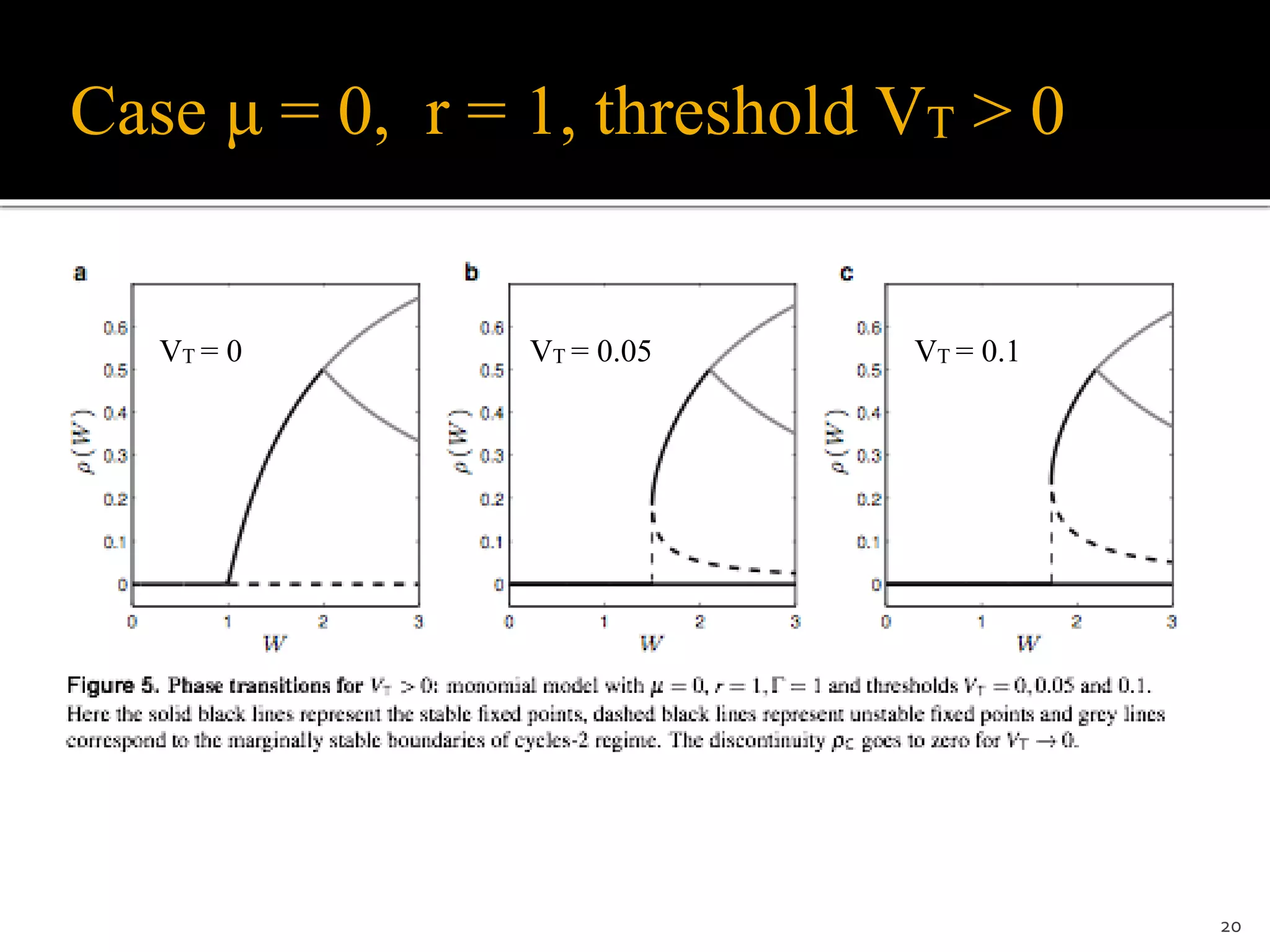
Case μ = 0, r = 1, threshold VT > 0
20
VT = 0 VT = 0.1VT = 0.05
V
Summary
 Continuous absorbing state phase
transition only for linear-saturating
model without threshold: r =1, VT = 0
 r < 1: no transition, Wc = 0.
 r > 1: discontinuous transition
 VT > 0: discontinuous transition
 Is r =1, VT = 0 biological?
 Is r =1, VT = 0 a kind of fine-tuning?
21
Φ(V)
Avalanche size distributions in the static
model with Wc =1, 𝚪c = 1
22
Complementary
cumulative
distribution function:
CS(s) = ∑
∞
k=s
PS(k) ∝ s-1/2
Linear saturating model: r = 1, VT = 0
PS(s) ∝ s-3/2
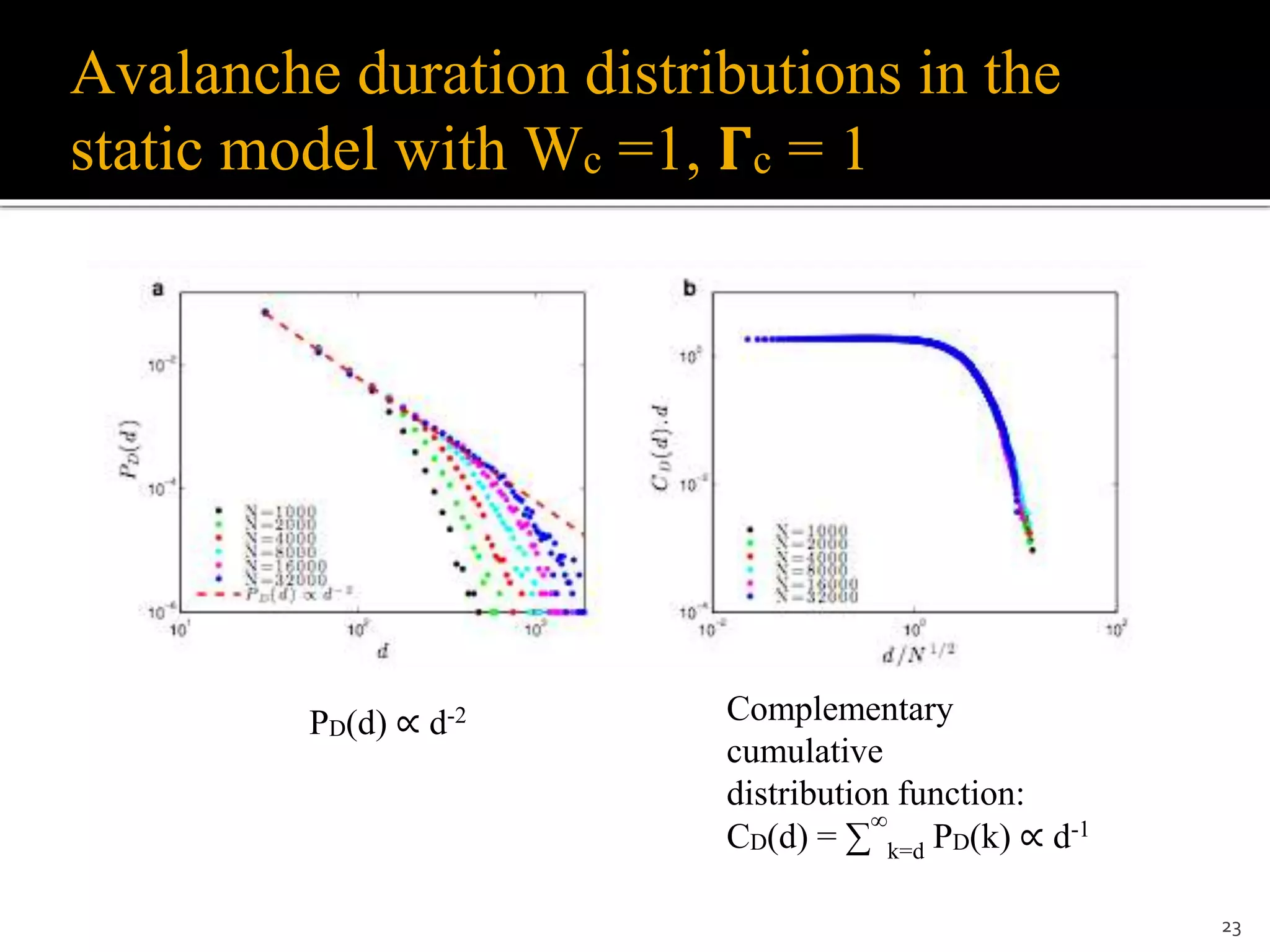
Avalanche duration distributions in the
static model with Wc =1, 𝚪c = 1
23
PD(d) ∝ d-2 Complementary
cumulative
distribution function:
CD(d) = ∑
∞
k=d PD(k) ∝ d-1
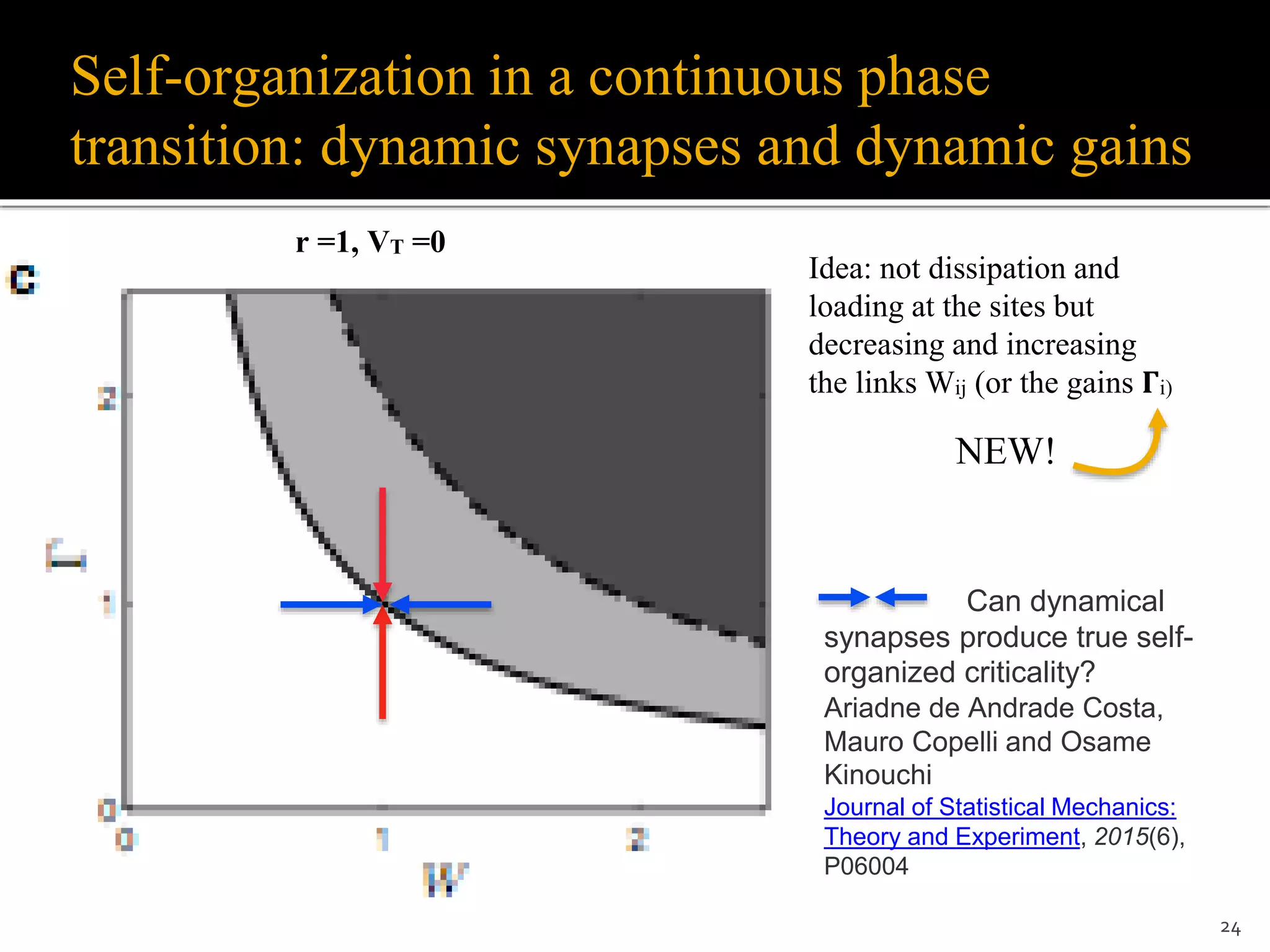
Self-organization in a continuous phase
transition: dynamic synapses and dynamic gains
24
r =1, VT =0
Idea: not dissipation and
loading at the sites but
decreasing and increasing
the links Wij (or the gains 𝚪i)
NEW!
Can dynamical
synapses produce true self-
organized criticality?
Ariadne de Andrade Costa,
Mauro Copelli and Osame
Kinouchi
Journal of Statistical Mechanics:
Theory and Experiment, 2015(6),
P06004
Why to separate the average gain 𝚪 from the
average synaptic weight W?
 In a biological network, each
neuron i has a neuronal gain 𝚪i[t]
located at the Axonal Initial
Segment (AIS). Its dynamics is
linked to sodium channels.
 The synapses Wij[t] are located at
the dendrites, very far from the
axon. Its dynamics is due to
neurotransmitter vesicle
depletion.
 So, although in our model they
appear always together as 𝚪W,
this is due to the use of point like
neurons. A neuron with at least
two compartments (dendrite +
soma) would segregate these
variables.
25AIS, 𝚪i[t]
Wij[t]
Dynamic synapses and dynamic gains
 Dynamic synapses (Levina et al., 2007; Levina et al.,
2009; Bonachela et al., 2010; Costa et al., 2015, Campos
et al., 2016):
Wij[t+1] = Wij[t] + 1/𝞽 (A − Wij[t]) − u Wij[t] Xj[t]
 Dynamic gains (Brochini et al., 2016):
𝚪i[t+1] = 𝚪i[t] + 1/𝞽 (A − 𝚪i[t]) − u 𝚪i[t] Xi[t]
 Parameters range:
0 < u < 1, A > Wc (or A > 𝚪c)
All works with dynamic synapses used
𝞽 = O(N)
26
Wc, 𝚪c
A, 𝞽 u
O(N2) equations
O(N) equations!
Problem 1: Same dynamics, different
universality classes?
27
Costa et al., 2015
Campos et al., 2016
Brochini et al. 2016
Levina et al., 2007
Bonachela et al., 2010
Dynamic PercolationDirected Percolation
Problem 2: scaling with N
 Up to now, models used 𝞽 =
O(N)
 When N → ∞, the dependence on
parameters (𝞽, A,u) vanishes,
with convergence to the critical
point Wc (good!)
 But this means a divergent
recovery time 𝞽 → ∞
(not biological, bad)
28
The same problem occurs with dynamic gains
 𝚪i[t+1] = 𝚪i[t] + 1/𝞽 (A - 𝚪i[t]) - u 𝚪i[t] Xi[t]
 Averaging + stationary state:
1/𝞽 (A - 𝚪*) = u 𝚪* ρ
 With ρ = ( 𝚪*- 𝚪c )/𝚪*, we get:
𝚪* = (𝚪c - Ax)/(1+x), with x = 1/(u𝞽)
We have 𝚪* → 𝚪c only for x → 0, that is, if 𝞽 → ∞ (not biological)
29
Self-organization of the average gain
toward the critical region
30
𝚪c
If we use 𝞽 = O(N), then x = O(N-1):
good power laws with scaling
31
cS = 2/3
𝚪* = (𝚪c - Ax)/(1+x)
x = 1/(u𝞽) ∝ 1/N
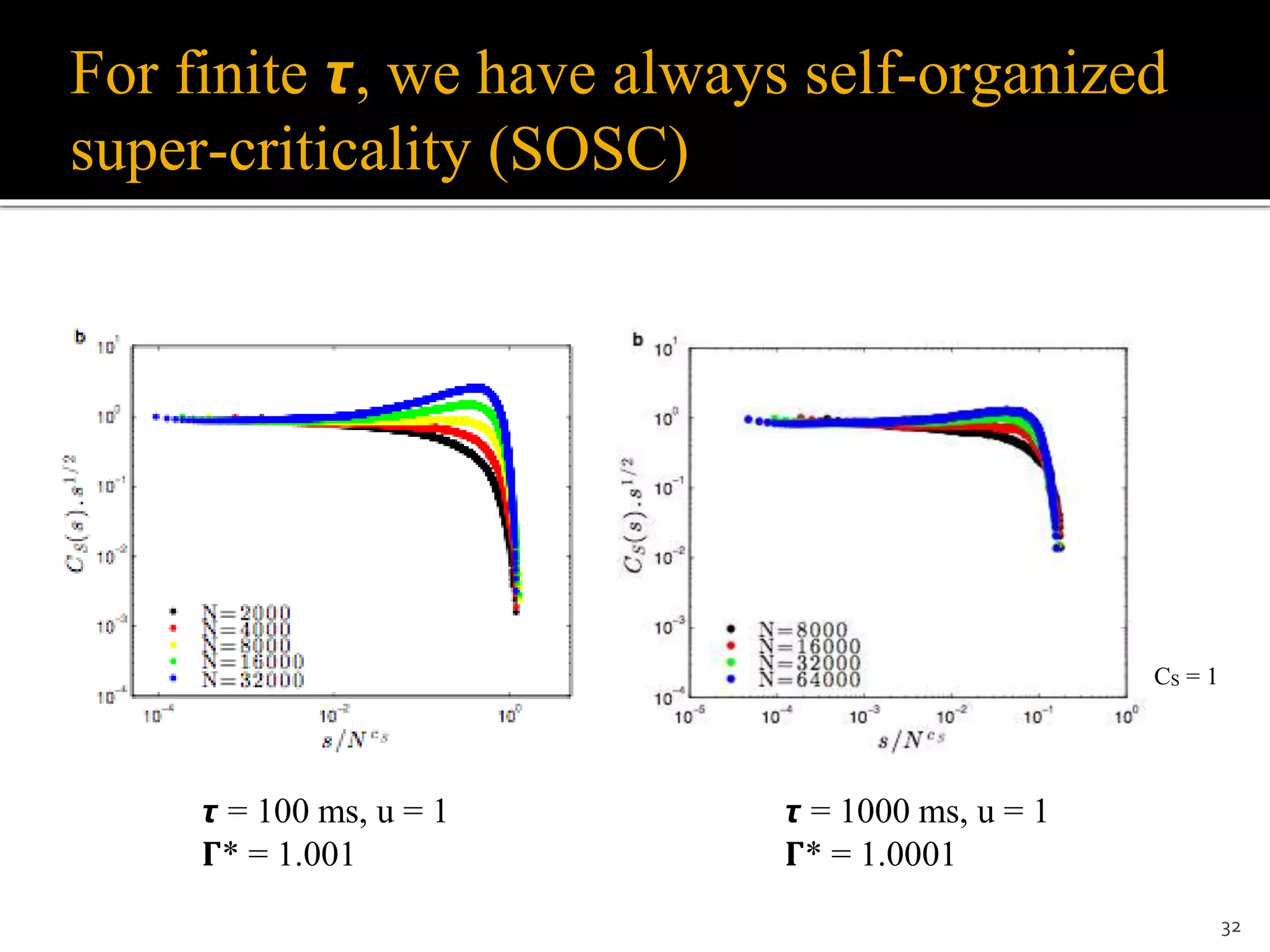
For finite 𝞽, we have always self-organized
super-criticality (SOSC)
32
𝞽 = 100 ms, u = 1
𝚪* = 1.001
𝞽 = 1000 ms, u = 1
𝚪* = 1.0001
CS = 1
Finite 𝞽: self-organized super-criticality
(SOSC) seems to be unavoidable
 But is this bad?
 Perhaps supercritical avalanches
exist but are being filtered away
in standard experiments
 Perhaps SOSC can explain
biological phenomena: large
avalanches (dragon kings),
epileptic activity etc.
 Perhaps only large avalanches
process informations and elicit
actions (who notice small
avalanches?)
 Perhaps, Turing was right…
34
Shaukat & Thivierge, 2016
Front. Comput. Neurosci. 10:29
0
0
1 1 1 1 1 1 1 1 1 1 1
𝚪1 = 1, 𝚪2 = 1,2
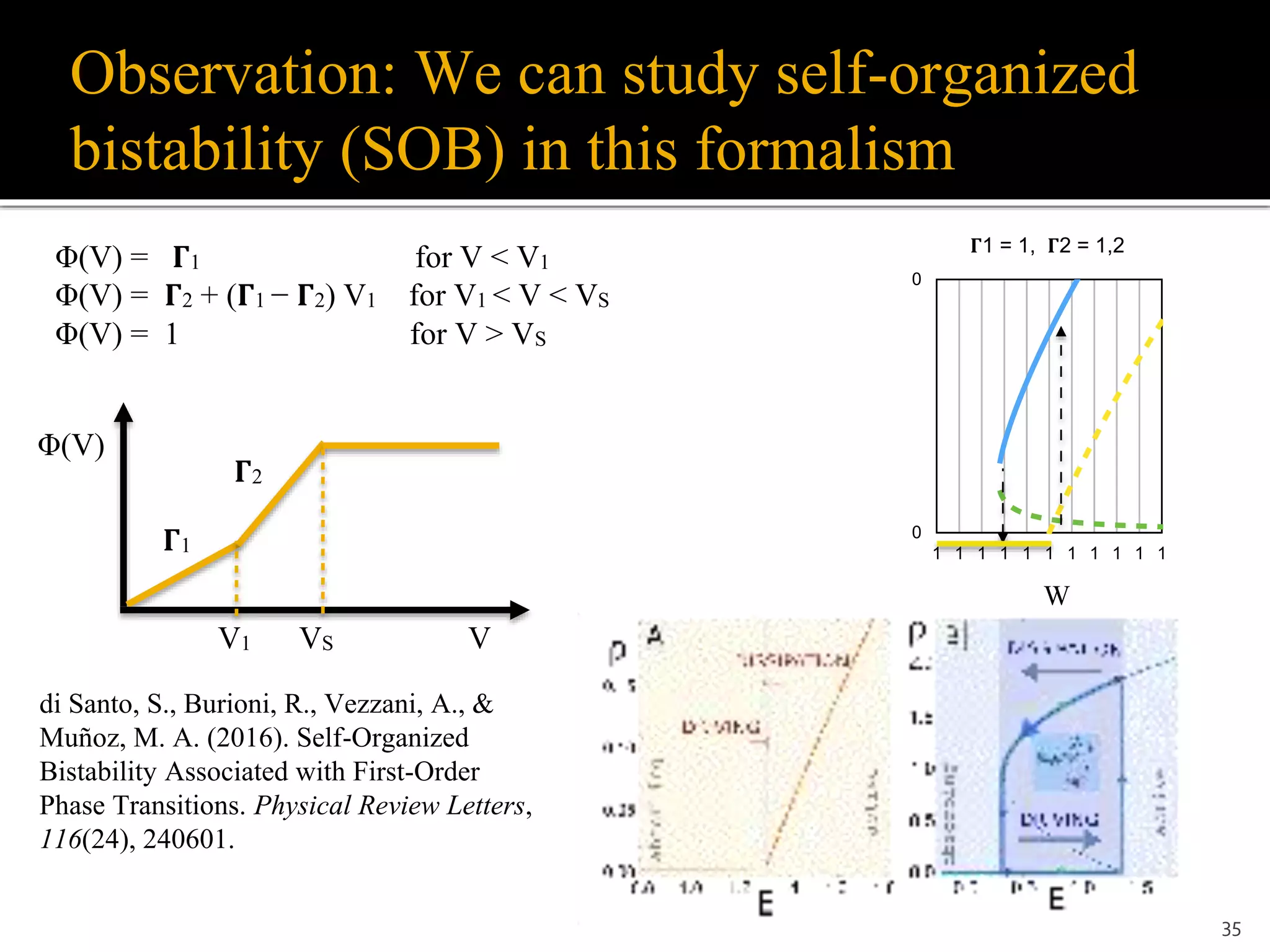
Observation: We can study self-organized
bistability (SOB) in this formalism
35
di Santo, S., Burioni, R., Vezzani, A., &
Muñoz, M. A. (2016). Self-Organized
Bistability Associated with First-Order
Phase Transitions. Physical Review Letters,
116(24), 240601.
Φ(V) = 𝚪1 for V < V1
Φ(V) = 𝚪2 + (𝚪1 − 𝚪2) V1 for V1 < V < VS
Φ(V) = 1 for V > VS
W
𝚪1
𝚪2
Φ(V)
VV1 VS
Perpectives: a new neuronal network
formalism to be explored
 More results, perhaps analytic, for the μ > 0 case.
 Better study of dynamic synapses and dynamic gains
 Other specific Φ functions (ex: Φ(V) = [𝚪(V-VT)]r/[1+[𝚪(V-VT)]r] = no 2-
cycles
 Theorems for general Φ functions (ex: all linear piecewise functions give
analytic solutions)
 Self-organized bistability (SOB)
 Other network topologies (scale free, small world etc.)
 Other kinds of couplings
 Inhibitory neurons (ex: Larremore et al., 2014)
 Very large networks: N > 106, synapses > 1010
 Realistic topologies (ex: cortical Potjans-Diesmann model with layers and
different neuron populations, N=8x10⁴, synapses = 3x10⁸, Cordeiro et al.,
2016)
 Etc., etc., etc…
36
Visit us at Ribeirão Preto!
(we also have research fellowships at Neuromat)
37
This paper results from research
activity on the
FAPESP Center for
Neuromathematics (FAPESP grant
2013/07699-0).
OK and AAC also received support
from Núcleo de Apoio à Pesquisa
CNAIPS-USP and FAPESP (grant
2016/00430-3).
LB, JS and ACR also received CNPq
support (grants 165828/2015-3,
310706/2015-7 and 306251/2014-0).

Neuronal self-organized criticality

  • 1.
    Dynamical neuronal gainsproduce self- organized criticality in stochastic spiking neural networks Osame Kinouchi Physics Department - FFCLRP - USP Departamento de Física - UFSC, Florianópolis - SC, December 19 2016
  • 2.
    Scientific Reports 6:35831 (2016) 2
  • 3.
    Collaborators at NEUROMAT 3 LudmilaBrochini Jorge Stolfi Ariadne A. Costa Antônio C. Roque Mauro Copellihttp://neuromat.numec.prp.usp.br/team
  • 4.
    Allan Turing (1950) Computingmachinery and intelligence. Mind, 59, 433-460. Is there a corresponding phenomenon [criticality] for minds, and is there one for machines? There does seem to be one for the human mind. The majority of them seems to be subcritical, i.e., to correspond in this analogy to piles of subcritical size. An idea presented to such a mind will on average give rise to less than one idea in reply. A smallish proportion are supercritical. An idea presented to such a mind may give rise to a whole "theory" consisting of secondary, tertiary and more remote ideas. (...) Adhering to this analogy we ask, "Can a machine be made to be supercritical?" 4
  • 5.
    Motivation: Neuronal Avalanches 5 AvalancheSize Distribution: PS(s) ∝ s-3/2 Avalanche Duration Distribution: PD(d) ∝ d-2 Mean-field exponents Beggs & Plenz, 2003
  • 6.
    Our model: Stochasticdiscrete time spiking neurons (Galves & Löcherbach, 2013) i = 1, 2, …, N neurons Xi[t] = 1 (spike) Vi[t+1] = 0 reset if Xi[t] = 1 Vi[t+1] = μVi[t] + I + N-1 ∑j Wij Xj[t] if Xi[t] = 0 Prob( Xi[t+1] = 1 ) = Φ(Vi[t]) Φ = firing probability function 0 ≤ Φ(V) ≤ 1 7 All-to-all network
  • 7.
    Examples of firingfunctions 8 1 VT VS V r = 1 r > 1 r < 1 Φ(V) For VT < V < VS: Φ(V) = [ 𝚪(V-VT) ]r 𝚪 = Neuronal Gain
  • 8.
    Mean field approach Order parameter: ρ[t] = 1/N ∑i Xi[t]  MF approximation: 1/N ∑i Wij Xi[t] = W ρ[t], where W = <Wij>  Voltages evolve as: Vi[t+1] = 0 if Xi[t] = 1 Vi[t+1] = μVi[t] + I + Wρ if Xi[t] = 0  ρ[t] = ∫ Φ(V) pt(V) dV  In the stationary state, the voltages assume a discrete stationary set of values Uk.  The density of neurons with Uk is 𝛈k . Normalization: ∑ 𝛈k = 1  So, in the stationary state, ρ = ∑k Φ(Uk) 𝛈k 9
  • 9.
    Stationary distributions pt(V) dV→ P(V) with discrete peaks
  • 10.
    Mean field stationarystates Uk = Voltage of the k-th stationary peak 𝛈k = peak height μ > 0 case (several peaks, only numeric solutions): ρ = ∑k=1 Φ(Uk) ηk Uk = μ Uk-1 + I + W ρ ηk = [1- Φ(Uk-1)] ηk-1 η0 = ρ = 1 - ∑k=1 ηk (Normalization) 11 Uk η0 = ρ η1 η2 η3 η4 Φ (1- Φ)η0 Φ Φ Φ (1- Φ)η1 (1- Φ)η2 (1- Φ)η3 U1 U2 U3 U4U0 = 0
  • 11.
    Example: μ >0, r = 1, VT = 0, I = 0 12
  • 12.
     Due tothe one step refractory period, we cannot have ρ > 1/2.  ρ(𝚪b,Wb) = 1/2 defines a bifurcation line (𝚪b = 2/Wb for the μ = 0 case)  Cycles-2 occur because there is only two peaks, with U1 > VS  Deterministic dynamics since now Φ(U1 > VS) = 1 𝛈0[t+1] = 𝛈1[t] = 1 - ρ[t] 𝛈1[t+1] = 𝛈0[t] = ρ[t]  Cycle dynamics: ρ[t+1] = 1 - ρ[t]  Solutions occur for any values inside the region [VS/W, (W-VS)/W] Observation: marginally stable cycles-2 13 VS Φ(U1) = 1 V 1 VVS 1 Φ(U1) = 1 0 0 𝛈1[t] 𝛈1[t+1] 𝛈1[t+1] 𝛈1[t] 𝛈0[t+1] 𝛈0[t] 𝛈0[t] 𝛈0[t+1]
  • 13.
    Case μ =0 14 μ = 0 case (only two peaks, analytic solutions): η0 = ρ = Φ(U1) η1 = Φ(I+Wρ) (1 - ρ) η1 = 1 - ρ (Normalization) With: Φ(x) = 0 for x < VT Φ(x) = [ 𝚪(x-VT) ]r for VT < x < VS = VT + 1/𝚪 Φ(x) = 1 for x > VS Very easy Math! (polinomial equations). Solve for 0 < ρ <1/2: ρ = [𝚪(I+Wρ-VT)]r (1-ρ) ρ η1 = 1- ρ 1-Φ 1 Φ U1
  • 14.
    Parameters of thefiring function Φ 15 1 Threshold voltage VT Saturation voltage VS =VT + 1/𝚪 V r = 1 r > 1 r < 1 Φ(V) For VT < V < VS: Φ(V) = [𝚪(V-VT)]r 𝚪 = Neuronal Gain
  • 15.
    μ = 0,linear saturating case r = 1, VT = 0 (Larremore et al., PRL 2014) But they do not report phase transitions 16 • Case r = 1, solve for 0 < ρ <1/2: ρ = [𝚪(I + Wρ − VT)] (1 − ρ) or: 𝚪W ρ2 + (1 − 𝚪W + 𝚪I − 𝚪VT) ρ + 𝚪VT − 𝚪I = 0 • Solutions: • Continuous and discontinuous phase transitions here Φ V
  • 16.
    Case μ =0, VT = 0, r = 1 Linear saturating model without threshold  Solutions: ρ+ = (W - Wc)/ W with Wc = 1/ 𝚪 or ρ+ = (𝚪 - 𝚪c) / 𝚪 with 𝚪c = 1/ W ρ− = 0 for W < Wc or 𝚪 < 𝚪 c Continuous transition with exponent β = 1 17 ρ = 0 0 < ρ < 1/2 cycles-2
  • 17.
    Case μ =0, VT = 0, r = 1, I > 0 18 At the critical line 𝚪cWc = 1, for I → 0: ρ ∝ I1/2 χ = dρ/dI ∝ I-1/2 Mean field critical exponent δ = 2 Stevens network psychophysical exponent: m = 1/δ = 1/2 (Kinouchi and Copelli, Nat. Phys. 2006)
  • 18.
    Case μ =0, VT = 0, 0 < r < 2 19 r = 1 Continuous phase transition r = 1.2 Discontinuous phase transition r = 2 Transition only to cycles-2 r < 1 Wc = 0 Φ(V) 𝚪 x W phase diagram r=1
  • 19.
    Case μ =0, r = 1, threshold VT > 0 20 VT = 0 VT = 0.1VT = 0.05
  • 20.
    V Summary  Continuous absorbingstate phase transition only for linear-saturating model without threshold: r =1, VT = 0  r < 1: no transition, Wc = 0.  r > 1: discontinuous transition  VT > 0: discontinuous transition  Is r =1, VT = 0 biological?  Is r =1, VT = 0 a kind of fine-tuning? 21 Φ(V)
  • 21.
    Avalanche size distributionsin the static model with Wc =1, 𝚪c = 1 22 Complementary cumulative distribution function: CS(s) = ∑ ∞ k=s PS(k) ∝ s-1/2 Linear saturating model: r = 1, VT = 0 PS(s) ∝ s-3/2
  • 22.
    Avalanche duration distributionsin the static model with Wc =1, 𝚪c = 1 23 PD(d) ∝ d-2 Complementary cumulative distribution function: CD(d) = ∑ ∞ k=d PD(k) ∝ d-1
  • 23.
    Self-organization in acontinuous phase transition: dynamic synapses and dynamic gains 24 r =1, VT =0 Idea: not dissipation and loading at the sites but decreasing and increasing the links Wij (or the gains 𝚪i) NEW! Can dynamical synapses produce true self- organized criticality? Ariadne de Andrade Costa, Mauro Copelli and Osame Kinouchi Journal of Statistical Mechanics: Theory and Experiment, 2015(6), P06004
  • 24.
    Why to separatethe average gain 𝚪 from the average synaptic weight W?  In a biological network, each neuron i has a neuronal gain 𝚪i[t] located at the Axonal Initial Segment (AIS). Its dynamics is linked to sodium channels.  The synapses Wij[t] are located at the dendrites, very far from the axon. Its dynamics is due to neurotransmitter vesicle depletion.  So, although in our model they appear always together as 𝚪W, this is due to the use of point like neurons. A neuron with at least two compartments (dendrite + soma) would segregate these variables. 25AIS, 𝚪i[t] Wij[t]
  • 25.
    Dynamic synapses anddynamic gains  Dynamic synapses (Levina et al., 2007; Levina et al., 2009; Bonachela et al., 2010; Costa et al., 2015, Campos et al., 2016): Wij[t+1] = Wij[t] + 1/𝞽 (A − Wij[t]) − u Wij[t] Xj[t]  Dynamic gains (Brochini et al., 2016): 𝚪i[t+1] = 𝚪i[t] + 1/𝞽 (A − 𝚪i[t]) − u 𝚪i[t] Xi[t]  Parameters range: 0 < u < 1, A > Wc (or A > 𝚪c) All works with dynamic synapses used 𝞽 = O(N) 26 Wc, 𝚪c A, 𝞽 u O(N2) equations O(N) equations!
  • 26.
    Problem 1: Samedynamics, different universality classes? 27 Costa et al., 2015 Campos et al., 2016 Brochini et al. 2016 Levina et al., 2007 Bonachela et al., 2010 Dynamic PercolationDirected Percolation
  • 27.
    Problem 2: scalingwith N  Up to now, models used 𝞽 = O(N)  When N → ∞, the dependence on parameters (𝞽, A,u) vanishes, with convergence to the critical point Wc (good!)  But this means a divergent recovery time 𝞽 → ∞ (not biological, bad) 28
  • 28.
    The same problemoccurs with dynamic gains  𝚪i[t+1] = 𝚪i[t] + 1/𝞽 (A - 𝚪i[t]) - u 𝚪i[t] Xi[t]  Averaging + stationary state: 1/𝞽 (A - 𝚪*) = u 𝚪* ρ  With ρ = ( 𝚪*- 𝚪c )/𝚪*, we get: 𝚪* = (𝚪c - Ax)/(1+x), with x = 1/(u𝞽) We have 𝚪* → 𝚪c only for x → 0, that is, if 𝞽 → ∞ (not biological) 29
  • 29.
    Self-organization of theaverage gain toward the critical region 30 𝚪c
  • 30.
    If we use𝞽 = O(N), then x = O(N-1): good power laws with scaling 31 cS = 2/3 𝚪* = (𝚪c - Ax)/(1+x) x = 1/(u𝞽) ∝ 1/N
  • 31.
    For finite 𝞽,we have always self-organized super-criticality (SOSC) 32 𝞽 = 100 ms, u = 1 𝚪* = 1.001 𝞽 = 1000 ms, u = 1 𝚪* = 1.0001 CS = 1
  • 32.
    Finite 𝞽: self-organizedsuper-criticality (SOSC) seems to be unavoidable  But is this bad?  Perhaps supercritical avalanches exist but are being filtered away in standard experiments  Perhaps SOSC can explain biological phenomena: large avalanches (dragon kings), epileptic activity etc.  Perhaps only large avalanches process informations and elicit actions (who notice small avalanches?)  Perhaps, Turing was right… 34 Shaukat & Thivierge, 2016 Front. Comput. Neurosci. 10:29
  • 33.
    0 0 1 1 11 1 1 1 1 1 1 1 𝚪1 = 1, 𝚪2 = 1,2 Observation: We can study self-organized bistability (SOB) in this formalism 35 di Santo, S., Burioni, R., Vezzani, A., & Muñoz, M. A. (2016). Self-Organized Bistability Associated with First-Order Phase Transitions. Physical Review Letters, 116(24), 240601. Φ(V) = 𝚪1 for V < V1 Φ(V) = 𝚪2 + (𝚪1 − 𝚪2) V1 for V1 < V < VS Φ(V) = 1 for V > VS W 𝚪1 𝚪2 Φ(V) VV1 VS
  • 34.
    Perpectives: a newneuronal network formalism to be explored  More results, perhaps analytic, for the μ > 0 case.  Better study of dynamic synapses and dynamic gains  Other specific Φ functions (ex: Φ(V) = [𝚪(V-VT)]r/[1+[𝚪(V-VT)]r] = no 2- cycles  Theorems for general Φ functions (ex: all linear piecewise functions give analytic solutions)  Self-organized bistability (SOB)  Other network topologies (scale free, small world etc.)  Other kinds of couplings  Inhibitory neurons (ex: Larremore et al., 2014)  Very large networks: N > 106, synapses > 1010  Realistic topologies (ex: cortical Potjans-Diesmann model with layers and different neuron populations, N=8x10⁴, synapses = 3x10⁸, Cordeiro et al., 2016)  Etc., etc., etc… 36
  • 35.
    Visit us atRibeirão Preto! (we also have research fellowships at Neuromat) 37 This paper results from research activity on the FAPESP Center for Neuromathematics (FAPESP grant 2013/07699-0). OK and AAC also received support from Núcleo de Apoio à Pesquisa CNAIPS-USP and FAPESP (grant 2016/00430-3). LB, JS and ACR also received CNPq support (grants 165828/2015-3, 310706/2015-7 and 306251/2014-0).