Class XI Chemistry
UNIT 12
ORGANIC CHEMISTRY – SOME BASIC PRINCIPLES
AND TECHNIQUES
Topics:-
• The Shapes of Carbon Compounds
• Hybridization in C
Organic compounds
• Compounds of carbon were initially extracted from natural substances(living
organism) and it was thought that these carbon compounds could only be
formed within living organism .
• In 1815 Berzelius, a Swedish chemist suggested a theory which is known as
the vital force theory. According to this theory "organic compounds are
produced only under the influence of some mysterious force existing in the
living organisms”.
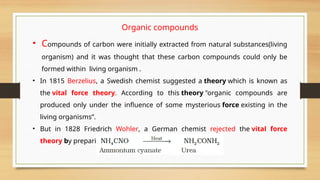
• But in 1828 Friedrich Wohler, a German chemist rejected the vital force
theory by preparing urea from ammonium cyanate.
• Acetic acid was synthesised by Kolbe (1845) and that of Methane by
Berthelot (1856)
• Class of chemical compounds in which one or more atoms of carbon are
covalently linked to atoms of other elements, most commonly hydrogen,
oxygen, or nitrogen are known as organic compounds except carbides,
oxides of carbon , carbonate , hydrogencarbonate and cyanides.
• Modern Definition of Organic Chemistry:- Branch of chemistry that deals
with the study of hydrocarbons and their derivatives
• Existence of large number of organic compounds is due to the self linking
property known as Catenation and due to tetravalency of carbon
Continue…
Organic compounds
The Shapes of Carbon Compounds
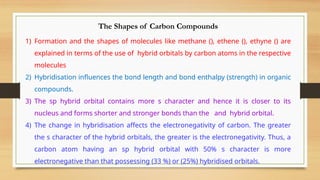
1) Formation and the shapes of molecules like methane (), ethene (), ethyne () are
explained in terms of the use of hybrid orbitals by carbon atoms in the respective
molecules
2) Hybridisation influences the bond length and bond enthalpy (strength) in organic
compounds.
3) The sp hybrid orbital contains more s character and hence it is closer to its
nucleus and forms shorter and stronger bonds than the and hybrid orbital.
4) The change in hybridisation affects the electronegativity of carbon. The greater
the s character of the hybrid orbitals, the greater is the electronegativity. Thus, a
carbon atom having an sp hybrid orbital with 50% s character is more
electronegative than that possessing (33 %) or (25%) hybridised orbitals.
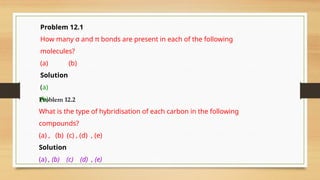
Problem 12.1
How many σ and π bonds are present in each of the following
molecules?
(a) (b)
Solution
(a)
(b)
Problem 12.2
What is the type of hybridisation of each carbon in the following
compounds?
(a) , (b) (c) , (d) , (e)
Solution
(a) , (b) (c) (d) , (e)
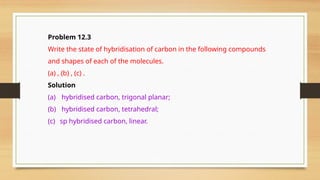
Problem 12.3
Write the state of hybridisation of carbon in the following compounds
and shapes of each of the molecules.
(a) , (b) , (c) .
Solution
(a) hybridised carbon, trigonal planar;
(b) hybridised carbon, tetrahedral;
(c) sp hybridised carbon, linear.
Class XI Chemistry
UNIT 12
ORGANIC CHEMISTRY – SOME BASIC PRINCIPLES
AND TECHNIQUES
Topics:-
• Structural Representations Of
Organic Compounds
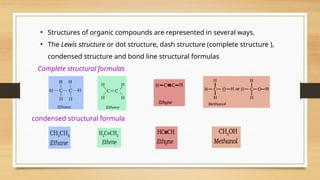
• Structures of organic compounds are represented in several ways.
• The Lewis structure or dot structure, dash structure (complete structure ),
condensed structure and bond line structural formulas
Complete structural formulas
condensed structural formula
bond-line structural representation
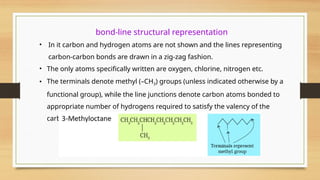
• In it carbon and hydrogen atoms are not shown and the lines representing
carbon-carbon bonds are drawn in a zig-zag fashion.
• The only atoms specifically written are oxygen, chlorine, nitrogen etc.
• The terminals denote methyl (–CH3) groups (unless indicated otherwise by a
functional group), while the line junctions denote carbon atoms bonded to
appropriate number of hydrogens required to satisfy the valency of the
carbon atoms.
bond-line structural representation
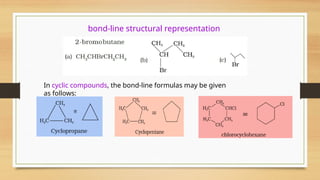
In cyclic compounds, the bond-line formulas may be given
as follows:
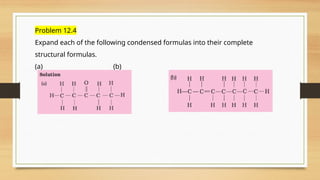
Problem 12.4
Expand each of the following condensed formulas into their complete
structural formulas.
(a) (b)
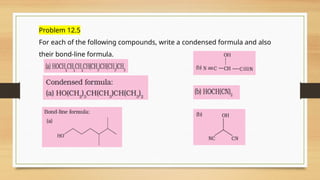
Problem 12.5
For each of the following compounds, write a condensed formula and also
their bond-line formula.
Three-Dimensional Representation of Organic
Molecules
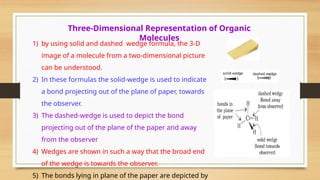
1) by using solid and dashed wedge formula, the 3-D
image of a molecule from a two-dimensional picture
can be understood.
2) In these formulas the solid-wedge is used to indicate
a bond projecting out of the plane of paper, towards
the observer.
3) The dashed-wedge is used to depict the bond
projecting out of the plane of the paper and away
from the observer
4) Wedges are shown in such a way that the broad end
of the wedge is towards the observer.
5) The bonds lying in plane of the paper are depicted by
Class XI Chemistry
UNIT 12
ORGANIC CHEMISTRY – SOME BASIC PRINCIPLES
AND TECHNIQUES
Topics:-
• Classification of Organic
Compounds
Classification of Organic Compounds
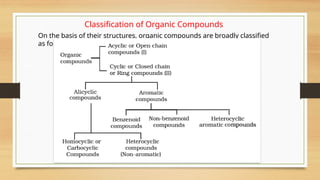
On the basis of their structures, organic compounds are broadly classified
as follows
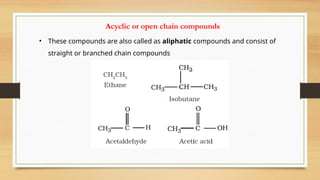
Acyclic or open chain compounds
• These compounds are also called as aliphatic compounds and consist of
straight or branched chain compounds
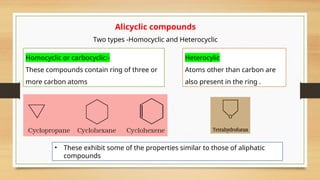
Alicyclic compounds
Two types -Homocyclic and Heterocyclic
Homocyclic or carbocyclic:-
These compounds contain ring of three or
more carbon atoms
Heterocylic
Atoms other than carbon are
also present in the ring .
• These exhibit some of the properties similar to those of aliphatic
compounds
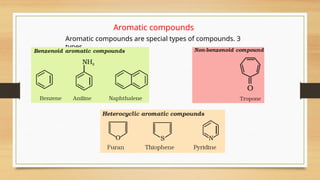
Aromatic compounds
Aromatic compounds are special types of compounds. 3
types
Functional Group
• The functional group is an atom or a group of atoms joined to the
carbon chain which is responsible for the characteristic chemical
properties of the organic compounds.
• The examples are hydroxyl group (–OH), aldehyde group (–CHO) and
carboxylic acid group (–COOH) etc.
Homologous Series
• A series of similarly constituted compounds in which the members present
have the same functional group, same chemical properties and any two
successive members in a particular series differ in their molecular formula by
–CH2 group.
• Some of these are alkanes, alkenes, alkynes, haloalkanes, alkanols, alkanals,
alkanones, alkanoic acids, amines etc.
Class XI Chemistry
UNIT 12
ORGANIC CHEMISTRY – SOME BASIC PRINCIPLES
AND TECHNIQUES
Topics:-
• IUPAC Nomenclature of Straight
Chain Hydrocarbons
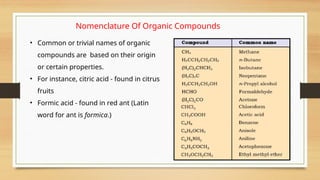
Nomenclature Of Organic Compounds
• Common or trivial names of organic
compounds are based on their origin
or certain properties.
• For instance, citric acid - found in citrus
fruits
• Formic acid - found in red ant (Latin
word for ant is formica.)
The IUPAC System of Nomenclature
• IUPAC -International Union of Pure and Applied Chemistry.
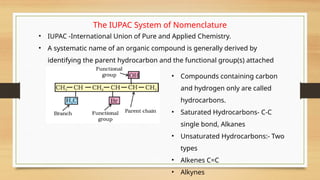
• A systematic name of an organic compound is generally derived by
identifying the parent hydrocarbon and the functional group(s) attached
to it
• Compounds containing carbon
and hydrogen only are called
hydrocarbons.
• Saturated Hydrocarbons- C-C
single bond, Alkanes
• Unsaturated Hydrocarbons:- Two
types
• Alkenes C=C
• Alkynes
IUPAC Nomenclature of Alkanes
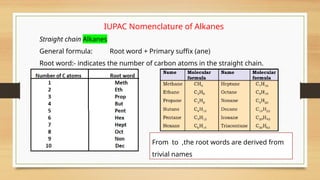
Straight chain Alkanes
General formula: Root word + Primary suffix (ane)
Root word:- indicates the number of carbon atoms in the straight chain.
From to ,the root words are derived from
trivial names
Alkenes:-
• Unsaturated hydrocarbons
• contain one or more Carbon-Carbon double bonds (C=C)
• General formula: IUPAC name :-Root word + Primary suffix (ene)
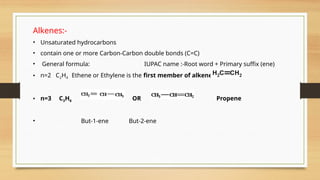
• n=2 C2H4 Ethene or Ethylene is the first member of alkene
• n=3 C3H6 OR Propene
• But-1-ene But-2-ene
Alkynes:-
• Unsaturated hydrocarbons
• contain one or more Carbon-Carbon triple bonds
• General formula:
• IUPAC name :-Root word + Primary suffix (yne)
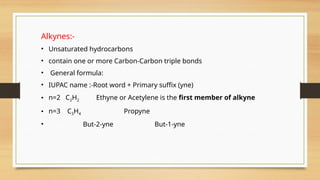
• n=2 C2H2 Ethyne or Acetylene is the first member of alkyne
• n=3 C3H4 Propyne
• But-2-yne But-1-yne
Class XI Chemistry
UNIT 12
ORGANIC CHEMISTRY – SOME BASIC PRINCIPLES
AND TECHNIQUES
Topics:-
• Different Types of Alkyl Groups
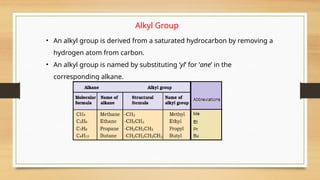
• An alkyl group is derived from a saturated hydrocarbon by removing a
hydrogen atom from carbon.
• An alkyl group is named by substituting ‘yl’ for ‘ane’ in the
corresponding alkane.
Alkyl Group
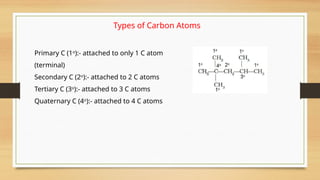
Types of Carbon Atoms
Primary C (1o
):- attached to only 1 C atom
(terminal)
Secondary C (2o
):- attached to 2 C atoms
Tertiary C (3o
):- attached to 3 C atoms
Quaternary C (4o
):- attached to 4 C atoms
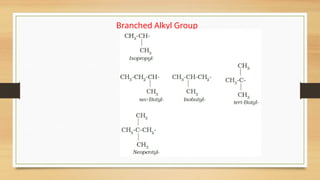
Branched Alkyl Group
Class XI Chemistry
UNIT 12
ORGANIC CHEMISTRY – SOME BASIC PRINCIPLES AND
TECHNIQUES
Topics:-
• IUPAC Nomenclature of Branched Chain
Alkanes
Nomenclature of branched chain alkanes
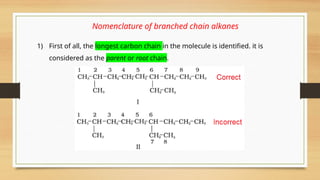
1) First of all, the longest carbon chain in the molecule is identified. it is
considered as the parent or root chain.
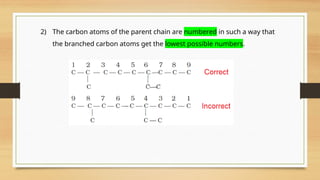
2) The carbon atoms of the parent chain are numbered in such a way that
the branched carbon atoms get the lowest possible numbers.
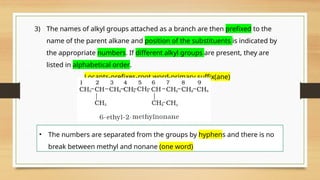
3) The names of alkyl groups attached as a branch are then prefixed to the
name of the parent alkane and position of the substituents is indicated by
the appropriate numbers. If different alkyl groups are present, they are
listed in alphabetical order.
Locants-prefixes-root word-primary suffix(ane)
• The numbers are separated from the groups by hyphens and there is no
break between methyl and nonane (one word)
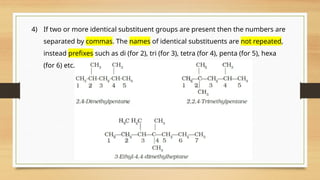
4) If two or more identical substituent groups are present then the numbers are
separated by commas. The names of identical substituents are not repeated,
instead prefixes such as di (for 2), tri (for 3), tetra (for 4), penta (for 5), hexa
(for 6) etc. are used.
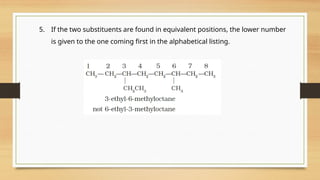
5. If the two substituents are found in equivalent positions, the lower number
is given to the one coming first in the alphabetical listing.
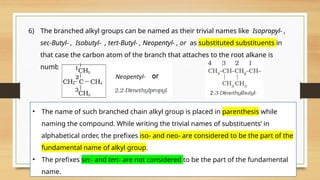
6) The branched alkyl groups can be named as their trivial names like Isopropyl- ,
sec-Butyl- , Isobutyl- , tert-Butyl- , Neopentyl- , or as substituted substituents in
that case the carbon atom of the branch that attaches to the root alkane is
numbered 1
• The name of such branched chain alkyl group is placed in parenthesis while
naming the compound. While writing the trivial names of substituents’ in
alphabetical order, the prefixes iso- and neo- are considered to be the part of the
fundamental name of alkyl group.
• The prefixes sec- and tert- are not considered to be the part of the fundamental
name.
• If there is more then one chain of equal size, then that chain is to be selected
which contains more number of side chains.
• After selection of the chain, numbering is to be done from the end closer to the
substituent.
5-(2-Ethylbutyl)-3,3-dimethyldecane
[and not 5-(2,2-Dimethylbutyl)-3-ethyldecane]
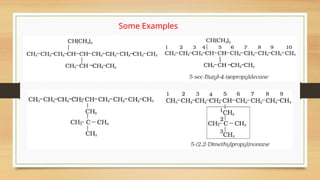
Some Examples
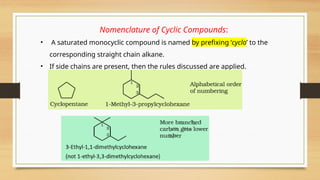
Nomenclature of Cyclic Compounds:
• A saturated monocyclic compound is named by prefixing ‘cyclo’ to the
corresponding straight chain alkane.
• If side chains are present, then the rules discussed are applied.
Class XI Chemistry
UNIT 12
ORGANIC CHEMISTRY – SOME BASIC PRINCIPLES AND
TECHNIQUES
Topic:-
IUPAC Nomenclature of Organic
Compounds having One Functional Group
Nomenclature of Organic Compounds having One
Functional Group
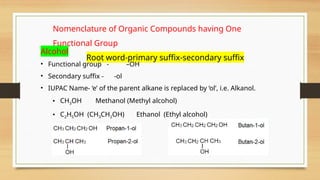
Root word-primary suffix-secondary suffix
Alcohol
• Functional group - –OH
• Secondary suffix - -ol
• IUPAC Name- ‘e’ of the parent alkane is replaced by ‘ol’, i.e. Alkanol.
• CH3OH Methanol (Methyl alcohol)
• C2H5OH (CH3CH2OH) Ethanol (Ethyl alcohol)
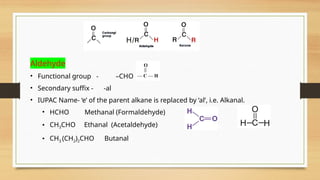
Aldehyde
• Functional group - –CHO
• Secondary suffix - -al
• IUPAC Name- ‘e’ of the parent alkane is replaced by ‘al’, i.e. Alkanal.
• HCHO Methanal (Formaldehyde)
• CH3CHO Ethanal (Acetaldehyde)
• CH3 (CH2)2CHO Butanal
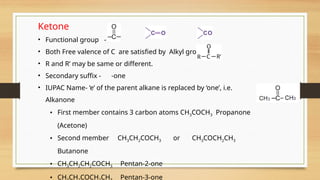
Ketone
• Functional group -
• Both Free valence of C are satisfied by Alkyl group
• R and R’ may be same or different.
• Secondary suffix - -one
• IUPAC Name- ‘e’ of the parent alkane is replaced by ‘one’, i.e.
Alkanone
• First member contains 3 carbon atoms CH3COCH3 Propanone
(Acetone)
• Second member CH3CH2COCH3 or CH3COCH2CH3
Butanone
• CH3CH2CH2COCH3 Pentan-2-one
• CH CH COCH CH Pentan-3-one
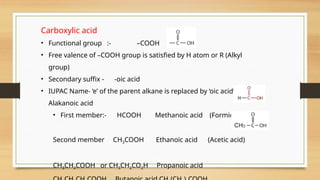
Carboxylic acid
• Functional group :- –COOH
• Free valence of –COOH group is satisfied by H atom or R (Alkyl
group)
• Secondary suffix - -oic acid
• IUPAC Name- ‘e’ of the parent alkane is replaced by ‘oic acid’, i.e.
Alakanoic acid
• First member:- HCOOH Methanoic acid (Formic acid)
Second member CH3COOH Ethanoic acid (Acetic acid)
CH3CH2COOH or CH3CH2CO2H Propanoic acid
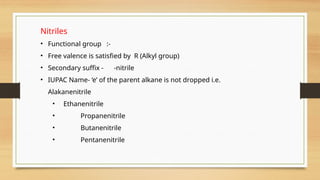
Nitriles
• Functional group :-
• Free valence is satisfied by R (Alkyl group)
• Secondary suffix - -nitrile
• IUPAC Name- ‘e’ of the parent alkane is not dropped i.e.
Alakanenitrile
• Ethanenitrile
• Propanenitrile
• Butanenitrile
• Pentanenitrile
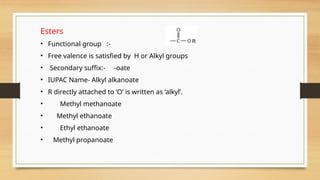
Esters
• Functional group :-
• Free valence is satisfied by H or Alkyl groups
• Secondary suffix:- -oate
• IUPAC Name- Alkyl alkanoate
• R directly attached to ‘O’ is written as ‘alkyl’.
• Methyl methanoate
• Methyl ethanoate
• Ethyl ethanoate
• Methyl propanoate
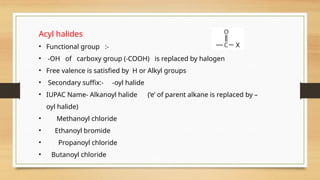
Acyl halides
• Functional group :-
• -OH of carboxy group (-COOH) is replaced by halogen
• Free valence is satisfied by H or Alkyl groups
• Secondary suffix:- -oyl halide
• IUPAC Name- Alkanoyl halide (‘e’ of parent alkane is replaced by –
oyl halide)
• Methanoyl chloride
• Ethanoyl bromide
• Propanoyl chloride
• Butanoyl chloride
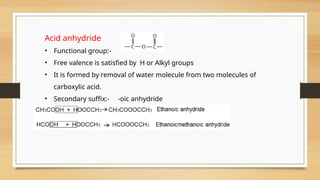
Acid anhydride
• Functional group:-
• Free valence is satisfied by H or Alkyl groups
• It is formed by removal of water molecule from two molecules of
carboxylic acid.
• Secondary suffix:- -oic anhydride
• IUPAC name:- alkanoic anhydride
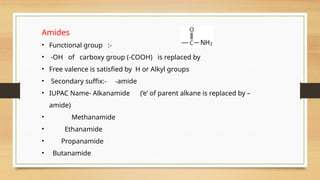
Amides
• Functional group :-
• -OH of carboxy group (-COOH) is replaced by
• Free valence is satisfied by H or Alkyl groups
• Secondary suffix:- -amide
• IUPAC Name- Alkanamide (‘e’ of parent alkane is replaced by –
amide)
• Methanamide
• Ethanamide
• Propanamide
• Butanamide
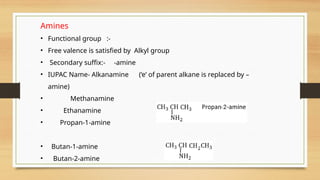
Amines
• Functional group :-
• Free valence is satisfied by Alkyl group
• Secondary suffix:- -amine
• IUPAC Name- Alkanamine (‘e’ of parent alkane is replaced by –
amine)
• Methanamine
• Ethanamine
• Propan-1-amine
• Butan-1-amine
• Butan-2-amine
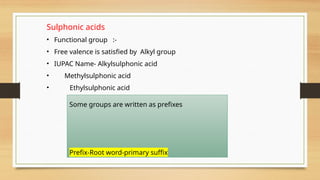
Sulphonic acids
• Functional group :-
• Free valence is satisfied by Alkyl group
• IUPAC Name- Alkylsulphonic acid
• Methylsulphonic acid
• Ethylsulphonic acid
Some groups are written as prefixes
Prefix-Root word-primary suffix
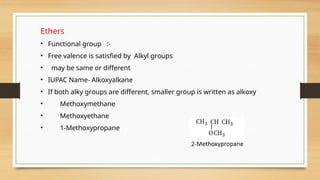
Ethers
• Functional group :-
• Free valence is satisfied by Alkyl groups
• may be same or different
• IUPAC Name- Alkoxyalkane
• If both alky groups are different, smaller group is written as alkoxy
• Methoxymethane
• Methoxyethane
• 1-Methoxypropane
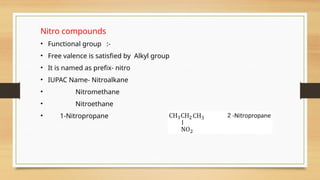
Nitro compounds
• Functional group :-
• Free valence is satisfied by Alkyl group
• It is named as prefix- nitro
• IUPAC Name- Nitroalkane
• Nitromethane
• Nitroethane
• 1-Nitropropane
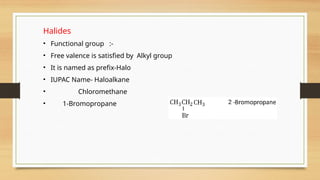
Halides
• Functional group :-
• Free valence is satisfied by Alkyl group
• It is named as prefix-Halo
• IUPAC Name- Haloalkane
• Chloromethane
• 1-Bromopropane
Class XI Chemistry
UNIT 12
ORGANIC CHEMISTRY – SOME BASIC PRINCIPLES AND
TECHNIQUES
Topic:-
IUPAC Nomenclature of Organic
Compounds having Poly Functional Group
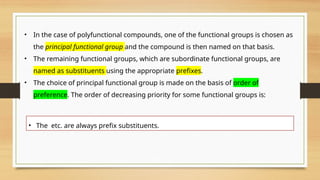
• In the case of polyfunctional compounds, one of the functional groups is chosen as
the principal functional group and the compound is then named on that basis.
• The remaining functional groups, which are subordinate functional groups, are
named as substituents using the appropriate prefixes.
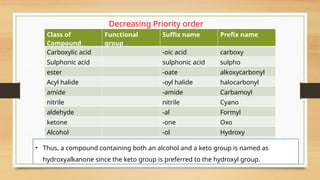
• The choice of principal functional group is made on the basis of order of
preference. The order of decreasing priority for some functional groups is:
• The etc. are always prefix substituents.
Decreasing Priority order
Class of
Compound
Functional
group
Suffix name Prefix name
Carboxylic acid -oic acid carboxy
Sulphonic acid sulphonic acid sulpho
ester -oate alkoxycarbonyl
Acyl halide -oyl halide halocarbonyl
amide -amide Carbamoyl
nitrile nitrile Cyano
aldehyde -al Formyl
ketone -one Oxo
Alcohol -ol Hydroxy
Amine -amine Amino
• Thus, a compound containing both an alcohol and a keto group is named as
hydroxyalkanone since the keto group is preferred to the hydroxyl group.
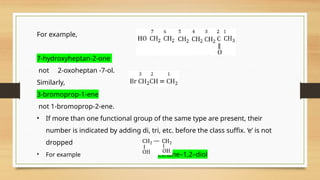
For example,
7-hydroxyheptan-2-one
not 2-oxoheptan -7-ol.
Similarly,
3-bromoprop-1-ene
not 1-bromoprop-2-ene.
• If more than one functional group of the same type are present, their
number is indicated by adding di, tri, etc. before the class suffix. ‘e’ is not
dropped
• For example ethane–1,2–diol
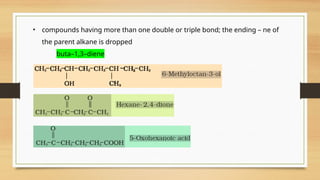
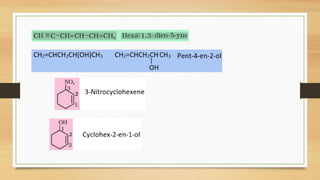
• compounds having more than one double or triple bond; the ending – ne of
the parent alkane is dropped
buta–1,3–diene
Class XI Chemistry
UNIT 12
ORGANIC CHEMISTRY – SOME BASIC PRINCIPLES AND
TECHNIQUES
Topic:-
Nomenclature of Substituted
Benzene Compounds
Nomenclature of Substituted Benzene
Compounds
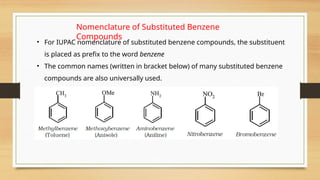
• For IUPAC nomenclature of substituted benzene compounds, the substituent
is placed as prefix to the word benzene
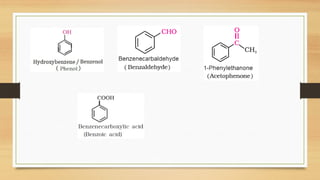
• The common names (written in bracket below) of many substituted benzene
compounds are also universally used.
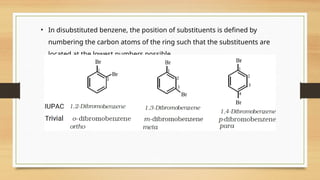
• In disubstituted benzene, the position of substituents is defined by
numbering the carbon atoms of the ring such that the substituents are
located at the lowest numbers possible.
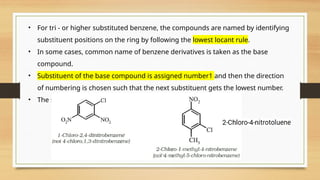
• For tri - or higher substituted benzene, the compounds are named by identifying
substituent positions on the ring by following the lowest locant rule.
• In some cases, common name of benzene derivatives is taken as the base
compound.
• Substituent of the base compound is assigned number1 and then the direction
of numbering is chosen such that the next substituent gets the lowest number.
• The substituents appear in the name in alphabetical order.
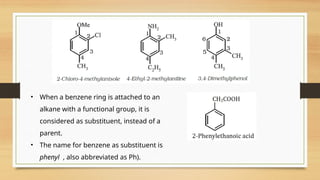
• When a benzene ring is attached to an
alkane with a functional group, it is
considered as substituent, instead of a
parent.
• The name for benzene as substituent is
phenyl , also abbreviated as Ph).
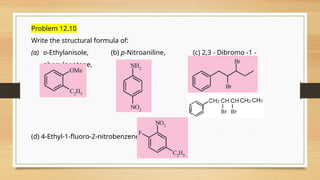
Problem 12.10
Write the structural formula of:
(a) o-Ethylanisole, (b) p-Nitroaniline, (c) 2,3 - Dibromo -1 -
phenylpentane,
(d) 4-Ethyl-1-fluoro-2-nitrobenzene.
Class XI Chemistry
UNIT 12
ORGANIC CHEMISTRY – SOME BASIC
PRINCIPLES AND TECHNIQUES
Topic:-
ISOMERISM
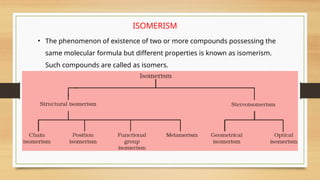
ISOMERISM
• The phenomenon of existence of two or more compounds possessing the
same molecular formula but different properties is known as isomerism.
Such compounds are called as isomers.
Structural Isomerism
• Compounds having the same molecular formula but different structures
(manners in which atoms are linked) are classified as structural isomers.
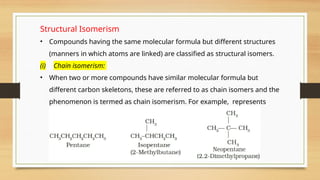
(i) Chain isomerism:
• When two or more compounds have similar molecular formula but
different carbon skeletons, these are referred to as chain isomers and the
phenomenon is termed as chain isomerism. For example, represents
three compounds:
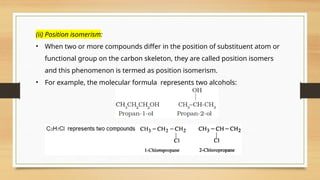
(ii) Position isomerism:
• When two or more compounds differ in the position of substituent atom or
functional group on the carbon skeleton, they are called position isomers
and this phenomenon is termed as position isomerism.
• For example, the molecular formula represents two alcohols:
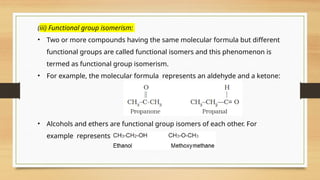
(iii) Functional group isomerism:
• Two or more compounds having the same molecular formula but different
functional groups are called functional isomers and this phenomenon is
termed as functional group isomerism.
• For example, the molecular formula represents an aldehyde and a ketone:
• Alcohols and ethers are functional group isomers of each other. For
example represents
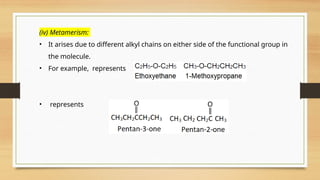
(iv) Metamerism:
• It arises due to different alkyl chains on either side of the functional group in
the molecule.
• For example, represents
• represents
Stereoisomerism
• The compounds that have the same constitution and sequence of
covalent bonds but differ in relative positions of their atoms or groups
in space are called stereoisomers. This special type of isomerism is
called as stereoisomerism
• It can be classified as geometrical and optical isomerism.
Class XI Chemistry
UNIT 12
ORGANIC CHEMISTRY – SOME BASIC PRINCIPLES AND
TECHNIQUES
Topic:-
• Fission or Cleavage of a Covalent
Bond
Fundamental Concepts In Organic Reaction
Mechanism
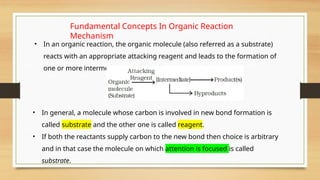
• In an organic reaction, the organic molecule (also referred as a substrate)
reacts with an appropriate attacking reagent and leads to the formation of
one or more intermediate(s) and finally product(s)
• In general, a molecule whose carbon is involved in new bond formation is
called substrate and the other one is called reagent.
• If both the reactants supply carbon to the new bond then choice is arbitrary
and in that case the molecule on which attention is focused is called
substrate.
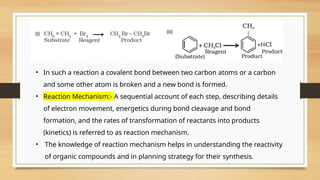
• In such a reaction a covalent bond between two carbon atoms or a carbon
and some other atom is broken and a new bond is formed.
• Reaction Mechanism:- A sequential account of each step, describing details
of electron movement, energetics during bond cleavage and bond
formation, and the rates of transformation of reactants into products
(kinetics) is referred to as reaction mechanism.
• The knowledge of reaction mechanism helps in understanding the reactivity
of organic compounds and in planning strategy for their synthesis.
Fission or Cleavage of a Covalent Bond
Two types:- (i) heterolytic cleavage (ii) homolytic cleavage.
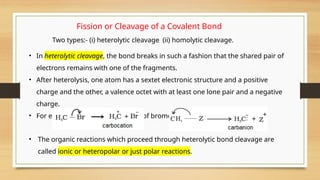
• In heterolytic cleavage, the bond breaks in such a fashion that the shared pair of
electrons remains with one of the fragments.
• After heterolysis, one atom has a sextet electronic structure and a positive
charge and the other, a valence octet with at least one lone pair and a negative
charge.
• For example, heterolytic cleavage of bromomethane
• The organic reactions which proceed through heterolytic bond cleavage are
called ionic or heteropolar or just polar reactions.
• In homolytic cleavage, one of the electrons of the shared pair in a covalent
bond goes with each of the bonded atoms.
• Thus, in homolytic cleavage, the movement of a single electron takes place
instead of an electron pair.
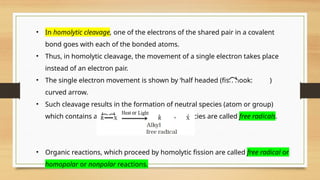
• The single electron movement is shown by ‘half headed (fish hook: )
curved arrow.
• Such cleavage results in the formation of neutral species (atom or group)
which contains an unpaired electron. These species are called free radicals.
• Organic reactions, which proceed by homolytic fission are called free radical or
homopolar or nonpolar reactions.
Class XI Chemistry
UNIT 12
ORGANIC CHEMISTRY – SOME BASIC PRINCIPLES AND
TECHNIQUES
Topic:-
• Reactive Intermediates
Carbocations:-
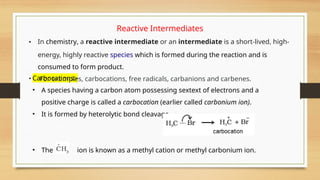
• A species having a carbon atom possessing sextext of electrons and a
positive charge is called a carbocation (earlier called carbonium ion).
• It is formed by heterolytic bond cleavage.
• The ion is known as a methyl cation or methyl carbonium ion.
Reactive Intermediates
• In chemistry, a reactive intermediate or an intermediate is a short-lived, high-
energy, highly reactive species which is formed during the reaction and is
consumed to form product.
• For examples, carbocations, free radicals, carbanions and carbenes.
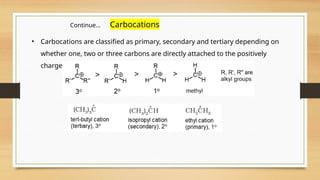
• Carbocations are classified as primary, secondary and tertiary depending on
whether one, two or three carbons are directly attached to the positively
charged carbon.
Continue… Carbocations
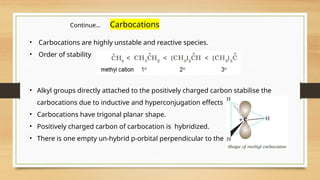
• Carbocations are highly unstable and reactive species.
• Order of stability
• Alkyl groups directly attached to the positively charged carbon stabilise the
carbocations due to inductive and hyperconjugation effects
• Carbocations have trigonal planar shape.
• Positively charged carbon of carbocation is hybridized.
• There is one empty un-hybrid p-orbital perpendicular to the plane.
Continue… Carbocations
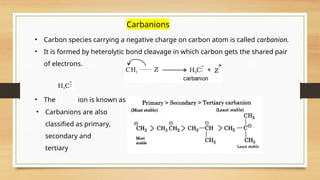
Carbanions
• Carbon species carrying a negative charge on carbon atom is called carbanion.
• It is formed by heterolytic bond cleavage in which carbon gets the shared pair
of electrons.
• The ion is known as a methyl anion.
• Carbanions are also
classified as primary,
secondary and
tertiary
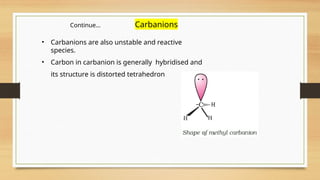
• Carbanions are also unstable and reactive
species.
• Carbon in carbanion is generally hybridised and
its structure is distorted tetrahedron
Continue… Carbanions
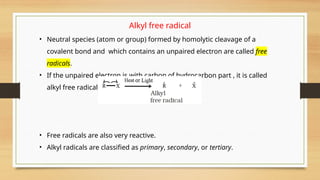
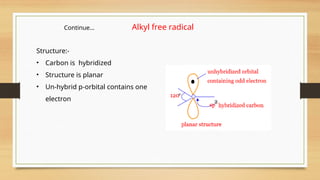
Alkyl free radical
• Neutral species (atom or group) formed by homolytic cleavage of a
covalent bond and which contains an unpaired electron are called free
radicals.
• If the unpaired electron is with carbon of hydrocarbon part , it is called
alkyl free radical
• Free radicals are also very reactive.
• Alkyl radicals are classified as primary, secondary, or tertiary.
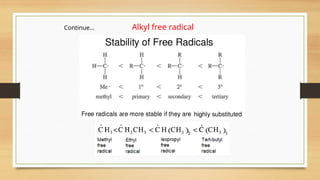
Continue… Alkyl free radical
Structure:-
• Carbon is hybridized
• Structure is planar
• Un-hybrid p-orbital contains one
electron
Class XI Chemistry
UNIT 12
ORGANIC CHEMISTRY – SOME BASIC PRINCIPLES AND
TECHNIQUES
Topic:-
• Attacking Reagents
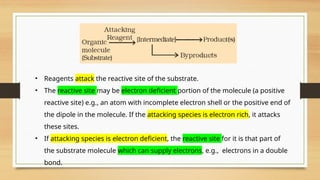
• Reagents attack the reactive site of the substrate.
• The reactive site may be electron deficient portion of the molecule (a positive
reactive site) e.g., an atom with incomplete electron shell or the positive end of
the dipole in the molecule. If the attacking species is electron rich, it attacks
these sites.
• If attacking species is electron deficient, the reactive site for it is that part of
the substrate molecule which can supply electrons, e.g., electrons in a double
bond.
• The species that attacks a substrate molecule or intermediate and forms a
product is called attacking reagent.
• It is of two types:
• Electrophilic reagent or electrophiles.
• Nucleophilic reagent or nucleophiles.
Electrophiles
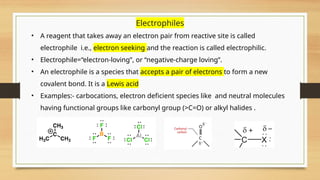
• A reagent that takes away an electron pair from reactive site is called
electrophile i.e., electron seeking and the reaction is called electrophilic.
• Electrophile=“electron-loving”, or “negative-charge loving”.
• An electrophile is a species that accepts a pair of electrons to form a new
covalent bond. It is a Lewis acid
• Examples:- carbocations, electron deficient species like and neutral molecules
having functional groups like carbonyl group (>C=O) or alkyl halides .
Nucleophiles
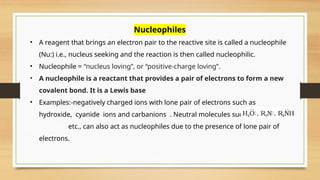
• A reagent that brings an electron pair to the reactive site is called a nucleophile
(Nu:) i.e., nucleus seeking and the reaction is then called nucleophilic.
• Nucleophile = “nucleus loving”, or “positive-charge loving”.
• A nucleophile is a reactant that provides a pair of electrons to form a new
covalent bond. It is a Lewis base
• Examples:-negatively charged ions with lone pair of electrons such as
hydroxide, cyanide ions and carbanions . Neutral molecules such as
etc., can also act as nucleophiles due to the presence of lone pair of
electrons.
• During a polar organic reaction, a nucleophile attacks an electrophilic centre
of the substrate which is that specific atom or part of the substrate which is
electron deficient.
• Similarly, the electrophiles attack at nucleophilic centre, which is the electron
rich centre of the substrate.
• Thus, the electrophiles receive electron pair from the substrate when the
two undergo bonding interaction.
• A curved-arrow notation is used to show the movement of an electron pair
from the nucleophile to the electrophile.
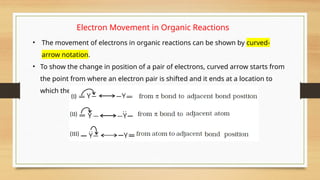
Electron Movement in Organic Reactions
• The movement of electrons in organic reactions can be shown by curved-
arrow notation.
• To show the change in position of a pair of electrons, curved arrow starts from
the point from where an electron pair is shifted and it ends at a location to
which the pair of electron may move.
Continue…Electron Movement in Organic Reactions
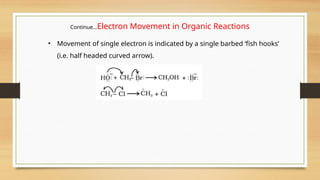
• Movement of single electron is indicated by a single barbed ‘fish hooks’
(i.e. half headed curved arrow).
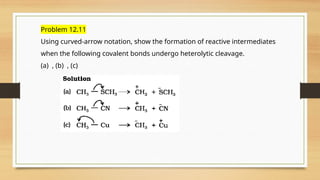
Problem 12.11
Using curved-arrow notation, show the formation of reactive intermediates
when the following covalent bonds undergo heterolytic cleavage.
(a) , (b) , (c)
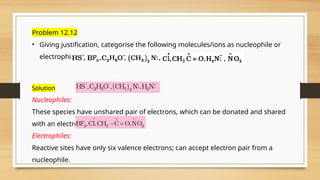
Problem 12.12
• Giving justification, categorise the following molecules/ions as nucleophile or
electrophile:
Solution
Nucleophiles:
These species have unshared pair of electrons, which can be donated and shared
with an electrophile.
Electrophiles:
Reactive sites have only six valence electrons; can accept electron pair from a
nucleophile.
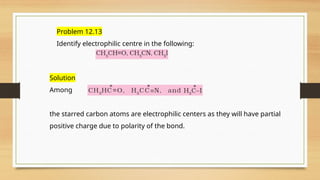
Problem 12.13
Identify electrophilic centre in the following:
Solution
Among
the starred carbon atoms are electrophilic centers as they will have partial
positive charge due to polarity of the bond.
Class XI Chemistry
UNIT 12
ORGANIC CHEMISTRY – SOME BASIC PRINCIPLES AND
TECHNIQUES
Topic:-
• Electron Displacement Effects in Covalent
Bonds
• Inductive Effect
Electron Displacement Effects in Covalent
Bonds
• Two types of electron displacement effects:
1. Permanent Electron Displacement Effects:-
• The electron displacements due to the influence of an atom or a
substituent group present in the molecule cause permanent
polarisation of the bond.
• Examples :-Inductive effect resonance effects Hyperconjugation
2. Temporary electron displacement effects :-
• Electron displacement in the presence of an appropriate attacking
reagent
• For example:-electromeric effect or polarizability effect.
Inductive Effect
• When a covalent bond is formed between atoms of different electronegativity,
the electron density is more towards the more electronegative atom of the
bond. Such a shift of electron density results in a polar covalent bond.
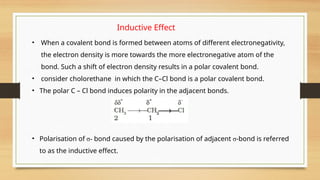
• consider cholorethane in which the C–Cl bond is a polar covalent bond.
• The polar C – Cl bond induces polarity in the adjacent bonds.
• Polarisation of σ- bond caused by the polarisation of adjacent σ-bond is referred
to as the inductive effect.
• The inductive effect is related to the ability of substituent(s) to either
withdraw or donate electron density to the attached carbon atom.
• Based on this ability, the substitutents can be classified as
• electron-withdrawing groups ( Have negative Inductive effect, – I
effect)
• Examples:- Halogens, nitro , cyano, carboxy, ester, aryloxy
• electron donating groups (Have positive Inductive effect, +I effect)
• Examples:- alkyl groups like methyl and ethyl .
Continue… Inductive Effect
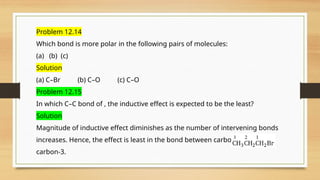
Problem 12.14
Which bond is more polar in the following pairs of molecules:
(a) (b) (c)
Solution
(a) C–Br (b) C–O (c) C–O
Problem 12.15
In which C–C bond of , the inductive effect is expected to be the least?
Solution
Magnitude of inductive effect diminishes as the number of intervening bonds
increases. Hence, the effect is least in the bond between carbon-2 and
carbon-3.
Class XI Chemistry
UNIT 12
ORGANIC CHEMISTRY – SOME BASIC PRINCIPLES AND
TECHNIQUES
Topic:-
Resonance Structure & Resonance
Effect
Resonance Structure
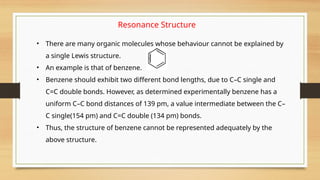
• There are many organic molecules whose behaviour cannot be explained by
a single Lewis structure.
• An example is that of benzene.
• Benzene should exhibit two different bond lengths, due to C–C single and
C=C double bonds. However, as determined experimentally benzene has a
uniform C–C bond distances of 139 pm, a value intermediate between the C–
C single(154 pm) and C=C double (134 pm) bonds.
• Thus, the structure of benzene cannot be represented adequately by the
above structure.
Resonance Structure
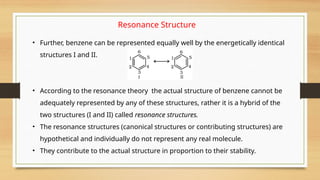
• Further, benzene can be represented equally well by the energetically identical
structures I and II.
• According to the resonance theory the actual structure of benzene cannot be
adequately represented by any of these structures, rather it is a hybrid of the
two structures (I and II) called resonance structures.
• The resonance structures (canonical structures or contributing structures) are
hypothetical and individually do not represent any real molecule.
• They contribute to the actual structure in proportion to their stability.
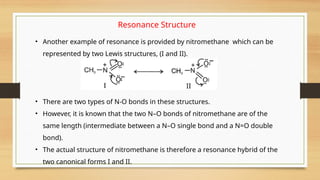
• Another example of resonance is provided by nitromethane which can be
represented by two Lewis structures, (I and II).
• There are two types of N-O bonds in these structures.
• However, it is known that the two N–O bonds of nitromethane are of the
same length (intermediate between a N–O single bond and a N=O double
bond).
• The actual structure of nitromethane is therefore a resonance hybrid of the
two canonical forms I and II.
Resonance Structure
• The energy of actual structure of the molecule (the resonance hybrid) is
lower than that of any of the canonical structures.
• The difference in energy between the actual structure and the lowest energy
resonance structure is called the resonance stabilisation energy or simply the
resonance energy.
• The more the number of important contributing structures, the more is the
resonance energy.
• Resonance is particularly important when the contributing structures are
equivalent in energy.
Resonance Energy
• The resonance structures have (i) the same positions of nuclei and (ii) the
same number of unpaired electrons.
• Among the resonance structures, the one which has following characteristics
is more stable than others:-
• more number of covalent bonds,
• all the atoms with octet of electrons (except hydrogen which has a duplet),
• less separation of opposite charges, (a negative charge if any on more
electronegative atom, a positive charge if any on more electropositive
atom) and
• more dispersal of charge,
The following rules are applied while writing resonance
structures:
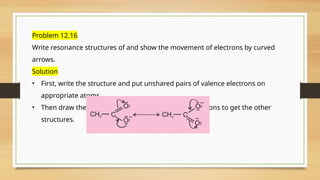
Problem 12.16
Write resonance structures of and show the movement of electrons by curved
arrows.
Solution
• First, write the structure and put unshared pairs of valence electrons on
appropriate atoms.
• Then draw the arrows one at a time moving the electrons to get the other
structures.
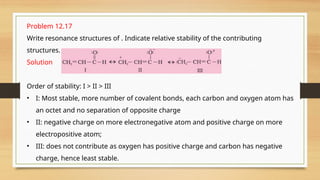
Problem 12.17
Write resonance structures of . Indicate relative stability of the contributing
structures.
Solution
Order of stability: I > II > III
• I: Most stable, more number of covalent bonds, each carbon and oxygen atom has
an octet and no separation of opposite charge
• II: negative charge on more electronegative atom and positive charge on more
electropositive atom;
• III: does not contribute as oxygen has positive charge and carbon has negative
charge, hence least stable.
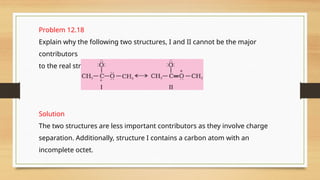
Problem 12.18
Explain why the following two structures, I and II cannot be the major
contributors
to the real structure of .
Solution
The two structures are less important contributors as they involve charge
separation. Additionally, structure I contains a carbon atom with an
incomplete octet.
Resonance Effect (R effect)
• The resonance effect is defined as ‘the polarity produced in the molecule by
the interaction of two -bonds or between a -bond and lone pair of electrons
present on an adjacent atom’.
• The effect is transmitted through the chain.
• It is also known as mesomeric effect, designated as M effect.
• There are two types of resonance effect:-
(a) Positive Resonance effect
(b) Negative Resonance effect
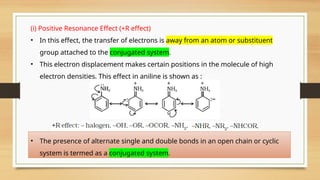
(i) Positive Resonance Effect (+R effect)
• In this effect, the transfer of electrons is away from an atom or substituent
group attached to the conjugated system.
• This electron displacement makes certain positions in the molecule of high
electron densities. This effect in aniline is shown as :
• The presence of alternate single and double bonds in an open chain or cyclic
system is termed as a conjugated system.
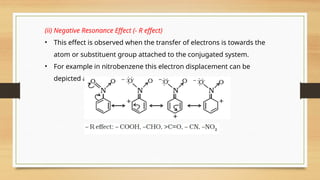
(ii) Negative Resonance Effect (- R effect)
• This effect is observed when the transfer of electrons is towards the
atom or substituent group attached to the conjugated system.
• For example in nitrobenzene this electron displacement can be
depicted as :
Class XI Chemistry
UNIT 12
ORGANIC CHEMISTRY – SOME BASIC PRINCIPLES AND
TECHNIQUES
Topic:-
Electromeric Effect
Electromeric Effect (E effect)
• It is a temporary effect.
• The organic compounds having a multiple bond (a double or triple bond)
show this effect in the presence of an attacking reagent only.
• It is defined as the complete transfer of a shared pair of π-electrons to one of
the atoms joined by a multiple bond on the demand of an attacking reagent.
• The effect is annulled (cancelled) as soon as the attacking reagent is removed
from the domain of the reaction.
• It is represented by E and the shifting of the electrons is shown by a curved
arrow
• There are two distinct types of electromeric effect:-+ E and -E
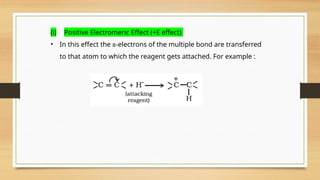
(i) Positive Electromeric Effect (+E effect)
• In this effect the π-electrons of the multiple bond are transferred
to that atom to which the reagent gets attached. For example :
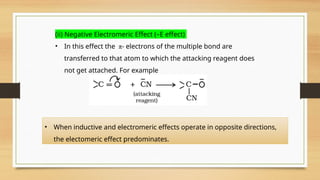
(ii) Negative Electromeric Effect (–E effect)
• In this effect the π- electrons of the multiple bond are
transferred to that atom to which the attacking reagent does
not get attached. For example
• When inductive and electromeric effects operate in opposite directions,
the electomeric effect predominates.
Class XI Chemistry
UNIT 12
ORGANIC CHEMISTRY – SOME BASIC PRINCIPLES AND
TECHNIQUES
Topic:-
Hyperconjugation
Hyperconjugation
• Hyperconjugation is a general stabilising interaction.
• It involves delocalisation of electrons of C—H bond of an alkyl group
directly attached to an atom of unsaturated system or to an atom with an
unshared p orbital.
• The electrons of C—H bond of the alkyl group enter into partial
conjugation with the attached unsaturated system or with the unshared p
orbital.
• Hyperconjugation is a permanent effect.
• The hyperconjugation may also be regarded as no bond resonance.
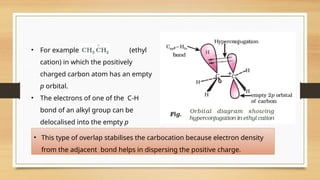
• For example (ethyl
cation) in which the positively
charged carbon atom has an empty
p orbital.
• The electrons of one of the C-H
bond of an alkyl group can be
delocalised into the empty p
orbital .
• This type of overlap stabilises the carbocation because electron density
from the adjacent bond helps in dispersing the positive charge.
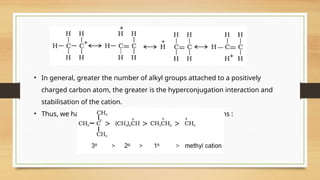
• In general, greater the number of alkyl groups attached to a positively
charged carbon atom, the greater is the hyperconjugation interaction and
stabilisation of the cation.
• Thus, we have the following relative stability of carbocations :
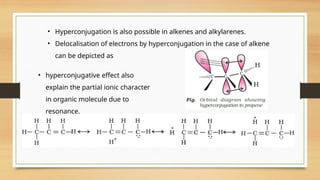
• Hyperconjugation is also possible in alkenes and alkylarenes.
• Delocalisation of electrons by hyperconjugation in the case of alkene
can be depicted as
• hyperconjugative effect also
explain the partial ionic character
in organic molecule due to
resonance.
Class XI Chemistry
UNIT 12
ORGANIC CHEMISTRY – SOME BASIC PRINCIPLES AND
TECHNIQUES
Topic:-
Types of Organic
Reactions
Types of Organic Reactions
Organic reactions can be classified into the following categories:
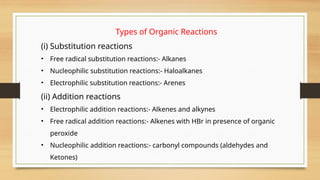
(i) Substitution reactions
(ii) Addition reactions
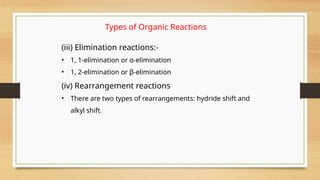
(iii) Elimination reactions
(iv) Rearrangement reactions
Depending upon the mechanism and attacking reagent substitution and
addition reactions are further classified as
• Nucleophilic reaction
• Electrophilic reaction
• Free radical reaction
Types of Organic Reactions
(i) Substitution reactions
• Free radical substitution reactions:- Alkanes
• Nucleophilic substitution reactions:- Haloalkanes
• Electrophilic substitution reactions:- Arenes
(ii) Addition reactions
• Electrophilic addition reactions:- Alkenes and alkynes
• Free radical addition reactions:- Alkenes with HBr in presence of organic
peroxide
• Nucleophilic addition reactions:- carbonyl compounds (aldehydes and
Ketones)
Types of Organic Reactions
(iii) Elimination reactions:-
• 1, 1-elimination or α-elimination
• 1, 2-elimination or β-elimination
(iv) Rearrangement reactions
• There are two types of rearrangements: hydride shift and
alkyl shift.

Organic Chemistry-Some Basic Principles and Techniques.pptx

  • 1.
    Class XI Chemistry UNIT12 ORGANIC CHEMISTRY – SOME BASIC PRINCIPLES AND TECHNIQUES Topics:- • The Shapes of Carbon Compounds • Hybridization in C
  • 2.
    Organic compounds • Compoundsof carbon were initially extracted from natural substances(living organism) and it was thought that these carbon compounds could only be formed within living organism . • In 1815 Berzelius, a Swedish chemist suggested a theory which is known as the vital force theory. According to this theory "organic compounds are produced only under the influence of some mysterious force existing in the living organisms”. • But in 1828 Friedrich Wohler, a German chemist rejected the vital force theory by preparing urea from ammonium cyanate.
  • 3.
    • Acetic acidwas synthesised by Kolbe (1845) and that of Methane by Berthelot (1856) • Class of chemical compounds in which one or more atoms of carbon are covalently linked to atoms of other elements, most commonly hydrogen, oxygen, or nitrogen are known as organic compounds except carbides, oxides of carbon , carbonate , hydrogencarbonate and cyanides. • Modern Definition of Organic Chemistry:- Branch of chemistry that deals with the study of hydrocarbons and their derivatives • Existence of large number of organic compounds is due to the self linking property known as Catenation and due to tetravalency of carbon Continue… Organic compounds
  • 4.
    The Shapes ofCarbon Compounds 1) Formation and the shapes of molecules like methane (), ethene (), ethyne () are explained in terms of the use of hybrid orbitals by carbon atoms in the respective molecules 2) Hybridisation influences the bond length and bond enthalpy (strength) in organic compounds. 3) The sp hybrid orbital contains more s character and hence it is closer to its nucleus and forms shorter and stronger bonds than the and hybrid orbital. 4) The change in hybridisation affects the electronegativity of carbon. The greater the s character of the hybrid orbitals, the greater is the electronegativity. Thus, a carbon atom having an sp hybrid orbital with 50% s character is more electronegative than that possessing (33 %) or (25%) hybridised orbitals.
  • 5.
    Problem 12.1 How manyσ and π bonds are present in each of the following molecules? (a) (b) Solution (a) (b) Problem 12.2 What is the type of hybridisation of each carbon in the following compounds? (a) , (b) (c) , (d) , (e) Solution (a) , (b) (c) (d) , (e)
  • 6.
    Problem 12.3 Write thestate of hybridisation of carbon in the following compounds and shapes of each of the molecules. (a) , (b) , (c) . Solution (a) hybridised carbon, trigonal planar; (b) hybridised carbon, tetrahedral; (c) sp hybridised carbon, linear.
  • 7.
    Class XI Chemistry UNIT12 ORGANIC CHEMISTRY – SOME BASIC PRINCIPLES AND TECHNIQUES Topics:- • Structural Representations Of Organic Compounds
  • 8.
    • Structures oforganic compounds are represented in several ways. • The Lewis structure or dot structure, dash structure (complete structure ), condensed structure and bond line structural formulas Complete structural formulas condensed structural formula
  • 9.
    bond-line structural representation •In it carbon and hydrogen atoms are not shown and the lines representing carbon-carbon bonds are drawn in a zig-zag fashion. • The only atoms specifically written are oxygen, chlorine, nitrogen etc. • The terminals denote methyl (–CH3) groups (unless indicated otherwise by a functional group), while the line junctions denote carbon atoms bonded to appropriate number of hydrogens required to satisfy the valency of the carbon atoms.
  • 10.
    bond-line structural representation Incyclic compounds, the bond-line formulas may be given as follows:
  • 11.
    Problem 12.4 Expand eachof the following condensed formulas into their complete structural formulas. (a) (b)
  • 12.
    Problem 12.5 For eachof the following compounds, write a condensed formula and also their bond-line formula.
  • 13.
    Three-Dimensional Representation ofOrganic Molecules 1) by using solid and dashed wedge formula, the 3-D image of a molecule from a two-dimensional picture can be understood. 2) In these formulas the solid-wedge is used to indicate a bond projecting out of the plane of paper, towards the observer. 3) The dashed-wedge is used to depict the bond projecting out of the plane of the paper and away from the observer 4) Wedges are shown in such a way that the broad end of the wedge is towards the observer. 5) The bonds lying in plane of the paper are depicted by
  • 14.
    Class XI Chemistry UNIT12 ORGANIC CHEMISTRY – SOME BASIC PRINCIPLES AND TECHNIQUES Topics:- • Classification of Organic Compounds
  • 15.
    Classification of OrganicCompounds On the basis of their structures, organic compounds are broadly classified as follows
  • 16.
    Acyclic or openchain compounds • These compounds are also called as aliphatic compounds and consist of straight or branched chain compounds
  • 17.
    Alicyclic compounds Two types-Homocyclic and Heterocyclic Homocyclic or carbocyclic:- These compounds contain ring of three or more carbon atoms Heterocylic Atoms other than carbon are also present in the ring . • These exhibit some of the properties similar to those of aliphatic compounds
  • 18.
    Aromatic compounds Aromatic compoundsare special types of compounds. 3 types
  • 19.
    Functional Group • Thefunctional group is an atom or a group of atoms joined to the carbon chain which is responsible for the characteristic chemical properties of the organic compounds. • The examples are hydroxyl group (–OH), aldehyde group (–CHO) and carboxylic acid group (–COOH) etc.
  • 20.
    Homologous Series • Aseries of similarly constituted compounds in which the members present have the same functional group, same chemical properties and any two successive members in a particular series differ in their molecular formula by –CH2 group. • Some of these are alkanes, alkenes, alkynes, haloalkanes, alkanols, alkanals, alkanones, alkanoic acids, amines etc.
  • 21.
    Class XI Chemistry UNIT12 ORGANIC CHEMISTRY – SOME BASIC PRINCIPLES AND TECHNIQUES Topics:- • IUPAC Nomenclature of Straight Chain Hydrocarbons
  • 22.
    Nomenclature Of OrganicCompounds • Common or trivial names of organic compounds are based on their origin or certain properties. • For instance, citric acid - found in citrus fruits • Formic acid - found in red ant (Latin word for ant is formica.)
  • 23.
    The IUPAC Systemof Nomenclature • IUPAC -International Union of Pure and Applied Chemistry. • A systematic name of an organic compound is generally derived by identifying the parent hydrocarbon and the functional group(s) attached to it • Compounds containing carbon and hydrogen only are called hydrocarbons. • Saturated Hydrocarbons- C-C single bond, Alkanes • Unsaturated Hydrocarbons:- Two types • Alkenes C=C • Alkynes
  • 24.
    IUPAC Nomenclature ofAlkanes Straight chain Alkanes General formula: Root word + Primary suffix (ane) Root word:- indicates the number of carbon atoms in the straight chain. From to ,the root words are derived from trivial names
  • 25.
    Alkenes:- • Unsaturated hydrocarbons •contain one or more Carbon-Carbon double bonds (C=C) • General formula: IUPAC name :-Root word + Primary suffix (ene) • n=2 C2H4 Ethene or Ethylene is the first member of alkene • n=3 C3H6 OR Propene • But-1-ene But-2-ene
  • 26.
    Alkynes:- • Unsaturated hydrocarbons •contain one or more Carbon-Carbon triple bonds • General formula: • IUPAC name :-Root word + Primary suffix (yne) • n=2 C2H2 Ethyne or Acetylene is the first member of alkyne • n=3 C3H4 Propyne • But-2-yne But-1-yne
  • 27.
    Class XI Chemistry UNIT12 ORGANIC CHEMISTRY – SOME BASIC PRINCIPLES AND TECHNIQUES Topics:- • Different Types of Alkyl Groups
  • 28.
    • An alkylgroup is derived from a saturated hydrocarbon by removing a hydrogen atom from carbon. • An alkyl group is named by substituting ‘yl’ for ‘ane’ in the corresponding alkane. Alkyl Group
  • 29.
    Types of CarbonAtoms Primary C (1o ):- attached to only 1 C atom (terminal) Secondary C (2o ):- attached to 2 C atoms Tertiary C (3o ):- attached to 3 C atoms Quaternary C (4o ):- attached to 4 C atoms
  • 30.
  • 31.
    Class XI Chemistry UNIT12 ORGANIC CHEMISTRY – SOME BASIC PRINCIPLES AND TECHNIQUES Topics:- • IUPAC Nomenclature of Branched Chain Alkanes
  • 32.
    Nomenclature of branchedchain alkanes 1) First of all, the longest carbon chain in the molecule is identified. it is considered as the parent or root chain.
  • 33.
    2) The carbonatoms of the parent chain are numbered in such a way that the branched carbon atoms get the lowest possible numbers.
  • 34.
    3) The namesof alkyl groups attached as a branch are then prefixed to the name of the parent alkane and position of the substituents is indicated by the appropriate numbers. If different alkyl groups are present, they are listed in alphabetical order. Locants-prefixes-root word-primary suffix(ane) • The numbers are separated from the groups by hyphens and there is no break between methyl and nonane (one word)
  • 35.
    4) If twoor more identical substituent groups are present then the numbers are separated by commas. The names of identical substituents are not repeated, instead prefixes such as di (for 2), tri (for 3), tetra (for 4), penta (for 5), hexa (for 6) etc. are used.
  • 36.
    5. If thetwo substituents are found in equivalent positions, the lower number is given to the one coming first in the alphabetical listing.
  • 37.
    6) The branchedalkyl groups can be named as their trivial names like Isopropyl- , sec-Butyl- , Isobutyl- , tert-Butyl- , Neopentyl- , or as substituted substituents in that case the carbon atom of the branch that attaches to the root alkane is numbered 1 • The name of such branched chain alkyl group is placed in parenthesis while naming the compound. While writing the trivial names of substituents’ in alphabetical order, the prefixes iso- and neo- are considered to be the part of the fundamental name of alkyl group. • The prefixes sec- and tert- are not considered to be the part of the fundamental name.
  • 38.
    • If thereis more then one chain of equal size, then that chain is to be selected which contains more number of side chains. • After selection of the chain, numbering is to be done from the end closer to the substituent. 5-(2-Ethylbutyl)-3,3-dimethyldecane [and not 5-(2,2-Dimethylbutyl)-3-ethyldecane]
  • 39.
  • 40.
    Nomenclature of CyclicCompounds: • A saturated monocyclic compound is named by prefixing ‘cyclo’ to the corresponding straight chain alkane. • If side chains are present, then the rules discussed are applied.
  • 41.
    Class XI Chemistry UNIT12 ORGANIC CHEMISTRY – SOME BASIC PRINCIPLES AND TECHNIQUES Topic:- IUPAC Nomenclature of Organic Compounds having One Functional Group
  • 42.
    Nomenclature of OrganicCompounds having One Functional Group Root word-primary suffix-secondary suffix Alcohol • Functional group - –OH • Secondary suffix - -ol • IUPAC Name- ‘e’ of the parent alkane is replaced by ‘ol’, i.e. Alkanol. • CH3OH Methanol (Methyl alcohol) • C2H5OH (CH3CH2OH) Ethanol (Ethyl alcohol)
  • 43.
    Aldehyde • Functional group- –CHO • Secondary suffix - -al • IUPAC Name- ‘e’ of the parent alkane is replaced by ‘al’, i.e. Alkanal. • HCHO Methanal (Formaldehyde) • CH3CHO Ethanal (Acetaldehyde) • CH3 (CH2)2CHO Butanal
  • 44.
    Ketone • Functional group- • Both Free valence of C are satisfied by Alkyl group • R and R’ may be same or different. • Secondary suffix - -one • IUPAC Name- ‘e’ of the parent alkane is replaced by ‘one’, i.e. Alkanone • First member contains 3 carbon atoms CH3COCH3 Propanone (Acetone) • Second member CH3CH2COCH3 or CH3COCH2CH3 Butanone • CH3CH2CH2COCH3 Pentan-2-one • CH CH COCH CH Pentan-3-one
  • 45.
    Carboxylic acid • Functionalgroup :- –COOH • Free valence of –COOH group is satisfied by H atom or R (Alkyl group) • Secondary suffix - -oic acid • IUPAC Name- ‘e’ of the parent alkane is replaced by ‘oic acid’, i.e. Alakanoic acid • First member:- HCOOH Methanoic acid (Formic acid) Second member CH3COOH Ethanoic acid (Acetic acid) CH3CH2COOH or CH3CH2CO2H Propanoic acid
  • 46.
    Nitriles • Functional group:- • Free valence is satisfied by R (Alkyl group) • Secondary suffix - -nitrile • IUPAC Name- ‘e’ of the parent alkane is not dropped i.e. Alakanenitrile • Ethanenitrile • Propanenitrile • Butanenitrile • Pentanenitrile
  • 47.
    Esters • Functional group:- • Free valence is satisfied by H or Alkyl groups • Secondary suffix:- -oate • IUPAC Name- Alkyl alkanoate • R directly attached to ‘O’ is written as ‘alkyl’. • Methyl methanoate • Methyl ethanoate • Ethyl ethanoate • Methyl propanoate
  • 48.
    Acyl halides • Functionalgroup :- • -OH of carboxy group (-COOH) is replaced by halogen • Free valence is satisfied by H or Alkyl groups • Secondary suffix:- -oyl halide • IUPAC Name- Alkanoyl halide (‘e’ of parent alkane is replaced by – oyl halide) • Methanoyl chloride • Ethanoyl bromide • Propanoyl chloride • Butanoyl chloride
  • 49.
    Acid anhydride • Functionalgroup:- • Free valence is satisfied by H or Alkyl groups • It is formed by removal of water molecule from two molecules of carboxylic acid. • Secondary suffix:- -oic anhydride • IUPAC name:- alkanoic anhydride
  • 50.
    Amides • Functional group:- • -OH of carboxy group (-COOH) is replaced by • Free valence is satisfied by H or Alkyl groups • Secondary suffix:- -amide • IUPAC Name- Alkanamide (‘e’ of parent alkane is replaced by – amide) • Methanamide • Ethanamide • Propanamide • Butanamide
  • 51.
    Amines • Functional group:- • Free valence is satisfied by Alkyl group • Secondary suffix:- -amine • IUPAC Name- Alkanamine (‘e’ of parent alkane is replaced by – amine) • Methanamine • Ethanamine • Propan-1-amine • Butan-1-amine • Butan-2-amine
  • 52.
    Sulphonic acids • Functionalgroup :- • Free valence is satisfied by Alkyl group • IUPAC Name- Alkylsulphonic acid • Methylsulphonic acid • Ethylsulphonic acid Some groups are written as prefixes Prefix-Root word-primary suffix
  • 53.
    Ethers • Functional group:- • Free valence is satisfied by Alkyl groups • may be same or different • IUPAC Name- Alkoxyalkane • If both alky groups are different, smaller group is written as alkoxy • Methoxymethane • Methoxyethane • 1-Methoxypropane
  • 54.
    Nitro compounds • Functionalgroup :- • Free valence is satisfied by Alkyl group • It is named as prefix- nitro • IUPAC Name- Nitroalkane • Nitromethane • Nitroethane • 1-Nitropropane
  • 55.
    Halides • Functional group:- • Free valence is satisfied by Alkyl group • It is named as prefix-Halo • IUPAC Name- Haloalkane • Chloromethane • 1-Bromopropane
  • 56.
    Class XI Chemistry UNIT12 ORGANIC CHEMISTRY – SOME BASIC PRINCIPLES AND TECHNIQUES Topic:- IUPAC Nomenclature of Organic Compounds having Poly Functional Group
  • 57.
    • In thecase of polyfunctional compounds, one of the functional groups is chosen as the principal functional group and the compound is then named on that basis. • The remaining functional groups, which are subordinate functional groups, are named as substituents using the appropriate prefixes. • The choice of principal functional group is made on the basis of order of preference. The order of decreasing priority for some functional groups is: • The etc. are always prefix substituents.
  • 58.
    Decreasing Priority order Classof Compound Functional group Suffix name Prefix name Carboxylic acid -oic acid carboxy Sulphonic acid sulphonic acid sulpho ester -oate alkoxycarbonyl Acyl halide -oyl halide halocarbonyl amide -amide Carbamoyl nitrile nitrile Cyano aldehyde -al Formyl ketone -one Oxo Alcohol -ol Hydroxy Amine -amine Amino • Thus, a compound containing both an alcohol and a keto group is named as hydroxyalkanone since the keto group is preferred to the hydroxyl group.
  • 59.
    For example, 7-hydroxyheptan-2-one not 2-oxoheptan-7-ol. Similarly, 3-bromoprop-1-ene not 1-bromoprop-2-ene. • If more than one functional group of the same type are present, their number is indicated by adding di, tri, etc. before the class suffix. ‘e’ is not dropped • For example ethane–1,2–diol
  • 60.
    • compounds havingmore than one double or triple bond; the ending – ne of the parent alkane is dropped buta–1,3–diene
  • 62.
    Class XI Chemistry UNIT12 ORGANIC CHEMISTRY – SOME BASIC PRINCIPLES AND TECHNIQUES Topic:- Nomenclature of Substituted Benzene Compounds
  • 63.
    Nomenclature of SubstitutedBenzene Compounds • For IUPAC nomenclature of substituted benzene compounds, the substituent is placed as prefix to the word benzene • The common names (written in bracket below) of many substituted benzene compounds are also universally used.
  • 65.
    • In disubstitutedbenzene, the position of substituents is defined by numbering the carbon atoms of the ring such that the substituents are located at the lowest numbers possible.
  • 66.
    • For tri- or higher substituted benzene, the compounds are named by identifying substituent positions on the ring by following the lowest locant rule. • In some cases, common name of benzene derivatives is taken as the base compound. • Substituent of the base compound is assigned number1 and then the direction of numbering is chosen such that the next substituent gets the lowest number. • The substituents appear in the name in alphabetical order.
  • 67.
    • When abenzene ring is attached to an alkane with a functional group, it is considered as substituent, instead of a parent. • The name for benzene as substituent is phenyl , also abbreviated as Ph).
  • 68.
    Problem 12.10 Write thestructural formula of: (a) o-Ethylanisole, (b) p-Nitroaniline, (c) 2,3 - Dibromo -1 - phenylpentane, (d) 4-Ethyl-1-fluoro-2-nitrobenzene.
  • 69.
    Class XI Chemistry UNIT12 ORGANIC CHEMISTRY – SOME BASIC PRINCIPLES AND TECHNIQUES Topic:- ISOMERISM
  • 70.
    ISOMERISM • The phenomenonof existence of two or more compounds possessing the same molecular formula but different properties is known as isomerism. Such compounds are called as isomers.
  • 71.
    Structural Isomerism • Compoundshaving the same molecular formula but different structures (manners in which atoms are linked) are classified as structural isomers. (i) Chain isomerism: • When two or more compounds have similar molecular formula but different carbon skeletons, these are referred to as chain isomers and the phenomenon is termed as chain isomerism. For example, represents three compounds:
  • 72.
    (ii) Position isomerism: •When two or more compounds differ in the position of substituent atom or functional group on the carbon skeleton, they are called position isomers and this phenomenon is termed as position isomerism. • For example, the molecular formula represents two alcohols:
  • 73.
    (iii) Functional groupisomerism: • Two or more compounds having the same molecular formula but different functional groups are called functional isomers and this phenomenon is termed as functional group isomerism. • For example, the molecular formula represents an aldehyde and a ketone: • Alcohols and ethers are functional group isomers of each other. For example represents
  • 74.
    (iv) Metamerism: • Itarises due to different alkyl chains on either side of the functional group in the molecule. • For example, represents • represents
  • 75.
    Stereoisomerism • The compoundsthat have the same constitution and sequence of covalent bonds but differ in relative positions of their atoms or groups in space are called stereoisomers. This special type of isomerism is called as stereoisomerism • It can be classified as geometrical and optical isomerism.
  • 76.
    Class XI Chemistry UNIT12 ORGANIC CHEMISTRY – SOME BASIC PRINCIPLES AND TECHNIQUES Topic:- • Fission or Cleavage of a Covalent Bond
  • 77.
    Fundamental Concepts InOrganic Reaction Mechanism • In an organic reaction, the organic molecule (also referred as a substrate) reacts with an appropriate attacking reagent and leads to the formation of one or more intermediate(s) and finally product(s) • In general, a molecule whose carbon is involved in new bond formation is called substrate and the other one is called reagent. • If both the reactants supply carbon to the new bond then choice is arbitrary and in that case the molecule on which attention is focused is called substrate.
  • 78.
    • In sucha reaction a covalent bond between two carbon atoms or a carbon and some other atom is broken and a new bond is formed. • Reaction Mechanism:- A sequential account of each step, describing details of electron movement, energetics during bond cleavage and bond formation, and the rates of transformation of reactants into products (kinetics) is referred to as reaction mechanism. • The knowledge of reaction mechanism helps in understanding the reactivity of organic compounds and in planning strategy for their synthesis.
  • 79.
    Fission or Cleavageof a Covalent Bond Two types:- (i) heterolytic cleavage (ii) homolytic cleavage. • In heterolytic cleavage, the bond breaks in such a fashion that the shared pair of electrons remains with one of the fragments. • After heterolysis, one atom has a sextet electronic structure and a positive charge and the other, a valence octet with at least one lone pair and a negative charge. • For example, heterolytic cleavage of bromomethane • The organic reactions which proceed through heterolytic bond cleavage are called ionic or heteropolar or just polar reactions.
  • 80.
    • In homolyticcleavage, one of the electrons of the shared pair in a covalent bond goes with each of the bonded atoms. • Thus, in homolytic cleavage, the movement of a single electron takes place instead of an electron pair. • The single electron movement is shown by ‘half headed (fish hook: ) curved arrow. • Such cleavage results in the formation of neutral species (atom or group) which contains an unpaired electron. These species are called free radicals. • Organic reactions, which proceed by homolytic fission are called free radical or homopolar or nonpolar reactions.
  • 81.
    Class XI Chemistry UNIT12 ORGANIC CHEMISTRY – SOME BASIC PRINCIPLES AND TECHNIQUES Topic:- • Reactive Intermediates
  • 82.
    Carbocations:- • A specieshaving a carbon atom possessing sextext of electrons and a positive charge is called a carbocation (earlier called carbonium ion). • It is formed by heterolytic bond cleavage. • The ion is known as a methyl cation or methyl carbonium ion. Reactive Intermediates • In chemistry, a reactive intermediate or an intermediate is a short-lived, high- energy, highly reactive species which is formed during the reaction and is consumed to form product. • For examples, carbocations, free radicals, carbanions and carbenes.
  • 83.
    • Carbocations areclassified as primary, secondary and tertiary depending on whether one, two or three carbons are directly attached to the positively charged carbon. Continue… Carbocations
  • 84.
    • Carbocations arehighly unstable and reactive species. • Order of stability • Alkyl groups directly attached to the positively charged carbon stabilise the carbocations due to inductive and hyperconjugation effects • Carbocations have trigonal planar shape. • Positively charged carbon of carbocation is hybridized. • There is one empty un-hybrid p-orbital perpendicular to the plane. Continue… Carbocations
  • 85.
    Carbanions • Carbon speciescarrying a negative charge on carbon atom is called carbanion. • It is formed by heterolytic bond cleavage in which carbon gets the shared pair of electrons. • The ion is known as a methyl anion. • Carbanions are also classified as primary, secondary and tertiary
  • 86.
    • Carbanions arealso unstable and reactive species. • Carbon in carbanion is generally hybridised and its structure is distorted tetrahedron Continue… Carbanions
  • 87.
    Alkyl free radical •Neutral species (atom or group) formed by homolytic cleavage of a covalent bond and which contains an unpaired electron are called free radicals. • If the unpaired electron is with carbon of hydrocarbon part , it is called alkyl free radical • Free radicals are also very reactive. • Alkyl radicals are classified as primary, secondary, or tertiary.
  • 88.
  • 89.
    Continue… Alkyl freeradical Structure:- • Carbon is hybridized • Structure is planar • Un-hybrid p-orbital contains one electron
  • 90.
    Class XI Chemistry UNIT12 ORGANIC CHEMISTRY – SOME BASIC PRINCIPLES AND TECHNIQUES Topic:- • Attacking Reagents
  • 91.
    • Reagents attackthe reactive site of the substrate. • The reactive site may be electron deficient portion of the molecule (a positive reactive site) e.g., an atom with incomplete electron shell or the positive end of the dipole in the molecule. If the attacking species is electron rich, it attacks these sites. • If attacking species is electron deficient, the reactive site for it is that part of the substrate molecule which can supply electrons, e.g., electrons in a double bond.
  • 92.
    • The speciesthat attacks a substrate molecule or intermediate and forms a product is called attacking reagent. • It is of two types: • Electrophilic reagent or electrophiles. • Nucleophilic reagent or nucleophiles.
  • 93.
    Electrophiles • A reagentthat takes away an electron pair from reactive site is called electrophile i.e., electron seeking and the reaction is called electrophilic. • Electrophile=“electron-loving”, or “negative-charge loving”. • An electrophile is a species that accepts a pair of electrons to form a new covalent bond. It is a Lewis acid • Examples:- carbocations, electron deficient species like and neutral molecules having functional groups like carbonyl group (>C=O) or alkyl halides .
  • 94.
    Nucleophiles • A reagentthat brings an electron pair to the reactive site is called a nucleophile (Nu:) i.e., nucleus seeking and the reaction is then called nucleophilic. • Nucleophile = “nucleus loving”, or “positive-charge loving”. • A nucleophile is a reactant that provides a pair of electrons to form a new covalent bond. It is a Lewis base • Examples:-negatively charged ions with lone pair of electrons such as hydroxide, cyanide ions and carbanions . Neutral molecules such as etc., can also act as nucleophiles due to the presence of lone pair of electrons.
  • 95.
    • During apolar organic reaction, a nucleophile attacks an electrophilic centre of the substrate which is that specific atom or part of the substrate which is electron deficient. • Similarly, the electrophiles attack at nucleophilic centre, which is the electron rich centre of the substrate. • Thus, the electrophiles receive electron pair from the substrate when the two undergo bonding interaction. • A curved-arrow notation is used to show the movement of an electron pair from the nucleophile to the electrophile.
  • 96.
    Electron Movement inOrganic Reactions • The movement of electrons in organic reactions can be shown by curved- arrow notation. • To show the change in position of a pair of electrons, curved arrow starts from the point from where an electron pair is shifted and it ends at a location to which the pair of electron may move.
  • 97.
    Continue…Electron Movement inOrganic Reactions • Movement of single electron is indicated by a single barbed ‘fish hooks’ (i.e. half headed curved arrow).
  • 98.
    Problem 12.11 Using curved-arrownotation, show the formation of reactive intermediates when the following covalent bonds undergo heterolytic cleavage. (a) , (b) , (c)
  • 99.
    Problem 12.12 • Givingjustification, categorise the following molecules/ions as nucleophile or electrophile: Solution Nucleophiles: These species have unshared pair of electrons, which can be donated and shared with an electrophile. Electrophiles: Reactive sites have only six valence electrons; can accept electron pair from a nucleophile.
  • 100.
    Problem 12.13 Identify electrophiliccentre in the following: Solution Among the starred carbon atoms are electrophilic centers as they will have partial positive charge due to polarity of the bond.
  • 101.
    Class XI Chemistry UNIT12 ORGANIC CHEMISTRY – SOME BASIC PRINCIPLES AND TECHNIQUES Topic:- • Electron Displacement Effects in Covalent Bonds • Inductive Effect
  • 102.
    Electron Displacement Effectsin Covalent Bonds • Two types of electron displacement effects: 1. Permanent Electron Displacement Effects:- • The electron displacements due to the influence of an atom or a substituent group present in the molecule cause permanent polarisation of the bond. • Examples :-Inductive effect resonance effects Hyperconjugation 2. Temporary electron displacement effects :- • Electron displacement in the presence of an appropriate attacking reagent • For example:-electromeric effect or polarizability effect.
  • 103.
    Inductive Effect • Whena covalent bond is formed between atoms of different electronegativity, the electron density is more towards the more electronegative atom of the bond. Such a shift of electron density results in a polar covalent bond. • consider cholorethane in which the C–Cl bond is a polar covalent bond. • The polar C – Cl bond induces polarity in the adjacent bonds. • Polarisation of σ- bond caused by the polarisation of adjacent σ-bond is referred to as the inductive effect.
  • 104.
    • The inductiveeffect is related to the ability of substituent(s) to either withdraw or donate electron density to the attached carbon atom. • Based on this ability, the substitutents can be classified as • electron-withdrawing groups ( Have negative Inductive effect, – I effect) • Examples:- Halogens, nitro , cyano, carboxy, ester, aryloxy • electron donating groups (Have positive Inductive effect, +I effect) • Examples:- alkyl groups like methyl and ethyl . Continue… Inductive Effect
  • 105.
    Problem 12.14 Which bondis more polar in the following pairs of molecules: (a) (b) (c) Solution (a) C–Br (b) C–O (c) C–O Problem 12.15 In which C–C bond of , the inductive effect is expected to be the least? Solution Magnitude of inductive effect diminishes as the number of intervening bonds increases. Hence, the effect is least in the bond between carbon-2 and carbon-3.
  • 106.
    Class XI Chemistry UNIT12 ORGANIC CHEMISTRY – SOME BASIC PRINCIPLES AND TECHNIQUES Topic:- Resonance Structure & Resonance Effect
  • 107.
    Resonance Structure • Thereare many organic molecules whose behaviour cannot be explained by a single Lewis structure. • An example is that of benzene. • Benzene should exhibit two different bond lengths, due to C–C single and C=C double bonds. However, as determined experimentally benzene has a uniform C–C bond distances of 139 pm, a value intermediate between the C– C single(154 pm) and C=C double (134 pm) bonds. • Thus, the structure of benzene cannot be represented adequately by the above structure.
  • 108.
    Resonance Structure • Further,benzene can be represented equally well by the energetically identical structures I and II. • According to the resonance theory the actual structure of benzene cannot be adequately represented by any of these structures, rather it is a hybrid of the two structures (I and II) called resonance structures. • The resonance structures (canonical structures or contributing structures) are hypothetical and individually do not represent any real molecule. • They contribute to the actual structure in proportion to their stability.
  • 109.
    • Another exampleof resonance is provided by nitromethane which can be represented by two Lewis structures, (I and II). • There are two types of N-O bonds in these structures. • However, it is known that the two N–O bonds of nitromethane are of the same length (intermediate between a N–O single bond and a N=O double bond). • The actual structure of nitromethane is therefore a resonance hybrid of the two canonical forms I and II. Resonance Structure
  • 110.
    • The energyof actual structure of the molecule (the resonance hybrid) is lower than that of any of the canonical structures. • The difference in energy between the actual structure and the lowest energy resonance structure is called the resonance stabilisation energy or simply the resonance energy. • The more the number of important contributing structures, the more is the resonance energy. • Resonance is particularly important when the contributing structures are equivalent in energy. Resonance Energy
  • 111.
    • The resonancestructures have (i) the same positions of nuclei and (ii) the same number of unpaired electrons. • Among the resonance structures, the one which has following characteristics is more stable than others:- • more number of covalent bonds, • all the atoms with octet of electrons (except hydrogen which has a duplet), • less separation of opposite charges, (a negative charge if any on more electronegative atom, a positive charge if any on more electropositive atom) and • more dispersal of charge, The following rules are applied while writing resonance structures:
  • 112.
    Problem 12.16 Write resonancestructures of and show the movement of electrons by curved arrows. Solution • First, write the structure and put unshared pairs of valence electrons on appropriate atoms. • Then draw the arrows one at a time moving the electrons to get the other structures.
  • 113.
    Problem 12.17 Write resonancestructures of . Indicate relative stability of the contributing structures. Solution Order of stability: I > II > III • I: Most stable, more number of covalent bonds, each carbon and oxygen atom has an octet and no separation of opposite charge • II: negative charge on more electronegative atom and positive charge on more electropositive atom; • III: does not contribute as oxygen has positive charge and carbon has negative charge, hence least stable.
  • 114.
    Problem 12.18 Explain whythe following two structures, I and II cannot be the major contributors to the real structure of . Solution The two structures are less important contributors as they involve charge separation. Additionally, structure I contains a carbon atom with an incomplete octet.
  • 115.
    Resonance Effect (Reffect) • The resonance effect is defined as ‘the polarity produced in the molecule by the interaction of two -bonds or between a -bond and lone pair of electrons present on an adjacent atom’. • The effect is transmitted through the chain. • It is also known as mesomeric effect, designated as M effect. • There are two types of resonance effect:- (a) Positive Resonance effect (b) Negative Resonance effect
  • 116.
    (i) Positive ResonanceEffect (+R effect) • In this effect, the transfer of electrons is away from an atom or substituent group attached to the conjugated system. • This electron displacement makes certain positions in the molecule of high electron densities. This effect in aniline is shown as : • The presence of alternate single and double bonds in an open chain or cyclic system is termed as a conjugated system.
  • 117.
    (ii) Negative ResonanceEffect (- R effect) • This effect is observed when the transfer of electrons is towards the atom or substituent group attached to the conjugated system. • For example in nitrobenzene this electron displacement can be depicted as :
  • 118.
    Class XI Chemistry UNIT12 ORGANIC CHEMISTRY – SOME BASIC PRINCIPLES AND TECHNIQUES Topic:- Electromeric Effect
  • 119.
    Electromeric Effect (Eeffect) • It is a temporary effect. • The organic compounds having a multiple bond (a double or triple bond) show this effect in the presence of an attacking reagent only. • It is defined as the complete transfer of a shared pair of π-electrons to one of the atoms joined by a multiple bond on the demand of an attacking reagent. • The effect is annulled (cancelled) as soon as the attacking reagent is removed from the domain of the reaction. • It is represented by E and the shifting of the electrons is shown by a curved arrow • There are two distinct types of electromeric effect:-+ E and -E
  • 120.
    (i) Positive ElectromericEffect (+E effect) • In this effect the π-electrons of the multiple bond are transferred to that atom to which the reagent gets attached. For example :
  • 121.
    (ii) Negative ElectromericEffect (–E effect) • In this effect the π- electrons of the multiple bond are transferred to that atom to which the attacking reagent does not get attached. For example • When inductive and electromeric effects operate in opposite directions, the electomeric effect predominates.
  • 122.
    Class XI Chemistry UNIT12 ORGANIC CHEMISTRY – SOME BASIC PRINCIPLES AND TECHNIQUES Topic:- Hyperconjugation
  • 123.
    Hyperconjugation • Hyperconjugation isa general stabilising interaction. • It involves delocalisation of electrons of C—H bond of an alkyl group directly attached to an atom of unsaturated system or to an atom with an unshared p orbital. • The electrons of C—H bond of the alkyl group enter into partial conjugation with the attached unsaturated system or with the unshared p orbital. • Hyperconjugation is a permanent effect. • The hyperconjugation may also be regarded as no bond resonance.
  • 124.
    • For example(ethyl cation) in which the positively charged carbon atom has an empty p orbital. • The electrons of one of the C-H bond of an alkyl group can be delocalised into the empty p orbital . • This type of overlap stabilises the carbocation because electron density from the adjacent bond helps in dispersing the positive charge.
  • 125.
    • In general,greater the number of alkyl groups attached to a positively charged carbon atom, the greater is the hyperconjugation interaction and stabilisation of the cation. • Thus, we have the following relative stability of carbocations :
  • 126.
    • Hyperconjugation isalso possible in alkenes and alkylarenes. • Delocalisation of electrons by hyperconjugation in the case of alkene can be depicted as • hyperconjugative effect also explain the partial ionic character in organic molecule due to resonance.
  • 127.
    Class XI Chemistry UNIT12 ORGANIC CHEMISTRY – SOME BASIC PRINCIPLES AND TECHNIQUES Topic:- Types of Organic Reactions
  • 128.
    Types of OrganicReactions Organic reactions can be classified into the following categories: (i) Substitution reactions (ii) Addition reactions (iii) Elimination reactions (iv) Rearrangement reactions Depending upon the mechanism and attacking reagent substitution and addition reactions are further classified as • Nucleophilic reaction • Electrophilic reaction • Free radical reaction
  • 129.
    Types of OrganicReactions (i) Substitution reactions • Free radical substitution reactions:- Alkanes • Nucleophilic substitution reactions:- Haloalkanes • Electrophilic substitution reactions:- Arenes (ii) Addition reactions • Electrophilic addition reactions:- Alkenes and alkynes • Free radical addition reactions:- Alkenes with HBr in presence of organic peroxide • Nucleophilic addition reactions:- carbonyl compounds (aldehydes and Ketones)
  • 130.
    Types of OrganicReactions (iii) Elimination reactions:- • 1, 1-elimination or α-elimination • 1, 2-elimination or β-elimination (iv) Rearrangement reactions • There are two types of rearrangements: hydride shift and alkyl shift.