Chemistry form 6
organic chemistry
chapter 3 :
benzene and its compound
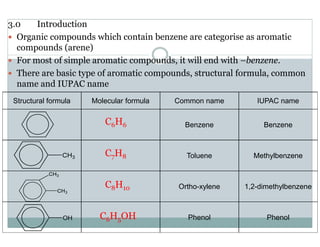
3.0 Introduction
Organic compounds which contain benzene are categorise as aromatic
compounds (arene)
For most of simple aromatic compounds, it will end with –benzene.
There are basic type of aromatic compounds, structural formula, common
name and IUPAC name
Structural formula Molecular formula Common name IUPAC name
Benzene Benzene
Toluene Methylbenzene
Ortho-xylene 1,2-dimethylbenzene
Phenol Phenol
C6H6
C7H8
C8H10
C6H5OH
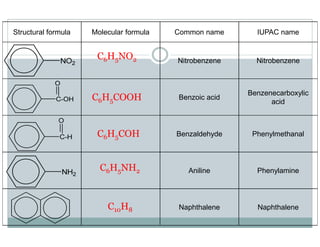
Structural formula Molecular formula Common name IUPAC name
Nitrobenzene Nitrobenzene
Benzoic acid
Benzenecarboxylic
acid
Benzaldehyde Phenylmethanal
Aniline Phenylamine
Naphthalene Naphthalene
C6H5NO2
C6H5COOH
C6H5COH
C6H5NH2
C10H8
3.1 Nomenclature of aromatic compounds
For simple aromatic compound, it is as describe in the table above
Benzene can also be considered as a branched group.
Branched benzene is called as phenyl (C6H5–)
When there are 2 or more substituents on benzene ring, 3 structural
isomers are possible. The substituents may be located by numbering the
atoms of the ring, or may be indicates by prefixes of ortho, meta, or para
Position of the 2 substituents in benzene ring
1,2-position [ortho (o)] 1,3-position [meta (m)] 1,4-position [para (p)]
1,2 – dichlorobenzene
ortho-dichlorobenzene
1,3 – dichlorobenzene
meta-dichlorobenzene
1,4 – dichlorobenzene
para-dichlorobenzene
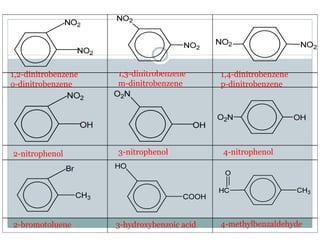
1,2-dinitrobenzene
o-dinitrobenzene
1,3-dinitrobenzene
m-dinitrobenzene
1,4-dinitrobenzene
p-dinitrobenzene
2-nitrophenol 3-nitrophenol 4-nitrophenol
2-bromotoluene 3-hydroxybenzoic acid 4-methylbenzaldehyde
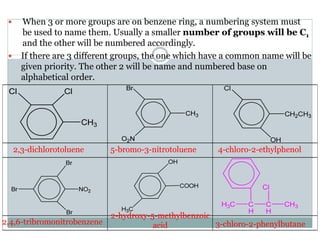
When 3 or more groups are on benzene ring, a numbering system must
be used to name them. Usually a smaller number of groups will be C1
and the other will be numbered accordingly.
If there are 3 different groups, the one which have a common name will be
given priority. The other 2 will be name and numbered base on
alphabetical order.
2,3-dichlorotoluene 5-bromo-3-nitrotoluene 4-chloro-2-ethylphenol
2,4,6-tribromonitrobenzene
2-hydroxy-5-methylbenzoic
acid 3-chloro-2-phenylbutane
3.2 Reaction of Benzene
Even though in benzene contain 3 double bonds, but as explained in
Kekule’s structure, it give an extra stability due to delocalised
ππππ – electrons in the ring and the resonance structure.
Thus, benzene usually undergoes substitution reaction instead of
addition reaction.
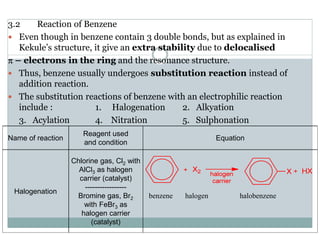
The substitution reactions of benzene with an electrophilic reaction
include : 1. Halogenation 2. Alkyation
3. Acylation 4. Nitration 5. Sulphonation
Name of reaction
Reagent used
and condition
Equation
Halogenation
Chlorine gas, Cl2 with
AlCl3 as halogen
carrier (catalyst)
-----------------
Bromine gas, Br2
with FeBr3 as
halogen carrier
(catalyst)
benzene halogen halobenzene
Name of reaction
Reagent used
and condition
Equation
Friedel – Crafts
Alkylation
Haloalkane (R – X)
with AlCl3 as
halogen carrier
(catalyst)
benzene haloalkane alkylbenzene
Friedel – Crafts
Acylation
Acyl chloride
with AlCl3 as
halogen carrier
(catalyst) benzene acyl chloride
Nitration
Concentrated
Nitric acid (HNO3)
catalysed by
concentrated
sulphuric acid and
reflux at 55oC
benzene nitric acid nitrobenzene
Sulphonation
Concentrated
sulphuric acid
(H2SO4) and heat at
55oC under reflux benzene sulphuric acid benzenesulphonic acid
3.2.1 Halogenation
Chlorine react with benzene under aluminium chloride as catalyst under
room condition
Bromine reacts with benzene only under the presence of catalyst iron (III)
bromide and some hear
The mechanism of halogenation of benzene
Step 1 : Formation of halogen ion (X+) as electrophile using
heterolytic fission reaction. In chlorine, aluminium chloride (electron
deficient compound) is readily to receive lone pair electron (act as
Lewis acid) from chlorine
Step 2 : Electrophilic attack on benzene ring to form a carbocation.
Cl+ ion attack the benzene ring and the delocalise π-electron form a C–Cl
bond in benzene. This will result a carbocation formed as intermediate and
disturb the ring (cause benzene ring become unstable)
Step 3 : Proton lost from carbocation. Carbocation transfers a
proton to [AlCl4]− and the benzene ring is stabilised back. This results in
the formation of chlorobenzene and HCl.
[As extra note, benzene also react with chlorine in the presence of UV and
some heat to form 1,2,3,4,5,6-hexachlorocyclohexane (addition reaction)]
Friedel–Crafts reaction
Similar to halogenation, Friedel – Crafts reaction also required a halogen
carrier to act as catalyst
Depending on the type of haloalkane used, the halogen carrier is also
different.
If chloroalkane (R–Cl) is used, the halogen carrier will be aluminium
chloride (AlCl3)
If bromoalkaane (R–Br) is used, the halogen carrier will be iron (III)
bromide (FeBr3)
3.2.2 Alkylation of Benzene
When chloroethane (CH3CH2Cl) react with benzene with the presence of
AlCl3, ethylbenzene is produced (C6H5–CH2CH3) under room temperature
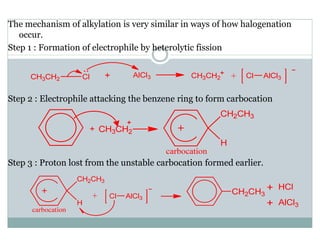
The mechanism of alkylation is very similar in ways of how halogenation
occur.
Step 1 : Formation of electrophile by heterolytic fission
Step 2 : Electrophile attacking the benzene ring to form carbocation
Step 3 : Proton lost from the unstable carbocation formed earlier.
3.2.3 Acylation of Benzene
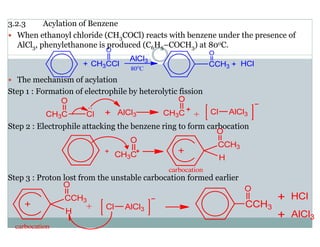
When ethanoyl chloride (CH3COCl) reacts with benzene under the presence of
AlCl3, phenylethanone is produced (C6H5–COCH3) at 80oC.
The mechanism of acylation
Step 1 : Formation of electrophile by heterolytic fission
Step 2 : Electrophile attacking the benzene ring to form carbocation
Step 3 : Proton lost from the unstable carbocation formed earlier
For nitration and sulphonation of benzene, halogen carrier is not used, as
the reagent used for the reaction is an acid. The mechanism of nitration
and sulphonation are also nearly similar to each other.
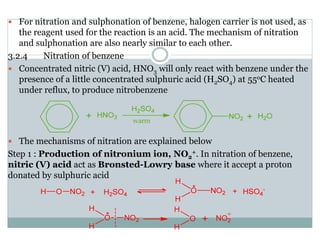
3.2.4 Nitration of benzene
Concentrated nitric (V) acid, HNO3 will only react with benzene under the
presence of a little concentrated sulphuric acid (H2SO4) at 55oC heated
under reflux, to produce nitrobenzene
The mechanisms of nitration are explained below
Step 1 : Production of nitronium ion, NO2
+. In nitration of benzene,
nitric (V) acid act as Bronsted-Lowry base where it accept a proton
donated by sulphuric acid
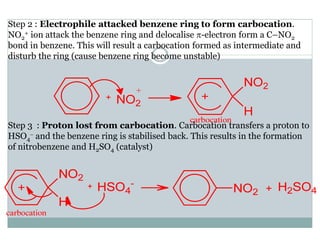
Step 2 : Electrophile attacked benzene ring to form carbocation.
NO2
+ ion attack the benzene ring and delocalise π-electron form a C–NO2
bond in benzene. This will result a carbocation formed as intermediate and
disturb the ring (cause benzene ring become unstable)
Step 3 : Proton lost from carbocation. Carbocation transfers a proton to
HSO4
− and the benzene ring is stabilised back. This results in the formation
of nitrobenzene and H2SO4 (catalyst)
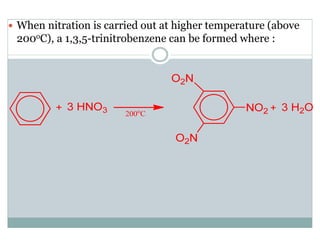
When nitration is carried out at higher temperature (above
200oC), a 1,3,5-trinitrobenzene can be formed where :
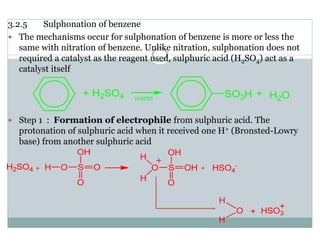
3.2.5 Sulphonation of benzene
The mechanisms occur for sulphonation of benzene is more or less the
same with nitration of benzene. Unlike nitration, sulphonation does not
required a catalyst as the reagent used, sulphuric acid (H2SO4) act as a
catalyst itself
Step 1 : Formation of electrophile from sulphuric acid. The
protonation of sulphuric acid when it received one H+ (Bronsted-Lowry
base) from another sulphuric acid
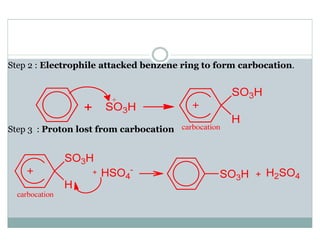
Step 2 : Electrophile attacked benzene ring to form carbocation.
Step 3 : Proton lost from carbocation
Other chemical reaction of benzene
Unlike alkene, benzene is stabilised by the delocalised π electrons. So, it
does not react easily as in alkene. For example, if benzene react with
acidified potassium manganate (VII), KMnO4 (H2SO4)
When react with hydrogen gas with presence of nickel as catalyst at 180oC,
it form cyclohexane. The reaction is an additional reaction.
benzene cyclohexane
Benzene also reacts with propene to give isopropylbenzene (well known as
cumene) which is a starting material to synthesis phenol. Concentrated
H3PO4 serve at catalyst under 250oC
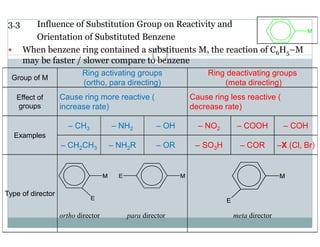
3.3 Influence of Substitution Group on Reactivity and
Orientation of Substituted Benzene
When benzene ring contained a substituents M, the reaction of C6H5–M
may be faster / slower compare to benzene
Group of M
Ring activating groups
(ortho, para directing)
Ring deactivating groups
(meta directing)
Effect of
groups
Cause ring more reactive (
increase rate)
Cause ring less reactive (
decrease rate)
Examples
– CH3 – NH2 – OH – NO2 – COOH – COH
– CH2CH3 – NH2R – OR – SO3H – COR –X (Cl, Br)
Type of director
ortho director para director meta director
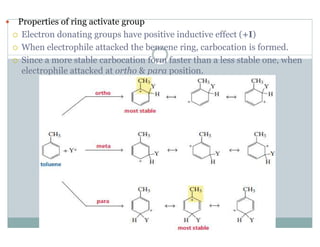
Properties of ring activate group
Electron donating groups have positive inductive effect (+I)
When electrophile attacked the benzene ring, carbocation is formed.
Since a more stable carbocation form faster than a less stable one, when
electrophile attacked at ortho & para position.
As discussed earlier, 3o carbocation is more stable than 2o carbocation.
Using resonance, it is possible for cation to reside at 3o carbon.
Since ortho / para position are more activated when a 30 carbocation
formed, it increase the rate of reaction
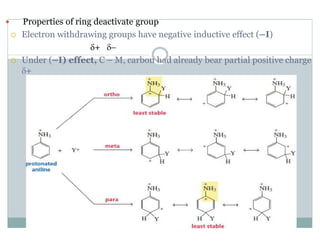
Properties of ring deactivate group
Electron withdrawing groups have negative inductive effect (–I)
δ+ δ−
Under (–I) effect, C – M, carbon had already bear partial positive charge
δ+
Unlike electron donating group, when the cation is placed at the directing
group of electron withdrawing group, it will tend to become unstable
So attacking at meta position is more stable than in ortho / para position.
Still, since in react much slower than in benzene, so electron
withdrawing group is to say deactivate benzene ring and cause the rate
of reaction decrease.
3.4 Reaction of methylbenzene
Methylbenzene resemble with benzene in many ways. As methylbenzene is
less toxic, is often used as reagent instead of benzene. Moreover, methyl
(CH3–) is ring activate group, it react faster and required lesser effort
(lower temperature, concentration electrophile) compare to benzene.
Unlike benzene, methylbenzene contain an aliphatic (CH3–) and aromatic
(C6H6). In other words, methylbenzene undergoes 2 distinctive type of
reaction :
⇒ reaction of the methyl group ⇒ reaction of the benzene ring
3.4.1 Reaction of the methyl group in methylbenzene
Name of
reaction
Reagent used
and condition
Equation
Oxidation of
methyl-
benzene
Acidified
potassium
manganate
(VII)
KMnO4 / H2SO4
*Observation : (1) purple colour of potassium manganate
(VII) decolourised when react with toluene
Acidified
potassium
dichromate (VI)
K2Cr2O7 /
H2SO4
+ H2
*Observation : Green colour of potassium dichromate (VI)
changed to orange colour
Chlorination
of
methylbenze
ne
Chlorine gas
under UV light
at room
temperature
* side product of reaction is HCl (g)
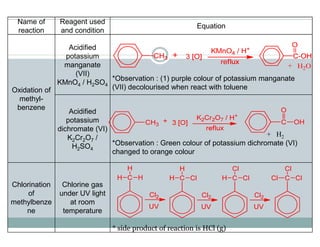
Methylbenzene reacts with strong oxidising agent such as acidified potassium
manganate (VII) [KMnO4 / H+] or acidified potassium dichromate (VI) [K2Cr2O7
/ H+] to form benzoic acid. This is a method to distinguish between
benzene and methylbenzene.
Under room temp, only H in methyl is substituted by Cl atom.
Step 1 : Initiation – Formation of Cl• (radical)
Step 2 : Propagation – Radical attack methylbenzene to form multiple form of
radical
Step 3 : Termination – chlorine radical react and methylbenzene radical
If temperature increases to 200oC, then, even the H inside benzene ring may
be substituted by Cl.
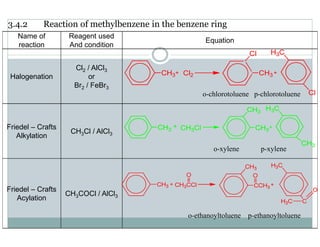
3.4.2 Reaction of methylbenzene in the benzene ring
Name of
reaction
Reagent used
And condition
Equation
Halogenation
Cl2 / AlCl3
or
Br2 / FeBr3
o-chlorotoluene p-chlorotoluene
Friedel – Crafts
Alkylation
CH3Cl / AlCl3
o-xylene p-xylene
Friedel – Crafts
Acylation
CH3COCl / AlCl3
o-ethanoyltoluene p-ethanoyltoluene
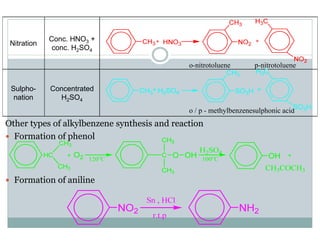
Other types of alkylbenzene synthesis and reaction
Formation of phenol
Formation of aniline
Nitration
Conc. HNO3 +
conc. H2SO4
o-nitrotoluene p-nitrotoluene
Sulpho-
nation
Concentrated
H2SO4
o / p - methylbenzenesulphonic acid
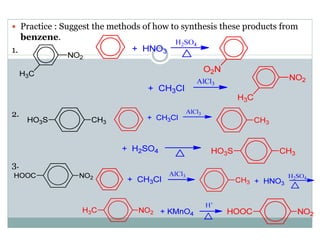
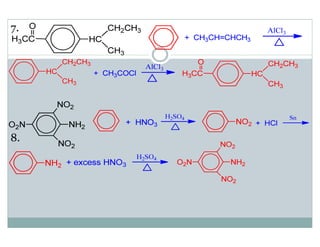
Practice : Suggest the methods of how to synthesis these products from
benzene.
1.
2.
3.
4.
5.
6.
7.
8.
Step 1 :H2SO4 + HNO3 NO2
+ + HSO4
- + H2O [1]
Reaction I is oxidation [1], where acidified potassium manganate (VII) [1]
under reflux [1]
Reaction II is free radical substitution reaction [1], where bromine gas [1]
under the presence of sunlight [1] is required
Reaction III is electrophilic aromatic substitution reaction [1], where bromine
gas react under the presence of iron (III) bromide [1]
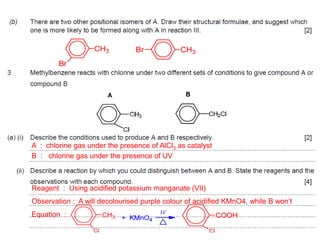
A : chlorine gas under the presence of AlCl3 as catalyst
B : chlorine gas under the presence of UV
Reagent : Using acidified potassium manganate (VII)
Observation : A will decolourised purple colour of acidified KMnO4, while B won’t
Equation :
HNO3 catalysed by H2SO4 under reflux
Acidified KMnO4 under reflux
HCl under Sn as catalyst
Step 1 :H2SO4 + HNO3 NO2
+ + HSO4
- + H2O [1]
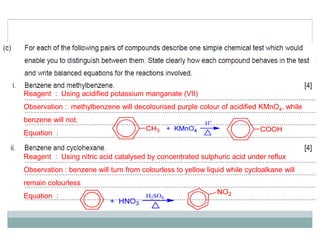
Reagent : Using acidified potassium manganate (VII)
Observation : methylbenzene will decolourised purple colour of acidified KMnO4, while
benzene will not.
Equation :
Reagent : Using nitric acid catalysed by concentrated sulphuric acid under reflux
Observation : benzene will turn from colourless to yellow liquid while cycloalkane will
remain colourless
Equation :

Organic Chemistry : Aromatic Compound (Benzene)

  • 1.
    Chemistry form 6 organicchemistry chapter 3 : benzene and its compound
  • 2.
    3.0 Introduction Organic compoundswhich contain benzene are categorise as aromatic compounds (arene) For most of simple aromatic compounds, it will end with –benzene. There are basic type of aromatic compounds, structural formula, common name and IUPAC name Structural formula Molecular formula Common name IUPAC name Benzene Benzene Toluene Methylbenzene Ortho-xylene 1,2-dimethylbenzene Phenol Phenol C6H6 C7H8 C8H10 C6H5OH
  • 3.
    Structural formula Molecularformula Common name IUPAC name Nitrobenzene Nitrobenzene Benzoic acid Benzenecarboxylic acid Benzaldehyde Phenylmethanal Aniline Phenylamine Naphthalene Naphthalene C6H5NO2 C6H5COOH C6H5COH C6H5NH2 C10H8
  • 4.
    3.1 Nomenclature ofaromatic compounds For simple aromatic compound, it is as describe in the table above Benzene can also be considered as a branched group. Branched benzene is called as phenyl (C6H5–) When there are 2 or more substituents on benzene ring, 3 structural isomers are possible. The substituents may be located by numbering the atoms of the ring, or may be indicates by prefixes of ortho, meta, or para Position of the 2 substituents in benzene ring 1,2-position [ortho (o)] 1,3-position [meta (m)] 1,4-position [para (p)] 1,2 – dichlorobenzene ortho-dichlorobenzene 1,3 – dichlorobenzene meta-dichlorobenzene 1,4 – dichlorobenzene para-dichlorobenzene
  • 5.
  • 6.
    When 3 ormore groups are on benzene ring, a numbering system must be used to name them. Usually a smaller number of groups will be C1 and the other will be numbered accordingly. If there are 3 different groups, the one which have a common name will be given priority. The other 2 will be name and numbered base on alphabetical order. 2,3-dichlorotoluene 5-bromo-3-nitrotoluene 4-chloro-2-ethylphenol 2,4,6-tribromonitrobenzene 2-hydroxy-5-methylbenzoic acid 3-chloro-2-phenylbutane
  • 7.
    3.2 Reaction ofBenzene Even though in benzene contain 3 double bonds, but as explained in Kekule’s structure, it give an extra stability due to delocalised ππππ – electrons in the ring and the resonance structure. Thus, benzene usually undergoes substitution reaction instead of addition reaction. The substitution reactions of benzene with an electrophilic reaction include : 1. Halogenation 2. Alkyation 3. Acylation 4. Nitration 5. Sulphonation Name of reaction Reagent used and condition Equation Halogenation Chlorine gas, Cl2 with AlCl3 as halogen carrier (catalyst) ----------------- Bromine gas, Br2 with FeBr3 as halogen carrier (catalyst) benzene halogen halobenzene
  • 8.
    Name of reaction Reagentused and condition Equation Friedel – Crafts Alkylation Haloalkane (R – X) with AlCl3 as halogen carrier (catalyst) benzene haloalkane alkylbenzene Friedel – Crafts Acylation Acyl chloride with AlCl3 as halogen carrier (catalyst) benzene acyl chloride Nitration Concentrated Nitric acid (HNO3) catalysed by concentrated sulphuric acid and reflux at 55oC benzene nitric acid nitrobenzene Sulphonation Concentrated sulphuric acid (H2SO4) and heat at 55oC under reflux benzene sulphuric acid benzenesulphonic acid
  • 9.
    3.2.1 Halogenation Chlorine reactwith benzene under aluminium chloride as catalyst under room condition Bromine reacts with benzene only under the presence of catalyst iron (III) bromide and some hear The mechanism of halogenation of benzene Step 1 : Formation of halogen ion (X+) as electrophile using heterolytic fission reaction. In chlorine, aluminium chloride (electron deficient compound) is readily to receive lone pair electron (act as Lewis acid) from chlorine
  • 10.
    Step 2 :Electrophilic attack on benzene ring to form a carbocation. Cl+ ion attack the benzene ring and the delocalise π-electron form a C–Cl bond in benzene. This will result a carbocation formed as intermediate and disturb the ring (cause benzene ring become unstable) Step 3 : Proton lost from carbocation. Carbocation transfers a proton to [AlCl4]− and the benzene ring is stabilised back. This results in the formation of chlorobenzene and HCl.
  • 11.
    [As extra note,benzene also react with chlorine in the presence of UV and some heat to form 1,2,3,4,5,6-hexachlorocyclohexane (addition reaction)]
  • 12.
    Friedel–Crafts reaction Similar tohalogenation, Friedel – Crafts reaction also required a halogen carrier to act as catalyst Depending on the type of haloalkane used, the halogen carrier is also different. If chloroalkane (R–Cl) is used, the halogen carrier will be aluminium chloride (AlCl3) If bromoalkaane (R–Br) is used, the halogen carrier will be iron (III) bromide (FeBr3) 3.2.2 Alkylation of Benzene When chloroethane (CH3CH2Cl) react with benzene with the presence of AlCl3, ethylbenzene is produced (C6H5–CH2CH3) under room temperature
  • 13.
    The mechanism ofalkylation is very similar in ways of how halogenation occur. Step 1 : Formation of electrophile by heterolytic fission Step 2 : Electrophile attacking the benzene ring to form carbocation Step 3 : Proton lost from the unstable carbocation formed earlier.
  • 14.
    3.2.3 Acylation ofBenzene When ethanoyl chloride (CH3COCl) reacts with benzene under the presence of AlCl3, phenylethanone is produced (C6H5–COCH3) at 80oC. The mechanism of acylation Step 1 : Formation of electrophile by heterolytic fission Step 2 : Electrophile attacking the benzene ring to form carbocation Step 3 : Proton lost from the unstable carbocation formed earlier
  • 15.
    For nitration andsulphonation of benzene, halogen carrier is not used, as the reagent used for the reaction is an acid. The mechanism of nitration and sulphonation are also nearly similar to each other. 3.2.4 Nitration of benzene Concentrated nitric (V) acid, HNO3 will only react with benzene under the presence of a little concentrated sulphuric acid (H2SO4) at 55oC heated under reflux, to produce nitrobenzene The mechanisms of nitration are explained below Step 1 : Production of nitronium ion, NO2 +. In nitration of benzene, nitric (V) acid act as Bronsted-Lowry base where it accept a proton donated by sulphuric acid
  • 16.
    Step 2 :Electrophile attacked benzene ring to form carbocation. NO2 + ion attack the benzene ring and delocalise π-electron form a C–NO2 bond in benzene. This will result a carbocation formed as intermediate and disturb the ring (cause benzene ring become unstable) Step 3 : Proton lost from carbocation. Carbocation transfers a proton to HSO4 − and the benzene ring is stabilised back. This results in the formation of nitrobenzene and H2SO4 (catalyst)
  • 17.
    When nitration iscarried out at higher temperature (above 200oC), a 1,3,5-trinitrobenzene can be formed where :
  • 18.
    3.2.5 Sulphonation ofbenzene The mechanisms occur for sulphonation of benzene is more or less the same with nitration of benzene. Unlike nitration, sulphonation does not required a catalyst as the reagent used, sulphuric acid (H2SO4) act as a catalyst itself Step 1 : Formation of electrophile from sulphuric acid. The protonation of sulphuric acid when it received one H+ (Bronsted-Lowry base) from another sulphuric acid
  • 19.
    Step 2 :Electrophile attacked benzene ring to form carbocation. Step 3 : Proton lost from carbocation
  • 20.
    Other chemical reactionof benzene Unlike alkene, benzene is stabilised by the delocalised π electrons. So, it does not react easily as in alkene. For example, if benzene react with acidified potassium manganate (VII), KMnO4 (H2SO4) When react with hydrogen gas with presence of nickel as catalyst at 180oC, it form cyclohexane. The reaction is an additional reaction. benzene cyclohexane Benzene also reacts with propene to give isopropylbenzene (well known as cumene) which is a starting material to synthesis phenol. Concentrated H3PO4 serve at catalyst under 250oC
  • 21.
    3.3 Influence ofSubstitution Group on Reactivity and Orientation of Substituted Benzene When benzene ring contained a substituents M, the reaction of C6H5–M may be faster / slower compare to benzene Group of M Ring activating groups (ortho, para directing) Ring deactivating groups (meta directing) Effect of groups Cause ring more reactive ( increase rate) Cause ring less reactive ( decrease rate) Examples – CH3 – NH2 – OH – NO2 – COOH – COH – CH2CH3 – NH2R – OR – SO3H – COR –X (Cl, Br) Type of director ortho director para director meta director
  • 22.
    Properties of ringactivate group Electron donating groups have positive inductive effect (+I) When electrophile attacked the benzene ring, carbocation is formed. Since a more stable carbocation form faster than a less stable one, when electrophile attacked at ortho & para position.
  • 23.
    As discussed earlier,3o carbocation is more stable than 2o carbocation. Using resonance, it is possible for cation to reside at 3o carbon. Since ortho / para position are more activated when a 30 carbocation formed, it increase the rate of reaction
  • 24.
    Properties of ringdeactivate group Electron withdrawing groups have negative inductive effect (–I) δ+ δ− Under (–I) effect, C – M, carbon had already bear partial positive charge δ+
  • 25.
    Unlike electron donatinggroup, when the cation is placed at the directing group of electron withdrawing group, it will tend to become unstable So attacking at meta position is more stable than in ortho / para position. Still, since in react much slower than in benzene, so electron withdrawing group is to say deactivate benzene ring and cause the rate of reaction decrease.
  • 26.
    3.4 Reaction ofmethylbenzene Methylbenzene resemble with benzene in many ways. As methylbenzene is less toxic, is often used as reagent instead of benzene. Moreover, methyl (CH3–) is ring activate group, it react faster and required lesser effort (lower temperature, concentration electrophile) compare to benzene. Unlike benzene, methylbenzene contain an aliphatic (CH3–) and aromatic (C6H6). In other words, methylbenzene undergoes 2 distinctive type of reaction : ⇒ reaction of the methyl group ⇒ reaction of the benzene ring 3.4.1 Reaction of the methyl group in methylbenzene
  • 27.
    Name of reaction Reagent used andcondition Equation Oxidation of methyl- benzene Acidified potassium manganate (VII) KMnO4 / H2SO4 *Observation : (1) purple colour of potassium manganate (VII) decolourised when react with toluene Acidified potassium dichromate (VI) K2Cr2O7 / H2SO4 + H2 *Observation : Green colour of potassium dichromate (VI) changed to orange colour Chlorination of methylbenze ne Chlorine gas under UV light at room temperature * side product of reaction is HCl (g)
  • 28.
    Methylbenzene reacts withstrong oxidising agent such as acidified potassium manganate (VII) [KMnO4 / H+] or acidified potassium dichromate (VI) [K2Cr2O7 / H+] to form benzoic acid. This is a method to distinguish between benzene and methylbenzene. Under room temp, only H in methyl is substituted by Cl atom. Step 1 : Initiation – Formation of Cl• (radical) Step 2 : Propagation – Radical attack methylbenzene to form multiple form of radical Step 3 : Termination – chlorine radical react and methylbenzene radical If temperature increases to 200oC, then, even the H inside benzene ring may be substituted by Cl.
  • 29.
    3.4.2 Reaction ofmethylbenzene in the benzene ring Name of reaction Reagent used And condition Equation Halogenation Cl2 / AlCl3 or Br2 / FeBr3 o-chlorotoluene p-chlorotoluene Friedel – Crafts Alkylation CH3Cl / AlCl3 o-xylene p-xylene Friedel – Crafts Acylation CH3COCl / AlCl3 o-ethanoyltoluene p-ethanoyltoluene
  • 30.
    Other types ofalkylbenzene synthesis and reaction Formation of phenol Formation of aniline Nitration Conc. HNO3 + conc. H2SO4 o-nitrotoluene p-nitrotoluene Sulpho- nation Concentrated H2SO4 o / p - methylbenzenesulphonic acid
  • 31.
    Practice : Suggestthe methods of how to synthesis these products from benzene. 1. 2. 3.
  • 32.
  • 33.
  • 34.
    Step 1 :H2SO4+ HNO3 NO2 + + HSO4 - + H2O [1]
  • 35.
    Reaction I isoxidation [1], where acidified potassium manganate (VII) [1] under reflux [1] Reaction II is free radical substitution reaction [1], where bromine gas [1] under the presence of sunlight [1] is required Reaction III is electrophilic aromatic substitution reaction [1], where bromine gas react under the presence of iron (III) bromide [1]
  • 36.
    A : chlorinegas under the presence of AlCl3 as catalyst B : chlorine gas under the presence of UV Reagent : Using acidified potassium manganate (VII) Observation : A will decolourised purple colour of acidified KMnO4, while B won’t Equation :
  • 38.
    HNO3 catalysed byH2SO4 under reflux Acidified KMnO4 under reflux HCl under Sn as catalyst Step 1 :H2SO4 + HNO3 NO2 + + HSO4 - + H2O [1]
  • 39.
    Reagent : Usingacidified potassium manganate (VII) Observation : methylbenzene will decolourised purple colour of acidified KMnO4, while benzene will not. Equation : Reagent : Using nitric acid catalysed by concentrated sulphuric acid under reflux Observation : benzene will turn from colourless to yellow liquid while cycloalkane will remain colourless Equation :