
Dr. Pranabjyoti Das
Arunodoi Jr College
Tangla
Class 10
Gen. Science
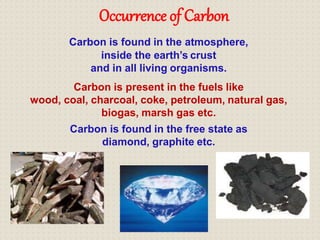
Carbon is found in the atmosphere,
inside the earth’s crust
and in all living organisms.
Carbon is present in the fuels like
wood, coal, charcoal, coke, petroleum, natural gas,
biogas, marsh gas etc.
Carbon is found in the free state as
diamond, graphite etc.
Occurrence of Carbon
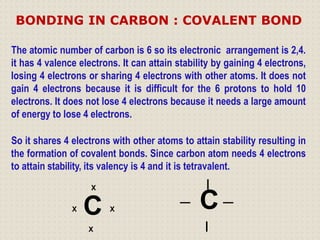
The atomic number of carbon is 6 so its electronic arrangement is 2,4.
it has 4 valence electrons. It can attain stability by gaining 4 electrons,
losing 4 electrons or sharing 4 electrons with other atoms. It does not
gain 4 electrons because it is difficult for the 6 protons to hold 10
electrons. It does not lose 4 electrons because it needs a large amount
of energy to lose 4 electrons.
So it shares 4 electrons with other atoms to attain stability resulting in
the formation of covalent bonds. Since carbon atom needs 4 electrons
to attain stability, its valency is 4 and it is tetravalent.
X
C
X
X X
I
_
C _
I
BONDING IN CARBON : COVALENT BOND
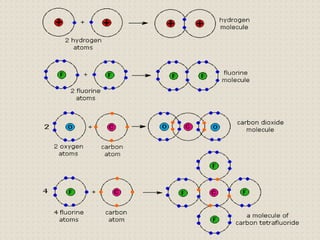
Covalent bond is a chemical bond formed by the sharing of
electrons between atoms. The sharing of one pair of electrons
results in the formation of single covalent bond.
Similarly sharing of two pairs of electrons results in the
formation of double covalent bond and sharing of three pairs of
electrons results in the formation of triple covalent bond.
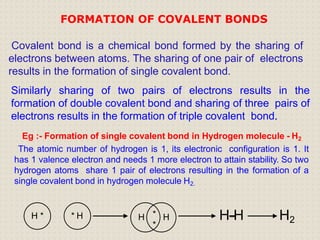
Eg :- Formation of single covalent bond in Hydrogen molecule - H2
The atomic number of hydrogen is 1, its electronic configuration is 1. It
has 1 valence electron and needs 1 more electron to attain stability. So two
hydrogen atoms share 1 pair of electrons resulting in the formation of a
single covalent bond in hydrogen molecule H2.
H * * H H H
*
*
H H H2
FORMATION OF COVALENT BONDS
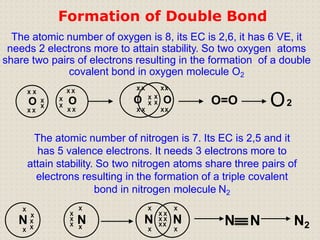
The atomic number of nitrogen is 7. Its EC is 2,5 and it
has 5 valence electrons. It needs 3 electrons more to
attain stability. So two nitrogen atoms share three pairs of
electrons resulting in the formation of a triple covalent
bond in nitrogen molecule N2
The atomic number of oxygen is 8, its EC is 2,6, it has 6 VE, it
needs 2 electrons more to attain stability. So two oxygen atoms
share two pairs of electrons resulting in the formation of a double
covalent bond in oxygen molecule O2
X X
O
X X
X
X
X X
O
X X
X
X
X X
O
X X
X X
X X
XX
O
XX
O=O
N
X
N
X
X
X
X
X
X
X
X
X
X
N
X
X
N
X
X X
X X
XX
2
N N N2
O
Formation of Double Bond
H
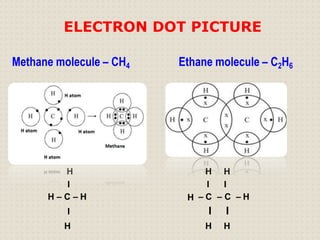
Methane molecule – CH4 Ethane molecule – C2H6
H H H
I
H – C – H H
I
– C
I
– C – H
I I I
H H H
ELECTRON DOT PICTURE
1) Carbon atoms can binds with other carbon atoms to form long,
branched chains or closed rings (Chains). This property is called as
catenation property of carbon
2) Since the valency of carbon is 4, it can form bonds with other carbon
atoms or with atoms of other elements like hydrogen, oxygen,
nitrogen, halogens etc.
I I I I I I
C – C – C – C – C – C
I I I I I I
C – C – C – C C
C
C
C
I I I I
_
C
_
I
C
Long chain
Branched chain Closed ring
I I I I C
_
_
_ _
Carbon forms a very large number of compounds. The number of
carbon compounds is more than three million. It is more than the
number of compounds formed by all other elements. This is because
VARSETILE NATURE OF CARBON
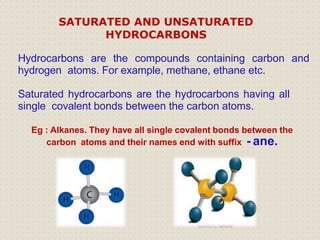
Hydrocarbons are the compounds containing carbon and
hydrogen atoms. For example, methane, ethane etc.
Saturated hydrocarbons are the hydrocarbons having all
single covalent bonds between the carbon atoms.
Eg : Alkanes. They have all single covalent bonds between the
carbon atoms and their names end with suffix - ane.
SATURATED AND UNSATURATED
HYDROCARBONS
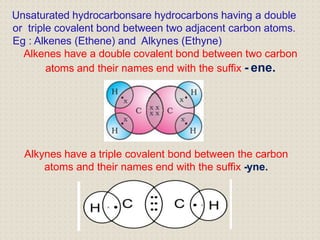
Unsaturated hydrocarbonsare hydrocarbons having a double
or triple covalent bond between two adjacent carbon atoms.
Eg : Alkenes (Ethene) and Alkynes (Ethyne)
Alkenes have a double covalent bond between two carbon
atoms and their names end with the suffix - ene.
Alkynes have a triple covalent bond between the carbon
atoms and their names end with the suffix -yne.
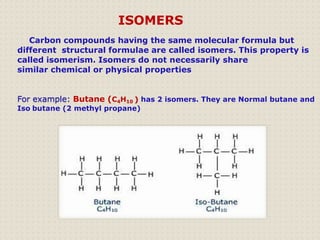
Carbon compounds having the same molecular formula but
different structural formulae are called isomers. This property is
called isomerism. Isomers do not necessarily share
similar chemical or physical properties
For example: Butane (C4H10 ) has 2 isomers. They are Normal butane and
Iso butane (2 methyl propane)
ISOMERS
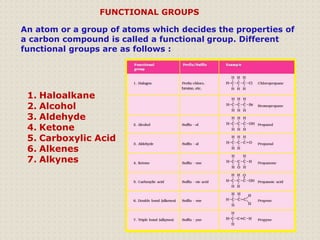
An atom or a group of atoms which decides the properties of
a carbon compound is called a functional group. Different
functional groups are as follows :
1. Haloalkane
2. Alcohol
3. Aldehyde
4. Ketone
5. Carboxylic Acid
6. Alkenes
7. Alkynes
FUNCTIONAL GROUPS
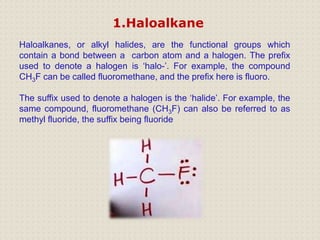
Haloalkanes, or alkyl halides, are the functional groups which
contain a bond between a carbon atom and a halogen. The prefix
used to denote a halogen is ‘halo-’. For example, the compound
CH3F can be called fluoromethane, and the prefix here is fluoro.
The suffix used to denote a halogen is the ‘halide’. For example, the
same compound, fluoromethane (CH3F) can also be referred to as
methyl fluoride, the suffix being fluoride
1.Haloalkane
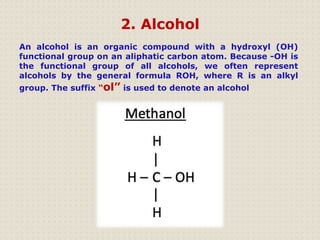
2. Alcohol
An alcohol is an organic compound with a hydroxyl (OH)
functional group on an aliphatic carbon atom. Because -OH is
the functional group of all alcohols, we often represent
alcohols by the general formula ROH, where R is an alkyl
group. The suffix “ol” is used to denote an alcohol
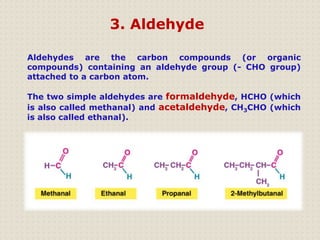
3. Aldehyde
Aldehydes are the carbon compounds (or organic
compounds) containing an aldehyde group (- CHO group)
attached to a carbon atom.
The two simple aldehydes are formaldehyde, HCHO (which
is also called methanal) and acetaldehyde, CH3CHO (which
is also called ethanal).
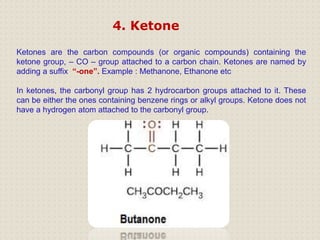
4. Ketone
Ketones are the carbon compounds (or organic compounds) containing the
ketone group, – CO – group attached to a carbon chain. Ketones are named by
adding a suffix “-one”. Example : Methanone, Ethanone etc
In ketones, the carbonyl group has 2 hydrocarbon groups attached to it. These
can be either the ones containing benzene rings or alkyl groups. Ketone does not
have a hydrogen atom attached to the carbonyl group.
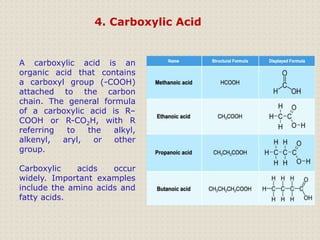
4. Carboxylic Acid
A carboxylic acid is an
organic acid that contains
a carboxyl group (-COOH)
attached to the carbon
chain. The general formula
of a carboxylic acid is R–
COOH or R-CO2H, with R
referring to the alkyl,
alkenyl, aryl, or other
group.
Carboxylic acids occur
widely. Important examples
include the amino acids and
fatty acids.
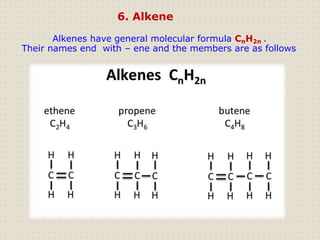
Alkenes have general molecular formula CnH2n .
Their names end with – ene and the members are as follows
6. Alkene
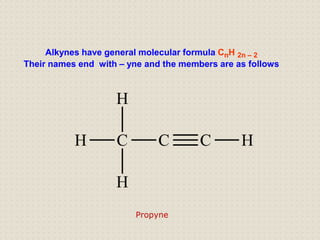
Alkynes have general molecular formula CnH 2n – 2
Their names end with – yne and the members are as follows
Propyne
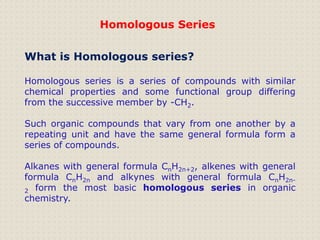
Homologous Series
What is Homologous series?
Homologous series is a series of compounds with similar
chemical properties and some functional group differing
from the successive member by -CH2.
Such organic compounds that vary from one another by a
repeating unit and have the same general formula form a
series of compounds.
Alkanes with general formula CnH2n+2, alkenes with general
formula CnH2n and alkynes with general formula CnH2n-
2 form the most basic homologous series in organic
chemistry.
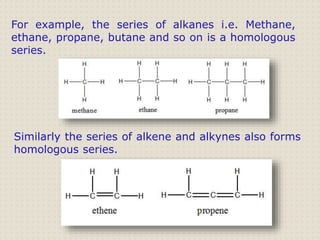
For example, the series of alkanes i.e. Methane,
ethane, propane, butane and so on is a homologous
series.
Similarly the series of alkene and alkynes also forms
homologous series.
Characteristics of a homologous series are:
(i) Each member of the series can be represented by a general
formula.
(ii) All the members of the series can be prepared by the same
general methods.
(iii) Physical properties changes throughout the series in a
regular way.
(iv) Members of homologous series have similar chemical
properties.
To Identify the number of carbon atoms in compound
• A saturated carbon compound containing one carbon atom will
be named as Methane
• Two carbon atom as Ethane
• Three carbon atom as Propane
• Four carbon atom as Butane
• Five carbon atom as Pentane
Similarly, an unsaturated carbon compound containing
Two carbon atom as Ethene or Ethyne
• Three carbon atom as Propene or Propyne
• Four carbon atom as Butene or Butyne
• Five carbon atom as Pentene or Pantyne
Nomenclature of Carbon compounds
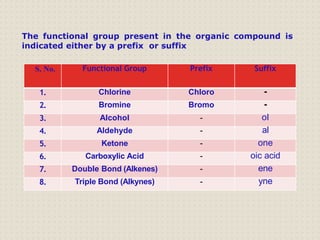
S. No. Functional Group Prefix Suffix
1. Chlorine Chloro -
2. Bromine Bromo -
3. Alcohol - ol
4. Aldehyde - al
5. Ketone - one
6. Carboxylic Acid - oic acid
7. Double Bond (Alkenes) - ene
8. Triple Bond (Alkynes) - yne
The functional group present in the organic compound is
indicated either by a prefix or suffix
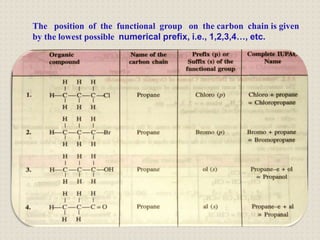
The position of the functional group on the carbon chain is given
by the lowest possible numerical prefix, i.e., 1,2,3,4…, etc.
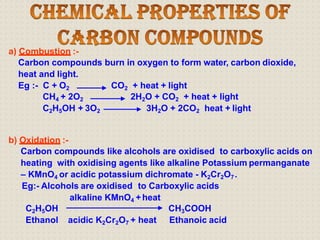
a) Combustion :-
Carbon compounds burn in oxygen to form water, carbon dioxide,
heat and light.
Eg :- C + O2
CH4 + 2O2
C2H5OH + 3O2
CO2 + heat + light
2H2O + CO2 + heat + light
3H2O + 2CO2 heat + light
b) Oxidation :-
Carbon compounds like alcohols are oxidised to carboxylic acids on
heating with oxidising agents like alkaline Potassium permanganate
– KMnO4 or acidic potassium dichromate - K2Cr2O7.
Eg:- Alcohols are oxidised to Carboxylic acids
alkaline KMnO4 +heat
C2H5OH
Ethanol acidic K2Cr2O7 + heat
CH3COOH
Ethanoic acid
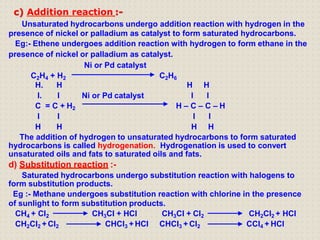
c) Addition reaction :-
Unsaturated hydrocarbons undergo addition reaction with hydrogen in the
presence of nickel or palladium as catalyst to form saturated hydrocarbons.
Eg:- Ethene undergoes addition reaction with hydrogen to form ethane in the
presence of nickel or palladium as catalyst.
Ni or Pd catalyst
C2H4 + H2 C2H6
H. H
I. I Ni or Pd catalyst
H H
I I
C = C + H2 H – C – C – H
I I
H H
I I
H H
The addition of hydrogen to unsaturated hydrocarbons to form saturated
hydrocarbons is called hydrogenation. Hydrogenation is used to convert
unsaturated oils and fats to saturated oils and fats.
d) Substitution reaction :-
Saturated hydrocarbons undergo substitution reaction with halogens to
form substitution products.
Eg :- Methane undergoes substitution reaction with chlorine in the presence
of sunlight to form substitution products.
CH4 + Cl2
CH2Cl2 +Cl2
CH3Cl + HCl
CHCI3 +HCl
CH3Cl + Cl2
CHCI3 + Cl2
CH2Cl2 + HCl
CCl4 + HCl
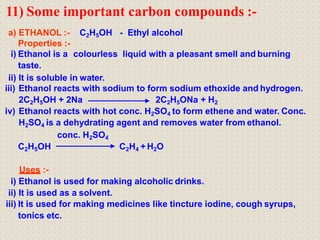
11) Some important carbon compounds :-
a) ETHANOL :- C2H5OH - Ethyl alcohol
Properties :-
i) Ethanol is a colourless liquid with a pleasant smell and burning
taste.
ii) It is soluble in water.
iii) Ethanol reacts with sodium to form sodium ethoxide and hydrogen.
2C2H5OH + 2Na 2C2H5ONa + H2
iv) Ethanol reacts with hot conc. H2SO4 to form ethene and water. Conc.
H2SO4 is a dehydrating agent and removes water from ethanol.
conc. H2SO4
C2H5OH C2H4 + H2O
Uses :-
i) Ethanol is used for making alcoholic drinks.
ii) It is used as a solvent.
iii) It is used for making medicines like tincture iodine, cough syrups,
tonics etc.
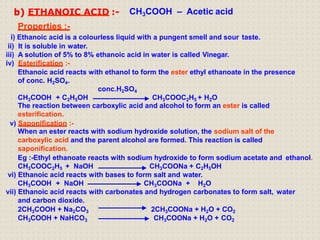
b) ETHANOIC ACID :- CH3COOH – Acetic acid
Properties :-
i) Ethanoic acid is a colourless liquid with a pungent smell and sour taste.
ii) It is soluble in water.
iii) A solution of 5% to 8% ethanoic acid in water is called Vinegar.
iv) Esterification :-
Ethanoic acid reacts with ethanol to form the ester ethyl ethanoate in the presence
of conc. H2SO4.
conc.H2SO4
CH3COOH + C2H5OH CH3COOC2H5 + H2O
The reaction between carboxylic acid and alcohol to form an ester is called
esterification.
v) Saponification :-
When an ester reacts with sodium hydroxide solution, the sodium salt of the
carboxylic acid and the parent alcohol are formed. This reaction is called
saponification.
Eg :-Ethyl ethanoate reacts with sodium hydroxide to form sodium acetate and ethanol.
CH3COOC2H5 + NaOH CH3COONa + C2H5OH
vi) Ethanoic acid reacts with bases to form salt and water.
CH3COOH + NaOH CH3COONa + H2O
vii) Ethanoic acid reacts with carbonates and hydrogen carbonates to form salt, water
and carbon dioxide.
2CH3COOH + Na2CO3
CH3COOH + NaHCO3
2CH3COONa + H2O + CO2
CH3COONa + H2O + CO2
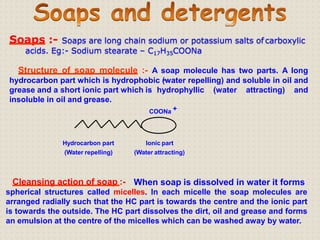
Soaps :- Soaps are long chain sodium or potassium salts of carboxylic
acids. Eg:- Sodium stearate – C17H35COONa
Structure of soap molecule :- A soap molecule has two parts. A long
hydrocarbon part which is hydrophobic (water repelling) and soluble in oil and
grease and a short ionic part which is hydrophyllic (water attracting) and
insoluble in oil and grease.
COONa +
Hydrocarbon part
(Water repelling)
Ionic part
(Water attracting)
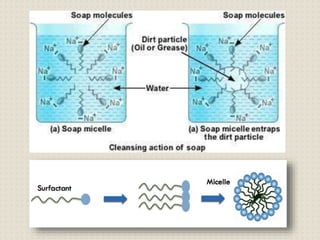
Cleansing action of soap :- When soap is dissolved in water it forms
spherical structures called micelles. In each micelle the soap molecules are
arranged radially such that the HC part is towards the centre and the ionic part
is towards the outside. The HC part dissolves the dirt, oil and grease and forms
an emulsion at the centre of the micelles which can be washed away by water.
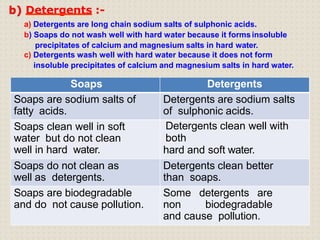
b) Detergents :-
a) Detergents are long chain sodium salts of sulphonic acids.
b) Soaps do not wash well with hard water because it formsinsoluble
precipitates of calcium and magnesium salts in hard water.
c) Detergents wash well with hard water because it does not form
insoluble precipitates of calcium and magnesium salts in hard water.
Soaps Detergents
Soaps are sodium salts of
fatty acids.
Detergents are sodium salts
of sulphonic acids.
Soaps clean well in soft
water but do not clean
well in hard water.
Detergents clean well with
both
hard and soft water.
Soaps do not clean as
well as detergents.
Detergents clean better
than soaps.
Soaps are biodegradable
and do not cause pollution.
Some detergents are
non biodegradable
and cause pollution.
Class 10 (Gen. Science)
Carbon and Its Compounds
Dr. Pranabjyoti Das
Arunodoi Jr. College
Tangla

Carbon and Its Compound

  • 1.
    Dr. Pranabjyoti Das ArunodoiJr College Tangla Class 10 Gen. Science
  • 2.
    Carbon is foundin the atmosphere, inside the earth’s crust and in all living organisms. Carbon is present in the fuels like wood, coal, charcoal, coke, petroleum, natural gas, biogas, marsh gas etc. Carbon is found in the free state as diamond, graphite etc. Occurrence of Carbon
  • 3.
    The atomic numberof carbon is 6 so its electronic arrangement is 2,4. it has 4 valence electrons. It can attain stability by gaining 4 electrons, losing 4 electrons or sharing 4 electrons with other atoms. It does not gain 4 electrons because it is difficult for the 6 protons to hold 10 electrons. It does not lose 4 electrons because it needs a large amount of energy to lose 4 electrons. So it shares 4 electrons with other atoms to attain stability resulting in the formation of covalent bonds. Since carbon atom needs 4 electrons to attain stability, its valency is 4 and it is tetravalent. X C X X X I _ C _ I BONDING IN CARBON : COVALENT BOND
  • 4.
    Covalent bond isa chemical bond formed by the sharing of electrons between atoms. The sharing of one pair of electrons results in the formation of single covalent bond. Similarly sharing of two pairs of electrons results in the formation of double covalent bond and sharing of three pairs of electrons results in the formation of triple covalent bond. Eg :- Formation of single covalent bond in Hydrogen molecule - H2 The atomic number of hydrogen is 1, its electronic configuration is 1. It has 1 valence electron and needs 1 more electron to attain stability. So two hydrogen atoms share 1 pair of electrons resulting in the formation of a single covalent bond in hydrogen molecule H2. H * * H H H * * H H H2 FORMATION OF COVALENT BONDS
  • 5.
    The atomic numberof nitrogen is 7. Its EC is 2,5 and it has 5 valence electrons. It needs 3 electrons more to attain stability. So two nitrogen atoms share three pairs of electrons resulting in the formation of a triple covalent bond in nitrogen molecule N2 The atomic number of oxygen is 8, its EC is 2,6, it has 6 VE, it needs 2 electrons more to attain stability. So two oxygen atoms share two pairs of electrons resulting in the formation of a double covalent bond in oxygen molecule O2 X X O X X X X X X O X X X X X X O X X X X X X XX O XX O=O N X N X X X X X X X X X X N X X N X X X X X XX 2 N N N2 O Formation of Double Bond
  • 7.
    H Methane molecule –CH4 Ethane molecule – C2H6 H H H I H – C – H H I – C I – C – H I I I H H H ELECTRON DOT PICTURE
  • 8.
    1) Carbon atomscan binds with other carbon atoms to form long, branched chains or closed rings (Chains). This property is called as catenation property of carbon 2) Since the valency of carbon is 4, it can form bonds with other carbon atoms or with atoms of other elements like hydrogen, oxygen, nitrogen, halogens etc. I I I I I I C – C – C – C – C – C I I I I I I C – C – C – C C C C C I I I I _ C _ I C Long chain Branched chain Closed ring I I I I C _ _ _ _ Carbon forms a very large number of compounds. The number of carbon compounds is more than three million. It is more than the number of compounds formed by all other elements. This is because VARSETILE NATURE OF CARBON
  • 9.
    Hydrocarbons are thecompounds containing carbon and hydrogen atoms. For example, methane, ethane etc. Saturated hydrocarbons are the hydrocarbons having all single covalent bonds between the carbon atoms. Eg : Alkanes. They have all single covalent bonds between the carbon atoms and their names end with suffix - ane. SATURATED AND UNSATURATED HYDROCARBONS
  • 10.
    Unsaturated hydrocarbonsare hydrocarbonshaving a double or triple covalent bond between two adjacent carbon atoms. Eg : Alkenes (Ethene) and Alkynes (Ethyne) Alkenes have a double covalent bond between two carbon atoms and their names end with the suffix - ene. Alkynes have a triple covalent bond between the carbon atoms and their names end with the suffix -yne.
  • 11.
    Carbon compounds havingthe same molecular formula but different structural formulae are called isomers. This property is called isomerism. Isomers do not necessarily share similar chemical or physical properties For example: Butane (C4H10 ) has 2 isomers. They are Normal butane and Iso butane (2 methyl propane) ISOMERS
  • 12.
    An atom ora group of atoms which decides the properties of a carbon compound is called a functional group. Different functional groups are as follows : 1. Haloalkane 2. Alcohol 3. Aldehyde 4. Ketone 5. Carboxylic Acid 6. Alkenes 7. Alkynes FUNCTIONAL GROUPS
  • 13.
    Haloalkanes, or alkylhalides, are the functional groups which contain a bond between a carbon atom and a halogen. The prefix used to denote a halogen is ‘halo-’. For example, the compound CH3F can be called fluoromethane, and the prefix here is fluoro. The suffix used to denote a halogen is the ‘halide’. For example, the same compound, fluoromethane (CH3F) can also be referred to as methyl fluoride, the suffix being fluoride 1.Haloalkane
  • 14.
    2. Alcohol An alcoholis an organic compound with a hydroxyl (OH) functional group on an aliphatic carbon atom. Because -OH is the functional group of all alcohols, we often represent alcohols by the general formula ROH, where R is an alkyl group. The suffix “ol” is used to denote an alcohol
  • 15.
    3. Aldehyde Aldehydes arethe carbon compounds (or organic compounds) containing an aldehyde group (- CHO group) attached to a carbon atom. The two simple aldehydes are formaldehyde, HCHO (which is also called methanal) and acetaldehyde, CH3CHO (which is also called ethanal).
  • 16.
    4. Ketone Ketones arethe carbon compounds (or organic compounds) containing the ketone group, – CO – group attached to a carbon chain. Ketones are named by adding a suffix “-one”. Example : Methanone, Ethanone etc In ketones, the carbonyl group has 2 hydrocarbon groups attached to it. These can be either the ones containing benzene rings or alkyl groups. Ketone does not have a hydrogen atom attached to the carbonyl group.
  • 17.
    4. Carboxylic Acid Acarboxylic acid is an organic acid that contains a carboxyl group (-COOH) attached to the carbon chain. The general formula of a carboxylic acid is R– COOH or R-CO2H, with R referring to the alkyl, alkenyl, aryl, or other group. Carboxylic acids occur widely. Important examples include the amino acids and fatty acids.
  • 18.
    Alkenes have generalmolecular formula CnH2n . Their names end with – ene and the members are as follows 6. Alkene
  • 19.
    Alkynes have generalmolecular formula CnH 2n – 2 Their names end with – yne and the members are as follows Propyne
  • 20.
    Homologous Series What isHomologous series? Homologous series is a series of compounds with similar chemical properties and some functional group differing from the successive member by -CH2. Such organic compounds that vary from one another by a repeating unit and have the same general formula form a series of compounds. Alkanes with general formula CnH2n+2, alkenes with general formula CnH2n and alkynes with general formula CnH2n- 2 form the most basic homologous series in organic chemistry.
  • 21.
    For example, theseries of alkanes i.e. Methane, ethane, propane, butane and so on is a homologous series. Similarly the series of alkene and alkynes also forms homologous series.
  • 22.
    Characteristics of ahomologous series are: (i) Each member of the series can be represented by a general formula. (ii) All the members of the series can be prepared by the same general methods. (iii) Physical properties changes throughout the series in a regular way. (iv) Members of homologous series have similar chemical properties.
  • 23.
    To Identify thenumber of carbon atoms in compound • A saturated carbon compound containing one carbon atom will be named as Methane • Two carbon atom as Ethane • Three carbon atom as Propane • Four carbon atom as Butane • Five carbon atom as Pentane Similarly, an unsaturated carbon compound containing Two carbon atom as Ethene or Ethyne • Three carbon atom as Propene or Propyne • Four carbon atom as Butene or Butyne • Five carbon atom as Pentene or Pantyne Nomenclature of Carbon compounds
  • 24.
    S. No. FunctionalGroup Prefix Suffix 1. Chlorine Chloro - 2. Bromine Bromo - 3. Alcohol - ol 4. Aldehyde - al 5. Ketone - one 6. Carboxylic Acid - oic acid 7. Double Bond (Alkenes) - ene 8. Triple Bond (Alkynes) - yne The functional group present in the organic compound is indicated either by a prefix or suffix
  • 25.
    The position ofthe functional group on the carbon chain is given by the lowest possible numerical prefix, i.e., 1,2,3,4…, etc.
  • 26.
    a) Combustion :- Carboncompounds burn in oxygen to form water, carbon dioxide, heat and light. Eg :- C + O2 CH4 + 2O2 C2H5OH + 3O2 CO2 + heat + light 2H2O + CO2 + heat + light 3H2O + 2CO2 heat + light b) Oxidation :- Carbon compounds like alcohols are oxidised to carboxylic acids on heating with oxidising agents like alkaline Potassium permanganate – KMnO4 or acidic potassium dichromate - K2Cr2O7. Eg:- Alcohols are oxidised to Carboxylic acids alkaline KMnO4 +heat C2H5OH Ethanol acidic K2Cr2O7 + heat CH3COOH Ethanoic acid
  • 27.
    c) Addition reaction:- Unsaturated hydrocarbons undergo addition reaction with hydrogen in the presence of nickel or palladium as catalyst to form saturated hydrocarbons. Eg:- Ethene undergoes addition reaction with hydrogen to form ethane in the presence of nickel or palladium as catalyst. Ni or Pd catalyst C2H4 + H2 C2H6 H. H I. I Ni or Pd catalyst H H I I C = C + H2 H – C – C – H I I H H I I H H The addition of hydrogen to unsaturated hydrocarbons to form saturated hydrocarbons is called hydrogenation. Hydrogenation is used to convert unsaturated oils and fats to saturated oils and fats. d) Substitution reaction :- Saturated hydrocarbons undergo substitution reaction with halogens to form substitution products. Eg :- Methane undergoes substitution reaction with chlorine in the presence of sunlight to form substitution products. CH4 + Cl2 CH2Cl2 +Cl2 CH3Cl + HCl CHCI3 +HCl CH3Cl + Cl2 CHCI3 + Cl2 CH2Cl2 + HCl CCl4 + HCl
  • 28.
    11) Some importantcarbon compounds :- a) ETHANOL :- C2H5OH - Ethyl alcohol Properties :- i) Ethanol is a colourless liquid with a pleasant smell and burning taste. ii) It is soluble in water. iii) Ethanol reacts with sodium to form sodium ethoxide and hydrogen. 2C2H5OH + 2Na 2C2H5ONa + H2 iv) Ethanol reacts with hot conc. H2SO4 to form ethene and water. Conc. H2SO4 is a dehydrating agent and removes water from ethanol. conc. H2SO4 C2H5OH C2H4 + H2O Uses :- i) Ethanol is used for making alcoholic drinks. ii) It is used as a solvent. iii) It is used for making medicines like tincture iodine, cough syrups, tonics etc.
  • 29.
    b) ETHANOIC ACID:- CH3COOH – Acetic acid Properties :- i) Ethanoic acid is a colourless liquid with a pungent smell and sour taste. ii) It is soluble in water. iii) A solution of 5% to 8% ethanoic acid in water is called Vinegar. iv) Esterification :- Ethanoic acid reacts with ethanol to form the ester ethyl ethanoate in the presence of conc. H2SO4. conc.H2SO4 CH3COOH + C2H5OH CH3COOC2H5 + H2O The reaction between carboxylic acid and alcohol to form an ester is called esterification. v) Saponification :- When an ester reacts with sodium hydroxide solution, the sodium salt of the carboxylic acid and the parent alcohol are formed. This reaction is called saponification. Eg :-Ethyl ethanoate reacts with sodium hydroxide to form sodium acetate and ethanol. CH3COOC2H5 + NaOH CH3COONa + C2H5OH vi) Ethanoic acid reacts with bases to form salt and water. CH3COOH + NaOH CH3COONa + H2O vii) Ethanoic acid reacts with carbonates and hydrogen carbonates to form salt, water and carbon dioxide. 2CH3COOH + Na2CO3 CH3COOH + NaHCO3 2CH3COONa + H2O + CO2 CH3COONa + H2O + CO2
  • 30.
    Soaps :- Soapsare long chain sodium or potassium salts of carboxylic acids. Eg:- Sodium stearate – C17H35COONa Structure of soap molecule :- A soap molecule has two parts. A long hydrocarbon part which is hydrophobic (water repelling) and soluble in oil and grease and a short ionic part which is hydrophyllic (water attracting) and insoluble in oil and grease. COONa + Hydrocarbon part (Water repelling) Ionic part (Water attracting) Cleansing action of soap :- When soap is dissolved in water it forms spherical structures called micelles. In each micelle the soap molecules are arranged radially such that the HC part is towards the centre and the ionic part is towards the outside. The HC part dissolves the dirt, oil and grease and forms an emulsion at the centre of the micelles which can be washed away by water.
  • 32.
    b) Detergents :- a)Detergents are long chain sodium salts of sulphonic acids. b) Soaps do not wash well with hard water because it formsinsoluble precipitates of calcium and magnesium salts in hard water. c) Detergents wash well with hard water because it does not form insoluble precipitates of calcium and magnesium salts in hard water. Soaps Detergents Soaps are sodium salts of fatty acids. Detergents are sodium salts of sulphonic acids. Soaps clean well in soft water but do not clean well in hard water. Detergents clean well with both hard and soft water. Soaps do not clean as well as detergents. Detergents clean better than soaps. Soaps are biodegradable and do not cause pollution. Some detergents are non biodegradable and cause pollution.
  • 33.
    Class 10 (Gen.Science) Carbon and Its Compounds Dr. Pranabjyoti Das Arunodoi Jr. College Tangla