1
Fundamentals of Organic Chemistry
CHEM 109
For Students of Health Colleges
Credit hrs.: (2+1)
King Saud University
College of Science, Chemistry Department
CHAPTER 2: Aliphatic Hydrocarbon
2
Hydrocarbons
Hydrocarbons
Aromatic
Unsaturated Cyclic
Aliphatic Hydrocarbons
Saturated
Alkanes
(Paraffin's)
CnH2n+2
Unsaturated
Alkenes
(Olefins)
CnH2n
Alkynes
(Acetylenes)
CnH2n-2
CH4
C
H3 CH3
C
H2 CH2
C
H3 C CH2
CH3
C
H CH
C
H3 C CH
Single ring Fused ring Conjoined
benzene ring
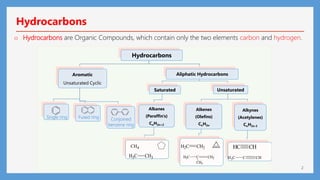
o Hydrocarbons are Organic Compounds, which contain only the two elements carbon and hydrogen.
Aliphatic Hydrocarbons
3
4
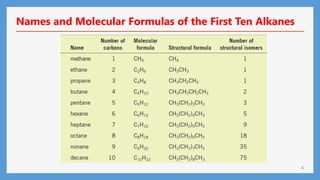
Names and Molecular Formulas of the First Ten Alkanes
5
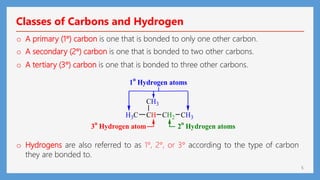
Classes of Carbons and Hydrogen
o A primary (1) carbon is one that is bonded to only one other carbon.
o A secondary (2) carbon is one that is bonded to two other carbons.
o A tertiary (3) carbon is one that is bonded to three other carbons.
H3C CH CH2 CH3
CH3
1o
Hydrogen atoms
3o
Hydrogen atom 2o
Hydrogen atoms
o Hydrogens are also referred to as 1, 2, or 3 according to the type of carbon
they are bonded to.
6
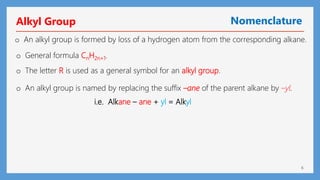
Alkyl Group Nomenclature
o An alkyl group is formed by loss of a hydrogen atom from the corresponding alkane.
i.e. Alkane – ane + yl = Alkyl
o General formula CnH2n+1.
o The letter R is used as a general symbol for an alkyl group.
o An alkyl group is named by replacing the suffix –ane of the parent alkane by –yl.
7
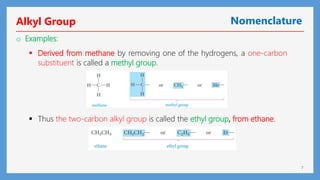
Alkyl Group Nomenclature
o Examples:
 Thus the two-carbon alkyl group is called the ethyl group, from ethane.
 Derived from methane by removing one of the hydrogens, a one-carbon
substituent is called a methyl group.
8
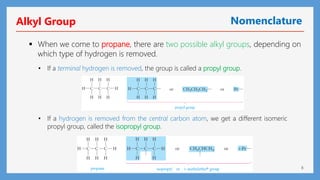
Alkyl Group Nomenclature
 When we come to propane, there are two possible alkyl groups, depending on
which type of hydrogen is removed.
• If a hydrogen is removed from the central carbon atom, we get a different isomeric
propyl group, called the isopropyl group.
• If a terminal hydrogen is removed, the group is called a propyl group.
9
Alkyl Group Nomenclature
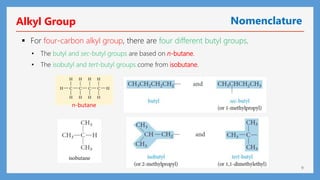
 For four-carbon alkyl group, there are four different butyl groups.
n-butane
• The butyl and sec-butyl groups are based on n-butane.
• The isobutyl and tert-butyl groups come from isobutane.
10
Nomenclature of Alkanes
Nomenclature of Saturated
Hydrocarbons
The IUPAC Rules
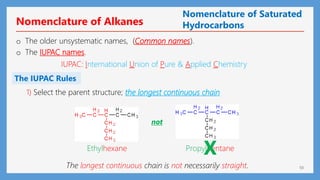
o The older unsystematic names, (Common names).
o The IUPAC names.
IUPAC: International Union of Pure & Applied Chemistry
1) Select the parent structure; the longest continuous chain
The longest continuous chain is not necessarily straight.
not
Ethylhexane Propylpentane
X
11
Nomenclature of Alkanes
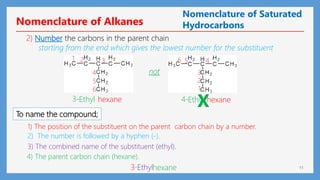
2) Number the carbons in the parent chain
starting from the end which gives the lowest number for the substituent
not
X
1 2 3
4
5
6 1
2
3
4
5
6
hexane
Ethyl
3- hexane
Ethyl
4-
To name the compound;
2) The number is followed by a hyphen (-).
1) The position of the substituent on the parent carbon chain by a number.
3) The combined name of the substituent (ethyl).
4) The parent carbon chain (hexane).
3-Ethylhexane
Nomenclature of Saturated
Hydrocarbons
12
Nomenclature of Alkanes
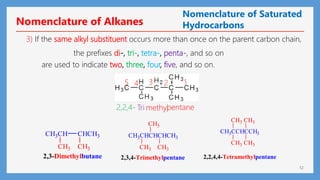
3) If the same alkyl substituent occurs more than once on the parent carbon chain,
the prefixes di-, tri-, tetra-, penta-, and so on
are used to indicate two, three, four, five, and so on.
1
2
3
4
5
methyl
2,2,4- pentane
Tri
CH3CH CHCH3
CH3 CH3
2,3-Dimethylbutane
CH3CHCHCHCH3
CH3
CH3
CH3
2,3,4-Trimethylpentane
CH3CCHCCH3
CH3 CH3
CH3 CH3
2,2,4,4-Tetramethylpentane
Nomenclature of Saturated
Hydrocarbons
13
Nomenclature of Alkanes
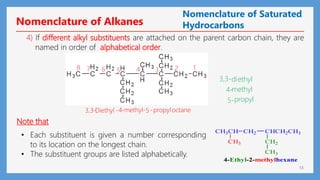
4) If different alkyl substituents are attached on the parent carbon chain, they are
named in order of alphabetical order.
1
2
3
4
5
methyl
3,3- octane
Diethyl
7
8 6
propyl
-
- -5
4
-
ethyl
di
3,3-
methyl
4-
propyl
5-
Note that
4-Ethyl-2-methylhexane
CH3CH
CH3
CH2 CHCH2CH3
CH2
CH3
• Each substituent is given a number corresponding
to its location on the longest chain.
• The substituent groups are listed alphabetically.
Nomenclature of Saturated
Hydrocarbons
14
Nomenclature of Alkanes
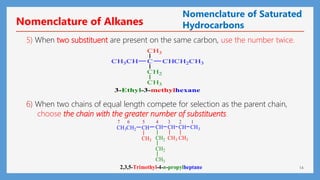
5) When two substituent are present on the same carbon, use the number twice.
CH3CH C CHCH2CH3
CH3
CH3
CH2
3-Ethyl-3-methylhexane
6) When two chains of equal length compete for selection as the parent chain,
choose the chain with the greater number of substituents.
CH3CH2 CH CH CH CH CH3
CH3 CH2 CH3 CH3
2,3,5-Trimethyl-4-n-propylheptane
CH2
CH3
1
2
3
4
5
6
7
Nomenclature of Saturated
Hydrocarbons
15
Nomenclature of Alkanes
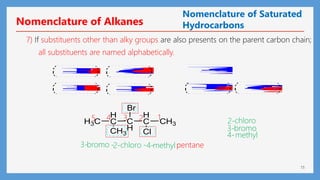
7) If substituents other than alky groups are also presents on the parent carbon chain;
all substituents are named alphabetically.
-
F
f
l
u
o
r
o
-
C
l
c
h
l
o
r
o
-
B
r
b
r
o
m
o
-
I
i
o
d
o
n
i
t
r
o
-
N
O
2
-
N
H
2
a
m
i
n
o
-
C
N
c
y
a
n
o
CH3
H3C
Cl
H
C
H
C
CH3
C
H
Br
1
2
3
4
5
pentane
bromo
3-
chloro
2-
methyl
4-
bromo
3- chloro
2- methyl
4-
- -
Nomenclature of Saturated
Hydrocarbons
16
Nomenclature of Alkanes
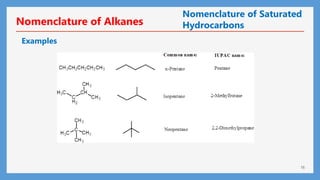
Examples
Nomenclature of Saturated
Hydrocarbons
17
Common Names
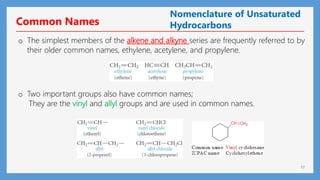
o The simplest members of the alkene and alkyne series are frequently referred to by
their older common names, ethylene, acetylene, and propylene.
o Two important groups also have common names;
They are the vinyl and allyl groups and are used in common names.
Nomenclature of Unsaturated
Hydrocarbons
18
The IUPAC Rules
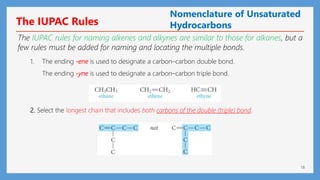
The IUPAC rules for naming alkenes and alkynes are similar to those for alkanes, but a
few rules must be added for naming and locating the multiple bonds.
1. The ending -ene is used to designate a carbon–carbon double bond.
The ending -yne is used to designate a carbon–carbon triple bond.
2. Select the longest chain that includes both carbons of the double (triple) bond.
Nomenclature of Unsaturated
Hydrocarbons
19
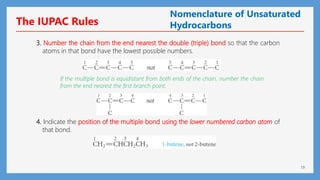
3. Number the chain from the end nearest the double (triple) bond so that the carbon
atoms in that bond have the lowest possible numbers.
If the multiple bond is equidistant from both ends of the chain, number the chain
from the end nearest the first branch point.
4. Indicate the position of the multiple bond using the lower numbered carbon atom of
that bond.
The IUPAC Rules
Nomenclature of Unsaturated
Hydrocarbons
20
NOTES
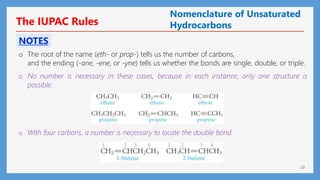
o The root of the name (eth- or prop-) tells us the number of carbons,
and the ending (-ane, -ene, or -yne) tells us whether the bonds are single, double, or triple.
o No number is necessary in these cases, because in each instance, only one structure is
possible.
o With four carbons, a number is necessary to locate the double bond.
The IUPAC Rules
Nomenclature of Unsaturated
Hydrocarbons
21
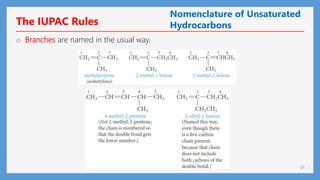
o Branches are named in the usual way.
The IUPAC Rules
Nomenclature of Unsaturated
Hydrocarbons
22
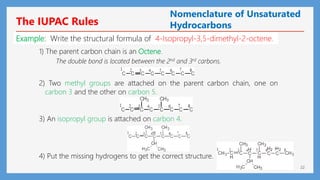
Example: Write the structural formula of 4-Isopropyl-3,5-dimethyl-2-octene.
1) The parent carbon chain is an Octene.
The double bond is located between the 2nd and 3rd carbons.
2) Two methyl groups are attached on the parent carbon chain, one on
carbon 3 and the other on carbon 5.
3) An isopropyl group is attached on carbon 4.
4) Put the missing hydrogens to get the correct structure.
The IUPAC Rules
Nomenclature of Unsaturated
Hydrocarbons
23
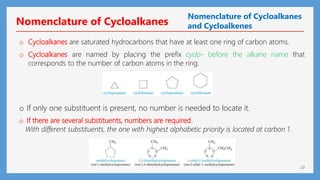
o Cycloalkanes are saturated hydrocarbons that have at least one ring of carbon atoms.
o Cycloalkanes are named by placing the prefix cyclo- before the alkane name that
corresponds to the number of carbon atoms in the ring.
o If only one substituent is present, no number is needed to locate it.
o If there are several substituents, numbers are required.
With different substituents, the one with highest alphabetic priority is located at carbon 1.
Nomenclature of Cycloalkanes
and Cycloalkenes
24
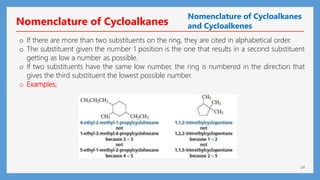
o If there are more than two substituents on the ring, they are cited in alphabetical order.
o The substituent given the number 1 position is the one that results in a second substituent
getting as low a number as possible.
o If two substituents have the same low number, the ring is numbered in the direction that
gives the third substituent the lowest possible number.
o Examples,
Nomenclature of Cycloalkanes
and Cycloalkenes
25
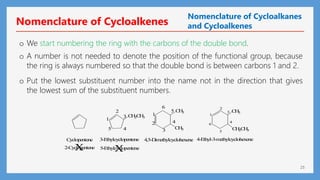
o We start numbering the ring with the carbons of the double bond.
o A number is not needed to denote the position of the functional group, because
the ring is always numbered so that the double bond is between carbons 1 and 2.
o Put the lowest substituent number into the name not in the direction that gives
the lowest sum of the substituent numbers.
C
H
2C
H
3
1
2
3
4
5
3-E
thylcyclopentene
C
H
3
C
H
3
1
2
3
4
5
6
4,5-D
im
ethylcyclohexene
C
H
3
C
H
2C
H
3
1
2
3
4
5
6
4-E
thyl-3-m
ethylcyclohexene
C
yclopentene
2-C
yclopentene 5-E
thylcyclopentene
X X
Nomenclature of Cycloalkenes
Nomenclature of Cycloalkanes
and Cycloalkenes
26
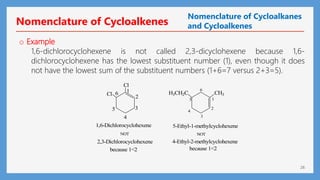
o Example
1,6-dichlorocyclohexene is not called 2,3-dicyclohexene because 1,6-
dichlorocyclohexene has the lowest substituent number (1), even though it does
not have the lowest sum of the substituent numbers (1+6=7 versus 2+3=5).
1
2
3
4
5
6 CH3
1
2
3
4
5
6
Cl
Cl
1,6-Dichlorocyclohexene
2,3-Dichlorocyclohexene 4-Ethyl-2-methylcyclohexene
NOT NOT
H3CH2C
5-Ethyl-1-methylcyclohexene
because 1<2 because 1<2
Nomenclature of Cycloalkenes
Nomenclature of Cycloalkanes
and Cycloalkenes
27
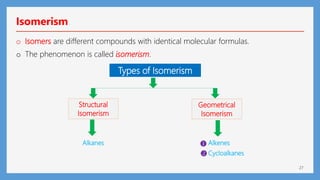
Isomerism
Alkanes

 Alkenes
Cycloalkanes
Types of Isomerism
Structural
Isomerism
Geometrical
Isomerism
o Isomers are different compounds with identical molecular formulas.
o The phenomenon is called isomerism.
28
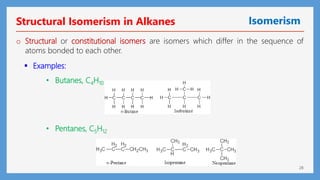
Structural Isomerism in Alkanes
o Structural or constitutional isomers are isomers which differ in the sequence of
atoms bonded to each other.
 Examples:
• Butanes, C4H10
• Pentanes, C5H12
Isomerism
29
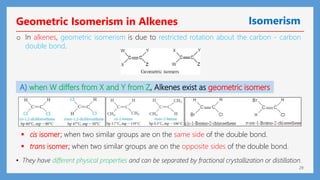
Geometric Isomerism in Alkenes Isomerism
o In alkenes, geometric isomerism is due to restricted rotation about the carbon - carbon
double bond.
A) when W differs from X and Y from Z, Alkenes exist as geometric isomers
 trans isomer; when two similar groups are on the opposite sides of the double bond.
 cis isomer; when two similar groups are on the same side of the double bond.
• They have different physical properties and can be separated by fractional crystallization or distillation.
30
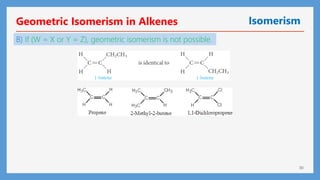
Geometric Isomerism in Alkenes Isomerism
B) If (W = X or Y = Z), geometric isomerism is not possible.
31
Geometric Isomerism in Alkenes Isomerism
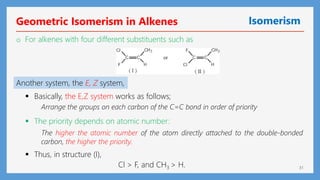
o For alkenes with four different substituents such as
Another system, the E, Z system,
 Thus, in structure (I),
 Basically, the E,Z system works as follows;
Arrange the groups on each carbon of the C=C bond in order of priority
 The priority depends on atomic number:
The higher the atomic number of the atom directly attached to the double-bonded
carbon, the higher the priority.
Cl > F, and CH3 > H.
32
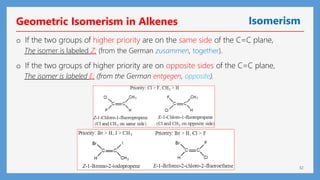
Geometric Isomerism in Alkenes Isomerism
o If the two groups of higher priority are on opposite sides of the C=C plane,
The isomer is labeled E; (from the German entgegen, opposite).
o If the two groups of higher priority are on the same side of the C=C plane,
The isomer is labeled Z; (from the German zusammen, together).
33
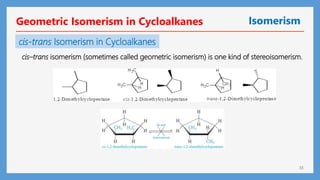
Geometric Isomerism in Cycloalkanes Isomerism
cis-trans Isomerism in Cycloalkanes
cis–trans isomerism (sometimes called geometric isomerism) is one kind of stereoisomerism.
34
Physical Properties of Aliphatic Hydrocarbons
Those properties that can be observed without the compound undergoing a chemical reaction.
o Physical State
Alkanes occur at room temperature are gases, liquids, and solids.
 C1 (C2) to C4 are gases,
 C5 to C17 are liquids,
 C18 and larger are wax –like solids.
o Solubility
 Aliphatic hydrocarbons are nonpolar compounds.
 Their solubility “ Like dissolve like”
 Aliphatic hydrocarbons are soluble in the nonpolar solvents;
carbon tetrachloride, CCl4 and benzene,
 Aliphatic hydrocarbons are insoluble in polar solvents like water.
35
Physical Properties of Aliphatic Hydrocarbons
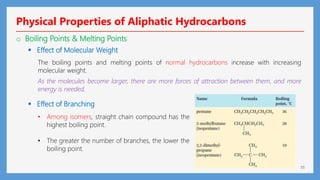
o Boiling Points & Melting Points
The boiling points and melting points of normal hydrocarbons increase with increasing
molecular weight.
 Effect of Molecular Weight
 Effect of Branching
As the molecules become larger, there are more forces of attraction between them, and more
energy is needed.
• Among isomers, straight chain compound has the
highest boiling point.
• The greater the number of branches, the lower the
boiling point.
36
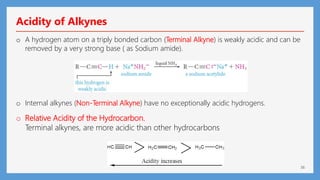
Acidity of Alkynes
o A hydrogen atom on a triply bonded carbon (Terminal Alkyne) is weakly acidic and can be
removed by a very strong base ( as Sodium amide).
o Internal alkynes (Non-Terminal Alkyne) have no exceptionally acidic hydrogens.
o Relative Acidity of the Hydrocarbon.
Terminal alkynes, are more acidic than other hydrocarbons
37
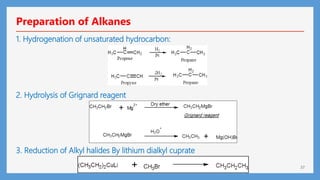
Preparation of Alkanes
1. Hydrogenation of unsaturated hydrocarbon:
2. Hydrolysis of Grignard reagent
3. Reduction of Alkyl halides By lithium dialkyl cuprate
38
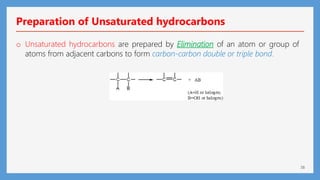
Preparation of Unsaturated hydrocarbons
o Unsaturated hydrocarbons are prepared by Elimination of an atom or group of
atoms from adjacent carbons to form carbon-carbon double or triple bond.
39
Preparation of Unsaturated
Hydrocarbons
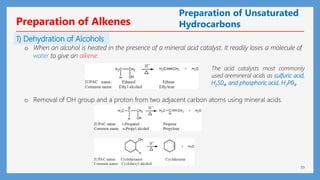
1) Dehydration of Alcohols
The acid catalysts most commonly
used aremineral acids as sulfuric acid,
H2S04, and phosphoric acid, H3P04.
o When an alcohol is heated in the presence of a mineral acid catalyst, It readily loses a molecule of
water to give an alkene.
Preparation of Alkenes
o Removal of OH group and a proton from two adjacent carbon atoms using mineral acids.
40
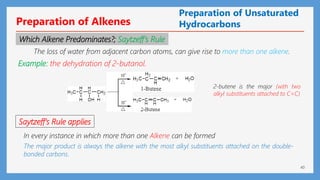
Which Alkene Predominates?; Saytzeff’s Rule
The loss of water from adjacent carbon atoms, can give rise to more than one alkene.
Example: the dehydration of 2-butanol.
Saytzeff’s Rule applies
In every instance in which more than one Alkene can be formed
The major product is always the alkene with the most alkyl substituents attached on the double-
bonded carbons.
2-butene is the major (with two
alkyl substituents attached to C=C)
Preparation of Unsaturated
Hydrocarbons
Preparation of Alkenes
41
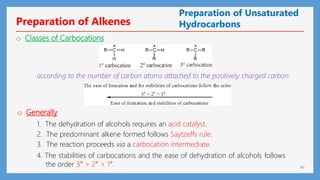
o Classes of Carbocations
according to the number of carbon atoms attached to the positively charged carbon.
o Generally
1. The dehydration of alcohols requires an acid catalyst.
2. The predominant alkene formed follows Saytzeffs rule.
3. The reaction proceeds via a carbocation intermediate.
4. The stabilities of carbocations and the ease of dehydration of alcohols follows
the order 3° > 2° > 1°.
Preparation of Unsaturated
Hydrocarbons
Preparation of Alkenes
42
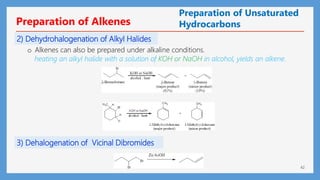
2) Dehydrohalogenation of Alkyl Halides
o Alkenes can also be prepared under alkaline conditions.
heating an alkyl halide with a solution of KOH or NaOH in alcohol, yields an alkene.
3) Dehalogenation of Vicinal Dibromides
Preparation of Unsaturated
Hydrocarbons
Preparation of Alkenes
43
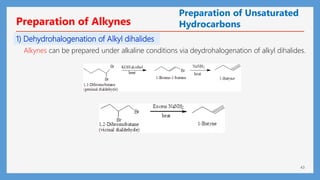
Alkynes can be prepared under alkaline conditions via deydrohalogenation of alkyl dihalides.
1) Dehydrohalogenation of Alkyl dihalides
Preparation of Unsaturated
Hydrocarbons
Preparation of Alkynes
44
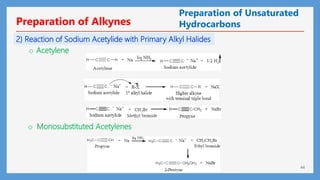
2) Reaction of Sodium Acetylide with Primary Alkyl Halides
o Acetylene
o Monosubstituted Acetylenes
Preparation of Unsaturated
Hydrocarbons
Preparation of Alkynes
45
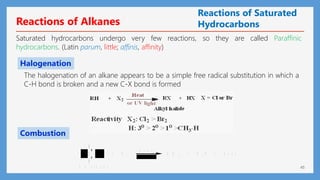
Reactions of Alkanes
Saturated hydrocarbons undergo very few reactions, so they are called Paraffinic
hydrocarbons. (Latin parum, little; affinis, affinity)
h e a t
H
C
H
+ O 2 C O 2 + H 2 O h e a t
A n a l k a n e
+
The halogenation of an alkane appears to be a simple free radical substitution in which a
C-H bond is broken and a new C-X bond is formed
Halogenation
Combustion
Reactions of Saturated
Hydrocarbons
46
Reactions of Alkanes
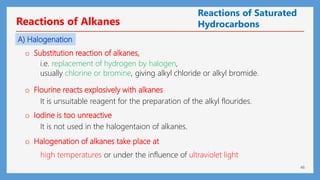
A) Halogenation
o Substitution reaction of alkanes,
o Flourine reacts explosively with alkanes
o Iodine is too unreactive
o Halogenation of alkanes take place at
i.e. replacement of hydrogen by halogen,
usually chlorine or bromine, giving alkyl chloride or alkyl bromide.
It is unsuitable reagent for the preparation of the alkyl flourides.
It is not used in the halogentaion of alkanes.
high temperatures or under the influence of ultraviolet light
Reactions of Saturated
Hydrocarbons
47
Reactions of Alkanes
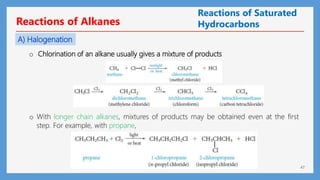
o Chlorination of an alkane usually gives a mixture of products
o With longer chain alkanes, mixtures of products may be obtained even at the first
step. For example, with propane,
A) Halogenation
Reactions of Saturated
Hydrocarbons
48
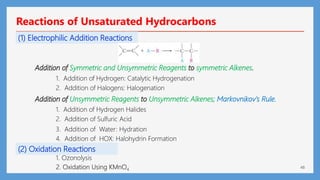
Reactions of Unsaturated Hydrocarbons
(1) Electrophilic Addition Reactions
Addition of Unsymmetric Reagents to Unsymmetric Alkenes; Markovnikov’s Rule.
Addition of Symmetric and Unsymmetric Reagents to symmetric Alkenes.
1. Addition of Hydrogen: Catalytic Hydrogenation
2. Addition of Halogens: Halogenation
1. Addition of Hydrogen Halides
2. Addition of Sulfuric Acid
3. Addition of Water: Hydration
4. Addition of HOX: Halohydrin Formation
(2) Oxidation Reactions
1. Ozonolysis
2. Oxidation Using KMnO4
49
Electrophilic Addition Reactions
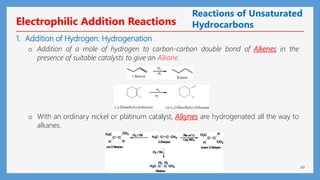
1. Addition of Hydrogen: Hydrogenation
o Addition of a mole of hydrogen to carbon-carbon double bond of Alkenes in the
presence of suitable catalysts to give an Alkane.
o With an ordinary nickel or platinum catalyst, Alkynes are hydrogenated all the way to
alkanes.
Reactions of Unsaturated
Hydrocarbons
50
Electrophilic Addition Reactions
Reactions of Unsaturated
Hydrocarbons
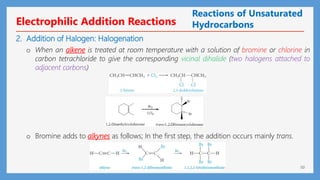
o When an alkene is treated at room temperature with a solution of bromine or chlorine in
carbon tetrachloride to give the corresponding vicinal dihalide (two halogens attached to
adjacent carbons)
o Bromine adds to alkynes as follows; In the first step, the addition occurs mainly trans.
2. Addition of Halogen: Halogenation
51
Electrophilic Addition Reactions
Reactions of Unsaturated
Hydrocarbons
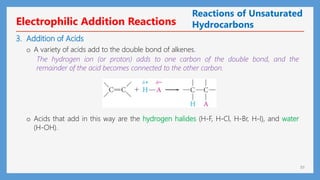
o A variety of acids add to the double bond of alkenes.
o Acids that add in this way are the hydrogen halides (H-F, H-Cl, H-Br, H-I), and water
(H-OH).
The hydrogen ion (or proton) adds to one carbon of the double bond, and the
remainder of the acid becomes connected to the other carbon.
3. Addition of Acids
52
Electrophilic Addition Reactions
Reactions of Unsaturated
Hydrocarbons
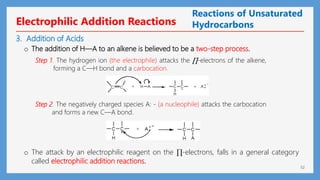
o The addition of H—A to an alkene is believed to be a two-step process.
Step 1. The hydrogen ion (the electrophile) attacks the ∏-electrons of the alkene,
forming a C—H bond and a carbocation.
Step 2. The negatively charged species A: - (a nucleophile) attacks the carbocation
and forms a new C—A bond.
o The attack by an electrophilic reagent on the ∏-electrons, falls in a general category
called electrophilic addition reactions.
3. Addition of Acids
53
Electrophilic Addition Reactions
Reactions of Unsaturated
Hydrocarbons
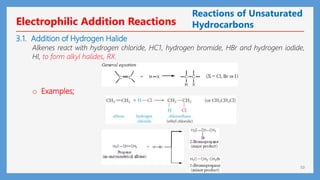
Alkenes react with hydrogen chloride, HC1, hydrogen bromide, HBr and hydrogen iodide,
HI, to form alkyl halides, RX.
o Examples;
3.1. Addition of Hydrogen Halide
54
Electrophilic Addition Reactions
Reactions of Unsaturated
Hydrocarbons
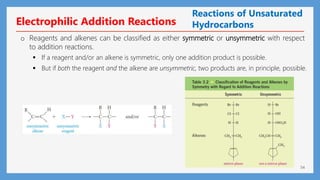
o Reagents and alkenes can be classified as either symmetric or unsymmetric with respect
to addition reactions.
 But if both the reagent and the alkene are unsymmetric, two products are, in principle, possible.
 If a reagent and/or an alkene is symmetric, only one addition product is possible.
55
Electrophilic Addition Reactions
Reactions of Unsaturated
Hydrocarbons
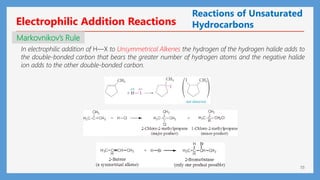
Markovnikov’s Rule
In electrophilic addition of H—X to Unsymmetrical Alkenes the hydrogen of the hydrogen halide adds to
the double-bonded carbon that bears the greater number of hydrogen atoms and the negative halide
ion adds to the other double-bonded carbon.
56
Electrophilic Addition Reactions
Reactions of Unsaturated
Hydrocarbons
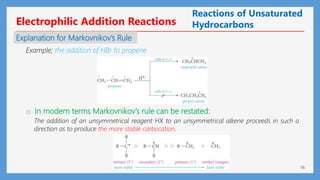
Explanation for Markovnikov’s Rule
Example; the addition of HBr to propene
o In modern terms Markovnikov’s rule can be restated:
The addition of an unsymmetrical reagent HX to an unsymmetrical alkene proceeds in such a
direction as to produce the more stable carbocation.
57
Electrophilic Addition Reactions
Reactions of Unsaturated
Hydrocarbons
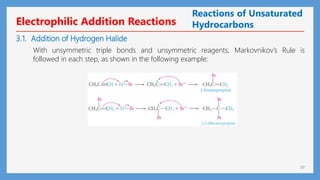
With unsymmetric triple bonds and unsymmetric reagents, Markovnikov’s Rule is
followed in each step, as shown in the following example:
3.1. Addition of Hydrogen Halide
58
Electrophilic Addition Reactions
Reactions of Unsaturated
Hydrocarbons
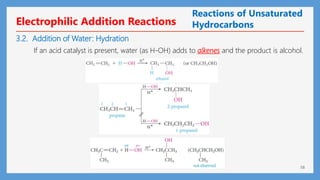
If an acid catalyst is present, water (as H-OH) adds to alkenes and the product is alcohol.
3.2. Addition of Water: Hydration
59
Electrophilic Addition Reactions
Reactions of Unsaturated
Hydrocarbons
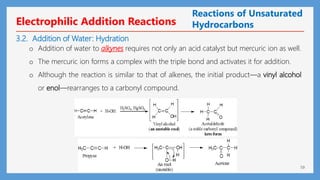
o Addition of water to alkynes requires not only an acid catalyst but mercuric ion as well.
o The mercuric ion forms a complex with the triple bond and activates it for addition.
o Although the reaction is similar to that of alkenes, the initial product—a vinyl alcohol
or enol—rearranges to a carbonyl compound.
3.2. Addition of Water: Hydration
60
Oxidation Reactions
Reactions of Unsaturated
Hydrocarbons
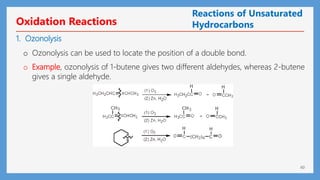
o Ozonolysis can be used to locate the position of a double bond.
o Example, ozonolysis of 1-butene gives two different aldehydes, whereas 2-butene
gives a single aldehyde.
1. Ozonolysis
61
Oxidation Reactions
Reactions of Unsaturated
Hydrocarbons
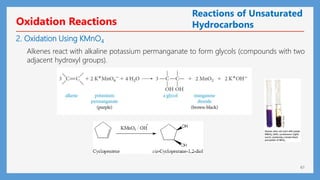
Alkenes react with alkaline potassium permanganate to form glycols (compounds with two
adjacent hydroxyl groups).
2. Oxidation Using KMnO4

2-chem_109_-_aliphatic_hydrocarbon (1).ppsx

  • 1.
    1 Fundamentals of OrganicChemistry CHEM 109 For Students of Health Colleges Credit hrs.: (2+1) King Saud University College of Science, Chemistry Department CHAPTER 2: Aliphatic Hydrocarbon
  • 2.
    2 Hydrocarbons Hydrocarbons Aromatic Unsaturated Cyclic Aliphatic Hydrocarbons Saturated Alkanes (Paraffin's) CnH2n+2 Unsaturated Alkenes (Olefins) CnH2n Alkynes (Acetylenes) CnH2n-2 CH4 C H3CH3 C H2 CH2 C H3 C CH2 CH3 C H CH C H3 C CH Single ring Fused ring Conjoined benzene ring o Hydrocarbons are Organic Compounds, which contain only the two elements carbon and hydrogen.
  • 3.
  • 4.
    4 Names and MolecularFormulas of the First Ten Alkanes
  • 5.
    5 Classes of Carbonsand Hydrogen o A primary (1) carbon is one that is bonded to only one other carbon. o A secondary (2) carbon is one that is bonded to two other carbons. o A tertiary (3) carbon is one that is bonded to three other carbons. H3C CH CH2 CH3 CH3 1o Hydrogen atoms 3o Hydrogen atom 2o Hydrogen atoms o Hydrogens are also referred to as 1, 2, or 3 according to the type of carbon they are bonded to.
  • 6.
    6 Alkyl Group Nomenclature oAn alkyl group is formed by loss of a hydrogen atom from the corresponding alkane. i.e. Alkane – ane + yl = Alkyl o General formula CnH2n+1. o The letter R is used as a general symbol for an alkyl group. o An alkyl group is named by replacing the suffix –ane of the parent alkane by –yl.
  • 7.
    7 Alkyl Group Nomenclature oExamples:  Thus the two-carbon alkyl group is called the ethyl group, from ethane.  Derived from methane by removing one of the hydrogens, a one-carbon substituent is called a methyl group.
  • 8.
    8 Alkyl Group Nomenclature When we come to propane, there are two possible alkyl groups, depending on which type of hydrogen is removed. • If a hydrogen is removed from the central carbon atom, we get a different isomeric propyl group, called the isopropyl group. • If a terminal hydrogen is removed, the group is called a propyl group.
  • 9.
    9 Alkyl Group Nomenclature For four-carbon alkyl group, there are four different butyl groups. n-butane • The butyl and sec-butyl groups are based on n-butane. • The isobutyl and tert-butyl groups come from isobutane.
  • 10.
    10 Nomenclature of Alkanes Nomenclatureof Saturated Hydrocarbons The IUPAC Rules o The older unsystematic names, (Common names). o The IUPAC names. IUPAC: International Union of Pure & Applied Chemistry 1) Select the parent structure; the longest continuous chain The longest continuous chain is not necessarily straight. not Ethylhexane Propylpentane X
  • 11.
    11 Nomenclature of Alkanes 2)Number the carbons in the parent chain starting from the end which gives the lowest number for the substituent not X 1 2 3 4 5 6 1 2 3 4 5 6 hexane Ethyl 3- hexane Ethyl 4- To name the compound; 2) The number is followed by a hyphen (-). 1) The position of the substituent on the parent carbon chain by a number. 3) The combined name of the substituent (ethyl). 4) The parent carbon chain (hexane). 3-Ethylhexane Nomenclature of Saturated Hydrocarbons
  • 12.
    12 Nomenclature of Alkanes 3)If the same alkyl substituent occurs more than once on the parent carbon chain, the prefixes di-, tri-, tetra-, penta-, and so on are used to indicate two, three, four, five, and so on. 1 2 3 4 5 methyl 2,2,4- pentane Tri CH3CH CHCH3 CH3 CH3 2,3-Dimethylbutane CH3CHCHCHCH3 CH3 CH3 CH3 2,3,4-Trimethylpentane CH3CCHCCH3 CH3 CH3 CH3 CH3 2,2,4,4-Tetramethylpentane Nomenclature of Saturated Hydrocarbons
  • 13.
    13 Nomenclature of Alkanes 4)If different alkyl substituents are attached on the parent carbon chain, they are named in order of alphabetical order. 1 2 3 4 5 methyl 3,3- octane Diethyl 7 8 6 propyl - - -5 4 - ethyl di 3,3- methyl 4- propyl 5- Note that 4-Ethyl-2-methylhexane CH3CH CH3 CH2 CHCH2CH3 CH2 CH3 • Each substituent is given a number corresponding to its location on the longest chain. • The substituent groups are listed alphabetically. Nomenclature of Saturated Hydrocarbons
  • 14.
    14 Nomenclature of Alkanes 5)When two substituent are present on the same carbon, use the number twice. CH3CH C CHCH2CH3 CH3 CH3 CH2 3-Ethyl-3-methylhexane 6) When two chains of equal length compete for selection as the parent chain, choose the chain with the greater number of substituents. CH3CH2 CH CH CH CH CH3 CH3 CH2 CH3 CH3 2,3,5-Trimethyl-4-n-propylheptane CH2 CH3 1 2 3 4 5 6 7 Nomenclature of Saturated Hydrocarbons
  • 15.
    15 Nomenclature of Alkanes 7)If substituents other than alky groups are also presents on the parent carbon chain; all substituents are named alphabetically. - F f l u o r o - C l c h l o r o - B r b r o m o - I i o d o n i t r o - N O 2 - N H 2 a m i n o - C N c y a n o CH3 H3C Cl H C H C CH3 C H Br 1 2 3 4 5 pentane bromo 3- chloro 2- methyl 4- bromo 3- chloro 2- methyl 4- - - Nomenclature of Saturated Hydrocarbons
  • 16.
  • 17.
    17 Common Names o Thesimplest members of the alkene and alkyne series are frequently referred to by their older common names, ethylene, acetylene, and propylene. o Two important groups also have common names; They are the vinyl and allyl groups and are used in common names. Nomenclature of Unsaturated Hydrocarbons
  • 18.
    18 The IUPAC Rules TheIUPAC rules for naming alkenes and alkynes are similar to those for alkanes, but a few rules must be added for naming and locating the multiple bonds. 1. The ending -ene is used to designate a carbon–carbon double bond. The ending -yne is used to designate a carbon–carbon triple bond. 2. Select the longest chain that includes both carbons of the double (triple) bond. Nomenclature of Unsaturated Hydrocarbons
  • 19.
    19 3. Number thechain from the end nearest the double (triple) bond so that the carbon atoms in that bond have the lowest possible numbers. If the multiple bond is equidistant from both ends of the chain, number the chain from the end nearest the first branch point. 4. Indicate the position of the multiple bond using the lower numbered carbon atom of that bond. The IUPAC Rules Nomenclature of Unsaturated Hydrocarbons
  • 20.
    20 NOTES o The rootof the name (eth- or prop-) tells us the number of carbons, and the ending (-ane, -ene, or -yne) tells us whether the bonds are single, double, or triple. o No number is necessary in these cases, because in each instance, only one structure is possible. o With four carbons, a number is necessary to locate the double bond. The IUPAC Rules Nomenclature of Unsaturated Hydrocarbons
  • 21.
    21 o Branches arenamed in the usual way. The IUPAC Rules Nomenclature of Unsaturated Hydrocarbons
  • 22.
    22 Example: Write thestructural formula of 4-Isopropyl-3,5-dimethyl-2-octene. 1) The parent carbon chain is an Octene. The double bond is located between the 2nd and 3rd carbons. 2) Two methyl groups are attached on the parent carbon chain, one on carbon 3 and the other on carbon 5. 3) An isopropyl group is attached on carbon 4. 4) Put the missing hydrogens to get the correct structure. The IUPAC Rules Nomenclature of Unsaturated Hydrocarbons
  • 23.
    23 o Cycloalkanes aresaturated hydrocarbons that have at least one ring of carbon atoms. o Cycloalkanes are named by placing the prefix cyclo- before the alkane name that corresponds to the number of carbon atoms in the ring. o If only one substituent is present, no number is needed to locate it. o If there are several substituents, numbers are required. With different substituents, the one with highest alphabetic priority is located at carbon 1. Nomenclature of Cycloalkanes Nomenclature of Cycloalkanes and Cycloalkenes
  • 24.
    24 o If thereare more than two substituents on the ring, they are cited in alphabetical order. o The substituent given the number 1 position is the one that results in a second substituent getting as low a number as possible. o If two substituents have the same low number, the ring is numbered in the direction that gives the third substituent the lowest possible number. o Examples, Nomenclature of Cycloalkanes Nomenclature of Cycloalkanes and Cycloalkenes
  • 25.
    25 o We startnumbering the ring with the carbons of the double bond. o A number is not needed to denote the position of the functional group, because the ring is always numbered so that the double bond is between carbons 1 and 2. o Put the lowest substituent number into the name not in the direction that gives the lowest sum of the substituent numbers. C H 2C H 3 1 2 3 4 5 3-E thylcyclopentene C H 3 C H 3 1 2 3 4 5 6 4,5-D im ethylcyclohexene C H 3 C H 2C H 3 1 2 3 4 5 6 4-E thyl-3-m ethylcyclohexene C yclopentene 2-C yclopentene 5-E thylcyclopentene X X Nomenclature of Cycloalkenes Nomenclature of Cycloalkanes and Cycloalkenes
  • 26.
    26 o Example 1,6-dichlorocyclohexene isnot called 2,3-dicyclohexene because 1,6- dichlorocyclohexene has the lowest substituent number (1), even though it does not have the lowest sum of the substituent numbers (1+6=7 versus 2+3=5). 1 2 3 4 5 6 CH3 1 2 3 4 5 6 Cl Cl 1,6-Dichlorocyclohexene 2,3-Dichlorocyclohexene 4-Ethyl-2-methylcyclohexene NOT NOT H3CH2C 5-Ethyl-1-methylcyclohexene because 1<2 because 1<2 Nomenclature of Cycloalkenes Nomenclature of Cycloalkanes and Cycloalkenes
  • 27.
    27 Isomerism Alkanes   Alkenes Cycloalkanes Types ofIsomerism Structural Isomerism Geometrical Isomerism o Isomers are different compounds with identical molecular formulas. o The phenomenon is called isomerism.
  • 28.
    28 Structural Isomerism inAlkanes o Structural or constitutional isomers are isomers which differ in the sequence of atoms bonded to each other.  Examples: • Butanes, C4H10 • Pentanes, C5H12 Isomerism
  • 29.
    29 Geometric Isomerism inAlkenes Isomerism o In alkenes, geometric isomerism is due to restricted rotation about the carbon - carbon double bond. A) when W differs from X and Y from Z, Alkenes exist as geometric isomers  trans isomer; when two similar groups are on the opposite sides of the double bond.  cis isomer; when two similar groups are on the same side of the double bond. • They have different physical properties and can be separated by fractional crystallization or distillation.
  • 30.
    30 Geometric Isomerism inAlkenes Isomerism B) If (W = X or Y = Z), geometric isomerism is not possible.
  • 31.
    31 Geometric Isomerism inAlkenes Isomerism o For alkenes with four different substituents such as Another system, the E, Z system,  Thus, in structure (I),  Basically, the E,Z system works as follows; Arrange the groups on each carbon of the C=C bond in order of priority  The priority depends on atomic number: The higher the atomic number of the atom directly attached to the double-bonded carbon, the higher the priority. Cl > F, and CH3 > H.
  • 32.
    32 Geometric Isomerism inAlkenes Isomerism o If the two groups of higher priority are on opposite sides of the C=C plane, The isomer is labeled E; (from the German entgegen, opposite). o If the two groups of higher priority are on the same side of the C=C plane, The isomer is labeled Z; (from the German zusammen, together).
  • 33.
    33 Geometric Isomerism inCycloalkanes Isomerism cis-trans Isomerism in Cycloalkanes cis–trans isomerism (sometimes called geometric isomerism) is one kind of stereoisomerism.
  • 34.
    34 Physical Properties ofAliphatic Hydrocarbons Those properties that can be observed without the compound undergoing a chemical reaction. o Physical State Alkanes occur at room temperature are gases, liquids, and solids.  C1 (C2) to C4 are gases,  C5 to C17 are liquids,  C18 and larger are wax –like solids. o Solubility  Aliphatic hydrocarbons are nonpolar compounds.  Their solubility “ Like dissolve like”  Aliphatic hydrocarbons are soluble in the nonpolar solvents; carbon tetrachloride, CCl4 and benzene,  Aliphatic hydrocarbons are insoluble in polar solvents like water.
  • 35.
    35 Physical Properties ofAliphatic Hydrocarbons o Boiling Points & Melting Points The boiling points and melting points of normal hydrocarbons increase with increasing molecular weight.  Effect of Molecular Weight  Effect of Branching As the molecules become larger, there are more forces of attraction between them, and more energy is needed. • Among isomers, straight chain compound has the highest boiling point. • The greater the number of branches, the lower the boiling point.
  • 36.
    36 Acidity of Alkynes oA hydrogen atom on a triply bonded carbon (Terminal Alkyne) is weakly acidic and can be removed by a very strong base ( as Sodium amide). o Internal alkynes (Non-Terminal Alkyne) have no exceptionally acidic hydrogens. o Relative Acidity of the Hydrocarbon. Terminal alkynes, are more acidic than other hydrocarbons
  • 37.
    37 Preparation of Alkanes 1.Hydrogenation of unsaturated hydrocarbon: 2. Hydrolysis of Grignard reagent 3. Reduction of Alkyl halides By lithium dialkyl cuprate
  • 38.
    38 Preparation of Unsaturatedhydrocarbons o Unsaturated hydrocarbons are prepared by Elimination of an atom or group of atoms from adjacent carbons to form carbon-carbon double or triple bond.
  • 39.
    39 Preparation of Unsaturated Hydrocarbons 1)Dehydration of Alcohols The acid catalysts most commonly used aremineral acids as sulfuric acid, H2S04, and phosphoric acid, H3P04. o When an alcohol is heated in the presence of a mineral acid catalyst, It readily loses a molecule of water to give an alkene. Preparation of Alkenes o Removal of OH group and a proton from two adjacent carbon atoms using mineral acids.
  • 40.
    40 Which Alkene Predominates?;Saytzeff’s Rule The loss of water from adjacent carbon atoms, can give rise to more than one alkene. Example: the dehydration of 2-butanol. Saytzeff’s Rule applies In every instance in which more than one Alkene can be formed The major product is always the alkene with the most alkyl substituents attached on the double- bonded carbons. 2-butene is the major (with two alkyl substituents attached to C=C) Preparation of Unsaturated Hydrocarbons Preparation of Alkenes
  • 41.
    41 o Classes ofCarbocations according to the number of carbon atoms attached to the positively charged carbon. o Generally 1. The dehydration of alcohols requires an acid catalyst. 2. The predominant alkene formed follows Saytzeffs rule. 3. The reaction proceeds via a carbocation intermediate. 4. The stabilities of carbocations and the ease of dehydration of alcohols follows the order 3° > 2° > 1°. Preparation of Unsaturated Hydrocarbons Preparation of Alkenes
  • 42.
    42 2) Dehydrohalogenation ofAlkyl Halides o Alkenes can also be prepared under alkaline conditions. heating an alkyl halide with a solution of KOH or NaOH in alcohol, yields an alkene. 3) Dehalogenation of Vicinal Dibromides Preparation of Unsaturated Hydrocarbons Preparation of Alkenes
  • 43.
    43 Alkynes can beprepared under alkaline conditions via deydrohalogenation of alkyl dihalides. 1) Dehydrohalogenation of Alkyl dihalides Preparation of Unsaturated Hydrocarbons Preparation of Alkynes
  • 44.
    44 2) Reaction ofSodium Acetylide with Primary Alkyl Halides o Acetylene o Monosubstituted Acetylenes Preparation of Unsaturated Hydrocarbons Preparation of Alkynes
  • 45.
    45 Reactions of Alkanes Saturatedhydrocarbons undergo very few reactions, so they are called Paraffinic hydrocarbons. (Latin parum, little; affinis, affinity) h e a t H C H + O 2 C O 2 + H 2 O h e a t A n a l k a n e + The halogenation of an alkane appears to be a simple free radical substitution in which a C-H bond is broken and a new C-X bond is formed Halogenation Combustion Reactions of Saturated Hydrocarbons
  • 46.
    46 Reactions of Alkanes A)Halogenation o Substitution reaction of alkanes, o Flourine reacts explosively with alkanes o Iodine is too unreactive o Halogenation of alkanes take place at i.e. replacement of hydrogen by halogen, usually chlorine or bromine, giving alkyl chloride or alkyl bromide. It is unsuitable reagent for the preparation of the alkyl flourides. It is not used in the halogentaion of alkanes. high temperatures or under the influence of ultraviolet light Reactions of Saturated Hydrocarbons
  • 47.
    47 Reactions of Alkanes oChlorination of an alkane usually gives a mixture of products o With longer chain alkanes, mixtures of products may be obtained even at the first step. For example, with propane, A) Halogenation Reactions of Saturated Hydrocarbons
  • 48.
    48 Reactions of UnsaturatedHydrocarbons (1) Electrophilic Addition Reactions Addition of Unsymmetric Reagents to Unsymmetric Alkenes; Markovnikov’s Rule. Addition of Symmetric and Unsymmetric Reagents to symmetric Alkenes. 1. Addition of Hydrogen: Catalytic Hydrogenation 2. Addition of Halogens: Halogenation 1. Addition of Hydrogen Halides 2. Addition of Sulfuric Acid 3. Addition of Water: Hydration 4. Addition of HOX: Halohydrin Formation (2) Oxidation Reactions 1. Ozonolysis 2. Oxidation Using KMnO4
  • 49.
    49 Electrophilic Addition Reactions 1.Addition of Hydrogen: Hydrogenation o Addition of a mole of hydrogen to carbon-carbon double bond of Alkenes in the presence of suitable catalysts to give an Alkane. o With an ordinary nickel or platinum catalyst, Alkynes are hydrogenated all the way to alkanes. Reactions of Unsaturated Hydrocarbons
  • 50.
    50 Electrophilic Addition Reactions Reactionsof Unsaturated Hydrocarbons o When an alkene is treated at room temperature with a solution of bromine or chlorine in carbon tetrachloride to give the corresponding vicinal dihalide (two halogens attached to adjacent carbons) o Bromine adds to alkynes as follows; In the first step, the addition occurs mainly trans. 2. Addition of Halogen: Halogenation
  • 51.
    51 Electrophilic Addition Reactions Reactionsof Unsaturated Hydrocarbons o A variety of acids add to the double bond of alkenes. o Acids that add in this way are the hydrogen halides (H-F, H-Cl, H-Br, H-I), and water (H-OH). The hydrogen ion (or proton) adds to one carbon of the double bond, and the remainder of the acid becomes connected to the other carbon. 3. Addition of Acids
  • 52.
    52 Electrophilic Addition Reactions Reactionsof Unsaturated Hydrocarbons o The addition of H—A to an alkene is believed to be a two-step process. Step 1. The hydrogen ion (the electrophile) attacks the ∏-electrons of the alkene, forming a C—H bond and a carbocation. Step 2. The negatively charged species A: - (a nucleophile) attacks the carbocation and forms a new C—A bond. o The attack by an electrophilic reagent on the ∏-electrons, falls in a general category called electrophilic addition reactions. 3. Addition of Acids
  • 53.
    53 Electrophilic Addition Reactions Reactionsof Unsaturated Hydrocarbons Alkenes react with hydrogen chloride, HC1, hydrogen bromide, HBr and hydrogen iodide, HI, to form alkyl halides, RX. o Examples; 3.1. Addition of Hydrogen Halide
  • 54.
    54 Electrophilic Addition Reactions Reactionsof Unsaturated Hydrocarbons o Reagents and alkenes can be classified as either symmetric or unsymmetric with respect to addition reactions.  But if both the reagent and the alkene are unsymmetric, two products are, in principle, possible.  If a reagent and/or an alkene is symmetric, only one addition product is possible.
  • 55.
    55 Electrophilic Addition Reactions Reactionsof Unsaturated Hydrocarbons Markovnikov’s Rule In electrophilic addition of H—X to Unsymmetrical Alkenes the hydrogen of the hydrogen halide adds to the double-bonded carbon that bears the greater number of hydrogen atoms and the negative halide ion adds to the other double-bonded carbon.
  • 56.
    56 Electrophilic Addition Reactions Reactionsof Unsaturated Hydrocarbons Explanation for Markovnikov’s Rule Example; the addition of HBr to propene o In modern terms Markovnikov’s rule can be restated: The addition of an unsymmetrical reagent HX to an unsymmetrical alkene proceeds in such a direction as to produce the more stable carbocation.
  • 57.
    57 Electrophilic Addition Reactions Reactionsof Unsaturated Hydrocarbons With unsymmetric triple bonds and unsymmetric reagents, Markovnikov’s Rule is followed in each step, as shown in the following example: 3.1. Addition of Hydrogen Halide
  • 58.
    58 Electrophilic Addition Reactions Reactionsof Unsaturated Hydrocarbons If an acid catalyst is present, water (as H-OH) adds to alkenes and the product is alcohol. 3.2. Addition of Water: Hydration
  • 59.
    59 Electrophilic Addition Reactions Reactionsof Unsaturated Hydrocarbons o Addition of water to alkynes requires not only an acid catalyst but mercuric ion as well. o The mercuric ion forms a complex with the triple bond and activates it for addition. o Although the reaction is similar to that of alkenes, the initial product—a vinyl alcohol or enol—rearranges to a carbonyl compound. 3.2. Addition of Water: Hydration
  • 60.
    60 Oxidation Reactions Reactions ofUnsaturated Hydrocarbons o Ozonolysis can be used to locate the position of a double bond. o Example, ozonolysis of 1-butene gives two different aldehydes, whereas 2-butene gives a single aldehyde. 1. Ozonolysis
  • 61.
    61 Oxidation Reactions Reactions ofUnsaturated Hydrocarbons Alkenes react with alkaline potassium permanganate to form glycols (compounds with two adjacent hydroxyl groups). 2. Oxidation Using KMnO4