INTRODUCTION
 Arches of foot act as:
 Pliable platform to support the body weight in upright
posture.
 Lever to propel the body forwards in walking, running
and jumping.
To meet these requirement, the human foot is designed in
the form of elastic arches or springs.
Arches are supported by intrinsic and extrinsic muscles of
the sole in addition to ligaments, aponeurosis and shape
of the bones.
FORMATION
Arches are formed by the tarsal and metatarsal bones
and are strengthened by ligaments, muscles, tendon
and aponeurosis.
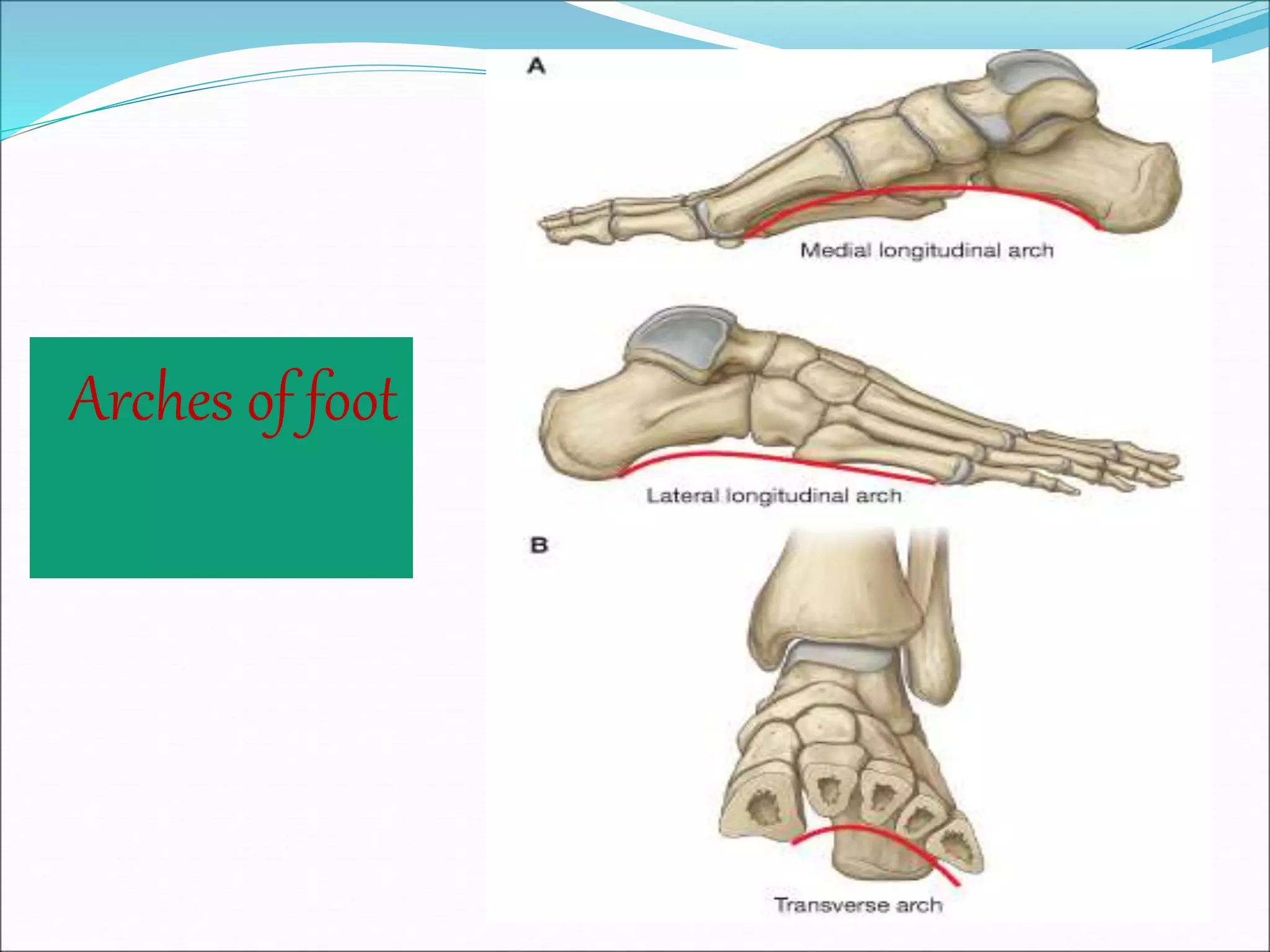
CLASSIFICATION
2 longitudinal arches
-Medial
-Lateral
Transverse arch
Arches of foot
FORMATION OF ARCHES
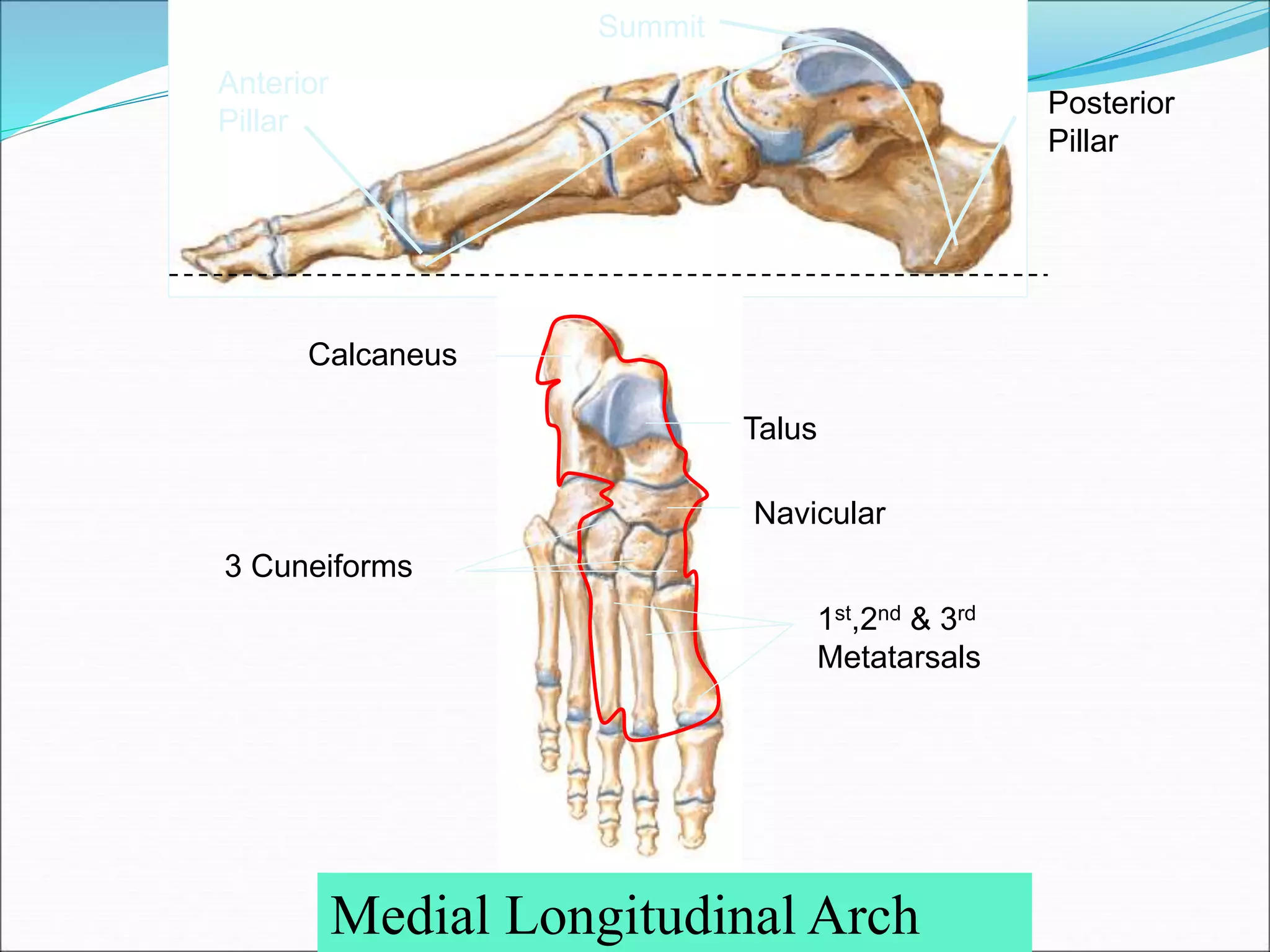
MEDIAL LONGITUDINAL ARCHES:
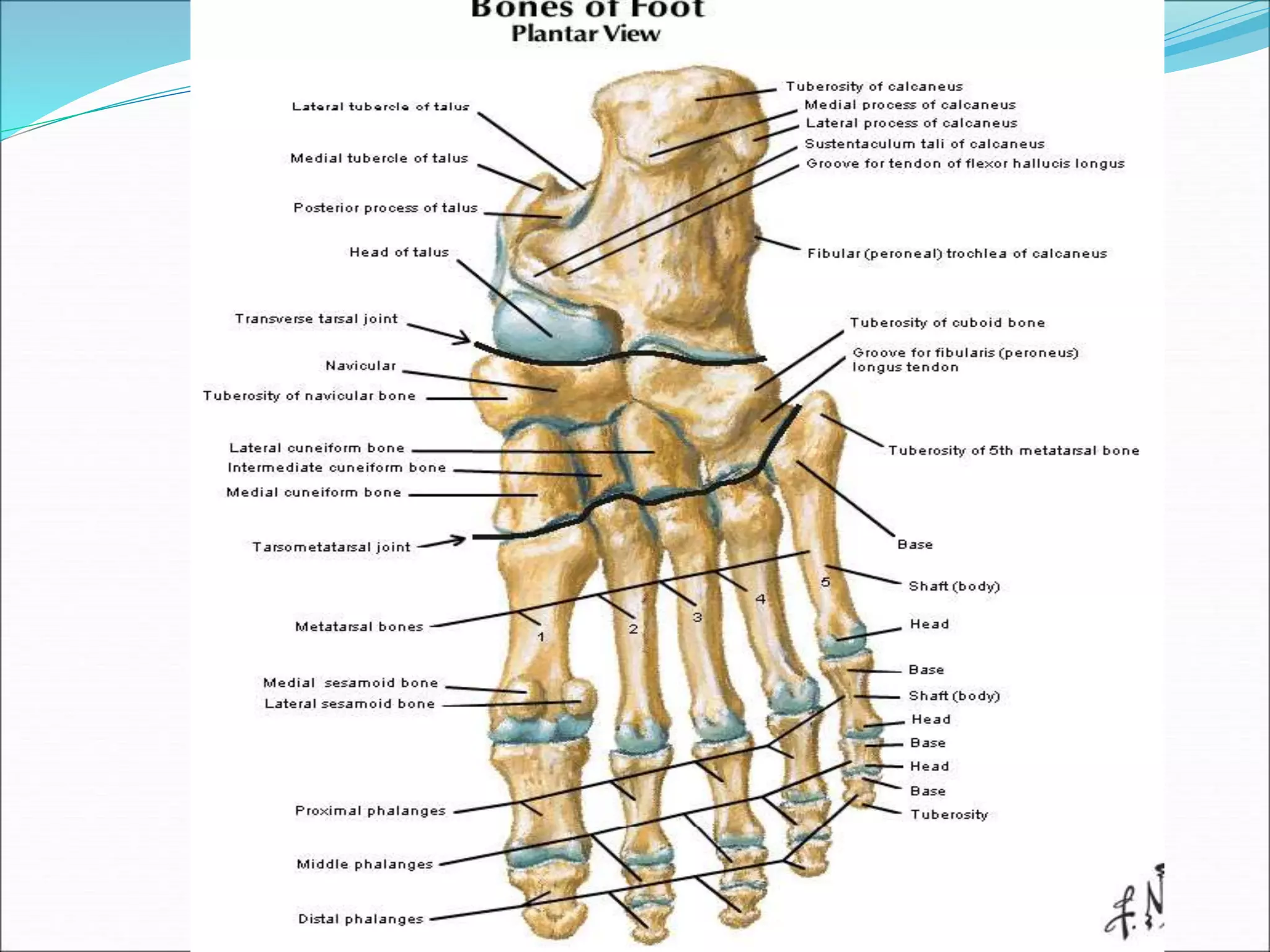
Summit: superior articular surface of talus.
Ends:
 Ant.end- by the heads of the 1st , 2nd & 3rd metatarsals.
 Post.end- by the medial tubercle of calcaneum.
Pillars:
 Ant.pillar- by navicular, 3 cuneiforms and 1st 3 metatarsals..
 Post. pillar- by medial half of calcaneum.
The main joint-talocalcaneonavicular joint.
Most vulnerable part- head of talus
Calcaneus
Talus
Navicular
3 Cuneiforms
1st,2nd & 3rd
Metatarsals
Medial Longitudinal Arch
Summit
Posterior
Pillar
Anterior
Pillar
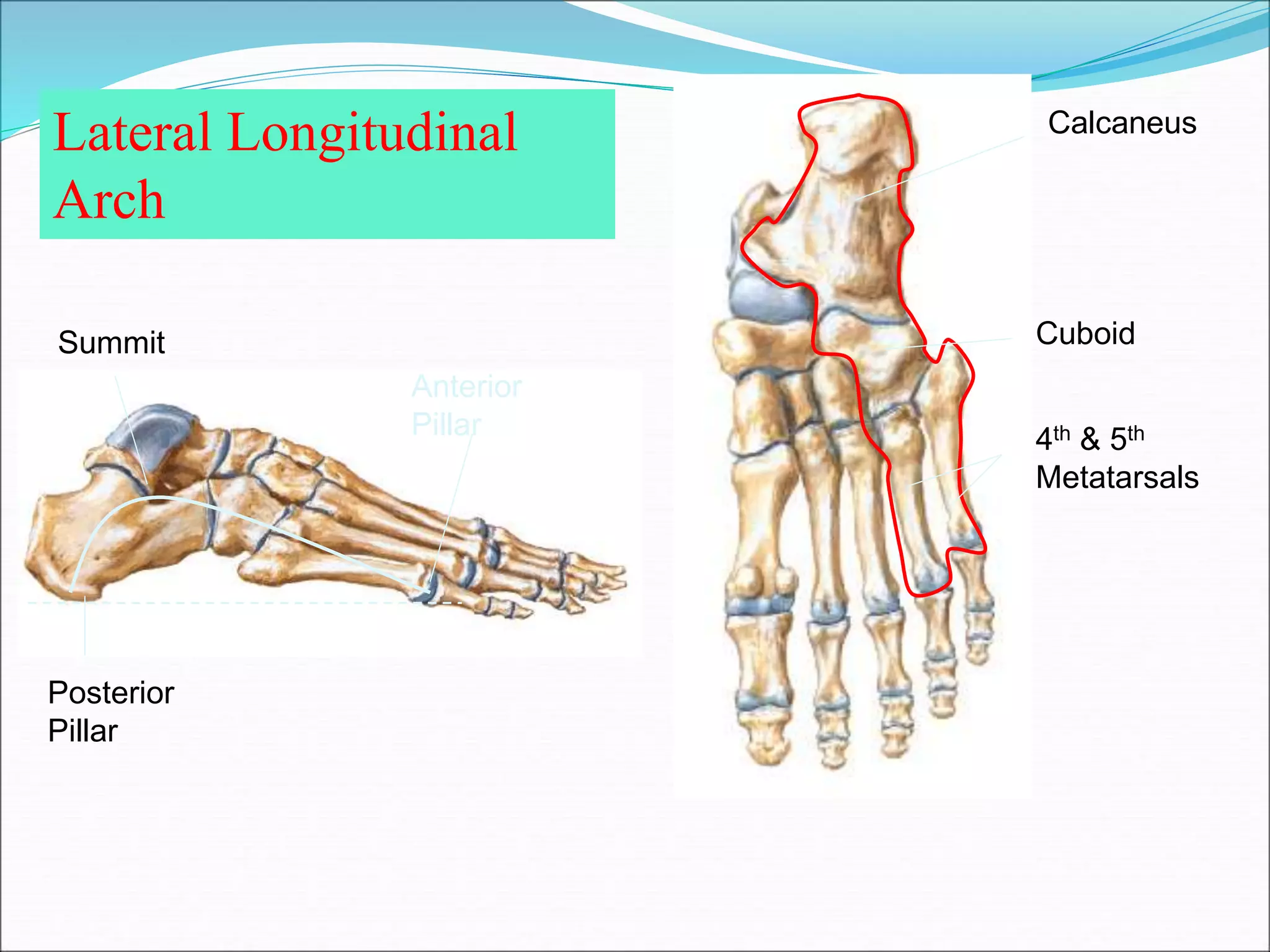
LATERAL LONGITUDINAL ARCHES:
Summit: articular facet on superior surface of calcaneum.
Ends:
 Ant.end- by the heads of the 4th & 5th metatarsals.
 Post.end- by the lateral tubercle of calcaneum.
Pillars:
 Ant.pillar- by cuboid and 4th & 5th metatarsals..
 Post. pillar- by lateral half of calcaneum.
The main joint-calcaneocuboid joint.
Most vulnerable part- calcaneocuboid joint
Calcaneus
Cuboid
4th & 5th
Metatarsals
Summit
Posterior
Pillar
Anterior
Pillar
Lateral Longitudinal
Arch
Transverse arch
Bases of
Metatarsals
Cuneiforms
Cuboid
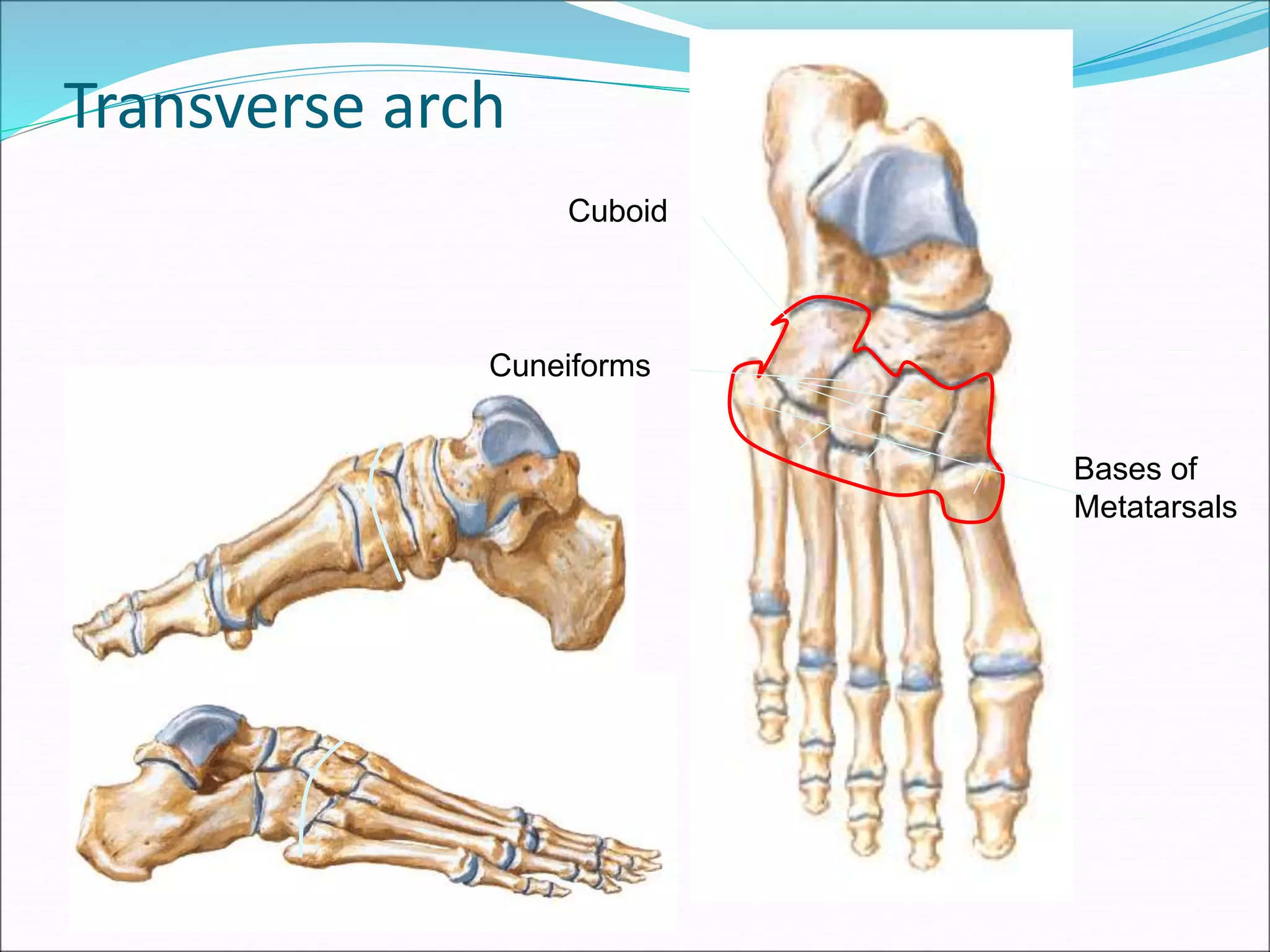
TRANSVERSE ARCH
 Formed by the greater part parts tarsus and metatarsus.
 Incomplete because only the lateral end comes in contact
with the ground. The arch forming half dome which is
completed by a similar half dome of the opposite foot.
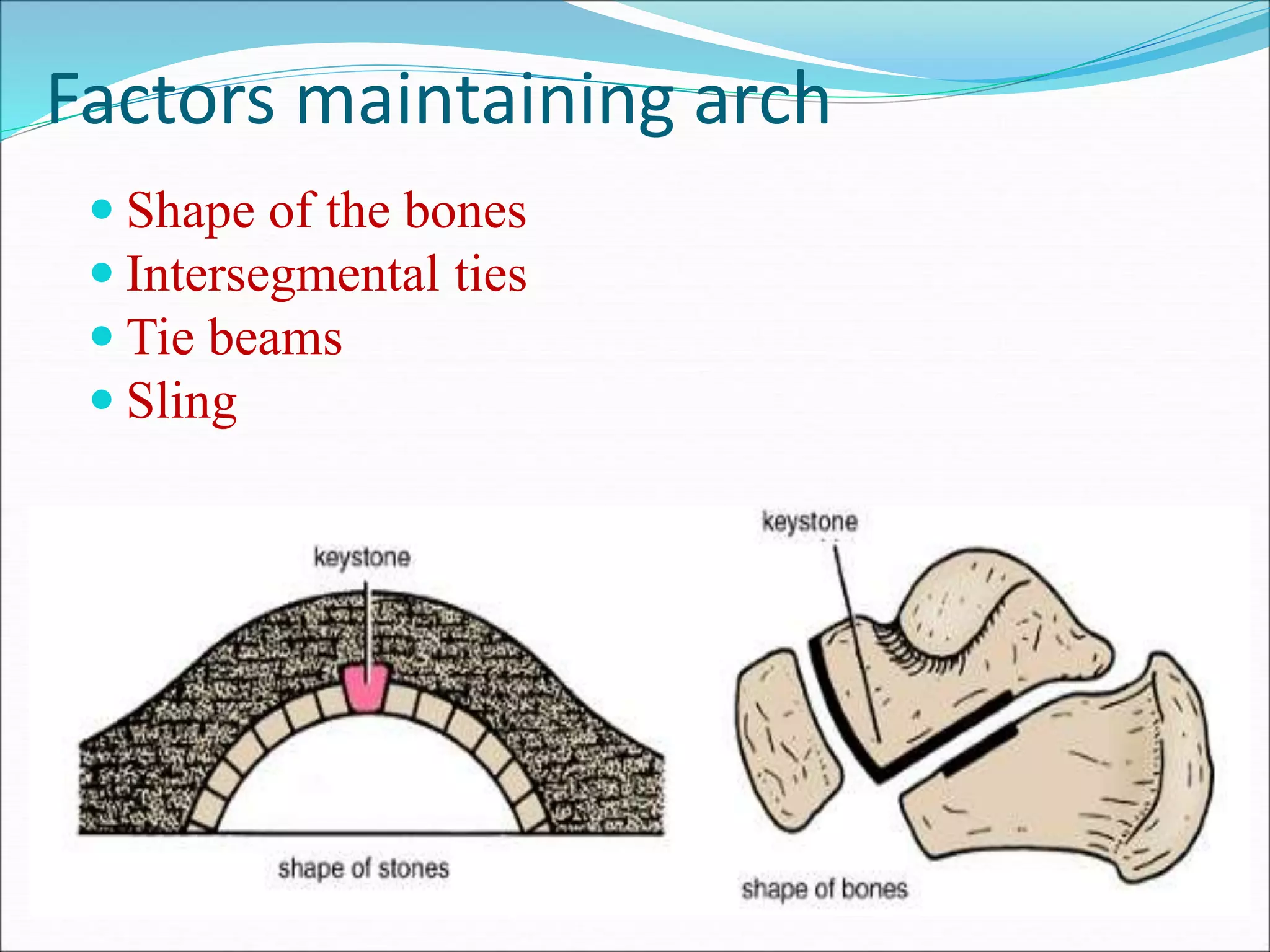
Factors maintaining arch
 Shape of the bones
 Intersegmental ties
 Tie beams
 Sling
MAINTENANCE OF OF ARCHES
MEDIAL LONGITUDINAL ARCHES
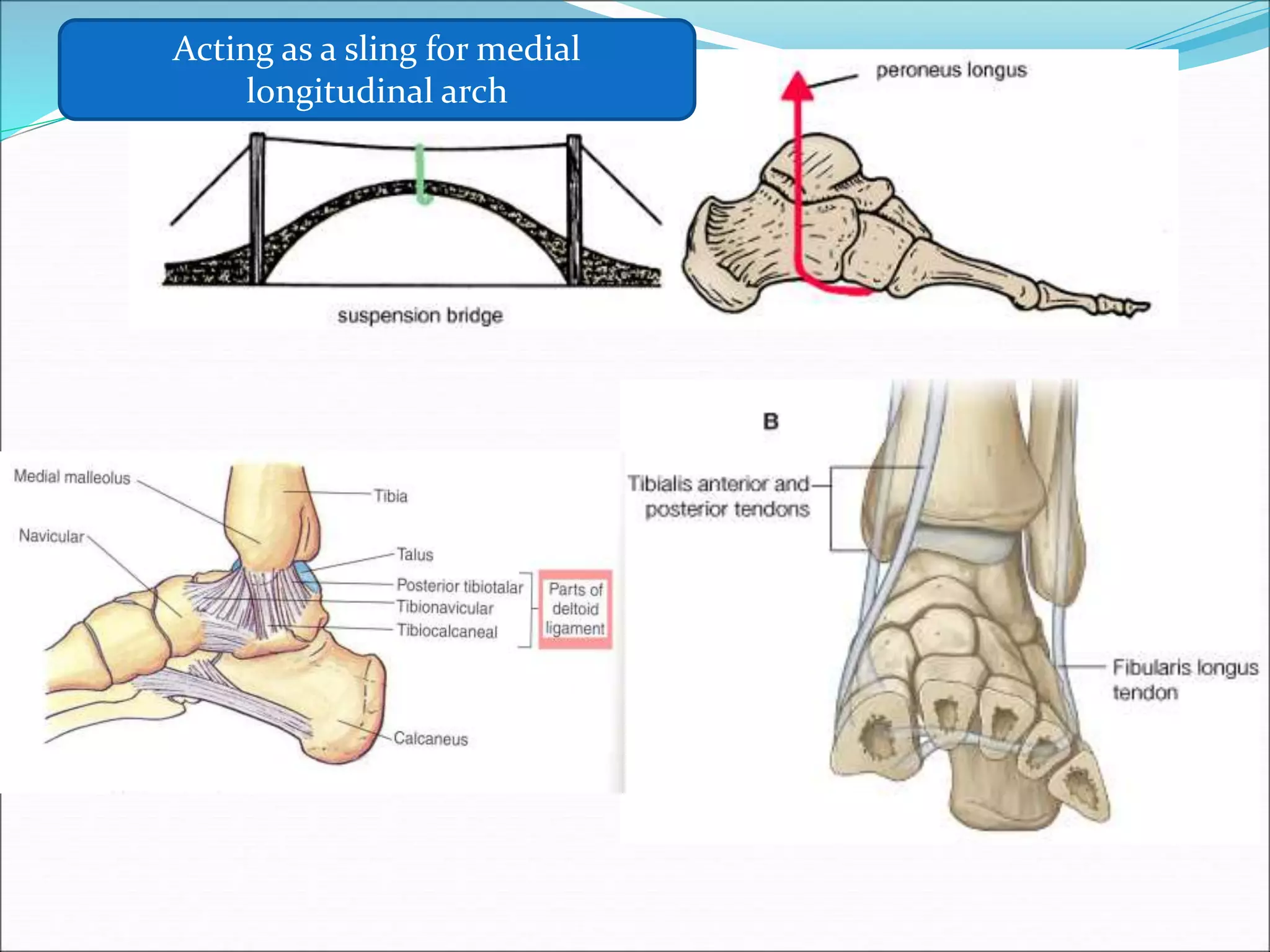
Summit is pulled upwards by tendons passing from
post.compartment of leg.
Bony configuration
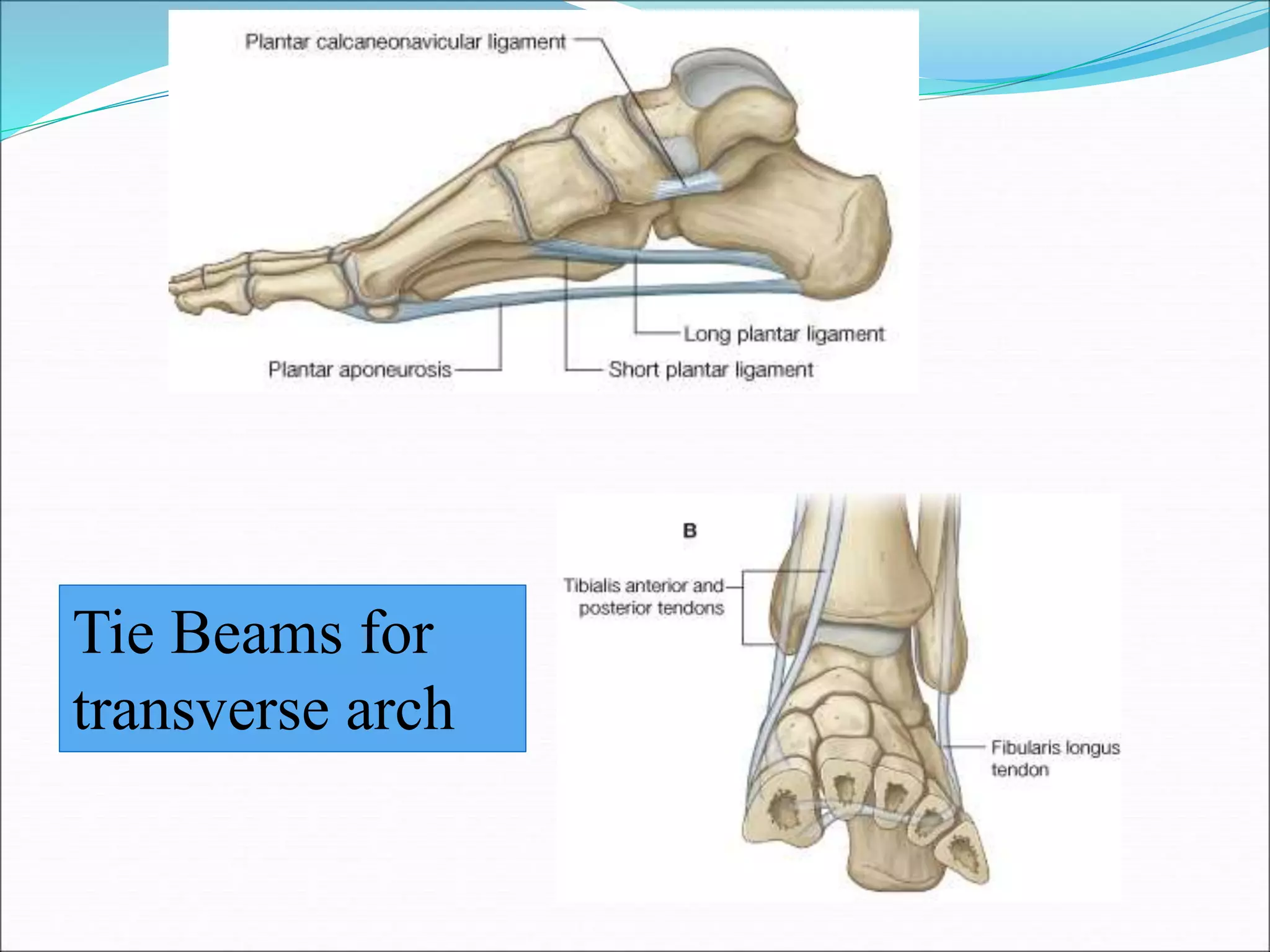
Plantar ligament
Plantar aponeurosis
Spring ligament
Tibialis posterior
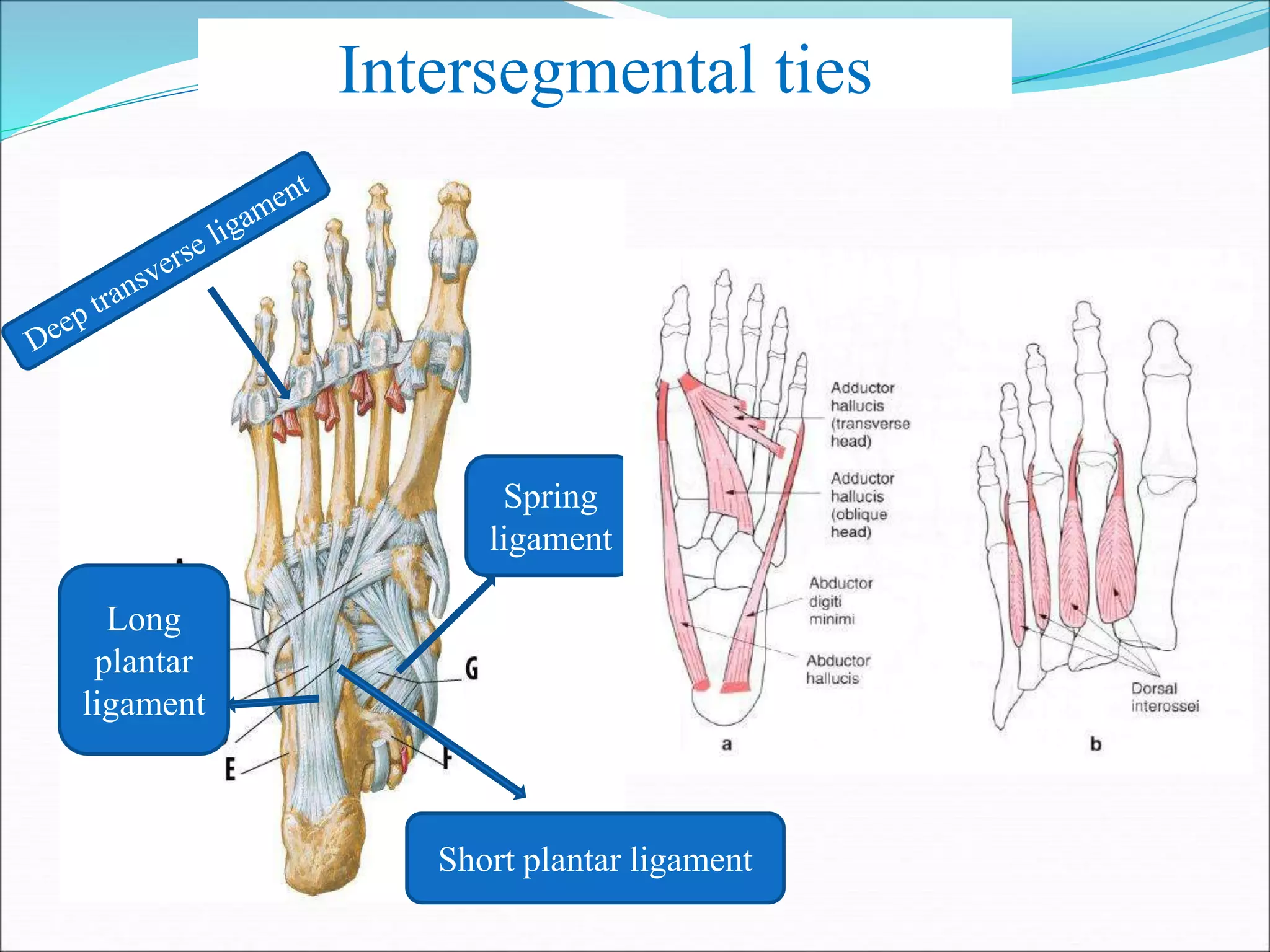
Intersegmental ties
Short plantar ligament
Long
plantar
ligament
Spring
ligament
Tie Beams for
longitudinal arches
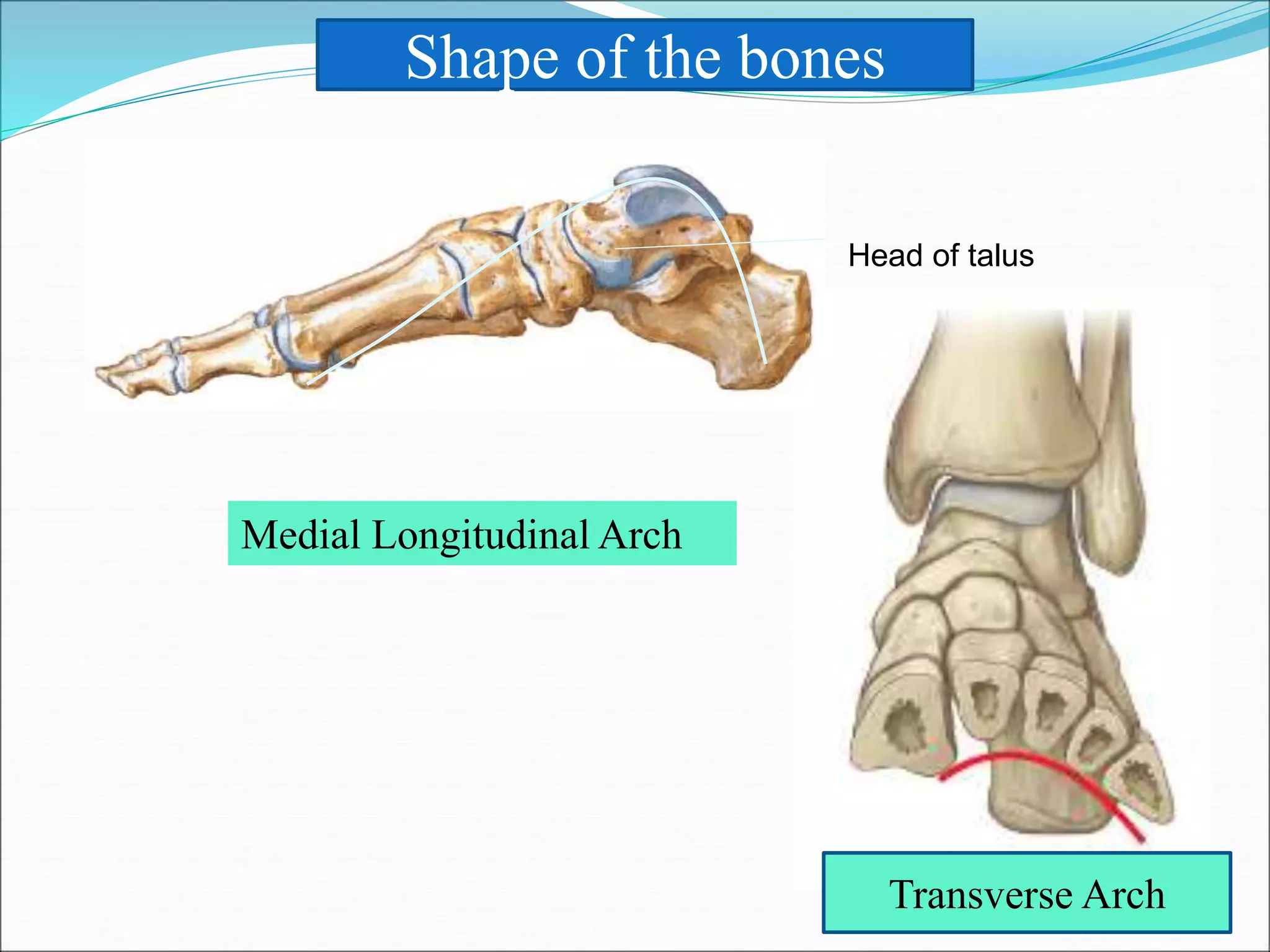
Medial Longitudinal Arch
Head of talus
Shape of the bones
Transverse Arch
Acting as a sling for medial
longitudinal arch
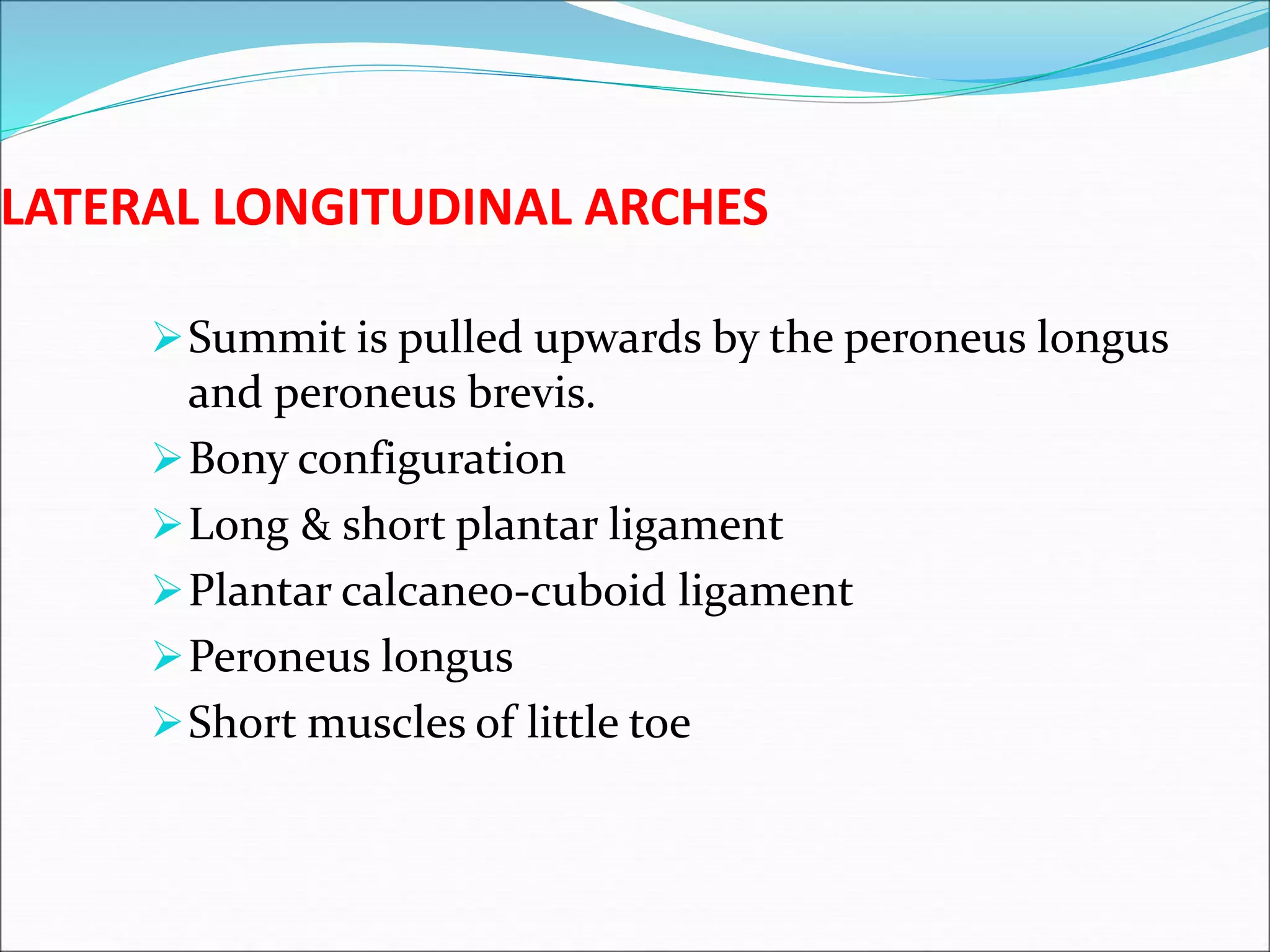
LATERAL LONGITUDINAL ARCHES
Summit is pulled upwards by the peroneus longus
and peroneus brevis.
Bony configuration
Long & short plantar ligament
Plantar calcaneo-cuboid ligament
Peroneus longus
Short muscles of little toe
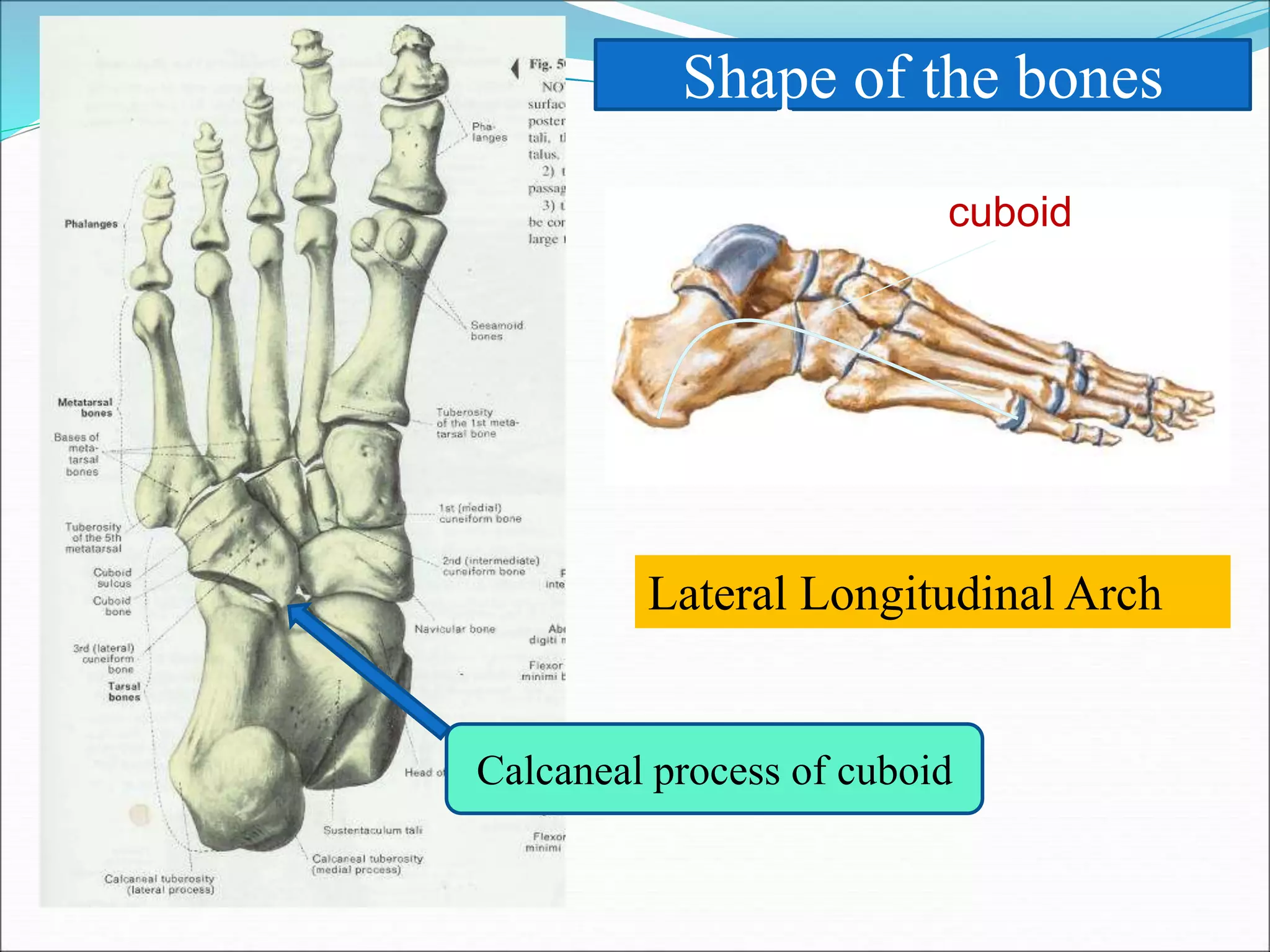
cuboid
Lateral Longitudinal Arch
Shape of the bones
Calcaneal process of cuboid
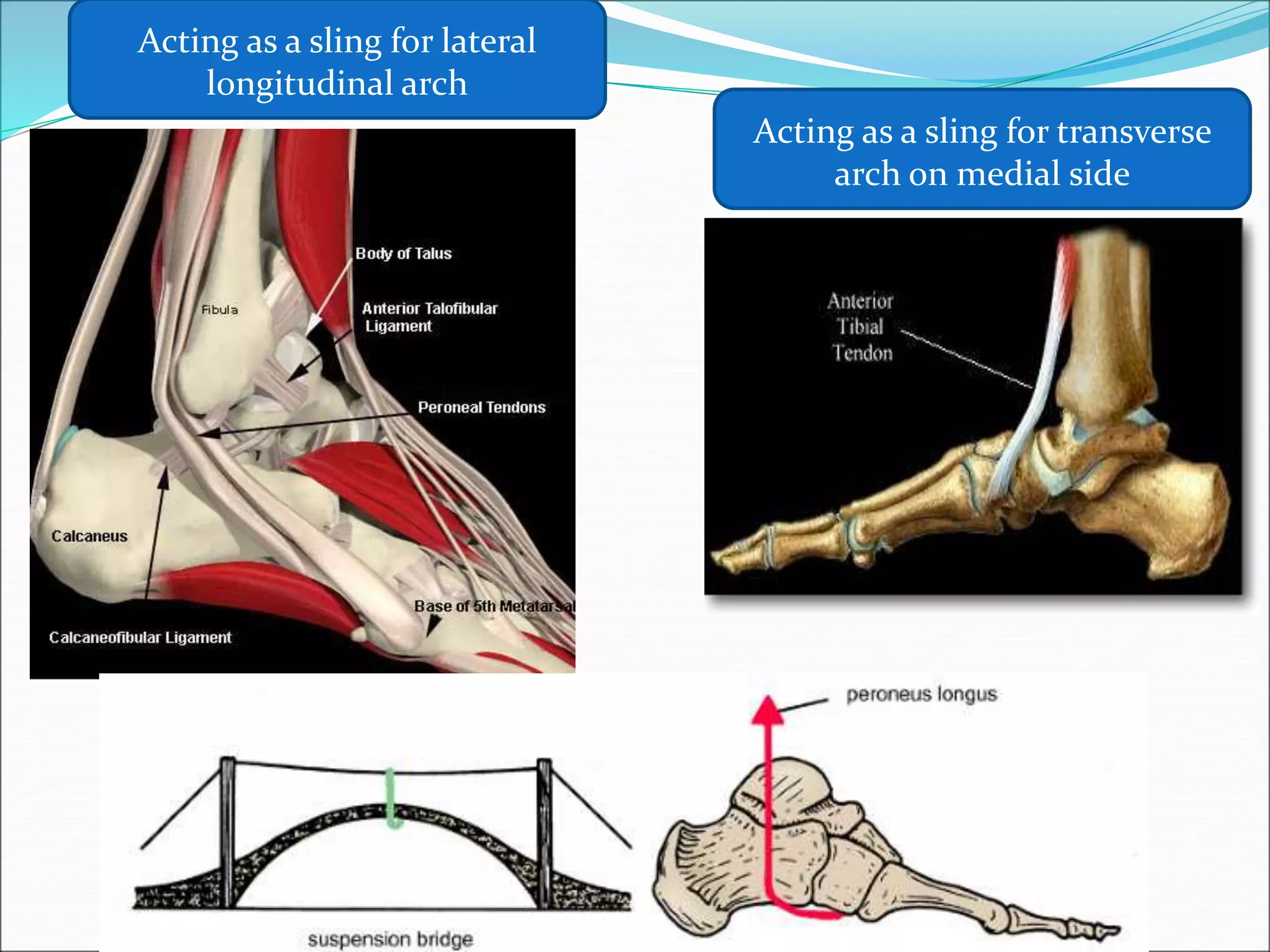
Acting as a sling for lateral
longitudinal arch
Acting as a sling for transverse
arch on medial side
TRANSVERSE ARCHES
Bony configuration
Plantar ligaments
Tibialis posterior
Peroneus longus
Tie Beams for
transverse arch
Functions of the arches of the foot
 Help in proportional distribution of body weight to the
ground
 Act as spring and helps in propulsion during running
and walking
 Act as shock absorbers in stepping particularly in
jumping
 Protect the soft tissues of the sole (like vessels and
nerves) against pressure
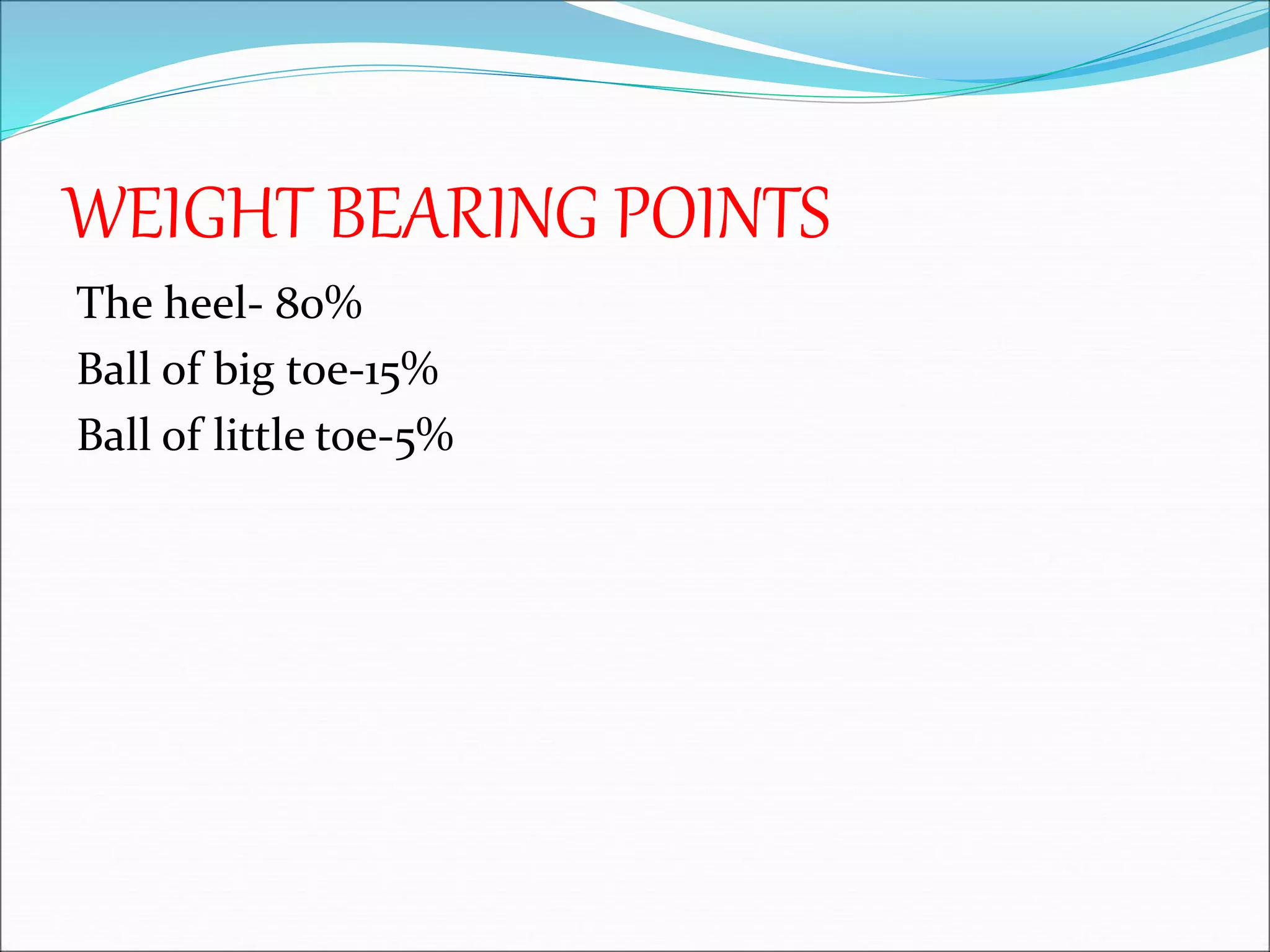
WEIGHT BEARING POINTS
The heel- 80%
Ball of big toe-15%
Ball of little toe-5%
APPLIED ANATOMY
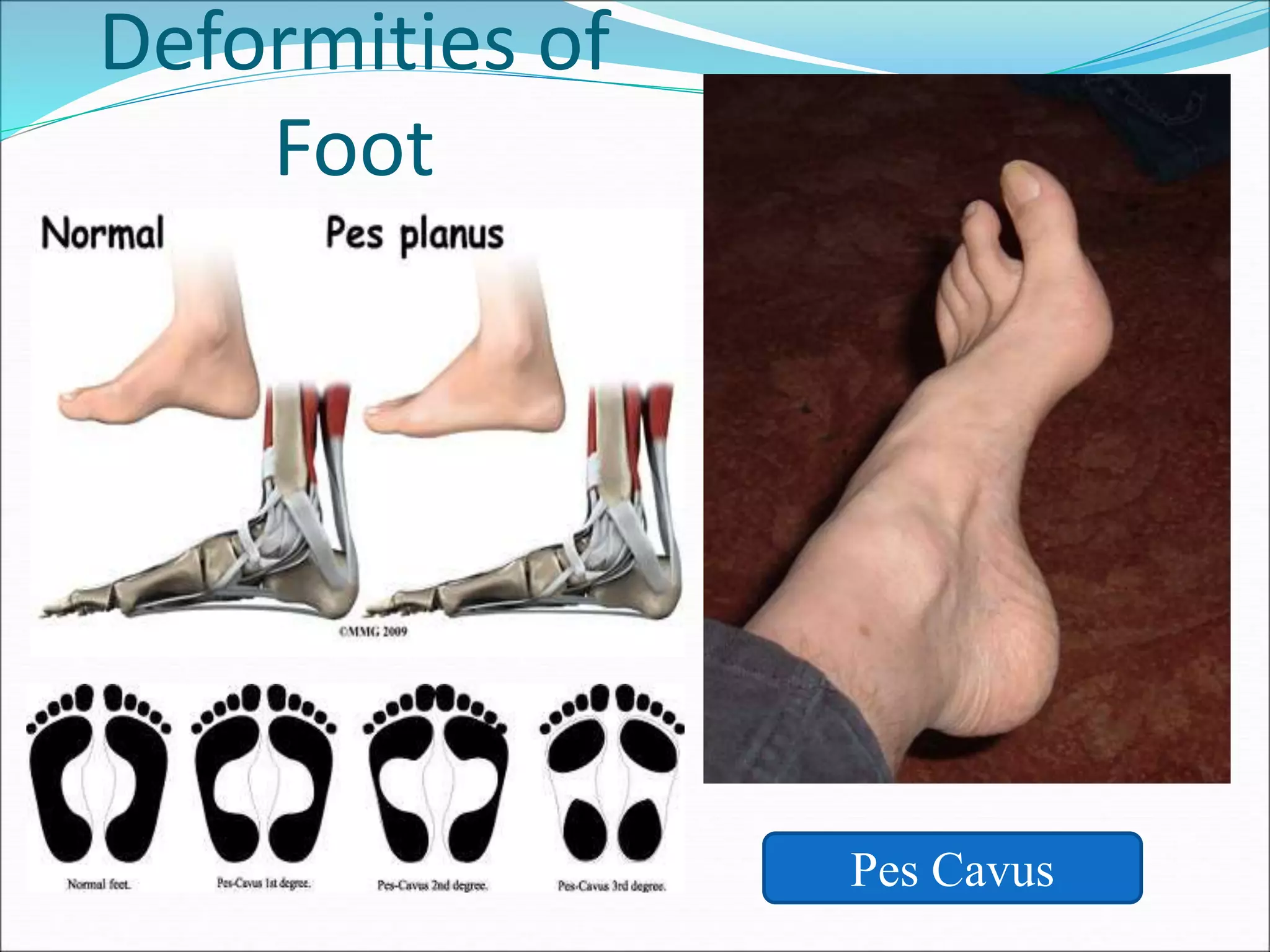
Flat foot ( pes planus)- commonest of all foot troubles
associated with loss of arches of foot.
Pes cavus- exaggeration of longitudinal arches.
Club foot
 Talipes equinus
 Talipes calcaneus
 Talipes varus
 Talipes valgus
 TALIPES EQUINO-VARUS (commonest)
March foot
Hallux valgus
Hammar toe
Deformities of
Foot
Pes Cavus
CLAW FoOT
Dorsiflexion of metatarsophalangeal joint & planter
flexion of interphalangeal joints due to atrophy of
lumbricals and interossei is known as ‘claw foot’
Arches of foot.ppt

Arches of foot.ppt