
Ms.Shilpi Damor
Assistant Professor, Deptt. of Zoology
Poddar Group of Institutions,jaipur
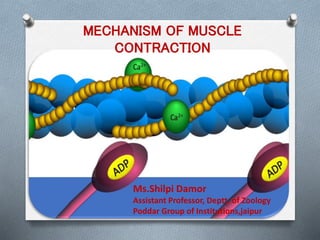
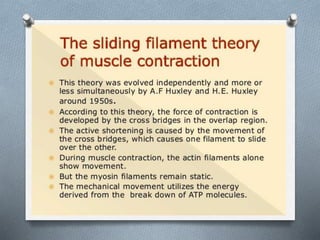
MECHANISM OF MUSCLE
CONTRACTION
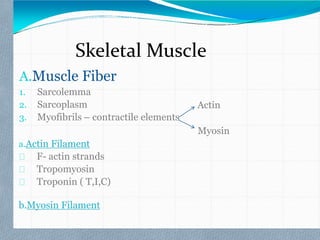
Skeletal Muscle
Actin
A.Muscle Fiber
1. Sarcolemma
2. Sarcoplasm
3. Myofibrils – contractile elements
Myosin
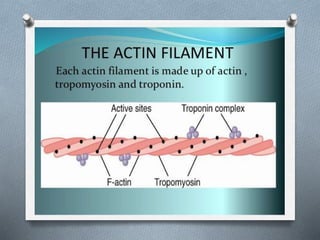
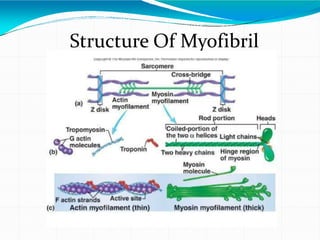
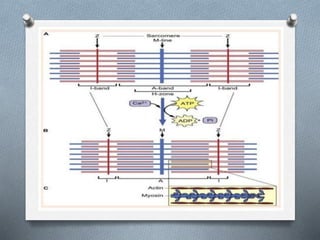
a.Actin Filament
F- actin strands
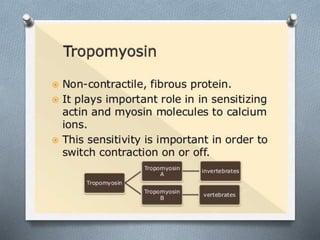
Tropomyosin
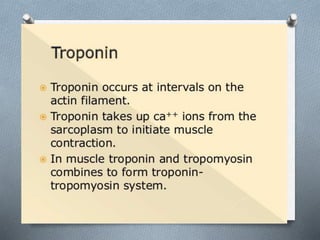
Troponin ( T,I,C)
b.Myosin Filament
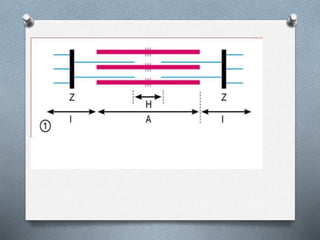
Structure Of Myofibril
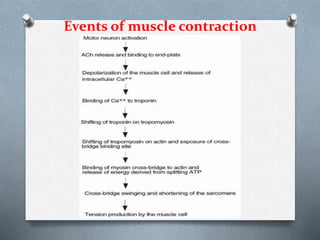
Events of muscle contraction
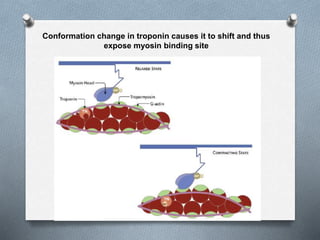
Conformation change in troponin causes it to shift and thus
expose myosin binding site
Excitation–Contraction
Coupling
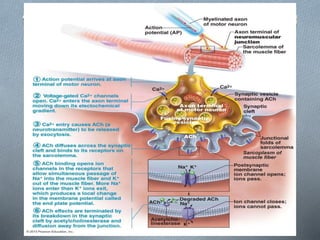
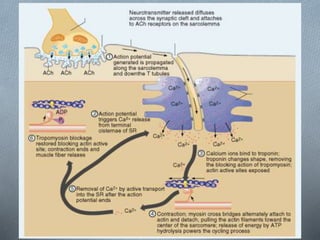
Excitation–contraction coupling is the physiological process of
converting an electrical stimulus to a mechanical response. It is the link
(transduction) between the action potential generated in the
sarcolemma and the start of a muscle contraction.
NOTE:
• Muscle contractions can be described based on two variables:
length and tension.
• A muscle contraction is described as isometric if the muscle
tension changes but the muscle length remains the same.
• In contrast, a muscle contraction is isotonic if muscle tension
remains the same throughout the contraction.
• If the muscle length shortens, the contraction is concentric; if
the muscle length lengthens, the contraction is eccentric.
• Therefore, neither length nor tension is likely to remain the
same in muscles that contract during loco motor activity.
Muscle twitch
Muscle twitch
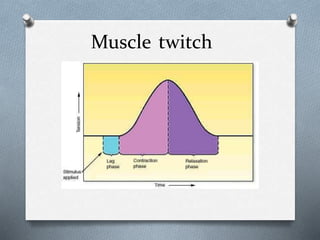
• A single action potential causes a
brief contraction followed by
relaxation
• This response is called a muscle twitch.
• The twitch starts about 2 ms after the
start of depolarization of the membrane,
before repolarization is complete
Muscle twitch
• Duration of the twitch varies with the type of muscle
being tested
• Fast muscle fibers, primarily those concerned with
fine, rapid, precise movement, have twitch durations
as short as 7.5 ms
• Slow muscle fibers, principally those involved in
strong, gross, sustained movements have twitch
durations up to 100 ms
• The strength of twitch depends on the number of
motor units activated
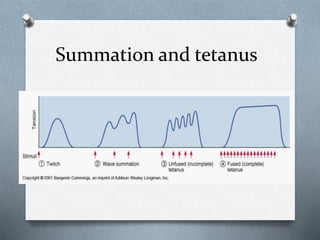
Summation and tetanus
Summation
• If 2 stimuli are delivered in rapid succession the
second twitch will be greater than the first
• This only occurs if repolarization is not
complete
• The tension developed during summation is
considerably greater than that during the single
muscle twitch
Tetanus
• With rapidly repeated stimulation, activation
of the contractile mechanism occurs
repeatedly before any relaxation has
occurred
• Individual responses fuse into one
continuous contraction
• Such a response is called a tetanus or
tetanic contraction
Tetanus
• It is a complete tetanus when there is no
relaxation between stimuli and an incomplete
tetanus when there are periods of incomplete
relaxation between the summated stimuli
• During a complete tetanus, the tension developed
is about four times that developed by the
individual twitch contractions
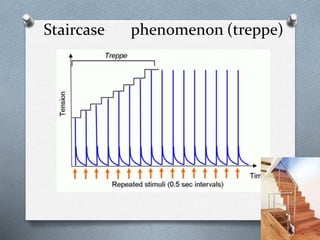
Staircase phenomenon (treppe)
• When a series of stimuli is delivered to skeletal
muscle, there is
an increase in the tension developed during each
twitch until,
after several contractions, a uniform tension per
contraction is reached
• This phenomenon is known as treppe, or the
"staircase" phenomenon
• This is the basis of “warm up”
• Treppe is believed to be due to increased
availability of Ca2+ for binding to troponin C,
accumulation of heat or effect of pH
• It also occurs in cardiac muscle although
cardiac muscles cannot be tetanised
• It should not be confused with summation of
contractions and tetanus
Staircase phenomenon (treppe)
Muscle contraction

Muscle contraction

  • 1.
    Ms.Shilpi Damor Assistant Professor,Deptt. of Zoology Poddar Group of Institutions,jaipur MECHANISM OF MUSCLE CONTRACTION
  • 2.
    Skeletal Muscle Actin A.Muscle Fiber 1.Sarcolemma 2. Sarcoplasm 3. Myofibrils – contractile elements Myosin a.Actin Filament F- actin strands Tropomyosin Troponin ( T,I,C) b.Myosin Filament
  • 9.
  • 15.
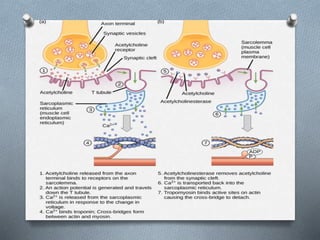
    Events of musclecontraction
  • 17.
    Conformation change introponin causes it to shift and thus expose myosin binding site
  • 18.
    Excitation–Contraction Coupling Excitation–contraction coupling isthe physiological process of converting an electrical stimulus to a mechanical response. It is the link (transduction) between the action potential generated in the sarcolemma and the start of a muscle contraction.
  • 20.
    NOTE: • Muscle contractionscan be described based on two variables: length and tension. • A muscle contraction is described as isometric if the muscle tension changes but the muscle length remains the same. • In contrast, a muscle contraction is isotonic if muscle tension remains the same throughout the contraction. • If the muscle length shortens, the contraction is concentric; if the muscle length lengthens, the contraction is eccentric. • Therefore, neither length nor tension is likely to remain the same in muscles that contract during loco motor activity.
  • 27.
  • 28.
    Muscle twitch • Asingle action potential causes a brief contraction followed by relaxation • This response is called a muscle twitch. • The twitch starts about 2 ms after the start of depolarization of the membrane, before repolarization is complete
  • 29.
    Muscle twitch • Durationof the twitch varies with the type of muscle being tested • Fast muscle fibers, primarily those concerned with fine, rapid, precise movement, have twitch durations as short as 7.5 ms • Slow muscle fibers, principally those involved in strong, gross, sustained movements have twitch durations up to 100 ms • The strength of twitch depends on the number of motor units activated
  • 30.
  • 31.
    Summation • If 2stimuli are delivered in rapid succession the second twitch will be greater than the first • This only occurs if repolarization is not complete • The tension developed during summation is considerably greater than that during the single muscle twitch
  • 32.
    Tetanus • With rapidlyrepeated stimulation, activation of the contractile mechanism occurs repeatedly before any relaxation has occurred • Individual responses fuse into one continuous contraction • Such a response is called a tetanus or tetanic contraction
  • 33.
    Tetanus • It isa complete tetanus when there is no relaxation between stimuli and an incomplete tetanus when there are periods of incomplete relaxation between the summated stimuli • During a complete tetanus, the tension developed is about four times that developed by the individual twitch contractions
  • 34.
    Staircase phenomenon (treppe) •When a series of stimuli is delivered to skeletal muscle, there is an increase in the tension developed during each twitch until, after several contractions, a uniform tension per contraction is reached • This phenomenon is known as treppe, or the "staircase" phenomenon • This is the basis of “warm up” • Treppe is believed to be due to increased availability of Ca2+ for binding to troponin C, accumulation of heat or effect of pH • It also occurs in cardiac muscle although cardiac muscles cannot be tetanised • It should not be confused with summation of contractions and tetanus
  • 35.