MICROENVIRONMENT OF NEURONS-
REVIEW OF BLOOD BRAIN BARRIER &
IMPORTANT
RK GOIT, LECTURER
DEPARTMENT OF PHYSIOLOGY
Cerebral blood flow
• the principal arterial inflow to the brain in human is via
four arteries: two internal carotids & two vertebrals
• blood flow to the brain is about 750 ml/min (15% of the
cardiac output)
• cerebral blood flow is 50ml/100g/min of brain tissue
• three metabolic factors have potent effects in controlling
cerebral blood flow:
• CO2 concentration
• H+ concentration
• O2 concentration
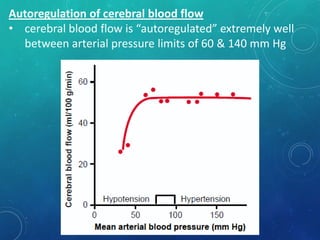
Autoregulation of cerebral blood flow
• cerebral blood flow is “autoregulated” extremely well
between arterial pressure limits of 60 & 140 mm Hg
Cerebral microcirculation
• the number of blood capillaries in the brain is greatest
where the metabolic needs are greatest
• the number of capillaries & rate of blood flow are about
four times as great as that of white matter in the gray
matter
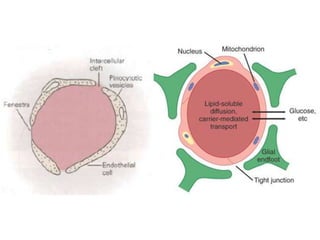
• brain capillaries are much less “leaky” than the blood
capillaries in almost any other tissue of the body
• the capillaries are supported on all sides by “glial feet,” &
provide physical support to prevent overstretching of the
capillaries
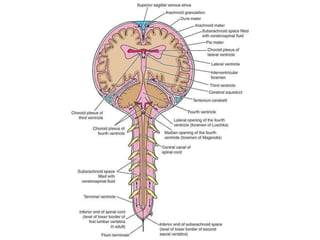
Cerebrospinal fluid
• a clear, colorless, almost protein free filtrate of blood
• volume is about 150 ml & rate of production is 550ml/d
• 50-70% of the CSF is formed in the choroid plexuses & the
remainder is formed around blood vessel & along
ventricular walls
• is present around the brain & spinal cord (in the
subarachnoid space) as well as inside the brain & spinal
cord (in its ventricles & the central canal respectively)
• all these chambers are connected with one another, & the
pressure of the fluid is maintained at a constant level
Functions of CSF
1. Mechanical protection
• serves as a cushion between the CNS & surrounding bones, thus
protecting it against mechanical trauma
• also buoys the brain so that it “floats” in cranial cavity
2. Homeostatic function
• pH of the CSF affects pulmonary ventilation & cerebral blood flow
• CSF also serves as a transport system for polypeptide hormones
secreted by hypothalamic neurons
3. Circulation
• CSF is a medium for minor exchange of nutrients & waste products
between the blood & adjacent nervous tissue
Formation
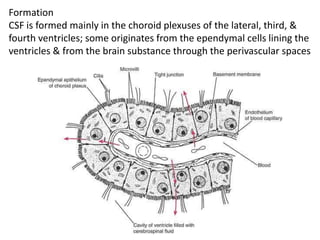
CSF is formed mainly in the choroid plexuses of the lateral, third, &
fourth ventricles; some originates from the ependymal cells lining the
ventricles & from the brain substance through the perivascular spaces
Absorption
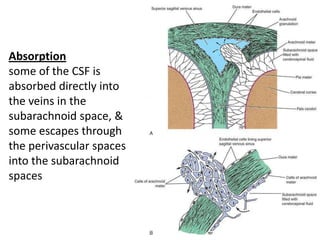
some of the CSF is
absorbed directly into
the veins in the
subarachnoid space, &
some escapes through
the perivascular spaces
into the subarachnoid
spaces
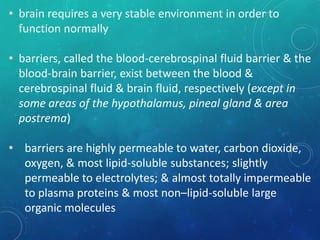
• brain requires a very stable environment in order to
function normally
• barriers, called the blood-cerebrospinal fluid barrier & the
blood-brain barrier, exist between the blood &
cerebrospinal fluid & brain fluid, respectively (except in
some areas of the hypothalamus, pineal gland & area
postrema)
• barriers are highly permeable to water, carbon dioxide,
oxygen, & most lipid-soluble substances; slightly
permeable to electrolytes; & almost totally impermeable
to plasma proteins & most non–lipid-soluble large
organic molecules
•
Blood brain barrier

Blood brain barrier

  • 1.
    MICROENVIRONMENT OF NEURONS- REVIEWOF BLOOD BRAIN BARRIER & IMPORTANT RK GOIT, LECTURER DEPARTMENT OF PHYSIOLOGY
  • 2.
    Cerebral blood flow •the principal arterial inflow to the brain in human is via four arteries: two internal carotids & two vertebrals • blood flow to the brain is about 750 ml/min (15% of the cardiac output) • cerebral blood flow is 50ml/100g/min of brain tissue • three metabolic factors have potent effects in controlling cerebral blood flow: • CO2 concentration • H+ concentration • O2 concentration
  • 3.
    Autoregulation of cerebralblood flow • cerebral blood flow is “autoregulated” extremely well between arterial pressure limits of 60 & 140 mm Hg
  • 4.
    Cerebral microcirculation • thenumber of blood capillaries in the brain is greatest where the metabolic needs are greatest • the number of capillaries & rate of blood flow are about four times as great as that of white matter in the gray matter • brain capillaries are much less “leaky” than the blood capillaries in almost any other tissue of the body • the capillaries are supported on all sides by “glial feet,” & provide physical support to prevent overstretching of the capillaries
  • 5.
    Cerebrospinal fluid • aclear, colorless, almost protein free filtrate of blood • volume is about 150 ml & rate of production is 550ml/d • 50-70% of the CSF is formed in the choroid plexuses & the remainder is formed around blood vessel & along ventricular walls • is present around the brain & spinal cord (in the subarachnoid space) as well as inside the brain & spinal cord (in its ventricles & the central canal respectively) • all these chambers are connected with one another, & the pressure of the fluid is maintained at a constant level
  • 6.
    Functions of CSF 1.Mechanical protection • serves as a cushion between the CNS & surrounding bones, thus protecting it against mechanical trauma • also buoys the brain so that it “floats” in cranial cavity 2. Homeostatic function • pH of the CSF affects pulmonary ventilation & cerebral blood flow • CSF also serves as a transport system for polypeptide hormones secreted by hypothalamic neurons 3. Circulation • CSF is a medium for minor exchange of nutrients & waste products between the blood & adjacent nervous tissue
  • 7.
    Formation CSF is formedmainly in the choroid plexuses of the lateral, third, & fourth ventricles; some originates from the ependymal cells lining the ventricles & from the brain substance through the perivascular spaces
  • 9.
    Absorption some of theCSF is absorbed directly into the veins in the subarachnoid space, & some escapes through the perivascular spaces into the subarachnoid spaces
  • 10.
    • brain requiresa very stable environment in order to function normally • barriers, called the blood-cerebrospinal fluid barrier & the blood-brain barrier, exist between the blood & cerebrospinal fluid & brain fluid, respectively (except in some areas of the hypothalamus, pineal gland & area postrema) • barriers are highly permeable to water, carbon dioxide, oxygen, & most lipid-soluble substances; slightly permeable to electrolytes; & almost totally impermeable to plasma proteins & most non–lipid-soluble large organic molecules
  • 11.