
INDUCTIVE TRANSDUCER
INTRODUCTION
Inductive transducer work on the
principle of inductance change due to
any appreciable change in the quantity
to be measured .
I.e. measured. For example, LVDT, a
kind of inductive transducers, measures
displacement in terms of voltage
difference between its two secondary
voltages.
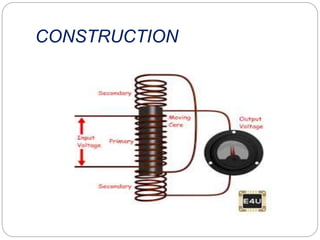
LVDT
 An inductive transducer is a device that
converts physical motion into a change
in inductance.
Number of turns
Geometric configuration
Permeability of the magnetic
material or magnetic circuits.
CONSTRUCTION
VARIABLE INDUCTANCE
TRANSDUCERS
Inductance is a measure that relates
electrical flux to current .
Inductance reactance is a measure of the
inductive effect can be expressed as,
X=2 PIE FL
Where X is the inductive reactance in
ohms, f is the frequency of the applied
voltage in HZ and L is the inductance in
henry s.
PRINCIPLE
 Change of self inductance
 Change of mutual inductance
 Production of eddy current
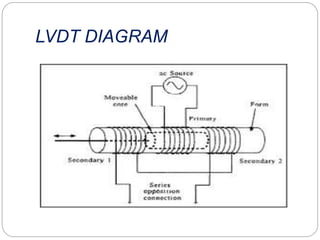
LVDT DIAGRAM
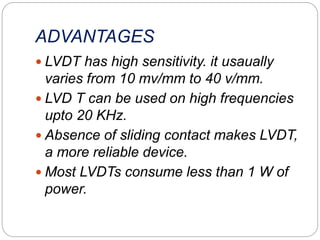
ADVANTAGES
 LVDT has high sensitivity. it usaually
varies from 10 mv/mm to 40 v/mm.
 LVD T can be used on high frequencies
upto 20 KHz.
 Absence of sliding contact makes LVDT,
a more reliable device.
 Most LVDTs consume less than 1 W of
power.
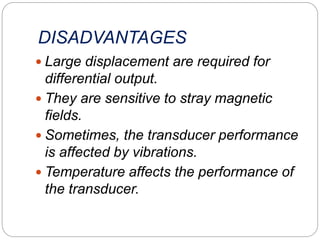
DISADVANTAGES
 Large displacement are required for
differential output.
 They are sensitive to stray magnetic
fields.
 Sometimes, the transducer performance
is affected by vibrations.
 Temperature affects the performance of
the transducer.
THANK YOU…

Inductive transducer

  • 1.
  • 2.
    INTRODUCTION Inductive transducer workon the principle of inductance change due to any appreciable change in the quantity to be measured . I.e. measured. For example, LVDT, a kind of inductive transducers, measures displacement in terms of voltage difference between its two secondary voltages.
  • 3.
    LVDT  An inductivetransducer is a device that converts physical motion into a change in inductance. Number of turns Geometric configuration Permeability of the magnetic material or magnetic circuits.
  • 4.
  • 5.
    VARIABLE INDUCTANCE TRANSDUCERS Inductance isa measure that relates electrical flux to current . Inductance reactance is a measure of the inductive effect can be expressed as, X=2 PIE FL Where X is the inductive reactance in ohms, f is the frequency of the applied voltage in HZ and L is the inductance in henry s.
  • 6.
    PRINCIPLE  Change ofself inductance  Change of mutual inductance  Production of eddy current
  • 7.
  • 8.
    ADVANTAGES  LVDT hashigh sensitivity. it usaually varies from 10 mv/mm to 40 v/mm.  LVD T can be used on high frequencies upto 20 KHz.  Absence of sliding contact makes LVDT, a more reliable device.  Most LVDTs consume less than 1 W of power.
  • 9.
    DISADVANTAGES  Large displacementare required for differential output.  They are sensitive to stray magnetic fields.  Sometimes, the transducer performance is affected by vibrations.  Temperature affects the performance of the transducer.
  • 10.