Download as PDF, PPTX










![Introduction
Introduction
Theory :
Constant Current power Supply :-
This electric field depends upon cross product of magnetic flux density [B] and current density [ J ].
R is called Hall Coefficient
Here, Ey is induced electric field
V is Hall voltage
B is magnetic flux density
jx is current density
n is charge carrier density
t is thickness of crystal
The hall coefficient is positive if the number of positive charge carriers is more than the negative
charge carriers. Similarly, it is negative when electrons are more than holes.
H
H](https://image.slidesharecdn.com/halleffect-221008114923-91e41341/75/Hall-effect-26-2048.jpg)
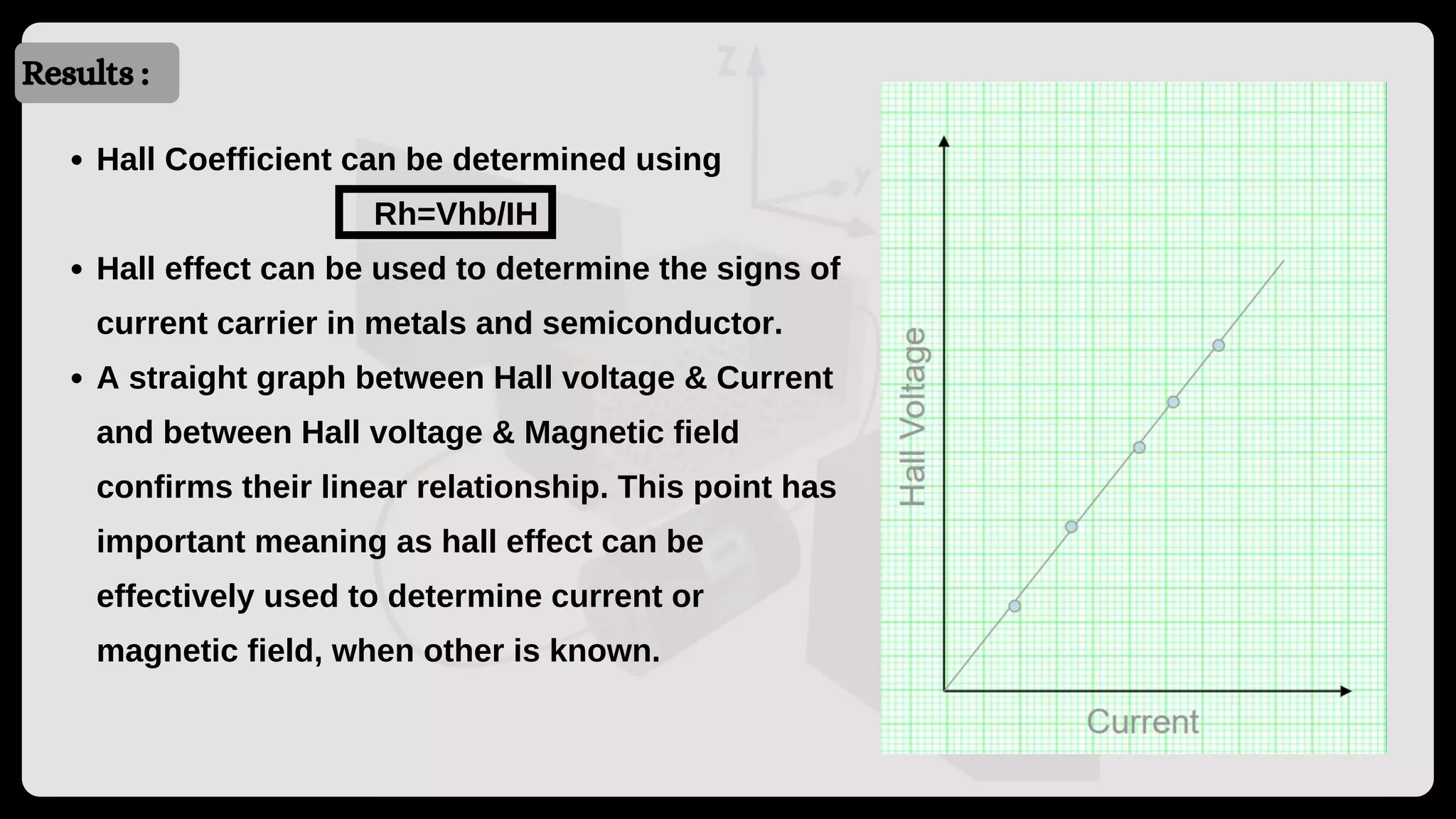

The Hall effect occurs when a conductor carrying a current is placed in a magnetic field perpendicular to the current. This causes charge carriers to be deflected to the sides of the conductor, creating a measurable voltage known as the Hall voltage. The Hall effect is used to determine properties like carrier density and type in materials. When a current-carrying semiconductor is in a perpendicular magnetic field, the Hall voltage is directly proportional to the current and magnetic field. Measuring this Hall voltage allows determining the Hall coefficient, which provides information about the dominant charge carriers in the material.


![3. Electric charge and electric fields [12hrs].pptx](https://cdn.slidesharecdn.com/ss_thumbnails/3-250325125403-64ebc3f7-thumbnail.jpg?width=640&height=640&fit=bounds)


