CURRENT AND POWER USING
HALL SENSORS
Hall effect sensors
 Hall effect was discovered in 1879 by
Edward H. Hall
 Exists in all conducting materials
 Is particularly pronounced and useful in
semiconductors.
 One of the simplest of all magnetic
sensing devices
 Used extensively in sensing position and
measuring magnetic fields
Hall effect - principles
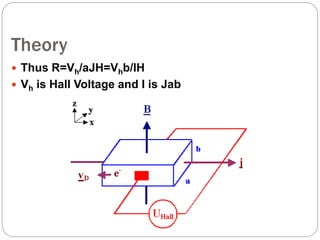
 Consider a block of conducting medium through
which a current of electrons is flowing caused by
an external field
 A magnetic filed B is established across the
conductor, perpendicular to the current (.
 The electrons flow at a velocity v
 A force perpendicular to both the current and
field is established.
F= qvBsinvb [N]
Theory
 Thus R=Vh/aJH=Vhb/IH
 Vh is Hall Voltage and I is Jab
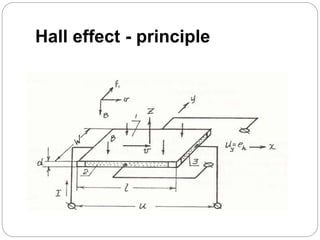
Hall effect - principle
Hall effect - principles
 The electrons are pulled towards the front
side surface of the conductor (holes in
semiconductors move towards the back)
 A voltage develops between the back
(positive) and front (negative) surface. This
voltage is the Hall voltage and is given by:
Vout = IB
qnd
V
d is the thickness of the hall plate,
n is the carrier density [charges/m3] and
q is the charge of the electron [C]
 If the current changes direction or the magnetic
field changes direction, the polarity of the Hall
voltage flips.
 The Hall effect sensor is polarity dependent,
 may be used to measure direction of a field
 or direction of motion if the sensor is properly set up.
 The term 1/qn [m3/C] is material dependent
and is called the Hall coefficient KH.
Hall coefficient
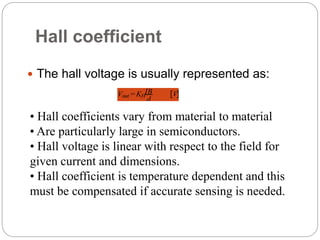
 The hall voltage is usually represented as:
Vout = KH
IB
d
V
• Hall coefficients vary from material to material
• Are particularly large in semiconductors.
• Hall voltage is linear with respect to the field for
given current and dimensions.
• Hall coefficient is temperature dependent and this
must be compensated if accurate sensing is needed.
Hall coefficient - cont.
 Hall coefficient is rather small - of the
order of 50 mV/T
 Most sensed fields are smaller than 1 T
 The Hall voltage can be as small as a few
V
 Must in almost all cases be amplified.
 Example, the earth’s magnetic field is only
about 50 T so that the output is a mere 25
V
Hall effect sensors - practical
considerations
 Hall voltages are easily measurable
quantities
 Hall sensors are among the most
commonly used sensors for magnetic
fields:
 simple, linear, very inexpensive, available in
arrays
 can be integrated within devices.
 Errors involved in measurement are
mostly due to temperature and variations
and the averaging effect of the Hall plate
size
 These can be compensated by appropriate
Hall effect sensors - fabrication
 A typical sensor will be a rectangular wafer of
small thickness
 Made of p or n doped semiconductor (InAs and
InSb are most commonly used because of their
larger carrier densities – hence larger Hall
coefficients)
 Silicon may also be used with reduced sensitivity)
 The sensor is usually identified by the two
transverse resistances – the control resistance
through which the control current flows and the
output resistance across which the Hall voltage
develops.
Hall effect sensors - applications
 In practical applications, the current is usually
kept constant so that the output voltage is
proportional to the field.
 The sensor may be used to measure field
(provided proper compensation can be
incorporated)
 It may be used as a detector or to operate a
switch.
 The latter is very common in sensing of
rotation which in itself may be used to
measure a variety of effect (shaft position,
frequency of rotation (rpm), position,
differential position, etc.).
Hall effect sensors - applications
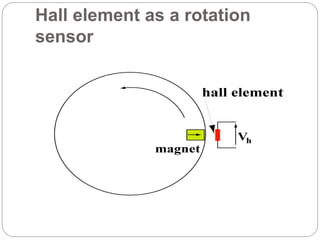
 Example is shown in Figure 5.31 where the rpm
of a shaft is sensed.
 Many variations of this basic configuration: for
example, measurement of angular displacement.
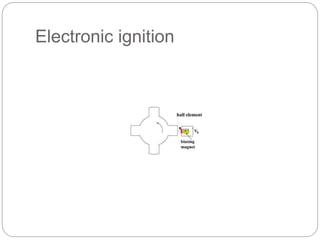
 Sensing of gears (electronic ignition)
 Multiple sensors can sense direction as well
Hall element as a rotation
sensor
Electronic ignition
Hall effect sensors -
applications
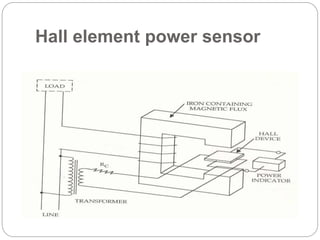
 Example: measuring power
 The magnetic field through the hall element is
proportional to the current being measured
 The current is proportional to voltage being
measured
 The Hall voltage is proportional to product of
current and voltage - power
Hall element power sensor
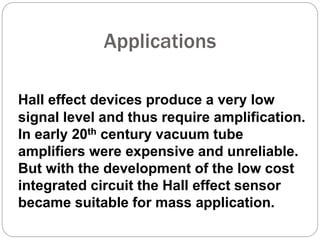
Applications
Hall effect devices produce a very low
signal level and thus require amplification.
In early 20th century vacuum tube
amplifiers were expensive and unreliable.
But with the development of the low cost
integrated circuit the Hall effect sensor
became suitable for mass application.
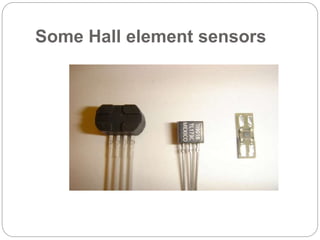
Some Hall element sensors
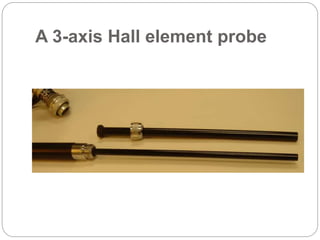
A 3-axis Hall element probe
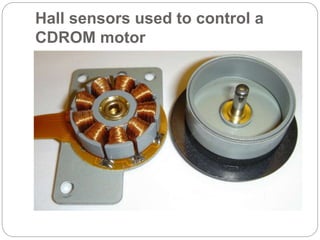
Hall sensors used to control a
CDROM motor
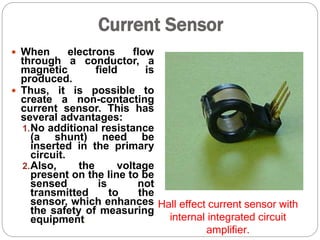
Current Sensor
 When electrons flow
through a conductor, a
magnetic field is
produced.
 Thus, it is possible to
create a non-contacting
current sensor. This has
several advantages:
1.No additional resistance
(a shunt) need be
inserted in the primary
circuit.
2.Also, the voltage
present on the line to be
sensed is not
transmitted to the
sensor, which enhances
the safety of measuring
equipment.
Hall effect current sensor with
internal integrated circuit
amplifier.
Current and power using hall sensors

Current and power using hall sensors

  • 1.
    CURRENT AND POWERUSING HALL SENSORS
  • 2.
    Hall effect sensors Hall effect was discovered in 1879 by Edward H. Hall  Exists in all conducting materials  Is particularly pronounced and useful in semiconductors.  One of the simplest of all magnetic sensing devices  Used extensively in sensing position and measuring magnetic fields
  • 3.
    Hall effect -principles  Consider a block of conducting medium through which a current of electrons is flowing caused by an external field  A magnetic filed B is established across the conductor, perpendicular to the current (.  The electrons flow at a velocity v  A force perpendicular to both the current and field is established. F= qvBsinvb [N]
  • 4.
    Theory  Thus R=Vh/aJH=Vhb/IH Vh is Hall Voltage and I is Jab
  • 5.
    Hall effect -principle
  • 6.
    Hall effect -principles  The electrons are pulled towards the front side surface of the conductor (holes in semiconductors move towards the back)  A voltage develops between the back (positive) and front (negative) surface. This voltage is the Hall voltage and is given by: Vout = IB qnd V d is the thickness of the hall plate, n is the carrier density [charges/m3] and q is the charge of the electron [C]
  • 7.
     If thecurrent changes direction or the magnetic field changes direction, the polarity of the Hall voltage flips.  The Hall effect sensor is polarity dependent,  may be used to measure direction of a field  or direction of motion if the sensor is properly set up.  The term 1/qn [m3/C] is material dependent and is called the Hall coefficient KH.
  • 8.
    Hall coefficient  Thehall voltage is usually represented as: Vout = KH IB d V • Hall coefficients vary from material to material • Are particularly large in semiconductors. • Hall voltage is linear with respect to the field for given current and dimensions. • Hall coefficient is temperature dependent and this must be compensated if accurate sensing is needed.
  • 9.
    Hall coefficient -cont.  Hall coefficient is rather small - of the order of 50 mV/T  Most sensed fields are smaller than 1 T  The Hall voltage can be as small as a few V  Must in almost all cases be amplified.  Example, the earth’s magnetic field is only about 50 T so that the output is a mere 25 V
  • 10.
    Hall effect sensors- practical considerations  Hall voltages are easily measurable quantities  Hall sensors are among the most commonly used sensors for magnetic fields:  simple, linear, very inexpensive, available in arrays  can be integrated within devices.  Errors involved in measurement are mostly due to temperature and variations and the averaging effect of the Hall plate size  These can be compensated by appropriate
  • 11.
    Hall effect sensors- fabrication  A typical sensor will be a rectangular wafer of small thickness  Made of p or n doped semiconductor (InAs and InSb are most commonly used because of their larger carrier densities – hence larger Hall coefficients)  Silicon may also be used with reduced sensitivity)  The sensor is usually identified by the two transverse resistances – the control resistance through which the control current flows and the output resistance across which the Hall voltage develops.
  • 12.
    Hall effect sensors- applications  In practical applications, the current is usually kept constant so that the output voltage is proportional to the field.  The sensor may be used to measure field (provided proper compensation can be incorporated)  It may be used as a detector or to operate a switch.  The latter is very common in sensing of rotation which in itself may be used to measure a variety of effect (shaft position, frequency of rotation (rpm), position, differential position, etc.).
  • 13.
    Hall effect sensors- applications  Example is shown in Figure 5.31 where the rpm of a shaft is sensed.  Many variations of this basic configuration: for example, measurement of angular displacement.  Sensing of gears (electronic ignition)  Multiple sensors can sense direction as well
  • 14.
    Hall element asa rotation sensor
  • 15.
  • 16.
    Hall effect sensors- applications  Example: measuring power  The magnetic field through the hall element is proportional to the current being measured  The current is proportional to voltage being measured  The Hall voltage is proportional to product of current and voltage - power
  • 17.
  • 18.
    Applications Hall effect devicesproduce a very low signal level and thus require amplification. In early 20th century vacuum tube amplifiers were expensive and unreliable. But with the development of the low cost integrated circuit the Hall effect sensor became suitable for mass application.
  • 19.
  • 20.
    A 3-axis Hallelement probe
  • 21.
    Hall sensors usedto control a CDROM motor
  • 22.
    Current Sensor  Whenelectrons flow through a conductor, a magnetic field is produced.  Thus, it is possible to create a non-contacting current sensor. This has several advantages: 1.No additional resistance (a shunt) need be inserted in the primary circuit. 2.Also, the voltage present on the line to be sensed is not transmitted to the sensor, which enhances the safety of measuring equipment. Hall effect current sensor with internal integrated circuit amplifier.