

QUANTUM HALL
EFFECT
SUBMITTED TO: Prof. R.S SINGH
SUBMITTED BY: VISHAL KUMAR JANGID,M.Sc(Final) 2016-17
JNVU (Department of Physics)
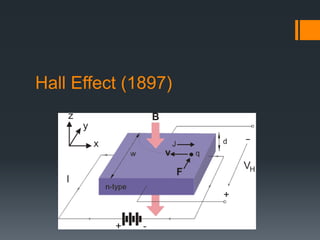
Hall Effect (1897)
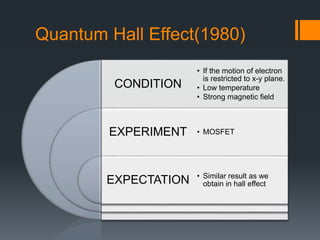
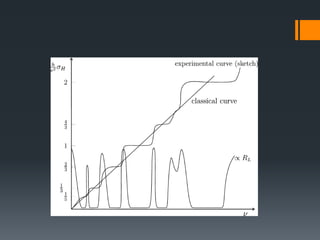
Quantum Hall Effect(1980)
CONDITION
EXPERIMENT
EXPECTATION
• If the motion of electron
is restricted to x-y plane.
• Low temperature
• Strong magnetic field
• MOSFET
• Similar result as we
obtain in hall effect
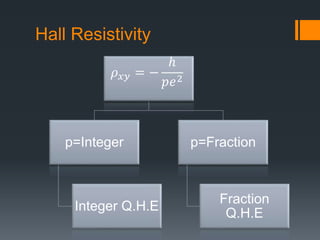
Hall Resistivity
𝜌 𝑥𝑦 = −
ℎ
𝑝𝑒2
p=Integer
Integer Q.H.E
p=Fraction
Fraction
Q.H.E
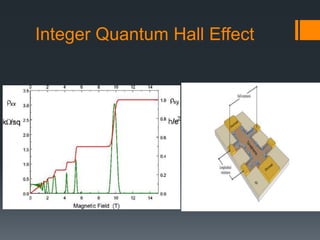
Integer Quantum Hall Effect
Explanation IQHE
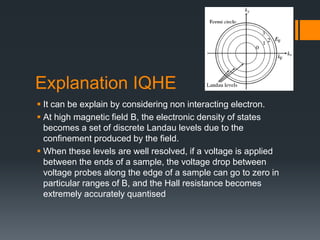
 It can be explain by considering non interacting electron.
 At high magnetic field B, the electronic density of states
becomes a set of discrete Landau levels due to the
confinement produced by the field.
 When these levels are well resolved, if a voltage is applied
between the ends of a sample, the voltage drop between
voltage probes along the edge of a sample can go to zero in
particular ranges of B, and the Hall resistance becomes
extremely accurately quantised
Continue ….
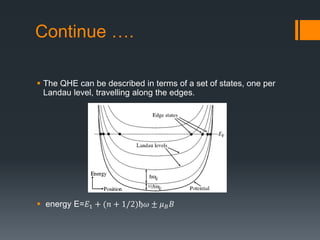
 The QHE can be described in terms of a set of states, one per
Landau level, travelling along the edges.
 energy E=𝐸1 + (𝑛 + 1/2)ђ𝜔 ± 𝜇 𝐵 𝐵
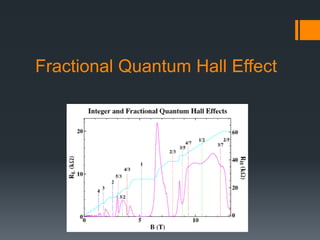
Fractional Quantum Hall Effect
Explanation
 By considering a two-dimensional system of strongly interacting
electrons.
 At particular magnetic fields, the electron gas condenses into a
remarkable state with liquid-like properties
 Filling factor: 𝑝 =
𝑛
𝑚
, where m is always turn out to be odd
number
 FRACTIONALLY-CHARGED QUASIPARTICLES :
consider quasiparticles with charge e*=e/q
 COMPOSITE FERMIONS:
 it attaches two (or, in general, an even number) flux
quanta h/e to each electron, forming integer-charged
quasiparticles called Composite Fermions
Thank you

Qhe

  • 1.
    QUANTUM HALL EFFECT SUBMITTED TO:Prof. R.S SINGH SUBMITTED BY: VISHAL KUMAR JANGID,M.Sc(Final) 2016-17 JNVU (Department of Physics)
  • 2.
  • 3.
    Quantum Hall Effect(1980) CONDITION EXPERIMENT EXPECTATION •If the motion of electron is restricted to x-y plane. • Low temperature • Strong magnetic field • MOSFET • Similar result as we obtain in hall effect
  • 5.
    Hall Resistivity 𝜌 𝑥𝑦= − ℎ 𝑝𝑒2 p=Integer Integer Q.H.E p=Fraction Fraction Q.H.E
  • 6.
  • 7.
    Explanation IQHE  Itcan be explain by considering non interacting electron.  At high magnetic field B, the electronic density of states becomes a set of discrete Landau levels due to the confinement produced by the field.  When these levels are well resolved, if a voltage is applied between the ends of a sample, the voltage drop between voltage probes along the edge of a sample can go to zero in particular ranges of B, and the Hall resistance becomes extremely accurately quantised
  • 8.
    Continue ….  TheQHE can be described in terms of a set of states, one per Landau level, travelling along the edges.  energy E=𝐸1 + (𝑛 + 1/2)ђ𝜔 ± 𝜇 𝐵 𝐵
  • 9.
  • 10.
    Explanation  By consideringa two-dimensional system of strongly interacting electrons.  At particular magnetic fields, the electron gas condenses into a remarkable state with liquid-like properties  Filling factor: 𝑝 = 𝑛 𝑚 , where m is always turn out to be odd number  FRACTIONALLY-CHARGED QUASIPARTICLES : consider quasiparticles with charge e*=e/q  COMPOSITE FERMIONS:  it attaches two (or, in general, an even number) flux quanta h/e to each electron, forming integer-charged quasiparticles called Composite Fermions
  • 11.