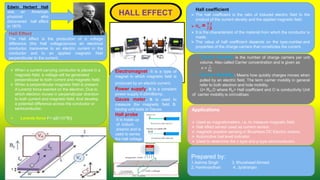
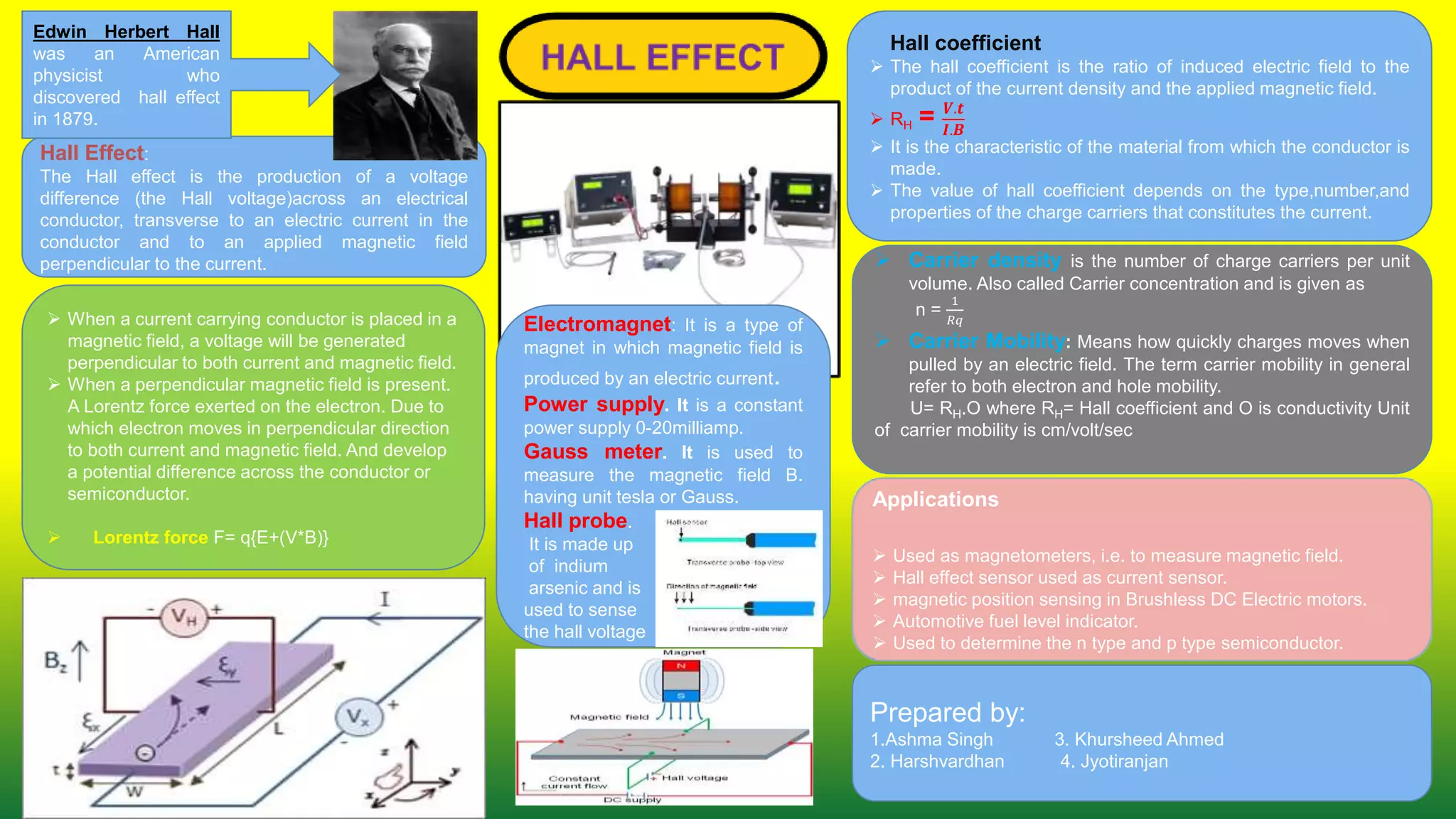
The Hall effect refers to the generation of a voltage difference across a conductor when subjected to an electric current and a perpendicular magnetic field, first discovered by Edwin Herbert Hall in 1879. It has various applications including magnetometers, current sensors, and position sensing in electric motors. Key concepts include the Hall coefficient, carrier density, and mobility, which characterize the materials involved in this phenomenon.