Inverters

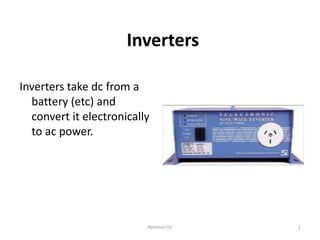
Inverters take dc from a
  battery (etc) and
  convert it electronically
  to ac power.


                          Revision 01   1
Revision 01   2
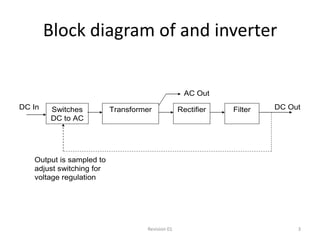
Block diagram of and inverter


                                                   AC Out
DC In   Switches          Transformer            Rectifier   Filter   DC Out
        DC to AC


   Output is sampled to
   adjust switching for
   voltage regulation


                                   Revision 01                             3
Inverter OPERATION
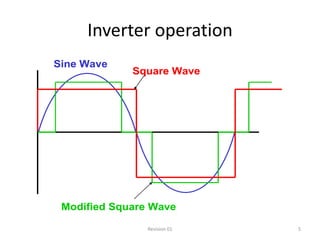
• Inverters are classified by their ac output
  waveform.

  – Square wave
  – Modified sine wave
  – True sine wave


                         Revision 01            4
Inverter operation
Sine Wave
             Square Wave


 Modified Square Wave

                Revision 01   5
Inverter operation
• Most smaller inverters are either square wave
  (cheap) or modified square wave.


                     Revision 01                  6
Inverter operation


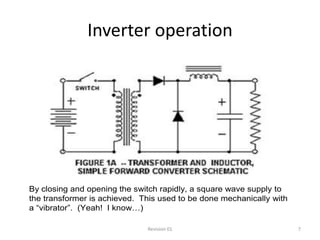
By closing and opening the switch rapidly, a square wave supply to
the transformer is achieved. This used to be done mechanically with
a “vibrator”. (Yeah! I know…)

                              Revision 01                             7
Inverter operation


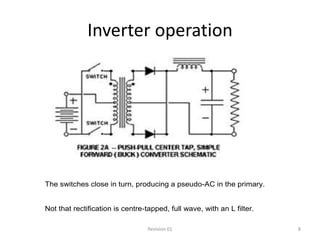
The switches close in turn, producing a pseudo-AC in the primary.


Not that rectification is centre-tapped, full wave, with an L filter.

                                 Revision 01                            8
Inverter operation


Here the rectifier is a full wave, bridge, with L filter.

                                   Revision 01              9
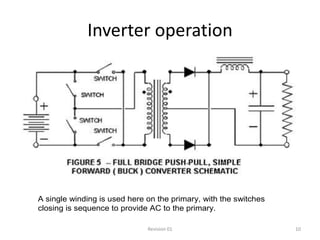
Inverter operation


A single winding is used here on the primary, with the switches
closing is sequence to provide AC to the primary.

                              Revision 01                         10
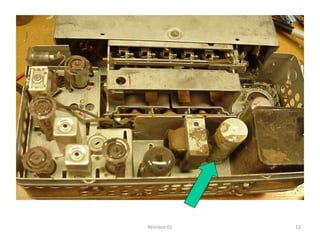
Vibrator
                Vibrator
                Here is what one looks like.
                Inside are vibrating mechanical
                contact points that oscillate and
                generate a low voltage AC
                signal from the DC voltage
                applied to it from the battery.
                The AC signal then feeds a
                transformer where the voltage
                is increased.


                                          AC Out


  Revision 01                                       11
Revision 01   12
Square waves
• Cheap
• Very poor regulation
• Produce large amounts of RFI
• Very rough AC
• Large amounts of harmonics
• Often used for small appliances eg; fluro lights
Very few but the very cheapest inverters any more are square
  wave. A square wave inverter will run simple things like tools
  with universal motors with no problem - but not much else.
  These are seldom seen any more except in small, very cheap
  or very old inverters.


                              Revision 01                          13

Inverters

  • 1.
    Inverters Inverters take dcfrom a battery (etc) and convert it electronically to ac power. Revision 01 1
  • 2.
  • 3.
    Block diagram ofand inverter AC Out DC In Switches Transformer Rectifier Filter DC Out DC to AC Output is sampled to adjust switching for voltage regulation Revision 01 3
  • 4.
    Inverter OPERATION • Invertersare classified by their ac output waveform. – Square wave – Modified sine wave – True sine wave Revision 01 4
  • 5.
    Inverter operation Sine Wave Square Wave Modified Square Wave Revision 01 5
  • 6.
    Inverter operation • Mostsmaller inverters are either square wave (cheap) or modified square wave. Revision 01 6
  • 7.
    Inverter operation By closingand opening the switch rapidly, a square wave supply to the transformer is achieved. This used to be done mechanically with a “vibrator”. (Yeah! I know…) Revision 01 7
  • 8.
    Inverter operation The switchesclose in turn, producing a pseudo-AC in the primary. Not that rectification is centre-tapped, full wave, with an L filter. Revision 01 8
  • 9.
    Inverter operation Here therectifier is a full wave, bridge, with L filter. Revision 01 9
  • 10.
    Inverter operation A singlewinding is used here on the primary, with the switches closing is sequence to provide AC to the primary. Revision 01 10
  • 11.
    Vibrator Vibrator Here is what one looks like. Inside are vibrating mechanical contact points that oscillate and generate a low voltage AC signal from the DC voltage applied to it from the battery. The AC signal then feeds a transformer where the voltage is increased. AC Out Revision 01 11
  • 12.
  • 13.
    Square waves • Cheap •Very poor regulation • Produce large amounts of RFI • Very rough AC • Large amounts of harmonics • Often used for small appliances eg; fluro lights Very few but the very cheapest inverters any more are square wave. A square wave inverter will run simple things like tools with universal motors with no problem - but not much else. These are seldom seen any more except in small, very cheap or very old inverters. Revision 01 13