Chapter 4 DC to AC Conversion (INVERTER) General concept Single-phase inverter Harmonics Modulation Three-phase inverter
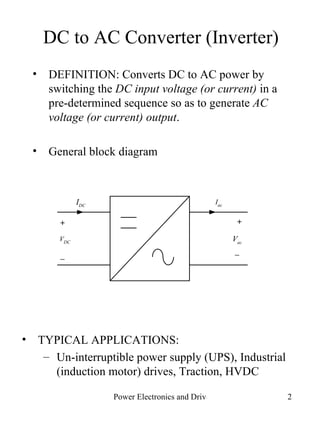
DC to AC Converter (Inverter) DEFINITION: Converts DC to AC power by switching the  DC input voltage (or current)  in a pre-determined sequence so as to generate  AC voltage (or current) output . General block diagram TYPICAL APPLICATIONS: Un-interruptible power supply (UPS), Industrial (induction motor) drives, Traction, HVDC
Simple square-wave inverter (1) To illustrate the concept of AC waveform generation
AC Waveform Generation
AC Waveforms
Harmonics Filtering Output of the inverter is “chopped AC voltage with zero DC component”. It contain  harmonics. An  LC section low-pass  filter  is normally fitted at the inverter output to reduce the high frequency harmonics. In some applications such as UPS, “ high purity ” sine wave output is required. Good filtering is a must. In some applications such as AC motor drive, filtering is not required.
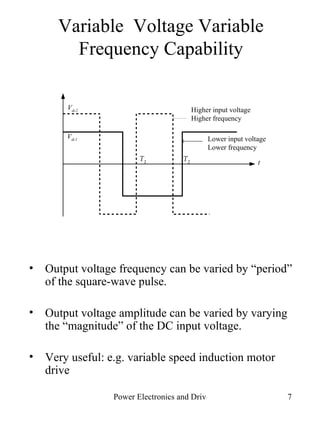
Variable  Voltage Variable Frequency Capability Output voltage frequency can be varied by “period” of the square-wave pulse. Output voltage amplitude can be varied by varying the “magnitude” of the DC input voltage. Very useful: e.g. variable speed induction motor drive
Output voltage harmonics/ distortion Harmonics cause distortion on the output voltage. Lower order harmonics (3 rd , 5 th  etc) are very difficult to filter, due to the filter size and high filter order. They can cause serious voltage distortion. Why need to consider harmonics? Sinusoidal waveform quality must match TNB supply.  “ Power Quality” issue. Harmonics may cause degradation of  equipment. Equipment need to be “de-rated”. Total Harmonic Distortion (THD) is a measure to determine the “quality” of a given waveform.
Total Harmonics Distortion (THD)
Fourier Series Study of harmonics requires understanding of wave shapes. Fourier Series is a tool to analyse wave shapes.
Harmonics of square-wave (1)
Harmonics of square wave (2)
Spectra of square wave  Spectra (harmonics) characteristics: Harmonic decreases with a factor of (1/ n ).  Even harmonics are absent Nearest harmonics is the 3rd. If fundamental is 50Hz, then nearest harmonic is 150Hz. Due to the small separation between the fundamental an harmonics, output low-pass filter design can be very difficult.
Quasi-square wave (QSW)
Harmonics control
Example
Half-bridge inverter (1) Also known as the “inverter leg”. Basic building block for full bridge, three phase and higher order inverters. G is the “centre point”. Both capacitors have the  same value. Thus the DC link is equally “spilt” into two. The top and bottom switch has to be “complementary”, i.e. If the top switch is closed (on), the bottom must be off, and vice-versa.
Shoot through fault and  “Dead-time” In practical, a dead time as shown below is required to avoid “shoot-through” faults, i.e. short circuit across the DC rail. Dead time creates “low frequency envelope”. Low frequency harmonics emerged. This is the main source of distortion for high-quality sine wave inverter.
Single-phase, full-bridge (1) Full bridge (single phase) is built from two half-bridge leg. The switching in the second leg is “delayed by 180 degrees” from the first leg.
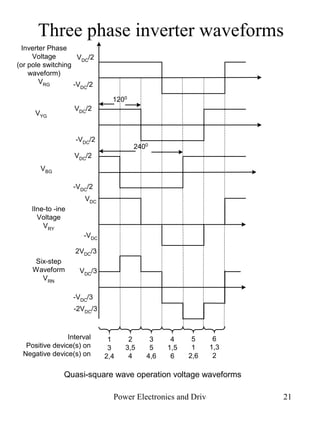
Three-phase inverter Each leg (Red, Yellow, Blue) is delayed by 120 degrees. A three-phase inverter with star connected load is shown below
Three phase inverter waveforms
Pulse Width Modulation (PWM) Triangulation method (Natural sampling) Amplitudes of the triangular wave (carrier) and sine wave (modulating) are compared to obtain PWM waveform. Simple analogue comparator can be used. Basically an analogue method. Its digital version, known as REGULAR sampling is widely used in industry.
PWM types Natural (sinusoidal) sampling (as shown on previous slide) Problems with analogue circuitry, e.g. Drift, sensitivity etc. Regular sampling simplified version of natural sampling that results in simple digital implementation Optimised PWM PWM waveform are constructed based on certain performance criteria, e.g. THD. Harmonic elimination/minimisation PWM PWM waveforms are constructed to eliminate some undesirable harmonics from the output waveform spectra.  Highly mathematical in nature Space-vector modulation (SVM) A simple technique based on volt-second that is normally used with three-phase inverter motor-drive
Modulation Index, Ratio
Regular sampling
Asymmetric and symmetric regular sampling
Bipolar Switching
Unipolar switching
Bipolar PWM switching: Pulse-width characterization
The  k th  Pulse
Determination of switching angles for kth PWM pulse (1)
PWM Switching angles (2)
Switching angles (3)
PWM switching angles (4)
Example For the PWM shown below, calculate the switching angles pulses no. 2.
Harmonics of bipolar PWM
Harmonics of Bipolar PWM
PWM Spectra
PWM spectra observations The harmonics appear in “clusters” at multiple of the carrier frequencies . Main harmonics located at :  f = kp   (f m );   k =1,2,3....  where  f m   is the frequency of the modulation (sine) waveform.  There also exist “side-bands” around the  main harmonic frequencies. Amplitude of the fundamental is proportional to the modulation index.  The relation ship is given as:    V 1 = M I V in The amplitude of the  harmonic changes with  M I . Its incidence (location on spectra) is not. When  p >10, or so, the harmonics can be normalised. For lower values of  p , the side-bands clusters overlap-normalised results no longer apply.
Tabulated Bipolar PWM Harmonics
Three-phase harmonics For three-phase inverters, there is significant advantage if  M R  is chosen to be: Odd:  All even harmonic will be eliminated from the pole-switching waveform. triplens  (multiple of three (e.g. 3,9,15,21, 27..): All triplens harmonics will be eliminated from the line-to-line output voltage. By observing the waveform, it can be seen that with odd  M R , the line-to-line voltage shape looks more “sinusoidal”. As can be noted from the spectra, the phase voltage amplitude is 0.8 (normalised). This is because the modulation index is 0.8. The line voltage amplitude is square root three of phase voltage due to the three-phase relationship
Effect of odd and “triplens”
Spectra: effect of “triplens”
Comments on PWM scheme It is desirable to have  M R  as large as possible. This will push the harmonic at higher frequencies on the spectrum. Thus filtering requirement is reduced. Although the voltage THD improvement is not significant, but the current THD will improve greatly because the load normally has some current filtering effect. However, higher  M R  has side effects: Higher switching frequency: More losses. Pulse width may be too small to be constructed. “Pulse dropping” may be required.
Example 1.                    The amplitudes of the pole switching waveform harmonics of the red phase of a three-phase inverter is shown in Table 1. The inverter uses a symmetric regular sampling PWM scheme. The carrier frequency is 1050Hz and the modulating frequency is 50Hz. The modulation index is 0.8. Calculate the harmonic amplitudes of the line-to-voltage (i.e. red to blue phase) and complete Table Q4.           The amplitudes of the pole switching waveform harmonics of the red phase of a three-phase inverter is shown in Table below. The inverter  uses a symmetric regular sampling PWM scheme. The carrier frequency is 1050Hz and the modulating frequency is 50Hz. The modulation index is 0.8. Calculate the harmonic amplitudes of the line-to-voltage (i.e. red to blue phase) and complete the table.   Harmonic number Amplitude (pole switching waveform) Amplitude (line-to line voltage) 1 1   19 0.3   21 0.8   23 0.3   37 0.1   39 0.2   41 0.25   43 0.25   45 0.2   47 0.1   57 0.05   59 0.1   61 0.15   63 0.2   65 0.15   67 0.1   69 0.05  

Inverter 2003

  • 1.
    Chapter 4 DCto AC Conversion (INVERTER) General concept Single-phase inverter Harmonics Modulation Three-phase inverter
  • 2.
    DC to ACConverter (Inverter) DEFINITION: Converts DC to AC power by switching the DC input voltage (or current) in a pre-determined sequence so as to generate AC voltage (or current) output . General block diagram TYPICAL APPLICATIONS: Un-interruptible power supply (UPS), Industrial (induction motor) drives, Traction, HVDC
  • 3.
    Simple square-wave inverter(1) To illustrate the concept of AC waveform generation
  • 4.
  • 5.
  • 6.
    Harmonics Filtering Outputof the inverter is “chopped AC voltage with zero DC component”. It contain harmonics. An LC section low-pass filter is normally fitted at the inverter output to reduce the high frequency harmonics. In some applications such as UPS, “ high purity ” sine wave output is required. Good filtering is a must. In some applications such as AC motor drive, filtering is not required.
  • 7.
    Variable VoltageVariable Frequency Capability Output voltage frequency can be varied by “period” of the square-wave pulse. Output voltage amplitude can be varied by varying the “magnitude” of the DC input voltage. Very useful: e.g. variable speed induction motor drive
  • 8.
    Output voltage harmonics/distortion Harmonics cause distortion on the output voltage. Lower order harmonics (3 rd , 5 th etc) are very difficult to filter, due to the filter size and high filter order. They can cause serious voltage distortion. Why need to consider harmonics? Sinusoidal waveform quality must match TNB supply. “ Power Quality” issue. Harmonics may cause degradation of equipment. Equipment need to be “de-rated”. Total Harmonic Distortion (THD) is a measure to determine the “quality” of a given waveform.
  • 9.
  • 10.
    Fourier Series Studyof harmonics requires understanding of wave shapes. Fourier Series is a tool to analyse wave shapes.
  • 11.
  • 12.
  • 13.
    Spectra of squarewave Spectra (harmonics) characteristics: Harmonic decreases with a factor of (1/ n ). Even harmonics are absent Nearest harmonics is the 3rd. If fundamental is 50Hz, then nearest harmonic is 150Hz. Due to the small separation between the fundamental an harmonics, output low-pass filter design can be very difficult.
  • 14.
  • 15.
  • 16.
  • 17.
    Half-bridge inverter (1)Also known as the “inverter leg”. Basic building block for full bridge, three phase and higher order inverters. G is the “centre point”. Both capacitors have the same value. Thus the DC link is equally “spilt” into two. The top and bottom switch has to be “complementary”, i.e. If the top switch is closed (on), the bottom must be off, and vice-versa.
  • 18.
    Shoot through faultand “Dead-time” In practical, a dead time as shown below is required to avoid “shoot-through” faults, i.e. short circuit across the DC rail. Dead time creates “low frequency envelope”. Low frequency harmonics emerged. This is the main source of distortion for high-quality sine wave inverter.
  • 19.
    Single-phase, full-bridge (1)Full bridge (single phase) is built from two half-bridge leg. The switching in the second leg is “delayed by 180 degrees” from the first leg.
  • 20.
    Three-phase inverter Eachleg (Red, Yellow, Blue) is delayed by 120 degrees. A three-phase inverter with star connected load is shown below
  • 21.
  • 22.
    Pulse Width Modulation(PWM) Triangulation method (Natural sampling) Amplitudes of the triangular wave (carrier) and sine wave (modulating) are compared to obtain PWM waveform. Simple analogue comparator can be used. Basically an analogue method. Its digital version, known as REGULAR sampling is widely used in industry.
  • 23.
    PWM types Natural(sinusoidal) sampling (as shown on previous slide) Problems with analogue circuitry, e.g. Drift, sensitivity etc. Regular sampling simplified version of natural sampling that results in simple digital implementation Optimised PWM PWM waveform are constructed based on certain performance criteria, e.g. THD. Harmonic elimination/minimisation PWM PWM waveforms are constructed to eliminate some undesirable harmonics from the output waveform spectra. Highly mathematical in nature Space-vector modulation (SVM) A simple technique based on volt-second that is normally used with three-phase inverter motor-drive
  • 24.
  • 25.
  • 26.
  • 27.
    Asymmetric and symmetricregular sampling
  • 28.
  • 29.
  • 30.
    Bipolar PWM switching:Pulse-width characterization
  • 31.
    The kth Pulse
  • 32.
    Determination of switchingangles for kth PWM pulse (1)
  • 33.
  • 34.
  • 35.
  • 36.
    Example For thePWM shown below, calculate the switching angles pulses no. 2.
  • 37.
  • 38.
  • 39.
  • 40.
    PWM spectra observationsThe harmonics appear in “clusters” at multiple of the carrier frequencies . Main harmonics located at : f = kp (f m ); k =1,2,3.... where f m is the frequency of the modulation (sine) waveform. There also exist “side-bands” around the main harmonic frequencies. Amplitude of the fundamental is proportional to the modulation index. The relation ship is given as: V 1 = M I V in The amplitude of the harmonic changes with M I . Its incidence (location on spectra) is not. When p >10, or so, the harmonics can be normalised. For lower values of p , the side-bands clusters overlap-normalised results no longer apply.
  • 41.
  • 42.
    Three-phase harmonics Forthree-phase inverters, there is significant advantage if M R is chosen to be: Odd: All even harmonic will be eliminated from the pole-switching waveform. triplens (multiple of three (e.g. 3,9,15,21, 27..): All triplens harmonics will be eliminated from the line-to-line output voltage. By observing the waveform, it can be seen that with odd M R , the line-to-line voltage shape looks more “sinusoidal”. As can be noted from the spectra, the phase voltage amplitude is 0.8 (normalised). This is because the modulation index is 0.8. The line voltage amplitude is square root three of phase voltage due to the three-phase relationship
  • 43.
    Effect of oddand “triplens”
  • 44.
    Spectra: effect of“triplens”
  • 45.
    Comments on PWMscheme It is desirable to have M R as large as possible. This will push the harmonic at higher frequencies on the spectrum. Thus filtering requirement is reduced. Although the voltage THD improvement is not significant, but the current THD will improve greatly because the load normally has some current filtering effect. However, higher M R has side effects: Higher switching frequency: More losses. Pulse width may be too small to be constructed. “Pulse dropping” may be required.
  • 46.
    Example 1.                   The amplitudes of the pole switching waveform harmonics of the red phase of a three-phase inverter is shown in Table 1. The inverter uses a symmetric regular sampling PWM scheme. The carrier frequency is 1050Hz and the modulating frequency is 50Hz. The modulation index is 0.8. Calculate the harmonic amplitudes of the line-to-voltage (i.e. red to blue phase) and complete Table Q4.           The amplitudes of the pole switching waveform harmonics of the red phase of a three-phase inverter is shown in Table below. The inverter uses a symmetric regular sampling PWM scheme. The carrier frequency is 1050Hz and the modulating frequency is 50Hz. The modulation index is 0.8. Calculate the harmonic amplitudes of the line-to-voltage (i.e. red to blue phase) and complete the table. Harmonic number Amplitude (pole switching waveform) Amplitude (line-to line voltage) 1 1   19 0.3   21 0.8   23 0.3   37 0.1   39 0.2   41 0.25   43 0.25   45 0.2   47 0.1   57 0.05   59 0.1   61 0.15   63 0.2   65 0.15   67 0.1   69 0.05