Cycloconverter
Step down cycloconverter
Operation of Step Down Cycloconverter
• A Step down cycloconverter
doesnot require forced
commutation.
• They only need line or natural
commutation which is provided by
the ac supply
Voltage and current waveforms for step down
cycloconverter with discontinuous load current
Voltage and current waveforms for step down
cycloconverter with continuous load current
1 phase to 3 phase cycloconverter
SINGLE-phase to three-phase cycloconverter-driven induction motors are ideal for
use in a single-phase traction system.
There are two methods of controlling this kind of cycloconverter
a) constant firing angle method
b) cosine wave crossing method (CWCM)
 Cosine wave crossing method (CWCM) gives better results than constant firing
angle method (L. Gyugi and B. R. Pelly, Static Power Frequency Changer.
NewYork: Wiley-Interscience, 1976.)
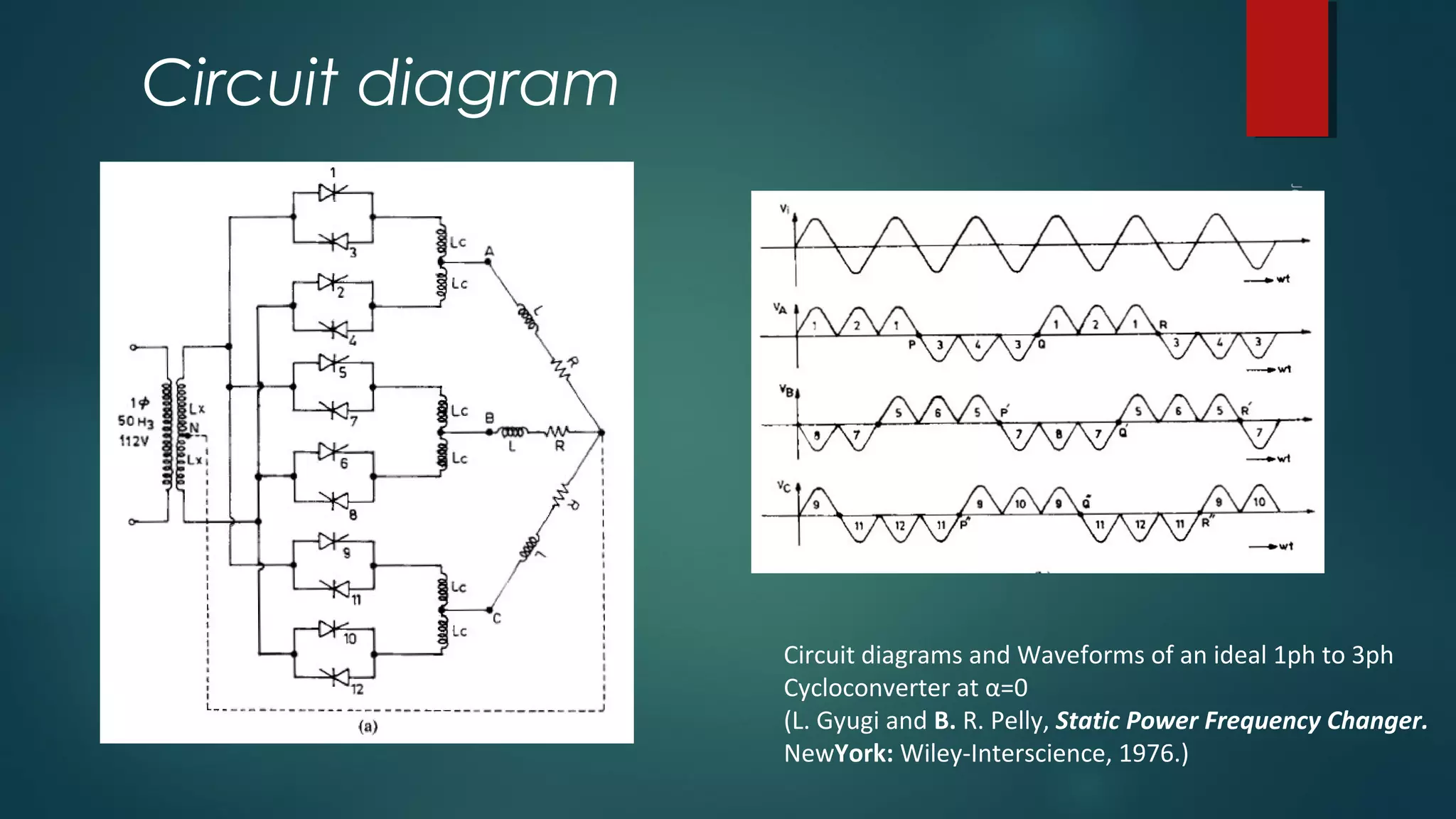
Circuit diagram
Circuit diagrams and Waveforms of an ideal 1ph to 3ph
Cycloconverter at α=0
(L. Gyugi and B. R. Pelly, Static Power Frequency Changer.
NewYork: Wiley-Interscience, 1976.)
Cosine Wave Crossing Method
In order to avoid the short circuit condition for high L / R loads it is
important that the current of the SCR fired just before the crossover point be
reduced to zero within 20 ms.
This ensures that SCR's 2 and 3 (or SCR's 1 and 4) are not fired
simultaneously.
This is somewhat achieved in CWCM where the firing of each SCR occurs
at different angles. Here, the first and last SCR's of each group are fired at
larger angles so that the previous SCR gets sufficient time to release its
stored energy. Consequently, the current buildup is reduced.
Typical firing angles for the sequence 121212 are 77, 57, 25, 0, 35, and 72"
respectively
(L. Gyugi and B. R. Pelly, Static Power Frequency Changer. NewYork: Wiley-
Interscience, 1976.)

Cycloconverter

  • 1.
  • 2.
  • 3.
    Operation of StepDown Cycloconverter • A Step down cycloconverter doesnot require forced commutation. • They only need line or natural commutation which is provided by the ac supply
  • 4.
    Voltage and currentwaveforms for step down cycloconverter with discontinuous load current
  • 5.
    Voltage and currentwaveforms for step down cycloconverter with continuous load current
  • 6.
    1 phase to3 phase cycloconverter SINGLE-phase to three-phase cycloconverter-driven induction motors are ideal for use in a single-phase traction system. There are two methods of controlling this kind of cycloconverter a) constant firing angle method b) cosine wave crossing method (CWCM)  Cosine wave crossing method (CWCM) gives better results than constant firing angle method (L. Gyugi and B. R. Pelly, Static Power Frequency Changer. NewYork: Wiley-Interscience, 1976.)
  • 7.
    Circuit diagram Circuit diagramsand Waveforms of an ideal 1ph to 3ph Cycloconverter at α=0 (L. Gyugi and B. R. Pelly, Static Power Frequency Changer. NewYork: Wiley-Interscience, 1976.)
  • 8.
    Cosine Wave CrossingMethod In order to avoid the short circuit condition for high L / R loads it is important that the current of the SCR fired just before the crossover point be reduced to zero within 20 ms. This ensures that SCR's 2 and 3 (or SCR's 1 and 4) are not fired simultaneously. This is somewhat achieved in CWCM where the firing of each SCR occurs at different angles. Here, the first and last SCR's of each group are fired at larger angles so that the previous SCR gets sufficient time to release its stored energy. Consequently, the current buildup is reduced. Typical firing angles for the sequence 121212 are 77, 57, 25, 0, 35, and 72" respectively (L. Gyugi and B. R. Pelly, Static Power Frequency Changer. NewYork: Wiley- Interscience, 1976.)