Power Electronics
Lecture-1
Introduction
1
Lecture Outline
2
Course Outline
3
Power Electronic Devices
• Diodes
• Power Transistors
• IGBTs
• etc.
Power Converters
• Uncontrolled Rectifiers
• Controlled rectifiers
• Inverters
• Converters
What is power electronics?
1) Definition
• Power Electronics: is the electronics applied to conversion and
control of electric power.
Electric
Power
Converter
Power
output
Power
input
Control
input
4
What is power electronics?
A more exact explanation:
• The primary task of power electronics is to process and control
the flow of electric energy by supplying voltages and currents in
a form that is optimally suited for user loads.
5
Prerequisites
• Power electronics incorporates concepts
from the fields of
– Analog circuits
– Electronic devices
– Control systems
– Power systems
– Magnetics
– Electric machines
– Numerical simulation
6
Scope
• It is not possible to build practical computers, cell phones, personal
data devices, cars, airplanes, industrial processes, and other
everyday products without power electronics.
• Alternative energy systems such as wind generators, solar power,
fuel cells, and others require power electronics to function.
• Technology advances such as electric and hybrid vehicles, laptop
computers, microwave ovens, flat-panel displays, LED lighting, and
hundreds of other innovations were not possible until advances in
power electronics enabled their implementation.
• Although no one can predict the future, it is certain that power
electronics will be at the heart of fundamental energy innovations.
7
Applications: Electric Vehicle
Tesla Model S
Functions of the power electronics:
1. Convert the DC battery voltage to
the variable AC required to drive
the AC motor
• 240 V battery
• Variable-frequency, variable-
voltage AC drives the motor
• AC motor propels the rear axle
• Up to 330 kW (acceleration)
• Up to 60 kW regenerative braking
2. Control charging of the battery
• Interface to 240 V 60 Hz 1φ 100 A circuit in
garage.
• Control AC current waveform to be sinusoidal,
unity power factor.
• Control charging of battery to maximize life. 8
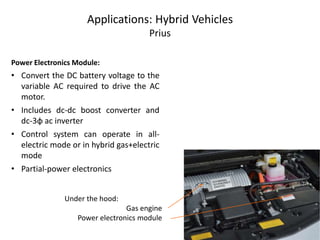
Applications: Hybrid Vehicles
Prius
Power Electronics Module:
• Convert the DC battery voltage to the
variable AC required to drive the AC
motor.
• Includes dc-dc boost converter and
dc-3φ ac inverter
• Control system can operate in all-
electric mode or in hybrid gas+electric
mode
• Partial-power electronics
Under the hood:
Gas engine
Power electronics module
9
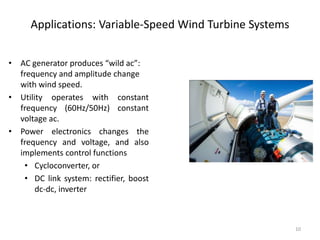
Applications: Variable-Speed Wind Turbine Systems
• AC generator produces “wild ac”:
frequency and amplitude change
with wind speed.
• Utility operates with constant
frequency (60Hz/50Hz) constant
voltage ac.
• Power electronics changes the
frequency and voltage, and also
implements control functions
• Cycloconverter, or
• DC link system: rectifier, boost
dc-dc, inverter
10
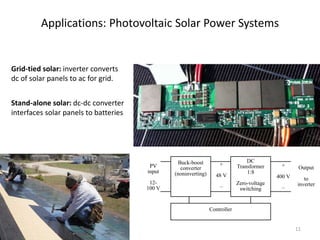
Applications: Photovoltaic Solar Power Systems
DC
Transformer
1:8
Zero-voltage
switching
Buck-boost
converter
(noninverting)
+
48 V
–
PV
input
12-
100 V
+
400 V
–
Output
to
inverter
Controller
Grid-tied solar: inverter converts
dc of solar panels to ac for grid.
Stand-alone solar: dc-dc converter
interfaces solar panels to batteries
11
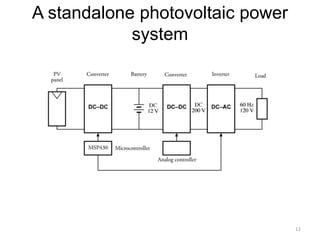
A standalone photovoltaic power
system
12
Applications: Computer power supply systems
vac(t)
iac(t) Charger
PWM
Rectifier
Lithium
battery
ac line input
85–265 Vrms
Inverter
Buck
converter
Boost
converter
Display
backlighting
Microprocessor
Power
management
Disk
drive
Laptop power system
iPhone power system and charger
13
Trends in Power Supplies
• Two distinct trends drive electronic power supplies, one
of the major classes of power electronic circuits.
– At one end, microprocessors, memory chips, and other
advanced digital circuits require increasing power levels and
increasing performance at very low voltage.
– At the other end, the explosive growth of portable devices
with rechargeable batteries. The power supplies for these
devices and for other consumer products must be cheap and
efficient.
14
Trends in Power Supplies
• In the past, bulky “linear” power supplies were designed
with transformers and rectifiers from the ac line
frequency to provide dc voltages for electronic circuits.
• In a well-designed power electronics arrangement
today, called a switch-mode power supply, an ac source
from a wall outlet is rectified without direct
transformation.
• The resulting high dc voltage is converted through a dc–
dc converter to the 1, 3, 5, and 12V, or other levels
required.
15
Trends in Power Supplies
• A personal computer commonly requires multiple 3.3-
and 5-V supplies, 12-V supplies, additional levels, and a
separate converter for 1-V delivery to the
microprocessor.
• Only a switch-mode supply can support such complex
requirements with acceptable costs.
16
Key Characteristics of Power Converter
• All power electronic circuits manage the flow of electrical
energy between an electrical source and a load.
• The parts in a circuit must direct electrical flows, not impede
them.
• The function of the power converter in the middle is to control
the energy flow between a source and a load.
• A crucial point emerges: to build a power converter, we should
consider only lossless components.
• A realistic converter design must approach 100% efficiency. 17
Devices Available to the circuit designer
18
Devices available to the circuit
designer
Signal processing: avoid magnetics
19
Devices available to the circuit
designer
Power processing: avoid lossy elements
20
Power loss in an ideal switch
• Switch closed: v(t) = 0
• Switch open: i(t) = 0
• In either event: p(t) = v(t) i(t) = 0
• Ideal switch consumes zero power
i
v
+
–
1
0
21
Power Electronic Devices
• The power Electronic devices provides the
utility of switching.
• The flow of power through these devices can
be controlled via small currents.
• Power electronics devices differ from ordinary
electronics devices in terms of their
characteristics.
22
Power Electronic Devices
• Power Semiconductor Devices can be
classified into three groups according to their
degree of controllability.
– Diodes (on and off controlled by power circuit)
– Thyristors (latched on by control signal but must
be turned off by power circuit)
– Controllable Switches (turned on and off by
control signal)
23
Conversion Examples
• Single-Switch Circuits
– Consider the circuit shown in figure.
– It contains an ac source, a switch, and a resistive load.
– It is a simple but complete power electronic system.
24
• What if the switch is turned on whenever Vac >0, and
turned off otherwise?
END OF LECTURE-1
25

Power Electronics

  • 1.
  • 2.
  • 3.
    Course Outline 3 Power ElectronicDevices • Diodes • Power Transistors • IGBTs • etc. Power Converters • Uncontrolled Rectifiers • Controlled rectifiers • Inverters • Converters
  • 4.
    What is powerelectronics? 1) Definition • Power Electronics: is the electronics applied to conversion and control of electric power. Electric Power Converter Power output Power input Control input 4
  • 5.
    What is powerelectronics? A more exact explanation: • The primary task of power electronics is to process and control the flow of electric energy by supplying voltages and currents in a form that is optimally suited for user loads. 5
  • 6.
    Prerequisites • Power electronicsincorporates concepts from the fields of – Analog circuits – Electronic devices – Control systems – Power systems – Magnetics – Electric machines – Numerical simulation 6
  • 7.
    Scope • It isnot possible to build practical computers, cell phones, personal data devices, cars, airplanes, industrial processes, and other everyday products without power electronics. • Alternative energy systems such as wind generators, solar power, fuel cells, and others require power electronics to function. • Technology advances such as electric and hybrid vehicles, laptop computers, microwave ovens, flat-panel displays, LED lighting, and hundreds of other innovations were not possible until advances in power electronics enabled their implementation. • Although no one can predict the future, it is certain that power electronics will be at the heart of fundamental energy innovations. 7
  • 8.
    Applications: Electric Vehicle TeslaModel S Functions of the power electronics: 1. Convert the DC battery voltage to the variable AC required to drive the AC motor • 240 V battery • Variable-frequency, variable- voltage AC drives the motor • AC motor propels the rear axle • Up to 330 kW (acceleration) • Up to 60 kW regenerative braking 2. Control charging of the battery • Interface to 240 V 60 Hz 1φ 100 A circuit in garage. • Control AC current waveform to be sinusoidal, unity power factor. • Control charging of battery to maximize life. 8
  • 9.
    Applications: Hybrid Vehicles Prius PowerElectronics Module: • Convert the DC battery voltage to the variable AC required to drive the AC motor. • Includes dc-dc boost converter and dc-3φ ac inverter • Control system can operate in all- electric mode or in hybrid gas+electric mode • Partial-power electronics Under the hood: Gas engine Power electronics module 9
  • 10.
    Applications: Variable-Speed WindTurbine Systems • AC generator produces “wild ac”: frequency and amplitude change with wind speed. • Utility operates with constant frequency (60Hz/50Hz) constant voltage ac. • Power electronics changes the frequency and voltage, and also implements control functions • Cycloconverter, or • DC link system: rectifier, boost dc-dc, inverter 10
  • 11.
    Applications: Photovoltaic SolarPower Systems DC Transformer 1:8 Zero-voltage switching Buck-boost converter (noninverting) + 48 V – PV input 12- 100 V + 400 V – Output to inverter Controller Grid-tied solar: inverter converts dc of solar panels to ac for grid. Stand-alone solar: dc-dc converter interfaces solar panels to batteries 11
  • 12.
  • 13.
    Applications: Computer powersupply systems vac(t) iac(t) Charger PWM Rectifier Lithium battery ac line input 85–265 Vrms Inverter Buck converter Boost converter Display backlighting Microprocessor Power management Disk drive Laptop power system iPhone power system and charger 13
  • 14.
    Trends in PowerSupplies • Two distinct trends drive electronic power supplies, one of the major classes of power electronic circuits. – At one end, microprocessors, memory chips, and other advanced digital circuits require increasing power levels and increasing performance at very low voltage. – At the other end, the explosive growth of portable devices with rechargeable batteries. The power supplies for these devices and for other consumer products must be cheap and efficient. 14
  • 15.
    Trends in PowerSupplies • In the past, bulky “linear” power supplies were designed with transformers and rectifiers from the ac line frequency to provide dc voltages for electronic circuits. • In a well-designed power electronics arrangement today, called a switch-mode power supply, an ac source from a wall outlet is rectified without direct transformation. • The resulting high dc voltage is converted through a dc– dc converter to the 1, 3, 5, and 12V, or other levels required. 15
  • 16.
    Trends in PowerSupplies • A personal computer commonly requires multiple 3.3- and 5-V supplies, 12-V supplies, additional levels, and a separate converter for 1-V delivery to the microprocessor. • Only a switch-mode supply can support such complex requirements with acceptable costs. 16
  • 17.
    Key Characteristics ofPower Converter • All power electronic circuits manage the flow of electrical energy between an electrical source and a load. • The parts in a circuit must direct electrical flows, not impede them. • The function of the power converter in the middle is to control the energy flow between a source and a load. • A crucial point emerges: to build a power converter, we should consider only lossless components. • A realistic converter design must approach 100% efficiency. 17
  • 18.
    Devices Available tothe circuit designer 18
  • 19.
    Devices available tothe circuit designer Signal processing: avoid magnetics 19
  • 20.
    Devices available tothe circuit designer Power processing: avoid lossy elements 20
  • 21.
    Power loss inan ideal switch • Switch closed: v(t) = 0 • Switch open: i(t) = 0 • In either event: p(t) = v(t) i(t) = 0 • Ideal switch consumes zero power i v + – 1 0 21
  • 22.
    Power Electronic Devices •The power Electronic devices provides the utility of switching. • The flow of power through these devices can be controlled via small currents. • Power electronics devices differ from ordinary electronics devices in terms of their characteristics. 22
  • 23.
    Power Electronic Devices •Power Semiconductor Devices can be classified into three groups according to their degree of controllability. – Diodes (on and off controlled by power circuit) – Thyristors (latched on by control signal but must be turned off by power circuit) – Controllable Switches (turned on and off by control signal) 23
  • 24.
    Conversion Examples • Single-SwitchCircuits – Consider the circuit shown in figure. – It contains an ac source, a switch, and a resistive load. – It is a simple but complete power electronic system. 24 • What if the switch is turned on whenever Vac >0, and turned off otherwise?
  • 25.