POWER QUALITY IMPROVEMENT IN DISTRIBUTION SYSTEM
USING D-STATCOM IN TRANMISSION LINE
1
MOTHER THERESA INSTITUTE OF ENGINEERING
AND TECHNOLOGY
Melumoi Post, Palamaner -517408.
Chittoor [Dist]. A.P.
PRESENTED BY
S.SHAFAIZAL (11HR1A0218)
 Introduction
 Common power quality problem
 voltage sag
 harmonic distortion
 low power factor
 about d- statcom
 voltage source convert
 controller
 energy storage circuit
2
Contents:
3
Introduction
A Power quality problem is an occurrence manifested as a nonstandard voltage,
current or frequency that results in a failure or a mis-operation of end user equipments.
Utility distribution networks, sensitive industrial loads and critical commercial
operations suffer from various types of outages and service interruptions which can cost
significant financial losses. In developing countries like India, where the variation of
power frequency and many such other determinants of power quality are themselves a
serious question, it is very vital to take positive steps in this direction. The present work is
to identify the prominent concerns in this area and hence the measures that can enhance
the quality of the power are recommended.
This paper presents the enhancement of voltage sags/swell; harmonic
distortion and low power factor using Distribution Static Compensator (D-STATCOM).
The model is based on the Voltage Source Converter (VSC) principle. The D-STATCOM
injects a current into the system to mitigate the voltage sags/swell. to improve harmonic
distortion and low power factor
4
Voltage sags are one of the most occurring
power quality problems. For an industry
voltage sags occur more often and cause severe
problems and economical losses. Utilities often
focus on disturbances from end-user equipment
as the main power quality problems
It is often set only two parameters
depth/magnitude and duration. The magnitude
is ranged from 10% to 90% nominal voltage
and with duration from half cycle to 1min.
. Voltage sag is caused by a fault in the
utility system, a fault within the customer’s
facility or a large increase of the load
current, like starting a motor or
transformer energizing.
Voltage sag
5
Harmonic distortion
Harmonic currents in distribution system can cause harmonic
distortion, low power factor and additional losses as well as
heating in the electrical equipment. It also can cause vibration
and noise in machines and malfunction of the sensitive
equipment. There are different ways to enhance power quality
problems in transmission and distribution systems
6
About Distribution Static Synchronous
Compensator (D-STATCOM)
 the D-STATCOM is one of the most effective devices. A
new PWM-based control scheme has been implemented to
control the electronic valves in the D-STATCOM.
 The D-STATCOM has additional capability to sustain
reactive current at low voltage, and can be developed as a
voltage and frequency support by replacing capacitors with
batteries as energy storage.
 To enhance the power quality such as voltage
sags/swell, harmonic distortion and low power factor
in distribution system.
7
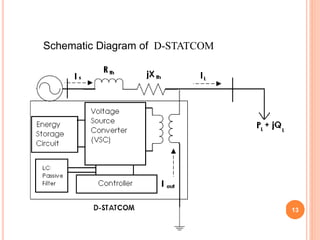
a dc energy storage device, a coupling transformer connected in
shunt to the distribution network through a coupling transformer. The
VSC converts the dc voltage across the storage device into a set of
three-phase ac output voltages. These voltages are in phase and
coupled with the ac system through the reactance of the coupling
transformer. Suitable adjustment of the phase and magnitude of the D-
STATCOM output voltages allows effective control of active and reactive
power exchanges between the D-STATCOM and the ac system. Such
configuration allows the device to absorb or generate controllable
active and reactive power.
The VSC connected in shunt with the ac system provides a
multifunctional topology which can be used for up to three quite
distinct purposes:
1. Voltage regulation and compensation of reactive power.
2. Correction of power factor and
3. Elimination of current harmonics.
output current will correct the voltage sags by adjusting the voltage
drop across the system impedance
Working of d- statcom
8
Voltage Source Converter (VSC)
A voltage-source converter is a power electronic device that
connected in shunt or parallel to the system. It can generate a
sinusoidal voltage with any required magnitude, frequency and
phase angle. The VSC used to either completely replace the voltage
or to inject the ‘missing voltage’. The ‘missing voltage’ is the
difference between the nominal voltage and the actual.
Suitable adjustment of the phase and magnitude of the D-
STATCOM output voltages allows effectives control of active
and reactive power exchanges between D-STATCOM and AC
system. In addition, the converter is normally based on some
kind of energy storage, which will supply the converter with a
DC voltage
9
CONTROLLER
The aim of the control scheme is to maintain constant voltage
magnitude at the point where a sensitive load is connected,
under system disturbances. The control system only measures
the r.m.s voltage at the load point, i.e., no reactive power
measurements are required. The VSC switching strategy is
based on a sinusoidal PWM technique which offers simplicity
and good response. Since custom power is a relatively low-
power application, PWM methods offer a more flexible option
than the Fundamental Frequency Switching (FFS) methods
favored in FACTS applications. Besides, high switching
frequencies can be used to improve on the efficiency of the
converter, without incurring significant switching losses.
 There are two approaches to the mitigation of power quality
problems.
1. load conditioning 2. line-conditioning
 Passive filters have been most commonly used to limit the
flow of harmonic currents in distribution systems.
 The performances of Conventional method (LC filter) is
not satisfactory due to the drawbacks
 Among the different new technical options available to
improve power quality, D-STATCOM have proved to be an
important and flexible alternative to compensate for current
and voltage disturbances in power distribution systems.
10
11
Fig. Circuit Diagram of DC Storage
ENERGY STORAGE CIRCUIT
DC source is connected in parallel with the DC capacitor. It carries
the input ripple current of the converter and it is the main reactive
energy storage element. This DC capacitor could be charged by a
battery source or could be recharged by the converter itself.
DISTRIBUTION NETWORK
12
Simple line presentation of generating distribution network
13
Schematic Diagram of D-STATCOM
14
The simulation results show that the voltage sags can be
mitigate by inserting D-STATCOM to the distribution system.
By adding LC Passive filter to D-STATCOM, The power factors
also increase close to unity. Thus, it can be concluded that by
adding D-STATCOM with LCL filter the power quality is
improved.
CONCLUSION
15
25
16

power quality improvement in distrution system using D statcom

  • 1.
    POWER QUALITY IMPROVEMENTIN DISTRIBUTION SYSTEM USING D-STATCOM IN TRANMISSION LINE 1 MOTHER THERESA INSTITUTE OF ENGINEERING AND TECHNOLOGY Melumoi Post, Palamaner -517408. Chittoor [Dist]. A.P. PRESENTED BY S.SHAFAIZAL (11HR1A0218)
  • 2.
     Introduction  Commonpower quality problem  voltage sag  harmonic distortion  low power factor  about d- statcom  voltage source convert  controller  energy storage circuit 2 Contents:
  • 3.
    3 Introduction A Power qualityproblem is an occurrence manifested as a nonstandard voltage, current or frequency that results in a failure or a mis-operation of end user equipments. Utility distribution networks, sensitive industrial loads and critical commercial operations suffer from various types of outages and service interruptions which can cost significant financial losses. In developing countries like India, where the variation of power frequency and many such other determinants of power quality are themselves a serious question, it is very vital to take positive steps in this direction. The present work is to identify the prominent concerns in this area and hence the measures that can enhance the quality of the power are recommended. This paper presents the enhancement of voltage sags/swell; harmonic distortion and low power factor using Distribution Static Compensator (D-STATCOM). The model is based on the Voltage Source Converter (VSC) principle. The D-STATCOM injects a current into the system to mitigate the voltage sags/swell. to improve harmonic distortion and low power factor
  • 4.
    4 Voltage sags areone of the most occurring power quality problems. For an industry voltage sags occur more often and cause severe problems and economical losses. Utilities often focus on disturbances from end-user equipment as the main power quality problems It is often set only two parameters depth/magnitude and duration. The magnitude is ranged from 10% to 90% nominal voltage and with duration from half cycle to 1min. . Voltage sag is caused by a fault in the utility system, a fault within the customer’s facility or a large increase of the load current, like starting a motor or transformer energizing. Voltage sag
  • 5.
    5 Harmonic distortion Harmonic currentsin distribution system can cause harmonic distortion, low power factor and additional losses as well as heating in the electrical equipment. It also can cause vibration and noise in machines and malfunction of the sensitive equipment. There are different ways to enhance power quality problems in transmission and distribution systems
  • 6.
    6 About Distribution StaticSynchronous Compensator (D-STATCOM)  the D-STATCOM is one of the most effective devices. A new PWM-based control scheme has been implemented to control the electronic valves in the D-STATCOM.  The D-STATCOM has additional capability to sustain reactive current at low voltage, and can be developed as a voltage and frequency support by replacing capacitors with batteries as energy storage.  To enhance the power quality such as voltage sags/swell, harmonic distortion and low power factor in distribution system.
  • 7.
    7 a dc energystorage device, a coupling transformer connected in shunt to the distribution network through a coupling transformer. The VSC converts the dc voltage across the storage device into a set of three-phase ac output voltages. These voltages are in phase and coupled with the ac system through the reactance of the coupling transformer. Suitable adjustment of the phase and magnitude of the D- STATCOM output voltages allows effective control of active and reactive power exchanges between the D-STATCOM and the ac system. Such configuration allows the device to absorb or generate controllable active and reactive power. The VSC connected in shunt with the ac system provides a multifunctional topology which can be used for up to three quite distinct purposes: 1. Voltage regulation and compensation of reactive power. 2. Correction of power factor and 3. Elimination of current harmonics. output current will correct the voltage sags by adjusting the voltage drop across the system impedance Working of d- statcom
  • 8.
    8 Voltage Source Converter(VSC) A voltage-source converter is a power electronic device that connected in shunt or parallel to the system. It can generate a sinusoidal voltage with any required magnitude, frequency and phase angle. The VSC used to either completely replace the voltage or to inject the ‘missing voltage’. The ‘missing voltage’ is the difference between the nominal voltage and the actual. Suitable adjustment of the phase and magnitude of the D- STATCOM output voltages allows effectives control of active and reactive power exchanges between D-STATCOM and AC system. In addition, the converter is normally based on some kind of energy storage, which will supply the converter with a DC voltage
  • 9.
    9 CONTROLLER The aim ofthe control scheme is to maintain constant voltage magnitude at the point where a sensitive load is connected, under system disturbances. The control system only measures the r.m.s voltage at the load point, i.e., no reactive power measurements are required. The VSC switching strategy is based on a sinusoidal PWM technique which offers simplicity and good response. Since custom power is a relatively low- power application, PWM methods offer a more flexible option than the Fundamental Frequency Switching (FFS) methods favored in FACTS applications. Besides, high switching frequencies can be used to improve on the efficiency of the converter, without incurring significant switching losses.
  • 10.
     There aretwo approaches to the mitigation of power quality problems. 1. load conditioning 2. line-conditioning  Passive filters have been most commonly used to limit the flow of harmonic currents in distribution systems.  The performances of Conventional method (LC filter) is not satisfactory due to the drawbacks  Among the different new technical options available to improve power quality, D-STATCOM have proved to be an important and flexible alternative to compensate for current and voltage disturbances in power distribution systems. 10
  • 11.
    11 Fig. Circuit Diagramof DC Storage ENERGY STORAGE CIRCUIT DC source is connected in parallel with the DC capacitor. It carries the input ripple current of the converter and it is the main reactive energy storage element. This DC capacitor could be charged by a battery source or could be recharged by the converter itself.
  • 12.
    DISTRIBUTION NETWORK 12 Simple linepresentation of generating distribution network
  • 13.
  • 14.
    14 The simulation resultsshow that the voltage sags can be mitigate by inserting D-STATCOM to the distribution system. By adding LC Passive filter to D-STATCOM, The power factors also increase close to unity. Thus, it can be concluded that by adding D-STATCOM with LCL filter the power quality is improved. CONCLUSION
  • 15.
  • 16.