PRESENTED BY : GAURAV SIL
Inventory Management
System
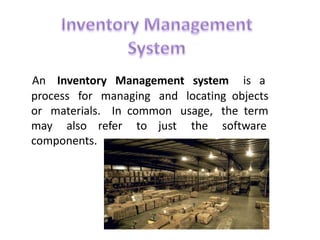
An Inventory Management system is a
process for managing and locating objects
or materials. In common usage, the term
may also refer to just the software
components.
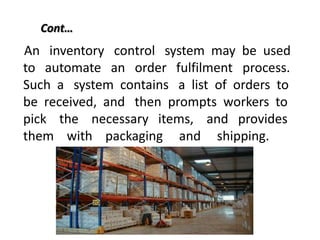
An inventory control system may be used
to automate an order fulfilment process.
Such a system contains a list of orders to
be received, and then prompts workers to
pick the necessary items, and provides
them with packaging and shipping.
Cont…
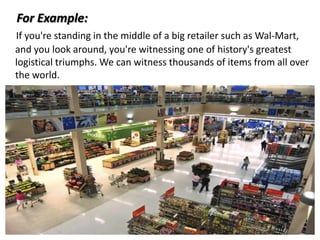
If you're standing in the middle of a big retailer such as Wal-Mart,
and you look around, you're witnessing one of history's greatest
logistical triumphs. We can witness thousands of items from all over
the world.
For Example:
Just In Time
An inventory strategy companies employ to increase
efficiency and decrease waste by receiving goods
only as they are needed in the production
process, thereby reducing inventory costs.
Just in Time Manufacturing (JIT) refers to a system
of manufacturing in which products are not built
until the product is ordered and paid for.
Some companies that have successfully
Implemented JIT include Toyota, Dell and
Harley Davidson.
A good example would be a car manufacturer
that operates with very low inventory
levels, relying on their supply chain to deliver the
parts they need to build cars. The parts needed to
manufacture the cars do not arrive before nor
after they are needed, rather they arrive just as
they are needed.
This inventory supply system represents a shift
away from the older "just in case" strategy where
producers carried large inventories in case higher
demand had to be met.
Cont…
An inventory-related equation that determines
the optimum order quantity that a company
should hold in its inventory given a set cost of
production, demand rate and other variables.
This is done to minimize variable inventory costs.
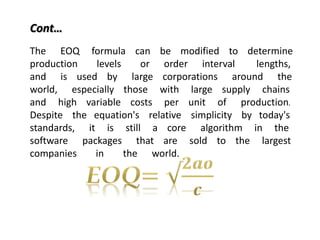
EOQ is at optimum level when the total of ordering
cost and carrying cost is minimized. It is the point
where ordering cost equal to the carrying cost.
The full equation is as follows:
The EOQ formula can be modified to determine
production levels or order interval lengths,
and is used by large corporations around the
world, especially those with large supply chains
and high variable costs per unit of production.
Cont…
Despite the equation's relative simplicity by today's
standards, it is still a core algorithm in the
software packages that are sold to the largest
companies in the world.
a= Total requirement
o= Ordering cost
c= Carrying cost
It is the Analysis for monitoring and control
of stores and spares inventory by classifying
them into 3 categories viz.,
Vital, Essential and Desirable
We use various types of analysis in stores
inventory. Basically 'VED' analysis used to
stock spare parts for the maintenance of
Plant & Machinery.
'V‘ stands for vital in other words,
We have to keep stocks.
'E' stands for essential in other words,
It can wait for some time.
'D‘ stands for desirable in other words,
It can run without this also.
Cont…
The VED analysis is done to determine
the criticality of an item and its effect
on production and other services. It is
specially used for classification of spare
parts. If a part is vital it is given ‘V’
classification, if it is essential, then it is
given ‘E’ classification and if it is not
so essential, the part is given ‘D’
classification. For ‘V’ items, a large
stock of inventory is generally
maintained, while for ‘D’ items, minimum
stock is enough.
Cont…
In ABC, classification inventories are
classified on the basis of their
consumption value and in HML analysis
the unit value is the basis, criticality
of inventories is the basis for
vital, essential and desirable
categorization.
Cont…
An accounting method that identifies the activities
that a firm performs, and then assigns indirect
costs to products. An activity based costing (ABC)
system recognizes the relationship between
costs, activities and products, and through this
relationship assigns indirect costs to products less
arbitrarily than traditional methods.
Some costs are difficult to assign through this
method of cost accounting. Indirect costs,
such as management and office staff salaries
are sometimes difficult to assign to a
particular product produced. For this reason,
this method has found its niche in the
manufacturing sector.
With ABC, a company can soundly estimate
the cost elements of entire products and
services. That may help inform a company's
decision to either.
Cont…
Cont…
 Identify and eliminate those products and services
that are unprofitable and lower the prices of
those that are overpriced (product and service
portfolio aim)
 Or identify and eliminate production or service
processes that are ineffective and allocate
processing concepts that lead to the very
same product at a better yield (process re-
engineering aim).
Inventory management system

Inventory management system

  • 1.
    PRESENTED BY :GAURAV SIL Inventory Management System
  • 2.
    An Inventory Managementsystem is a process for managing and locating objects or materials. In common usage, the term may also refer to just the software components.
  • 4.
    An inventory controlsystem may be used to automate an order fulfilment process. Such a system contains a list of orders to be received, and then prompts workers to pick the necessary items, and provides them with packaging and shipping. Cont…
  • 5.
    If you're standingin the middle of a big retailer such as Wal-Mart, and you look around, you're witnessing one of history's greatest logistical triumphs. We can witness thousands of items from all over the world. For Example:
  • 7.
    Just In Time Aninventory strategy companies employ to increase efficiency and decrease waste by receiving goods only as they are needed in the production process, thereby reducing inventory costs. Just in Time Manufacturing (JIT) refers to a system of manufacturing in which products are not built until the product is ordered and paid for. Some companies that have successfully Implemented JIT include Toyota, Dell and Harley Davidson.
  • 8.
    A good examplewould be a car manufacturer that operates with very low inventory levels, relying on their supply chain to deliver the parts they need to build cars. The parts needed to manufacture the cars do not arrive before nor after they are needed, rather they arrive just as they are needed. This inventory supply system represents a shift away from the older "just in case" strategy where producers carried large inventories in case higher demand had to be met. Cont…
  • 9.
    An inventory-related equationthat determines the optimum order quantity that a company should hold in its inventory given a set cost of production, demand rate and other variables. This is done to minimize variable inventory costs.
  • 11.
    EOQ is atoptimum level when the total of ordering cost and carrying cost is minimized. It is the point where ordering cost equal to the carrying cost. The full equation is as follows:
  • 12.
    The EOQ formulacan be modified to determine production levels or order interval lengths, and is used by large corporations around the world, especially those with large supply chains and high variable costs per unit of production. Cont… Despite the equation's relative simplicity by today's standards, it is still a core algorithm in the software packages that are sold to the largest companies in the world.
  • 13.
    a= Total requirement o=Ordering cost c= Carrying cost
  • 14.
    It is theAnalysis for monitoring and control of stores and spares inventory by classifying them into 3 categories viz., Vital, Essential and Desirable
  • 15.
    We use varioustypes of analysis in stores inventory. Basically 'VED' analysis used to stock spare parts for the maintenance of Plant & Machinery. 'V‘ stands for vital in other words, We have to keep stocks. 'E' stands for essential in other words, It can wait for some time. 'D‘ stands for desirable in other words, It can run without this also. Cont…
  • 16.
    The VED analysisis done to determine the criticality of an item and its effect on production and other services. It is specially used for classification of spare parts. If a part is vital it is given ‘V’ classification, if it is essential, then it is given ‘E’ classification and if it is not so essential, the part is given ‘D’ classification. For ‘V’ items, a large stock of inventory is generally maintained, while for ‘D’ items, minimum stock is enough. Cont…
  • 17.
    In ABC, classificationinventories are classified on the basis of their consumption value and in HML analysis the unit value is the basis, criticality of inventories is the basis for vital, essential and desirable categorization. Cont…
  • 18.
    An accounting methodthat identifies the activities that a firm performs, and then assigns indirect costs to products. An activity based costing (ABC) system recognizes the relationship between costs, activities and products, and through this relationship assigns indirect costs to products less arbitrarily than traditional methods.
  • 19.
    Some costs aredifficult to assign through this method of cost accounting. Indirect costs, such as management and office staff salaries are sometimes difficult to assign to a particular product produced. For this reason, this method has found its niche in the manufacturing sector. With ABC, a company can soundly estimate the cost elements of entire products and services. That may help inform a company's decision to either. Cont…
  • 20.
    Cont…  Identify andeliminate those products and services that are unprofitable and lower the prices of those that are overpriced (product and service portfolio aim)  Or identify and eliminate production or service processes that are ineffective and allocate processing concepts that lead to the very same product at a better yield (process re- engineering aim).