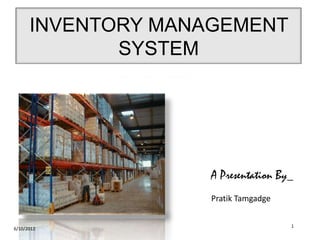
INVENTORY MANAGEMENT
SYSTEM
A Presentation By_
Pratik Tamgadge
6/10/2012
1
Contents
• What is Inventory for organization?
• Types of Inventories
• What is Inventory management
• Tasks in Inventory management
• Inventory management flow cycle
• Inventory management models
• Need of inventory management
26/10/2012
What is Inventory?
• Inventory is stock of items held to meet future
demand.
• It is a list for goods and materials, or those
goods and materials themselves, held available
in stock by a business.
• It is collection of goods processed to form
desired output to the organization.
36/10/2012
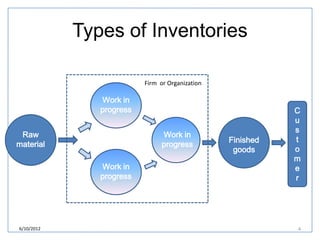
Types of Inventories
Raw
material
Raw
material
Work in
progress
Work in
progress
Work in
progress
Work in
progress
Work in
progress
Work in
progress
Work in
progress
Work in
progress
Work in
progress
Finished
goods
C
u
s
t
o
m
e
r
4
Firm or Organization
C
u
s
t
o
m
e
r
6/10/2012
• Raw Material Goods
– Basic inputs that are converted into finished product through the
manufacturing process.
• “Work in progress” Goods
– Semi-manufactured products need some more works before they
become finished goods for sale.
• Finished Goods
– Completely manufactured products ready for sale.
• Supplied Goods
– Office and plant cleaning materials not directly enter production but
are necessary for production process and do not involve significant
investment.
5
Types of Inventories contd.
6/10/2012
What is Inventory Management?
• Inventory management is all about specifying the size and
placement of stocked goods.
• It is required at different locations within a facility or within
multiple locations of a supply network to protect the regular and
planned course of production against the random disturbance of
running out of materials or goods.
• Inventory management also concerns with carrying costs of
inventory, asset management, inventory forecasting, inventory
valuation, inventory visibility, future inventory price forecasting,
physical inventory, available physical space for inventory.
67/10/2012
• Track inventory
– To look after the amount of inventory i.e. stock coming into the
business.
• How much to order?
– To specify units of inventory to be used by organization.
• When to order?
– Specify the duration of getting the inventory.
Tasks in Inventory
Management
76/10/2012
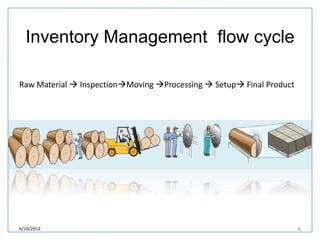
Inventory Management flow cycle
Raw Material  InspectionMoving Processing  Setup Final Product
86/10/2012
Advantages of Inventory Management
• To decouple or separate various parts of the
production process.
• To split up the firm from fluctuations in demand and
provide a stock of goods that will provide a selection
i.e. variety for customers.
• To take advantage of quantity discounts.
• To survive against inflation.
97/10/2012
Inventory Management Models
For implementing specific model to any organization or
firm, we must determine when and how much inventory is to
be ordered.
Here is the classification of models,
• Basic Economic Order Quantity_EOQ
• Production Order Quantity_POQ
• Probabilistic Models and safety stock
107/10/2012
Basic Economic Order Quantity
model
• Demand of inventory is known, constant, and
independent.
• Receipt of inventory is instantaneous and complete.
• Quantity discounts are not possible.
117/10/2012
Production Order Quantity model
• Used when inventory builds up over a period of
time after an order is placed.
• Used when units are produced and sold
simultaneously.
127/10/2012
Probabilistic Models and Safety
Stock
• Used when demand of inventory is not constant or
certain.
• Demand may fluctuate over time due to seasonal,
cyclical and random influences viz. availability of
stock.
• Used for safety stock to achieve a desired service
level and avoid stock outs i.e. emptying of stock.
137/10/2012
reasons for keeping stock
To preserve the Inventory management, collection of
stock should be in solid state. Here are some reasons for
firms to keep the stock,
• Time
– The time lags present in the supply chain, from supplier
to user at every stage, requires that you maintain
certain amounts of inventory to use in this lead time.
• Variations
– Inventory is to be maintained for consumption during
'variations in lead time'.
147/10/2012
Reasons for keeping stock contd.
• Uncertainty
– Inventories are maintained as buffers to meet
uncertainties in demand, supply and movements of
goods.
• Economies of scale
– Ideal condition of "one unit at a time at a place, where
a user needs it, when he needs it" principle tends to
incur lots of costs in terms of logistics. So bulk buying,
movement and storing brings in economies of scale,
thus inventory.
157/10/2012
7/10/2012 16

Inventory Management System

  • 1.
    INVENTORY MANAGEMENT SYSTEM A PresentationBy_ Pratik Tamgadge 6/10/2012 1
  • 2.
    Contents • What isInventory for organization? • Types of Inventories • What is Inventory management • Tasks in Inventory management • Inventory management flow cycle • Inventory management models • Need of inventory management 26/10/2012
  • 3.
    What is Inventory? •Inventory is stock of items held to meet future demand. • It is a list for goods and materials, or those goods and materials themselves, held available in stock by a business. • It is collection of goods processed to form desired output to the organization. 36/10/2012
  • 4.
    Types of Inventories Raw material Raw material Workin progress Work in progress Work in progress Work in progress Work in progress Work in progress Work in progress Work in progress Work in progress Finished goods C u s t o m e r 4 Firm or Organization C u s t o m e r 6/10/2012
  • 5.
    • Raw MaterialGoods – Basic inputs that are converted into finished product through the manufacturing process. • “Work in progress” Goods – Semi-manufactured products need some more works before they become finished goods for sale. • Finished Goods – Completely manufactured products ready for sale. • Supplied Goods – Office and plant cleaning materials not directly enter production but are necessary for production process and do not involve significant investment. 5 Types of Inventories contd. 6/10/2012
  • 6.
    What is InventoryManagement? • Inventory management is all about specifying the size and placement of stocked goods. • It is required at different locations within a facility or within multiple locations of a supply network to protect the regular and planned course of production against the random disturbance of running out of materials or goods. • Inventory management also concerns with carrying costs of inventory, asset management, inventory forecasting, inventory valuation, inventory visibility, future inventory price forecasting, physical inventory, available physical space for inventory. 67/10/2012
  • 7.
    • Track inventory –To look after the amount of inventory i.e. stock coming into the business. • How much to order? – To specify units of inventory to be used by organization. • When to order? – Specify the duration of getting the inventory. Tasks in Inventory Management 76/10/2012
  • 8.
    Inventory Management flowcycle Raw Material  InspectionMoving Processing  Setup Final Product 86/10/2012
  • 9.
    Advantages of InventoryManagement • To decouple or separate various parts of the production process. • To split up the firm from fluctuations in demand and provide a stock of goods that will provide a selection i.e. variety for customers. • To take advantage of quantity discounts. • To survive against inflation. 97/10/2012
  • 10.
    Inventory Management Models Forimplementing specific model to any organization or firm, we must determine when and how much inventory is to be ordered. Here is the classification of models, • Basic Economic Order Quantity_EOQ • Production Order Quantity_POQ • Probabilistic Models and safety stock 107/10/2012
  • 11.
    Basic Economic OrderQuantity model • Demand of inventory is known, constant, and independent. • Receipt of inventory is instantaneous and complete. • Quantity discounts are not possible. 117/10/2012
  • 12.
    Production Order Quantitymodel • Used when inventory builds up over a period of time after an order is placed. • Used when units are produced and sold simultaneously. 127/10/2012
  • 13.
    Probabilistic Models andSafety Stock • Used when demand of inventory is not constant or certain. • Demand may fluctuate over time due to seasonal, cyclical and random influences viz. availability of stock. • Used for safety stock to achieve a desired service level and avoid stock outs i.e. emptying of stock. 137/10/2012
  • 14.
    reasons for keepingstock To preserve the Inventory management, collection of stock should be in solid state. Here are some reasons for firms to keep the stock, • Time – The time lags present in the supply chain, from supplier to user at every stage, requires that you maintain certain amounts of inventory to use in this lead time. • Variations – Inventory is to be maintained for consumption during 'variations in lead time'. 147/10/2012
  • 15.
    Reasons for keepingstock contd. • Uncertainty – Inventories are maintained as buffers to meet uncertainties in demand, supply and movements of goods. • Economies of scale – Ideal condition of "one unit at a time at a place, where a user needs it, when he needs it" principle tends to incur lots of costs in terms of logistics. So bulk buying, movement and storing brings in economies of scale, thus inventory. 157/10/2012
  • 16.