SAFETY STOCKS
By:SHASHANK SHEKHER SINGH- 83
VIKAS SINGH-104

KUMAR RAVI-111
ANKIT SEMWAL -125
WAZIBUR REHMAN-106
NIKUNJ SHARMA-143
SAFETY STOCKS DEFINED
Safety stock is a term that is used to describe the
amount of inventory or stock that is kept on hand in
order to reduce the chance of a temporary shortfall
of materials from taking place.
 Also known as buffer stock.
 This type of inventory is helpful in dealing with
sudden upswings in demand or just for making sure
there are enough raw materials and supplies on
hand to keep production going while waiting for the
next scheduled delivery of materials from a
supplier.

CONTINUED..
The amount of safety stock an organization
chooses to keep on hand can dramatically affect
their business.
 Too much safety stock can result in high holding
costs of inventory. In addition, products which are
stored for too long a time can spoil, expire, or break
during the warehousing process.
 Too little safety stock can result in lost sales
and, thus, a higher rate of customer turnover. As a
result, finding the right balance between too much
and too little safety stock is essential.

WHY SAFETY STOCKS ARE NEEDED?
The main goal of safety stocks is to absorb the
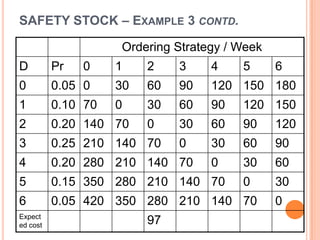
variability of the customer demand.
 Indeed, the Production Planning is based on a
forecast, which is (by definition) different from the
real demand.
 By
absorbing these variations, safety stock
improves the customer service level.
 By creating a safety stock, you will also prevent
stock-outs from other variations :


an upward trend in the demand
 a problem in the incoming product flow (machinery
breakdown, supplies delayed, strike, ...)

UNCERTAINTIES IN INVENTORY MANAGEMENT


In actual case of inventory model, there are always
uncertainties stemming from two basic reasons:
 Variability in sales, hence variability in the demand for the
materials or the consumption of the material.
 Delay in supply of raw material.



Demand is a prediction based on past history, trend
factor(s), and/or known future usage of a product. The item’s
actual usage will probably be more or less than this quantity.
Safety stock is needed for those occasions when actual usage
exceeds forecasted demand. It is “insurance” to help ensure
that you can fulfill customer requests for a product during the
time necessary to replenish inventory.


The anticipated lead time is also a prediction, usually
based on the lead times from the last several stock
receipts. Sometimes the actual lead time will be greater
than what was projected. Safety stock provides
protection from stock outs when the time it takes to
receive a replenishment shipment exceeds the projected
lead time.
SERVICE LEVEL


Service level (denoted as Fx) is typically measured
as Fx = (demand filled) over (total demand).



Service level may also be defines as demand
fulfilled over a particular period of time.



Service Level may also be defined as the Ratio of
„No of units supplied without delay‟ and „No of units
demanded‟
SAFETY STOCK AND SERVICE LEVEL
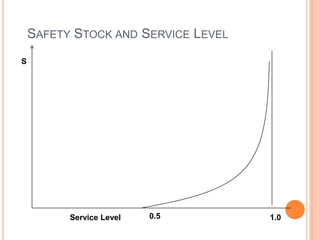
 Safety

stock determines the chance of a stockout
during lead time
 The complement of this chance is called the service
level
 Service level is defined as the probability of not
incurring a stockout during any one lead time
 The higher the probability inventory will be on
hand, the more likely customer demand will be met.
 Service level of 90% means there is a .90
probability that demand will be met during lead time
and .10 probability of a stockout.
SAFETY STOCK AND SERVICE LEVEL
S

Service Level

0.5

1.0
RISK LEVEL


Defined as the percentage of demand that will not
be fulfilled during a particular period of time



Service level= 1- Risk level
SAFETY STOCK AND REORDER POINT


Without safety stock:

R nL
where R


With safety stock:

reorder point in units

n

daily demand in units

L

lead time in days

R nL SS
where SS

safety stock in units
SAFETY STOCK EXAMPLE
Daily demand = 20 units

Lead time = 10 days

S.D. of lead time demand = 50 units

Service level = 90%
Determine:


1.
2.

Safety stock
Reorder point
SAFETY STOCK SOLUTION
Step 1 – determine z

From Appendix B :

z 1.28

Step 2 – determine safety stock

SS 1.28 50 64 units
Step 3 – determine reorder point

R

nL SS

20 10 64 264 units
CALCULATION OF SERVICE LEVEL
can also be calculated by equating Carrying cost
per unit per annum with shortage cost per unit per
annum.

i.e. Cc = Cs
= Csus * Prob. Of shortage * Number of
times shortage situations can occur
in a year
= Csus * (1 – Fx) * R/Q
 (1 – Fx) = Cc * (Q R) * 1 / Csus
Fx = 1 - Cc * (Q R) * 1 / Csus

CONTD.


Another formula for service level is
Fx=Ku/(Ku+Ko)
being
Ku= Under stocking cost
Ko=Overstocking cost
NUMERICAL
Ajay bakery makes ginger bread; one of its fastest
selling products. From past history Ajay estimates the
demand pattern to be:
Demand(no. of buns)

Probability of Demand

400

0.05

500

0.10

600

0.20

700

0.30

800

0.20

900

0.10

1000

0.05

The selling price of each bread is 80 paise. The buns
that are not sold on the day they are made, are sold the
next day at the reduced price of 40 paise each. If the
cost of each bun is 55 paise, what is optimum number
of buns Ajay should make?
Here Ku the understocking cost, is the profit
forgone, which is the difference between sales price
per unit and unit cost: (80p – 55p)= 25p
Ko, the overstocking cost, is the loss in the sale on
the next day; which is the difference between the
cost per unit and the salvage value per unit:
55p – 40p= 15p
Fx=Ku/(Ku+Ko)= 0.25/0.25+0.15=0.625
Cumm.
frequency

Demand(no. of buns)

Probability of Demand

400

0.05

0.05

500

0.10

0.15

600

0.20

0.35

700

0.30

0.65

800

0.20

0.85

900

0.10

0.95

1000

0.05

1.00

This is met at x=700, where the cumulative
probability is 0.650 slightly exceeding the value
0.625
THE CONVENTIONAL WAYS OF CALCULATING
SAFETY STOCK
There are two common conventional methods for
calculating the safety stock quantity for a product:
 Percentage of Lead Time Demand
 Days Supply
 It refer to two variables, “forecast demand” and
“usage.” Forecast demand is a prediction of how
much of a product will be sold or otherwise used in
a particular month, and usage is the quantity that
was actually sold or used.

Percentage of Lead Time Demand
Inventory consultant Gordon Graham long advocated
that, for most items, 50% of lead time demand provides
an adequate safety stock quantity. Let’s look at an
example:

Demand/Day = (390/30) = 13 pieces
Projected Lead Time = 8 days
Demand During the Lead Time = (8 x 13) = 104
pieces
Safety Stock = (104 x 50%) = 52 pieces
This method is easy to understand but it tends to maintain
too much or too little safety stock for many items. For
example:
 Products with long but very reliable lead times and with
fairly consistent demand. If we use this method for an
imported product with a 12-week lead time, we’ll keep six
weeks stock in reserve as safety stock. If we usually receive
the shipment on time and demand doesn’t vary substantially
from month to month, we’ll have too much safety stock – in
other words, too much money tied up in non-productive
inventory.



Products with very short lead times and significant variations in
demand from month to month. If a product had a one-week lead
time, this method will keep a three or day supply of the item in
reserve as safety stock. If usage tends to vary significantly from
month to month, there probably won’t be enough safety stock
available to consistently fill customer demand and the company will
experience stock outs.

DAYS SUPPLY


The days supply method allows a buyer to manually specify a
number of days supply of a product to hold in reserve as
safety stock. Because a buyer usually does not have the time
to review the safety stock parameters for every item each
month, he or she will probably set the days supply to provide
more than enough safety stock. After all, in the eyes of most
buyers, excess inventory is usually preferable to stock outs.
As a result, the days supply method often results in the
accumulation of non-producing inventory.
SAFETY STOCK CALCULATION FOR CONSTANT
LEAD TIME AND NORMALLY DISTRIBUTED DDLT
The projected level of demand for a product from
consumers during its lead time from the supplier to
the retailer
 For the desired service level, find the value of “Z”
from the table “Area under Normal Curve”
 Other notations are




µL be Mean demand during lead time (DDLT)

 σL be standard deviation of demand during lead time


let x be stock at which order is placed
CONTD.


((X - µL)/σL = Z



Safety stock is = Z x σL
Continuous System: Deterministic Model
Reorder Point
• The reorder point is the inventory level at which a new
order is placed.
• Order must be made while there is enough stock in place to
cover demand during lead time.
• Formulation:
•R = dL

•where d = demand rate per time period
•

L = lead time
Reorder Point and Safety Stock
NUMERICAL 1


ABC Ltd. is engaged in production of tires. It
purchases rims from DEL Ltd. an external supplier.
DEL Ltd. takes 10 days in manufacturing and
delivering an order. ABC's requires 10,000 units of
rims. Its ordering cost is $1,000 per order and its
carrying costs are $3 per unit per year. The
maximum usage per day could be 50 per day.
Calculate safety stock.
SOLN.
Maximum daily usage is 50 units and average daily
usage is 27.4 (10,000 annual demand ÷ 365 days).
 Safety Stock = (50-27.4) × 10 = 226 units.
 Reorder Level = Safety Stock + Average Daily
Usage × Lead Time
 Reorder Level = 226 units + 27.4 units × 10 = 500
units.

NUMERICAL 2


Costas Hamburger Shop uses 20 gallons of cola
per day. The lead time is normally distributed with a
mean of 5 days and a standard deviation of 2 days.
Determine the level of safety stock and optimal
reorder point. Assume a service level of 99%.
SOLN.
ROP = Expected demand during lead time + safety
stock
d = 20 gallons per day.
LT= 5 days.
σLT = 2 days.
For a service level of 99%, z = 2.33.
Safety stock = 2.33 (20)(2) = 93.2 gallons.
ROP = 20(5) + 93.2 = 193.2 gallons

NUM. 3


Presume that Litely carries a modern white kitchen
ceiling lamp that is quite popular. The anticipated
demand during lead-time can be approximated by a
normal curve having a mean of 180 units and a
standard deviation of 40 units. What safety stock
should Litely carry to achieve a 95% service level?
To find the safety stock for a 95% service level it is necessary to calculate the 95th percentile on
the normal curve. Using the standard Normal table from the text, we find the Z value for 0.95 is
1.65 standard units. The safety stock is then given by:
(165* 40) 180 66 180 246 Ceiling Lamps
.
A TV dealer finds the cost of holding a TV in stock for a
week as Rs 30 and cost of unit shortage as Rs 70. For a
particular model of TV, the weekly sales distribution is given in
the table below. How many units should the dealer order per
week?

Sales 0

1

2

3

4

5

6

Prob. 0.05 0.10 0.20 0.25 0.20 0.15 0.05
SAFETY STOCK – EXAMPLE 3 (SOLUTION)

Weekly Cc = Rs. 30 , Cs = Rs. 70

Ordering Strategy / Week
D

Pr

0

0.05

1

0.10

2

0.20

3

0.25

4

0.20

5

0.15

6

0.05
Weekly Cc = Rs. 30 , Cs = Rs. 70

SAFETY STOCK – EXAMPLE 3 (SOLUTION)

Ordering Strategy / Week
D

Pr

0

0.05

1

0.10

2

0.20

3

0.25

4

0.20

5

0.15

6

0.05

0

1

2

3

4

5

6
Weekly Cc = Rs. 30 , Cs = Rs. 70

SAFETY STOCK – EXAMPLE 3 CONTD.

Ordering Strategy / Week
D

Pr

0

0.05 0

1

0.10 70

2

0.20 140

3

0.25 210

4

0.20 280

5

0.15 350

6

0.05 420

Expect
ed cost

0

1

2

3

4

5

6
SAFETY STOCK – EXAMPLE 3 CONTD.
Ordering Strategy / Week
D

Pr

0

1

2

3

4

0.05 0

30

60

90

120 150 180

1

0.10 70

0

30

60

90

120 150

2

0.20 140 70

0

30

60

90

120

3

0.25 210 140 70

0

30

60

90

4

0.20 280 210 140 70

0

30

60

5

0.15 350 280 210 140 70

0

30

6

0.05 420 350 280 210 140 70

Expect
ed cost

0

5

6

0
SAFETY STOCK – EXAMPLE 3 CONTD.
Ordering Strategy / Week
D

Pr

0

1

2

3

4

0.05 0

30

60

90

120 150 180

1

0.10 70

0

30

60

90

120 150

2

0.20 140 70

0

30

60

90

120

3

0.25 210 140 70

0

30

60

90

4

0.20 280 210 140 70

0

30

60

5

0.15 350 280 210 140 70

0

30

6

0.05 420 350 280 210 140 70

Expect
ed cost

0

97

5

6

0
SAFETY STOCK – EXAMPLE 3 CONTD.
Ordering Strategy / Week
D

Pr

0

1

2

3

0

0.05

0

30

60

90

120 150 180

1

0.10

70

0

30

60

90

120 150

2

0.20 140

70

0

30

60

90

120

3

0.25 210 140

70

0

30

60

90

4

0.20 280 210 140

70

0

30

60

5

0.15 350 280 210 140

70

0

30

6

0.05 420 350 280 210 140

70

0

62

87

Expect
ed cost

217 152

97

62

4

52

5

6
SAFETY STOCK – EXAMPLE 3 CONTD.
Ordering Strategy / Week
D

Pr

0

1

2

3

0

0.05

0

30

60

90

120 150 180

1

0.10

70

0

30

60

90

120 150

2

0.20 140

70

0

30

60

90

120

3

0.25 210 140

70

0

30

60

90

4

0.20 280 210 140

70

0

30

60

5

0.15 350 280 210 140

70

0

30

6

0.05 420 350 280 210 140

70

0

62

87

Expect
ed cost

217 152

97

62

4

52

5

6
EXAMPLE 4
Sai electrical buy electrical switches for the
assembly of variety of electrical products. Sai
observes that the usage pattern of these boughtout switches follow normal distribution with a mean
of 1000 switches per week and a standard
deviation of 200. the buying process takes one
week. The inventory holding cost is Rs.5/- per unit
and the cost of ordering is Rs. 200/- per order. Sai
allows for only 2 stock out situation in a year.
Compute the safety stock required.
Thank you

Safety stocks final

  • 1.
    SAFETY STOCKS By:SHASHANK SHEKHERSINGH- 83 VIKAS SINGH-104 KUMAR RAVI-111 ANKIT SEMWAL -125 WAZIBUR REHMAN-106 NIKUNJ SHARMA-143
  • 2.
    SAFETY STOCKS DEFINED Safetystock is a term that is used to describe the amount of inventory or stock that is kept on hand in order to reduce the chance of a temporary shortfall of materials from taking place.  Also known as buffer stock.  This type of inventory is helpful in dealing with sudden upswings in demand or just for making sure there are enough raw materials and supplies on hand to keep production going while waiting for the next scheduled delivery of materials from a supplier. 
  • 3.
    CONTINUED.. The amount ofsafety stock an organization chooses to keep on hand can dramatically affect their business.  Too much safety stock can result in high holding costs of inventory. In addition, products which are stored for too long a time can spoil, expire, or break during the warehousing process.  Too little safety stock can result in lost sales and, thus, a higher rate of customer turnover. As a result, finding the right balance between too much and too little safety stock is essential. 
  • 4.
    WHY SAFETY STOCKSARE NEEDED? The main goal of safety stocks is to absorb the variability of the customer demand.  Indeed, the Production Planning is based on a forecast, which is (by definition) different from the real demand.  By absorbing these variations, safety stock improves the customer service level.  By creating a safety stock, you will also prevent stock-outs from other variations :  an upward trend in the demand  a problem in the incoming product flow (machinery breakdown, supplies delayed, strike, ...) 
  • 5.
    UNCERTAINTIES IN INVENTORYMANAGEMENT  In actual case of inventory model, there are always uncertainties stemming from two basic reasons:  Variability in sales, hence variability in the demand for the materials or the consumption of the material.  Delay in supply of raw material.  Demand is a prediction based on past history, trend factor(s), and/or known future usage of a product. The item’s actual usage will probably be more or less than this quantity. Safety stock is needed for those occasions when actual usage exceeds forecasted demand. It is “insurance” to help ensure that you can fulfill customer requests for a product during the time necessary to replenish inventory.
  • 6.
     The anticipated leadtime is also a prediction, usually based on the lead times from the last several stock receipts. Sometimes the actual lead time will be greater than what was projected. Safety stock provides protection from stock outs when the time it takes to receive a replenishment shipment exceeds the projected lead time.
  • 7.
    SERVICE LEVEL  Service level(denoted as Fx) is typically measured as Fx = (demand filled) over (total demand).  Service level may also be defines as demand fulfilled over a particular period of time.  Service Level may also be defined as the Ratio of „No of units supplied without delay‟ and „No of units demanded‟
  • 8.
    SAFETY STOCK ANDSERVICE LEVEL  Safety stock determines the chance of a stockout during lead time  The complement of this chance is called the service level  Service level is defined as the probability of not incurring a stockout during any one lead time  The higher the probability inventory will be on hand, the more likely customer demand will be met.  Service level of 90% means there is a .90 probability that demand will be met during lead time and .10 probability of a stockout.
  • 9.
    SAFETY STOCK ANDSERVICE LEVEL S Service Level 0.5 1.0
  • 10.
    RISK LEVEL  Defined asthe percentage of demand that will not be fulfilled during a particular period of time  Service level= 1- Risk level
  • 11.
    SAFETY STOCK ANDREORDER POINT  Without safety stock: R nL where R  With safety stock: reorder point in units n daily demand in units L lead time in days R nL SS where SS safety stock in units
  • 12.
    SAFETY STOCK EXAMPLE Dailydemand = 20 units  Lead time = 10 days  S.D. of lead time demand = 50 units  Service level = 90% Determine:  1. 2. Safety stock Reorder point
  • 13.
    SAFETY STOCK SOLUTION Step1 – determine z From Appendix B : z 1.28 Step 2 – determine safety stock SS 1.28 50 64 units Step 3 – determine reorder point R nL SS 20 10 64 264 units
  • 15.
    CALCULATION OF SERVICELEVEL can also be calculated by equating Carrying cost per unit per annum with shortage cost per unit per annum.  i.e. Cc = Cs = Csus * Prob. Of shortage * Number of times shortage situations can occur in a year = Csus * (1 – Fx) * R/Q  (1 – Fx) = Cc * (Q R) * 1 / Csus Fx = 1 - Cc * (Q R) * 1 / Csus 
  • 16.
    CONTD.  Another formula forservice level is Fx=Ku/(Ku+Ko) being Ku= Under stocking cost Ko=Overstocking cost
  • 17.
    NUMERICAL Ajay bakery makesginger bread; one of its fastest selling products. From past history Ajay estimates the demand pattern to be: Demand(no. of buns) Probability of Demand 400 0.05 500 0.10 600 0.20 700 0.30 800 0.20 900 0.10 1000 0.05 The selling price of each bread is 80 paise. The buns that are not sold on the day they are made, are sold the next day at the reduced price of 40 paise each. If the cost of each bun is 55 paise, what is optimum number of buns Ajay should make?
  • 18.
    Here Ku theunderstocking cost, is the profit forgone, which is the difference between sales price per unit and unit cost: (80p – 55p)= 25p Ko, the overstocking cost, is the loss in the sale on the next day; which is the difference between the cost per unit and the salvage value per unit: 55p – 40p= 15p Fx=Ku/(Ku+Ko)= 0.25/0.25+0.15=0.625
  • 19.
    Cumm. frequency Demand(no. of buns) Probabilityof Demand 400 0.05 0.05 500 0.10 0.15 600 0.20 0.35 700 0.30 0.65 800 0.20 0.85 900 0.10 0.95 1000 0.05 1.00 This is met at x=700, where the cumulative probability is 0.650 slightly exceeding the value 0.625
  • 20.
    THE CONVENTIONAL WAYSOF CALCULATING SAFETY STOCK There are two common conventional methods for calculating the safety stock quantity for a product:  Percentage of Lead Time Demand  Days Supply  It refer to two variables, “forecast demand” and “usage.” Forecast demand is a prediction of how much of a product will be sold or otherwise used in a particular month, and usage is the quantity that was actually sold or used. 
  • 21.
    Percentage of LeadTime Demand Inventory consultant Gordon Graham long advocated that, for most items, 50% of lead time demand provides an adequate safety stock quantity. Let’s look at an example: Demand/Day = (390/30) = 13 pieces Projected Lead Time = 8 days Demand During the Lead Time = (8 x 13) = 104 pieces Safety Stock = (104 x 50%) = 52 pieces
  • 22.
    This method iseasy to understand but it tends to maintain too much or too little safety stock for many items. For example:  Products with long but very reliable lead times and with fairly consistent demand. If we use this method for an imported product with a 12-week lead time, we’ll keep six weeks stock in reserve as safety stock. If we usually receive the shipment on time and demand doesn’t vary substantially from month to month, we’ll have too much safety stock – in other words, too much money tied up in non-productive inventory. 
  • 23.
     Products with veryshort lead times and significant variations in demand from month to month. If a product had a one-week lead time, this method will keep a three or day supply of the item in reserve as safety stock. If usage tends to vary significantly from month to month, there probably won’t be enough safety stock available to consistently fill customer demand and the company will experience stock outs. DAYS SUPPLY  The days supply method allows a buyer to manually specify a number of days supply of a product to hold in reserve as safety stock. Because a buyer usually does not have the time to review the safety stock parameters for every item each month, he or she will probably set the days supply to provide more than enough safety stock. After all, in the eyes of most buyers, excess inventory is usually preferable to stock outs. As a result, the days supply method often results in the accumulation of non-producing inventory.
  • 24.
    SAFETY STOCK CALCULATIONFOR CONSTANT LEAD TIME AND NORMALLY DISTRIBUTED DDLT The projected level of demand for a product from consumers during its lead time from the supplier to the retailer  For the desired service level, find the value of “Z” from the table “Area under Normal Curve”  Other notations are   µL be Mean demand during lead time (DDLT)  σL be standard deviation of demand during lead time  let x be stock at which order is placed
  • 25.
    CONTD.  ((X - µL)/σL= Z  Safety stock is = Z x σL
  • 26.
  • 27.
    Reorder Point • Thereorder point is the inventory level at which a new order is placed. • Order must be made while there is enough stock in place to cover demand during lead time. • Formulation: •R = dL •where d = demand rate per time period • L = lead time
  • 28.
    Reorder Point andSafety Stock
  • 29.
    NUMERICAL 1  ABC Ltd.is engaged in production of tires. It purchases rims from DEL Ltd. an external supplier. DEL Ltd. takes 10 days in manufacturing and delivering an order. ABC's requires 10,000 units of rims. Its ordering cost is $1,000 per order and its carrying costs are $3 per unit per year. The maximum usage per day could be 50 per day. Calculate safety stock.
  • 30.
    SOLN. Maximum daily usageis 50 units and average daily usage is 27.4 (10,000 annual demand ÷ 365 days).  Safety Stock = (50-27.4) × 10 = 226 units.  Reorder Level = Safety Stock + Average Daily Usage × Lead Time  Reorder Level = 226 units + 27.4 units × 10 = 500 units. 
  • 31.
    NUMERICAL 2  Costas HamburgerShop uses 20 gallons of cola per day. The lead time is normally distributed with a mean of 5 days and a standard deviation of 2 days. Determine the level of safety stock and optimal reorder point. Assume a service level of 99%.
  • 32.
    SOLN. ROP = Expecteddemand during lead time + safety stock d = 20 gallons per day. LT= 5 days. σLT = 2 days. For a service level of 99%, z = 2.33. Safety stock = 2.33 (20)(2) = 93.2 gallons. ROP = 20(5) + 93.2 = 193.2 gallons 
  • 33.
    NUM. 3  Presume thatLitely carries a modern white kitchen ceiling lamp that is quite popular. The anticipated demand during lead-time can be approximated by a normal curve having a mean of 180 units and a standard deviation of 40 units. What safety stock should Litely carry to achieve a 95% service level?
  • 34.
    To find thesafety stock for a 95% service level it is necessary to calculate the 95th percentile on the normal curve. Using the standard Normal table from the text, we find the Z value for 0.95 is 1.65 standard units. The safety stock is then given by: (165* 40) 180 66 180 246 Ceiling Lamps .
  • 35.
    A TV dealerfinds the cost of holding a TV in stock for a week as Rs 30 and cost of unit shortage as Rs 70. For a particular model of TV, the weekly sales distribution is given in the table below. How many units should the dealer order per week? Sales 0 1 2 3 4 5 6 Prob. 0.05 0.10 0.20 0.25 0.20 0.15 0.05
  • 36.
    SAFETY STOCK –EXAMPLE 3 (SOLUTION) Weekly Cc = Rs. 30 , Cs = Rs. 70 Ordering Strategy / Week D Pr 0 0.05 1 0.10 2 0.20 3 0.25 4 0.20 5 0.15 6 0.05
  • 37.
    Weekly Cc =Rs. 30 , Cs = Rs. 70 SAFETY STOCK – EXAMPLE 3 (SOLUTION) Ordering Strategy / Week D Pr 0 0.05 1 0.10 2 0.20 3 0.25 4 0.20 5 0.15 6 0.05 0 1 2 3 4 5 6
  • 38.
    Weekly Cc =Rs. 30 , Cs = Rs. 70 SAFETY STOCK – EXAMPLE 3 CONTD. Ordering Strategy / Week D Pr 0 0.05 0 1 0.10 70 2 0.20 140 3 0.25 210 4 0.20 280 5 0.15 350 6 0.05 420 Expect ed cost 0 1 2 3 4 5 6
  • 39.
    SAFETY STOCK –EXAMPLE 3 CONTD. Ordering Strategy / Week D Pr 0 1 2 3 4 0.05 0 30 60 90 120 150 180 1 0.10 70 0 30 60 90 120 150 2 0.20 140 70 0 30 60 90 120 3 0.25 210 140 70 0 30 60 90 4 0.20 280 210 140 70 0 30 60 5 0.15 350 280 210 140 70 0 30 6 0.05 420 350 280 210 140 70 Expect ed cost 0 5 6 0
  • 40.
    SAFETY STOCK –EXAMPLE 3 CONTD. Ordering Strategy / Week D Pr 0 1 2 3 4 0.05 0 30 60 90 120 150 180 1 0.10 70 0 30 60 90 120 150 2 0.20 140 70 0 30 60 90 120 3 0.25 210 140 70 0 30 60 90 4 0.20 280 210 140 70 0 30 60 5 0.15 350 280 210 140 70 0 30 6 0.05 420 350 280 210 140 70 Expect ed cost 0 97 5 6 0
  • 41.
    SAFETY STOCK –EXAMPLE 3 CONTD. Ordering Strategy / Week D Pr 0 1 2 3 0 0.05 0 30 60 90 120 150 180 1 0.10 70 0 30 60 90 120 150 2 0.20 140 70 0 30 60 90 120 3 0.25 210 140 70 0 30 60 90 4 0.20 280 210 140 70 0 30 60 5 0.15 350 280 210 140 70 0 30 6 0.05 420 350 280 210 140 70 0 62 87 Expect ed cost 217 152 97 62 4 52 5 6
  • 42.
    SAFETY STOCK –EXAMPLE 3 CONTD. Ordering Strategy / Week D Pr 0 1 2 3 0 0.05 0 30 60 90 120 150 180 1 0.10 70 0 30 60 90 120 150 2 0.20 140 70 0 30 60 90 120 3 0.25 210 140 70 0 30 60 90 4 0.20 280 210 140 70 0 30 60 5 0.15 350 280 210 140 70 0 30 6 0.05 420 350 280 210 140 70 0 62 87 Expect ed cost 217 152 97 62 4 52 5 6
  • 43.
    EXAMPLE 4 Sai electricalbuy electrical switches for the assembly of variety of electrical products. Sai observes that the usage pattern of these boughtout switches follow normal distribution with a mean of 1000 switches per week and a standard deviation of 200. the buying process takes one week. The inventory holding cost is Rs.5/- per unit and the cost of ordering is Rs. 200/- per order. Sai allows for only 2 stock out situation in a year. Compute the safety stock required.
  • 44.