Cross Docking

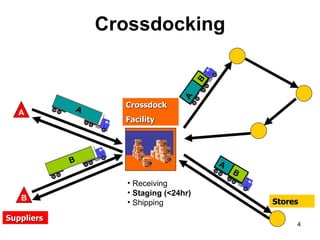
A logistics activity that attempts to reduce
costs and total lead time.

Breaks down received items on the loading
dock and immediately matches them with
outgoing shipment requirements, instead of
stocking the items in warehouse locations
and returning to pick for orders at a later time.
Cross Docking…

Eliminates the need to place inventory
in storage.

The idea is to transfer incoming
shipments directly to outgoing trailers
without storing them in between.
Cross Docking…
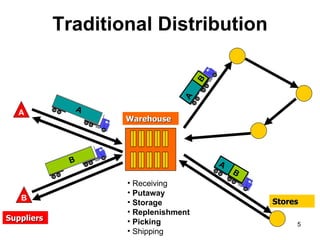
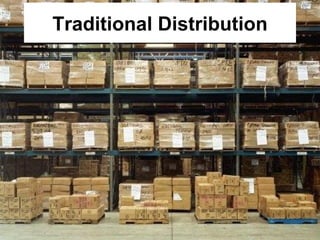
In a traditional warehouse, goods are received
from vendors and stored in devices like racks or
shelving.

When a customer (e.g., the consumer or
perhaps a retail outlet) requests an item,
workers pick it from the shelves and send it to
the destination.
Crossdocking


                                      B
                                A
            A     Crossdock
   A
                  Facility


            B                             A
                                              B
                  • Receiving
                  • Staging (<24hr)
   B                                              Stores
                  • Shipping
Suppliers
                                                       4
Traditional Distribution


                                      B
                                 A
   A          A
                    Warehouse


             B                            A
                                              B
                    • Receiving
                    • Putaway
   B                                              Stores
                    • Storage
                    • Replenishment
Suppliers           • Picking                          5
                    • Shipping
Traditional Distribution


                           6
Crossdocking

• 550,000 warehouses in the U.S. alone
  (1995 estimate)
• Crossdocking can turn warehouses
  into transfer nodes, rather than storage
  nodes


                                         7
Cross Docking…
In a crossdock, goods arriving from the vendor
already have a customer assigned, so workers
need only move the shipment from the inbound
trailer to an outbound trailer bound for the
appropriate destination.

The already part should make you think of
information system requirements--a chief
obstacle to implementing crossdocking
successfully.
Cross Docking…
            (classification)

In pre-distribution crossdocking, the customer is
assigned before the shipment leaves the vendor, so it
arrives to the crossdock bagged and tagged for transfer.

In post-distribution crossdocking, the crossdock itself
allocates material to its stores.
Applicability of Crossdocking
         Has Increased
• Fierce competition in all
  industries, especially retail
• Cooperating with supply chain
  partners to reduce the system-
  wide costs
• Internet allows companies to
  communicate among each other
  – In real time
  – At costs significantly lower than
                                        10
    the past
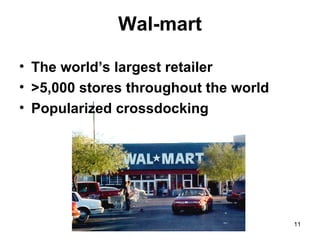
Wal-mart

• The world’s largest retailer
• >5,000 stores throughout the world
• Popularized crossdocking


                                       11

Cross docking

  • 1.
    Cross Docking A logisticsactivity that attempts to reduce costs and total lead time. Breaks down received items on the loading dock and immediately matches them with outgoing shipment requirements, instead of stocking the items in warehouse locations and returning to pick for orders at a later time.
  • 2.
    Cross Docking… Eliminates theneed to place inventory in storage. The idea is to transfer incoming shipments directly to outgoing trailers without storing them in between.
  • 3.
    Cross Docking… In atraditional warehouse, goods are received from vendors and stored in devices like racks or shelving. When a customer (e.g., the consumer or perhaps a retail outlet) requests an item, workers pick it from the shelves and send it to the destination.
  • 4.
    Crossdocking B A A Crossdock A Facility B A B • Receiving • Staging (<24hr) B Stores • Shipping Suppliers 4
  • 5.
    Traditional Distribution B A A A Warehouse B A B • Receiving • Putaway B Stores • Storage • Replenishment Suppliers • Picking 5 • Shipping
  • 6.
  • 7.
    Crossdocking • 550,000 warehousesin the U.S. alone (1995 estimate) • Crossdocking can turn warehouses into transfer nodes, rather than storage nodes 7
  • 8.
    Cross Docking… In acrossdock, goods arriving from the vendor already have a customer assigned, so workers need only move the shipment from the inbound trailer to an outbound trailer bound for the appropriate destination. The already part should make you think of information system requirements--a chief obstacle to implementing crossdocking successfully.
  • 9.
    Cross Docking… (classification) In pre-distribution crossdocking, the customer is assigned before the shipment leaves the vendor, so it arrives to the crossdock bagged and tagged for transfer. In post-distribution crossdocking, the crossdock itself allocates material to its stores.
  • 10.
    Applicability of Crossdocking Has Increased • Fierce competition in all industries, especially retail • Cooperating with supply chain partners to reduce the system- wide costs • Internet allows companies to communicate among each other – In real time – At costs significantly lower than 10 the past
  • 11.
    Wal-mart • The world’slargest retailer • >5,000 stores throughout the world • Popularized crossdocking 11