IDEAL INSTITUTE OF ENGINEERING
NAME- SUBHADIP MAJUMDER
ROLL NO- 27901321017
DEPARTMENT- CIVIL ENGINEERING
SEMESTER- 6th
YEAR- 3rd
SUBJECT- ENGINEERING ECONOMICS, ESTIMATE & COSTING
SUBJECT CODE- CE(PC)602
1
-:TOPIC:-
ECONOMIC ORDER QUANTITY
Inventory
2
Definition
“The term inventory include materials- raw, in
progress, finished packaging, spares, and
other stock in order to meet an un expected
demand or distribution in the future.”
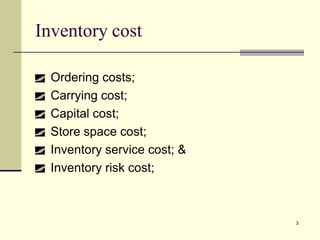
Inventory cost
Ordering costs;
Carrying cost;
Capital cost;
Store space cost;
Inventory service cost; &
Inventory risk cost;
3
Inventory management & control
4
Inventory management involves the:
“Development and administration of policies
systems and procedures, which will minimize
total cost related to inventory decisions and
related functions such as production
scheduling, purchasing and traffic”.
What is EOQ ?
5
Economic order quantity is one of the
techniques of inventory control which minimizes
total holding and ordering costs for the year.
The economic order quantity is the technique
which solves the problem of the materials
manager.
Definition of EOQ
6
“ EOQ is essentially an accounting formula that
determines at which the combination of order,
costs and inventory carrying cost are the least.
The result is the most cost effective quality to
order. In purchasing this is known as order
quantity, in manufacturing it is known as the
production lot size.”
- Dave Piasecki
EOQ Models
‘Q’ Models; &
‘P’ Models.
7
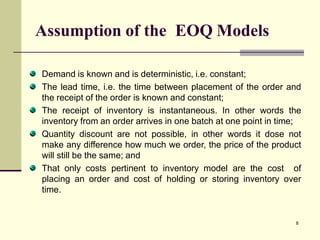
Assumption of the EOQ Models
Demand is known and is deterministic, i.e. constant;
The lead time, i.e. the time between placement of the order and
the receipt of the order is known and constant;
The receipt of inventory is instantaneous. In other words the
inventory from an order arrives in one batch at one point in time;
Quantity discount are not possible, in other words it dose not
make any difference how much we order, the price of the product
will still be the same; and
That only costs pertinent to inventory model are the cost of
placing an order and cost of holding or storing inventory over
time.
8
‘Q’ Model of EOQ
9
 In ‘Q’ model, a fixed quantity of material is
ordered when ever the stock on hand reaches
the recorder point the fixed quantity of
material ordered each time is nothing but the
economic order quantity (EOQ). when the
new consignment arrives the total stock shall
be within the maximum and the minimum
limits.
Graphic presentation of ‘Q’ Model
E
O
Q
RE-ORDER
LEVEL
BUFFER
STOCK
MAXIMUM
LEVEL
MINIMUM
LEVEL
E G
I
N
V
E
N
T
O
R
Y
TIME PERIOD
K
A B C D
10
Mathematical method of EOQ
The objective is to determine the quantity to order
which minimize the total annual inventory
management cost;
Minimize Total cost per period = inventory holding
cost per period + order cost per period;
Where order cost = the number of order placed in the
period ‘x’ order cost; and
Carrying cost = average inventory level ‘x’ the
carrying costs of 1 unit of stock for one period.
11
Mathematical formula of ‘Q’ Model
Where as ,
Q denotes order quantity;
A denotes demand per time period (e.g.-annual demand);
S denotes carrying / holding cost of 1 unit of stock for one
period; and
P denotes order cost.
EOQ = Square Root of 2AP/S
12
12/08/09 15
Example:
Q. Calculate the economic order quantity if annual demand for the
product is 5,000 unit. The ordering cost is Rs 30 per order and
holding cost is Rs 6/- per unit per annual.
Sol:-
Now,
Given R=5000 unit
Cp= Rs. 30
Ch=Rs. 6
EOQ = J ( 2RCp/ CH)
= J(2*5000*30/6)
= J 5000
= 224 or 22.5 units.
13
Merits of ‘Q’ system
Each material can be in the most economical
quantity;
Purchasing an inventory control personnel
automatically devote attention to the items
that are needed only when required; and
Positive control can be easily exerted to
maintain total inventory investment at the
desired level, simply by manipulating the
plant maximum and minimum values.
14
Demerits of ‘Q’ system
The orders are raised at irregular intervals which may not
be convenient to the suppliers;
In case the lead time is very high supply of inventory may
interpret;
EOQ may give you an order quantity which is much below
the supplier minimum, and there is always a chance that
the ordering level for an item has been reached but not
noticed in which case a stock out may occur; and
The items cannot be group and ordered at a time since the
recorder points occur irregularly.
15
‘P’ model of EOQ
In this model the stock position of each item
of material is regularly is reviewed;
Under this model inventory is ordered based
on fixed period.
16
12/08/09 19
L
I
T
UNITS OF
STOCK
Replenishment
level
R1 15
days
Y1
Y2 Y3
R3
R1
G
S3
R2
S2
S1
S2
R2 R3 S3
Graphical Presentation of ‘P’ Model
17
Merits of P model
The ordering and inventory cost are low;
The supplier will also offer attractive discount
on sales are granted; and
The system works well for material which
exhibit an irregular or seasonal use and
whose purchase must be planned in advance
on the basis of sales estimates.
18
Demerits of ‘P’ model
It compels a periodic review of all item; this in itself
make the system somewhat inefficient. because of
difference in uses rate supply may not have to be
order until succeeding review;
Equally important the system demand the
establishment of rather inflexibility order quantities. in
The interest of the administrative efficiency; and
The periodic review system tends to peak the
purchasing work around the review dates.
19
THANK YOU
20

EEEC PPT.pptx

  • 1.
    IDEAL INSTITUTE OFENGINEERING NAME- SUBHADIP MAJUMDER ROLL NO- 27901321017 DEPARTMENT- CIVIL ENGINEERING SEMESTER- 6th YEAR- 3rd SUBJECT- ENGINEERING ECONOMICS, ESTIMATE & COSTING SUBJECT CODE- CE(PC)602 1 -:TOPIC:- ECONOMIC ORDER QUANTITY
  • 2.
    Inventory 2 Definition “The term inventoryinclude materials- raw, in progress, finished packaging, spares, and other stock in order to meet an un expected demand or distribution in the future.”
  • 3.
    Inventory cost Ordering costs; Carryingcost; Capital cost; Store space cost; Inventory service cost; & Inventory risk cost; 3
  • 4.
    Inventory management &control 4 Inventory management involves the: “Development and administration of policies systems and procedures, which will minimize total cost related to inventory decisions and related functions such as production scheduling, purchasing and traffic”.
  • 5.
    What is EOQ? 5 Economic order quantity is one of the techniques of inventory control which minimizes total holding and ordering costs for the year. The economic order quantity is the technique which solves the problem of the materials manager.
  • 6.
    Definition of EOQ 6 “EOQ is essentially an accounting formula that determines at which the combination of order, costs and inventory carrying cost are the least. The result is the most cost effective quality to order. In purchasing this is known as order quantity, in manufacturing it is known as the production lot size.” - Dave Piasecki
  • 7.
    EOQ Models ‘Q’ Models;& ‘P’ Models. 7
  • 8.
    Assumption of theEOQ Models Demand is known and is deterministic, i.e. constant; The lead time, i.e. the time between placement of the order and the receipt of the order is known and constant; The receipt of inventory is instantaneous. In other words the inventory from an order arrives in one batch at one point in time; Quantity discount are not possible, in other words it dose not make any difference how much we order, the price of the product will still be the same; and That only costs pertinent to inventory model are the cost of placing an order and cost of holding or storing inventory over time. 8
  • 9.
    ‘Q’ Model ofEOQ 9  In ‘Q’ model, a fixed quantity of material is ordered when ever the stock on hand reaches the recorder point the fixed quantity of material ordered each time is nothing but the economic order quantity (EOQ). when the new consignment arrives the total stock shall be within the maximum and the minimum limits.
  • 10.
    Graphic presentation of‘Q’ Model E O Q RE-ORDER LEVEL BUFFER STOCK MAXIMUM LEVEL MINIMUM LEVEL E G I N V E N T O R Y TIME PERIOD K A B C D 10
  • 11.
    Mathematical method ofEOQ The objective is to determine the quantity to order which minimize the total annual inventory management cost; Minimize Total cost per period = inventory holding cost per period + order cost per period; Where order cost = the number of order placed in the period ‘x’ order cost; and Carrying cost = average inventory level ‘x’ the carrying costs of 1 unit of stock for one period. 11
  • 12.
    Mathematical formula of‘Q’ Model Where as , Q denotes order quantity; A denotes demand per time period (e.g.-annual demand); S denotes carrying / holding cost of 1 unit of stock for one period; and P denotes order cost. EOQ = Square Root of 2AP/S 12
  • 13.
    12/08/09 15 Example: Q. Calculatethe economic order quantity if annual demand for the product is 5,000 unit. The ordering cost is Rs 30 per order and holding cost is Rs 6/- per unit per annual. Sol:- Now, Given R=5000 unit Cp= Rs. 30 Ch=Rs. 6 EOQ = J ( 2RCp/ CH) = J(2*5000*30/6) = J 5000 = 224 or 22.5 units. 13
  • 14.
    Merits of ‘Q’system Each material can be in the most economical quantity; Purchasing an inventory control personnel automatically devote attention to the items that are needed only when required; and Positive control can be easily exerted to maintain total inventory investment at the desired level, simply by manipulating the plant maximum and minimum values. 14
  • 15.
    Demerits of ‘Q’system The orders are raised at irregular intervals which may not be convenient to the suppliers; In case the lead time is very high supply of inventory may interpret; EOQ may give you an order quantity which is much below the supplier minimum, and there is always a chance that the ordering level for an item has been reached but not noticed in which case a stock out may occur; and The items cannot be group and ordered at a time since the recorder points occur irregularly. 15
  • 16.
    ‘P’ model ofEOQ In this model the stock position of each item of material is regularly is reviewed; Under this model inventory is ordered based on fixed period. 16
  • 17.
    12/08/09 19 L I T UNITS OF STOCK Replenishment level R115 days Y1 Y2 Y3 R3 R1 G S3 R2 S2 S1 S2 R2 R3 S3 Graphical Presentation of ‘P’ Model 17
  • 18.
    Merits of Pmodel The ordering and inventory cost are low; The supplier will also offer attractive discount on sales are granted; and The system works well for material which exhibit an irregular or seasonal use and whose purchase must be planned in advance on the basis of sales estimates. 18
  • 19.
    Demerits of ‘P’model It compels a periodic review of all item; this in itself make the system somewhat inefficient. because of difference in uses rate supply may not have to be order until succeeding review; Equally important the system demand the establishment of rather inflexibility order quantities. in The interest of the administrative efficiency; and The periodic review system tends to peak the purchasing work around the review dates. 19
  • 20.