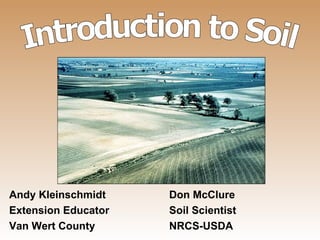
Introduction to Soil Andy Kleinschmidt Don McClure Extension Educator Soil Scientist Van Wert County NRCS-USDA
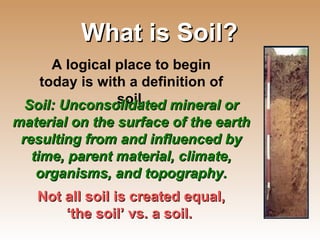
What is Soil? A logical place to begin today is with a definition of soil. Soil: Unconsolidated mineral or material on the surface of the earth resulting from and influenced by time, parent material, climate, organisms, and topography. Not all soil is created equal, ‘the soil’ vs. a soil.
Why are soils important? Great integrator Producer and absorber of gases Medium for plant growth Medium of crop production Home to organisms (plants, animals and others) Waste decomposer Snapshot  of geologic, climatic,  biological, and human history Source material for construction,  medicine, art, etc. Filter of water and wastes Essential natural resource
Objectives Soil color Soil texture Soil structure Soil pH CEC Microorganisms Nutrient movement
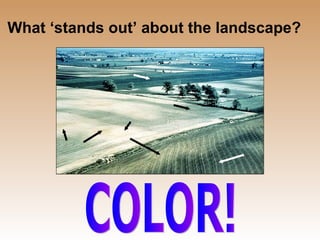
What ‘stands out’ about the landscape? COLOR!
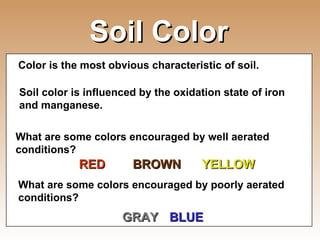
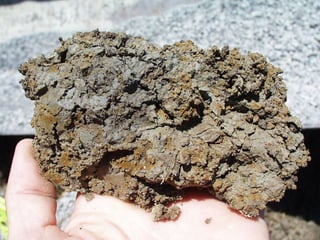
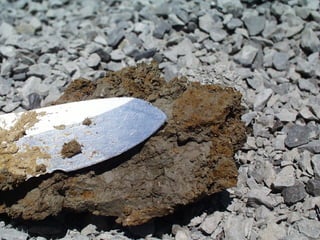
Soil Color Color is the most obvious characteristic of soil. What are some colors encouraged by well aerated conditions? What are some colors encouraged by poorly aerated conditions? Soil color is influenced by the oxidation state of iron and manganese. RED YELLOW BROWN GRAY BLUE
 
 
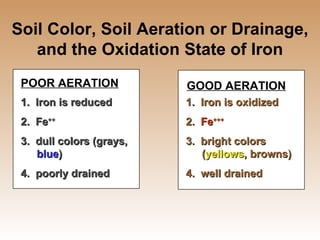
Soil Color, Soil Aeration or Drainage, and the Oxidation State of Iron 1.  Iron is reduced 2.  Fe ++ 3.  dull colors (grays,  blue ) 4.  poorly drained 1.  Iron is oxidized 2.  Fe +++ 3.  bright colors ( yellows , browns) 4.  well drained POOR AERATION GOOD AERATION
 
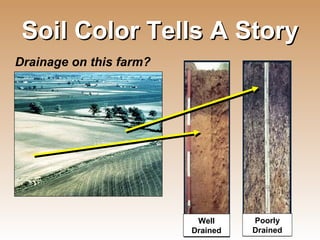
Soil Color Tells A Story Well Drained Poorly Drained Drainage on this farm?
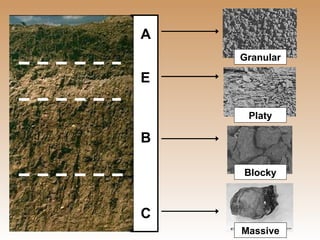
Soil Horizons B C Ap Zone of highest organic matter content.  The ‘p’ denotes that this soil has been plowed.  A layer of accumulation of iron and clays.  Blocky structure is readily seen in this layer. Unconsolidated material.  Outside the zone of major biological activity and is not affected by soil forming processes.
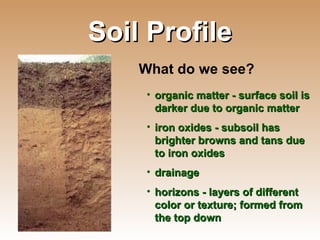
Soil Profile What do we see? organic matter - surface soil is darker due to organic matter iron oxides - subsoil has brighter browns and tans due to iron oxides drainage horizons - layers of different color or texture; formed from the top down
 
. . . more on Soil Horizons Mollisol Alfisol B C Ap A
USDA-NRCS National Soil Survey Center
Average Soil Composition { } Pore space 50% Solids 50% 25% Water 25% Air 5% Organic Matter 45% Inorganic (mineral materials)                                                                                                    
Soil Texture Determined by the relative proportion of sand, silt and clay Surface Area   Charge Sand 50 cm 2 /g none Silt 500 cm 2 /g none Clay 5,000,000 cm 2 /g negative
Relative Size Comparison of Soil Particles Sand  - feels gritty Silt - feels floury (2.00 - 0.05 mm)  (0.05 - 0.002 mm) (< 0.002 mm) barrel plate coin Clay - feels sticky USDA system for determining soil separates
Clay Silty Clay Silty Clay Loam Clay Loam Sandy Clay Sandy Clay Loam Loam Silt Loam Silt Sandy Loam Sand Percent Clay Percent Silt Percent Sand Fine Medium Coarse Loamy Sand Soil Triangle
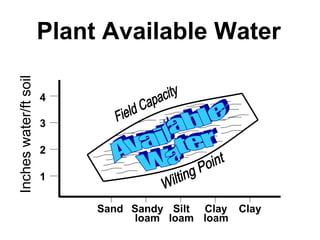
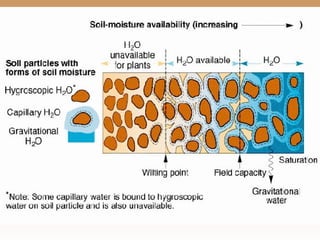
Sand Sandy loam Silt loam Clay loam Clay 1 2 3 4 Available Water Inches water/ft soil Plant Available Water Field Capacity Wilting Point
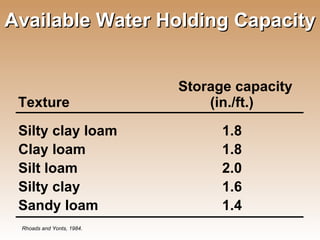
Available Water Holding Capacity Rhoads and Yonts, 1984. Storage capacity Silty clay loam   1.8 Clay loam   1.8 Silty clay   1.6 Silt loam   2.0 Sandy loam     1.4 Texture  (in./ft.)
 
Comparison of Coarse Textured and Fine Textured Soils  Coarse Textured Soil Less porespace but more macropores Fine Textured Soil More total porespace Texture and Pore Space
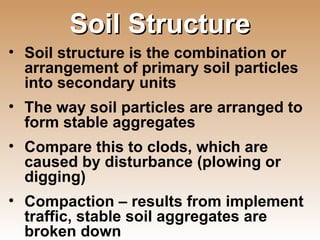
Soil Structure Soil structure is the combination or arrangement of primary soil particles into secondary units The way soil particles are arranged to form stable aggregates Compare this to clods, which are caused by disturbance (plowing or digging) Compaction – results from implement traffic, stable soil aggregates are broken down
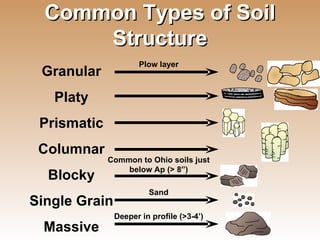
Common Types of Soil Structure Granular Platy Prismatic Columnar Blocky Single Grain Massive Common to Ohio soils just below Ap (> 8”) Plow layer Sand Deeper in profile (>3-4’)
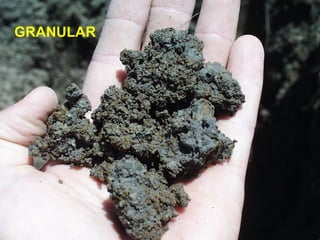
GRANULAR
BLOCKY
C B E A Granular Platy Blocky Massive
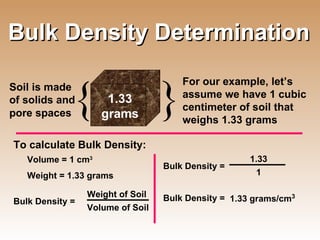
Bulk Density Determination For our example, let’s assume we have 1 cubic centimeter of soil that weighs 1.33 grams Soil is made of solids and pore spaces 1.33 grams { } To calculate Bulk Density: Volume = 1 cm 3  Weight = 1.33 grams Bulk Density =   Weight of Soil Volume of Soil Bulk Density =   1.33 1 Bulk Density =   1.33 grams/cm 3
Bulk Density (con’t.)   Bulk density (g/cm 3 ) Soil  Cropped  Uncropped Hagerstown loam (PA)   1.25 Marshall silt loam (IA)   1.13 Nappanese silt loam (OH)   1.31 Data from Lyon et al. (50%) (56%) (51%) (57%) (63%) (60%) 1.07 0.93 1.05 What impact does this have on pore space?
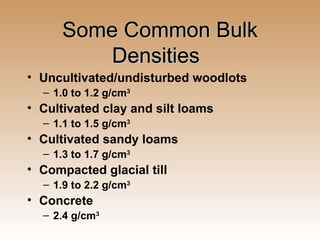
Some Common Bulk Densities Uncultivated/undisturbed woodlots  1.0 to 1.2 g/cm 3 Cultivated clay and silt loams 1.1 to 1.5 g/cm 3 Cultivated sandy loams 1.3 to 1.7 g/cm 3 Compacted glacial till 1.9 to 2.2 g/cm 3 Concrete 2.4 g/cm 3
Bulk Density and Compaction 8 inches 1.43 0 inches 7 inches 9 inches 10 inches Bulk Density (g/cm 3 ) 1.90 1.87 1.84 1.80 1.60 Plow layer Compacted zone Uncompacted  subsoil Depth Data from Camp and Lund Till 2.20
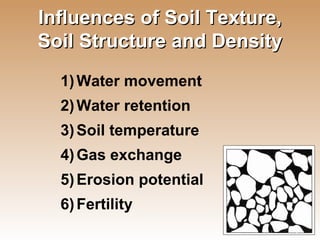
Influences of Soil Texture, Soil Structure and Density Water movement Water retention Soil temperature Gas exchange Erosion potential Fertility
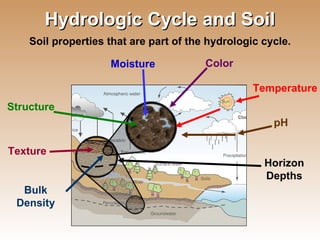
Hydrologic Cycle and Soil Color Structure Bulk Density Texture pH Temperature Moisture Horizon Depths Soil properties that are part of the hydrologic cycle.
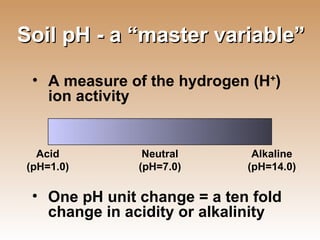
Soil pH - a “master variable” Acid (pH=1.0) Neutral (pH=7.0) Alkaline (pH=14.0) A measure of the hydrogen (H + ) ion activity One pH unit change = a ten fold change in acidity or alkalinity
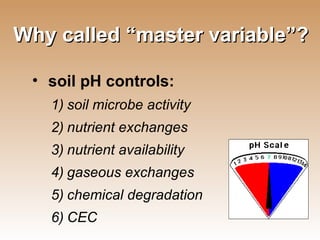
Why called “master variable”? soil pH controls: soil microbe activity nutrient exchanges nutrient availability gaseous exchanges chemical degradation CEC
pH value { { Too alkaline for most plants Too acidic for most plants Range of alkalinity  soils of arid and semiarid regions have pH greater than 8.0 Range of acidity  weathered soils of the southeastern US coastal plains typically have pH less than 5.0 4.0 5.0 6.0 7.0 8.0 9.0 10.0
Soil pH Methods for soil pH determination can vary widely Measure of the direct concentration of H +  ions in the soil solution Buffer pH measures both H +  ions in the soil solution and the reserve H +  ions bound on cation exchange sites It is used to express the acidity or alkalinity of the soil solution, not lime requirement pH represents the equation -log[H + ]
Factors Affecting Soil pH Parent Soil Material Precipitation Nitrogen Applications Cropping Sequence Organic Matter Breakdown
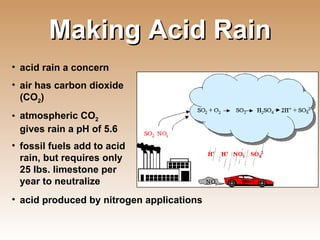
Making Acid Rain acid rain a concern air has carbon dioxide (CO 2 ) acid produced by nitrogen applications H 2 O + CO 2   H 2 CO 3     (carbonic acid) atmospheric CO 2  gives rain a pH of 5.6 fossil fuels add to acid rain, but requires only 25 lbs. limestone per year to neutralize
Clay Minerals Clay structure magnified 1,600 times
Clays are layered minerals made of . . . . . . together they form . . .
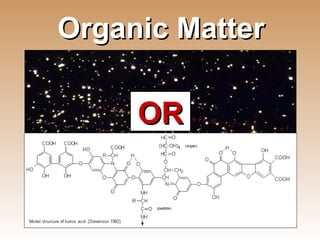
Organic Matter OR
Factors Influencing Organic Matter Accumulation Topography Native Vegetation Climate Time Organisms
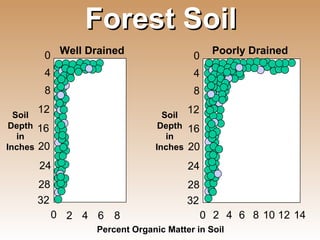
Forest Soil 0 4 8 12 16 20 24 28 32 0 2 4 6 8 0 4 8 12 16 20 24 28 32 0 2 4 6 8 10 12 14 Percent Organic Matter in Soil Well Drained Poorly Drained Soil Depth in Inches Soil Depth in Inches
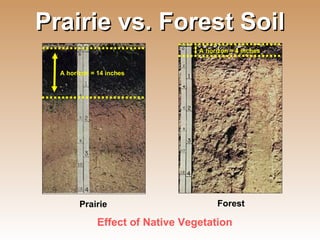
Prairie vs. Forest Soil Prairie Forest Effect of Native Vegetation A horizon = 14 inches A horizon = 4 inches
Importance of Soil Organic Matter Physical and Chemical Properties Improves physical condition Allows for good aggregation of soil particles because of the plant and animal residues in the surface Increased water infiltration Allows water saturation by acting as an absorbent Improves Soil Tilth Allows for more uniformity of the soil aggregates in proportion to the plant, animal and mineral residues present
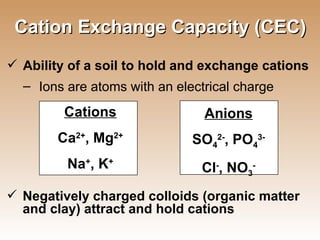
Cation Exchange Capacity (CEC) Ability of a soil to hold and exchange cations Ions are atoms with an electrical charge Negatively charged colloids (organic matter and clay) attract and hold cations Cations Ca 2+ , Mg 2+ Na + , K + Anions SO 4 2- , PO 4 3- Cl - , NO 3 -
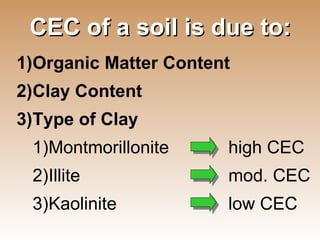
CEC of a soil is due to: Organic Matter Content Clay Content Type of Clay Montmorillonite   high CEC Illite   mod. CEC Kaolinite   low CEC
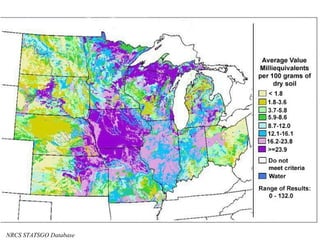
NRCS STATSGO Database
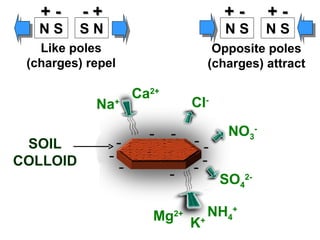
CEC (con’t.) Most soils are negatively charged and hold cations. Cations held on exchange sites may move into the soil solution & be taken up by roots. Anions are not held on soil and are subject to leaching (P is exception).
SOIL COLLOID N S N S S N N S + - - + + - + - Like poles (charges) repel Opposite poles (charges) attract Ca 2+ K + Na + Mg 2+ SO 4 2- NO 3 - Cl - NH 4 +
Common CEC Range Heavy Clay 50 CEC Sand 2 CEC CEC 25 More Clay, More Positions to Hold Cations CEC 5 Less Clay, Fewer Positions to Hold Cations K + Ca 2+ Mg 2+ NH 4 + Na + K + Ca 2+ K + Sand Clay Another Schematic Look at CEC
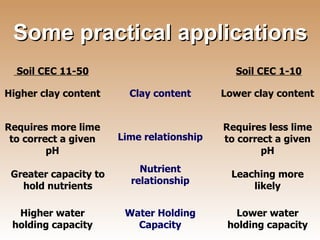
Some practical applications Soil CEC 11-50 Soil CEC 1-10 Clay content Nutrient relationship Water Holding Capacity Lime relationship Higher clay content Lower clay content Requires more lime to correct a given pH Requires less lime to correct a given pH Greater capacity to hold nutrients Leaching more likely Higher water holding capacity Lower water holding capacity
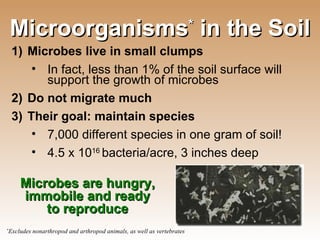
Microorganisms *  in the Soil Microbes live in small clumps  In fact, less than 1% of the soil surface will support the growth of microbes Do not migrate much Their goal: maintain species 7,000 different species in one gram of soil! 4.5 x 10 16  bacteria/acre, 3 inches deep * Excludes nonarthropod and arthropod animals, as well as vertebrates Microbes are hungry, immobile and ready to reproduce
One final thought . . .  What do you notice about this soil core? macropores
Preferential Flow  Calculated from Kladivco, et al. (1999); models from Cornell Example of pesticide leaching  through preferential flow.  Atrazine applied. Initial storm of season.  Notice preferential flow. A B C Soil Horizon 68% of leachable atrazine was lost to preferential flow during the first storm. What are the implications from a soil fertility standpoint?
Soils ENJOY THE REMAINDER OF THE TRAINING. WE’RE GLAD YOU ARE HERE.

Introduction to Soil Science

  • 1.
    Introduction to SoilAndy Kleinschmidt Don McClure Extension Educator Soil Scientist Van Wert County NRCS-USDA
  • 2.
    What is Soil?A logical place to begin today is with a definition of soil. Soil: Unconsolidated mineral or material on the surface of the earth resulting from and influenced by time, parent material, climate, organisms, and topography. Not all soil is created equal, ‘the soil’ vs. a soil.
  • 3.
    Why are soilsimportant? Great integrator Producer and absorber of gases Medium for plant growth Medium of crop production Home to organisms (plants, animals and others) Waste decomposer Snapshot of geologic, climatic, biological, and human history Source material for construction, medicine, art, etc. Filter of water and wastes Essential natural resource
  • 4.
    Objectives Soil colorSoil texture Soil structure Soil pH CEC Microorganisms Nutrient movement
  • 5.
    What ‘stands out’about the landscape? COLOR!
  • 6.
    Soil Color Coloris the most obvious characteristic of soil. What are some colors encouraged by well aerated conditions? What are some colors encouraged by poorly aerated conditions? Soil color is influenced by the oxidation state of iron and manganese. RED YELLOW BROWN GRAY BLUE
  • 7.
  • 8.
  • 9.
    Soil Color, SoilAeration or Drainage, and the Oxidation State of Iron 1. Iron is reduced 2. Fe ++ 3. dull colors (grays, blue ) 4. poorly drained 1. Iron is oxidized 2. Fe +++ 3. bright colors ( yellows , browns) 4. well drained POOR AERATION GOOD AERATION
  • 10.
  • 11.
    Soil Color TellsA Story Well Drained Poorly Drained Drainage on this farm?
  • 12.
    Soil Horizons BC Ap Zone of highest organic matter content. The ‘p’ denotes that this soil has been plowed. A layer of accumulation of iron and clays. Blocky structure is readily seen in this layer. Unconsolidated material. Outside the zone of major biological activity and is not affected by soil forming processes.
  • 13.
    Soil Profile Whatdo we see? organic matter - surface soil is darker due to organic matter iron oxides - subsoil has brighter browns and tans due to iron oxides drainage horizons - layers of different color or texture; formed from the top down
  • 14.
  • 15.
    . . .more on Soil Horizons Mollisol Alfisol B C Ap A
  • 16.
  • 17.
    Average Soil Composition{ } Pore space 50% Solids 50% 25% Water 25% Air 5% Organic Matter 45% Inorganic (mineral materials)                                                                                                    
  • 18.
    Soil Texture Determinedby the relative proportion of sand, silt and clay Surface Area Charge Sand 50 cm 2 /g none Silt 500 cm 2 /g none Clay 5,000,000 cm 2 /g negative
  • 19.
    Relative Size Comparisonof Soil Particles Sand - feels gritty Silt - feels floury (2.00 - 0.05 mm) (0.05 - 0.002 mm) (< 0.002 mm) barrel plate coin Clay - feels sticky USDA system for determining soil separates
  • 20.
    Clay Silty ClaySilty Clay Loam Clay Loam Sandy Clay Sandy Clay Loam Loam Silt Loam Silt Sandy Loam Sand Percent Clay Percent Silt Percent Sand Fine Medium Coarse Loamy Sand Soil Triangle
  • 21.
    Sand Sandy loamSilt loam Clay loam Clay 1 2 3 4 Available Water Inches water/ft soil Plant Available Water Field Capacity Wilting Point
  • 22.
    Available Water HoldingCapacity Rhoads and Yonts, 1984. Storage capacity Silty clay loam 1.8 Clay loam 1.8 Silty clay 1.6 Silt loam 2.0 Sandy loam 1.4 Texture (in./ft.)
  • 23.
  • 24.
    Comparison of CoarseTextured and Fine Textured Soils Coarse Textured Soil Less porespace but more macropores Fine Textured Soil More total porespace Texture and Pore Space
  • 25.
    Soil Structure Soilstructure is the combination or arrangement of primary soil particles into secondary units The way soil particles are arranged to form stable aggregates Compare this to clods, which are caused by disturbance (plowing or digging) Compaction – results from implement traffic, stable soil aggregates are broken down
  • 26.
    Common Types ofSoil Structure Granular Platy Prismatic Columnar Blocky Single Grain Massive Common to Ohio soils just below Ap (> 8”) Plow layer Sand Deeper in profile (>3-4’)
  • 27.
  • 28.
  • 29.
    C B EA Granular Platy Blocky Massive
  • 30.
    Bulk Density DeterminationFor our example, let’s assume we have 1 cubic centimeter of soil that weighs 1.33 grams Soil is made of solids and pore spaces 1.33 grams { } To calculate Bulk Density: Volume = 1 cm 3 Weight = 1.33 grams Bulk Density = Weight of Soil Volume of Soil Bulk Density = 1.33 1 Bulk Density = 1.33 grams/cm 3
  • 31.
    Bulk Density (con’t.) Bulk density (g/cm 3 ) Soil Cropped Uncropped Hagerstown loam (PA) 1.25 Marshall silt loam (IA) 1.13 Nappanese silt loam (OH) 1.31 Data from Lyon et al. (50%) (56%) (51%) (57%) (63%) (60%) 1.07 0.93 1.05 What impact does this have on pore space?
  • 32.
    Some Common BulkDensities Uncultivated/undisturbed woodlots 1.0 to 1.2 g/cm 3 Cultivated clay and silt loams 1.1 to 1.5 g/cm 3 Cultivated sandy loams 1.3 to 1.7 g/cm 3 Compacted glacial till 1.9 to 2.2 g/cm 3 Concrete 2.4 g/cm 3
  • 33.
    Bulk Density andCompaction 8 inches 1.43 0 inches 7 inches 9 inches 10 inches Bulk Density (g/cm 3 ) 1.90 1.87 1.84 1.80 1.60 Plow layer Compacted zone Uncompacted subsoil Depth Data from Camp and Lund Till 2.20
  • 34.
    Influences of SoilTexture, Soil Structure and Density Water movement Water retention Soil temperature Gas exchange Erosion potential Fertility
  • 35.
    Hydrologic Cycle andSoil Color Structure Bulk Density Texture pH Temperature Moisture Horizon Depths Soil properties that are part of the hydrologic cycle.
  • 36.
    Soil pH -a “master variable” Acid (pH=1.0) Neutral (pH=7.0) Alkaline (pH=14.0) A measure of the hydrogen (H + ) ion activity One pH unit change = a ten fold change in acidity or alkalinity
  • 37.
    Why called “mastervariable”? soil pH controls: soil microbe activity nutrient exchanges nutrient availability gaseous exchanges chemical degradation CEC
  • 38.
    pH value {{ Too alkaline for most plants Too acidic for most plants Range of alkalinity soils of arid and semiarid regions have pH greater than 8.0 Range of acidity weathered soils of the southeastern US coastal plains typically have pH less than 5.0 4.0 5.0 6.0 7.0 8.0 9.0 10.0
  • 39.
    Soil pH Methodsfor soil pH determination can vary widely Measure of the direct concentration of H + ions in the soil solution Buffer pH measures both H + ions in the soil solution and the reserve H + ions bound on cation exchange sites It is used to express the acidity or alkalinity of the soil solution, not lime requirement pH represents the equation -log[H + ]
  • 40.
    Factors Affecting SoilpH Parent Soil Material Precipitation Nitrogen Applications Cropping Sequence Organic Matter Breakdown
  • 41.
    Making Acid Rainacid rain a concern air has carbon dioxide (CO 2 ) acid produced by nitrogen applications H 2 O + CO 2 H 2 CO 3 (carbonic acid) atmospheric CO 2 gives rain a pH of 5.6 fossil fuels add to acid rain, but requires only 25 lbs. limestone per year to neutralize
  • 42.
    Clay Minerals Claystructure magnified 1,600 times
  • 43.
    Clays are layeredminerals made of . . . . . . together they form . . .
  • 44.
  • 45.
    Factors Influencing OrganicMatter Accumulation Topography Native Vegetation Climate Time Organisms
  • 46.
    Forest Soil 04 8 12 16 20 24 28 32 0 2 4 6 8 0 4 8 12 16 20 24 28 32 0 2 4 6 8 10 12 14 Percent Organic Matter in Soil Well Drained Poorly Drained Soil Depth in Inches Soil Depth in Inches
  • 47.
    Prairie vs. ForestSoil Prairie Forest Effect of Native Vegetation A horizon = 14 inches A horizon = 4 inches
  • 48.
    Importance of SoilOrganic Matter Physical and Chemical Properties Improves physical condition Allows for good aggregation of soil particles because of the plant and animal residues in the surface Increased water infiltration Allows water saturation by acting as an absorbent Improves Soil Tilth Allows for more uniformity of the soil aggregates in proportion to the plant, animal and mineral residues present
  • 49.
    Cation Exchange Capacity(CEC) Ability of a soil to hold and exchange cations Ions are atoms with an electrical charge Negatively charged colloids (organic matter and clay) attract and hold cations Cations Ca 2+ , Mg 2+ Na + , K + Anions SO 4 2- , PO 4 3- Cl - , NO 3 -
  • 50.
    CEC of asoil is due to: Organic Matter Content Clay Content Type of Clay Montmorillonite high CEC Illite mod. CEC Kaolinite low CEC
  • 51.
  • 52.
    CEC (con’t.) Mostsoils are negatively charged and hold cations. Cations held on exchange sites may move into the soil solution & be taken up by roots. Anions are not held on soil and are subject to leaching (P is exception).
  • 53.
    SOIL COLLOID NS N S S N N S + - - + + - + - Like poles (charges) repel Opposite poles (charges) attract Ca 2+ K + Na + Mg 2+ SO 4 2- NO 3 - Cl - NH 4 +
  • 54.
    Common CEC RangeHeavy Clay 50 CEC Sand 2 CEC CEC 25 More Clay, More Positions to Hold Cations CEC 5 Less Clay, Fewer Positions to Hold Cations K + Ca 2+ Mg 2+ NH 4 + Na + K + Ca 2+ K + Sand Clay Another Schematic Look at CEC
  • 55.
    Some practical applicationsSoil CEC 11-50 Soil CEC 1-10 Clay content Nutrient relationship Water Holding Capacity Lime relationship Higher clay content Lower clay content Requires more lime to correct a given pH Requires less lime to correct a given pH Greater capacity to hold nutrients Leaching more likely Higher water holding capacity Lower water holding capacity
  • 56.
    Microorganisms * in the Soil Microbes live in small clumps In fact, less than 1% of the soil surface will support the growth of microbes Do not migrate much Their goal: maintain species 7,000 different species in one gram of soil! 4.5 x 10 16 bacteria/acre, 3 inches deep * Excludes nonarthropod and arthropod animals, as well as vertebrates Microbes are hungry, immobile and ready to reproduce
  • 57.
    One final thought. . . What do you notice about this soil core? macropores
  • 58.
    Preferential Flow Calculated from Kladivco, et al. (1999); models from Cornell Example of pesticide leaching through preferential flow. Atrazine applied. Initial storm of season. Notice preferential flow. A B C Soil Horizon 68% of leachable atrazine was lost to preferential flow during the first storm. What are the implications from a soil fertility standpoint?
  • 59.
    Soils ENJOY THEREMAINDER OF THE TRAINING. WE’RE GLAD YOU ARE HERE.