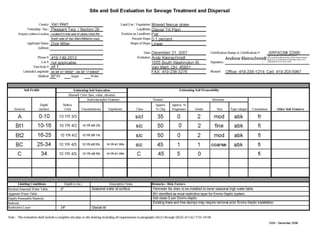
Site and Soil Evaluation and Soil Protection   Andy Kleinschmidt OSU Extension, Van Wert County 419-238-1214 (office) 419-203-5967 (cell) kleinschmidt.5@osu.edu or andykleinschmidt@gmail.com


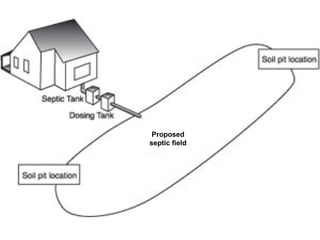
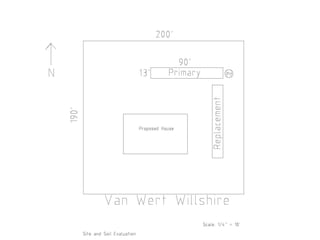
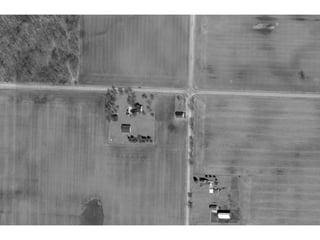
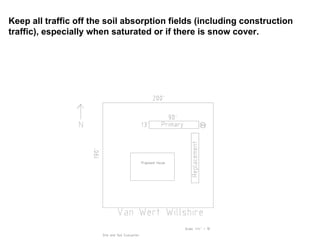
Proposed septic field
 
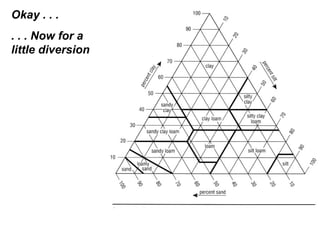
Okay . . .  . . . Now for a little diversion
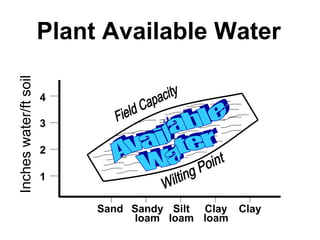
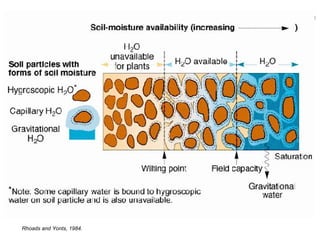
Sand Sandy loam Silt loam Clay loam Clay 1 2 3 4 Available Water Inches water/ft soil Plant Available Water Field Capacity Wilting Point
Available Water Holding Capacity Rhoads and Yonts, 1984. Storage capacity Silty clay loam   1.8 Clay loam   1.8 Silty clay   1.6 Silt loam   2.0 Sandy loam     1.4 Texture  (in./ft.)
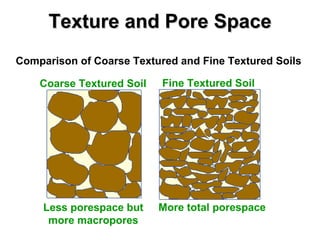
Comparison of Coarse Textured and Fine Textured Soils  Coarse Textured Soil Less porespace but more macropores Fine Textured Soil More total porespace Texture and Pore Space
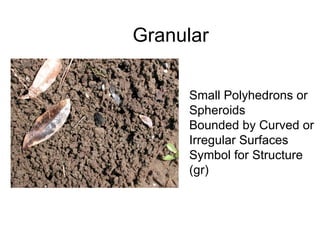
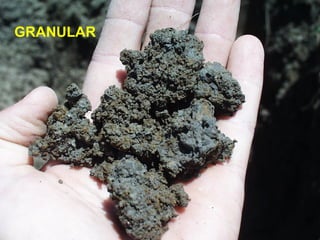
Granular Small Polyhedrons or Spheroids Bounded by Curved or Irregular Surfaces Symbol for Structure (gr)
GRANULAR
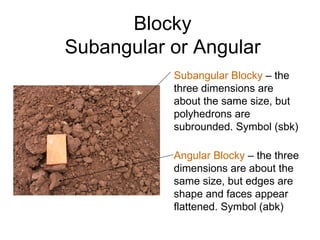
Blocky Subangular or Angular Subangular Blocky  – the three dimensions are about the same size, but polyhedrons are subrounded. Symbol (sbk) Angular Blocky  – the three dimensions are about the same size, but edges are shape and faces appear flattened. Symbol (abk)
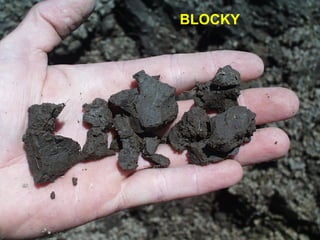
BLOCKY
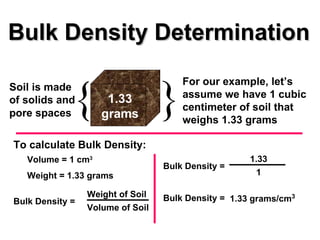
Bulk Density Determination For our example, let’s assume we have 1 cubic centimeter of soil that weighs 1.33 grams Soil is made of solids and pore spaces 1.33 grams { } To calculate Bulk Density: Volume = 1 cm 3  Weight = 1.33 grams Bulk Density =   Weight of Soil Volume of Soil Bulk Density =   1.33 1 Bulk Density =   1.33 grams/cm 3
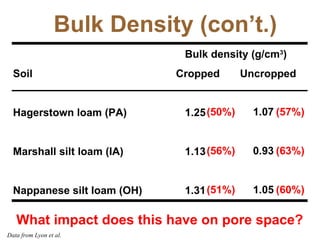
Bulk Density (con’t.)   Bulk density (g/cm 3 ) Soil  Cropped  Uncropped Hagerstown loam (PA)   1.25 Marshall silt loam (IA)   1.13 Nappanese silt loam (OH)   1.31 Data from Lyon et al. (50%) (56%) (51%) (57%) (63%) (60%) 1.07 0.93 1.05 What impact does this have on pore space?
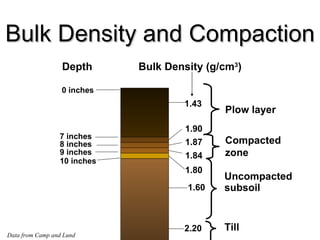
Bulk Density and Compaction 8 inches 1.43 0 inches 7 inches 9 inches 10 inches Bulk Density (g/cm 3 ) 1.90 1.87 1.84 1.80 1.60 Plow layer Compacted zone Uncompacted  subsoil Depth Data from Camp and Lund Till 2.20
Some Common Bulk Densities Uncultivated/undisturbed woodlots  1.0 to 1.2 g/cm 3 Cultivated clay and silt loams 1.1 to 1.5 g/cm 3 Cultivated sandy loams 1.3 to 1.7 g/cm 3 Compacted glacial till 1.9 to 2.2 g/cm 3 Concrete 2.4 g/cm 3
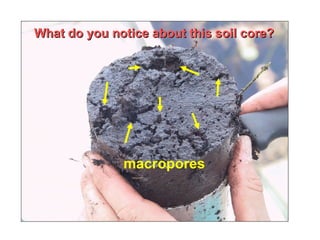
What do you notice about this soil core? macropores
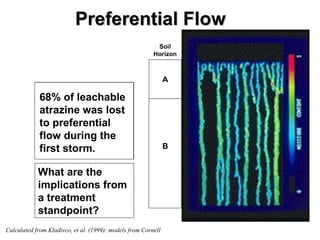
Preferential Flow   A B Soil Horizon Calculated from Kladivco, et al. (1999); models from Cornell Example of pesticide leaching  through preferential flow.  Atrazine applied. Initial storm of season.  Notice preferential flow. 68% of leachable atrazine was lost to preferential flow during the first storm. What are the implications from a treatment standpoint?
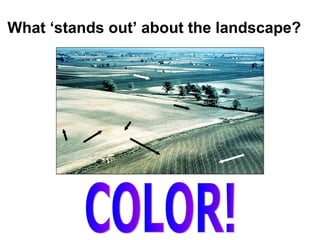
What ‘stands out’ about the landscape? COLOR!
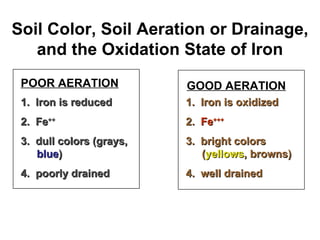
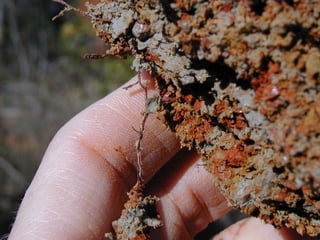
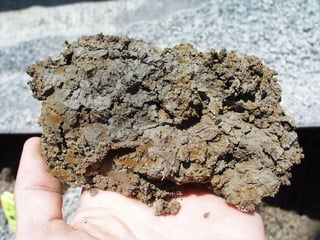
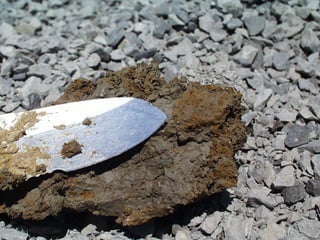
Soil Color, Soil Aeration or Drainage, and the Oxidation State of Iron 1.  Iron is reduced 2.  Fe ++ 3.  dull colors (grays,  blue ) 4.  poorly drained 1.  Iron is oxidized 2.  Fe +++ 3.  bright colors ( yellows , browns) 4.  well drained POOR AERATION GOOD AERATION


Okay . . .  . . . Back to the site and soil evalution.
 
 
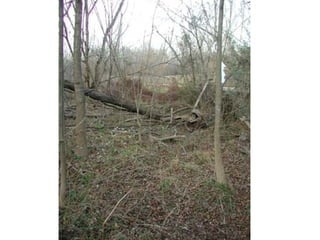
Not suitable . . .  Wetland Poor soil structure Flood prone Extremely shallow to bedrock Recently disturbed Excessively gravelly What else makes a site not suitable?
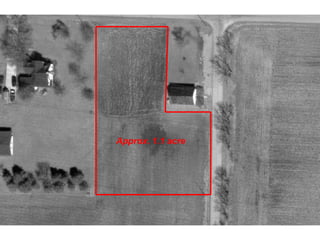
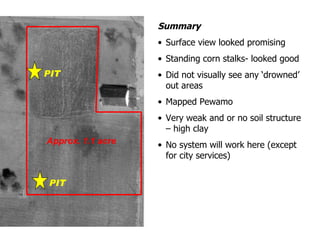
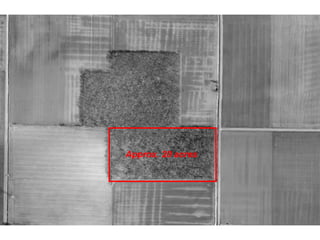
Approx. 1.1 acre
 
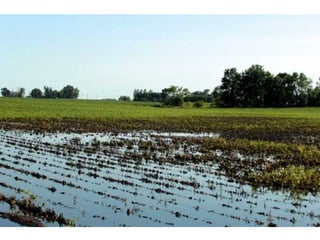
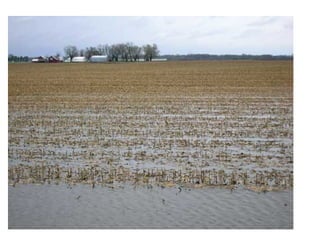
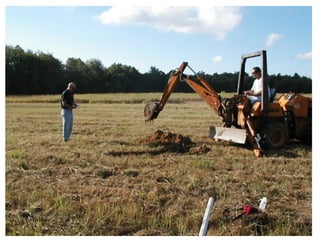
Summary Surface view looked promising Standing corn stalks- looked good Did not visually see any ‘drowned’ out areas Mapped Pewamo Very weak and or no soil structure – high clay No system will work here (except for city services) PIT PIT Approx. 1.1 acre
Approx. 20 acres
 
Ohio Rapid Assessment Method Provides for a quantitative wetland assessment of a parcel  Does not replace a formal wetland delineation Allows for categorizing wetlands: Category 1, 2, or 3. Training and additional information online at: http://www.epa.state.oh.us/dsw/wetlands/WetlandEcologySection.html#Training
 
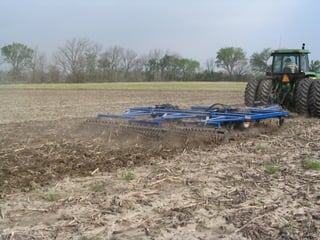
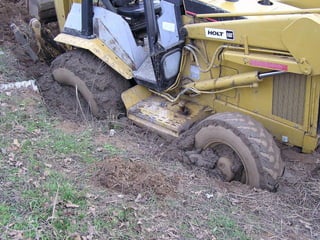
Keep all traffic off the soil absorption fields (including construction traffic), especially when saturated or if there is snow cover.
Do not discharge from basement footing drains or other clean water sources into the soil absorption fields. Divert downspouts and other rainwater drainage away from the soil absorption fields. The extra rainwater can overwhelm the system. Establish a grass cover over the soil absorption fields as soon as possible after installation to prevent erosion and promote plant uptake of water. Avoid planting trees on or adjacent to the soil absorption fields. Keep pavement, decks, above ground pools, and out buildings off of and away from the soil absorption fields. Construction activity can compact the soil and the structures limit access to the septic system or soil absorption fields for maintenance. Never put additional fill over the soil absorption fields.

Site and Soil Evaluation and Soil Protection

  • 1.
    Site and SoilEvaluation and Soil Protection Andy Kleinschmidt OSU Extension, Van Wert County 419-238-1214 (office) 419-203-5967 (cell) kleinschmidt.5@osu.edu or andykleinschmidt@gmail.com
  • 2.
  • 3.
  • 4.
  • 5.
  • 6.
  • 7.
  • 8.
  • 9.
  • 10.
  • 11.
    Okay . .. . . . Now for a little diversion
  • 12.
    Sand Sandy loamSilt loam Clay loam Clay 1 2 3 4 Available Water Inches water/ft soil Plant Available Water Field Capacity Wilting Point
  • 13.
    Available Water HoldingCapacity Rhoads and Yonts, 1984. Storage capacity Silty clay loam 1.8 Clay loam 1.8 Silty clay 1.6 Silt loam 2.0 Sandy loam 1.4 Texture (in./ft.)
  • 14.
    Comparison of CoarseTextured and Fine Textured Soils Coarse Textured Soil Less porespace but more macropores Fine Textured Soil More total porespace Texture and Pore Space
  • 15.
    Granular Small Polyhedronsor Spheroids Bounded by Curved or Irregular Surfaces Symbol for Structure (gr)
  • 16.
  • 17.
    Blocky Subangular orAngular Subangular Blocky – the three dimensions are about the same size, but polyhedrons are subrounded. Symbol (sbk) Angular Blocky – the three dimensions are about the same size, but edges are shape and faces appear flattened. Symbol (abk)
  • 18.
  • 19.
    Bulk Density DeterminationFor our example, let’s assume we have 1 cubic centimeter of soil that weighs 1.33 grams Soil is made of solids and pore spaces 1.33 grams { } To calculate Bulk Density: Volume = 1 cm 3 Weight = 1.33 grams Bulk Density = Weight of Soil Volume of Soil Bulk Density = 1.33 1 Bulk Density = 1.33 grams/cm 3
  • 20.
    Bulk Density (con’t.) Bulk density (g/cm 3 ) Soil Cropped Uncropped Hagerstown loam (PA) 1.25 Marshall silt loam (IA) 1.13 Nappanese silt loam (OH) 1.31 Data from Lyon et al. (50%) (56%) (51%) (57%) (63%) (60%) 1.07 0.93 1.05 What impact does this have on pore space?
  • 21.
    Bulk Density andCompaction 8 inches 1.43 0 inches 7 inches 9 inches 10 inches Bulk Density (g/cm 3 ) 1.90 1.87 1.84 1.80 1.60 Plow layer Compacted zone Uncompacted subsoil Depth Data from Camp and Lund Till 2.20
  • 22.
    Some Common BulkDensities Uncultivated/undisturbed woodlots 1.0 to 1.2 g/cm 3 Cultivated clay and silt loams 1.1 to 1.5 g/cm 3 Cultivated sandy loams 1.3 to 1.7 g/cm 3 Compacted glacial till 1.9 to 2.2 g/cm 3 Concrete 2.4 g/cm 3
  • 23.
    What do younotice about this soil core? macropores
  • 24.
    Preferential Flow A B Soil Horizon Calculated from Kladivco, et al. (1999); models from Cornell Example of pesticide leaching through preferential flow. Atrazine applied. Initial storm of season. Notice preferential flow. 68% of leachable atrazine was lost to preferential flow during the first storm. What are the implications from a treatment standpoint?
  • 25.
    What ‘stands out’about the landscape? COLOR!
  • 26.
    Soil Color, SoilAeration or Drainage, and the Oxidation State of Iron 1. Iron is reduced 2. Fe ++ 3. dull colors (grays, blue ) 4. poorly drained 1. Iron is oxidized 2. Fe +++ 3. bright colors ( yellows , browns) 4. well drained POOR AERATION GOOD AERATION
  • 27.
  • 28.
  • 29.
  • 30.
    Okay . .. . . . Back to the site and soil evalution.
  • 31.
  • 32.
  • 33.
    Not suitable .. . Wetland Poor soil structure Flood prone Extremely shallow to bedrock Recently disturbed Excessively gravelly What else makes a site not suitable?
  • 34.
  • 35.
  • 36.
    Summary Surface viewlooked promising Standing corn stalks- looked good Did not visually see any ‘drowned’ out areas Mapped Pewamo Very weak and or no soil structure – high clay No system will work here (except for city services) PIT PIT Approx. 1.1 acre
  • 37.
  • 38.
  • 39.
    Ohio Rapid AssessmentMethod Provides for a quantitative wetland assessment of a parcel Does not replace a formal wetland delineation Allows for categorizing wetlands: Category 1, 2, or 3. Training and additional information online at: http://www.epa.state.oh.us/dsw/wetlands/WetlandEcologySection.html#Training
  • 40.
  • 41.
    Keep all trafficoff the soil absorption fields (including construction traffic), especially when saturated or if there is snow cover.
  • 42.
    Do not dischargefrom basement footing drains or other clean water sources into the soil absorption fields. Divert downspouts and other rainwater drainage away from the soil absorption fields. The extra rainwater can overwhelm the system. Establish a grass cover over the soil absorption fields as soon as possible after installation to prevent erosion and promote plant uptake of water. Avoid planting trees on or adjacent to the soil absorption fields. Keep pavement, decks, above ground pools, and out buildings off of and away from the soil absorption fields. Construction activity can compact the soil and the structures limit access to the septic system or soil absorption fields for maintenance. Never put additional fill over the soil absorption fields.