Soil Bulk density, Particle
density and Porosity-Factors
influencing-significance
K. Maheshwaran, Asst.Prof. (SS&AC)
Sethu Bhaskara Agricultural College &
Research Foundation
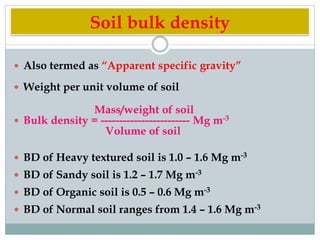
Soil bulk density
 Also termed as “Apparent specific gravity”
 Weight per unit volume of soil
Mass/weight of soil
 Bulk density = ------------------------ Mg m-3
Volume of soil
 BD of Heavy textured soil is 1.0 – 1.6 Mg m-3
 BD of Sandy soil is 1.2 – 1.7 Mg m-3
 BD of Organic soil is 0.5 – 0.6 Mg m-3
 BD of Normal soil ranges from 1.4 – 1.6 Mg m-3
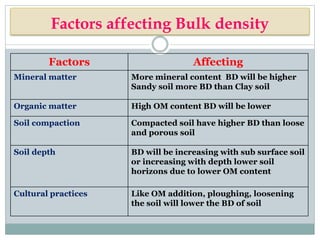
Factors affecting Bulk density
Factors Affecting
Mineral matter More mineral content BD will be higher
Sandy soil more BD than Clay soil
Organic matter High OM content BD will be lower
Soil compaction Compacted soil have higher BD than loose
and porous soil
Soil depth BD will be increasing with sub surface soil
or increasing with depth lower soil
horizons due to lower OM content
Cultural practices Like OM addition, ploughing, loosening
the soil will lower the BD of soil
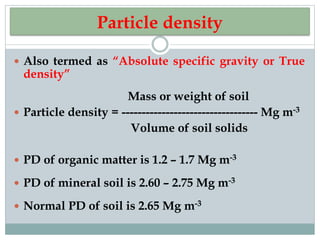
Particle density
 Also termed as “Absolute specific gravity or True
density”
Mass or weight of soil
 Particle density = ---------------------------------- Mg m-3
Volume of soil solids
 PD of organic matter is 1.2 – 1.7 Mg m-3
 PD of mineral soil is 2.60 – 2.75 Mg m-3
 Normal PD of soil is 2.65 Mg m-3
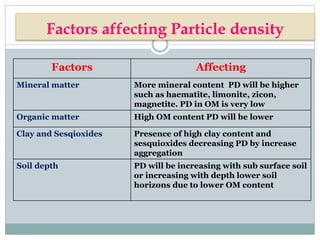
Factors Affecting
Mineral matter More mineral content PD will be higher
such as haematite, limonite, zicon,
magnetite. PD in OM is very low
Organic matter High OM content PD will be lower
Clay and Sesqioxides Presence of high clay content and
sesquioxides decreasing PD by increase
aggregation
Soil depth PD will be increasing with sub surface soil
or increasing with depth lower soil
horizons due to lower OM content
Factors affecting Particle density
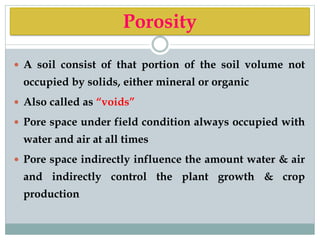
Porosity
 A soil consist of that portion of the soil volume not
occupied by solids, either mineral or organic
 Also called as “voids”
 Pore space under field condition always occupied with
water and air at all times
 Pore space indirectly influence the amount water & air
and indirectly control the plant growth & crop
production
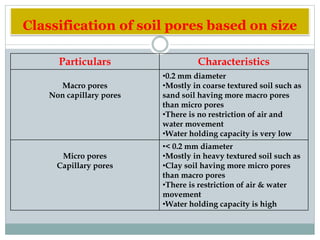
Classification of soil pores based on size
Particulars Characteristics
Macro pores
Non capillary pores
•0.2 mm diameter
•Mostly in coarse textured soil such as
sand soil having more macro pores
than micro pores
•There is no restriction of air and
water movement
•Water holding capacity is very low
Micro pores
Capillary pores
•< 0.2 mm diameter
•Mostly in heavy textured soil such as
•Clay soil having more micro pores
than macro pores
•There is restriction of air & water
movement
•Water holding capacity is high
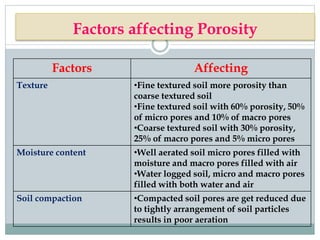
Factors affecting Porosity
Factors Affecting
Texture •Fine textured soil more porosity than
coarse textured soil
•Fine textured soil with 60% porosity, 50%
of micro pores and 10% of macro pores
•Coarse textured soil with 30% porosity,
25% of macro pores and 5% micro pores
Moisture content •Well aerated soil micro pores filled with
moisture and macro pores filled with air
•Water logged soil, micro and macro pores
filled with both water and air
Soil compaction •Compacted soil pores are get reduced due
to tightly arrangement of soil particles
results in poor aeration
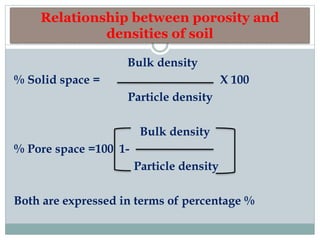
Relationship between porosity and
densities of soil
Bulk density
% Solid space = X 100
Particle density
Bulk density
% Pore space =100 1-
Particle density
Both are expressed in terms of percentage %
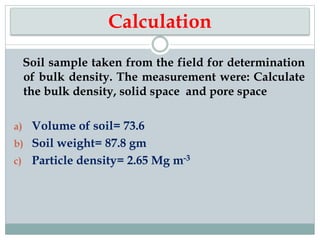
Calculation
Soil sample taken from the field for determination
of bulk density. The measurement were: Calculate
the bulk density, solid space and pore space
a) Volume of soil= 73.6
b) Soil weight= 87.8 gm
c) Particle density= 2.65 Mg m-3

Soil bulk density particle density

  • 1.
    Soil Bulk density,Particle density and Porosity-Factors influencing-significance K. Maheshwaran, Asst.Prof. (SS&AC) Sethu Bhaskara Agricultural College & Research Foundation
  • 2.
    Soil bulk density Also termed as “Apparent specific gravity”  Weight per unit volume of soil Mass/weight of soil  Bulk density = ------------------------ Mg m-3 Volume of soil  BD of Heavy textured soil is 1.0 – 1.6 Mg m-3  BD of Sandy soil is 1.2 – 1.7 Mg m-3  BD of Organic soil is 0.5 – 0.6 Mg m-3  BD of Normal soil ranges from 1.4 – 1.6 Mg m-3
  • 3.
    Factors affecting Bulkdensity Factors Affecting Mineral matter More mineral content BD will be higher Sandy soil more BD than Clay soil Organic matter High OM content BD will be lower Soil compaction Compacted soil have higher BD than loose and porous soil Soil depth BD will be increasing with sub surface soil or increasing with depth lower soil horizons due to lower OM content Cultural practices Like OM addition, ploughing, loosening the soil will lower the BD of soil
  • 4.
    Particle density  Alsotermed as “Absolute specific gravity or True density” Mass or weight of soil  Particle density = ---------------------------------- Mg m-3 Volume of soil solids  PD of organic matter is 1.2 – 1.7 Mg m-3  PD of mineral soil is 2.60 – 2.75 Mg m-3  Normal PD of soil is 2.65 Mg m-3
  • 5.
    Factors Affecting Mineral matterMore mineral content PD will be higher such as haematite, limonite, zicon, magnetite. PD in OM is very low Organic matter High OM content PD will be lower Clay and Sesqioxides Presence of high clay content and sesquioxides decreasing PD by increase aggregation Soil depth PD will be increasing with sub surface soil or increasing with depth lower soil horizons due to lower OM content Factors affecting Particle density
  • 6.
    Porosity  A soilconsist of that portion of the soil volume not occupied by solids, either mineral or organic  Also called as “voids”  Pore space under field condition always occupied with water and air at all times  Pore space indirectly influence the amount water & air and indirectly control the plant growth & crop production
  • 7.
    Classification of soilpores based on size Particulars Characteristics Macro pores Non capillary pores •0.2 mm diameter •Mostly in coarse textured soil such as sand soil having more macro pores than micro pores •There is no restriction of air and water movement •Water holding capacity is very low Micro pores Capillary pores •< 0.2 mm diameter •Mostly in heavy textured soil such as •Clay soil having more micro pores than macro pores •There is restriction of air & water movement •Water holding capacity is high
  • 8.
    Factors affecting Porosity FactorsAffecting Texture •Fine textured soil more porosity than coarse textured soil •Fine textured soil with 60% porosity, 50% of micro pores and 10% of macro pores •Coarse textured soil with 30% porosity, 25% of macro pores and 5% micro pores Moisture content •Well aerated soil micro pores filled with moisture and macro pores filled with air •Water logged soil, micro and macro pores filled with both water and air Soil compaction •Compacted soil pores are get reduced due to tightly arrangement of soil particles results in poor aeration
  • 9.
    Relationship between porosityand densities of soil Bulk density % Solid space = X 100 Particle density Bulk density % Pore space =100 1- Particle density Both are expressed in terms of percentage %
  • 10.
    Calculation Soil sample takenfrom the field for determination of bulk density. The measurement were: Calculate the bulk density, solid space and pore space a) Volume of soil= 73.6 b) Soil weight= 87.8 gm c) Particle density= 2.65 Mg m-3