1
Unit E: Basic Principles of Soil
Science
Lesson 4: Understanding
Soil Texture and Structure
2
Important Terms
• Clods
• Loam
• Peds
• Permeability
• Soil structure
• Soil texture
• Soil workability
• Textural triangle
• Water-holding
capacity
3
What is soil texture and why is
it important?
• Soil texture is the fineness or
coarseness of a soil.
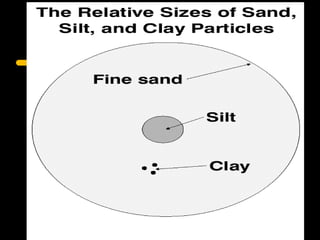
• It describes the proportion of three
sizes of soil particles. These are:
–Sand - large particle
–Silt - medium sized particle
–Clay - small particle
4
Texture is important because
it affects:
• Water-holding capacity the ability of
a soil to retain water for use by
plants
• Permeability the ease with which air
and water may pass through the
soil.
5
Texture is important because
it affects:
• Soil workability the ease with which
soil may be tilled and the timing of
working the soil after a rain
• Ability of plants to grow some root
crops like carrots and onions will
have difficulty growing in a fine-
textured soil
6
7
How is the texture of soil
determined?
• Soil texture may be determined in
one of two ways:
–The percentages of sand, silt, and
clay may be tested in the lab.
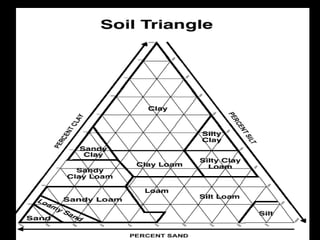
• Once tested, you may determine the
textural class of the soil by referring to
the textural triangle.
–The ribbon method.
8
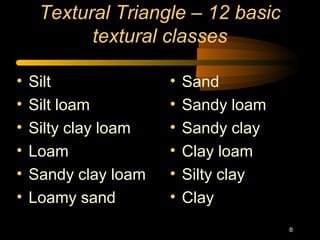
Textural Triangle – 12 basic
textural classes
• Silt
• Silt loam
• Silty clay loam
• Loam
• Sandy clay loam
• Loamy sand
• Sand
• Sandy loam
• Sandy clay
• Clay loam
• Silty clay
• Clay
9
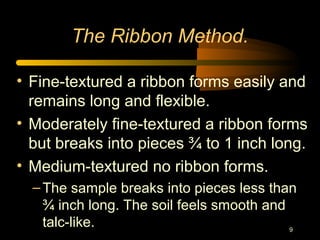
The Ribbon Method.
• Fine-textured a ribbon forms easily and
remains long and flexible.
• Moderately fine-textured a ribbon forms
but breaks into pieces ¾ to 1 inch long.
• Medium-textured no ribbon forms.
–The sample breaks into pieces less than
¾ inch long. The soil feels smooth and
talc-like.
10
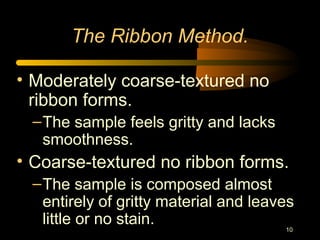
The Ribbon Method.
• Moderately coarse-textured no
ribbon forms.
–The sample feels gritty and lacks
smoothness.
• Coarse-textured no ribbon forms.
–The sample is composed almost
entirely of gritty material and leaves
little or no stain.
11
12
What is soil structure, how does it
form, and why is it important?
• Soil structure is the arrangement of
the soil particles into clusters or
aggregates of various sizes and
shapes.
• Aggregates that occur naturally in
the soil are referred to as peds,
while clumps of soil caused by
tillage are called clods.
13
What is soil structure, how does it
form, and why is it important
• Structure is formed in two steps.
• 1. A clump of soil particles sticks loosely
together. These are created through:
– Plant roots surrounding the soil and separating
clumps
– Freezing and thawing of soil
– Soil becomes wet and then dries
– The soil is tilled
– Fungal activity
14
What is soil structure, how does it
form, and why is it important
• 2. Weak aggregates are cemented
to make them distinct and strong.
• Clay, iron oxides, and organic
matter may act as cements.
–When soil microorganisms break
down plant residues, they produce
gums that also glue peds together.
15
What is soil structure, how does it
form, and why is it important
• Soil structure is important for
several reasons:
–It improves soil tilth.
–It improves permeability.
–It resists the beating action of
raindrops, minimizing the formation of
crusts that reduce crop stands.
16
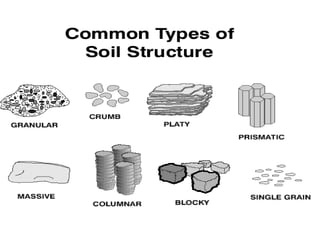
What are the various soil structures
and what do they look like?
• There are eight primary types of structure.
They are:
–Granular
–Crumb
–Platy
–Prismatic or Columnar
–Blocky
–Structureless
• 1. Single grain
17
18
Review / Summary
• Describe the concept of soil texture
and its importance.
• Determine the texture of a soil
sample.
• Describe soil structure, its
formation, and importance.
• Identify various soil structures.

Soil Texture and Structure

  • 1.
    1 Unit E: BasicPrinciples of Soil Science Lesson 4: Understanding Soil Texture and Structure
  • 2.
    2 Important Terms • Clods •Loam • Peds • Permeability • Soil structure • Soil texture • Soil workability • Textural triangle • Water-holding capacity
  • 3.
    3 What is soiltexture and why is it important? • Soil texture is the fineness or coarseness of a soil. • It describes the proportion of three sizes of soil particles. These are: –Sand - large particle –Silt - medium sized particle –Clay - small particle
  • 4.
    4 Texture is importantbecause it affects: • Water-holding capacity the ability of a soil to retain water for use by plants • Permeability the ease with which air and water may pass through the soil.
  • 5.
    5 Texture is importantbecause it affects: • Soil workability the ease with which soil may be tilled and the timing of working the soil after a rain • Ability of plants to grow some root crops like carrots and onions will have difficulty growing in a fine- textured soil
  • 6.
  • 7.
    7 How is thetexture of soil determined? • Soil texture may be determined in one of two ways: –The percentages of sand, silt, and clay may be tested in the lab. • Once tested, you may determine the textural class of the soil by referring to the textural triangle. –The ribbon method.
  • 8.
    8 Textural Triangle –12 basic textural classes • Silt • Silt loam • Silty clay loam • Loam • Sandy clay loam • Loamy sand • Sand • Sandy loam • Sandy clay • Clay loam • Silty clay • Clay
  • 9.
    9 The Ribbon Method. •Fine-textured a ribbon forms easily and remains long and flexible. • Moderately fine-textured a ribbon forms but breaks into pieces ¾ to 1 inch long. • Medium-textured no ribbon forms. –The sample breaks into pieces less than ¾ inch long. The soil feels smooth and talc-like.
  • 10.
    10 The Ribbon Method. •Moderately coarse-textured no ribbon forms. –The sample feels gritty and lacks smoothness. • Coarse-textured no ribbon forms. –The sample is composed almost entirely of gritty material and leaves little or no stain.
  • 11.
  • 12.
    12 What is soilstructure, how does it form, and why is it important? • Soil structure is the arrangement of the soil particles into clusters or aggregates of various sizes and shapes. • Aggregates that occur naturally in the soil are referred to as peds, while clumps of soil caused by tillage are called clods.
  • 13.
    13 What is soilstructure, how does it form, and why is it important • Structure is formed in two steps. • 1. A clump of soil particles sticks loosely together. These are created through: – Plant roots surrounding the soil and separating clumps – Freezing and thawing of soil – Soil becomes wet and then dries – The soil is tilled – Fungal activity
  • 14.
    14 What is soilstructure, how does it form, and why is it important • 2. Weak aggregates are cemented to make them distinct and strong. • Clay, iron oxides, and organic matter may act as cements. –When soil microorganisms break down plant residues, they produce gums that also glue peds together.
  • 15.
    15 What is soilstructure, how does it form, and why is it important • Soil structure is important for several reasons: –It improves soil tilth. –It improves permeability. –It resists the beating action of raindrops, minimizing the formation of crusts that reduce crop stands.
  • 16.
    16 What are thevarious soil structures and what do they look like? • There are eight primary types of structure. They are: –Granular –Crumb –Platy –Prismatic or Columnar –Blocky –Structureless • 1. Single grain
  • 17.
  • 18.
    18 Review / Summary •Describe the concept of soil texture and its importance. • Determine the texture of a soil sample. • Describe soil structure, its formation, and importance. • Identify various soil structures.