Edaphic Factors
Properties of soil
Dr. T. Annie Sheron
Asst. Professor of Botany
Kakatiya Govt. College, Hanamkonda
Telangana
The upper layer of earth in which plants grow
soil is the weathered surface of the earth crust which is
mixed with organic material and in which plants grow
Soil is a mixture of organic
matter, minerals, gases, liquids, and organisms that
together support life
SOIL
Properties of soil
1. Soil texture
2. Soil structure
3. Density & soil weight
4. Permeability
5. Soil colour
6. Soil temperature
7. Soil water
8. Soil solution
9. Soil air
10. Soil organisms
11. Soil plasticity, Cohesion and adhesion
12. Soil pH
13. Inorganic matter of soil
14. Organic matter of soil
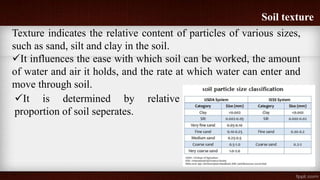
Texture indicates the relative content of particles of various sizes,
such as sand, silt and clay in the soil.
It influences the ease with which soil can be worked, the amount
of water and air it holds, and the rate at which water can enter and
move through soil.
Soil texture
It is determined by relative
proportion of soil seperates.
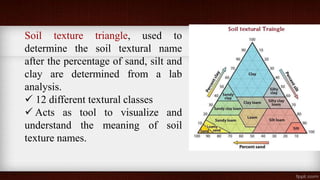
Soil texture triangle, used to
determine the soil textural name
after the percentage of sand, silt and
clay are determined from a lab
analysis.
 12 different textural classes
 Acts as tool to visualize and
understand the meaning of soil
texture names.
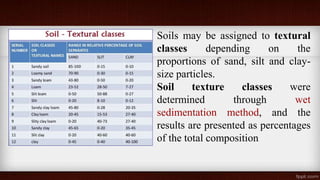
Soils may be assigned to textural
classes depending on the
proportions of sand, silt and clay-
size particles.
Soil texture classes were
determined through wet
sedimentation method, and the
results are presented as percentages
of the total composition
Soil structure
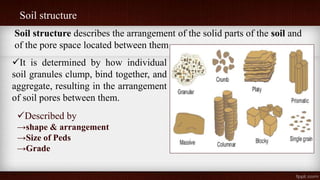
Soil structure describes the arrangement of the solid parts of the soil and
of the pore space located between them
It is determined by how individual
soil granules clump, bind together, and
aggregate, resulting in the arrangement
of soil pores between them.
Described by
→shape & arrangement
→Size of Peds
→Grade
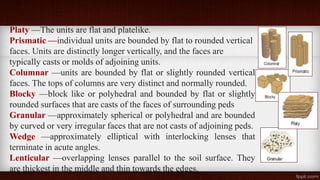
Platy —The units are flat and platelike.
Prismatic —individual units are bounded by flat to rounded vertical
faces. Units are distinctly longer vertically, and the faces are
typically casts or molds of adjoining units.
Columnar —units are bounded by flat or slightly rounded vertical
faces. The tops of columns are very distinct and normally rounded.
Blocky —block like or polyhedral and bounded by flat or slightly
rounded surfaces that are casts of the faces of surrounding peds
Granular —approximately spherical or polyhedral and are bounded
by curved or very irregular faces that are not casts of adjoining peds.
Wedge —approximately elliptical with interlocking lenses that
terminate in acute angles.
Lenticular —overlapping lenses parallel to the soil surface. They
are thickest in the middle and thin towards the edges.
Density & soil weight
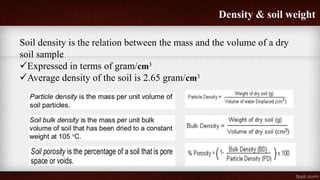
Soil density is the relation between the mass and the volume of a dry
soil sample
Expressed in terms of gram/cm3
Average density of the soil is 2.65 gram/cm3
Soil Porosity
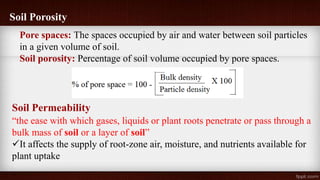
Pore spaces: The spaces occupied by air and water between soil particles
in a given volume of soil.
Soil porosity: Percentage of soil volume occupied by pore spaces.
Soil Permeability
“the ease with which gases, liquids or plant roots penetrate or pass through a
bulk mass of soil or a layer of soil”
It affects the supply of root-zone air, moisture, and nutrients available for
plant uptake
Soil colour
Soil color is produced by the minerals present and by the organic matter
content.
Exhibit a wide range of colour; grey, black,
white, reds, browns, yellows and greens.
Provide a valuable insight into the soil
environment and hence is very important in
assessment and classification.
Soil color does not affect the behavior and
use of soil
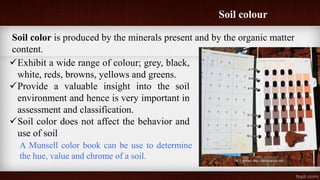
A Munsell color book can be use to determine
the hue, value and chrome of a soil.
Soil temperature:
Soil temperature is simply the measurement of the warmth in the soil.
Thermal conductivity: The flow of the temperature in the soil
Ideal soil temperatures for planting most plants are 65 to 75 F. (18-24
C.).
 Directly affects germination, plant growth and rate of nitrification
Influences soil moisture content, aeration and availability of
plant nutrients.
Most organisms within soil thrive at temperatures between 25-35C
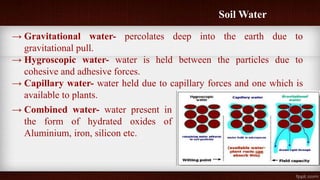
Soil Water
→ Gravitational water- percolates deep into the earth due to
gravitational pull.
→ Hygroscopic water- water is held between the particles due to
cohesive and adhesive forces.
→ Capillary water- water held due to capillary forces and one which is
available to plants.
→ Combined water- water present in
the form of hydrated oxides of
Aluminium, iron, silicon etc.
Available water- water present in the form of hydrated oxides of
Aluminium, iron, silicon etc.
→Hollard is the amount of total water present in soil.
→Chesard is the amound of water available to the plants.
→Echard is the amount of water which cannot absorbed by the
plants.
Hollard =Chresard + Echard
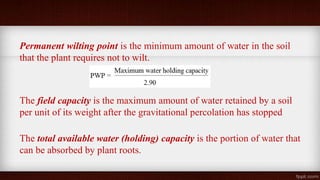
Permanent wilting point is the minimum amount of water in the soil
that the plant requires not to wilt.
The field capacity is the maximum amount of water retained by a soil
per unit of its weight after the gravitational percolation has stopped
The total available water (holding) capacity is the portion of water that
can be absorbed by plant roots.
Soil Solution
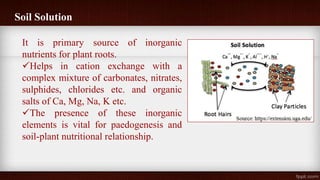
It is primary source of inorganic
nutrients for plant roots.
Helps in cation exchange with a
complex mixture of carbonates, nitrates,
sulphides, chlorides etc. and organic
salts of Ca, Mg, Na, K etc.
The presence of these inorganic
elements is vital for paedogenesis and
soil-plant nutritional relationship.
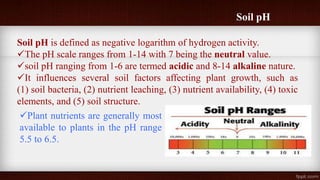
Soil pH is defined as negative logarithm of hydrogen activity.
The pH scale ranges from 1-14 with 7 being the neutral value.
soil pH ranging from 1-6 are termed acidic and 8-14 alkaline nature.
It influences several soil factors affecting plant growth, such as
(1) soil bacteria, (2) nutrient leaching, (3) nutrient availability, (4) toxic
elements, and (5) soil structure.
Soil pH
Plant nutrients are generally most
available to plants in the pH range
5.5 to 6.5.
Soil Air
Soil air is the gaseous phase of the soil.
Composition of soil air  Nitrogen 79.2%; Oxygen 20.6%; CO2
0.25% * (more CO2 concentration than in atmosphere)
 Soil aeration influences the availability of many nutrients. Soil air is
needed by many of the microorganisms that release plant nutrients to
the soil.
An appropriate balance between soil air and soil water must be
maintained since soil air is displaced by soil water.
Soil organisms
Soil organisms represent a large fraction of global terrestrial
biodiversity
Soil organisms include bacteria, fungi, actinomycetes, blue green algae,
protozoans, rotifers, nematodes, earth worms, molluscs, arthropods etc.
Constitute the soil food web
 Decomposition of organic
matter
Nitrogen fixation
Soil aeration
Secrets chemicals that stimulate
growth hormones
Denitrifying & desulphofying
 Causes plant diseases
Mycorrhizal association
Activities of soil organisms
Soil plasticity, Cohesion & adhesion
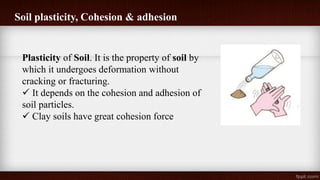
Plasticity of Soil. It is the property of soil by
which it undergoes deformation without
cracking or fracturing.
 It depends on the cohesion and adhesion of
soil particles.
 Clay soils have great cohesion force
Soil Inorganic matter
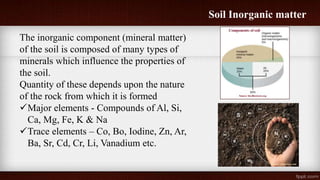
The inorganic component (mineral matter)
of the soil is composed of many types of
minerals which influence the properties of
the soil.
Quantity of these depends upon the nature
of the rock from which it is formed
Major elements - Compounds of Al, Si,
Ca, Mg, Fe, K & Na
Trace elements – Co, Bo, Iodine, Zn, Ar,
Ba, Sr, Cd, Cr, Li, Vanadium etc.
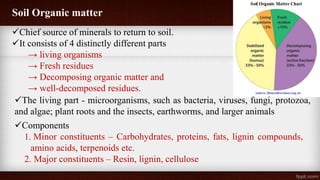
Chief source of minerals to return to soil.
It consists of 4 distinctly different parts
→ living organisms
→ Fresh residues
→ Decomposing organic matter and
→ well-decomposed residues.
Soil Organic matter
The living part - microorganisms, such as bacteria, viruses, fungi, protozoa,
and algae; plant roots and the insects, earthworms, and larger animals
Components
1. Minor constituents – Carbohydrates, proteins, fats, lignin compounds,
amino acids, terpenoids etc.
2. Major constituents – Resin, lignin, cellulose
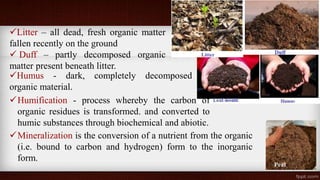
Litter – all dead, fresh organic matter
fallen recently on the ground
 Duff – partly decomposed organic
matter present beneath litter.
Humus - dark, completely decomposed
organic material.
Humification - process whereby the carbon of
organic residues is transformed. and converted to
humic substances through biochemical and abiotic.
Mineralization is the conversion of a nutrient from the organic
(i.e. bound to carbon and hydrogen) form to the inorganic
form.
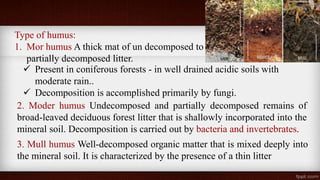
Type of humus:
1. Mor humus A thick mat of un decomposed to
partially decomposed litter.
 Present in coniferous forests - in well drained acidic soils with
moderate rain..
 Decomposition is accomplished primarily by fungi.
2. Moder humus Undecomposed and partially decomposed remains of
broad-leaved deciduous forest litter that is shallowly incorporated into the
mineral soil. Decomposition is carried out by bacteria and invertebrates.
3. Mull humus Well-decomposed organic matter that is mixed deeply into
the mineral soil. It is characterized by the presence of a thin litter
Advantages of soil humus:
 Increases soil fertility and soil digestion.
 Increases microbial activity and organic matter content of soil
 Improves buffering capacity (neutralizes pH in the soil)
 serves as a source of nitrogen, pho- sporus, and sulfur for higher
plants.
 Improves soil structure, drainage, and aeration and exchange capacity
 Increases water-holding capacity of soil,
 Enhances the dissolution of silicate minerals
 Serves as a source of energy for the growth and development of micro-
organisms.

Edaphic factor - soil properties

  • 1.
    Edaphic Factors Properties ofsoil Dr. T. Annie Sheron Asst. Professor of Botany Kakatiya Govt. College, Hanamkonda Telangana
  • 2.
    The upper layerof earth in which plants grow soil is the weathered surface of the earth crust which is mixed with organic material and in which plants grow Soil is a mixture of organic matter, minerals, gases, liquids, and organisms that together support life SOIL
  • 3.
    Properties of soil 1.Soil texture 2. Soil structure 3. Density & soil weight 4. Permeability 5. Soil colour 6. Soil temperature 7. Soil water 8. Soil solution 9. Soil air 10. Soil organisms 11. Soil plasticity, Cohesion and adhesion 12. Soil pH 13. Inorganic matter of soil 14. Organic matter of soil
  • 4.
    Texture indicates therelative content of particles of various sizes, such as sand, silt and clay in the soil. It influences the ease with which soil can be worked, the amount of water and air it holds, and the rate at which water can enter and move through soil. Soil texture It is determined by relative proportion of soil seperates.
  • 5.
    Soil texture triangle,used to determine the soil textural name after the percentage of sand, silt and clay are determined from a lab analysis.  12 different textural classes  Acts as tool to visualize and understand the meaning of soil texture names.
  • 6.
    Soils may beassigned to textural classes depending on the proportions of sand, silt and clay- size particles. Soil texture classes were determined through wet sedimentation method, and the results are presented as percentages of the total composition
  • 7.
    Soil structure Soil structuredescribes the arrangement of the solid parts of the soil and of the pore space located between them It is determined by how individual soil granules clump, bind together, and aggregate, resulting in the arrangement of soil pores between them. Described by →shape & arrangement →Size of Peds →Grade
  • 8.
    Platy —The unitsare flat and platelike. Prismatic —individual units are bounded by flat to rounded vertical faces. Units are distinctly longer vertically, and the faces are typically casts or molds of adjoining units. Columnar —units are bounded by flat or slightly rounded vertical faces. The tops of columns are very distinct and normally rounded. Blocky —block like or polyhedral and bounded by flat or slightly rounded surfaces that are casts of the faces of surrounding peds Granular —approximately spherical or polyhedral and are bounded by curved or very irregular faces that are not casts of adjoining peds. Wedge —approximately elliptical with interlocking lenses that terminate in acute angles. Lenticular —overlapping lenses parallel to the soil surface. They are thickest in the middle and thin towards the edges.
  • 9.
    Density & soilweight Soil density is the relation between the mass and the volume of a dry soil sample Expressed in terms of gram/cm3 Average density of the soil is 2.65 gram/cm3
  • 10.
    Soil Porosity Pore spaces:The spaces occupied by air and water between soil particles in a given volume of soil. Soil porosity: Percentage of soil volume occupied by pore spaces. Soil Permeability “the ease with which gases, liquids or plant roots penetrate or pass through a bulk mass of soil or a layer of soil” It affects the supply of root-zone air, moisture, and nutrients available for plant uptake
  • 11.
    Soil colour Soil coloris produced by the minerals present and by the organic matter content. Exhibit a wide range of colour; grey, black, white, reds, browns, yellows and greens. Provide a valuable insight into the soil environment and hence is very important in assessment and classification. Soil color does not affect the behavior and use of soil A Munsell color book can be use to determine the hue, value and chrome of a soil.
  • 12.
    Soil temperature: Soil temperatureis simply the measurement of the warmth in the soil. Thermal conductivity: The flow of the temperature in the soil Ideal soil temperatures for planting most plants are 65 to 75 F. (18-24 C.).  Directly affects germination, plant growth and rate of nitrification Influences soil moisture content, aeration and availability of plant nutrients. Most organisms within soil thrive at temperatures between 25-35C
  • 13.
    Soil Water → Gravitationalwater- percolates deep into the earth due to gravitational pull. → Hygroscopic water- water is held between the particles due to cohesive and adhesive forces. → Capillary water- water held due to capillary forces and one which is available to plants. → Combined water- water present in the form of hydrated oxides of Aluminium, iron, silicon etc.
  • 14.
    Available water- waterpresent in the form of hydrated oxides of Aluminium, iron, silicon etc. →Hollard is the amount of total water present in soil. →Chesard is the amound of water available to the plants. →Echard is the amount of water which cannot absorbed by the plants. Hollard =Chresard + Echard
  • 15.
    Permanent wilting pointis the minimum amount of water in the soil that the plant requires not to wilt. The field capacity is the maximum amount of water retained by a soil per unit of its weight after the gravitational percolation has stopped The total available water (holding) capacity is the portion of water that can be absorbed by plant roots.
  • 16.
    Soil Solution It isprimary source of inorganic nutrients for plant roots. Helps in cation exchange with a complex mixture of carbonates, nitrates, sulphides, chlorides etc. and organic salts of Ca, Mg, Na, K etc. The presence of these inorganic elements is vital for paedogenesis and soil-plant nutritional relationship.
  • 17.
    Soil pH isdefined as negative logarithm of hydrogen activity. The pH scale ranges from 1-14 with 7 being the neutral value. soil pH ranging from 1-6 are termed acidic and 8-14 alkaline nature. It influences several soil factors affecting plant growth, such as (1) soil bacteria, (2) nutrient leaching, (3) nutrient availability, (4) toxic elements, and (5) soil structure. Soil pH Plant nutrients are generally most available to plants in the pH range 5.5 to 6.5.
  • 18.
    Soil Air Soil airis the gaseous phase of the soil. Composition of soil air  Nitrogen 79.2%; Oxygen 20.6%; CO2 0.25% * (more CO2 concentration than in atmosphere)  Soil aeration influences the availability of many nutrients. Soil air is needed by many of the microorganisms that release plant nutrients to the soil. An appropriate balance between soil air and soil water must be maintained since soil air is displaced by soil water.
  • 19.
    Soil organisms Soil organismsrepresent a large fraction of global terrestrial biodiversity Soil organisms include bacteria, fungi, actinomycetes, blue green algae, protozoans, rotifers, nematodes, earth worms, molluscs, arthropods etc. Constitute the soil food web  Decomposition of organic matter Nitrogen fixation Soil aeration Secrets chemicals that stimulate growth hormones Denitrifying & desulphofying  Causes plant diseases Mycorrhizal association Activities of soil organisms
  • 20.
    Soil plasticity, Cohesion& adhesion Plasticity of Soil. It is the property of soil by which it undergoes deformation without cracking or fracturing.  It depends on the cohesion and adhesion of soil particles.  Clay soils have great cohesion force
  • 21.
    Soil Inorganic matter Theinorganic component (mineral matter) of the soil is composed of many types of minerals which influence the properties of the soil. Quantity of these depends upon the nature of the rock from which it is formed Major elements - Compounds of Al, Si, Ca, Mg, Fe, K & Na Trace elements – Co, Bo, Iodine, Zn, Ar, Ba, Sr, Cd, Cr, Li, Vanadium etc.
  • 22.
    Chief source ofminerals to return to soil. It consists of 4 distinctly different parts → living organisms → Fresh residues → Decomposing organic matter and → well-decomposed residues. Soil Organic matter The living part - microorganisms, such as bacteria, viruses, fungi, protozoa, and algae; plant roots and the insects, earthworms, and larger animals Components 1. Minor constituents – Carbohydrates, proteins, fats, lignin compounds, amino acids, terpenoids etc. 2. Major constituents – Resin, lignin, cellulose
  • 23.
    Litter – alldead, fresh organic matter fallen recently on the ground  Duff – partly decomposed organic matter present beneath litter. Humus - dark, completely decomposed organic material. Humification - process whereby the carbon of organic residues is transformed. and converted to humic substances through biochemical and abiotic. Mineralization is the conversion of a nutrient from the organic (i.e. bound to carbon and hydrogen) form to the inorganic form.
  • 24.
    Type of humus: 1.Mor humus A thick mat of un decomposed to partially decomposed litter.  Present in coniferous forests - in well drained acidic soils with moderate rain..  Decomposition is accomplished primarily by fungi. 2. Moder humus Undecomposed and partially decomposed remains of broad-leaved deciduous forest litter that is shallowly incorporated into the mineral soil. Decomposition is carried out by bacteria and invertebrates. 3. Mull humus Well-decomposed organic matter that is mixed deeply into the mineral soil. It is characterized by the presence of a thin litter
  • 25.
    Advantages of soilhumus:  Increases soil fertility and soil digestion.  Increases microbial activity and organic matter content of soil  Improves buffering capacity (neutralizes pH in the soil)  serves as a source of nitrogen, pho- sporus, and sulfur for higher plants.  Improves soil structure, drainage, and aeration and exchange capacity  Increases water-holding capacity of soil,  Enhances the dissolution of silicate minerals  Serves as a source of energy for the growth and development of micro- organisms.