Soil Structure,
Density, and Porosity
Laboratory #4
Objectives
 Understand the concept of soil structure and
how it differs from soil texture.
 Understand how soil structure influences other
soil properties.
 Learn how soil structure affects other soil
properties and why it is important to maintain soil
structure.
 Learn how land use and management affects
soil structure.
Definition
 Soil structure is the arrangement of the
primary soil particles (sand, silt, and clay)
and other soil materials into discrete
aggregates.
Peds
 Structural units are called peds, and have
distinct boundaries and well-defined planes of
weakness between the aggregates.
 Peds consist of primary particles bound together
by cementing agents like organic matter, clay,
and hydrous oxides of iron and aluminum.
 Peds can take several shapes.
Ped Shapes
 Granular
 Blocky
 Prismatic
 Columnar
 Platy
 Single-grained
 Massive
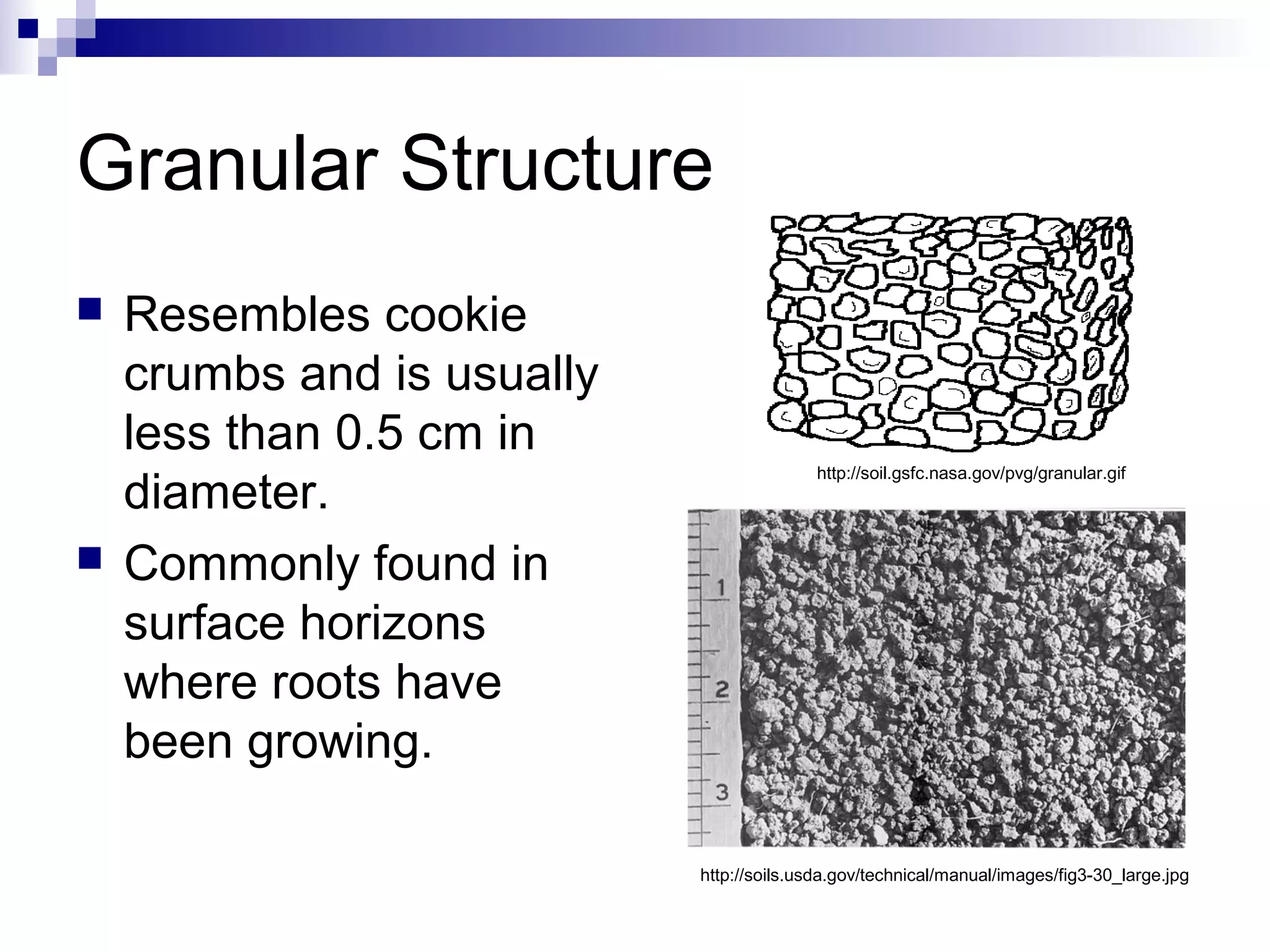
Granular Structure
 Resembles cookie
crumbs and is usually
less than 0.5 cm in
diameter.
 Commonly found in
surface horizons
where roots have
been growing.
http://soil.gsfc.nasa.gov/pvg/granular.gif
http://soils.usda.gov/technical/manual/images/fig3-30_large.jpg
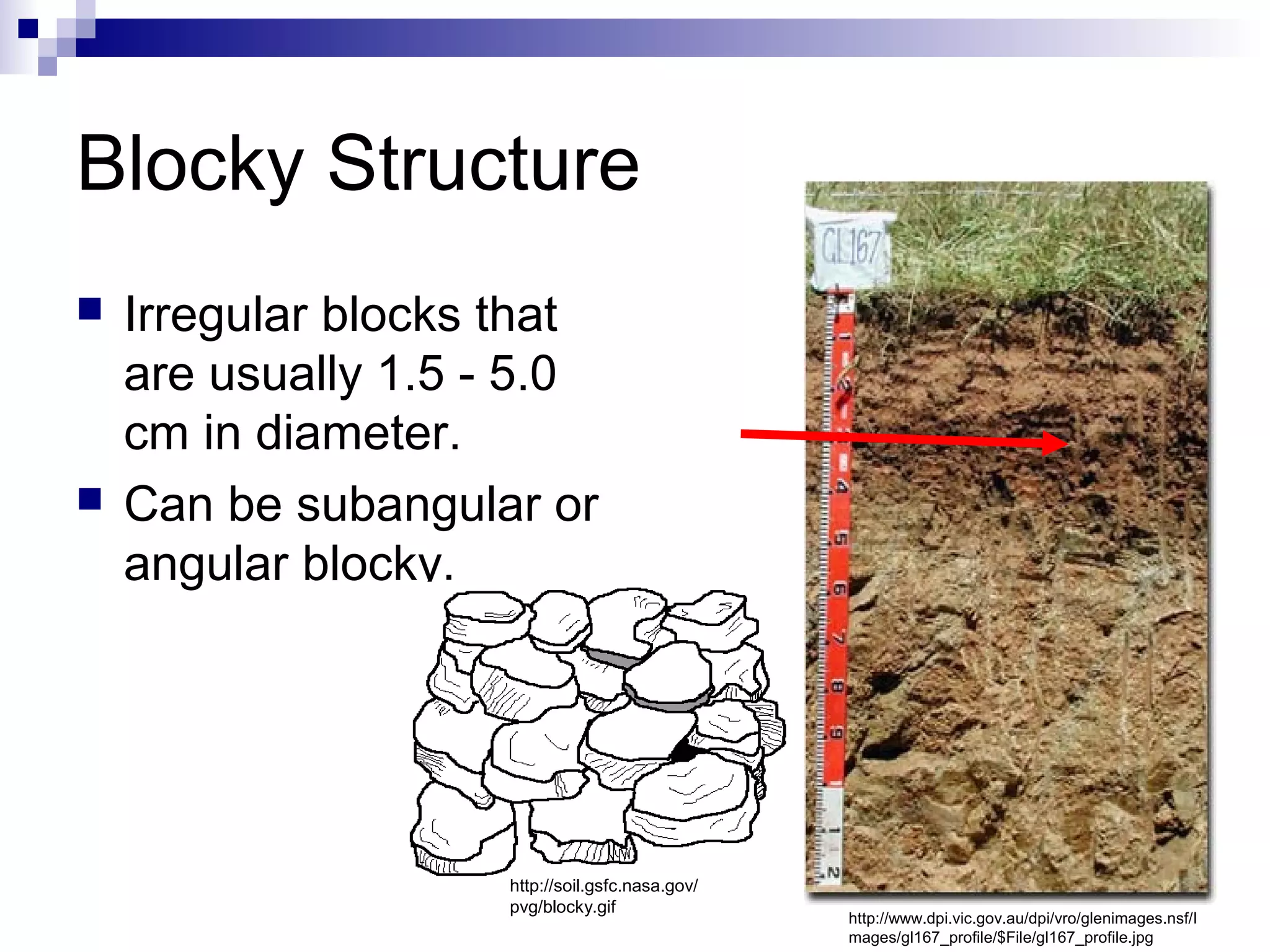
Blocky Structure
 Irregular blocks that
are usually 1.5 - 5.0
cm in diameter.
 Can be subangular or
angular blocky.
http://soil.gsfc.nasa.gov/
pvg/blocky.gif
http://www.dpi.vic.gov.au/dpi/vro/glenimages.nsf/I
mages/gl167_profile/$File/gl167_profile.jpg
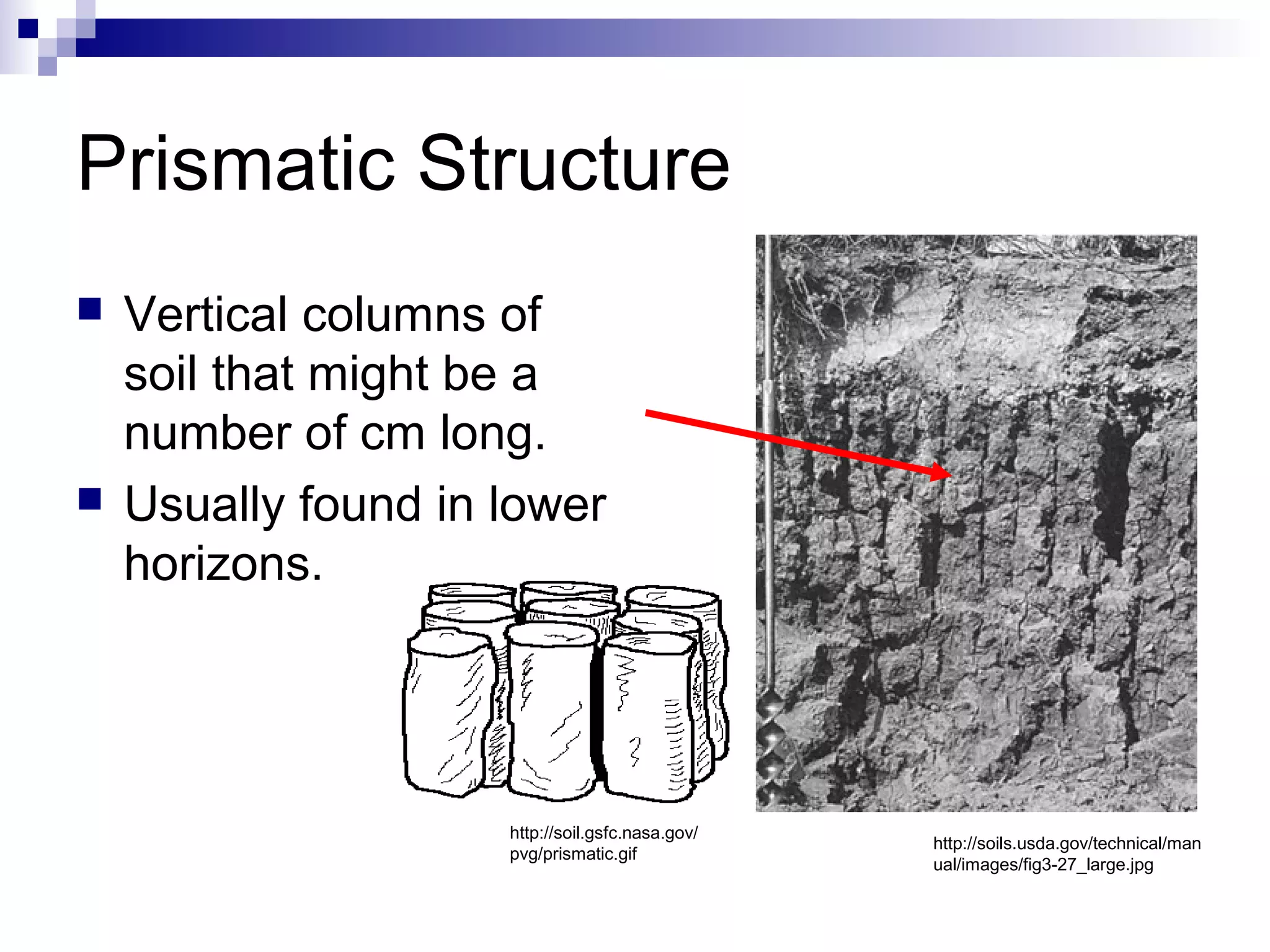
Prismatic Structure
 Vertical columns of
soil that might be a
number of cm long.
 Usually found in lower
horizons.
http://soil.gsfc.nasa.gov/
pvg/prismatic.gif
http://soils.usda.gov/technical/man
ual/images/fig3-27_large.jpg
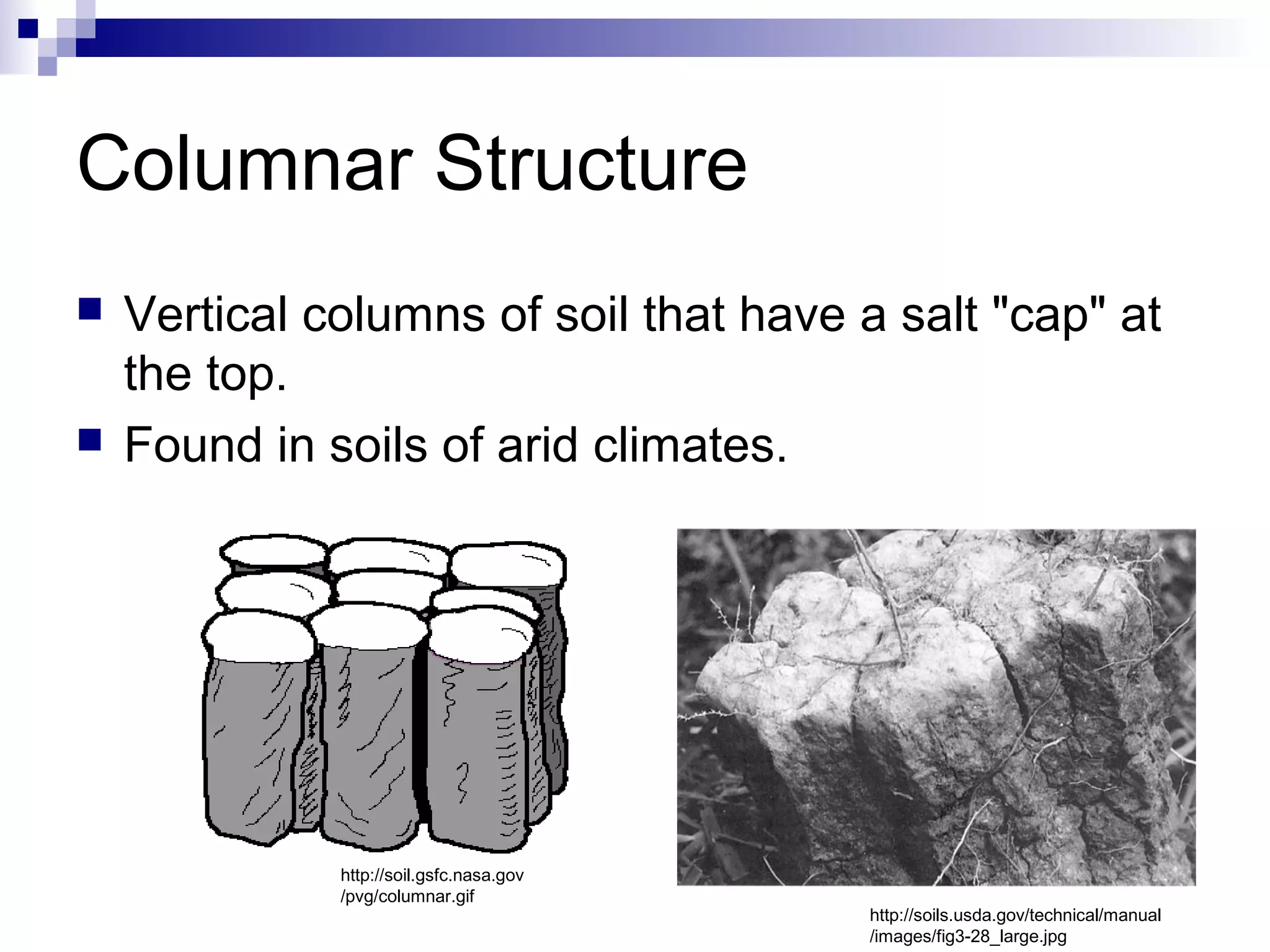
Columnar Structure
 Vertical columns of soil that have a salt "cap" at
the top.
 Found in soils of arid climates.
http://soil.gsfc.nasa.gov
/pvg/columnar.gif
http://soils.usda.gov/technical/manual
/images/fig3-28_large.jpg
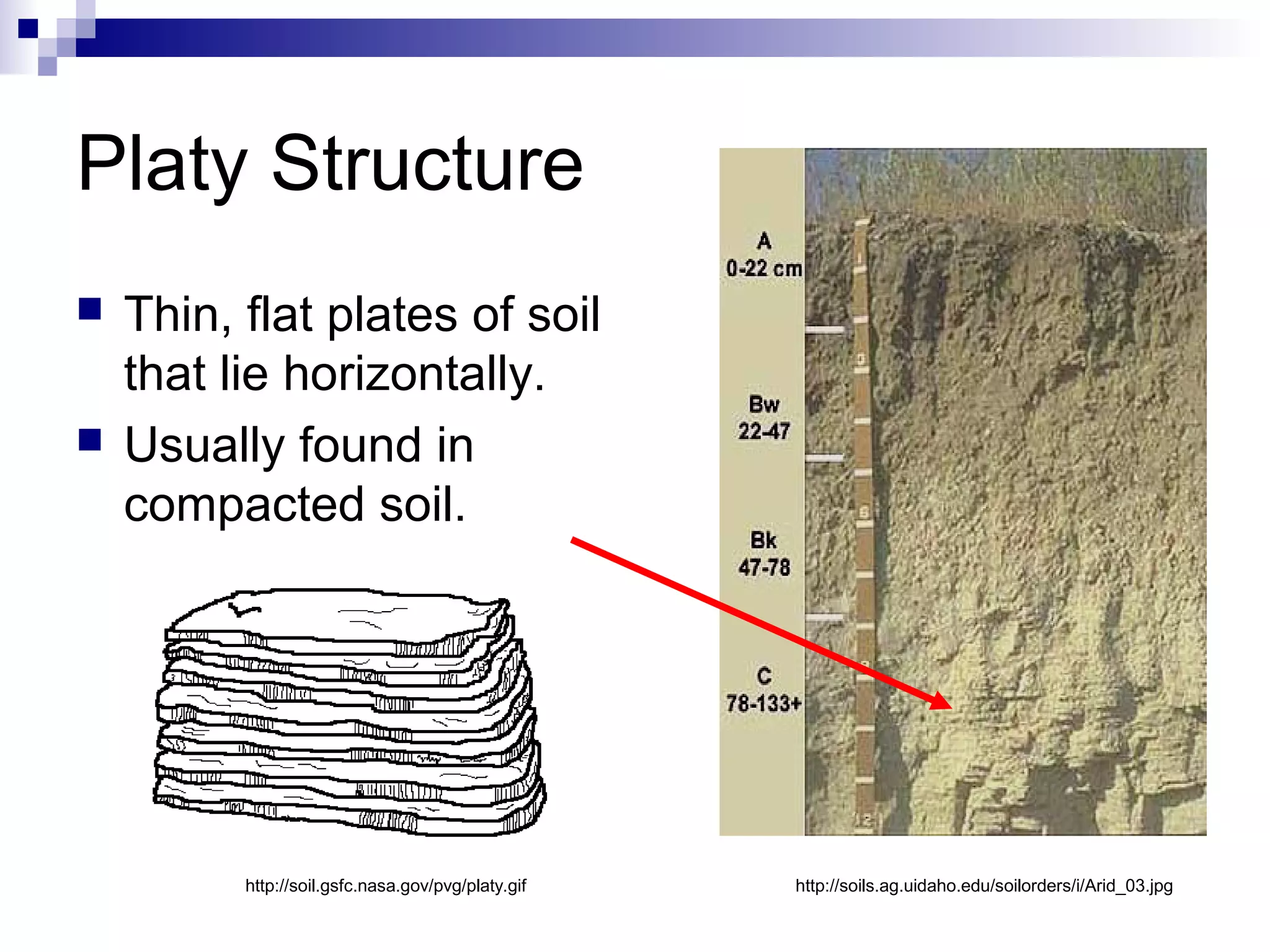
Platy Structure
 Thin, flat plates of soil
that lie horizontally.
 Usually found in
compacted soil.
http://soil.gsfc.nasa.gov/pvg/platy.gif http://soils.ag.uidaho.edu/soilorders/i/Arid_03.jpg
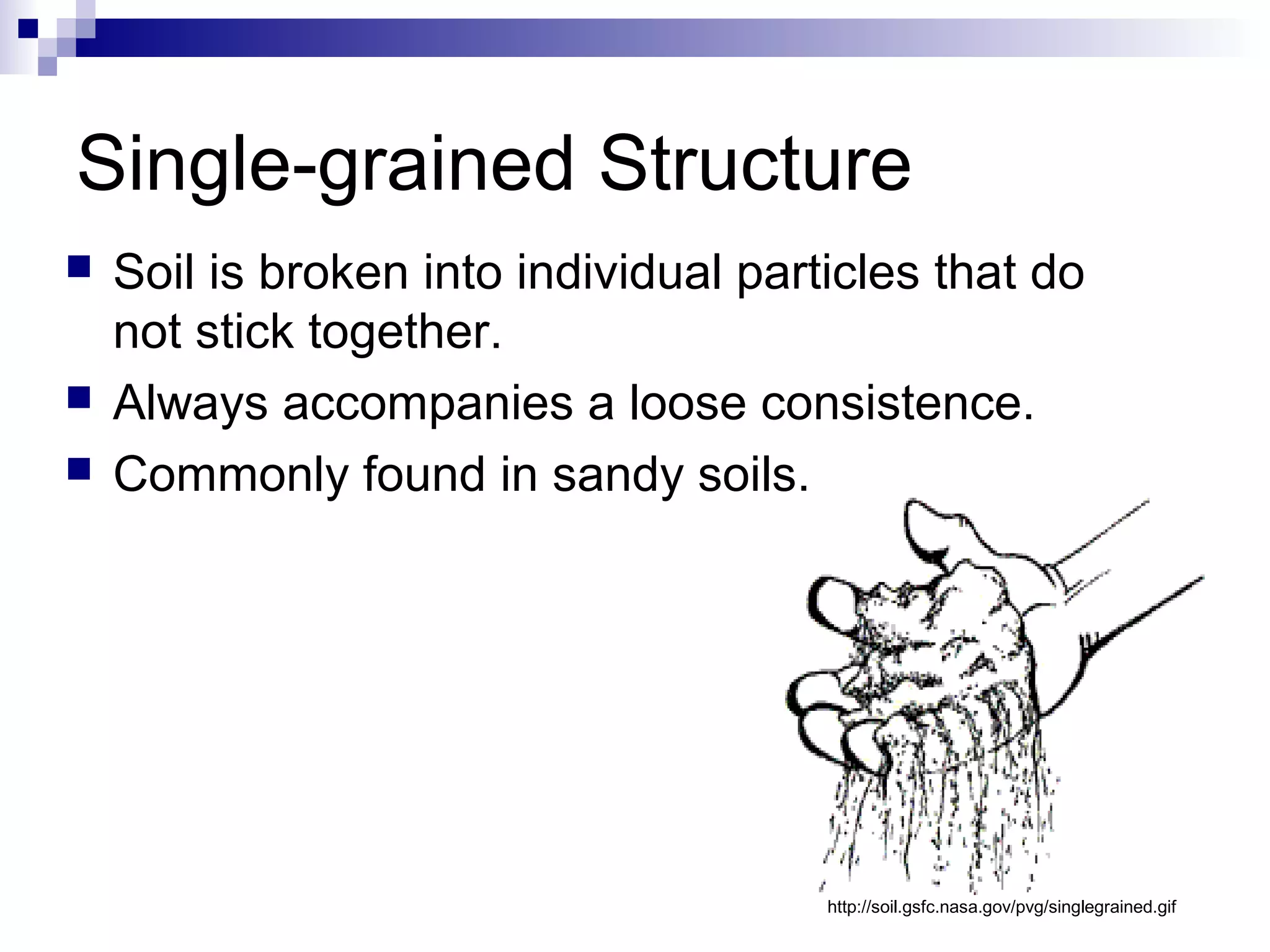
Single-grained Structure
 Soil is broken into individual particles that do
not stick together.
 Always accompanies a loose consistence.
 Commonly found in sandy soils.
http://soil.gsfc.nasa.gov/pvg/singlegrained.gif
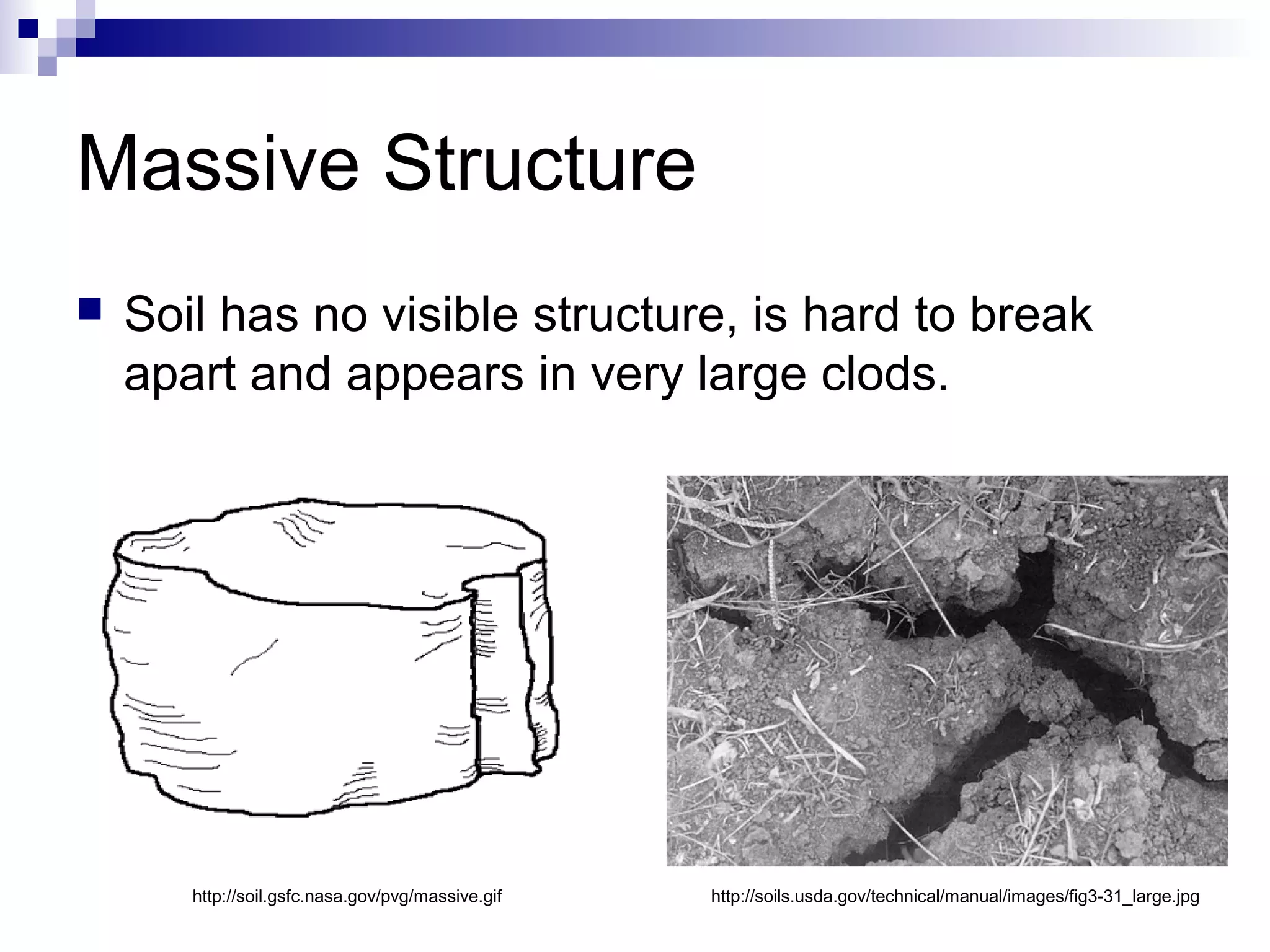
Massive Structure
 Soil has no visible structure, is hard to break
apart and appears in very large clods.
http://soil.gsfc.nasa.gov/pvg/massive.gif http://soils.usda.gov/technical/manual/images/fig3-31_large.jpg
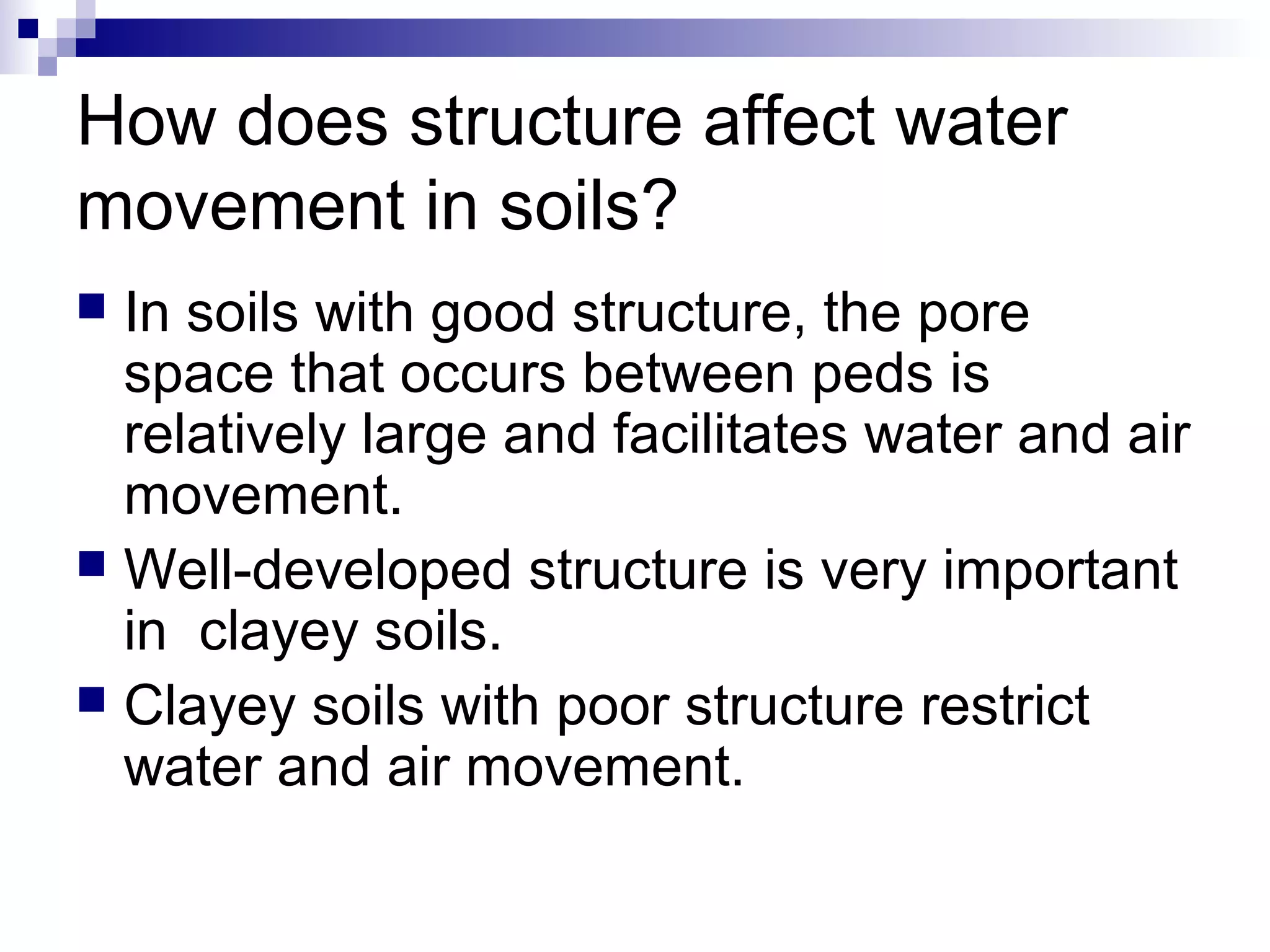
Grade of Soil Structure
 The terms weak, moderate, or strong are used
to describe the grade or how stable the peds are
and how hard they are to break apart.
 What do you think
the grade would be
for this picture?
http://soils.usda.gov/technical/manual/images/fig3-27_large.jpg
Class of Soil Structure
 The size or class of the peds is described
as fine, medium, or coarse.
How does structure affect water
movement in soils?
 In soils with good structure, the pore
space that occurs between peds is
relatively large and facilitates water and air
movement.
 Well-developed structure is very important
in clayey soils.
 Clayey soils with poor structure restrict
water and air movement.
Degree of Water Movement
http://ohioline.osu.edu/b905/images/006.jpg
StructureStructure
WaterWater
MovementMovement
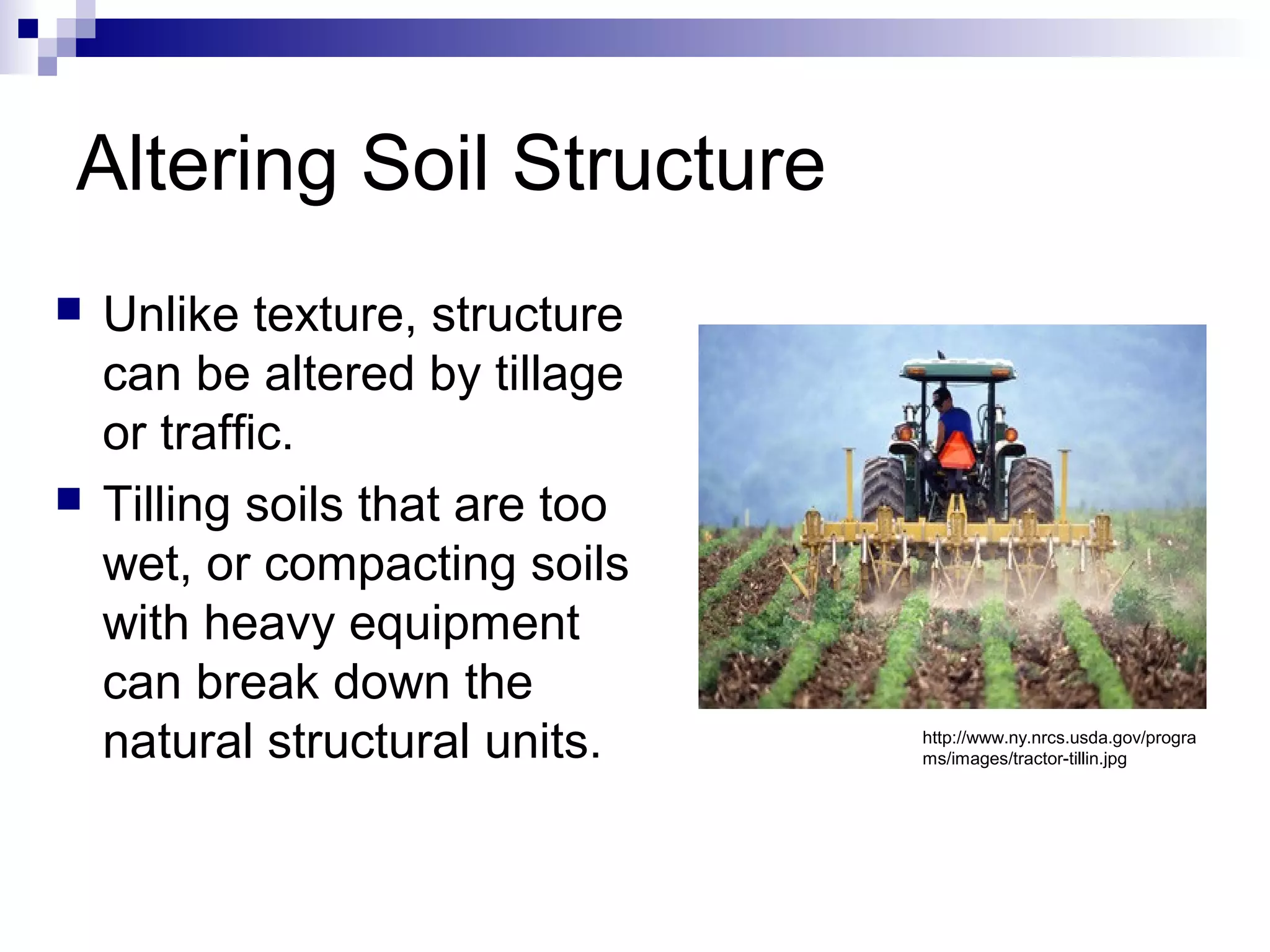
Altering Soil Structure
 Unlike texture, structure
can be altered by tillage
or traffic.
 Tilling soils that are too
wet, or compacting soils
with heavy equipment
can break down the
natural structural units. http://www.ny.nrcs.usda.gov/progra
ms/images/tractor-tillin.jpg
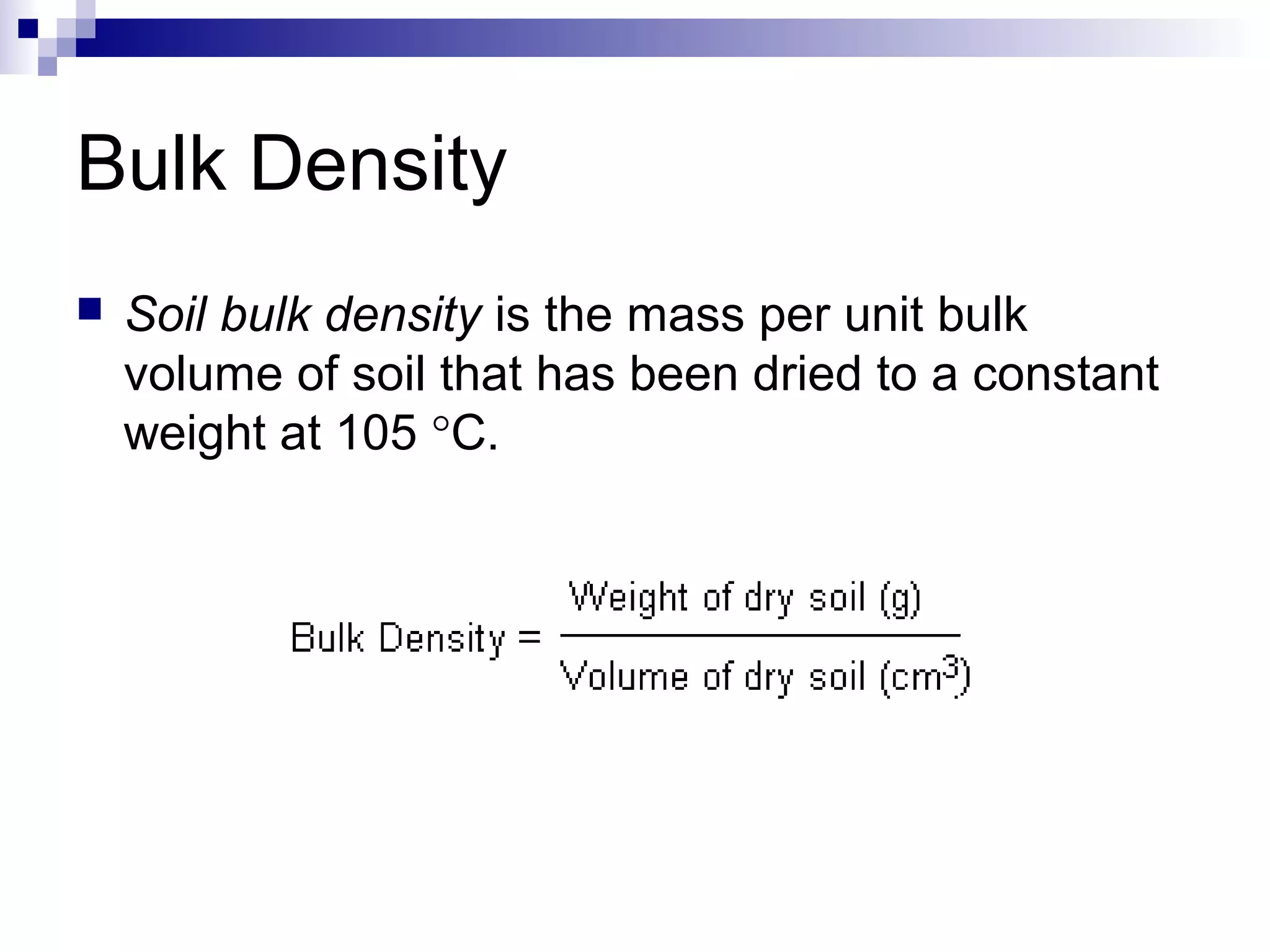
Bulk Density
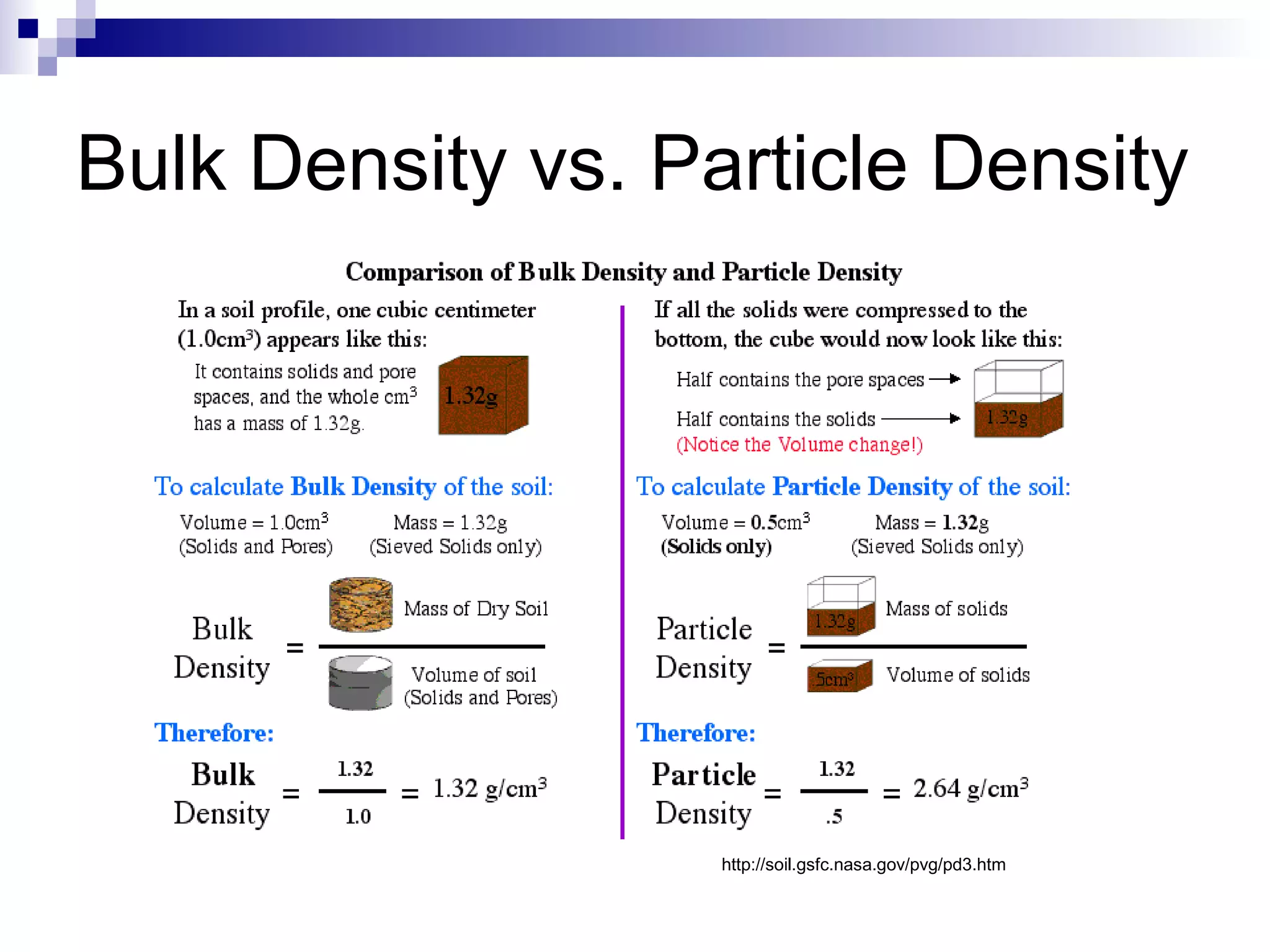
 Soil bulk density is the mass per unit bulk
volume of soil that has been dried to a constant
weight at 105 °C.
Bulk Density Example
 If we have a soil that weighs 50 grams after
being oven-dried and has a volume of 30
cm3
, what will be the bulk density?
 It would be 50 g/30 cm3
or 1.67 g/ cm3
.
Bulk Density in the Field
 Bulk density of organic soils can be very
low, such as 0.5 g/cm3.
 Clayey soils have higher bulk densities.
 Compacted clay soils have very high bulk
densities, between 1.6 and 1.8 g/cm3.
Particle Density and Porosity
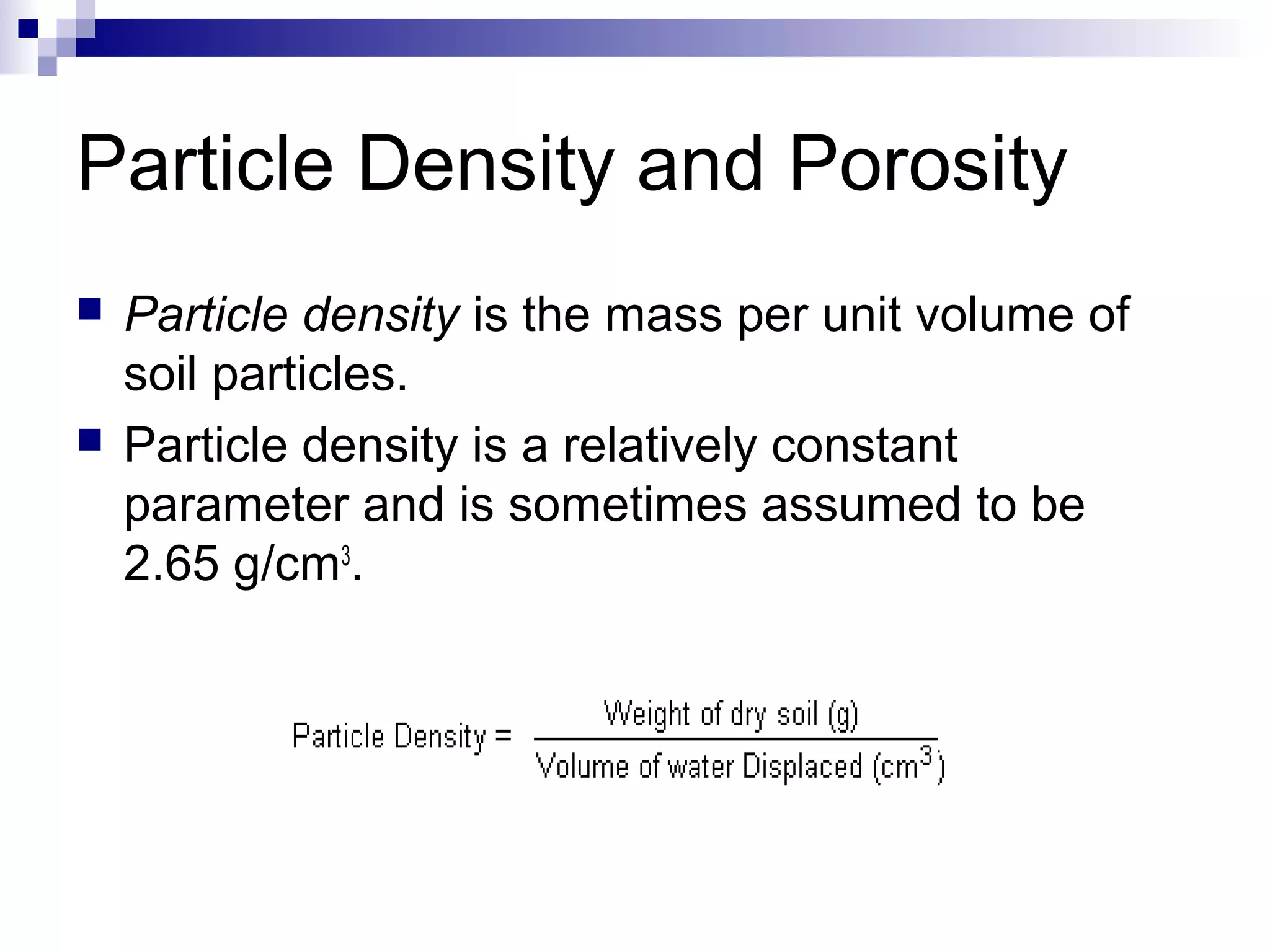
 Particle density is the mass per unit volume of
soil particles.
 Particle density is a relatively constant
parameter and is sometimes assumed to be
2.65 g/cm3
.
Bulk Density vs. Particle Density
http://soil.gsfc.nasa.gov/pvg/pd3.htm
Porosity
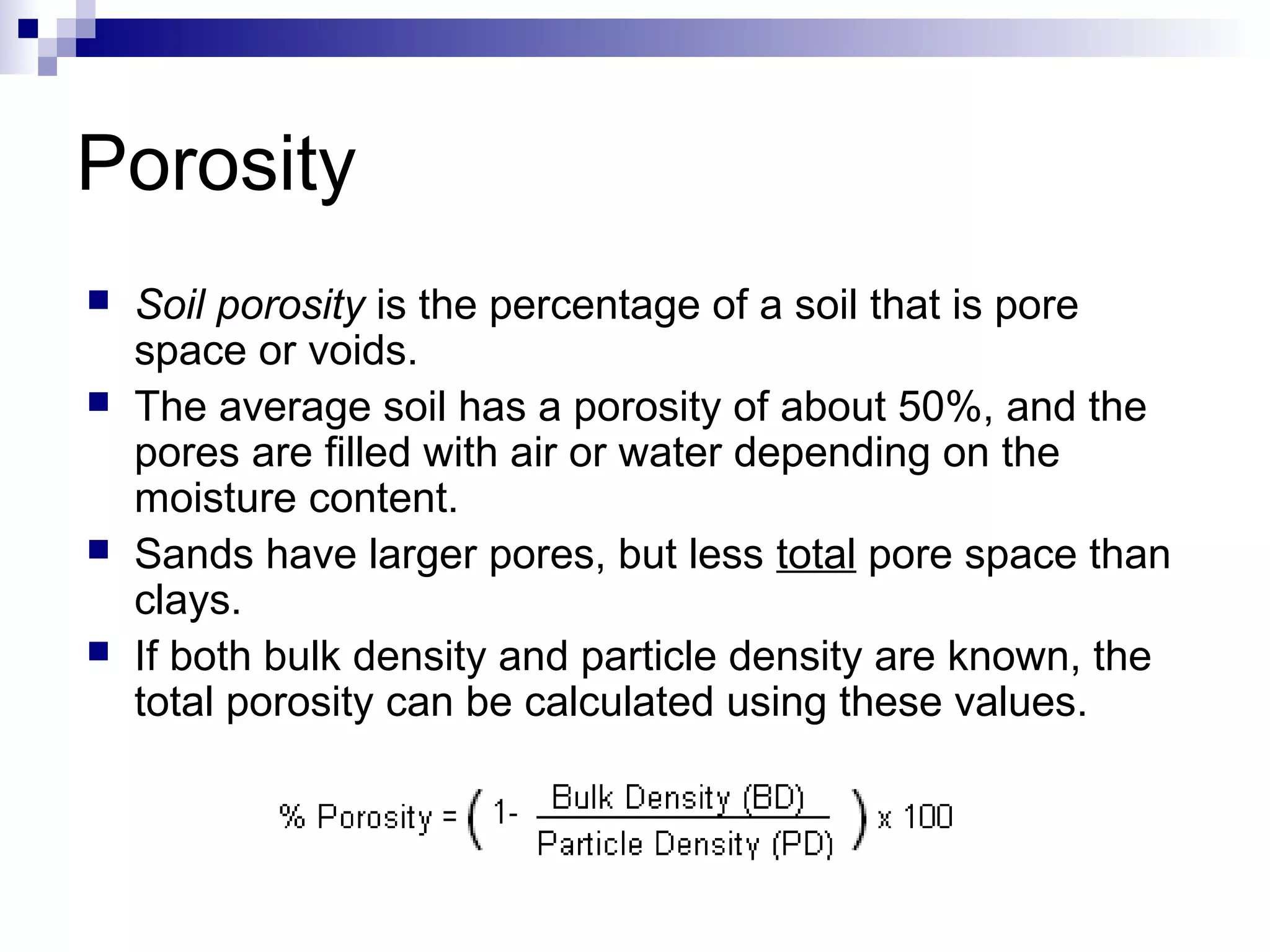
 Soil porosity is the percentage of a soil that is pore
space or voids.
 The average soil has a porosity of about 50%, and the
pores are filled with air or water depending on the
moisture content.
 Sands have larger pores, but less total pore space than
clays.
 If both bulk density and particle density are known, the
total porosity can be calculated using these values.
Soil Permeability
 Soil permeability is the ease with which air,
water, or plant roots penetrate or pass through
soil.
 Soils with large pores that are connected are
more permeable.
 Rainwater soaks in readily and moves down
through the soil profile.
 Clayey soils can have greater total porosity than
sand and still be less permeable than sand since
the pores are small.
Soil Strength
 Soil strength is defined as the amount of
force required to move or rearrange soil
particles.
 Soil strength is an important physical
property affecting plant growth and
seedling emergence.
 It is affected by three main factors;
moisture content, soil texture, and bulk
density.
Moisture Content & Soil Strength
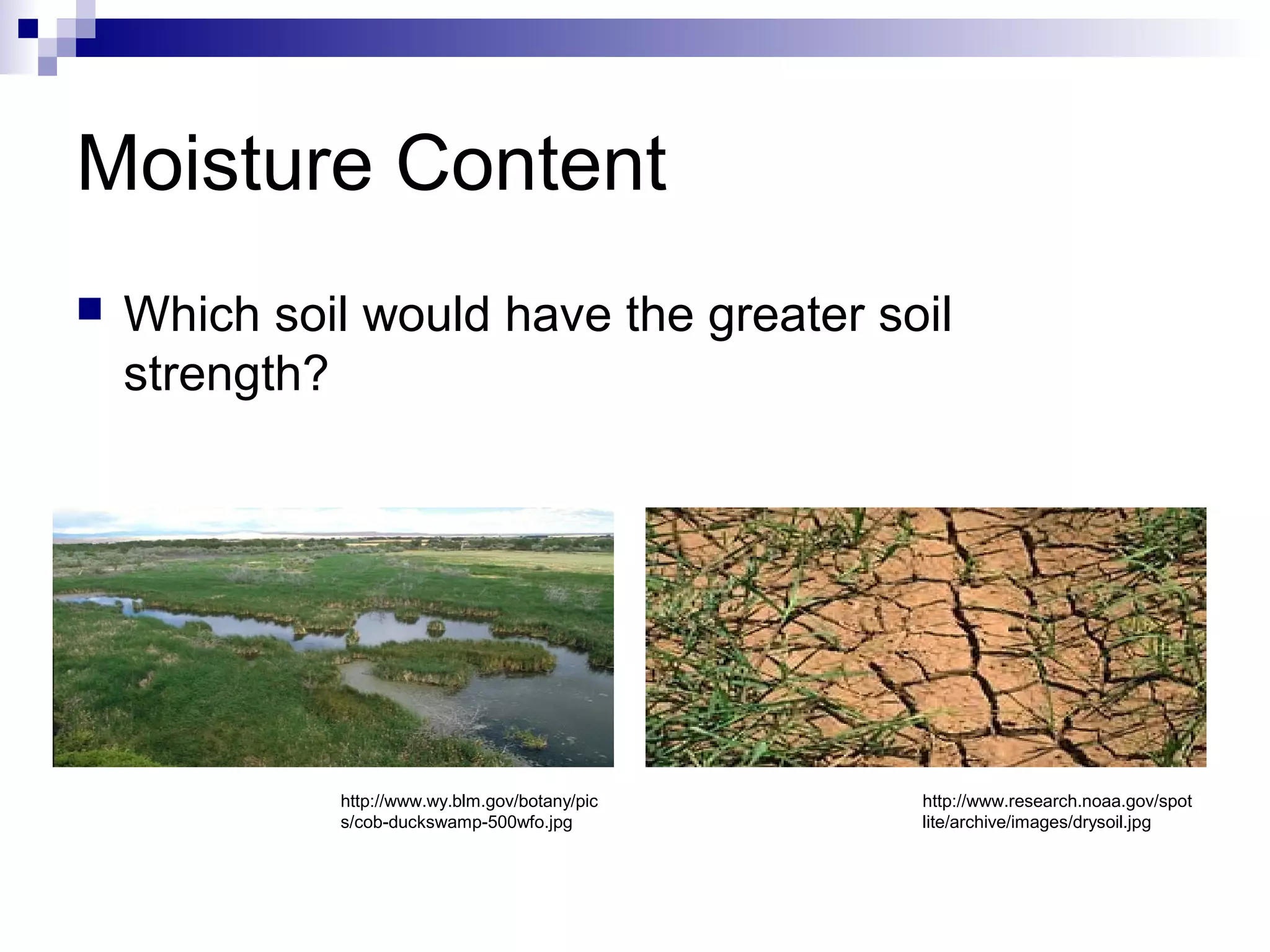
 Water content is the most important factor
determining soil strength.
 The lower the soil water content, or the
drier the soil, the greater the soil strength.
 Soils that are saturated, or waterlogged
have weak soil strengths.
Moisture Content
 Which soil would have the greater soil
strength?
http://www.wy.blm.gov/botany/pic
s/cob-duckswamp-500wfo.jpg
http://www.research.noaa.gov/spot
lite/archive/images/drysoil.jpg
Soil Texture & Soil Strength
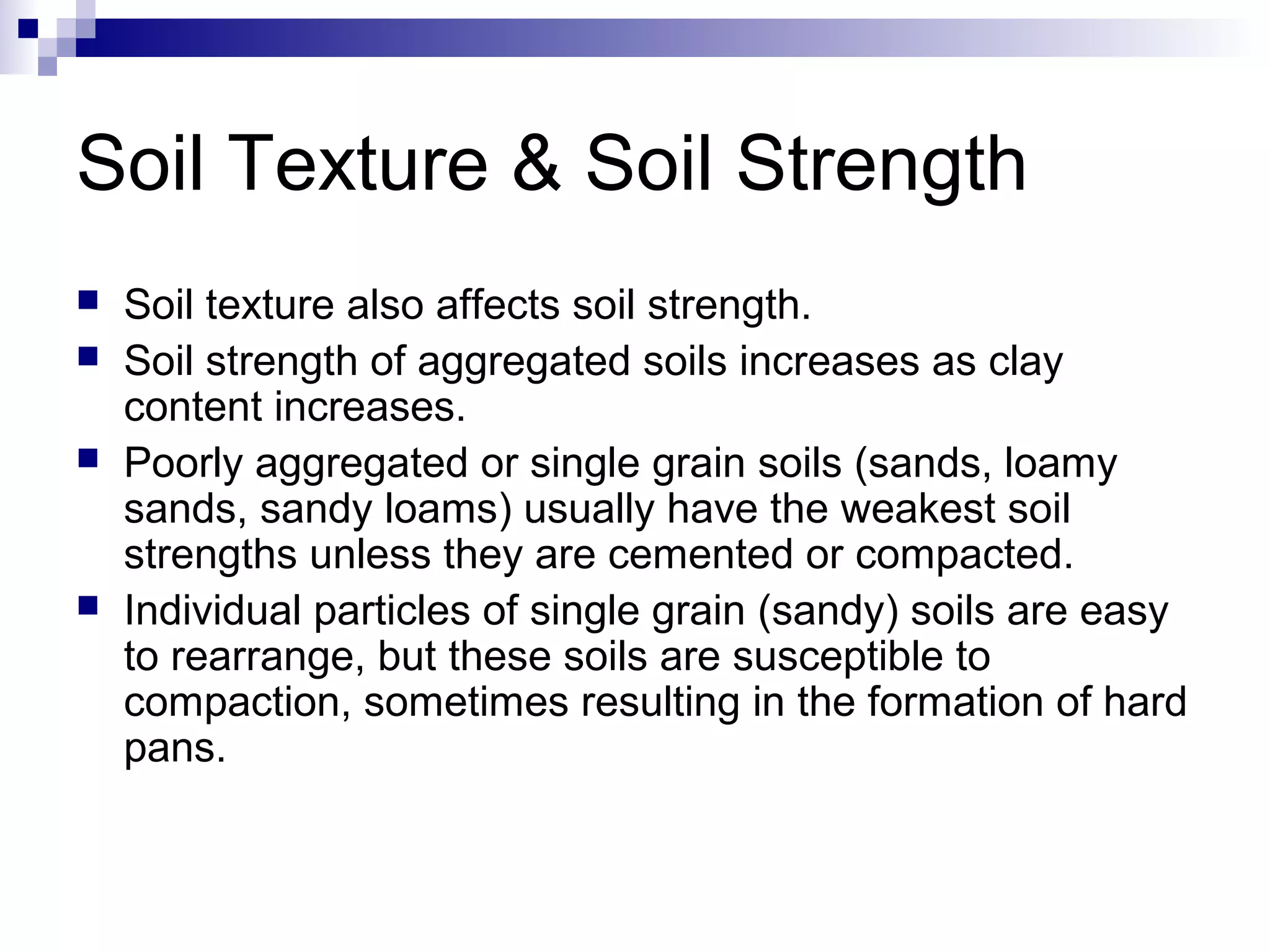
 Soil texture also affects soil strength.
 Soil strength of aggregated soils increases as clay
content increases.
 Poorly aggregated or single grain soils (sands, loamy
sands, sandy loams) usually have the weakest soil
strengths unless they are cemented or compacted.
 Individual particles of single grain (sandy) soils are easy
to rearrange, but these soils are susceptible to
compaction, sometimes resulting in the formation of hard
pans.
Bulk Density & Soil Strength
 Bulk density is the third factor affecting soil
strength.
 As bulk density of a given soil increases
soil strength also increases.
 Remember that soil is composed of solids
and pores, and the greater the bulk
density the greater the amount of solids,
and the smaller the amount of pore space.
Soil Management Problems
 Two examples of management problems caused
by increasing soil strength are soil crusts and
tillage pans.
 A soil crust is a thin soil layer that forms at the
soil surface following heavy rains.
 Tillage or hard pans are high bulk density (>1.7
g/cm3
) layers that occur within the Ap and E
horizons.
 Compaction caused by traffic of equipment,
vehicles, or even foot traffic often increases soil
strength to levels that restrict root penetration
and plant growth.
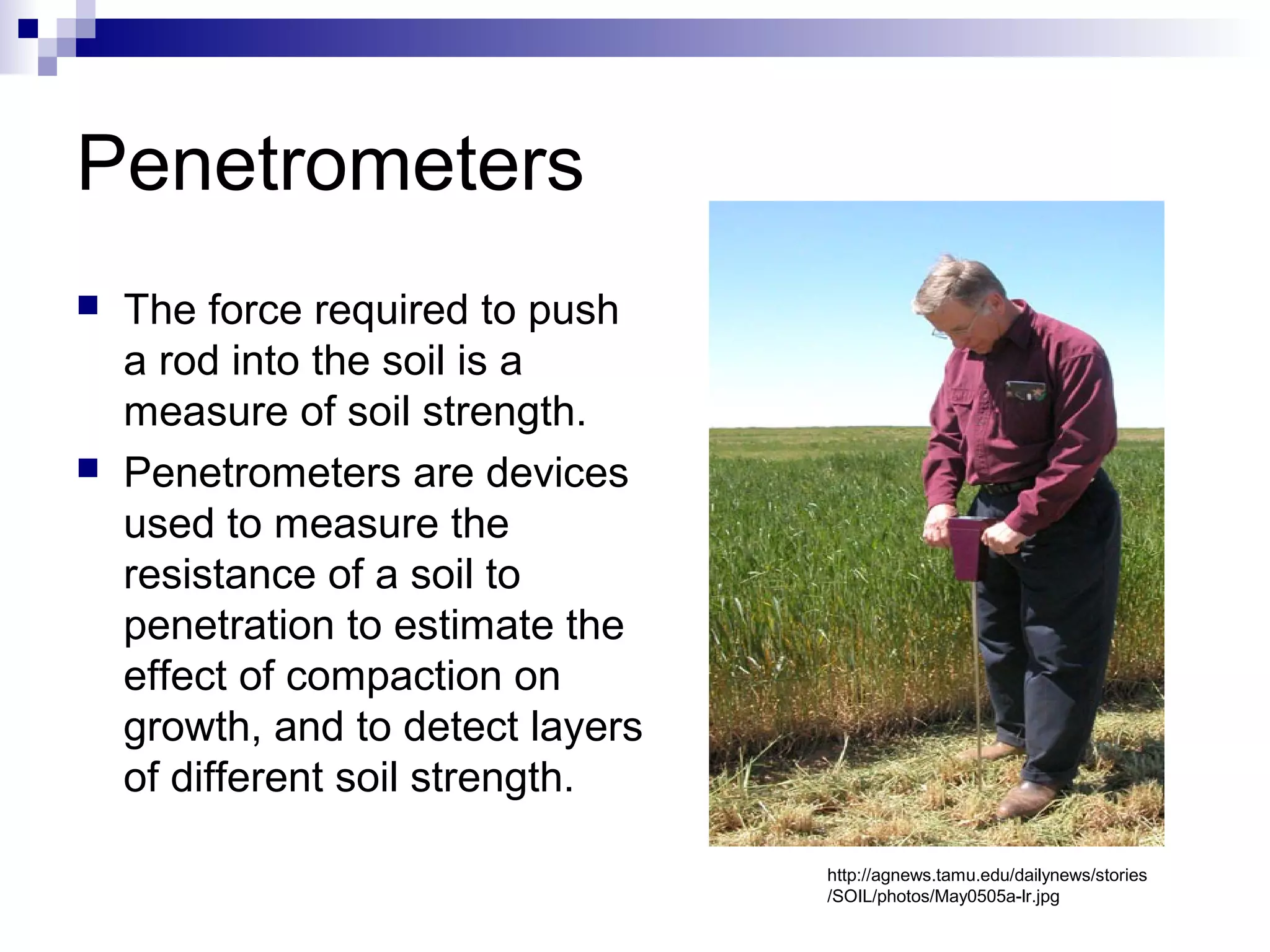
Penetrometers
 The force required to push
a rod into the soil is a
measure of soil strength.
 Penetrometers are devices
used to measure the
resistance of a soil to
penetration to estimate the
effect of compaction on
growth, and to detect layers
of different soil strength.
http://agnews.tamu.edu/dailynews/stories
/SOIL/photos/May0505a-lr.jpg
Questions?

Soil structure, density and porosity

  • 1.
    Soil Structure, Density, andPorosity Laboratory #4
  • 2.
    Objectives  Understand theconcept of soil structure and how it differs from soil texture.  Understand how soil structure influences other soil properties.  Learn how soil structure affects other soil properties and why it is important to maintain soil structure.  Learn how land use and management affects soil structure.
  • 3.
    Definition  Soil structureis the arrangement of the primary soil particles (sand, silt, and clay) and other soil materials into discrete aggregates.
  • 4.
    Peds  Structural unitsare called peds, and have distinct boundaries and well-defined planes of weakness between the aggregates.  Peds consist of primary particles bound together by cementing agents like organic matter, clay, and hydrous oxides of iron and aluminum.  Peds can take several shapes.
  • 5.
    Ped Shapes  Granular Blocky  Prismatic  Columnar  Platy  Single-grained  Massive
  • 6.
    Granular Structure  Resemblescookie crumbs and is usually less than 0.5 cm in diameter.  Commonly found in surface horizons where roots have been growing. http://soil.gsfc.nasa.gov/pvg/granular.gif http://soils.usda.gov/technical/manual/images/fig3-30_large.jpg
  • 7.
    Blocky Structure  Irregularblocks that are usually 1.5 - 5.0 cm in diameter.  Can be subangular or angular blocky. http://soil.gsfc.nasa.gov/ pvg/blocky.gif http://www.dpi.vic.gov.au/dpi/vro/glenimages.nsf/I mages/gl167_profile/$File/gl167_profile.jpg
  • 8.
    Prismatic Structure  Verticalcolumns of soil that might be a number of cm long.  Usually found in lower horizons. http://soil.gsfc.nasa.gov/ pvg/prismatic.gif http://soils.usda.gov/technical/man ual/images/fig3-27_large.jpg
  • 9.
    Columnar Structure  Verticalcolumns of soil that have a salt "cap" at the top.  Found in soils of arid climates. http://soil.gsfc.nasa.gov /pvg/columnar.gif http://soils.usda.gov/technical/manual /images/fig3-28_large.jpg
  • 10.
    Platy Structure  Thin,flat plates of soil that lie horizontally.  Usually found in compacted soil. http://soil.gsfc.nasa.gov/pvg/platy.gif http://soils.ag.uidaho.edu/soilorders/i/Arid_03.jpg
  • 11.
    Single-grained Structure  Soilis broken into individual particles that do not stick together.  Always accompanies a loose consistence.  Commonly found in sandy soils. http://soil.gsfc.nasa.gov/pvg/singlegrained.gif
  • 12.
    Massive Structure  Soilhas no visible structure, is hard to break apart and appears in very large clods. http://soil.gsfc.nasa.gov/pvg/massive.gif http://soils.usda.gov/technical/manual/images/fig3-31_large.jpg
  • 13.
    Grade of SoilStructure  The terms weak, moderate, or strong are used to describe the grade or how stable the peds are and how hard they are to break apart.  What do you think the grade would be for this picture? http://soils.usda.gov/technical/manual/images/fig3-27_large.jpg
  • 14.
    Class of SoilStructure  The size or class of the peds is described as fine, medium, or coarse.
  • 15.
    How does structureaffect water movement in soils?  In soils with good structure, the pore space that occurs between peds is relatively large and facilitates water and air movement.  Well-developed structure is very important in clayey soils.  Clayey soils with poor structure restrict water and air movement.
  • 16.
    Degree of WaterMovement http://ohioline.osu.edu/b905/images/006.jpg StructureStructure WaterWater MovementMovement
  • 17.
    Altering Soil Structure Unlike texture, structure can be altered by tillage or traffic.  Tilling soils that are too wet, or compacting soils with heavy equipment can break down the natural structural units. http://www.ny.nrcs.usda.gov/progra ms/images/tractor-tillin.jpg
  • 18.
    Bulk Density  Soilbulk density is the mass per unit bulk volume of soil that has been dried to a constant weight at 105 °C.
  • 19.
    Bulk Density Example If we have a soil that weighs 50 grams after being oven-dried and has a volume of 30 cm3 , what will be the bulk density?  It would be 50 g/30 cm3 or 1.67 g/ cm3 .
  • 20.
    Bulk Density inthe Field  Bulk density of organic soils can be very low, such as 0.5 g/cm3.  Clayey soils have higher bulk densities.  Compacted clay soils have very high bulk densities, between 1.6 and 1.8 g/cm3.
  • 21.
    Particle Density andPorosity  Particle density is the mass per unit volume of soil particles.  Particle density is a relatively constant parameter and is sometimes assumed to be 2.65 g/cm3 .
  • 22.
    Bulk Density vs.Particle Density http://soil.gsfc.nasa.gov/pvg/pd3.htm
  • 23.
    Porosity  Soil porosityis the percentage of a soil that is pore space or voids.  The average soil has a porosity of about 50%, and the pores are filled with air or water depending on the moisture content.  Sands have larger pores, but less total pore space than clays.  If both bulk density and particle density are known, the total porosity can be calculated using these values.
  • 24.
    Soil Permeability  Soilpermeability is the ease with which air, water, or plant roots penetrate or pass through soil.  Soils with large pores that are connected are more permeable.  Rainwater soaks in readily and moves down through the soil profile.  Clayey soils can have greater total porosity than sand and still be less permeable than sand since the pores are small.
  • 25.
    Soil Strength  Soilstrength is defined as the amount of force required to move or rearrange soil particles.  Soil strength is an important physical property affecting plant growth and seedling emergence.  It is affected by three main factors; moisture content, soil texture, and bulk density.
  • 26.
    Moisture Content &Soil Strength  Water content is the most important factor determining soil strength.  The lower the soil water content, or the drier the soil, the greater the soil strength.  Soils that are saturated, or waterlogged have weak soil strengths.
  • 27.
    Moisture Content  Whichsoil would have the greater soil strength? http://www.wy.blm.gov/botany/pic s/cob-duckswamp-500wfo.jpg http://www.research.noaa.gov/spot lite/archive/images/drysoil.jpg
  • 28.
    Soil Texture &Soil Strength  Soil texture also affects soil strength.  Soil strength of aggregated soils increases as clay content increases.  Poorly aggregated or single grain soils (sands, loamy sands, sandy loams) usually have the weakest soil strengths unless they are cemented or compacted.  Individual particles of single grain (sandy) soils are easy to rearrange, but these soils are susceptible to compaction, sometimes resulting in the formation of hard pans.
  • 29.
    Bulk Density &Soil Strength  Bulk density is the third factor affecting soil strength.  As bulk density of a given soil increases soil strength also increases.  Remember that soil is composed of solids and pores, and the greater the bulk density the greater the amount of solids, and the smaller the amount of pore space.
  • 30.
    Soil Management Problems Two examples of management problems caused by increasing soil strength are soil crusts and tillage pans.  A soil crust is a thin soil layer that forms at the soil surface following heavy rains.  Tillage or hard pans are high bulk density (>1.7 g/cm3 ) layers that occur within the Ap and E horizons.  Compaction caused by traffic of equipment, vehicles, or even foot traffic often increases soil strength to levels that restrict root penetration and plant growth.
  • 31.
    Penetrometers  The forcerequired to push a rod into the soil is a measure of soil strength.  Penetrometers are devices used to measure the resistance of a soil to penetration to estimate the effect of compaction on growth, and to detect layers of different soil strength. http://agnews.tamu.edu/dailynews/stories /SOIL/photos/May0505a-lr.jpg
  • 32.