Lecture 2 : Soil genesis:
Soil forming rocks and
minerals classification
What is Rocks?
Rocks are the materials that form the essential part of
the Earth’s solid crust. “Rocks are hard mass of mineral
matter comprising one or more rock forming
minerals”.
Rocks are formed from the molten material known as
magma. The study of rocks is called Petrology (in
Greek, petra means rock, logos means science).
Petrology deals with the description of rocks.
Petrogenesis is the study of the origin of rocks.
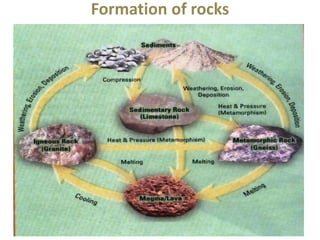
Formation of rocks
1. Cooling and consolidation of molten magma
within or on the surface of earth = Igneous or
Primary rocks.
2. Transportation and cementation of primary
rocks = Sedimentary or Secondary rocks.
3. Alteration of the existing primary and
secondary rocks = Metamorphic rocks.
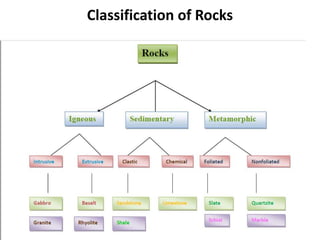
Classification of Rocks
1. Igneous rocks (primary or massive rocks)
• These are first formed in the earth
crust due to the solidification of
molten magma.
• Based on the mode of formation,
they are further classified as
extrusive and intrusive rocks
• Extrusive rocks or volcanic rocks
• These rocks are formed due to the consolidation of
magma on the surface of the earth. The magma, when
it flows on the Earth surface is called LAVA. E.g. Basalt.
• Intrusive rocks or plutonic rocks
• These rocks are produced due to solidification of
magma below the surface of the earth.
• Plutonic – intrusive rocks solidifies at greater depth and
Hypabassal rocks solidifies at shallow depth from the
surface. E.g. Granite, syenite, diorite, Gabbro etc.
• Rocks formed in vertical cracks are called dykes and in
horizontal cracks are called sills.
• Vesicular rocks: Molten magma cools on the surface.
Steam of water is entrapped into rocks and forms
vesicles.
2. Sedimentary rocks
• These rocks are formed from the
consolidation of sediments accumulated
through wind or water action at the surface
of the earth. Many are deposited in layer or
formed through chemical reactions as
precipitates from aqueous solutions.
• Sediments may contain various size
particles cemented together by substances
like SiO2, Fe2O3 or lime. These rocks are also
called as clastic rocks.
Based on the origin, the sedimentary
rocks are classified as
• 1. Residual : Laterite
• 2. Transported
a. Deposited as solids in suspension :
Sandstone, shale
b. Deposited by chemical precipitation :
Limestone, ironstone
c. Deposited through agency of organic
matter: Peat, Phosphatic deposits
Based on the grain size, sedimentary
rocks are classified as
• 1. Rocks with boulder pebbles sized
minerals (Rudaceous) :Conglomerate
• 2. Rocks with sand size particles
(Arenaceous) : Sandstone
• 3. Rocks with silt size particles (silt rocks) :
Siltstone
• 4. Rocks with clay size particles
(Argillaceous) : Shale
3. Metamorphic rocks
• These are formed from igneous and
sedimentary rocks under the influence of heat,
pressure, chemically active liquids and gases.
Change may occur in mineral composition or
texture or both. The changes due to water is
called hydro metamorphosis and due to pressure
is called dynamo metamorphosis
• Sand stone : Quartizite
• Shale : Slate/mica, schist
• Lime stone : Marble
• Granite : granite gneiss
• Dolerite : Hornblende gneiss
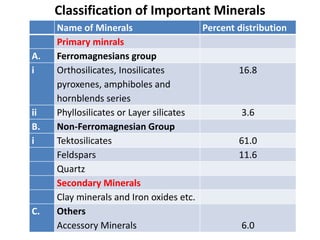
Classification of Important Minerals
Name of Minerals Percent distribution
Primary minrals
A. Ferromagnesians group
i Orthosilicates, Inosilicates
pyroxenes, amphiboles and
hornblends series
16.8
ii Phyllosilicates or Layer silicates 3.6
B. Non-Ferromagnesian Group
i Tektosilicates 61.0
Feldspars 11.6
Quartz
Secondary Minerals
Clay minerals and Iron oxides etc.
C. Others
Accessory Minerals 6.0
Ferro magnesium minerals
• Pyroxenes and amphiboles: The pyroxenes and amphiboles are two
groups of ferromagnesian minerals (heavy group) the structure of
which consists of long chains of linked silica tetrahedral. The
pyroxenes consist of a single chain (2 oxygen shared in each
tetrahedron) whereas amphiboles consist of a double chains
(alternately 2 and 3 oxygen atoms shared successive tetrahedral).
These chain silicates are sometimes referred to inosilicates.
• The pyroxene group of minerals comprised of different minerals
namely enstatite, hypersthene, diopside and augite, of which augite is
the most important minerals in soils and it is found in basic rocks.
• The amphibole group of minerals are common in acidic rocks and it
can be represented by the isomorphous series between tremolite
actinolite olivine and hornblende. Hornblende weathers fairly rapidly.
Olivine (olive-green) minerals from an isomorphous series between
foresterite (Mg2 SiO4) and fayalite (Fe2SiO4).
• Pyroxenes are more basic in character and therefore it weathers more rapidly than
amphiboles.
• Micas: Micas occur extensively in soils. They are primarily
originated from the parent rock from which the soil is
derived. Generally soils are inherited from well-ordered and
imperfectly ordered micas. Well-ordered micas are derived
from sedimentary rocks.
• The most common well ordered micas are muscovite,
paragonite, biotite and phlogopite (trioctahedral). The
imperfectly ordered micas contain less potassium and more
water a compared to well-ordered micas and this type of
micas are most abundant in the clay fraction of soils.
• Among the ordered micas, biotite weathers more rapidly
than muscovite.
• In imperfectly ordered micas, many of the illite-type
specimens as well as the disordered.
• Micas of soils exhibits some mixed-layering with phases of
vermiculite, smectite group of minerals, chlorite and
intergrades of several of these species.
Non-ferromagnesium minerals
• Feldspars: Feldspars are anhydrous aluminosilicates of K,
Na and Ca and occasionally of other large cations such as
Ba.
• The feldspar structure consists of tetrahedral which are
attracted by sharing each oxygen atom between
neighbouring tetrahedran. The tetrahedral contain mainly
Silicons with sufficient Al substitution. It belongs to the
group of minerals that are light in weight. There are two
groups of feldspars:
(i) potassium feldspars (KA1Si3O8) include orthoclase,
microcline, adularia and sanidine. Orthoclase and microcline are
more common in the plutonic and metamorphic rocks. The
potassium feldspars occur commonly in the silts and sands of
soils and also abundant in clay-size.
(ii) plagioclase feldspars- a series consisting of a solid solution
of albite (NaA1Si3O8) high in sodium and anorthite (CaA12Si2O8)
high in calcium. Plagioclase weathers more rapidly than
orthoclase.
• Quartz: It is very densely packed and occurs in
a high degree of purity. It is strongly resistant
to weathering as the structure is densely
packed, electrically neutral and free from any
substitution.
• It is the most abundant mineral next to
feldspars.
• Serpentine, a hydrous magnesium silicate
occurs more commonly as a secondary product.
• Garnets are characteristic of metamorphic rocks
and are very hard and most resistant to
weathering.
Silicate minerals
• Ortho/ Neosilicates
• The minerals in this group are composed of single
tetrahedral linked together by Mg or Fe.
• To effect a break down, it is considered sufficient to
sever the weaker Mg-O or Fe-O bonds.
• Non-withstanding the bond energy considerations
susceptibility of the minerals in this group to
breakdown by weathering appears to vary considerably
from one mineral to another.
• e.g., zircon makes the mineral comparatively hard. On
the other hand, the looser packing of oxygens in olivine
makes the mineral weather faster.
• Inosilicates
• The inosilicate group has in its structure single-
chain (pyroxenes) and double chain(amphiboles)
silica tetrahedral linked together by Ca, Mg, or
Fe. Because of the presence of many weak spots
provided by the Ca-O, Mg-O, or Fe-O bonds,
these minerals tend to weather rapidly.
• Phyllosilicates
• Linkages of silica tetrahedral and Alumina
octahedral sheets by mutually shared oxygen
atoms from the basis for the structure of this
group. Some of the minerals, e.g., biotite and
muscovite, are relatively susceptible to
weathering, whereas others, like clay minerals,
are resistant weathering products and further
breakdown of clays is difficult.
• Tectosilicates
• The minerals are considered solid solution minerals
with a framework of silica tetrahedral, in which the
cavities are occupied by Na, Ca, and so on.
• The minerals in this group may also vary
considerably in their resistance to weathering, e.g.,
leucite and plagioclase versus potash fertilizers.
• The relative degree of close packing of atoms in
their structural frame work may be the reason for
such variability in weathering.
• Increased substitution of Al and Si in tetrahedral of
plagioclase mineral is also considered a factor that
makes these minerals weaker than potash feldspars.
Non-silicate minerals
• Oxides:
• Hematite (Fe2O3)
• Limonite (Fe2O3, 3H2O)
• Goethite (FeO (OH) H2O)
• Gibbsite (Al2O3H2O)
• The red, yellow or brown colours in
soils are due to the presence of
goethite and hematite, which occur
as coatings on the surface of soil
particles.
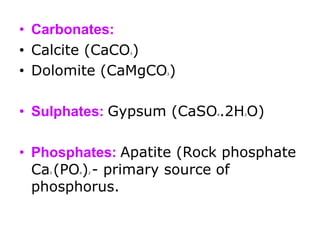
• Carbonates:
• Calcite (CaCO3)
• Dolomite (CaMgCO3)
• Sulphates: Gypsum (CaSO4.2H2O)
• Phosphates: Apatite (Rock phosphate
Ca3 (PO4)2 - primary source of
phosphorus.
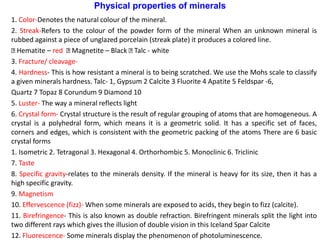
Physical properties of minerals
1. Color-Denotes the natural colour of the mineral.
2. Streak-Refers to the colour of the powder form of the mineral When an unknown mineral is
rubbed against a piece of unglazed porcelain (streak plate) it produces a colored line.
Hematite – red Magnetite – Black Talc - white
3. Fracture/ cleavage-
4. Hardness- This is how resistant a mineral is to being scratched. We use the Mohs scale to classify
a given minerals hardness. Talc- 1, Gypsum 2 Calcite 3 Fluorite 4 Apatite 5 Feldspar -6,
Quartz 7 Topaz 8 Corundum 9 Diamond 10
5. Luster- The way a mineral reflects light
6. Crystal form- Crystal structure is the result of regular grouping of atoms that are homogeneous. A
crystal is a polyhedral form, which means it is a geometric solid. It has a specific set of faces,
corners and edges, which is consistent with the geometric packing of the atoms There are 6 basic
crystal forms
1. Isometric 2. Tetragonal 3. Hexagonal 4. Orthorhombic 5. Monoclinic 6. Triclinic
7. Taste
8. Specific gravity-relates to the minerals density. If the mineral is heavy for its size, then it has a
high specific gravity.
9. Magnetism
10. Effervescence (fizz)- When some minerals are exposed to acids, they begin to fizz (calcite).
11. Birefringence- This is also known as double refraction. Birefringent minerals split the light into
two different rays which gives the illusion of double vision in this Iceland Spar Calcite
12. Fluorescence- Some minerals display the phenomenon of photoluminescence.
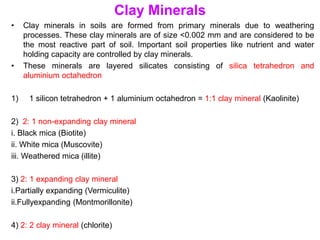
Clay Minerals
• Clay minerals in soils are formed from primary minerals due to weathering
processes. These clay minerals are of size <0.002 mm and are considered to be
the most reactive part of soil. Important soil properties like nutrient and water
holding capacity are controlled by clay minerals.
• These minerals are layered silicates consisting of silica tetrahedron and
aluminium octahedron
1) 1 silicon tetrahedron + 1 aluminium octahedron = 1:1 clay mineral (Kaolinite)
2) 2: 1 non-expanding clay mineral
i. Black mica (Biotite)
ii. White mica (Muscovite)
iii. Weathered mica (illite)
3) 2: 1 expanding clay mineral
i.Partially expanding (Vermiculite)
ii.Fullyexpanding (Montmorillonite)
4) 2: 2 clay mineral (chlorite)

Soil Forming Rocks and Minerals Classification

  • 1.
    Lecture 2 :Soil genesis: Soil forming rocks and minerals classification
  • 2.
    What is Rocks? Rocksare the materials that form the essential part of the Earth’s solid crust. “Rocks are hard mass of mineral matter comprising one or more rock forming minerals”. Rocks are formed from the molten material known as magma. The study of rocks is called Petrology (in Greek, petra means rock, logos means science). Petrology deals with the description of rocks. Petrogenesis is the study of the origin of rocks.
  • 3.
  • 4.
    1. Cooling andconsolidation of molten magma within or on the surface of earth = Igneous or Primary rocks. 2. Transportation and cementation of primary rocks = Sedimentary or Secondary rocks. 3. Alteration of the existing primary and secondary rocks = Metamorphic rocks.
  • 5.
  • 6.
    1. Igneous rocks(primary or massive rocks) • These are first formed in the earth crust due to the solidification of molten magma. • Based on the mode of formation, they are further classified as extrusive and intrusive rocks
  • 7.
    • Extrusive rocksor volcanic rocks • These rocks are formed due to the consolidation of magma on the surface of the earth. The magma, when it flows on the Earth surface is called LAVA. E.g. Basalt. • Intrusive rocks or plutonic rocks • These rocks are produced due to solidification of magma below the surface of the earth. • Plutonic – intrusive rocks solidifies at greater depth and Hypabassal rocks solidifies at shallow depth from the surface. E.g. Granite, syenite, diorite, Gabbro etc. • Rocks formed in vertical cracks are called dykes and in horizontal cracks are called sills. • Vesicular rocks: Molten magma cools on the surface. Steam of water is entrapped into rocks and forms vesicles.
  • 8.
    2. Sedimentary rocks •These rocks are formed from the consolidation of sediments accumulated through wind or water action at the surface of the earth. Many are deposited in layer or formed through chemical reactions as precipitates from aqueous solutions. • Sediments may contain various size particles cemented together by substances like SiO2, Fe2O3 or lime. These rocks are also called as clastic rocks.
  • 9.
    Based on theorigin, the sedimentary rocks are classified as • 1. Residual : Laterite • 2. Transported a. Deposited as solids in suspension : Sandstone, shale b. Deposited by chemical precipitation : Limestone, ironstone c. Deposited through agency of organic matter: Peat, Phosphatic deposits
  • 10.
    Based on thegrain size, sedimentary rocks are classified as • 1. Rocks with boulder pebbles sized minerals (Rudaceous) :Conglomerate • 2. Rocks with sand size particles (Arenaceous) : Sandstone • 3. Rocks with silt size particles (silt rocks) : Siltstone • 4. Rocks with clay size particles (Argillaceous) : Shale
  • 11.
    3. Metamorphic rocks •These are formed from igneous and sedimentary rocks under the influence of heat, pressure, chemically active liquids and gases. Change may occur in mineral composition or texture or both. The changes due to water is called hydro metamorphosis and due to pressure is called dynamo metamorphosis • Sand stone : Quartizite • Shale : Slate/mica, schist • Lime stone : Marble • Granite : granite gneiss • Dolerite : Hornblende gneiss
  • 12.
    Classification of ImportantMinerals Name of Minerals Percent distribution Primary minrals A. Ferromagnesians group i Orthosilicates, Inosilicates pyroxenes, amphiboles and hornblends series 16.8 ii Phyllosilicates or Layer silicates 3.6 B. Non-Ferromagnesian Group i Tektosilicates 61.0 Feldspars 11.6 Quartz Secondary Minerals Clay minerals and Iron oxides etc. C. Others Accessory Minerals 6.0
  • 13.
    Ferro magnesium minerals •Pyroxenes and amphiboles: The pyroxenes and amphiboles are two groups of ferromagnesian minerals (heavy group) the structure of which consists of long chains of linked silica tetrahedral. The pyroxenes consist of a single chain (2 oxygen shared in each tetrahedron) whereas amphiboles consist of a double chains (alternately 2 and 3 oxygen atoms shared successive tetrahedral). These chain silicates are sometimes referred to inosilicates. • The pyroxene group of minerals comprised of different minerals namely enstatite, hypersthene, diopside and augite, of which augite is the most important minerals in soils and it is found in basic rocks. • The amphibole group of minerals are common in acidic rocks and it can be represented by the isomorphous series between tremolite actinolite olivine and hornblende. Hornblende weathers fairly rapidly. Olivine (olive-green) minerals from an isomorphous series between foresterite (Mg2 SiO4) and fayalite (Fe2SiO4). • Pyroxenes are more basic in character and therefore it weathers more rapidly than amphiboles.
  • 14.
    • Micas: Micasoccur extensively in soils. They are primarily originated from the parent rock from which the soil is derived. Generally soils are inherited from well-ordered and imperfectly ordered micas. Well-ordered micas are derived from sedimentary rocks. • The most common well ordered micas are muscovite, paragonite, biotite and phlogopite (trioctahedral). The imperfectly ordered micas contain less potassium and more water a compared to well-ordered micas and this type of micas are most abundant in the clay fraction of soils. • Among the ordered micas, biotite weathers more rapidly than muscovite. • In imperfectly ordered micas, many of the illite-type specimens as well as the disordered. • Micas of soils exhibits some mixed-layering with phases of vermiculite, smectite group of minerals, chlorite and intergrades of several of these species.
  • 15.
    Non-ferromagnesium minerals • Feldspars:Feldspars are anhydrous aluminosilicates of K, Na and Ca and occasionally of other large cations such as Ba. • The feldspar structure consists of tetrahedral which are attracted by sharing each oxygen atom between neighbouring tetrahedran. The tetrahedral contain mainly Silicons with sufficient Al substitution. It belongs to the group of minerals that are light in weight. There are two groups of feldspars: (i) potassium feldspars (KA1Si3O8) include orthoclase, microcline, adularia and sanidine. Orthoclase and microcline are more common in the plutonic and metamorphic rocks. The potassium feldspars occur commonly in the silts and sands of soils and also abundant in clay-size. (ii) plagioclase feldspars- a series consisting of a solid solution of albite (NaA1Si3O8) high in sodium and anorthite (CaA12Si2O8) high in calcium. Plagioclase weathers more rapidly than orthoclase.
  • 16.
    • Quartz: Itis very densely packed and occurs in a high degree of purity. It is strongly resistant to weathering as the structure is densely packed, electrically neutral and free from any substitution. • It is the most abundant mineral next to feldspars. • Serpentine, a hydrous magnesium silicate occurs more commonly as a secondary product. • Garnets are characteristic of metamorphic rocks and are very hard and most resistant to weathering.
  • 17.
    Silicate minerals • Ortho/Neosilicates • The minerals in this group are composed of single tetrahedral linked together by Mg or Fe. • To effect a break down, it is considered sufficient to sever the weaker Mg-O or Fe-O bonds. • Non-withstanding the bond energy considerations susceptibility of the minerals in this group to breakdown by weathering appears to vary considerably from one mineral to another. • e.g., zircon makes the mineral comparatively hard. On the other hand, the looser packing of oxygens in olivine makes the mineral weather faster.
  • 18.
    • Inosilicates • Theinosilicate group has in its structure single- chain (pyroxenes) and double chain(amphiboles) silica tetrahedral linked together by Ca, Mg, or Fe. Because of the presence of many weak spots provided by the Ca-O, Mg-O, or Fe-O bonds, these minerals tend to weather rapidly. • Phyllosilicates • Linkages of silica tetrahedral and Alumina octahedral sheets by mutually shared oxygen atoms from the basis for the structure of this group. Some of the minerals, e.g., biotite and muscovite, are relatively susceptible to weathering, whereas others, like clay minerals, are resistant weathering products and further breakdown of clays is difficult.
  • 19.
    • Tectosilicates • Theminerals are considered solid solution minerals with a framework of silica tetrahedral, in which the cavities are occupied by Na, Ca, and so on. • The minerals in this group may also vary considerably in their resistance to weathering, e.g., leucite and plagioclase versus potash fertilizers. • The relative degree of close packing of atoms in their structural frame work may be the reason for such variability in weathering. • Increased substitution of Al and Si in tetrahedral of plagioclase mineral is also considered a factor that makes these minerals weaker than potash feldspars.
  • 20.
    Non-silicate minerals • Oxides: •Hematite (Fe2O3) • Limonite (Fe2O3, 3H2O) • Goethite (FeO (OH) H2O) • Gibbsite (Al2O3H2O) • The red, yellow or brown colours in soils are due to the presence of goethite and hematite, which occur as coatings on the surface of soil particles.
  • 21.
    • Carbonates: • Calcite(CaCO3) • Dolomite (CaMgCO3) • Sulphates: Gypsum (CaSO4.2H2O) • Phosphates: Apatite (Rock phosphate Ca3 (PO4)2 - primary source of phosphorus.
  • 22.
    Physical properties ofminerals 1. Color-Denotes the natural colour of the mineral. 2. Streak-Refers to the colour of the powder form of the mineral When an unknown mineral is rubbed against a piece of unglazed porcelain (streak plate) it produces a colored line. Hematite – red Magnetite – Black Talc - white 3. Fracture/ cleavage- 4. Hardness- This is how resistant a mineral is to being scratched. We use the Mohs scale to classify a given minerals hardness. Talc- 1, Gypsum 2 Calcite 3 Fluorite 4 Apatite 5 Feldspar -6, Quartz 7 Topaz 8 Corundum 9 Diamond 10 5. Luster- The way a mineral reflects light 6. Crystal form- Crystal structure is the result of regular grouping of atoms that are homogeneous. A crystal is a polyhedral form, which means it is a geometric solid. It has a specific set of faces, corners and edges, which is consistent with the geometric packing of the atoms There are 6 basic crystal forms 1. Isometric 2. Tetragonal 3. Hexagonal 4. Orthorhombic 5. Monoclinic 6. Triclinic 7. Taste 8. Specific gravity-relates to the minerals density. If the mineral is heavy for its size, then it has a high specific gravity. 9. Magnetism 10. Effervescence (fizz)- When some minerals are exposed to acids, they begin to fizz (calcite). 11. Birefringence- This is also known as double refraction. Birefringent minerals split the light into two different rays which gives the illusion of double vision in this Iceland Spar Calcite 12. Fluorescence- Some minerals display the phenomenon of photoluminescence.
  • 23.
    Clay Minerals • Clayminerals in soils are formed from primary minerals due to weathering processes. These clay minerals are of size <0.002 mm and are considered to be the most reactive part of soil. Important soil properties like nutrient and water holding capacity are controlled by clay minerals. • These minerals are layered silicates consisting of silica tetrahedron and aluminium octahedron 1) 1 silicon tetrahedron + 1 aluminium octahedron = 1:1 clay mineral (Kaolinite) 2) 2: 1 non-expanding clay mineral i. Black mica (Biotite) ii. White mica (Muscovite) iii. Weathered mica (illite) 3) 2: 1 expanding clay mineral i.Partially expanding (Vermiculite) ii.Fullyexpanding (Montmorillonite) 4) 2: 2 clay mineral (chlorite)