Soil texture :
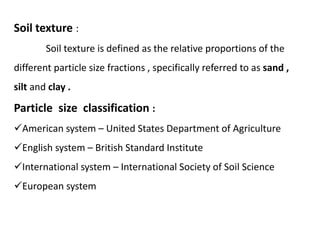
Soil texture is defined as the relative proportions of the
different particle size fractions , specifically referred to as sand ,
silt and clay .
Particle size classification :
American system – United States Department of Agriculture
English system – British Standard Institute
International system – International Society of Soil Science
European system
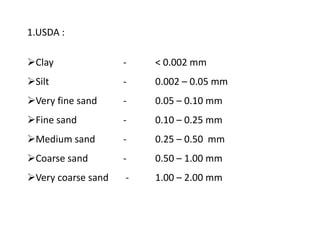
1.USDA :
Clay - < 0.002 mm
Silt - 0.002 – 0.05 mm
Very fine sand - 0.05 – 0.10 mm
Fine sand - 0.10 – 0.25 mm
Medium sand - 0.25 – 0.50 mm
Coarse sand - 0.50 – 1.00 mm
Very coarse sand - 1.00 – 2.00 mm
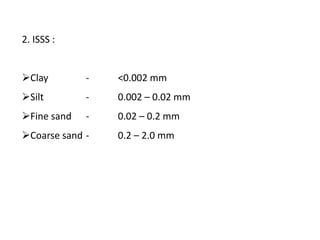
2. ISSS :
Clay - <0.002 mm
Silt - 0.002 – 0.02 mm
Fine sand - 0.02 – 0.2 mm
Coarse sand - 0.2 – 2.0 mm
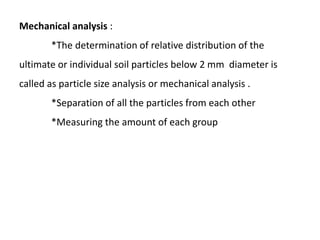
Mechanical analysis :
*The determination of relative distribution of the
ultimate or individual soil particles below 2 mm diameter is
called as particle size analysis or mechanical analysis .
*Separation of all the particles from each other
*Measuring the amount of each group
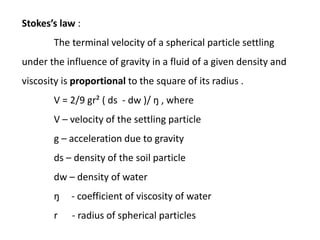
Stokes’s law :
The terminal velocity of a spherical particle settling
under the influence of gravity in a fluid of a given density and
viscosity is proportional to the square of its radius .
V = 2/9 gr² ( ds - dw )/ ŋ , where
V – velocity of the settling particle
g – acceleration due to gravity
ds – density of the soil particle
dw – density of water
ŋ - coefficient of viscosity of water
r - radius of spherical particles
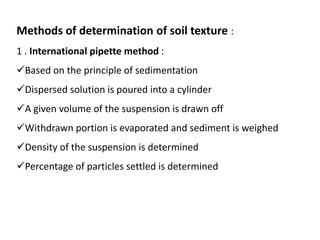
Methods of determination of soil texture :
1 . International pipette method :
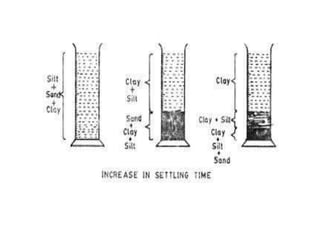
Based on the principle of sedimentation
Dispersed solution is poured into a cylinder
A given volume of the suspension is drawn off
Withdrawn portion is evaporated and sediment is weighed
Density of the suspension is determined
Percentage of particles settled is determined
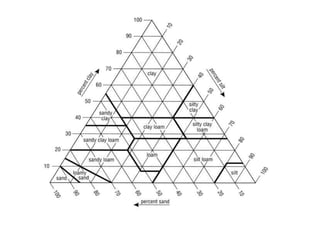
•Look at the orientation of the percentages on the sides of the
triangle
•The numbers are arranged symmetrically around the perimeter
•On the left the numbers correspond to the percentage of clay
•on the right the numbers correspond to the percentage of silt
•At the bottom of the triangle chart are the percentages of sand.
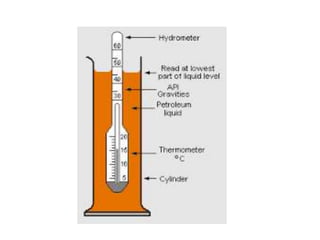
2.Hydrometer method :
Developed by Bouyoucos
Dispersed suspension is poured into a tall cylinder with a
hydrometer
Hydrometer reading is noted at 40 seconds for sand (
quantity of silt + clay can be determined )
Reading noted after 1 hour for silt and after 2 hours for clay
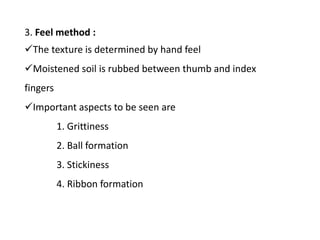
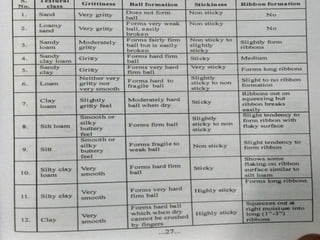
3. Feel method :
The texture is determined by hand feel
Moistened soil is rubbed between thumb and index
fingers
Important aspects to be seen are
1. Grittiness
2. Ball formation
3. Stickiness
4. Ribbon formation
4. Elutriation :
• Elutriation is a process for separating particles based on
their size, shape and density, using a stream of gas or liquid
flowing in a direction usually opposite to the direction of
sedimentation.
• This method is mainly used for particles smaller than
1 μm.
5.Decantation :
• Decantation is a process for the separation of mixtures,
by removing a layer of liquid, generally one from which a
precipitate has settled .
Influence of soil separates on soil properties :
Sandy soil :
•62.5µm and 2mm
•Coarse textured
•Low water retentive
•Well aerated
•Easy to cultivate
•Light soils
•Carrot , Beetroot , Garlic
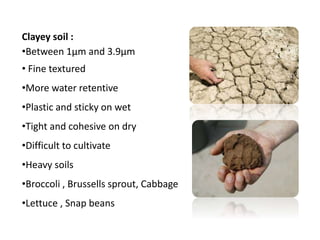
Clayey soil :
•Between 1µm and 3.9µm
• Fine textured
•More water retentive
•Plastic and sticky on wet
•Tight and cohesive on dry
•Difficult to cultivate
•Heavy soils
•Broccoli , Brussells sprout, Cabbage
•Lettuce , Snap beans
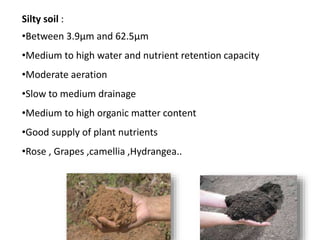
Silty soil :
•Between 3.9µm and 62.5µm
•Medium to high water and nutrient retention capacity
•Moderate aeration
•Slow to medium drainage
•Medium to high organic matter content
•Good supply of plant nutrients
•Rose , Grapes ,camellia ,Hydrangea..
Effect of soil texture on crop growth :
•Good effect on management and productivity of soil
•Tillage operations
•Root penetration
•Allows rapid evaporation and percolation
•Drainage and aeration
•Nutrient retention capacity
•Water holding capacity
•Cation exchange capacity
REFERENCES :
•Narayanasamy , G. , Fundamentals of Soil Science , Indian
Society of Soil Science , 2002 ,New Delhi.
•Miller , C.E. and Turk , L.M. ,Fundamentals of Soil Science ,
Biotech books, 2006 , Delhi .
•Nyle C Brady and Ray R Weil , The Nature and Properties of
Soils , 14 th edition , Dorling Kindersley (India) Pvt Ltd. , Delhi.
•http://www.cfr.washington.edu/classes.esrm.410/texture.htm
•http://www.agvise.com/educational-articles/soil-texture-
makes-a-difference/

Determination of Soil Texture.

  • 2.
    Soil texture : Soiltexture is defined as the relative proportions of the different particle size fractions , specifically referred to as sand , silt and clay . Particle size classification : American system – United States Department of Agriculture English system – British Standard Institute International system – International Society of Soil Science European system
  • 3.
    1.USDA : Clay -< 0.002 mm Silt - 0.002 – 0.05 mm Very fine sand - 0.05 – 0.10 mm Fine sand - 0.10 – 0.25 mm Medium sand - 0.25 – 0.50 mm Coarse sand - 0.50 – 1.00 mm Very coarse sand - 1.00 – 2.00 mm
  • 4.
    2. ISSS : Clay- <0.002 mm Silt - 0.002 – 0.02 mm Fine sand - 0.02 – 0.2 mm Coarse sand - 0.2 – 2.0 mm
  • 5.
    Mechanical analysis : *Thedetermination of relative distribution of the ultimate or individual soil particles below 2 mm diameter is called as particle size analysis or mechanical analysis . *Separation of all the particles from each other *Measuring the amount of each group
  • 6.
    Stokes’s law : Theterminal velocity of a spherical particle settling under the influence of gravity in a fluid of a given density and viscosity is proportional to the square of its radius . V = 2/9 gr² ( ds - dw )/ ŋ , where V – velocity of the settling particle g – acceleration due to gravity ds – density of the soil particle dw – density of water ŋ - coefficient of viscosity of water r - radius of spherical particles
  • 7.
    Methods of determinationof soil texture : 1 . International pipette method : Based on the principle of sedimentation Dispersed solution is poured into a cylinder A given volume of the suspension is drawn off Withdrawn portion is evaporated and sediment is weighed Density of the suspension is determined Percentage of particles settled is determined
  • 10.
    •Look at theorientation of the percentages on the sides of the triangle •The numbers are arranged symmetrically around the perimeter •On the left the numbers correspond to the percentage of clay •on the right the numbers correspond to the percentage of silt •At the bottom of the triangle chart are the percentages of sand.
  • 11.
    2.Hydrometer method : Developedby Bouyoucos Dispersed suspension is poured into a tall cylinder with a hydrometer Hydrometer reading is noted at 40 seconds for sand ( quantity of silt + clay can be determined ) Reading noted after 1 hour for silt and after 2 hours for clay
  • 13.
    3. Feel method: The texture is determined by hand feel Moistened soil is rubbed between thumb and index fingers Important aspects to be seen are 1. Grittiness 2. Ball formation 3. Stickiness 4. Ribbon formation
  • 15.
    4. Elutriation : •Elutriation is a process for separating particles based on their size, shape and density, using a stream of gas or liquid flowing in a direction usually opposite to the direction of sedimentation. • This method is mainly used for particles smaller than 1 μm.
  • 16.
    5.Decantation : • Decantationis a process for the separation of mixtures, by removing a layer of liquid, generally one from which a precipitate has settled .
  • 17.
    Influence of soilseparates on soil properties : Sandy soil : •62.5µm and 2mm •Coarse textured •Low water retentive •Well aerated •Easy to cultivate •Light soils •Carrot , Beetroot , Garlic
  • 18.
    Clayey soil : •Between1µm and 3.9µm • Fine textured •More water retentive •Plastic and sticky on wet •Tight and cohesive on dry •Difficult to cultivate •Heavy soils •Broccoli , Brussells sprout, Cabbage •Lettuce , Snap beans
  • 19.
    Silty soil : •Between3.9µm and 62.5µm •Medium to high water and nutrient retention capacity •Moderate aeration •Slow to medium drainage •Medium to high organic matter content •Good supply of plant nutrients •Rose , Grapes ,camellia ,Hydrangea..
  • 20.
    Effect of soiltexture on crop growth : •Good effect on management and productivity of soil •Tillage operations •Root penetration •Allows rapid evaporation and percolation •Drainage and aeration •Nutrient retention capacity •Water holding capacity •Cation exchange capacity
  • 21.
    REFERENCES : •Narayanasamy ,G. , Fundamentals of Soil Science , Indian Society of Soil Science , 2002 ,New Delhi. •Miller , C.E. and Turk , L.M. ,Fundamentals of Soil Science , Biotech books, 2006 , Delhi . •Nyle C Brady and Ray R Weil , The Nature and Properties of Soils , 14 th edition , Dorling Kindersley (India) Pvt Ltd. , Delhi. •http://www.cfr.washington.edu/classes.esrm.410/texture.htm •http://www.agvise.com/educational-articles/soil-texture- makes-a-difference/