Item 13: Soil pH
Basic theoretical principles
• Soil pH is considered the single most important
chemical property of soil because it affects plant
growth and nutrient availability in many different
and complex ways.
• Soil pH is a measure of the soil solution’s (soil
water) acidity and alkalinity.
• pH is the negative logarithm of the hydrogen ion
concentration [H+]
pH = -log [H+]
Testing for Soil pH
• soil to water ratios of 1:1 (most common in
most of the U.S.) or 1:2, 1:2.5, 1:5, 1:10
• saturated soil paste.
• Dilute salt solution (KCl, CaCl2)
• it is important to be aware of the soil pH test
being used and to be consistent between
methods to ensure comparable data over time
• ISO 10390:2005, has unified the pH analysis at
a soil:solution ratio of 1:5
• ASTM D4972-13, provide the standard
method for the soil:solution ratio of 1:1
• Kalra, Y.P., & Maynard, D.G. (1991) suggest to
measure at soil:solution ratio of 1:4
• Diagnosis and Improvement of Saline and
Alkali Soils ( 1954) suggest saturated paste
method for saline-sodic soils
Testing for Soil pH
• several European and worldwide initiatives
including the GlobalSoilMap and the
international soil classification have unified
the pH measurement (soil:water at the ratio
of 1:5)
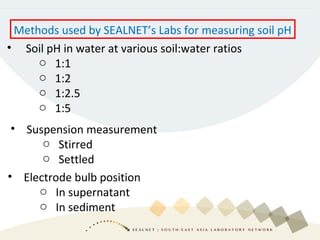
• Soil pH in water at various soil:water ratios
o 1:1
o 1:2
o 1:2.5
o 1:5
Methods used by SEALNET’s Labs for measuring soil pH
• Suspension measurement
o Stirred
o Settled
• Electrode bulb position
o In supernatant
o In sediment
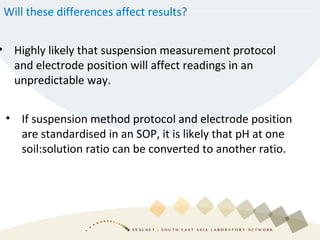
Will these differences affect results?
• Highly likely that suspension measurement protocol
and electrode position will affect readings in an
unpredictable way.
• If suspension method protocol and electrode position
are standardised in an SOP, it is likely that pH at one
soil:solution ratio can be converted to another ratio.
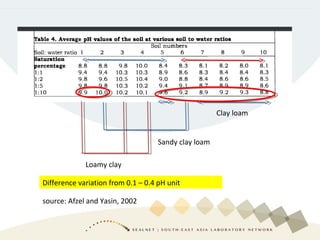
Clay loam
Sandy clay loam
Loamy clay
source: Afzel and Yasin, 2002
Difference variation from 0.1 – 0.4 pH unit
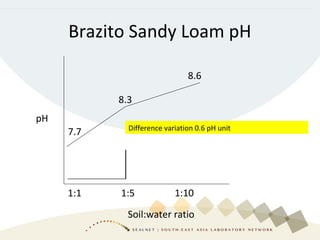
pH
Soil:water ratio
1:1 1:5 1:10
7.7
8.3
8.6
Brazito Sandy Loam pH
CaCl2 7.4
KCl 7.1
Difference variation 0.6 pH unit
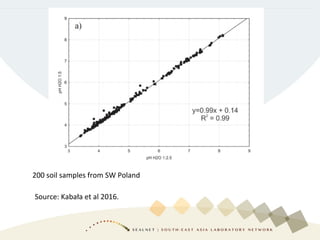
200 soil samples from SW Poland
Source: Kabała et al 2016.
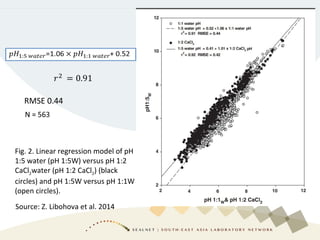
Fig. 2. Linear regression model of pH
1:5 water (pH 1:5W) versus pH 1:2
CaCl2water (pH 1:2 CaCl2) (black
circles) and pH 1:5W versus pH 1:1W
(open circles).
Source: Z. Libohova et al. 2014
RMSE 0.44
What critical factors will the SOP for soil pH need to address?
• Soil and water ratio
• Suspension measurement- stirred versus settled
• Electrode bulb position
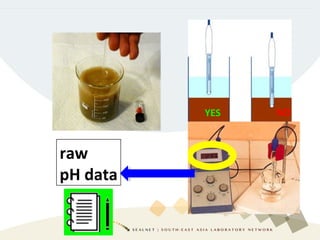
raw
pH data
YES NO
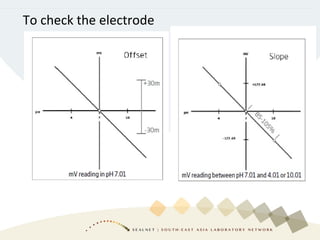
To check the electrode
Quality of water use
• distilled water (DI) for rising electrodes;
however, deionized , RO, pure are also
recommend
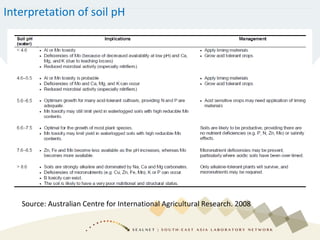
Interpretation of soil pH
Source: Australian Centre for International Agricultural Research. 2008
Thank you for your attention…

Soil pH

  • 1.
  • 2.
    Basic theoretical principles •Soil pH is considered the single most important chemical property of soil because it affects plant growth and nutrient availability in many different and complex ways. • Soil pH is a measure of the soil solution’s (soil water) acidity and alkalinity. • pH is the negative logarithm of the hydrogen ion concentration [H+] pH = -log [H+]
  • 3.
    Testing for SoilpH • soil to water ratios of 1:1 (most common in most of the U.S.) or 1:2, 1:2.5, 1:5, 1:10 • saturated soil paste. • Dilute salt solution (KCl, CaCl2) • it is important to be aware of the soil pH test being used and to be consistent between methods to ensure comparable data over time
  • 4.
    • ISO 10390:2005,has unified the pH analysis at a soil:solution ratio of 1:5 • ASTM D4972-13, provide the standard method for the soil:solution ratio of 1:1 • Kalra, Y.P., & Maynard, D.G. (1991) suggest to measure at soil:solution ratio of 1:4 • Diagnosis and Improvement of Saline and Alkali Soils ( 1954) suggest saturated paste method for saline-sodic soils Testing for Soil pH
  • 5.
    • several Europeanand worldwide initiatives including the GlobalSoilMap and the international soil classification have unified the pH measurement (soil:water at the ratio of 1:5)
  • 6.
    • Soil pHin water at various soil:water ratios o 1:1 o 1:2 o 1:2.5 o 1:5 Methods used by SEALNET’s Labs for measuring soil pH • Suspension measurement o Stirred o Settled • Electrode bulb position o In supernatant o In sediment
  • 7.
    Will these differencesaffect results? • Highly likely that suspension measurement protocol and electrode position will affect readings in an unpredictable way. • If suspension method protocol and electrode position are standardised in an SOP, it is likely that pH at one soil:solution ratio can be converted to another ratio.
  • 8.
    Clay loam Sandy clayloam Loamy clay source: Afzel and Yasin, 2002 Difference variation from 0.1 – 0.4 pH unit
  • 9.
    pH Soil:water ratio 1:1 1:51:10 7.7 8.3 8.6 Brazito Sandy Loam pH CaCl2 7.4 KCl 7.1 Difference variation 0.6 pH unit
  • 10.
    200 soil samplesfrom SW Poland Source: Kabała et al 2016.
  • 11.
    Fig. 2. Linearregression model of pH 1:5 water (pH 1:5W) versus pH 1:2 CaCl2water (pH 1:2 CaCl2) (black circles) and pH 1:5W versus pH 1:1W (open circles). Source: Z. Libohova et al. 2014 RMSE 0.44
  • 12.
    What critical factorswill the SOP for soil pH need to address? • Soil and water ratio • Suspension measurement- stirred versus settled • Electrode bulb position
  • 13.
  • 14.
    To check theelectrode
  • 15.
    Quality of wateruse • distilled water (DI) for rising electrodes; however, deionized , RO, pure are also recommend
  • 16.
    Interpretation of soilpH Source: Australian Centre for International Agricultural Research. 2008
  • 17.
    Thank you foryour attention…