NUST Institute of Civil Engineering/Engr Sajjad Ahmad1
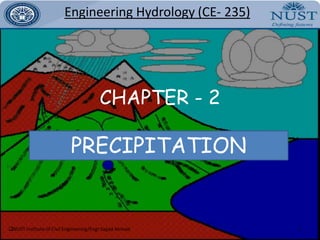
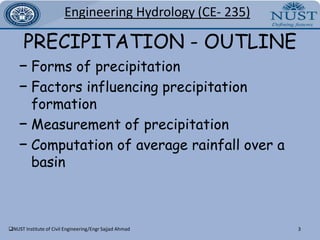
Engineering Hydrology(CE- 235)CHAPTER - 22PRECIPITATIONNUST Institute of Civil Engineering/Engr Sajjad AhmadPRECIPITATION - OUTLINEForms of precipitation
Factors influencing precipitation formation
Measurement of precipitation
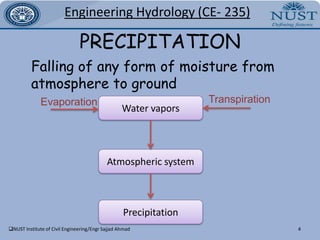
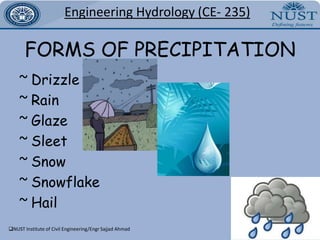
Computation of average rainfall over a basin3Engineering Hydrology(CE- 235)NUST Institute of Civil Engineering/Engr Sajjad Ahmad	Falling of any form of moisture from atmosphere to ground4Engineering Hydrology(CE- 235)PRECIPITATIONTranspirationEvaporationWater vaporsAtmospheric systemPrecipitationNUST Institute of Civil Engineering/Engr Sajjad AhmadFORMS OF PRECIPITATIONDrizzle
Rain
Glaze
Sleet
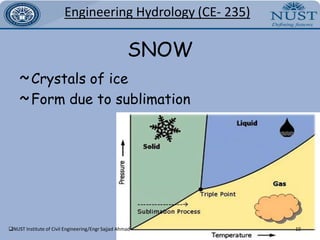
Snow
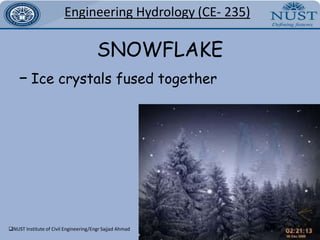
Snowflake
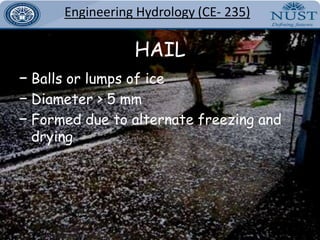
Hail5Engineering Hydrology(CE- 235)NUST Institute of Civil Engineering/Engr Sajjad Ahmad6Engineering Hydrology(CE- 235)DRIZZLEMinute particles of water
Drop size < 0.5 mm
Intensity < 1.0 mm/hr
Do not produce runoff
NUST Institute of Civil Engineering/Engr Sajjad Ahmad7Engineering Hydrology(CE- 235)RAINMinimum drop size ≈ 0.5 mm
Maximum drop size ≈ 6.25 mm
Can produce runoff if
Rainfall intensity greater than the rate of infiltration
NUST Institute of Civil Engineering/Engr Sajjad Ahmad8Engineering Hydrology(CE- 235)GLAZEIce coating on drizzle or rain drops
Ice coating forms when
Drops comes in contact with cold surfaces on the ground
NUST Institute of Civil Engineering/Engr Sajjad Ahmad9Engineering Hydrology(CE- 235)SLEETDrizzle or rain drops in frozen form
Drops freezes while falling through air at subfreezing temperature
NUST Institute of Civil Engineering/Engr Sajjad Ahmad10Engineering Hydrology(CE- 235)SNOWCrystals of ice
Form due to sublimation
NUST Institute of Civil Engineering/Engr Sajjad Ahmad11Engineering Hydrology(CE- 235)SNOWFLAKEIce crystals fused together
NUST Institute of Civil Engineering/Engr Sajjad Ahmad12Engineering Hydrology(CE- 235)HAILBalls or lumps of ice
Diameter > 5 mm
Formed due to alternate freezing and drying
NUST Institute of Civil Engineering/Engr Sajjad Ahmad13Engineering Hydrology(CE- 235)FACTORS INFLUENCING PRECIPITATION FORMATIONMechanism of cooling of air
Water vapor condensation and formation of droplets
Mechanism for growth of cloud droplets
Mechanism for accumulation of moisture
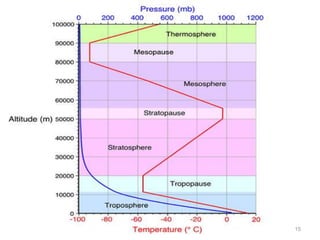
NUST Institute of Civil Engineering/Engr Sajjad AhmadMECHANISM OF COOLING OF AIRThe warm air near the surface rises carrying moisture/water vapors with it
The air cools as it ascends due to lower temperature14Engineering Hydrology(CE- 235)NUST Institute of Civil Engineering/Engr Sajjad AhmadNUST Institute of Civil Engineering/Engr Sajjad Ahmad15
Engineering Hydrology(CE- 235)CODENSATION OF WATER VAPORSWater vapors condensed in presence of hygroscopic nuclei
These nuclei comes from sea salt or combustion products of sulfurous and nitrous acids
NUST Institute of Civil Engineering/Engr Sajjad Ahmad16
17Engineering Hydrology(CE- 235)GROWTH OF CLOUD DROPLETSDrops should be of sufficient size to over come the drag and uplift forces of air
Droplet size can grow by two means
Coalescence of droplets through collisions
Bergeron’s effect
NUST Institute of Civil Engineering/Engr Sajjad Ahmad18Engineering Hydrology(CE- 235)BERGERON’S EFFECTIf temp is b/w 10 to 20 F then mixture of water droplets and ice crystals exists in atmosphere
Due to higher saturation capacity around the droplets, some water evaporates
While due to low saturation capacity around the ice crystals vapors condense and ice crystal size increases
NUST Institute of Civil Engineering/Engr Sajjad Ahmad19Engineering Hydrology(CE- 235)ACCUMULATION OF MOISTUREThe quantity of water fall over basin is much more than the amount of moisture over the basin
Therefore continuous supply of moisture is required
This process is known as convergence
NUST Institute of Civil Engineering/Engr Sajjad Ahmad20Engineering Hydrology(CE- 235)CONVERGENCEIt is the process of inflow of moisture from other areas to the basin
It can be defined as
The net horizontal influx of air per unit area
NUST Institute of Civil Engineering/Engr Sajjad Ahmad21Engineering Hydrology(CE- 235)PRECIPITATION CLASSIFICATION BASED ON LIFTING MECHANISMConvectional precipitation
Orographic precipitation
Cyclonic precipitation
Turbulent ascent precipitation
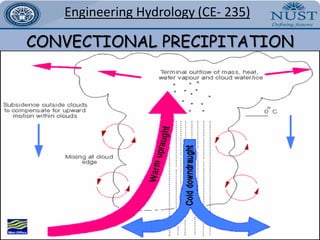
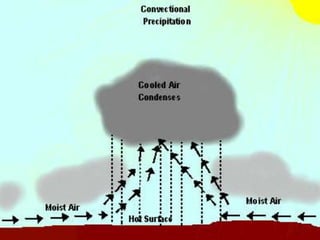
NUST Institute of Civil Engineering/Engr Sajjad Ahmad22Engineering Hydrology(CE- 235)CONVECTIONAL PRECIPITATIONNUST Institute of Civil Engineering/Engr Sajjad Ahmad23Engineering Hydrology(CE- 235)CONVECTIONAL PRECIPITATIONNUST Institute of Civil Engineering/Engr Sajjad Ahmad24Engineering Hydrology(CE- 235)CONVECTIONAL PRECIPITATIONNatural rising of warmer, lighter air in colder, denser surroundings
In the hot day, the ground surface gets heated, causing the warmer air to lift up
the colder air comes to take its place
The vertical air currents develop tremendous velocities the vapors condensed and Convective precipitation occurs
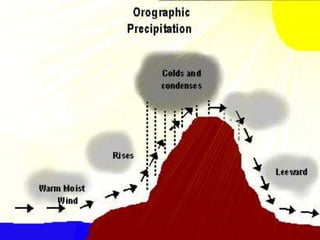
NUST Institute of Civil Engineering/Engr Sajjad Ahmad25Engineering Hydrology(CE- 235)OROGRAPHIC PRECIPITATIONNUST Institute of Civil Engineering/Engr Sajjad Ahmad26Engineering Hydrology(CE- 235)OROGRAPHIC PRECIPITATIONOrographic precipitation is caused by air masses which strike some natural topographic barriers like mountains, and cannot move forward
Hence rise up, causing condensation and precipitation
All the precipitation in Himalayan region is because of this nature
NUST Institute of Civil Engineering/Engr Sajjad Ahmad27Engineering Hydrology(CE- 235)CYCLONIC PRECIPITATIONCyclonic precipitation is caused by lifting of an air mass due to the pressure difference
Cyclonic precipitation may be either frontal or non-frontal cyclonic precipitation
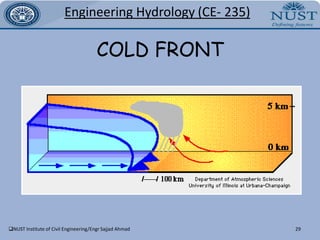
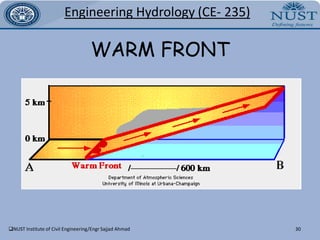
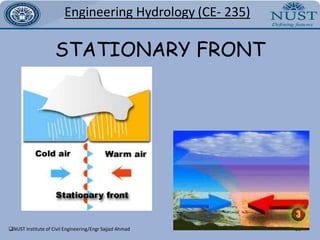
NUST Institute of Civil Engineering/Engr Sajjad Ahmad28Engineering Hydrology(CE- 235)FRONTAL PRECIPITATIONIt results from the lifting of warm and moist air on one side of a frontal surface over colder, denser air on the other side

ce235-eh-lec-2

  • 1.
    NUST Institute ofCivil Engineering/Engr Sajjad Ahmad1
  • 2.
    Engineering Hydrology(CE- 235)CHAPTER- 22PRECIPITATIONNUST Institute of Civil Engineering/Engr Sajjad AhmadPRECIPITATION - OUTLINEForms of precipitation
  • 3.
  • 4.
  • 5.
    Computation of averagerainfall over a basin3Engineering Hydrology(CE- 235)NUST Institute of Civil Engineering/Engr Sajjad Ahmad Falling of any form of moisture from atmosphere to ground4Engineering Hydrology(CE- 235)PRECIPITATIONTranspirationEvaporationWater vaporsAtmospheric systemPrecipitationNUST Institute of Civil Engineering/Engr Sajjad AhmadFORMS OF PRECIPITATIONDrizzle
  • 6.
  • 7.
  • 8.
  • 9.
  • 10.
  • 11.
    Hail5Engineering Hydrology(CE- 235)NUSTInstitute of Civil Engineering/Engr Sajjad Ahmad6Engineering Hydrology(CE- 235)DRIZZLEMinute particles of water
  • 12.
  • 13.
  • 14.
  • 15.
    NUST Institute ofCivil Engineering/Engr Sajjad Ahmad7Engineering Hydrology(CE- 235)RAINMinimum drop size ≈ 0.5 mm
  • 16.
  • 17.
  • 18.
    Rainfall intensity greaterthan the rate of infiltration
  • 19.
    NUST Institute ofCivil Engineering/Engr Sajjad Ahmad8Engineering Hydrology(CE- 235)GLAZEIce coating on drizzle or rain drops
  • 20.
  • 21.
    Drops comes incontact with cold surfaces on the ground
  • 22.
    NUST Institute ofCivil Engineering/Engr Sajjad Ahmad9Engineering Hydrology(CE- 235)SLEETDrizzle or rain drops in frozen form
  • 23.
    Drops freezes whilefalling through air at subfreezing temperature
  • 24.
    NUST Institute ofCivil Engineering/Engr Sajjad Ahmad10Engineering Hydrology(CE- 235)SNOWCrystals of ice
  • 25.
    Form due tosublimation
  • 26.
    NUST Institute ofCivil Engineering/Engr Sajjad Ahmad11Engineering Hydrology(CE- 235)SNOWFLAKEIce crystals fused together
  • 27.
    NUST Institute ofCivil Engineering/Engr Sajjad Ahmad12Engineering Hydrology(CE- 235)HAILBalls or lumps of ice
  • 28.
  • 29.
    Formed due toalternate freezing and drying
  • 30.
    NUST Institute ofCivil Engineering/Engr Sajjad Ahmad13Engineering Hydrology(CE- 235)FACTORS INFLUENCING PRECIPITATION FORMATIONMechanism of cooling of air
  • 31.
    Water vapor condensationand formation of droplets
  • 32.
    Mechanism for growthof cloud droplets
  • 33.
  • 34.
    NUST Institute ofCivil Engineering/Engr Sajjad AhmadMECHANISM OF COOLING OF AIRThe warm air near the surface rises carrying moisture/water vapors with it
  • 35.
    The air coolsas it ascends due to lower temperature14Engineering Hydrology(CE- 235)NUST Institute of Civil Engineering/Engr Sajjad AhmadNUST Institute of Civil Engineering/Engr Sajjad Ahmad15
  • 36.
    Engineering Hydrology(CE- 235)CODENSATIONOF WATER VAPORSWater vapors condensed in presence of hygroscopic nuclei
  • 37.
    These nuclei comesfrom sea salt or combustion products of sulfurous and nitrous acids
  • 38.
    NUST Institute ofCivil Engineering/Engr Sajjad Ahmad16
  • 39.
    17Engineering Hydrology(CE- 235)GROWTHOF CLOUD DROPLETSDrops should be of sufficient size to over come the drag and uplift forces of air
  • 40.
    Droplet size cangrow by two means
  • 41.
    Coalescence of dropletsthrough collisions
  • 42.
  • 43.
    NUST Institute ofCivil Engineering/Engr Sajjad Ahmad18Engineering Hydrology(CE- 235)BERGERON’S EFFECTIf temp is b/w 10 to 20 F then mixture of water droplets and ice crystals exists in atmosphere
  • 44.
    Due to highersaturation capacity around the droplets, some water evaporates
  • 45.
    While due tolow saturation capacity around the ice crystals vapors condense and ice crystal size increases
  • 46.
    NUST Institute ofCivil Engineering/Engr Sajjad Ahmad19Engineering Hydrology(CE- 235)ACCUMULATION OF MOISTUREThe quantity of water fall over basin is much more than the amount of moisture over the basin
  • 47.
    Therefore continuous supplyof moisture is required
  • 48.
    This process isknown as convergence
  • 49.
    NUST Institute ofCivil Engineering/Engr Sajjad Ahmad20Engineering Hydrology(CE- 235)CONVERGENCEIt is the process of inflow of moisture from other areas to the basin
  • 50.
    It can bedefined as
  • 51.
    The net horizontalinflux of air per unit area
  • 52.
    NUST Institute ofCivil Engineering/Engr Sajjad Ahmad21Engineering Hydrology(CE- 235)PRECIPITATION CLASSIFICATION BASED ON LIFTING MECHANISMConvectional precipitation
  • 53.
  • 54.
  • 55.
  • 56.
    NUST Institute ofCivil Engineering/Engr Sajjad Ahmad22Engineering Hydrology(CE- 235)CONVECTIONAL PRECIPITATIONNUST Institute of Civil Engineering/Engr Sajjad Ahmad23Engineering Hydrology(CE- 235)CONVECTIONAL PRECIPITATIONNUST Institute of Civil Engineering/Engr Sajjad Ahmad24Engineering Hydrology(CE- 235)CONVECTIONAL PRECIPITATIONNatural rising of warmer, lighter air in colder, denser surroundings
  • 57.
    In the hotday, the ground surface gets heated, causing the warmer air to lift up
  • 58.
    the colder aircomes to take its place
  • 59.
    The vertical aircurrents develop tremendous velocities the vapors condensed and Convective precipitation occurs
  • 60.
    NUST Institute ofCivil Engineering/Engr Sajjad Ahmad25Engineering Hydrology(CE- 235)OROGRAPHIC PRECIPITATIONNUST Institute of Civil Engineering/Engr Sajjad Ahmad26Engineering Hydrology(CE- 235)OROGRAPHIC PRECIPITATIONOrographic precipitation is caused by air masses which strike some natural topographic barriers like mountains, and cannot move forward
  • 61.
    Hence rise up,causing condensation and precipitation
  • 62.
    All the precipitationin Himalayan region is because of this nature
  • 63.
    NUST Institute ofCivil Engineering/Engr Sajjad Ahmad27Engineering Hydrology(CE- 235)CYCLONIC PRECIPITATIONCyclonic precipitation is caused by lifting of an air mass due to the pressure difference
  • 64.
    Cyclonic precipitation maybe either frontal or non-frontal cyclonic precipitation
  • 65.
    NUST Institute ofCivil Engineering/Engr Sajjad Ahmad28Engineering Hydrology(CE- 235)FRONTAL PRECIPITATIONIt results from the lifting of warm and moist air on one side of a frontal surface over colder, denser air on the other side