dal.ca
www.dal.ca

The Origin of Soil and Its Properties
Andrew Hammermeister
Organic Agriculture Centre of Canada
Dalhousie University, Faculty of Agriculture
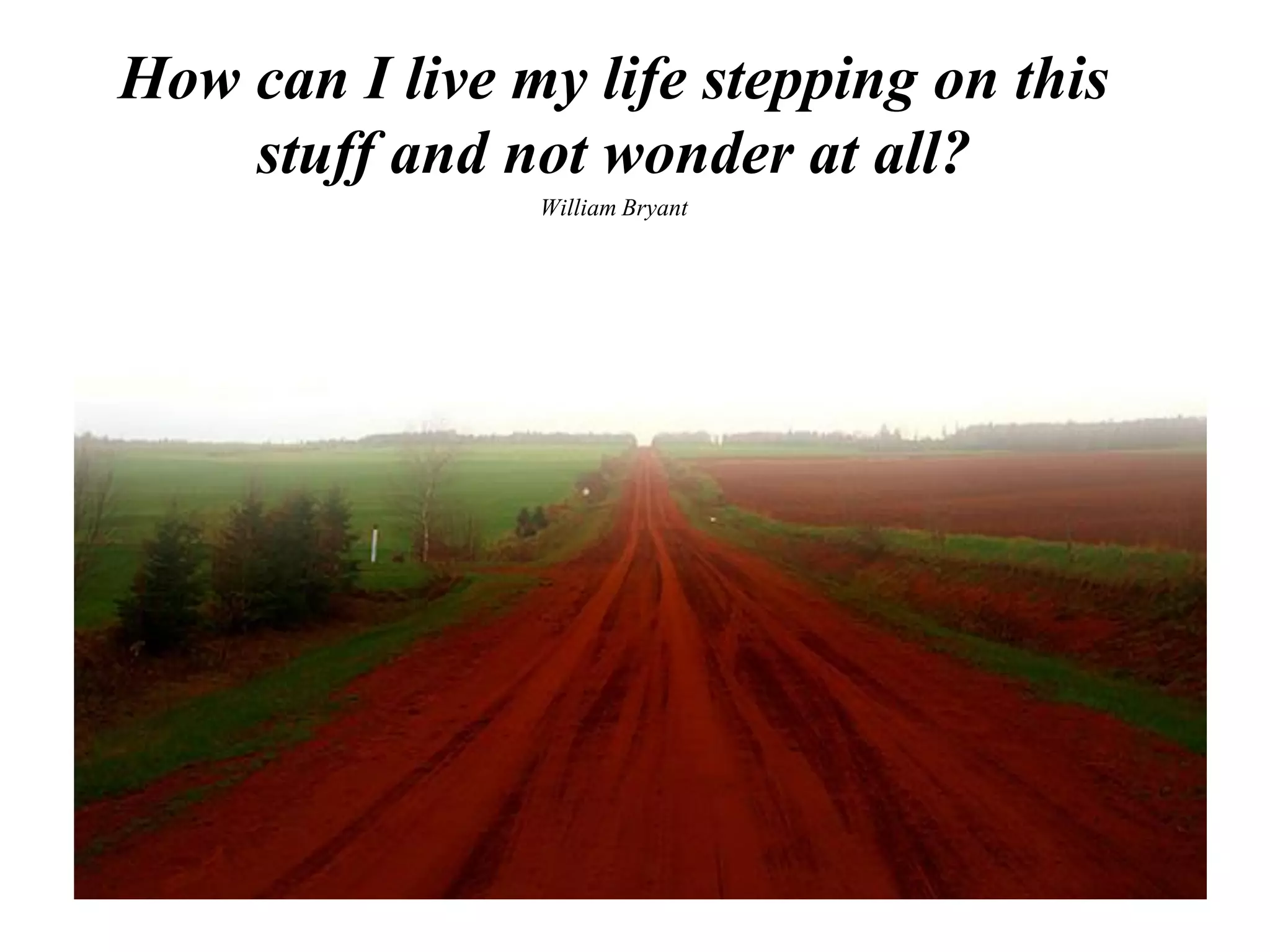
How can I live my life stepping on this
stuff and not wonder at all?
William Bryant
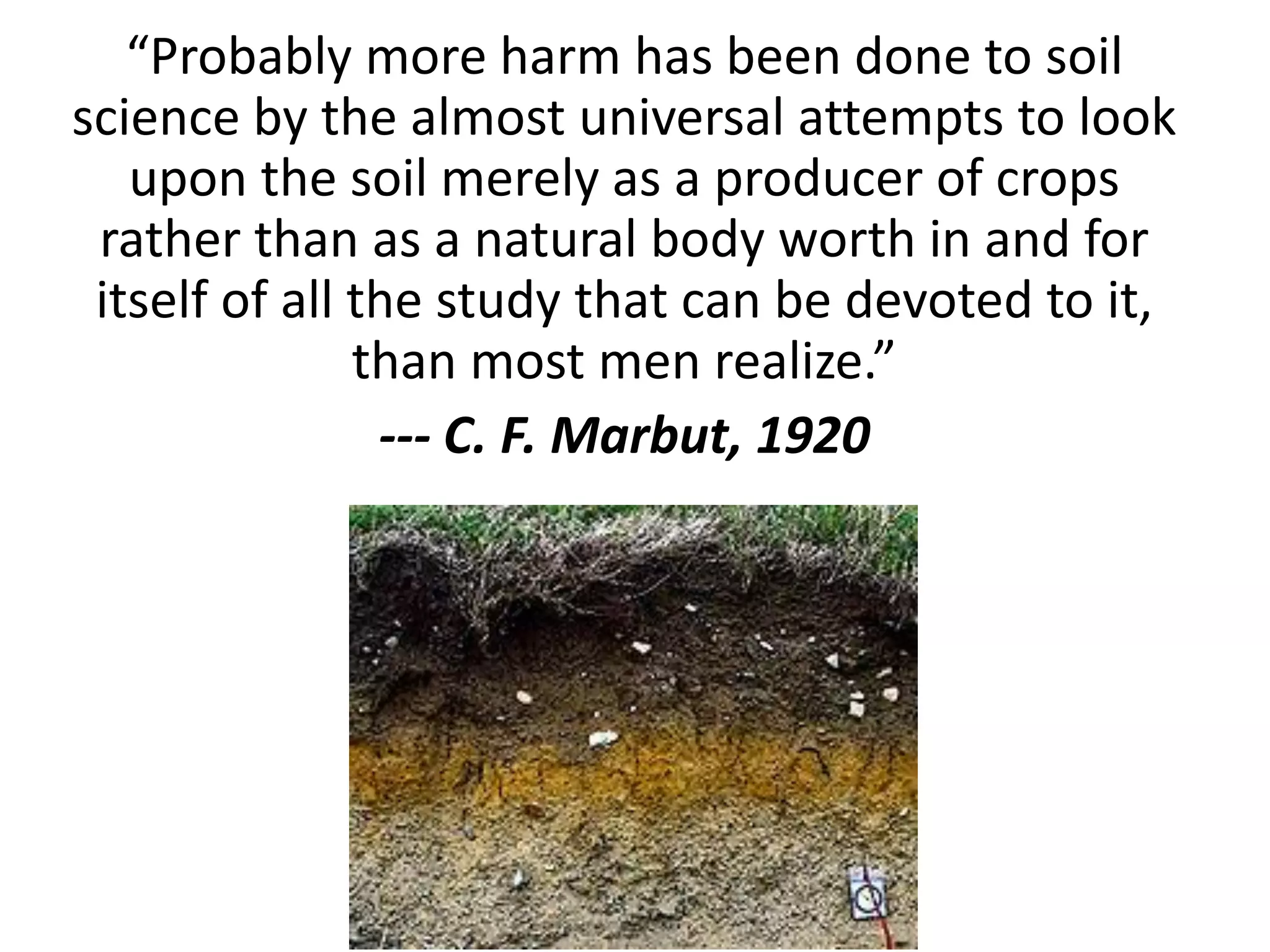
“Probably more harm has been done to soil
science by the almost universal attempts to look
upon the soil merely as a producer of crops
rather than as a natural body worth in and for
itself of all the study that can be devoted to it,
than most men realize.”
--- C. F. Marbut, 1920
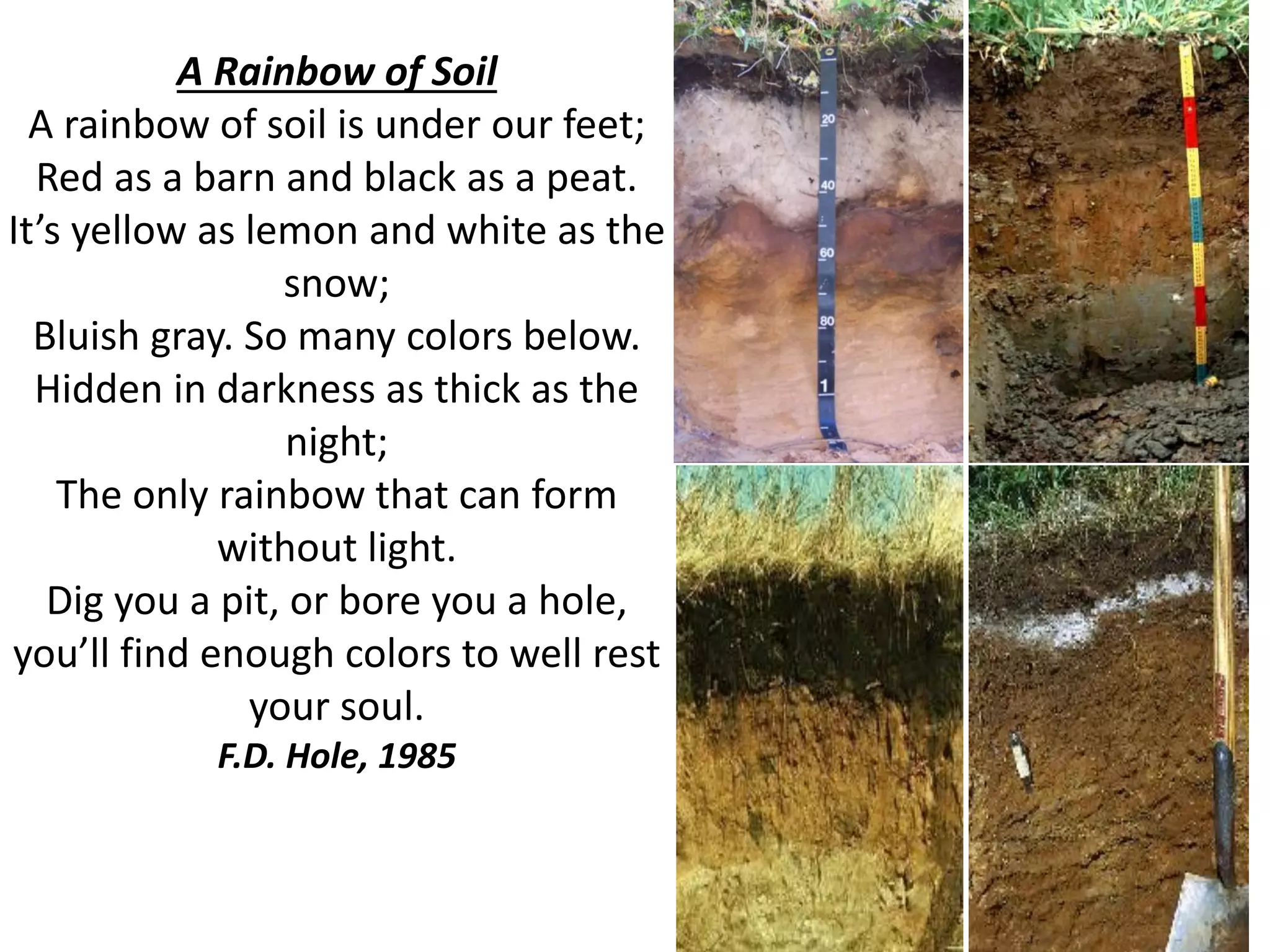
A Rainbow of Soil
A rainbow of soil is under our feet;
Red as a barn and black as a peat.
It’s yellow as lemon and white as the
snow;
Bluish gray. So many colors below.
Hidden in darkness as thick as the
night;
The only rainbow that can form
without light.
Dig you a pit, or bore you a hole,
you’ll find enough colors to well rest
your soul.
F.D. Hole, 1985
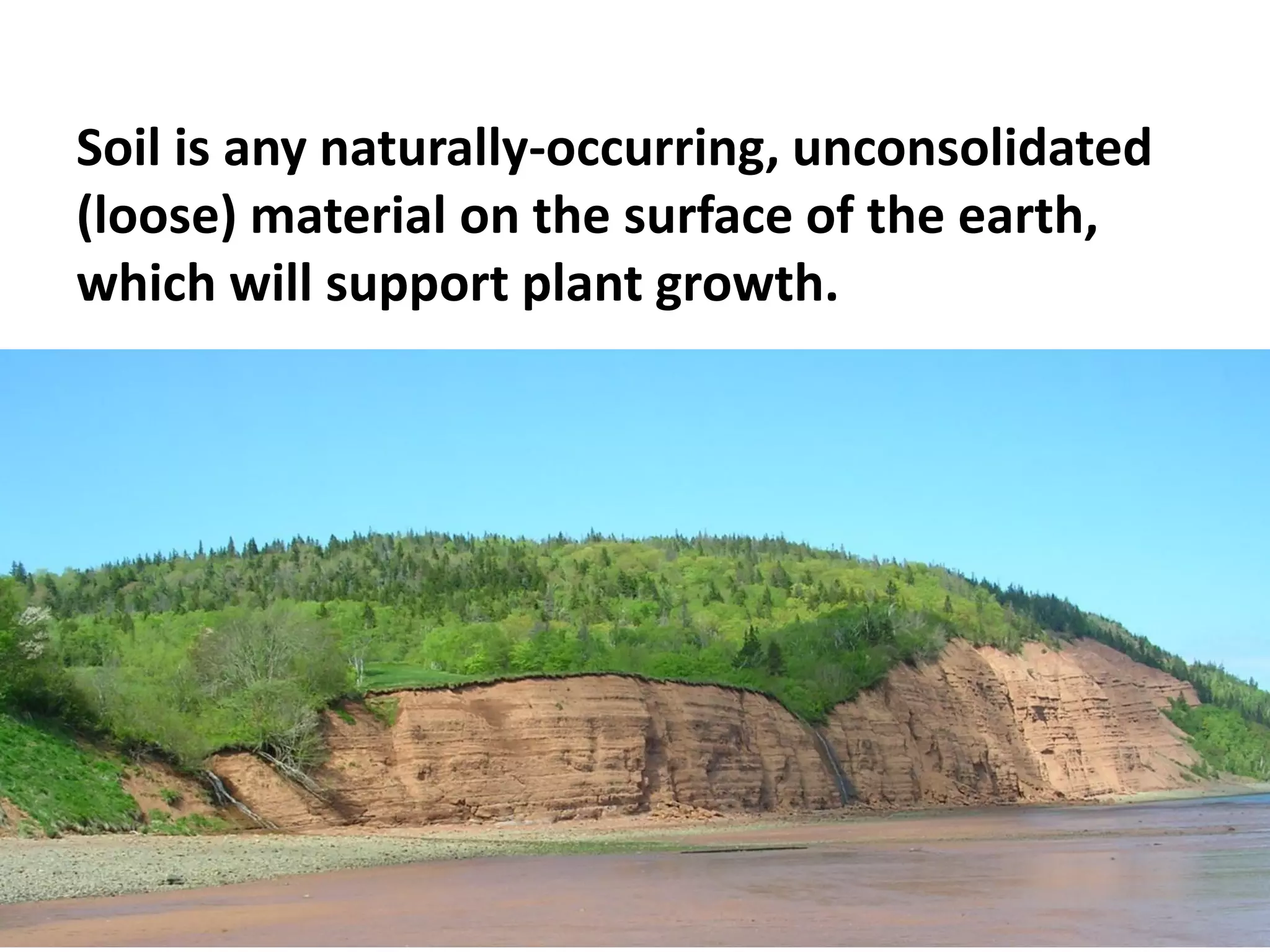
Soil is any naturally-occurring, unconsolidated
(loose) material on the surface of the earth,
which will support plant growth.
Soil
• Basic resource sustaining all terrestrial
ecosystems.
• Soils are not a renewable resource in the scale of
human lifetimes.
• Most soil profiles are thousand of years in the
making

• In some regions of the world, human activities
are destroying some soils faster than nature can
rebuild/restore them
Soil performs 3 main functions:
1. Provide a medium for plant growth
2. Regulate and partition water flow through the
environment
3. Serve as an environmental buffer
a.

Can hold nutrients and release them as required by plants

b.

Can also breakdown harmful compounds into substances that
are not toxic to plants and animals (limited ability).
Soil is a product of:
Parent material
Climate
Topography
Biology
Time

Humans!
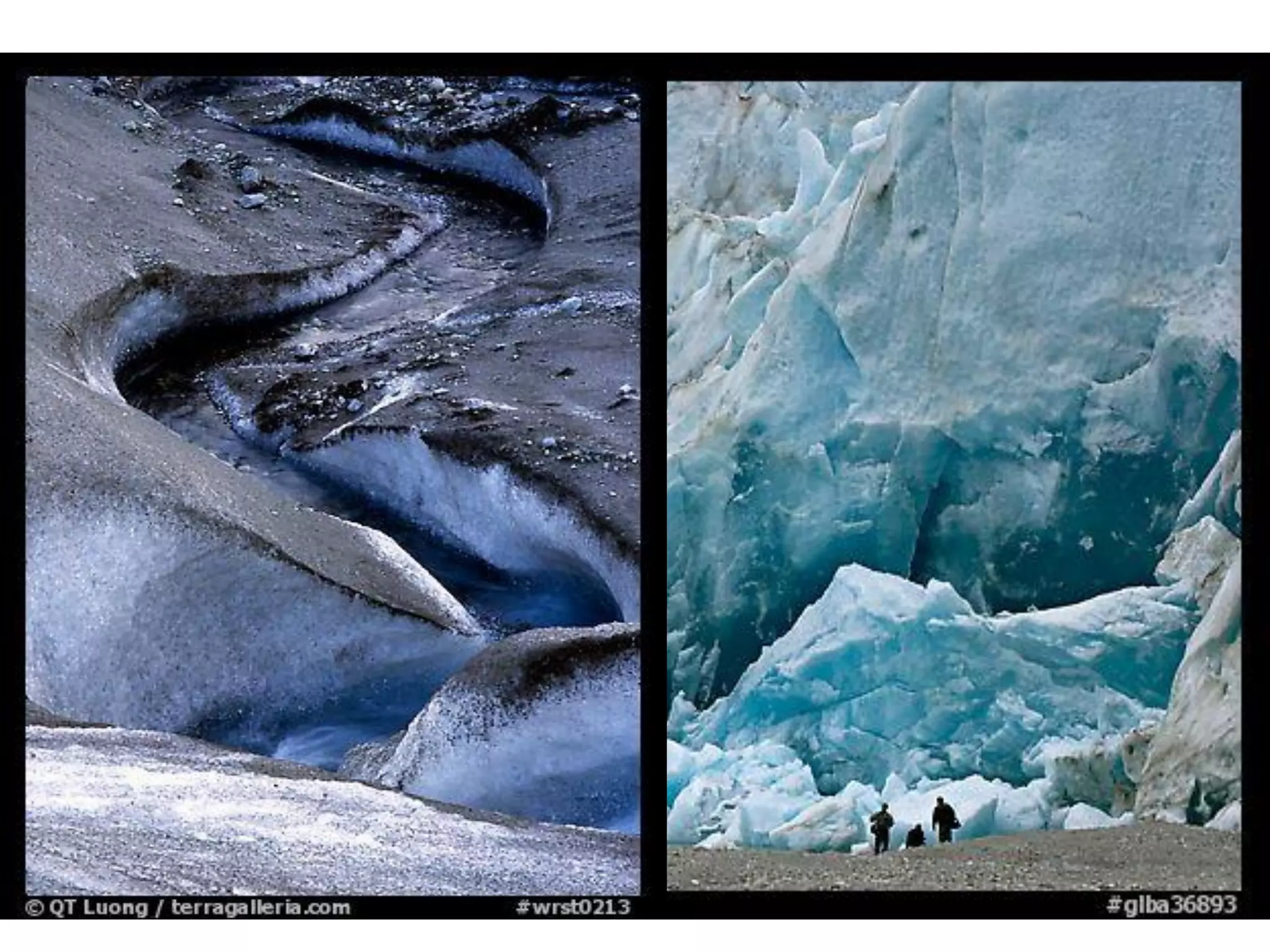
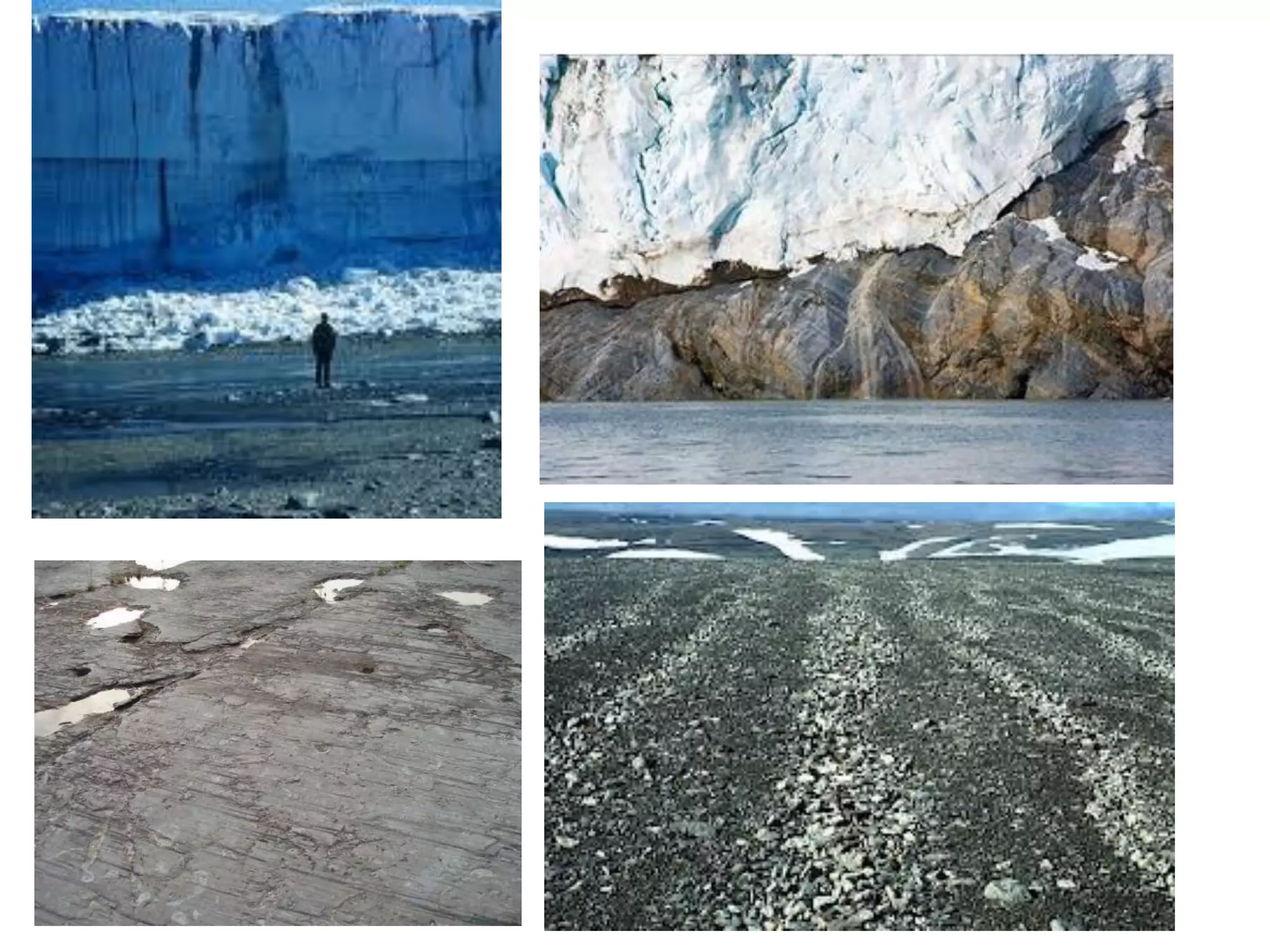
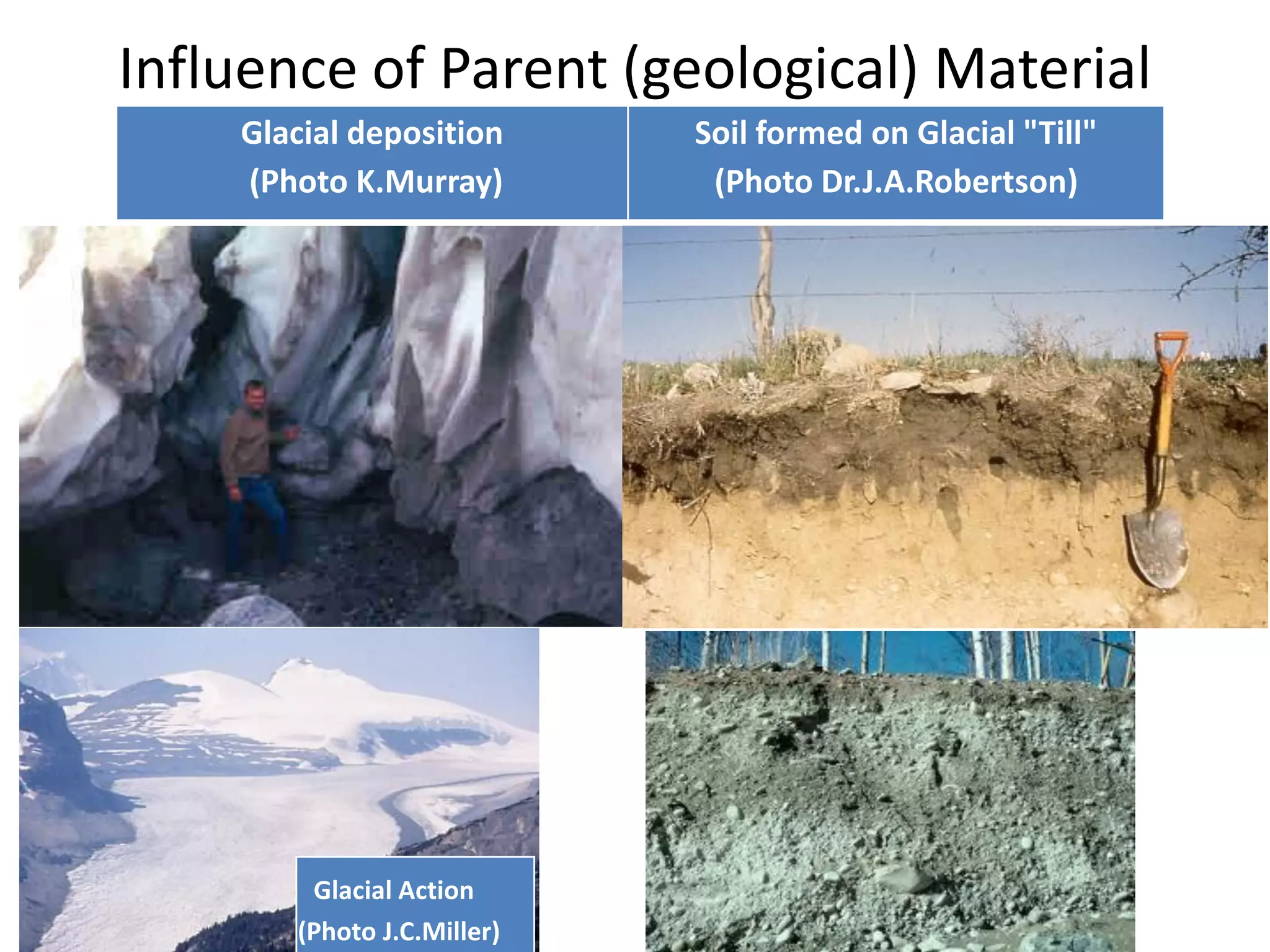
Influence of Parent (geological) Material
Glacial deposition
(Photo K.Murray)

Glacial Action
(Photo J.C.Miller)

Soil formed on Glacial "Till"
(Photo Dr.J.A.Robertson)
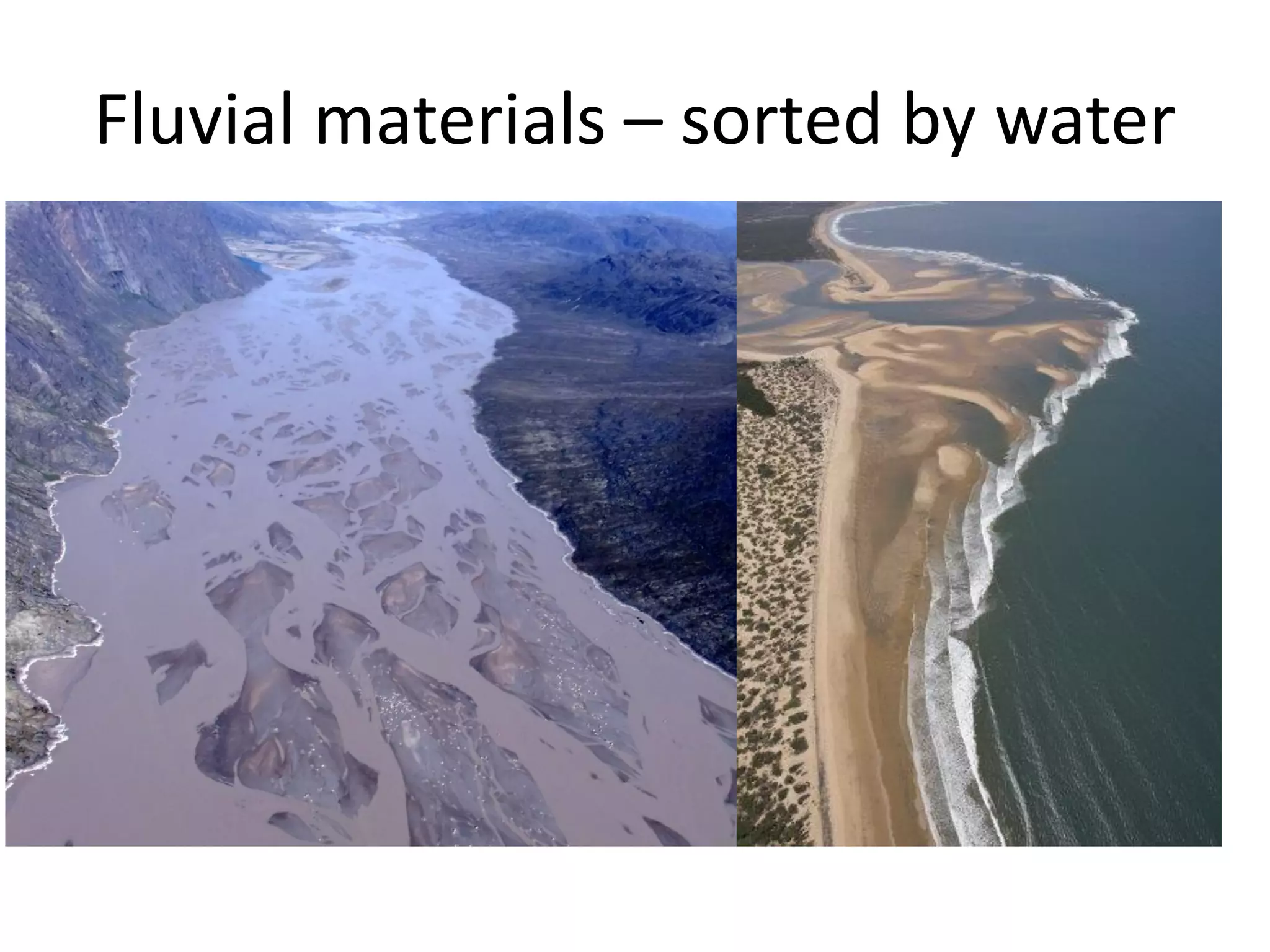
Fluvial materials – sorted by water
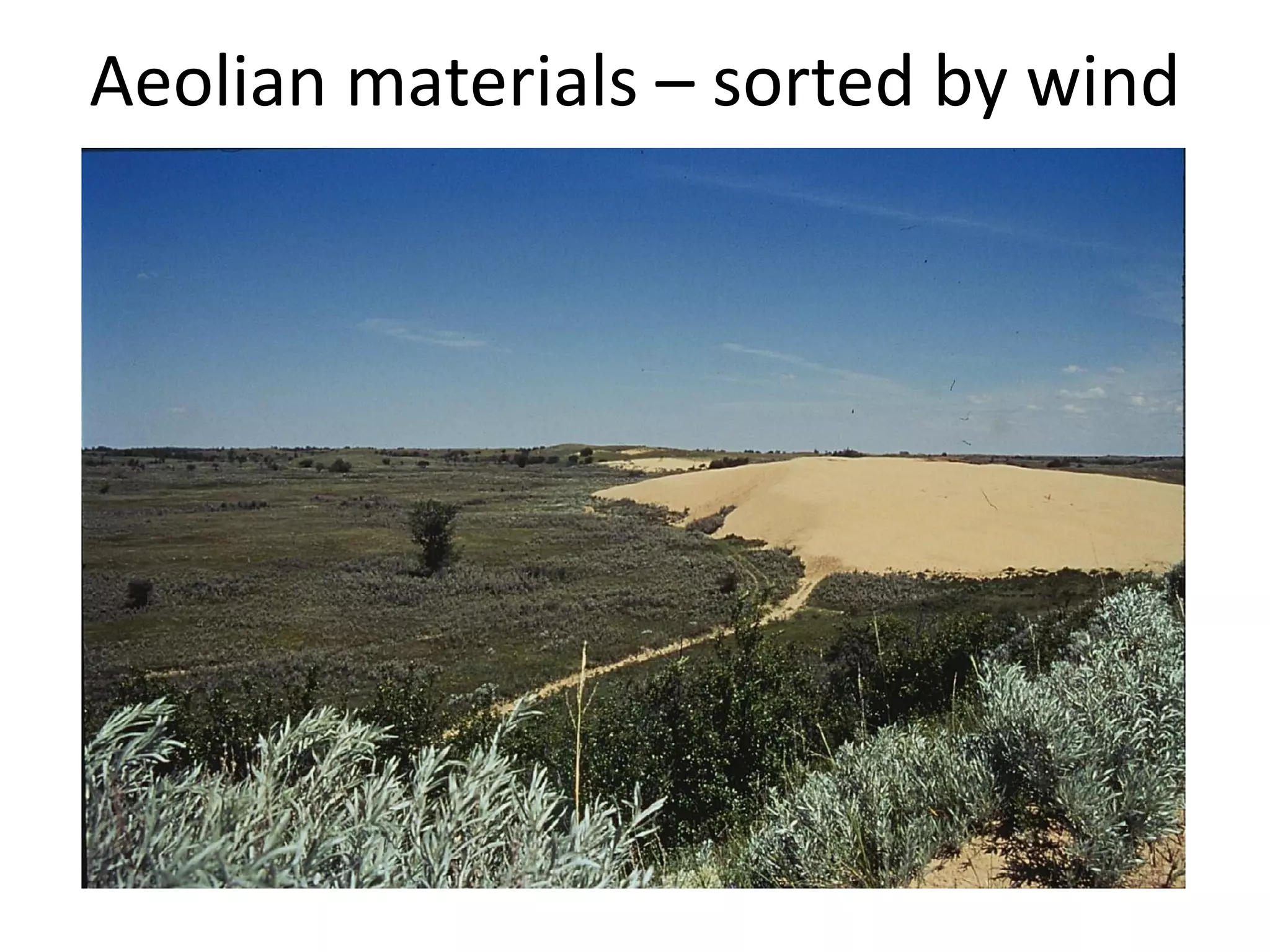
Aeolian materials – sorted by wind
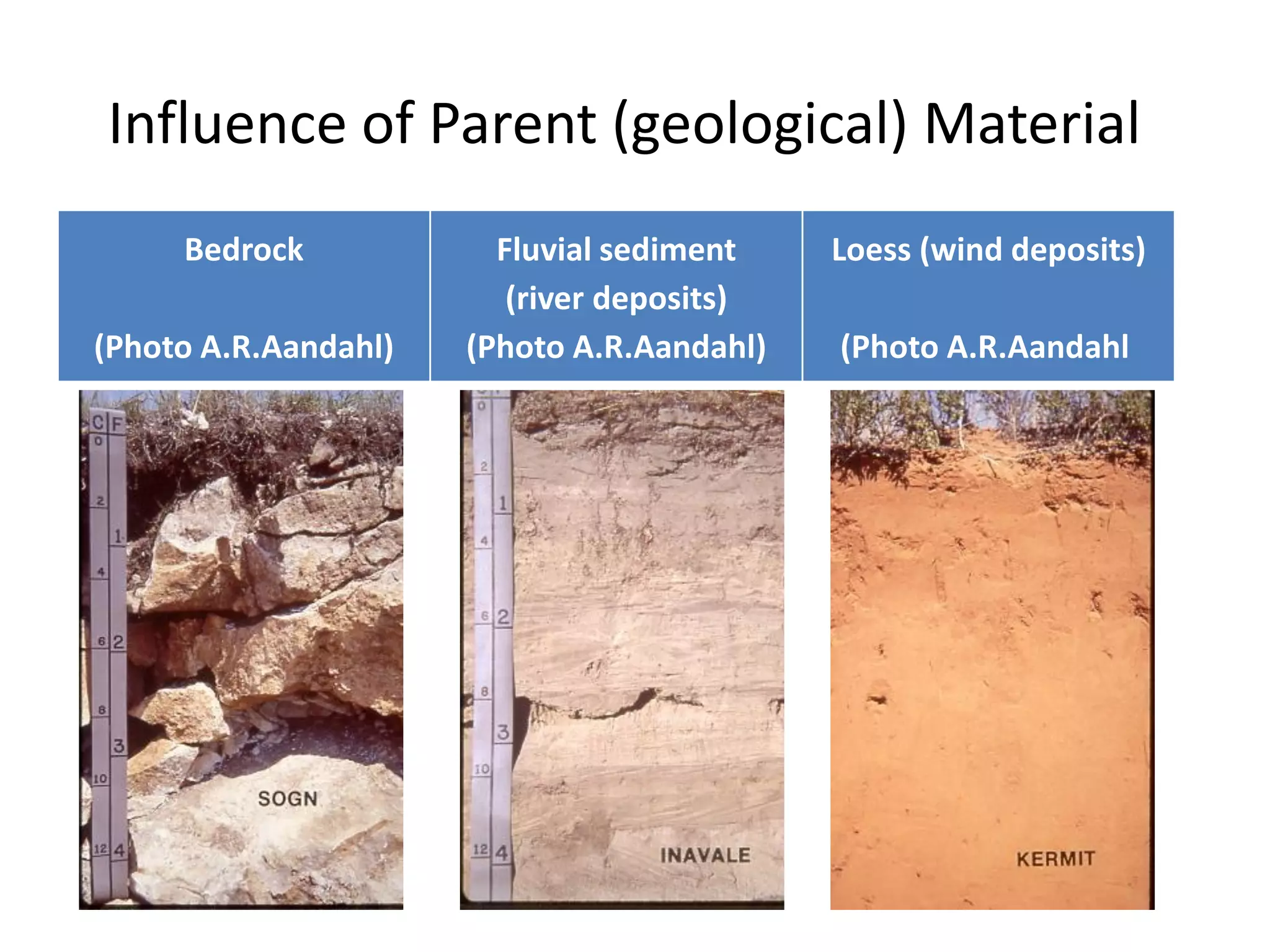
Influence of Parent (geological) Material
Bedrock
(Photo A.R.Aandahl)

Fluvial sediment
(river deposits)
(Photo A.R.Aandahl)

Loess (wind deposits)
(Photo A.R.Aandahl
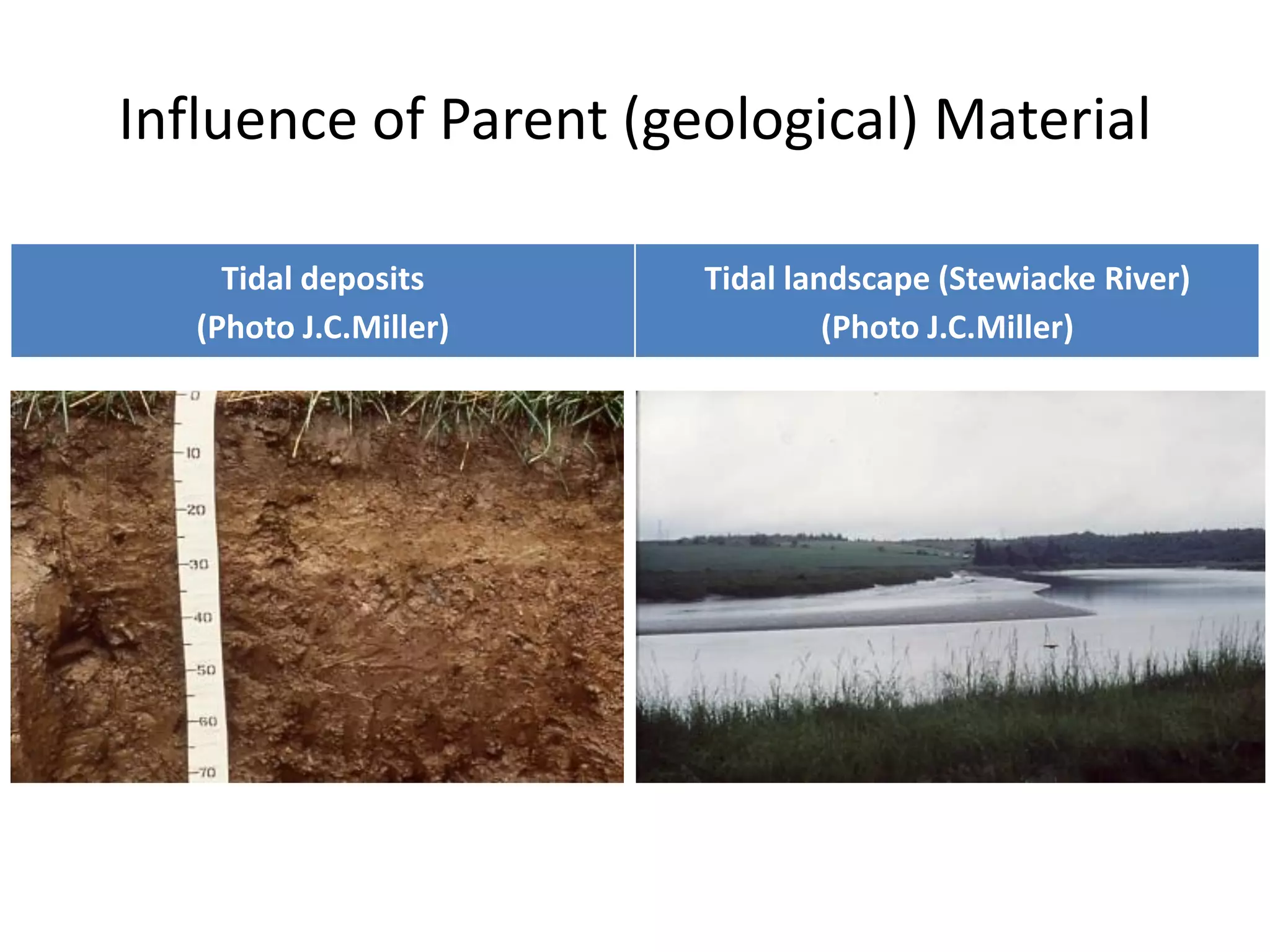
Influence of Parent (geological) Material
Tidal deposits
(Photo J.C.Miller)

Tidal landscape (Stewiacke River)
(Photo J.C.Miller)
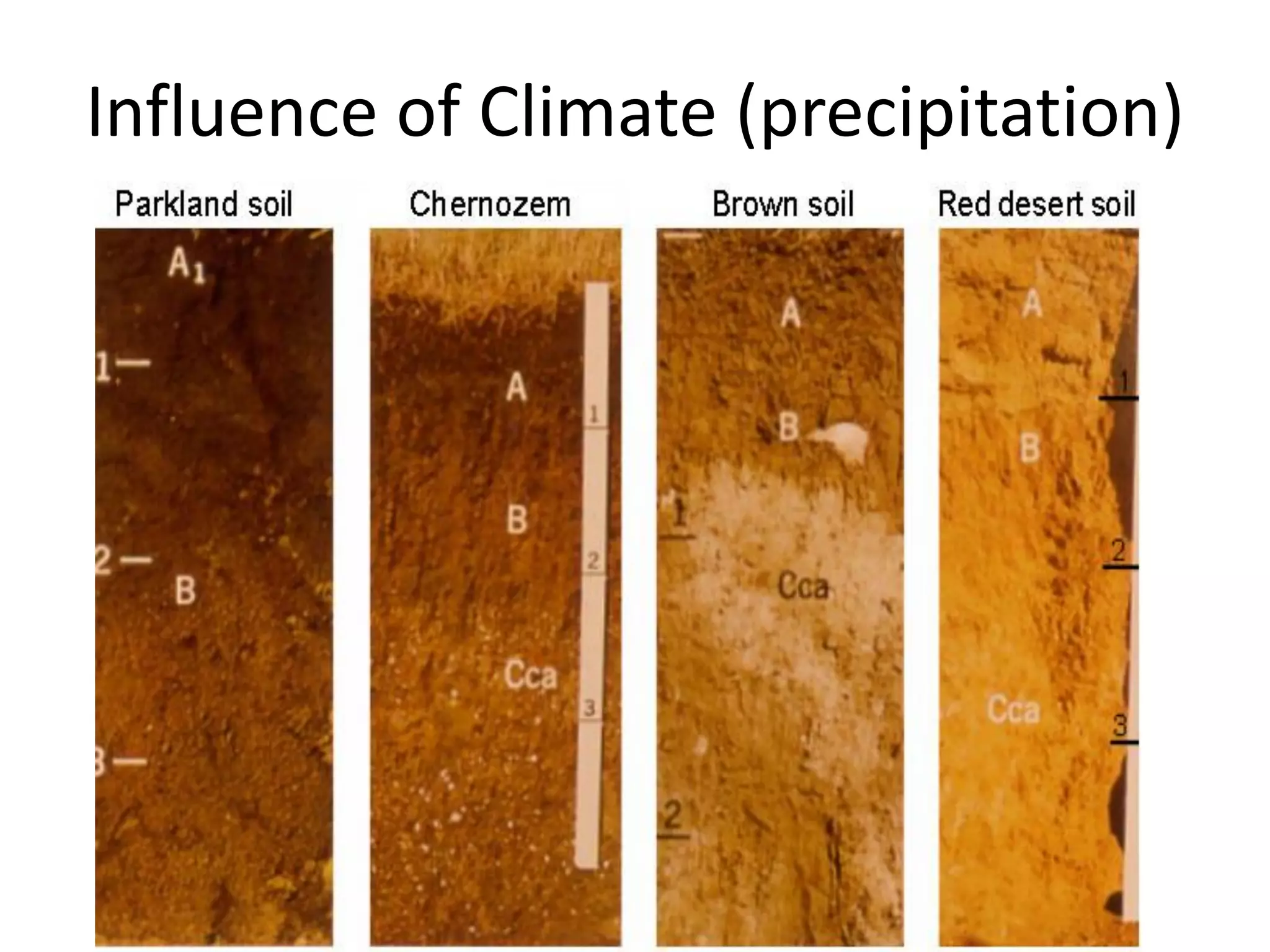
Influence of Climate (precipitation)
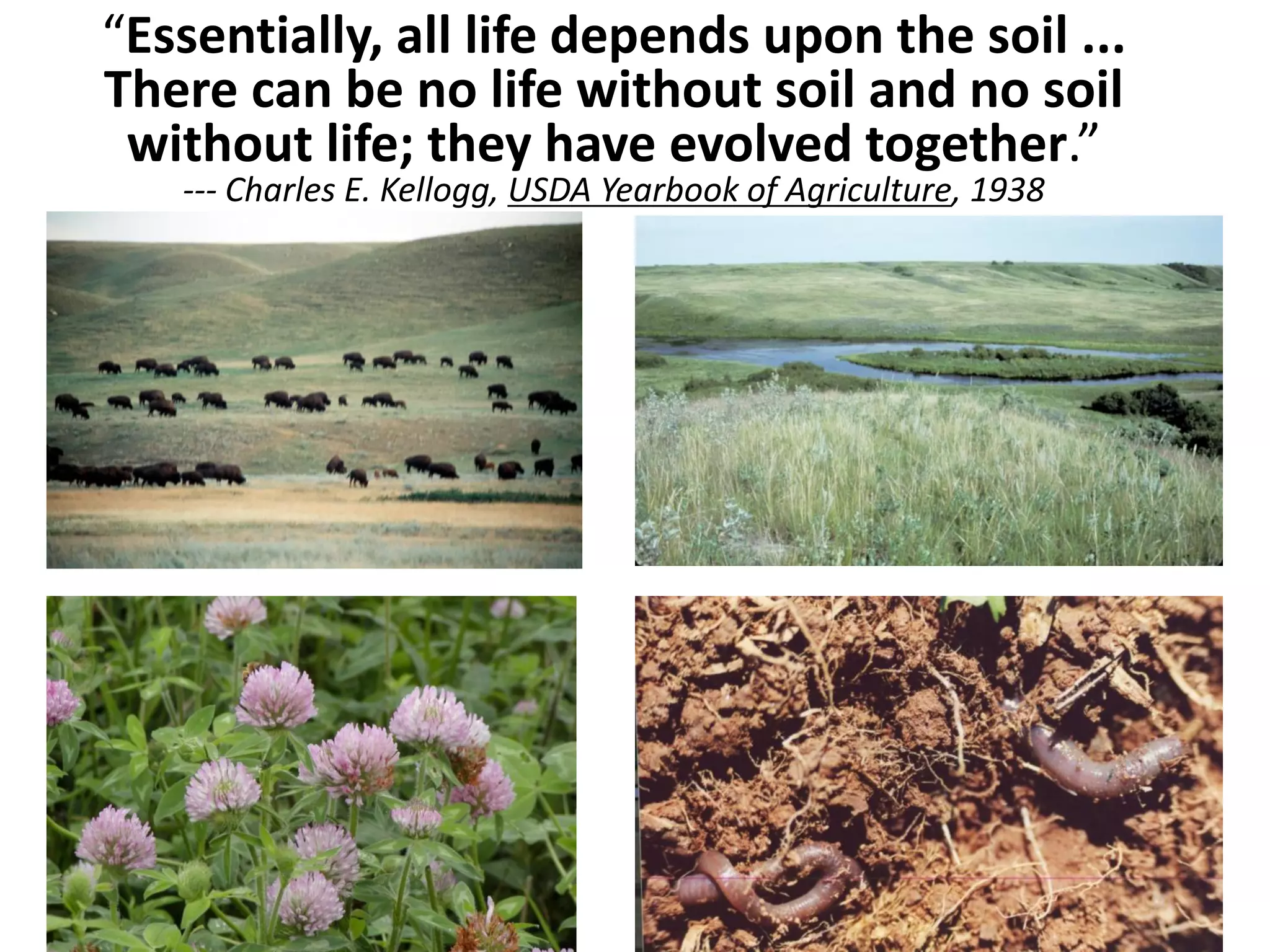
“Essentially, all life depends upon the soil ...
There can be no life without soil and no soil
without life; they have evolved together.”
--- Charles E. Kellogg, USDA Yearbook of Agriculture, 1938
Soil Ecology

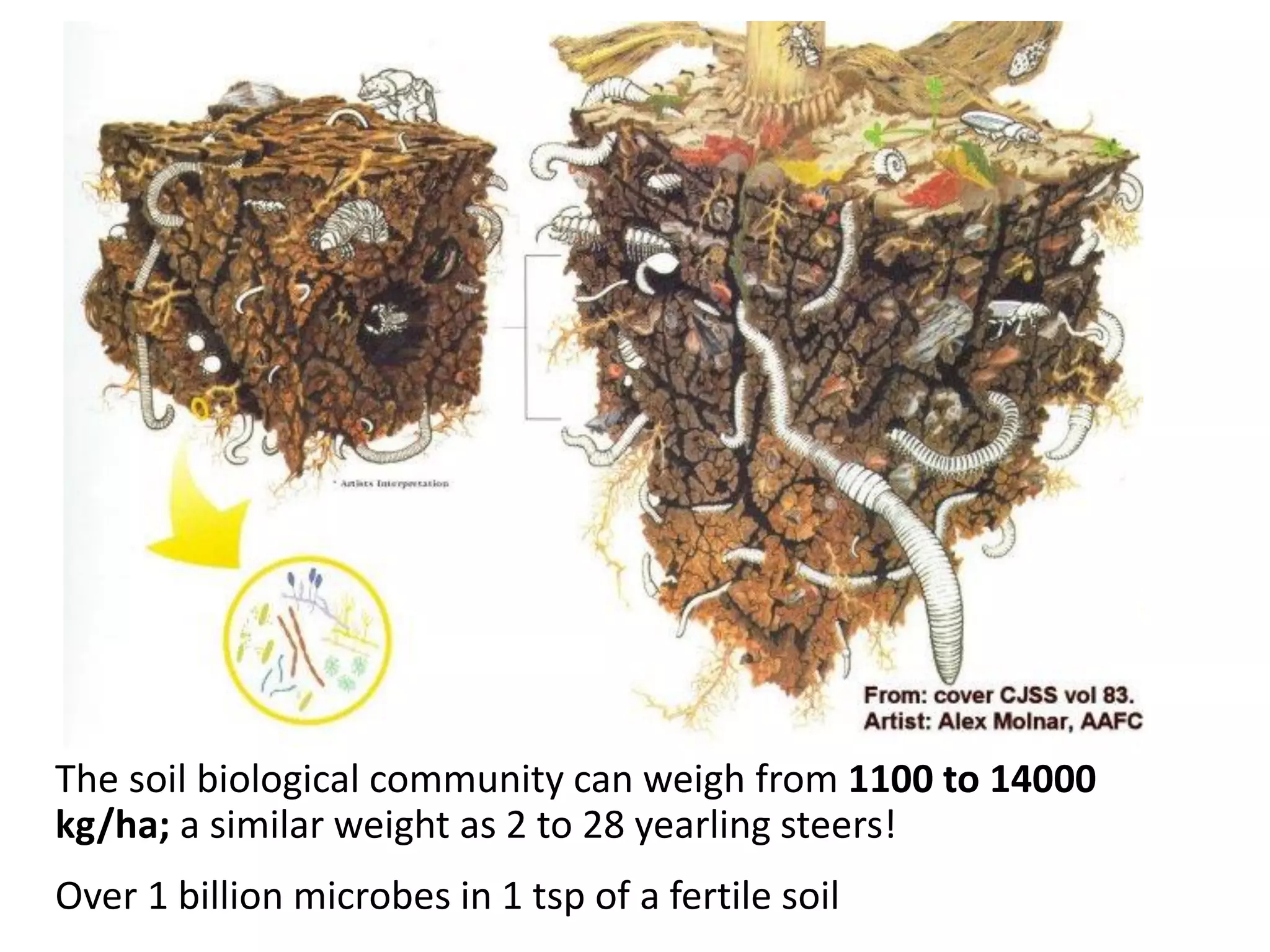
The soil biological community can weigh from 1100 to 14000
kg/ha; a similar weight as 2 to 28 yearling steers!
Over 1 billion microbes in 1 tsp of a fertile soil
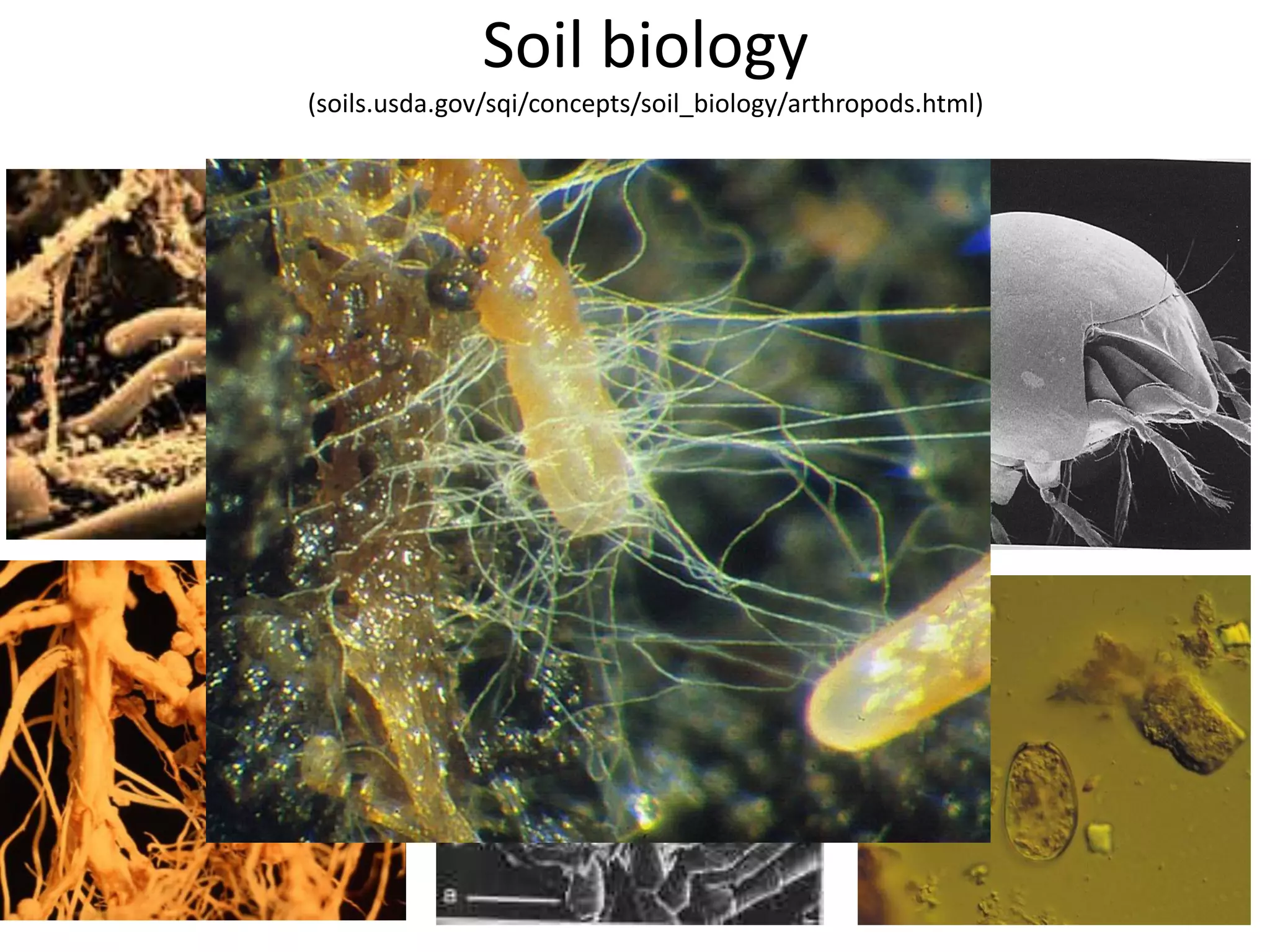
Soil biology
(soils.usda.gov/sqi/concepts/soil_biology/arthropods.html)
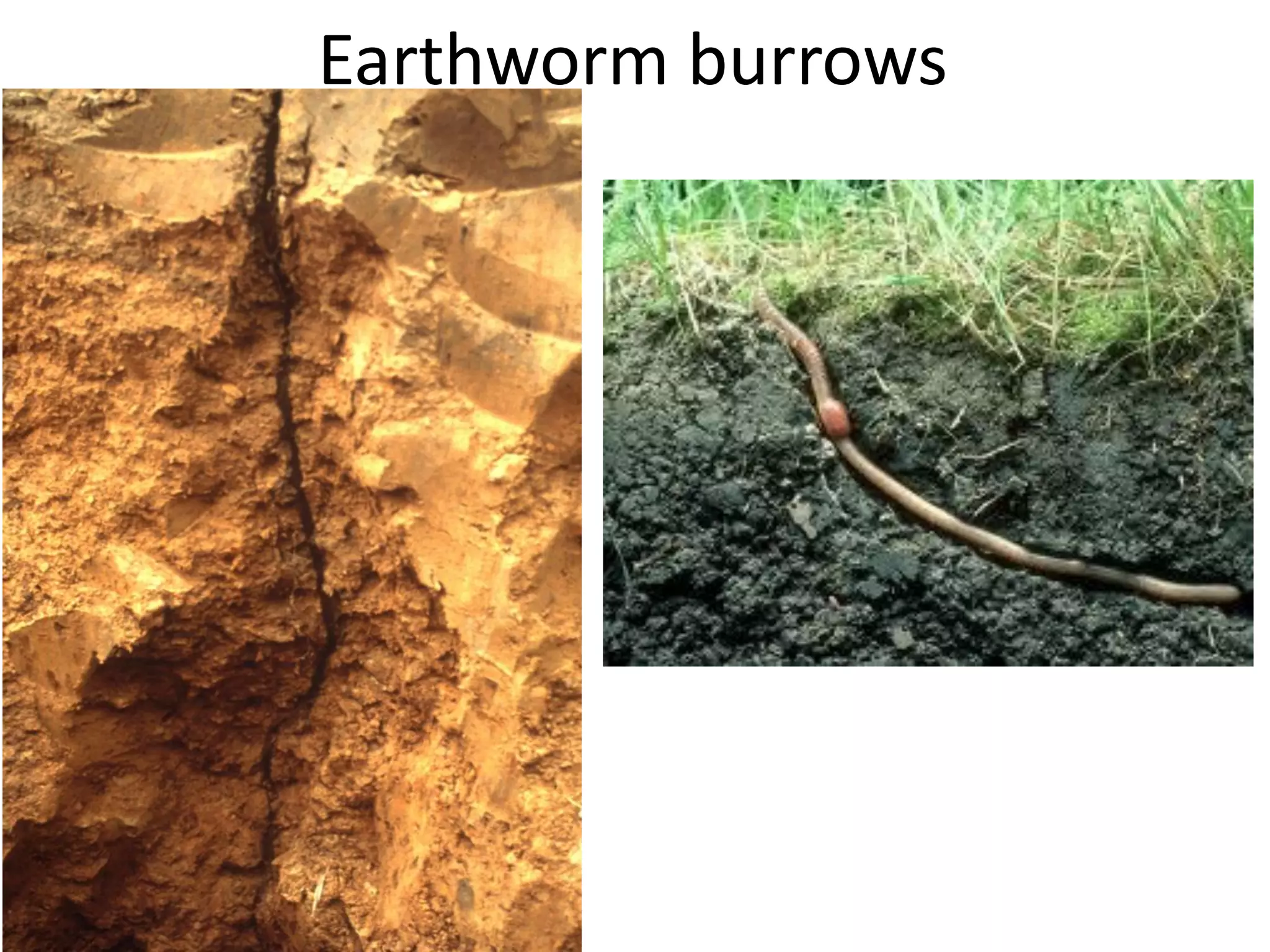
Earthworm burrows
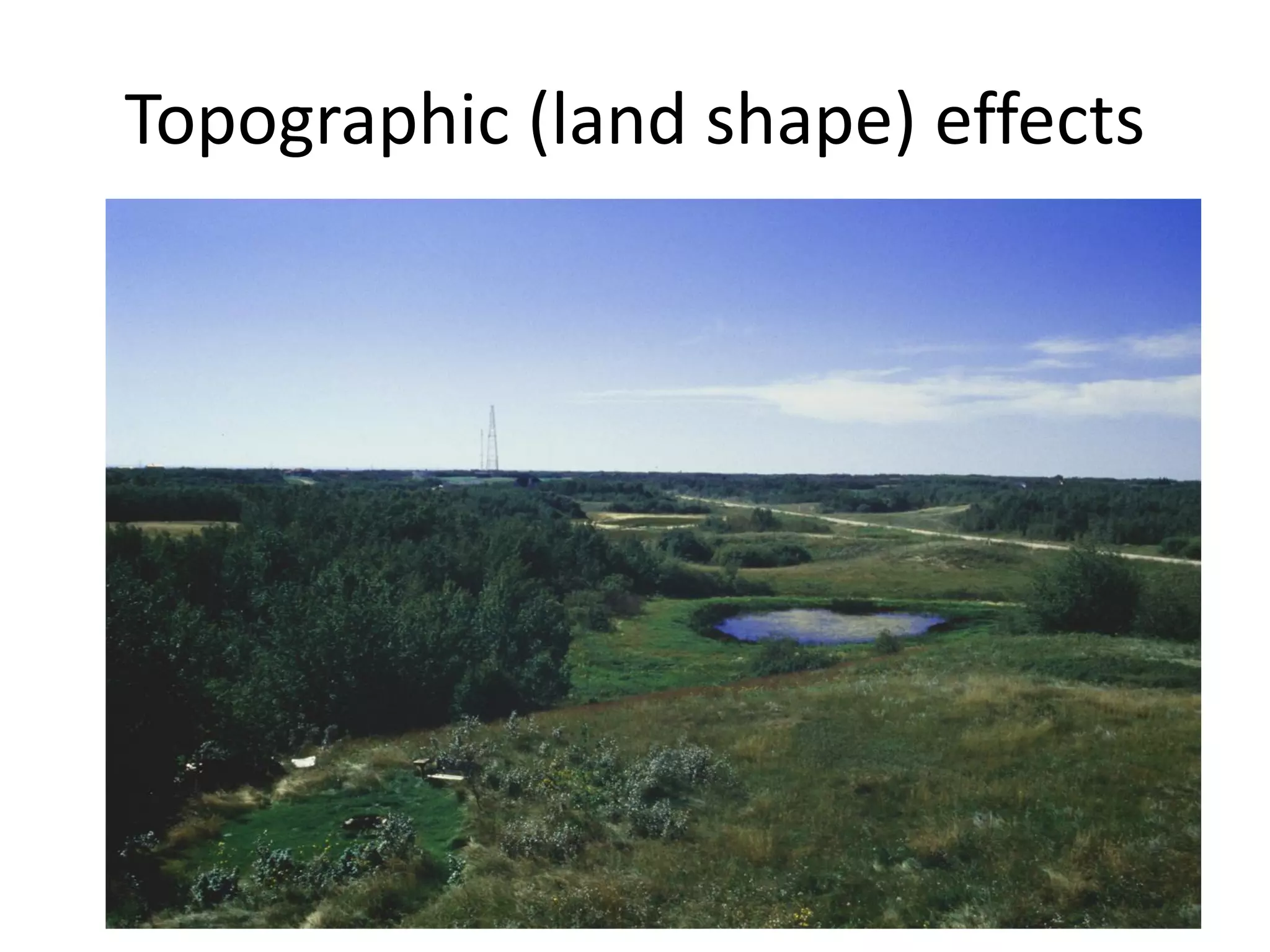
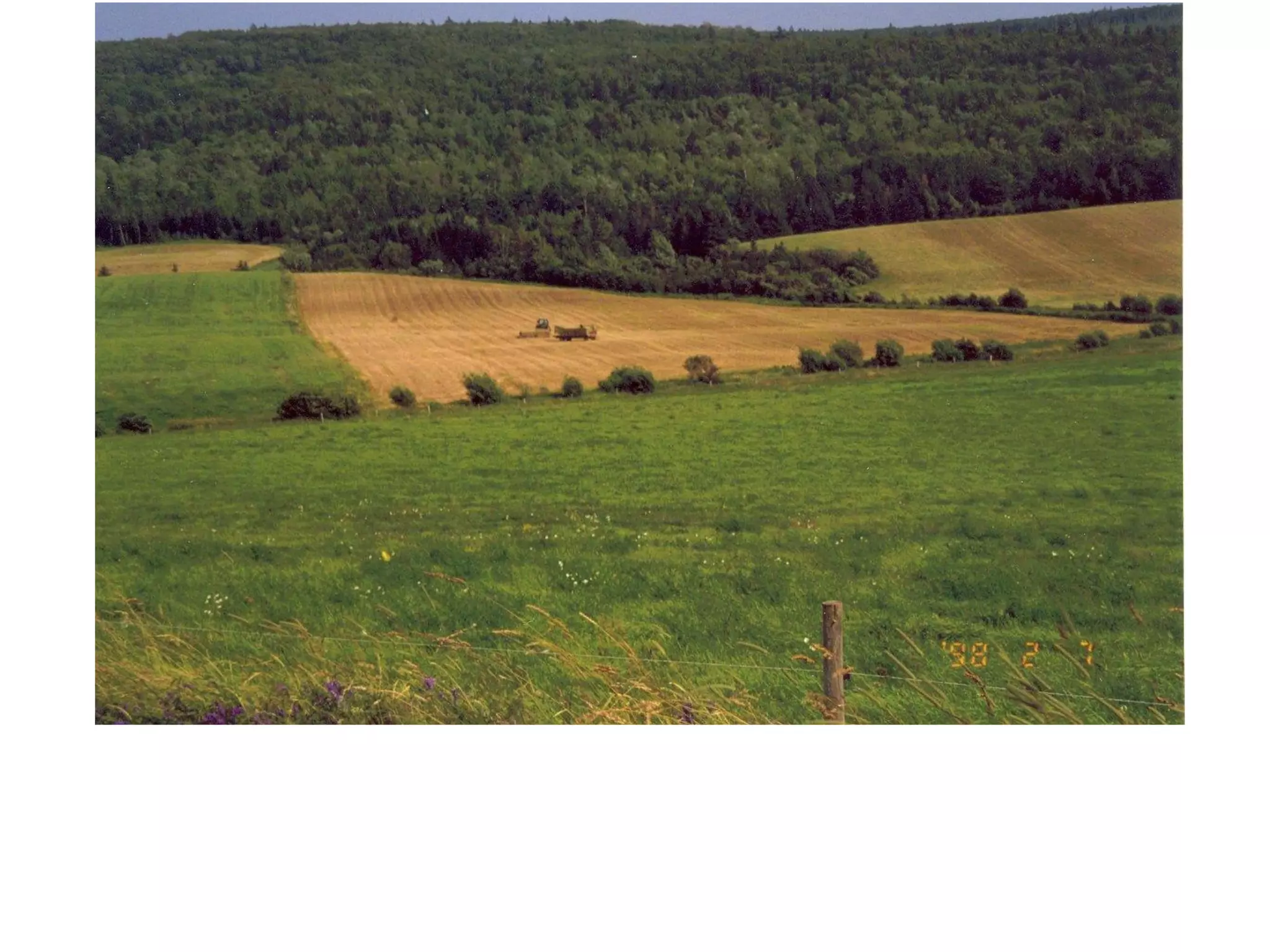
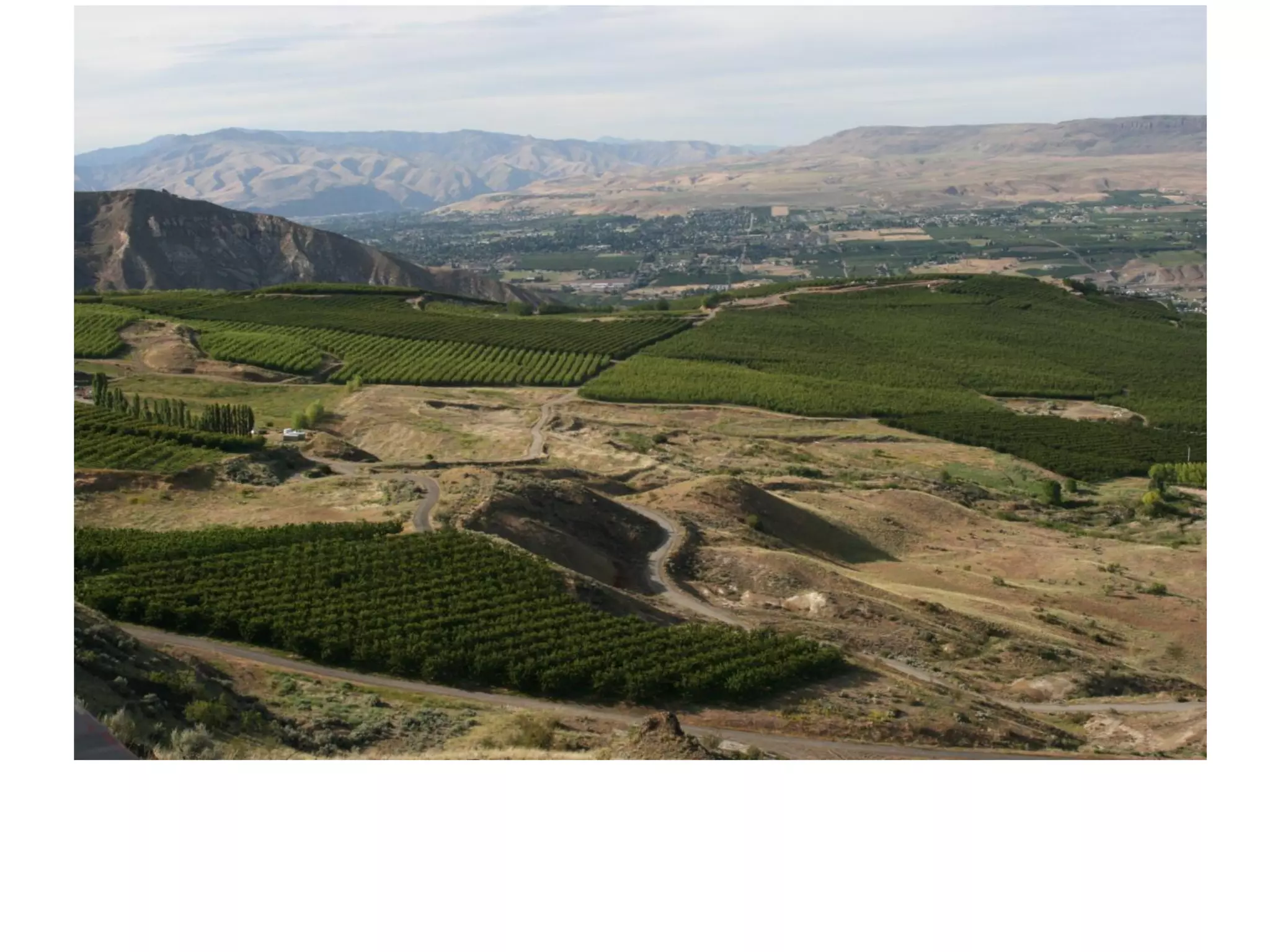
Topographic (land shape) effects
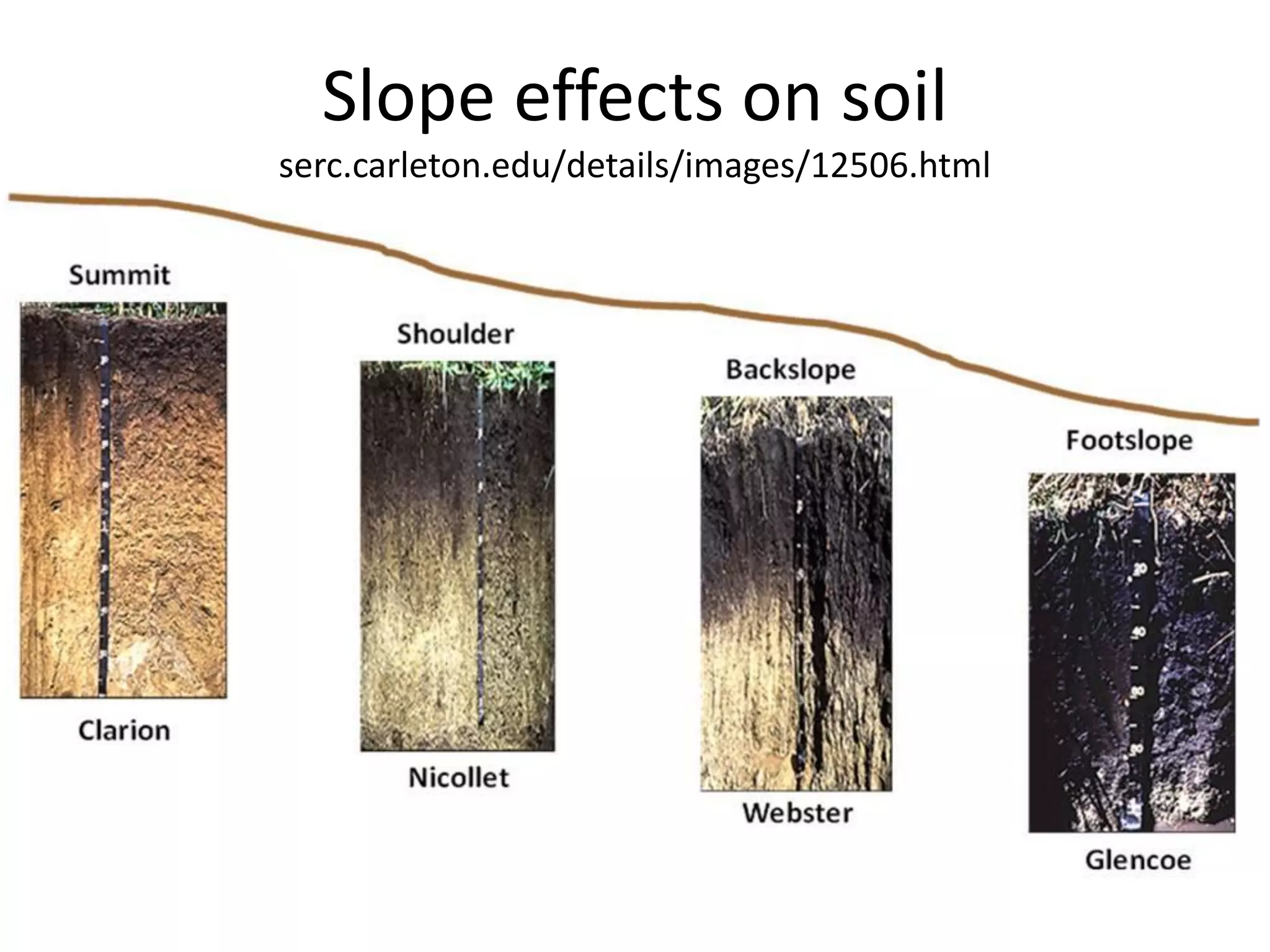
Slope effects on soil
serc.carleton.edu/details/images/12506.html
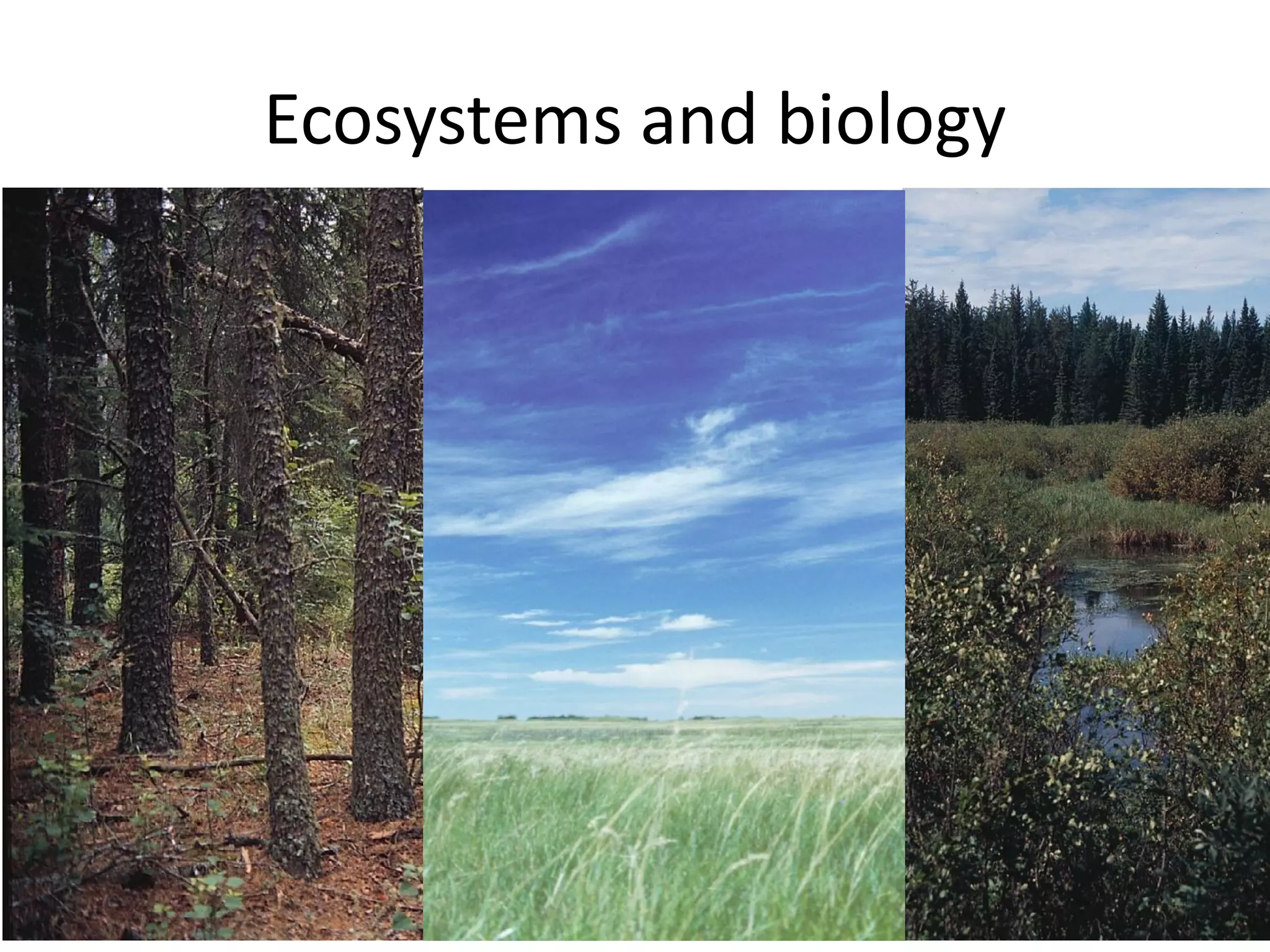
Ecosystems and biology
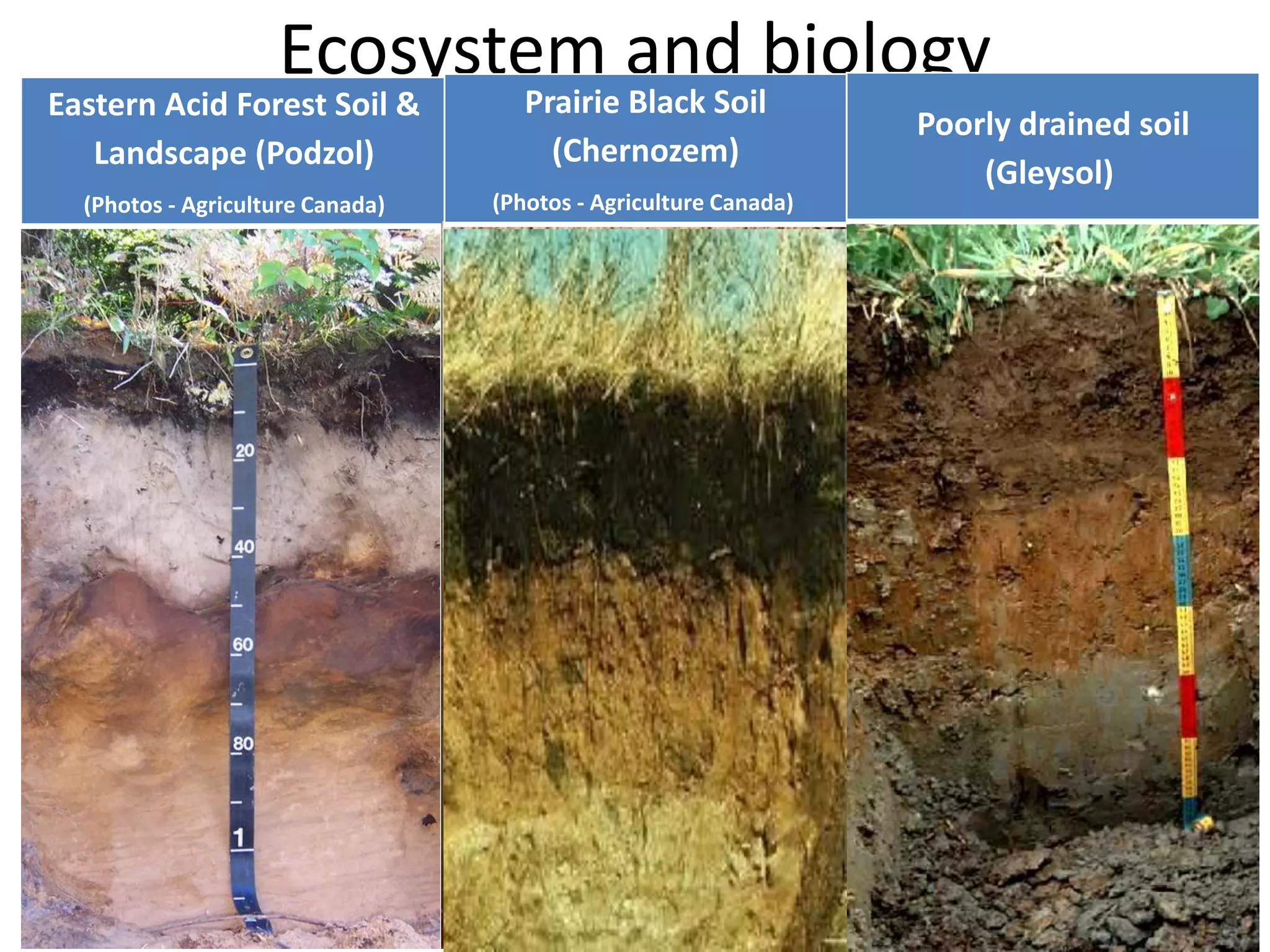
Ecosystem and biology

Eastern Acid Forest Soil &
Landscape (Podzol)

Prairie Black Soil
(Chernozem)

(Photos - Agriculture Canada)

(Photos - Agriculture Canada)

Poorly drained soil
(Gleysol)
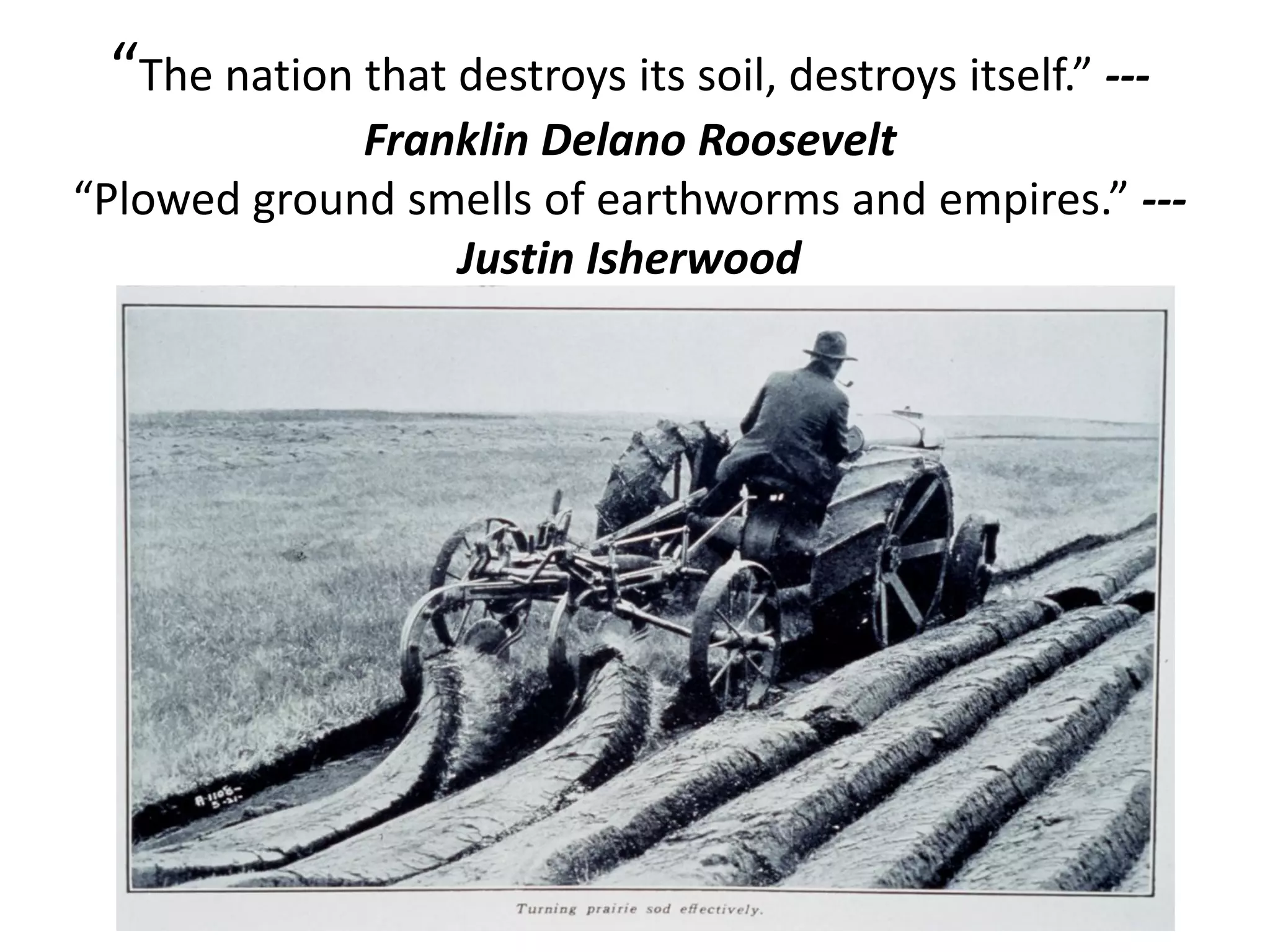
“The nation that destroys its soil, destroys itself.” --Franklin Delano Roosevelt
“Plowed ground smells of earthworms and empires.” --Justin Isherwood
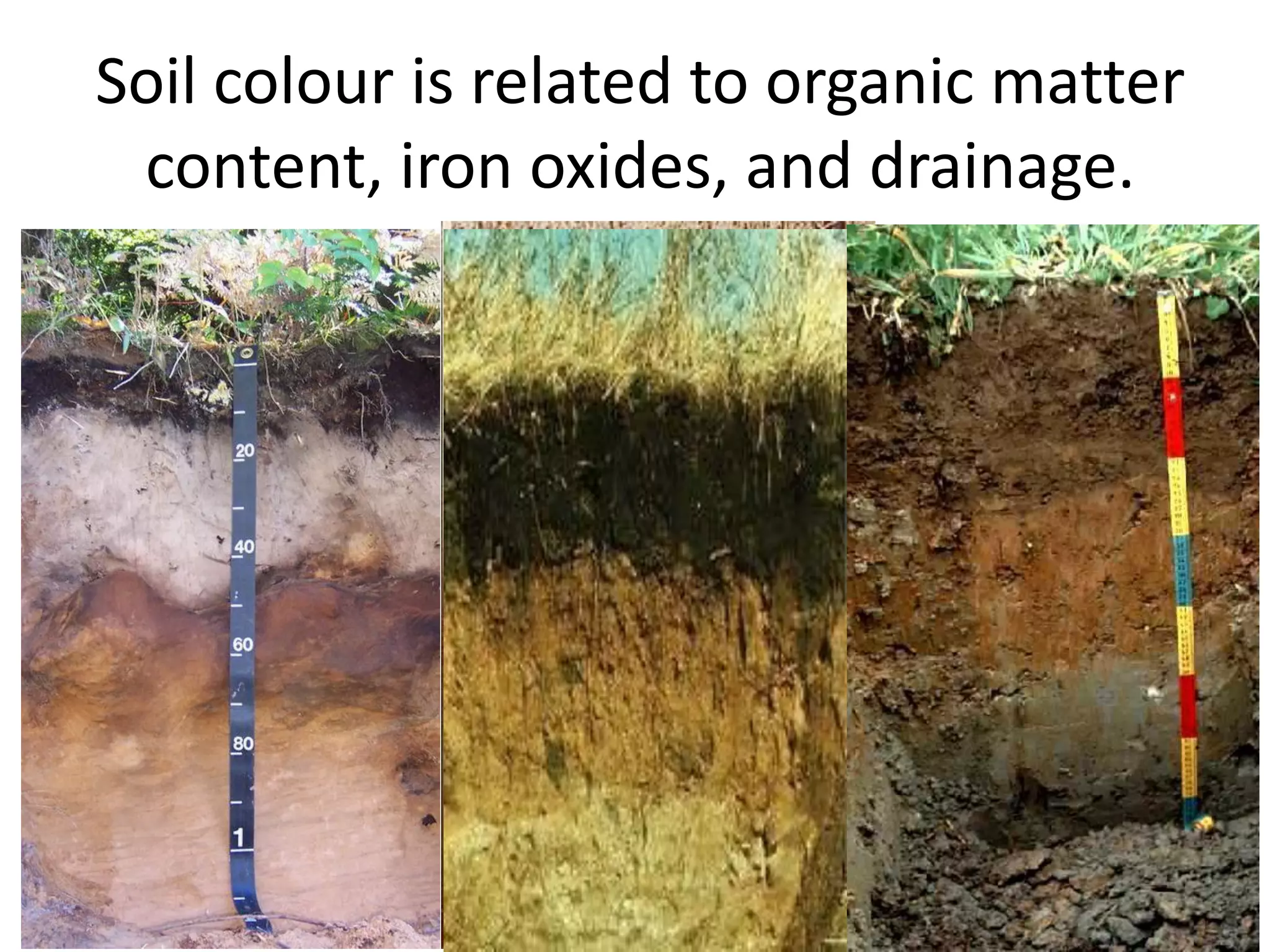
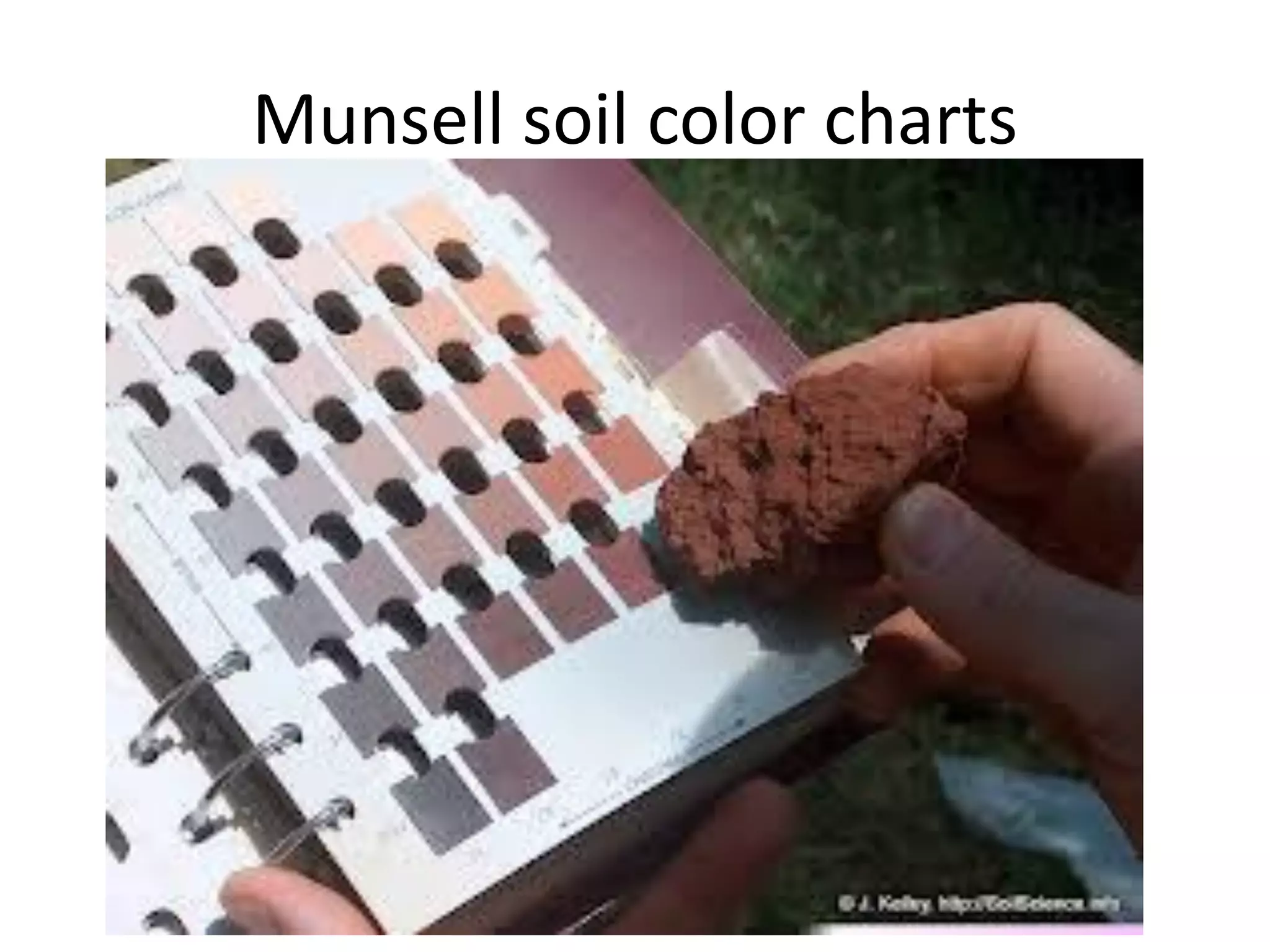
Soil colour is related to organic matter
content, iron oxides, and drainage.
Munsell soil color charts
•

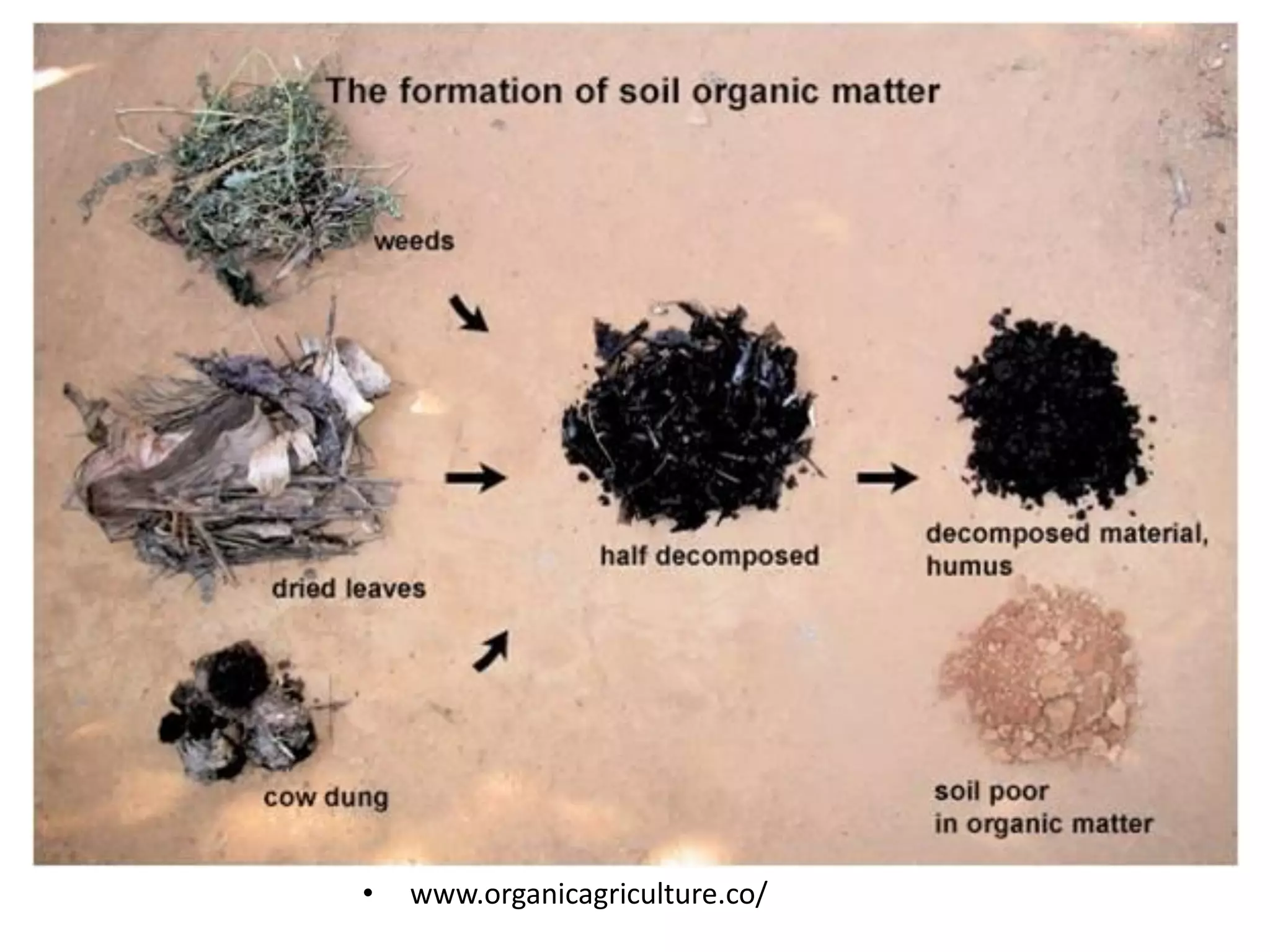
www.organicagriculture.co/
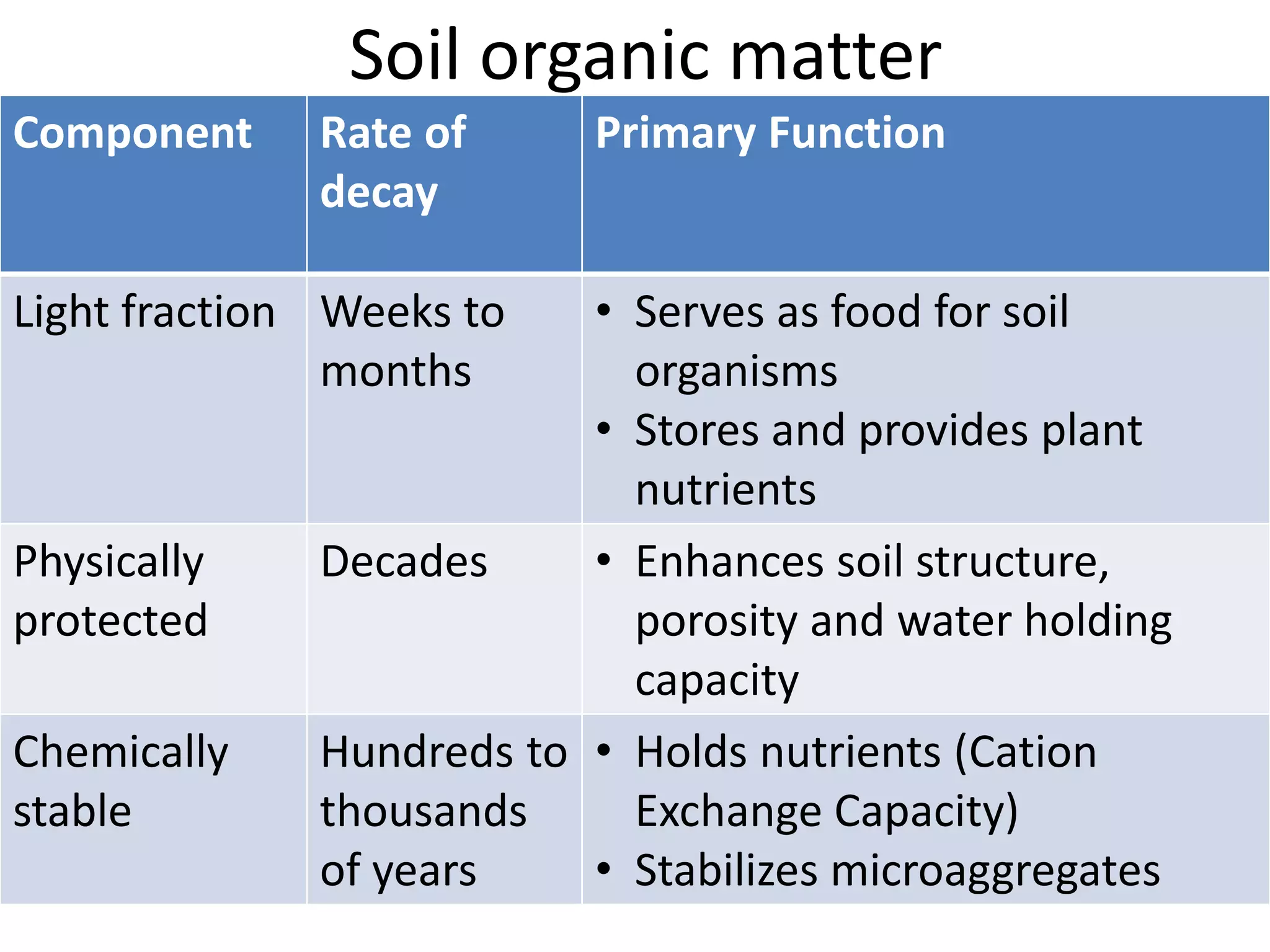
Soil organic matter
Component

Rate of
decay

• Serves as food for soil
organisms
• Stores and provides plant
nutrients
Decades
• Enhances soil structure,
porosity and water holding
capacity
Hundreds to • Holds nutrients (Cation
thousands
Exchange Capacity)
of years
• Stabilizes microaggregates

Light fraction Weeks to
months

Physically
protected
Chemically
stable

Primary Function
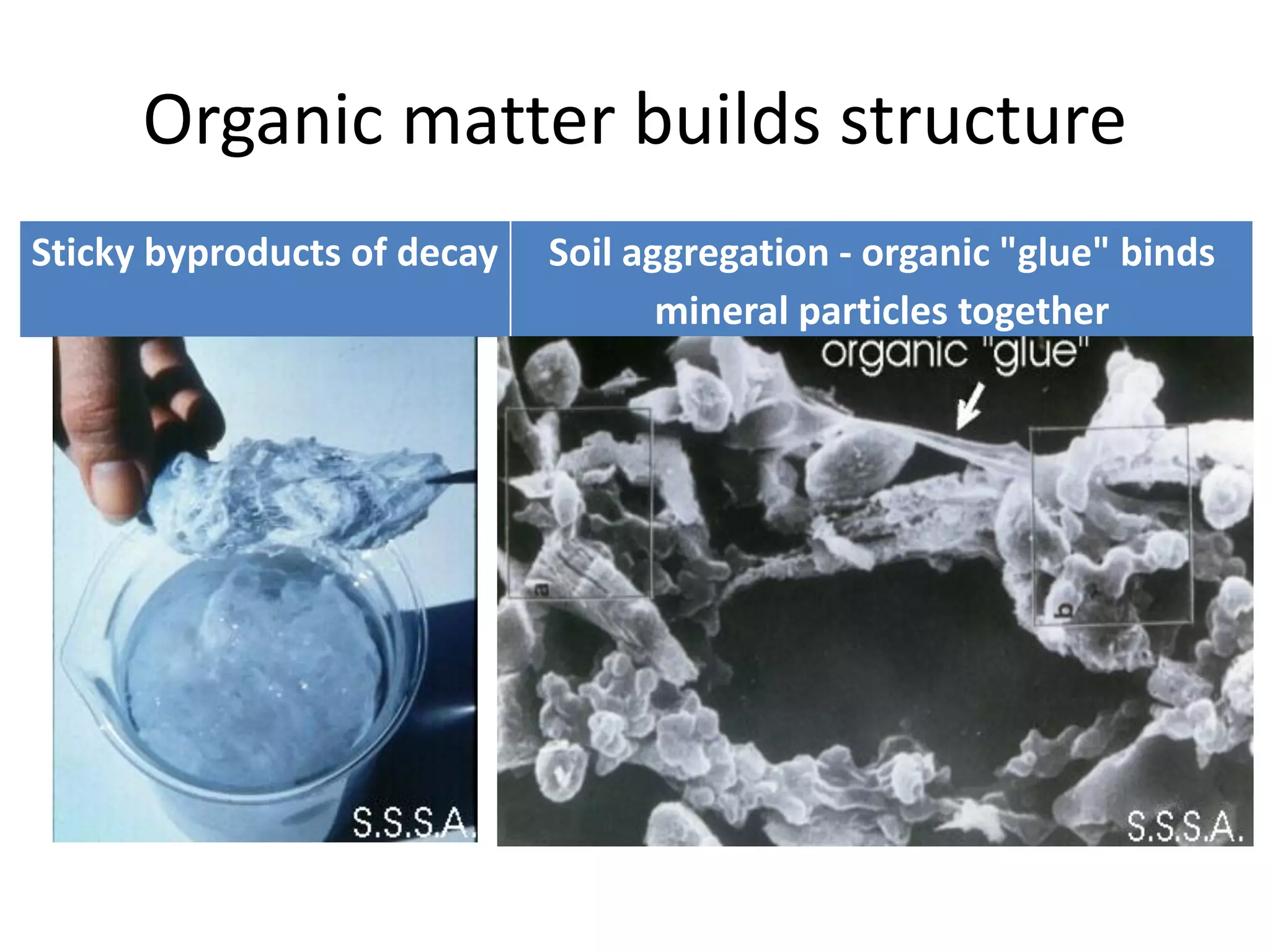
Organic matter builds structure
Sticky byproducts of decay

Soil aggregation - organic "glue" binds
mineral particles together
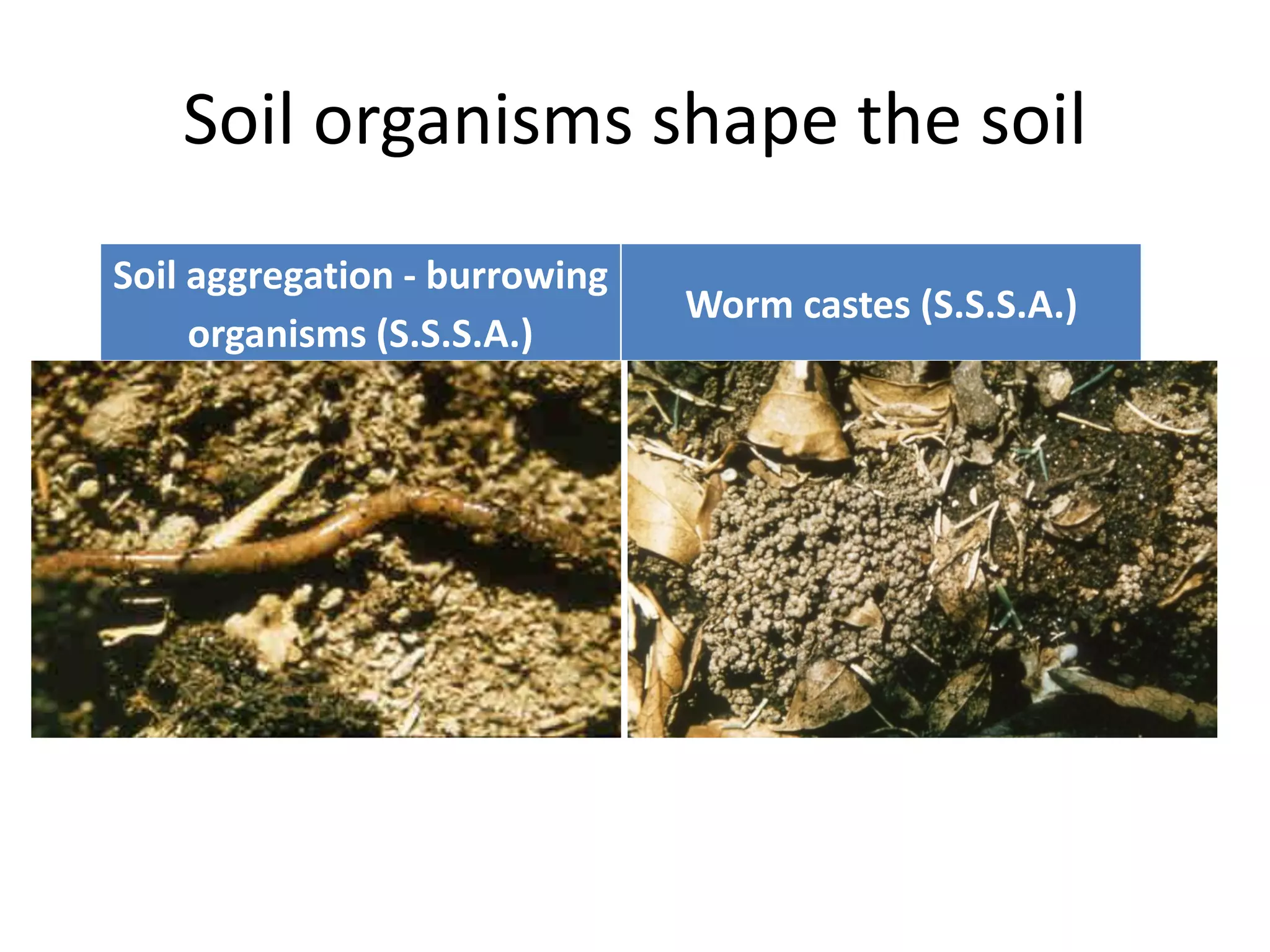
Soil organisms shape the soil
Soil aggregation - burrowing
organisms (S.S.S.A.)

Worm castes (S.S.S.A.)
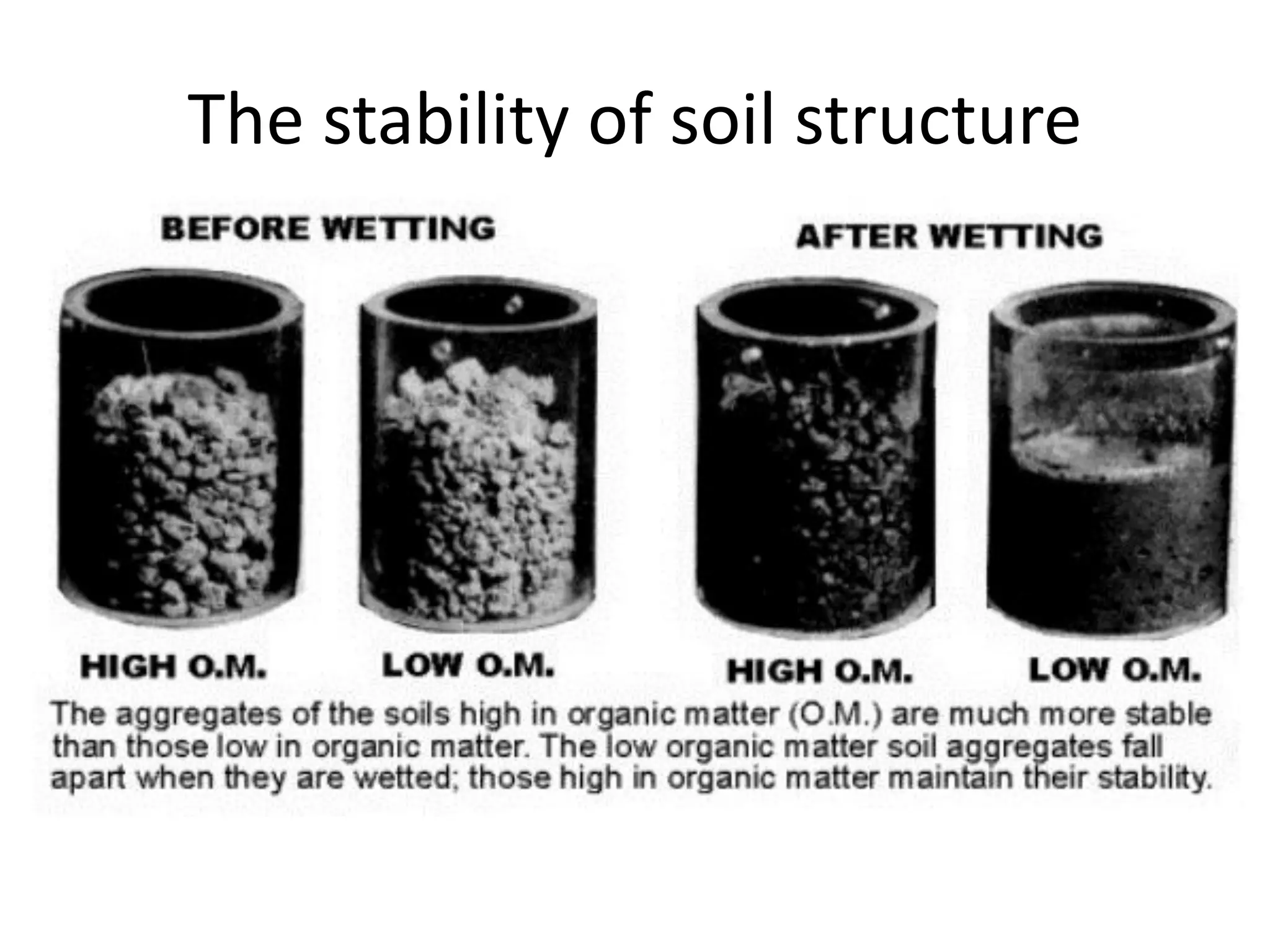
The stability of soil structure
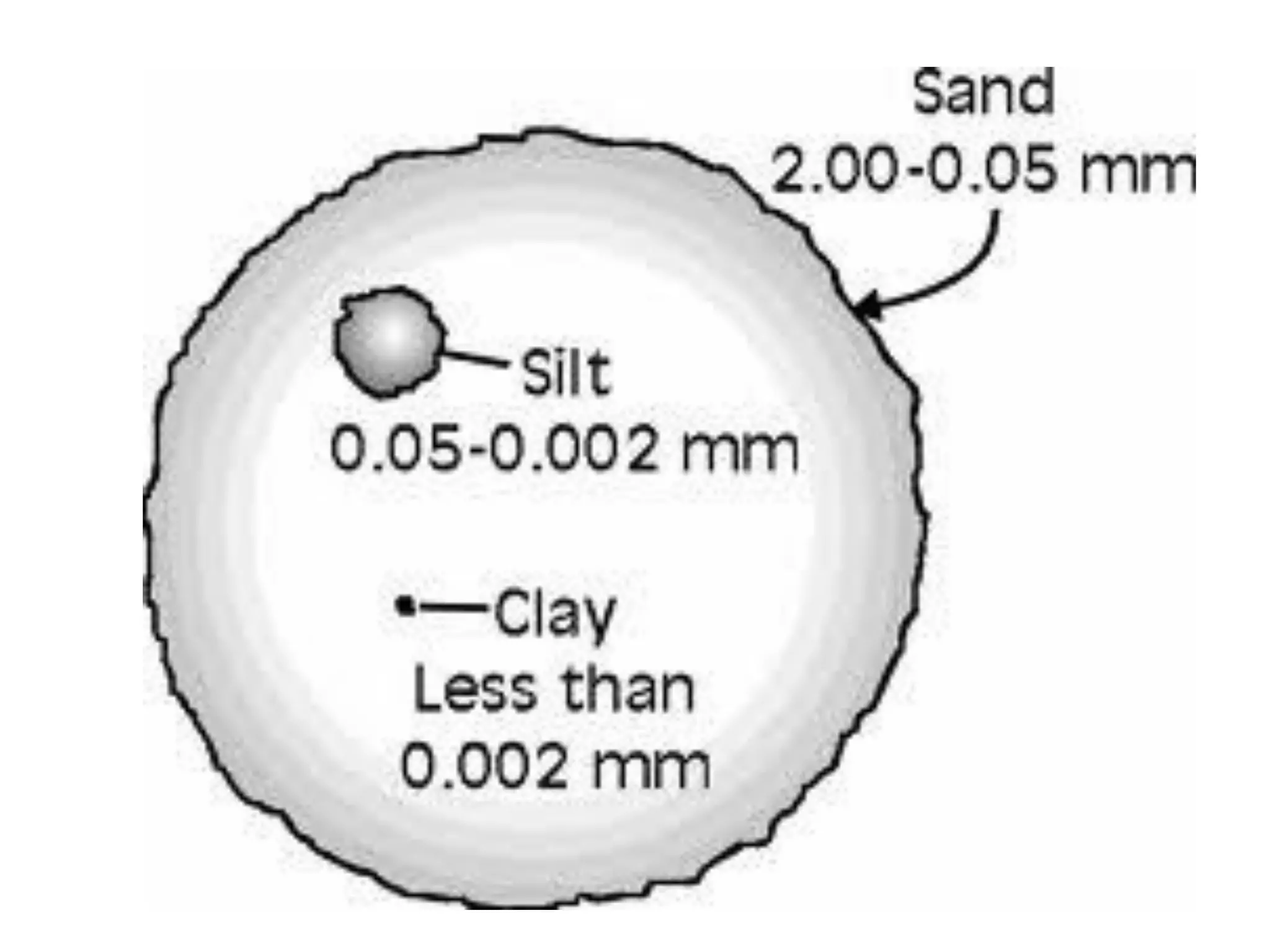
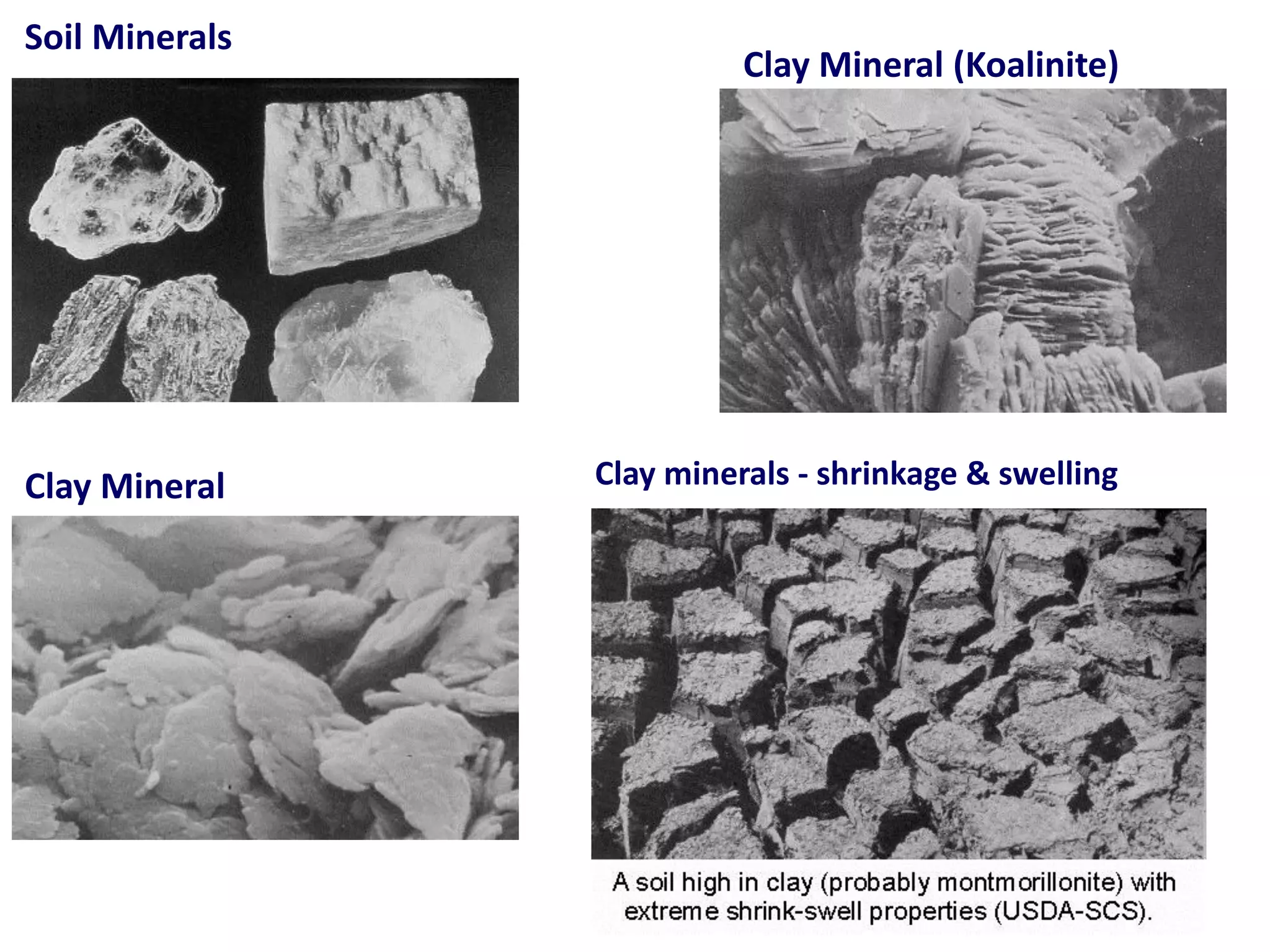
Soil Minerals

Clay Mineral

Clay Mineral (Koalinite)

Clay minerals - shrinkage & swelling
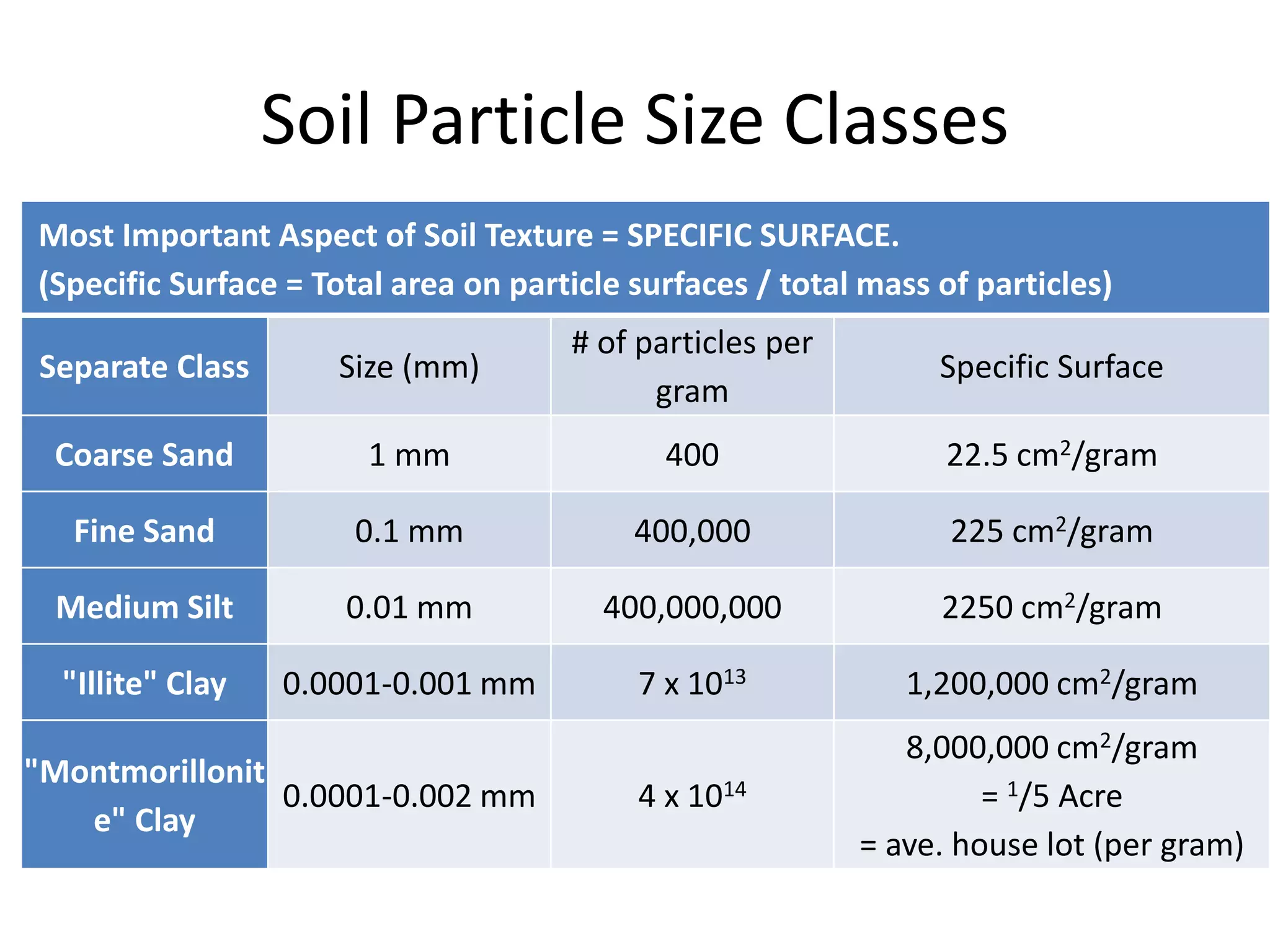
Soil Particle Size Classes
Most Important Aspect of Soil Texture = SPECIFIC SURFACE.
(Specific Surface = Total area on particle surfaces / total mass of particles)
Separate Class

Size (mm)

# of particles per
gram

Specific Surface

Coarse Sand

1 mm

400

22.5 cm2/gram

Fine Sand

0.1 mm

400,000

225 cm2/gram

Medium Silt

0.01 mm

400,000,000

2250 cm2/gram

"Illite" Clay

0.0001-0.001 mm

7 x 10¹³

1,200,000 cm2/gram

4 x 10¹⁴

8,000,000 cm2/gram
= 1/5 Acre
= ave. house lot (per gram)

"Montmorillonit
0.0001-0.002 mm
e" Clay
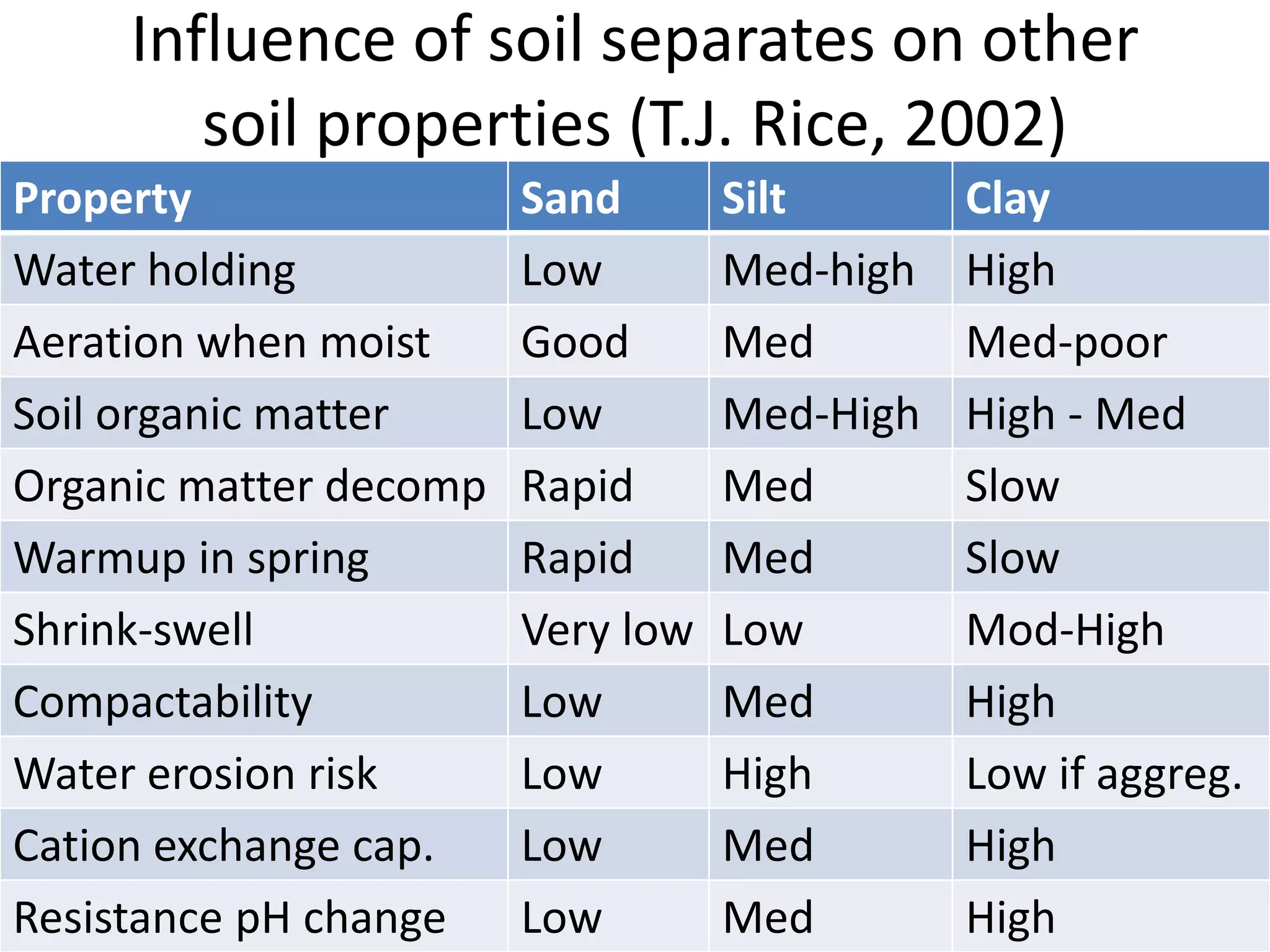
Influence of soil separates on other
soil properties (T.J. Rice, 2002)
Property
Water holding
Aeration when moist
Soil organic matter
Organic matter decomp
Warmup in spring
Shrink-swell
Compactability
Water erosion risk
Cation exchange cap.
Resistance pH change

Sand
Low
Good
Low
Rapid
Rapid
Very low
Low
Low
Low
Low

Silt
Med-high
Med
Med-High
Med
Med
Low
Med
High
Med
Med

Clay
High
Med-poor
High - Med
Slow
Slow
Mod-High
High
Low if aggreg.
High
High
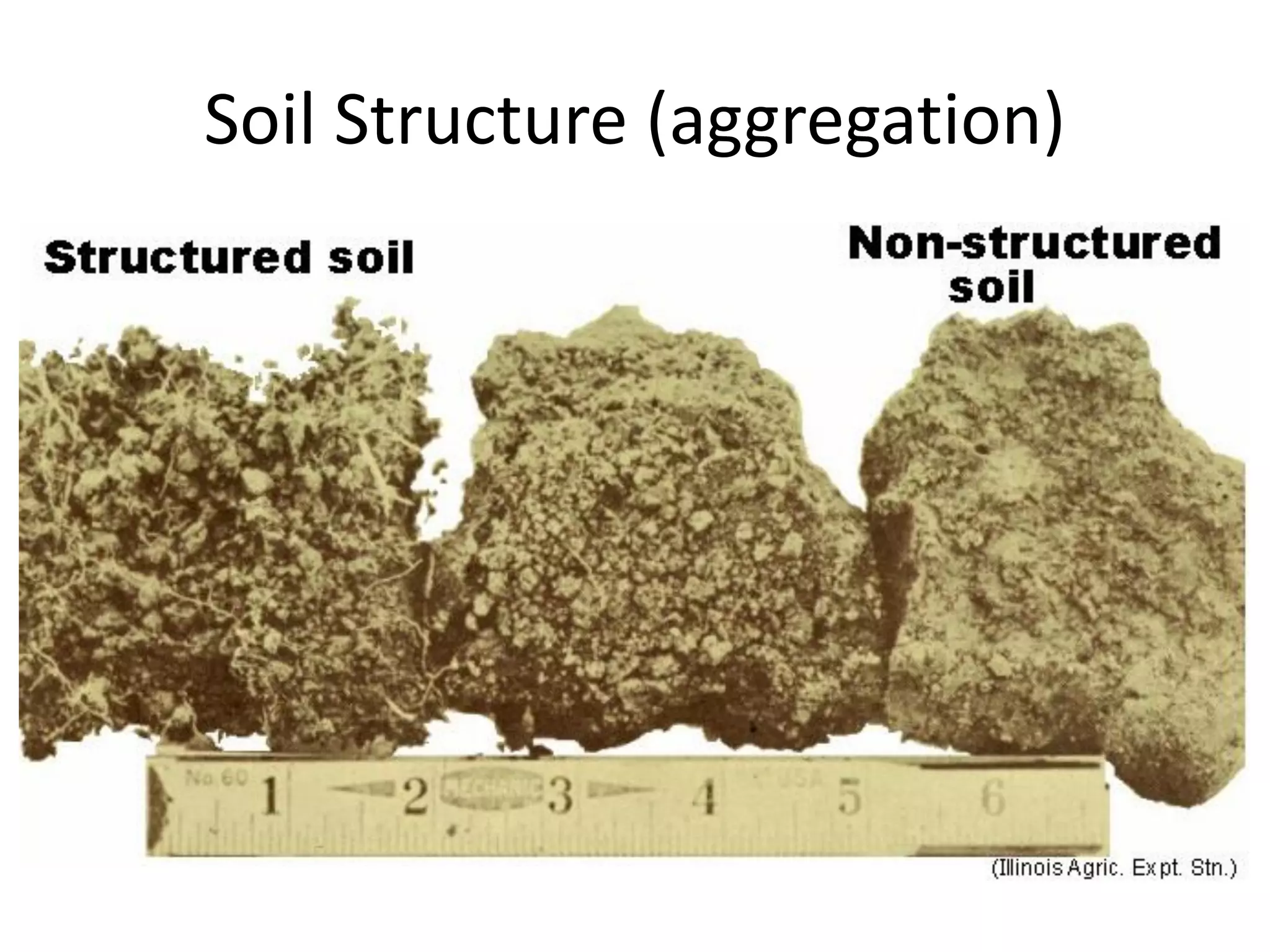
Soil Structure (aggregation)
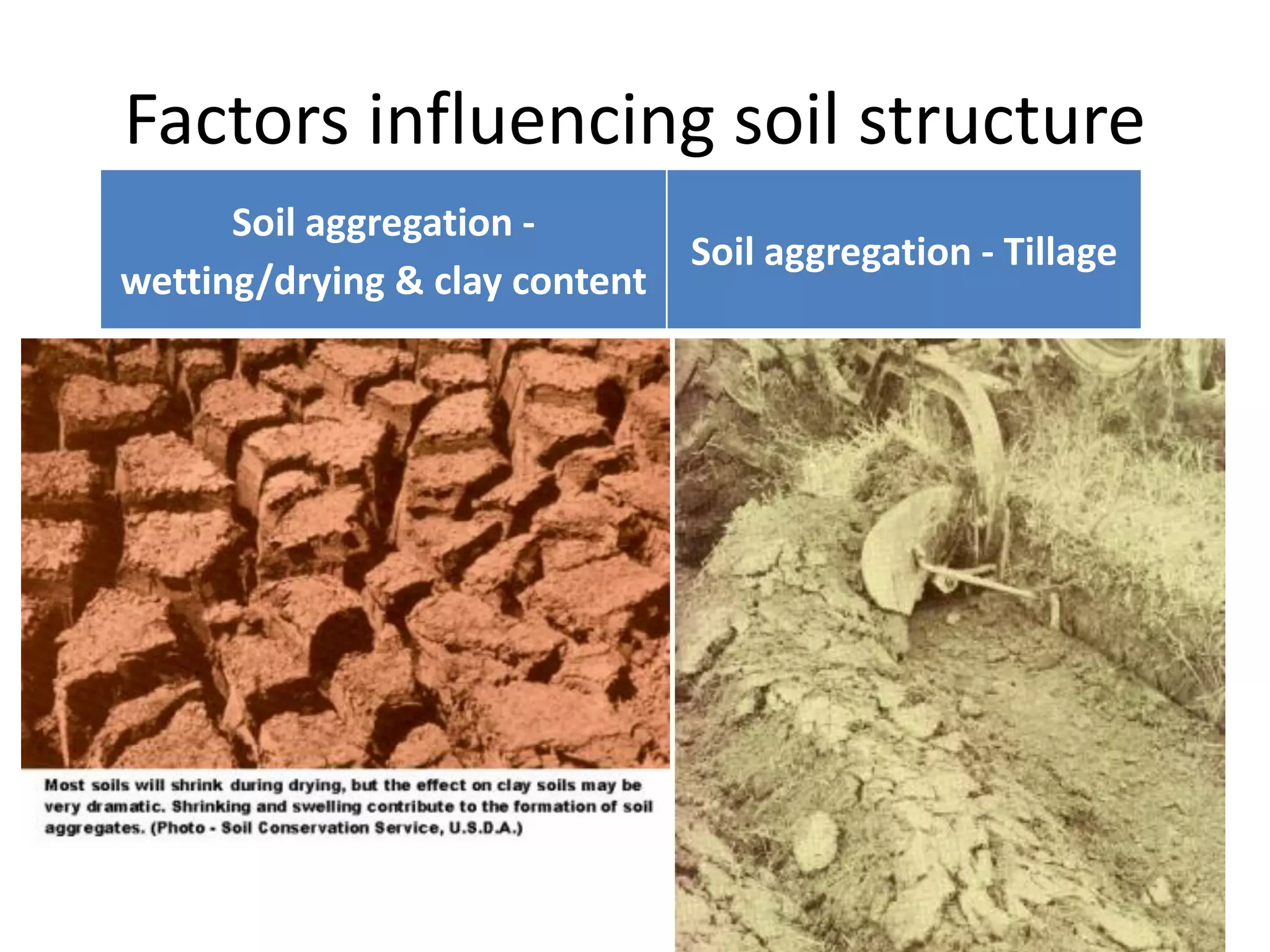
Factors influencing soil structure
Soil aggregation wetting/drying & clay content

Soil aggregation - Tillage
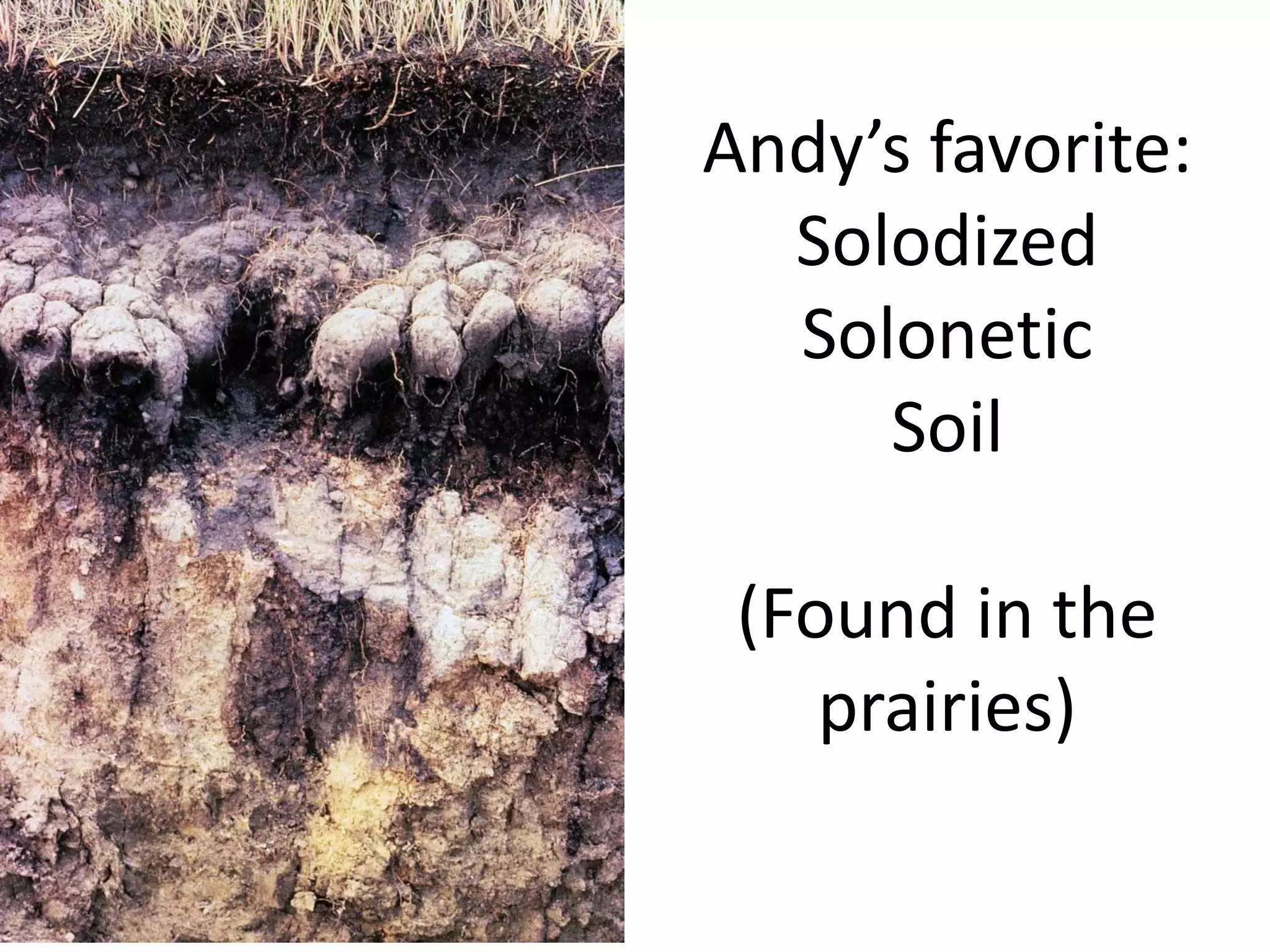
Andy’s favorite:
Solodized
Solonetic
Soil
(Found in the
prairies)
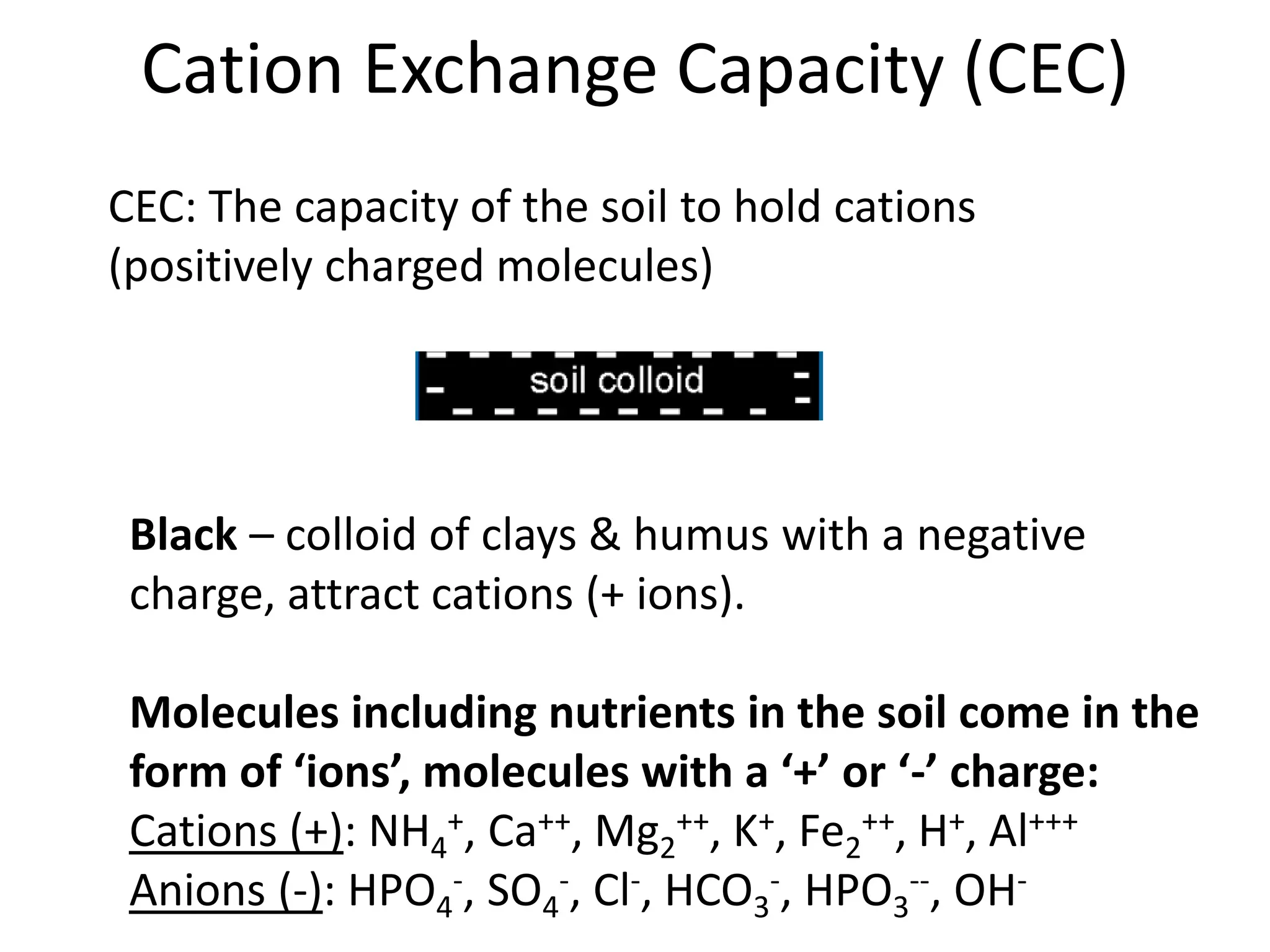
Cation Exchange Capacity (CEC)
CEC: The capacity of the soil to hold cations
(positively charged molecules)

Black – colloid of clays & humus with a negative
charge, attract cations (+ ions).
Molecules including nutrients in the soil come in the
form of ‘ions’, molecules with a ‘+’ or ‘-’ charge:
Cations (+): NH4+, Ca++, Mg2++, K+, Fe2++, H+, Al+++
Anions (-): HPO4-, SO4-, Cl-, HCO3-, HPO3--, OH-
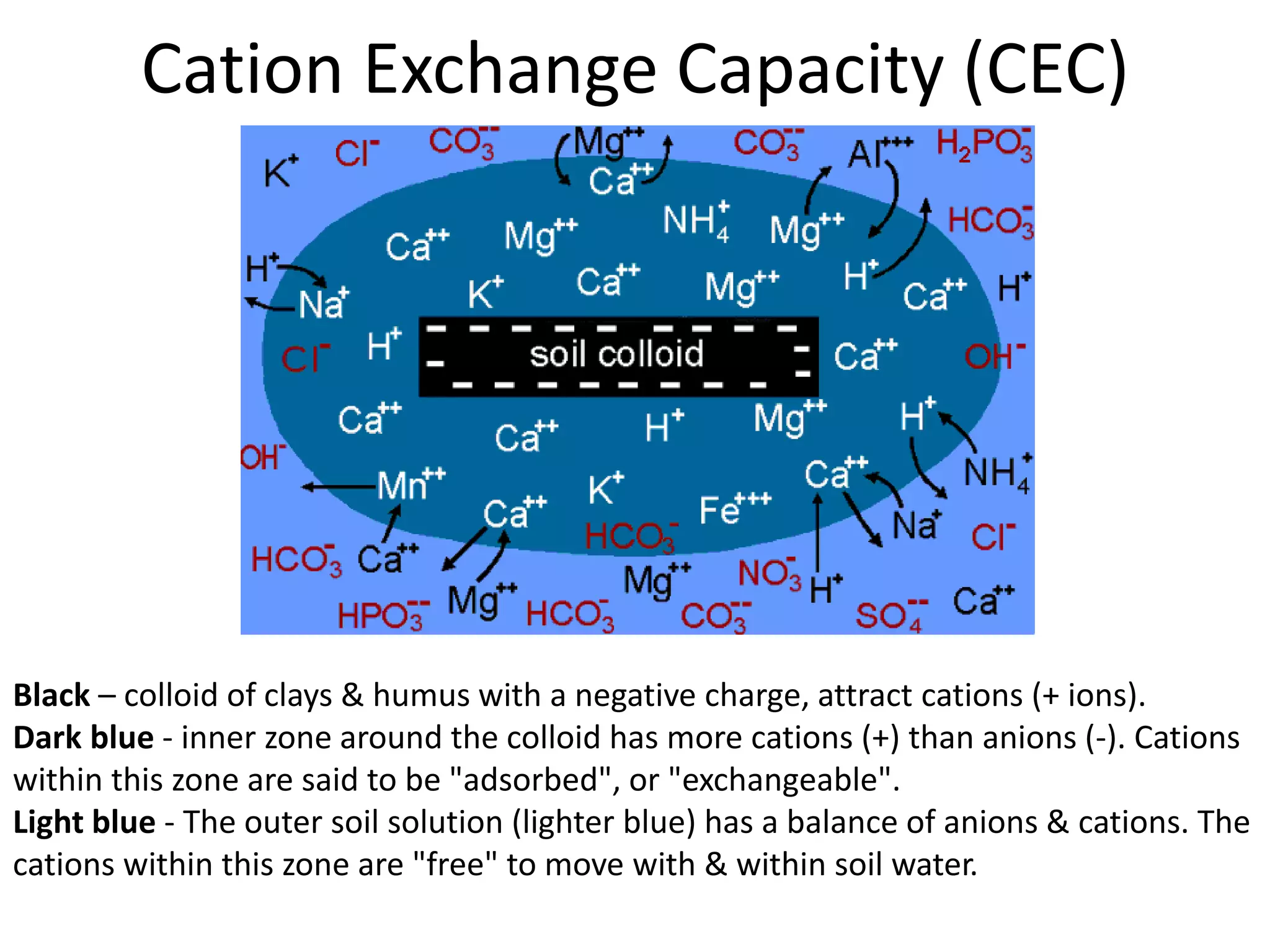
Cation Exchange Capacity (CEC)

Black – colloid of clays & humus with a negative charge, attract cations (+ ions).
Dark blue - inner zone around the colloid has more cations (+) than anions (-). Cations
within this zone are said to be "adsorbed", or "exchangeable".
Light blue - The outer soil solution (lighter blue) has a balance of anions & cations. The
cations within this zone are "free" to move with & within soil water.
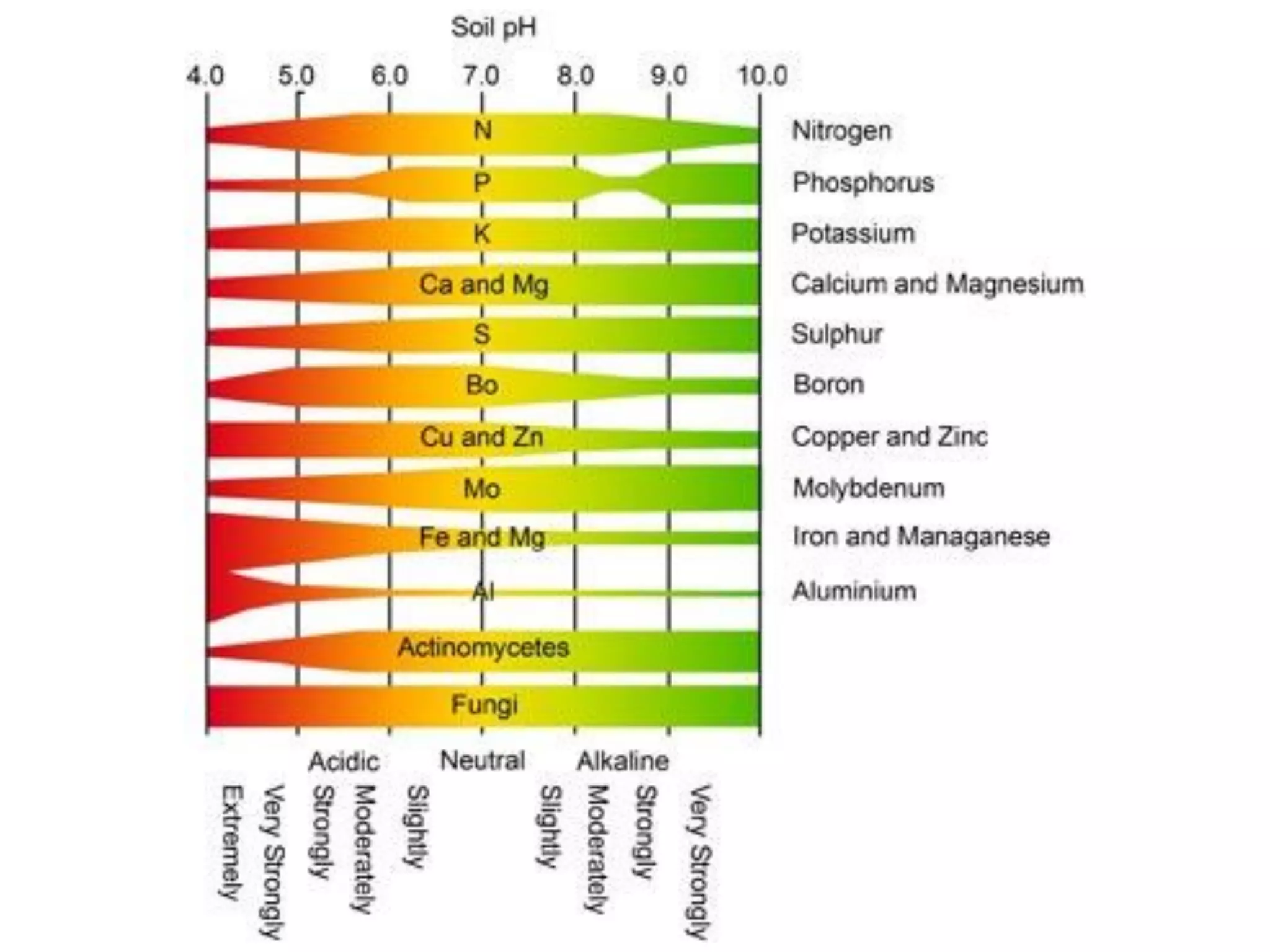
Soil pH

• pH: measure of the concentration of H+ in soil
solution:
pH = - log [H+]

• Therefore, low pH value, means high H+
concentration, and more acidic
• Higher concentration:
– Acidic or sour
– Corrodes metals
– Bumps desirable cations off of soil exchange
– Nutrient imbalance
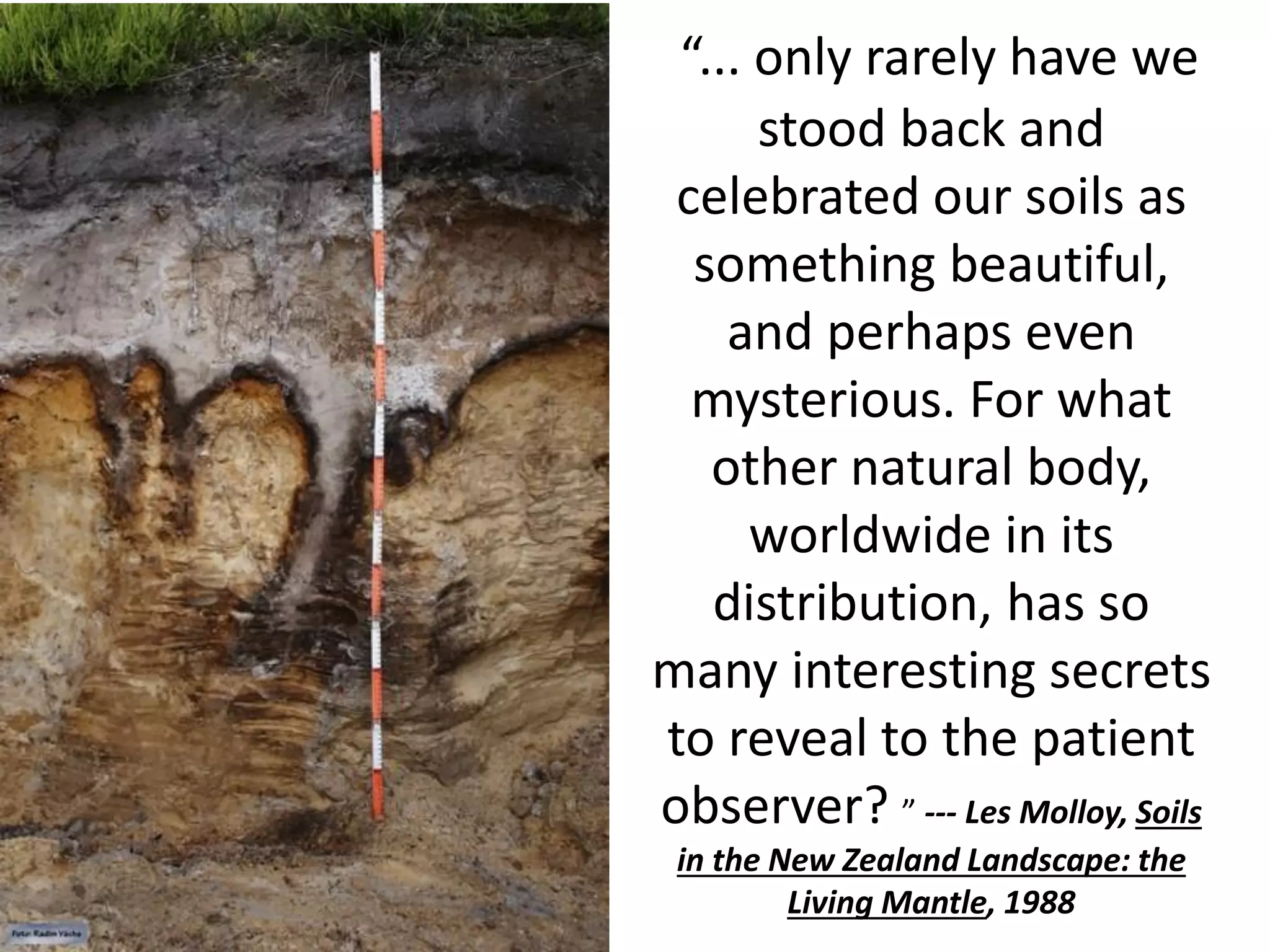
“... only rarely have we
stood back and
celebrated our soils as
something beautiful,
and perhaps even
mysterious. For what
other natural body,
worldwide in its
distribution, has so
many interesting secrets
to reveal to the patient
observer? ” --- Les Molloy, Soils
in the New Zealand Landscape: the
Living Mantle, 1988
dal.ca
www.dal.ca

Visit

OACC.INFO for

Production, research and market information
Upcoming workshops & symposiums
Virtual farm tours
Organic award winners
Organic policy toolbox
Monthly e-zine
Visit

•
•
•
•
•
•

OACC.INFO for

Production, research and market information
Upcoming workshops & symposiums
Virtual farm tours
Organic award winners
Organic policy toolbox
Monthly e-zine

Hammemermeister origin of soil & its properties.acorn

  • 1.
    dal.ca www.dal.ca The Origin ofSoil and Its Properties Andrew Hammermeister Organic Agriculture Centre of Canada Dalhousie University, Faculty of Agriculture
  • 2.
    How can Ilive my life stepping on this stuff and not wonder at all? William Bryant
  • 3.
    “Probably more harmhas been done to soil science by the almost universal attempts to look upon the soil merely as a producer of crops rather than as a natural body worth in and for itself of all the study that can be devoted to it, than most men realize.” --- C. F. Marbut, 1920
  • 4.
    A Rainbow ofSoil A rainbow of soil is under our feet; Red as a barn and black as a peat. It’s yellow as lemon and white as the snow; Bluish gray. So many colors below. Hidden in darkness as thick as the night; The only rainbow that can form without light. Dig you a pit, or bore you a hole, you’ll find enough colors to well rest your soul. F.D. Hole, 1985
  • 5.
    Soil is anynaturally-occurring, unconsolidated (loose) material on the surface of the earth, which will support plant growth.
  • 6.
    Soil • Basic resourcesustaining all terrestrial ecosystems. • Soils are not a renewable resource in the scale of human lifetimes. • Most soil profiles are thousand of years in the making • In some regions of the world, human activities are destroying some soils faster than nature can rebuild/restore them
  • 7.
    Soil performs 3main functions: 1. Provide a medium for plant growth 2. Regulate and partition water flow through the environment 3. Serve as an environmental buffer a. Can hold nutrients and release them as required by plants b. Can also breakdown harmful compounds into substances that are not toxic to plants and animals (limited ability).
  • 8.
    Soil is aproduct of: Parent material Climate Topography Biology Time Humans!
  • 11.
    Influence of Parent(geological) Material Glacial deposition (Photo K.Murray) Glacial Action (Photo J.C.Miller) Soil formed on Glacial "Till" (Photo Dr.J.A.Robertson)
  • 12.
    Fluvial materials –sorted by water
  • 13.
    Aeolian materials –sorted by wind
  • 14.
    Influence of Parent(geological) Material Bedrock (Photo A.R.Aandahl) Fluvial sediment (river deposits) (Photo A.R.Aandahl) Loess (wind deposits) (Photo A.R.Aandahl
  • 15.
    Influence of Parent(geological) Material Tidal deposits (Photo J.C.Miller) Tidal landscape (Stewiacke River) (Photo J.C.Miller)
  • 16.
    Influence of Climate(precipitation)
  • 17.
    “Essentially, all lifedepends upon the soil ... There can be no life without soil and no soil without life; they have evolved together.” --- Charles E. Kellogg, USDA Yearbook of Agriculture, 1938
  • 18.
    Soil Ecology The soilbiological community can weigh from 1100 to 14000 kg/ha; a similar weight as 2 to 28 yearling steers! Over 1 billion microbes in 1 tsp of a fertile soil
  • 19.
  • 20.
  • 21.
  • 22.
    Slope effects onsoil serc.carleton.edu/details/images/12506.html
  • 23.
  • 24.
    Ecosystem and biology EasternAcid Forest Soil & Landscape (Podzol) Prairie Black Soil (Chernozem) (Photos - Agriculture Canada) (Photos - Agriculture Canada) Poorly drained soil (Gleysol)
  • 25.
    “The nation thatdestroys its soil, destroys itself.” --Franklin Delano Roosevelt “Plowed ground smells of earthworms and empires.” --Justin Isherwood
  • 32.
    Soil colour isrelated to organic matter content, iron oxides, and drainage.
  • 33.
  • 34.
  • 35.
    Soil organic matter Component Rateof decay • Serves as food for soil organisms • Stores and provides plant nutrients Decades • Enhances soil structure, porosity and water holding capacity Hundreds to • Holds nutrients (Cation thousands Exchange Capacity) of years • Stabilizes microaggregates Light fraction Weeks to months Physically protected Chemically stable Primary Function
  • 36.
    Organic matter buildsstructure Sticky byproducts of decay Soil aggregation - organic "glue" binds mineral particles together
  • 37.
    Soil organisms shapethe soil Soil aggregation - burrowing organisms (S.S.S.A.) Worm castes (S.S.S.A.)
  • 38.
    The stability ofsoil structure
  • 39.
    Soil Minerals Clay Mineral ClayMineral (Koalinite) Clay minerals - shrinkage & swelling
  • 41.
    Soil Particle SizeClasses Most Important Aspect of Soil Texture = SPECIFIC SURFACE. (Specific Surface = Total area on particle surfaces / total mass of particles) Separate Class Size (mm) # of particles per gram Specific Surface Coarse Sand 1 mm 400 22.5 cm2/gram Fine Sand 0.1 mm 400,000 225 cm2/gram Medium Silt 0.01 mm 400,000,000 2250 cm2/gram "Illite" Clay 0.0001-0.001 mm 7 x 10¹³ 1,200,000 cm2/gram 4 x 10¹⁴ 8,000,000 cm2/gram = 1/5 Acre = ave. house lot (per gram) "Montmorillonit 0.0001-0.002 mm e" Clay
  • 43.
    Influence of soilseparates on other soil properties (T.J. Rice, 2002) Property Water holding Aeration when moist Soil organic matter Organic matter decomp Warmup in spring Shrink-swell Compactability Water erosion risk Cation exchange cap. Resistance pH change Sand Low Good Low Rapid Rapid Very low Low Low Low Low Silt Med-high Med Med-High Med Med Low Med High Med Med Clay High Med-poor High - Med Slow Slow Mod-High High Low if aggreg. High High
  • 44.
  • 46.
    Factors influencing soilstructure Soil aggregation wetting/drying & clay content Soil aggregation - Tillage
  • 47.
  • 48.
    Cation Exchange Capacity(CEC) CEC: The capacity of the soil to hold cations (positively charged molecules) Black – colloid of clays & humus with a negative charge, attract cations (+ ions). Molecules including nutrients in the soil come in the form of ‘ions’, molecules with a ‘+’ or ‘-’ charge: Cations (+): NH4+, Ca++, Mg2++, K+, Fe2++, H+, Al+++ Anions (-): HPO4-, SO4-, Cl-, HCO3-, HPO3--, OH-
  • 49.
    Cation Exchange Capacity(CEC) Black – colloid of clays & humus with a negative charge, attract cations (+ ions). Dark blue - inner zone around the colloid has more cations (+) than anions (-). Cations within this zone are said to be "adsorbed", or "exchangeable". Light blue - The outer soil solution (lighter blue) has a balance of anions & cations. The cations within this zone are "free" to move with & within soil water.
  • 50.
    Soil pH • pH:measure of the concentration of H+ in soil solution: pH = - log [H+] • Therefore, low pH value, means high H+ concentration, and more acidic • Higher concentration: – Acidic or sour – Corrodes metals – Bumps desirable cations off of soil exchange – Nutrient imbalance
  • 52.
    “... only rarelyhave we stood back and celebrated our soils as something beautiful, and perhaps even mysterious. For what other natural body, worldwide in its distribution, has so many interesting secrets to reveal to the patient observer? ” --- Les Molloy, Soils in the New Zealand Landscape: the Living Mantle, 1988
  • 53.
    dal.ca www.dal.ca Visit OACC.INFO for Production, researchand market information Upcoming workshops & symposiums Virtual farm tours Organic award winners Organic policy toolbox Monthly e-zine
  • 54.
    Visit • • • • • • OACC.INFO for Production, researchand market information Upcoming workshops & symposiums Virtual farm tours Organic award winners Organic policy toolbox Monthly e-zine