Welcome!
We will start shortly, but are waiting for people to join,
don’t worry if you can’t hear anything yet.
Before we start we will be going through some E-Seminar
housekeeping items, so that everyone can participate
fully in the online meeting
If you are having difficulties joining the meeting please
call Sue O’Neil on 0116 295 0081
NHS Improving Quality
Process Mapping
1. Welcome and Introduction
2. Housekeeping
3. Process mapping for those new to service improvement
4. Decide what is to be process mapped
5. Engage with key stakeholders and plan a process mapping session
6. Create the current state process map
7. Value streams
8. Analyse and improve the process map
9. Shaping a future state process map
10. Mapping top tips
11. What use is mapping?
12. Links and Contacts details
AGENDA
NHS Improving Quality
Process Mapping
www.nhsiq.nhs.uk
Welcome and Introduction
Elaine Kemp
Programme Delivery Manager
Living longer Lives
Jeri Hawkins
Mental Health and Dementia
Delivery Support Manager
• During the E-Seminar we will mute all delegate’s lines throughout
the presentation.
• If at other times you are in a noisy environment please mute your
line by pressing the mute button on your screen (this can be
found on the right hand side of the screen)
• If you would like to ask a question please use the raise hand
button (this can be found on the right hand side of the screen)
• This is an interactive session, please add your comments, and
thoughts into the chat box as we go through the presentation.
• At the Q&A session, type your question into the chat, or raise your
hand, we will un-mute all lines during the Q&A.
• If you are having any technical problems, send a message to the
Host via the chat panel or call Sue O’Neil on 0116 295 0081
• We will now start recording this Webinar
What is a process map?
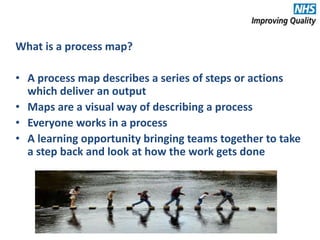
• A process map describes a series of steps or actions
which deliver an output
• Maps are a visual way of describing a process
• Everyone works in a process
• A learning opportunity bringing teams together to take
a step back and look at how the work gets done
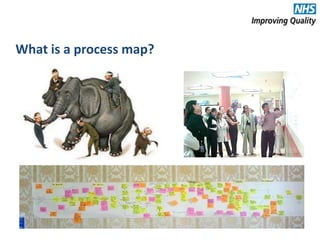
What is a process map?
What will you process map and why?
Process maps help clarify what we do and why
we do it – highlight opportunities for
improvement
Identifies –
• Bottle neck – delays
• Unnecessary steps – don’t add value/waste
• Duplication and rework
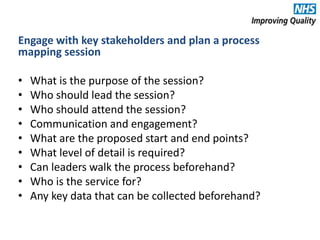
Engage with key stakeholders and plan a process
mapping session
• What is the purpose of the session?
• Who should lead the session?
• Who should attend the session?
• Communication and engagement?
• What are the proposed start and end points?
• What level of detail is required?
• Can leaders walk the process beforehand?
• Who is the service for?
• Any key data that can be collected beforehand?
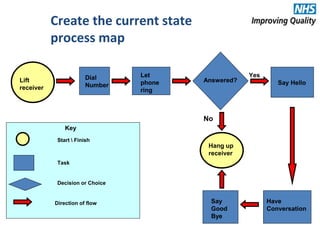
Lift
receiver
Dial
Number
Let
phone
ring
Say Hello
Have
Conversation
Say
Good
Bye
Hang up
receiver
Answered?
Yes
No
Start  Finish
Task
Decision or Choice
Direction of flow
Key
Create the current state
process map
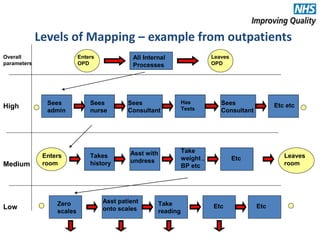
Levels of Mapping – example from outpatients
Enters
OPD
All Internal
Processes
Leaves
OPD
Sees
admin
Sees
nurse
Sees
Consultant
Has
Tests
Sees
Consultant
Etc etcHigh
Medium
Enters
room
Takes
history
Asst with
undress
Take
weight ,
BP etc
Etc Leaves
room
Asst patient
onto scales
Zero
scales
Take
reading
EtcLow
Overall
parameters
Etc
Choose & Book
(C&B)
Fully Booked System
Admin post x
GP Paper
Referrals
Partially Booked
Non GP
•DVLA
•Consultants
•Community
Services
•Dental
•Self Referral
Print off ‘Work List’
of new
received referrals
Daily in AM
Update form with
•UBRN
•NHS No
•Hospital No
•Breach date
•Appointment Date
•Clinic Code
•Consultant
See Example form XX
Attach completed
UHL’s C&B ‘Referral
Tracking Form’
Take referral letters
and Referral Tracking
form (C&B only) to
Medical Secretary
Daily in AM for
Consultant Grading
OPW List Team
receive graded referral
letter back from
Medical Secretary and
any signed test
request cards
Rejected
Accepted
OPW List Team update the
HISS system
GP not always creating and attaching
referral letter to the C&B system within
48 hrs. Takes time to chase.
The ‘Status column on the work list
does not update from ‘Never Reviewed
Status’’. Useful if could identify if letters
have been printed
See Example form XX
Check C&B System for Referral Letter Print off Referral Letter
Check
HISS for
UBRN
Creation
date &
Clinician
Letters not always attached on the C&B
system in a Word Format. Takes time to
convert from ‘Rich Text, and print them off.
There is no facility to resave the Word version
on the system by the OPW List team
Not all GP’s are able to attach more than one
document to the system and fax over other
documents. Not going to a central number
Work list does
not identify:
•Consultant to
be seen
•Date UBRN
created.
Have to check
on Hiss
Letter received by
and is date
stamped by
•OPW List Team
•Medical
Secretary – gives
to OPW team
Check HISS to identify if patient has
been seen in the hospital previously
to ensure there is only one set of
medical notes
Register the
referral letter on
HISS
Stamp Letter with
‘Outcomes List’’
See Example XX
This creates and
opens an episode
Patients may have more than one UHL
number. Need to get them merged via
medical records
Can have system numbers
OPW List team can allocate U number
Referral Received
Referral letters do
not always have all
the information
required on them.
Will now go on
Booking List with
Partial Booking
Team and chased
weekly if not
returnedIf test required
card requests are
taken to the
Investigations
Dept by the OPW
List Team
Update with
•Tests required
•Breach date
•Appt date for clinic
Not all GP’s are
using the system
ProcessWhat is done Issues
OPW List team send appointment
confirmation to patient.
Discharged
Letter cc to GP by
Medical Secretary
Referred onto another consultant (cardiologist / cardiac
surgeon)
Due to lack of information on C&B website, the initial
referral was sent to wrong cardiology consultant
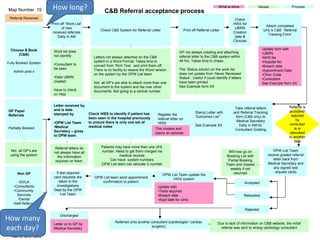
Map Number 19 C&B Referral acceptance process
Name and date
Rebooked
Referral is
accepted/
rejected
by
consultan
ts or
rebooked
to another
date
How long?
How many
each day?
Is it a Value Stream or Process Map?
• What the heck is a “Value Stream”?
• Why does it matter to me?
• What is the difference between a Value Stream
Map and a process map?
• When should I use a Value Stream Map
Value Streams
• Concept from Lean (Toyota Production System)
• Mapping and visualisation of complexity brings about
shared understanding
– Real benefit in the mapping process itself
• Value stream = broad & wide view
– Use for identifying improvement opportunities across
departments/organisations
• Process map/chart = detailed micro-level
– Use for identifying specific improvements and waste at a
detailed level
• Which to use – Both!
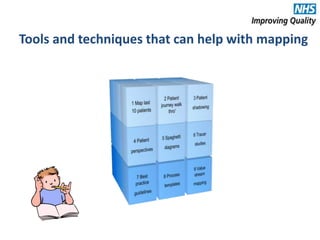
Tools and techniques that can help with mapping
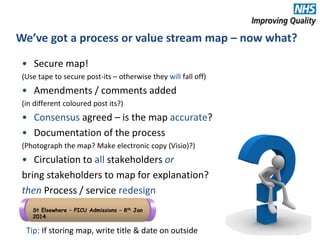
We’ve got a process or value stream map – now what?
• Secure map!
(Use tape to secure post-its – otherwise they will fall off)
• Amendments / comments added
(in different coloured post its?)
• Consensus agreed – is the map accurate?
• Documentation of the process
(Photograph the map? Make electronic copy (Visio)?)
• Circulation to all stakeholders or
bring stakeholders to map for explanation?
then Process / service redesign
St Elsewhere – PICU Admissions – 8th Jan
2014
Tip: If storing map, write title & date on outside
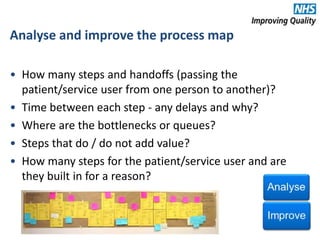
Analyse and improve the process map
• How many steps and handoffs (passing the
patient/service user from one person to another)?
• Time between each step - any delays and why?
• Where are the bottlenecks or queues?
• Steps that do / do not add value?
• How many steps for the patient/service user and are
they built in for a reason?
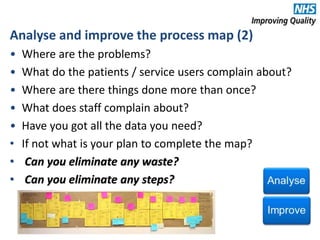
Analyse and improve the process map (2)
• Where are the problems?
• What do the patients / service users complain about?
• Where are there things done more than once?
• What does staff complain about?
• Have you got all the data you need?
• If not what is your plan to complete the map?
• Can you eliminate any waste?
• Can you eliminate any steps?
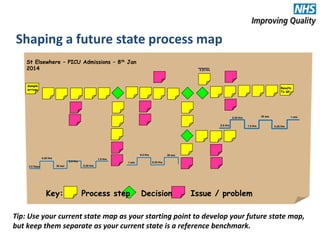
Shaping a future state process map
0.25 Hrs
0.25 Hrs30 sec2.0 Days
0.5 Hrs
1.5 Hrs
0.25 Hrs
30 sec0.5 Hrs
1 min
Sample
arrives
Results
To GP
Key: Process step Decision Issue / problem
St Elsewhere – PICU Admissions – 8th Jan
2014
0.5 Hrs
0.25 Hrs
1.5 Hrs
30 sec
0.25 Hrs
1 min
0.25 Hrs
Tip: Use your current state map as your starting point to develop your future state map,
but keep them separate as your current state is a reference benchmark.
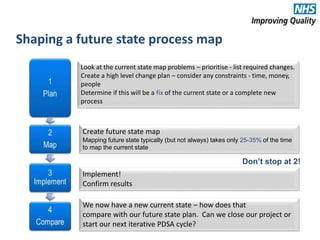
Shaping a future state process map
Look at the current state map problems – prioritise - list required changes.
Create a high level change plan – consider any constraints - time, money,
people
Determine if this will be a fix of the current state or a complete new
process
Create future state map
Mapping future state typically (but not always) takes only 25-35% of the time
to map the current state
Don’t stop at 2!
Implement!
Confirm results
We now have a new current state – how does that
compare with our future state plan. Can we close our project or
start our next iterative PDSA cycle?
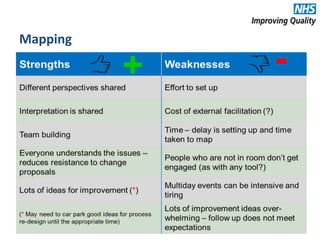
Mapping
+ -
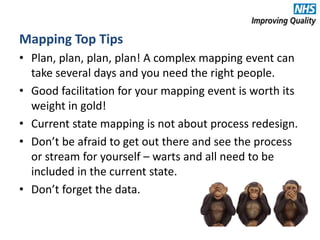
Mapping Top Tips
• Plan, plan, plan, plan! A complex mapping event can
take several days and you need the right people.
• Good facilitation for your mapping event is worth its
weight in gold!
• Current state mapping is not about process redesign.
• Don’t be afraid to get out there and see the process
or stream for yourself – warts and all need to be
included in the current state.
• Don’t forget the data.
What use is process mapping?
Example 1:
• A series of multidisciplinary process mapping events
were undertaken in NHS Fife to commence the
development of Integrated Care Pathways in Mental
Health. As part of the development of Integrated
Care Pathways (ICPs) in Mental Health, process
mapping sessions were carried out for the five
diagnostic specific and the generic ICPs.
What use is process mapping?
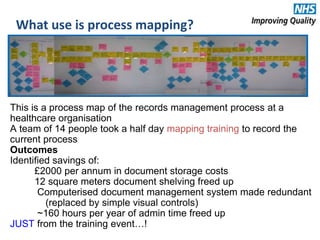
This is a process map of the records management process at a
healthcare organisation
A team of 14 people took a half day mapping training to record the
current process
Outcomes
Identified savings of:
£2000 per annum in document storage costs
12 square meters document shelving freed up
Computerised document management system made redundant
(replaced by simple visual controls)
~160 hours per year of admin time freed up
JUST from the training event…!
Any Questions?
Click links to see - A simple guide to service improvement
Bringing lean to life
CLOSE
THANK YOU FOR JOINING US TODAY
• For further information please see
our website
http://www.nhsiq.nhs.uk/
• Elaine.kemp@nhsiq.nhs.uk
• Jeri.hawkins@nhsiq.nhs.uk
You will be sent a link to both the recorded presentation and slides

Introduction to Process Mapping

  • 1.
    Welcome! We will startshortly, but are waiting for people to join, don’t worry if you can’t hear anything yet. Before we start we will be going through some E-Seminar housekeeping items, so that everyone can participate fully in the online meeting If you are having difficulties joining the meeting please call Sue O’Neil on 0116 295 0081 NHS Improving Quality Process Mapping
  • 2.
    1. Welcome andIntroduction 2. Housekeeping 3. Process mapping for those new to service improvement 4. Decide what is to be process mapped 5. Engage with key stakeholders and plan a process mapping session 6. Create the current state process map 7. Value streams 8. Analyse and improve the process map 9. Shaping a future state process map 10. Mapping top tips 11. What use is mapping? 12. Links and Contacts details AGENDA
  • 3.
    NHS Improving Quality ProcessMapping www.nhsiq.nhs.uk Welcome and Introduction Elaine Kemp Programme Delivery Manager Living longer Lives Jeri Hawkins Mental Health and Dementia Delivery Support Manager
  • 4.
    • During theE-Seminar we will mute all delegate’s lines throughout the presentation. • If at other times you are in a noisy environment please mute your line by pressing the mute button on your screen (this can be found on the right hand side of the screen) • If you would like to ask a question please use the raise hand button (this can be found on the right hand side of the screen) • This is an interactive session, please add your comments, and thoughts into the chat box as we go through the presentation. • At the Q&A session, type your question into the chat, or raise your hand, we will un-mute all lines during the Q&A. • If you are having any technical problems, send a message to the Host via the chat panel or call Sue O’Neil on 0116 295 0081 • We will now start recording this Webinar
  • 5.
    What is aprocess map? • A process map describes a series of steps or actions which deliver an output • Maps are a visual way of describing a process • Everyone works in a process • A learning opportunity bringing teams together to take a step back and look at how the work gets done
  • 6.
    What is aprocess map?
  • 7.
    What will youprocess map and why? Process maps help clarify what we do and why we do it – highlight opportunities for improvement Identifies – • Bottle neck – delays • Unnecessary steps – don’t add value/waste • Duplication and rework
  • 8.
    Engage with keystakeholders and plan a process mapping session • What is the purpose of the session? • Who should lead the session? • Who should attend the session? • Communication and engagement? • What are the proposed start and end points? • What level of detail is required? • Can leaders walk the process beforehand? • Who is the service for? • Any key data that can be collected beforehand?
  • 9.
    Lift receiver Dial Number Let phone ring Say Hello Have Conversation Say Good Bye Hang up receiver Answered? Yes No Start Finish Task Decision or Choice Direction of flow Key Create the current state process map
  • 10.
    Levels of Mapping– example from outpatients Enters OPD All Internal Processes Leaves OPD Sees admin Sees nurse Sees Consultant Has Tests Sees Consultant Etc etcHigh Medium Enters room Takes history Asst with undress Take weight , BP etc Etc Leaves room Asst patient onto scales Zero scales Take reading EtcLow Overall parameters Etc
  • 11.
    Choose & Book (C&B) FullyBooked System Admin post x GP Paper Referrals Partially Booked Non GP •DVLA •Consultants •Community Services •Dental •Self Referral Print off ‘Work List’ of new received referrals Daily in AM Update form with •UBRN •NHS No •Hospital No •Breach date •Appointment Date •Clinic Code •Consultant See Example form XX Attach completed UHL’s C&B ‘Referral Tracking Form’ Take referral letters and Referral Tracking form (C&B only) to Medical Secretary Daily in AM for Consultant Grading OPW List Team receive graded referral letter back from Medical Secretary and any signed test request cards Rejected Accepted OPW List Team update the HISS system GP not always creating and attaching referral letter to the C&B system within 48 hrs. Takes time to chase. The ‘Status column on the work list does not update from ‘Never Reviewed Status’’. Useful if could identify if letters have been printed See Example form XX Check C&B System for Referral Letter Print off Referral Letter Check HISS for UBRN Creation date & Clinician Letters not always attached on the C&B system in a Word Format. Takes time to convert from ‘Rich Text, and print them off. There is no facility to resave the Word version on the system by the OPW List team Not all GP’s are able to attach more than one document to the system and fax over other documents. Not going to a central number Work list does not identify: •Consultant to be seen •Date UBRN created. Have to check on Hiss Letter received by and is date stamped by •OPW List Team •Medical Secretary – gives to OPW team Check HISS to identify if patient has been seen in the hospital previously to ensure there is only one set of medical notes Register the referral letter on HISS Stamp Letter with ‘Outcomes List’’ See Example XX This creates and opens an episode Patients may have more than one UHL number. Need to get them merged via medical records Can have system numbers OPW List team can allocate U number Referral Received Referral letters do not always have all the information required on them. Will now go on Booking List with Partial Booking Team and chased weekly if not returnedIf test required card requests are taken to the Investigations Dept by the OPW List Team Update with •Tests required •Breach date •Appt date for clinic Not all GP’s are using the system ProcessWhat is done Issues OPW List team send appointment confirmation to patient. Discharged Letter cc to GP by Medical Secretary Referred onto another consultant (cardiologist / cardiac surgeon) Due to lack of information on C&B website, the initial referral was sent to wrong cardiology consultant Map Number 19 C&B Referral acceptance process Name and date Rebooked Referral is accepted/ rejected by consultan ts or rebooked to another date How long? How many each day?
  • 12.
    Is it aValue Stream or Process Map? • What the heck is a “Value Stream”? • Why does it matter to me? • What is the difference between a Value Stream Map and a process map? • When should I use a Value Stream Map
  • 13.
    Value Streams • Conceptfrom Lean (Toyota Production System) • Mapping and visualisation of complexity brings about shared understanding – Real benefit in the mapping process itself • Value stream = broad & wide view – Use for identifying improvement opportunities across departments/organisations • Process map/chart = detailed micro-level – Use for identifying specific improvements and waste at a detailed level • Which to use – Both!
  • 14.
    Tools and techniquesthat can help with mapping
  • 15.
    We’ve got aprocess or value stream map – now what? • Secure map! (Use tape to secure post-its – otherwise they will fall off) • Amendments / comments added (in different coloured post its?) • Consensus agreed – is the map accurate? • Documentation of the process (Photograph the map? Make electronic copy (Visio)?) • Circulation to all stakeholders or bring stakeholders to map for explanation? then Process / service redesign St Elsewhere – PICU Admissions – 8th Jan 2014 Tip: If storing map, write title & date on outside
  • 16.
    Analyse and improvethe process map • How many steps and handoffs (passing the patient/service user from one person to another)? • Time between each step - any delays and why? • Where are the bottlenecks or queues? • Steps that do / do not add value? • How many steps for the patient/service user and are they built in for a reason?
  • 17.
    Analyse and improvethe process map (2) • Where are the problems? • What do the patients / service users complain about? • Where are there things done more than once? • What does staff complain about? • Have you got all the data you need? • If not what is your plan to complete the map? • Can you eliminate any waste? • Can you eliminate any steps?
  • 18.
    Shaping a futurestate process map 0.25 Hrs 0.25 Hrs30 sec2.0 Days 0.5 Hrs 1.5 Hrs 0.25 Hrs 30 sec0.5 Hrs 1 min Sample arrives Results To GP Key: Process step Decision Issue / problem St Elsewhere – PICU Admissions – 8th Jan 2014 0.5 Hrs 0.25 Hrs 1.5 Hrs 30 sec 0.25 Hrs 1 min 0.25 Hrs Tip: Use your current state map as your starting point to develop your future state map, but keep them separate as your current state is a reference benchmark.
  • 19.
    Shaping a futurestate process map Look at the current state map problems – prioritise - list required changes. Create a high level change plan – consider any constraints - time, money, people Determine if this will be a fix of the current state or a complete new process Create future state map Mapping future state typically (but not always) takes only 25-35% of the time to map the current state Don’t stop at 2! Implement! Confirm results We now have a new current state – how does that compare with our future state plan. Can we close our project or start our next iterative PDSA cycle?
  • 20.
  • 21.
    Mapping Top Tips •Plan, plan, plan, plan! A complex mapping event can take several days and you need the right people. • Good facilitation for your mapping event is worth its weight in gold! • Current state mapping is not about process redesign. • Don’t be afraid to get out there and see the process or stream for yourself – warts and all need to be included in the current state. • Don’t forget the data.
  • 22.
    What use isprocess mapping? Example 1: • A series of multidisciplinary process mapping events were undertaken in NHS Fife to commence the development of Integrated Care Pathways in Mental Health. As part of the development of Integrated Care Pathways (ICPs) in Mental Health, process mapping sessions were carried out for the five diagnostic specific and the generic ICPs.
  • 23.
    What use isprocess mapping? This is a process map of the records management process at a healthcare organisation A team of 14 people took a half day mapping training to record the current process Outcomes Identified savings of: £2000 per annum in document storage costs 12 square meters document shelving freed up Computerised document management system made redundant (replaced by simple visual controls) ~160 hours per year of admin time freed up JUST from the training event…!
  • 24.
    Any Questions? Click linksto see - A simple guide to service improvement Bringing lean to life
  • 25.
    CLOSE THANK YOU FORJOINING US TODAY • For further information please see our website http://www.nhsiq.nhs.uk/ • Elaine.kemp@nhsiq.nhs.uk • Jeri.hawkins@nhsiq.nhs.uk You will be sent a link to both the recorded presentation and slides