


LEAN AND THE
FINANCE/ACCOUNTING
FUNCTION
DAVID B. BLAIN (PRINCIPAL)
LEAN AND THE
FINANCE/ACCOUNTING
FUNCTION
DAVID B. BLAIN (PRINCIPAL)
WEBINAR AGENDA
• The need for LEAN Accounting Versus Traditional Accounting Methods
• LEAN Accounting and Finance Techniques
• Implementing LEAN Accounting
• Questions
THE NEED FOR LEAN
ACCOUNTING
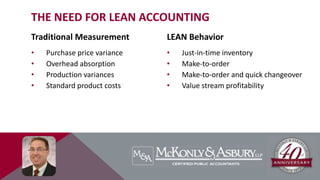
• Purchase price variance
• Overhead absorption
• Production variances
• Standard product costs
• Just-in-time inventory
• Make-to-order
• Make-to-order and quick changeover
• Value stream profitability
THE NEED FOR LEAN ACCOUNTING
Traditional Measurement LEAN Behavior
THE NEED FOR LEAN ACCOUNTING, CONT.
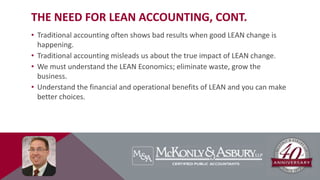
• Traditional accounting often shows bad results when good LEAN change is
happening.
• Traditional accounting misleads us about the true impact of LEAN change.
• We must understand the LEAN Economics; eliminate waste, grow the
business.
• Understand the financial and operational benefits of LEAN and you can make
better choices.
THE NEED FOR LEAN ACCOUNTING, CONT.
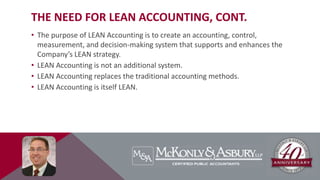
• The purpose of LEAN Accounting is to create an accounting, control,
measurement, and decision-making system that supports and enhances the
Company’s LEAN strategy.
• LEAN Accounting is not an additional system.
• LEAN Accounting replaces the traditional accounting methods.
• LEAN Accounting is itself LEAN.
LEAN ACCOUNTING AND
FINANCE TECHNIQUES
LEAN ACCOUNTING AND FINANCE TECHNIQUES
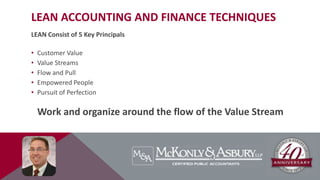
LEAN Consist of 5 Key Principals
• Customer Value
• Value Streams
• Flow and Pull
• Empowered People
• Pursuit of Perfection
Work and organize around the flow of the Value Stream
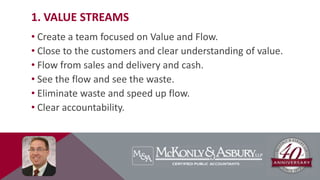
1. VALUE STREAMS
• Create a team focused on Value and Flow.
• Close to the customers and clear understanding of value.
• Flow from sales and delivery and cash.
• See the flow and see the waste.
• Eliminate waste and speed up flow.
• Clear accountability.
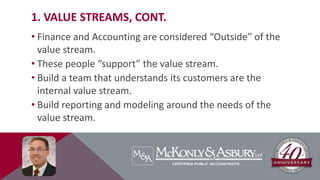
1. VALUE STREAMS, CONT.
• Finance and Accounting are considered “Outside” of the
value stream.
• These people “support” the value stream.
• Build a team that understands its customers are the
internal value stream.
• Build reporting and modeling around the needs of the
value stream.
2. SIMPLIFIED REPORTING
• Quick, understandable and timely value stream reporting.
• Financial reporting for better cost controls.
• Weekly value stream meetings to understand spending
and make improvements.
• Clear accountability for revenue, costs and profits.
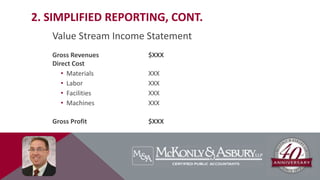
2. SIMPLIFIED REPORTING, CONT.
Value Stream Income Statement
Gross Revenues $XXX
Direct Cost
• Materials XXX
• Labor XXX
• Facilities XXX
• Machines XXX
Gross Profit $XXX
2. SIMPLIFIED REPORTING, CONT.
Benefits of a Value Stream Income Statement
• Understood by everyone
• Separates value stream profit from financial accounting adjustments.
• Accurate cost information
• Real spending
• Checkbook of the value stream
• Relationship to continuous improvement
• Eliminate waste – reduce actual costs
3. WEEKLY PROBLEM SOLVING
Weekly Problem Solving Drives Improvement
• Visual display of measures.
• Measures updated in the value stream.
• Weekly value stream meetings to analyze results.
• Root causes identified and solutions created.
4. BOX SCORES
• See the true performance
• Operational, capacity usage, financial
• Keys that drive good financial outcomes
• Make better decisions
• See the true impact on the value stream
• Valid, up-to-date information
• Evaluate many scenarios and what-ifs
• Standardized work for decisions
• Understand Value Stream Performance and Make Good Decisions
• Improve Process Capabilities
• Improve Value Provided To The Market
• Relentlessly Eliminate Waste
• Create Opportunity to add demand
• Increase Revenue and Cash Flow
• Reduce Costs and Increase Cash Flow
4. BOX SCORES, CONT.
Operational/Capacity Measures
• Units per person
• On time shipments
• Average Cost
• AP/AR Days
• Productive Time
• Non Productive Time
• Available Capacity
Financial Measures
• Revenue
• Material Costs
• Inventory
• Value Stream Profit
• Value Stream Return on Sales
4. BOX SCORES, CONT.
5. VALUE BASED PRICING
• Price and cost are not related.
• Price is determined by the value created for the customer.
• We need a deep understanding of what creates value for
our customers.
• Differentiate customers, products, and markets based on
value.
5. VALUE BASE PRICING, CONT.
Primary Drivers of Value for Customers
• Direct financial benefit to the customer.
• Customers’ of customer have direct financial benefit that results
in additional services for customer.
• Risk reduction.
• Ease of doing business.
• Intangible issues.
5. VALUE BASE PRICING, CONT.
Voice of the Customer
• To understand the customers’ value proposition. We must
listen!
• Voice of the Customer is a systematic way to learn what the
customer values, why they value these things, and how much
they value them.
• From this we can calculate the value we create for the customer,
set a value-based price, and decide the target cost.
6. TARGET COSTING
Most Companies: Price = Cost + Margin
LEAN: Cost = Price – Profit Needed
Target cost is defined as the allowable cost that can be incurred on
a product and still earn the required profit
6. TARGET COSTING, CONT.
• Creates deep understanding of the value and costs.
• Design products to meet the value needs of the customer.
• Design products to meet the profit needs of the business.
• Drive value stream spending to match target costs.
Cost Are Driven By Value.
Get The Right Costs.
6. TARGET COSTING, CONT.
Achieving Target Costs
• Most costs are determined during design.
• Planned material costs are tracked and reported against the target material cost throughout
the design process.
• Tooling and other start up costs are tracked and reported throughout the design process.
• Concurrent engineering ensures that the new products are designed for flow through the
value stream.
• Additional costs of production and distribution are assessed using the box score.
• After product launch the value stream team tracks the actual costs through value stream
accounting.
7. BUDGETING VS. PLANNING
• Budgeting process is complicated and time consuming .
• Budgets are usually out of date before they are implemented.
• Budgeting is classic “Top Down” management.
• LEAN companies create financial forecasts each month coming
from the planning process.
• Sales, Operations and Financial Planning (SOFP)
7. BUDGETING VS. PLANNING, CONT.
SOFP Eliminates Annual Budgeting
• Financial forecast is updated monthly with 15-24 month
projections.
• Authorized by Executive Leaders
• Financial forecasts are relevant, accurate and timely.
• Better control and accountability.
7. BUDGETING VS. PLANNING, CONT.
SOFP Has Continuous Improvement Built Into the Process
• Sales and Capacity forecasts are reviewed for accuracy and bias,
and projects done to improve.
• Financial results are reviewed for achievement using a financial
report and a box score.
IMPLEMENTING LEAN
ACCOUNTING
IMPLEMENTING LEAN ACCOUNTING
Identify Roles and Responsibilities of Senior Leadership
• Include LEAN Accounting in strategy deployment.
• Assign people full-time to LEAN Accounting implement teams.
• Approve, sanction and support implement plans.
IMPLEMENTING LEAN ACCOUNTING, CONT.
Establish a Formal Implementation Process
• Establish a pilot location
• Assess and learn
• Full deployment
The Key to Successful Implementation
LEARN BY PRACTICING
IMPLEMENTING LEAN ACCOUNTING, CONT.
Benefits of a LEAN Accounting System
Profit Assumption
• Increase revenue by providing superior value to customers.
• Manage cost by managing flow and waste.
Measures
• Frequent reporting of process measurements – Flow, Quality, Productivity, Delivery
and Cost
IMPLEMENTING LEAN ACCOUNTING, CONT.
Benefits of a LEAN Accounting System
Behaviors
• Make-to-order
• Short lead times
• Visual Controls
• Continuous improvement/elimination of waste
Results
• Superior Customer Value - Quality, Delivery, Lead Time
David B. Blain
• dblain@macpas.com
• 717-761-7910
• www.leanaccountants.com
CONTACT
McKonly & Asbury Webinar - LEAN and the Finance and Accounting Process

McKonly & Asbury Webinar - LEAN and the Finance and Accounting Process

  • 1.
  • 4.
  • 5.
    WEBINAR AGENDA • Theneed for LEAN Accounting Versus Traditional Accounting Methods • LEAN Accounting and Finance Techniques • Implementing LEAN Accounting • Questions
  • 6.
    THE NEED FORLEAN ACCOUNTING
  • 7.
    • Purchase pricevariance • Overhead absorption • Production variances • Standard product costs • Just-in-time inventory • Make-to-order • Make-to-order and quick changeover • Value stream profitability THE NEED FOR LEAN ACCOUNTING Traditional Measurement LEAN Behavior
  • 8.
    THE NEED FORLEAN ACCOUNTING, CONT. • Traditional accounting often shows bad results when good LEAN change is happening. • Traditional accounting misleads us about the true impact of LEAN change. • We must understand the LEAN Economics; eliminate waste, grow the business. • Understand the financial and operational benefits of LEAN and you can make better choices.
  • 9.
    THE NEED FORLEAN ACCOUNTING, CONT. • The purpose of LEAN Accounting is to create an accounting, control, measurement, and decision-making system that supports and enhances the Company’s LEAN strategy. • LEAN Accounting is not an additional system. • LEAN Accounting replaces the traditional accounting methods. • LEAN Accounting is itself LEAN.
  • 10.
  • 11.
    LEAN ACCOUNTING ANDFINANCE TECHNIQUES LEAN Consist of 5 Key Principals • Customer Value • Value Streams • Flow and Pull • Empowered People • Pursuit of Perfection Work and organize around the flow of the Value Stream
  • 12.
    1. VALUE STREAMS •Create a team focused on Value and Flow. • Close to the customers and clear understanding of value. • Flow from sales and delivery and cash. • See the flow and see the waste. • Eliminate waste and speed up flow. • Clear accountability.
  • 13.
    1. VALUE STREAMS,CONT. • Finance and Accounting are considered “Outside” of the value stream. • These people “support” the value stream. • Build a team that understands its customers are the internal value stream. • Build reporting and modeling around the needs of the value stream.
  • 14.
    2. SIMPLIFIED REPORTING •Quick, understandable and timely value stream reporting. • Financial reporting for better cost controls. • Weekly value stream meetings to understand spending and make improvements. • Clear accountability for revenue, costs and profits.
  • 15.
    2. SIMPLIFIED REPORTING,CONT. Value Stream Income Statement Gross Revenues $XXX Direct Cost • Materials XXX • Labor XXX • Facilities XXX • Machines XXX Gross Profit $XXX
  • 16.
    2. SIMPLIFIED REPORTING,CONT. Benefits of a Value Stream Income Statement • Understood by everyone • Separates value stream profit from financial accounting adjustments. • Accurate cost information • Real spending • Checkbook of the value stream • Relationship to continuous improvement • Eliminate waste – reduce actual costs
  • 17.
    3. WEEKLY PROBLEMSOLVING Weekly Problem Solving Drives Improvement • Visual display of measures. • Measures updated in the value stream. • Weekly value stream meetings to analyze results. • Root causes identified and solutions created.
  • 18.
    4. BOX SCORES •See the true performance • Operational, capacity usage, financial • Keys that drive good financial outcomes • Make better decisions • See the true impact on the value stream • Valid, up-to-date information • Evaluate many scenarios and what-ifs • Standardized work for decisions • Understand Value Stream Performance and Make Good Decisions
  • 19.
    • Improve ProcessCapabilities • Improve Value Provided To The Market • Relentlessly Eliminate Waste • Create Opportunity to add demand • Increase Revenue and Cash Flow • Reduce Costs and Increase Cash Flow 4. BOX SCORES, CONT.
  • 20.
    Operational/Capacity Measures • Unitsper person • On time shipments • Average Cost • AP/AR Days • Productive Time • Non Productive Time • Available Capacity Financial Measures • Revenue • Material Costs • Inventory • Value Stream Profit • Value Stream Return on Sales 4. BOX SCORES, CONT.
  • 21.
    5. VALUE BASEDPRICING • Price and cost are not related. • Price is determined by the value created for the customer. • We need a deep understanding of what creates value for our customers. • Differentiate customers, products, and markets based on value.
  • 22.
    5. VALUE BASEPRICING, CONT. Primary Drivers of Value for Customers • Direct financial benefit to the customer. • Customers’ of customer have direct financial benefit that results in additional services for customer. • Risk reduction. • Ease of doing business. • Intangible issues.
  • 23.
    5. VALUE BASEPRICING, CONT. Voice of the Customer • To understand the customers’ value proposition. We must listen! • Voice of the Customer is a systematic way to learn what the customer values, why they value these things, and how much they value them. • From this we can calculate the value we create for the customer, set a value-based price, and decide the target cost.
  • 24.
    6. TARGET COSTING MostCompanies: Price = Cost + Margin LEAN: Cost = Price – Profit Needed Target cost is defined as the allowable cost that can be incurred on a product and still earn the required profit
  • 25.
    6. TARGET COSTING,CONT. • Creates deep understanding of the value and costs. • Design products to meet the value needs of the customer. • Design products to meet the profit needs of the business. • Drive value stream spending to match target costs. Cost Are Driven By Value. Get The Right Costs.
  • 26.
    6. TARGET COSTING,CONT. Achieving Target Costs • Most costs are determined during design. • Planned material costs are tracked and reported against the target material cost throughout the design process. • Tooling and other start up costs are tracked and reported throughout the design process. • Concurrent engineering ensures that the new products are designed for flow through the value stream. • Additional costs of production and distribution are assessed using the box score. • After product launch the value stream team tracks the actual costs through value stream accounting.
  • 27.
    7. BUDGETING VS.PLANNING • Budgeting process is complicated and time consuming . • Budgets are usually out of date before they are implemented. • Budgeting is classic “Top Down” management. • LEAN companies create financial forecasts each month coming from the planning process. • Sales, Operations and Financial Planning (SOFP)
  • 28.
    7. BUDGETING VS.PLANNING, CONT. SOFP Eliminates Annual Budgeting • Financial forecast is updated monthly with 15-24 month projections. • Authorized by Executive Leaders • Financial forecasts are relevant, accurate and timely. • Better control and accountability.
  • 29.
    7. BUDGETING VS.PLANNING, CONT. SOFP Has Continuous Improvement Built Into the Process • Sales and Capacity forecasts are reviewed for accuracy and bias, and projects done to improve. • Financial results are reviewed for achievement using a financial report and a box score.
  • 30.
  • 31.
    IMPLEMENTING LEAN ACCOUNTING IdentifyRoles and Responsibilities of Senior Leadership • Include LEAN Accounting in strategy deployment. • Assign people full-time to LEAN Accounting implement teams. • Approve, sanction and support implement plans.
  • 32.
    IMPLEMENTING LEAN ACCOUNTING,CONT. Establish a Formal Implementation Process • Establish a pilot location • Assess and learn • Full deployment The Key to Successful Implementation LEARN BY PRACTICING
  • 33.
    IMPLEMENTING LEAN ACCOUNTING,CONT. Benefits of a LEAN Accounting System Profit Assumption • Increase revenue by providing superior value to customers. • Manage cost by managing flow and waste. Measures • Frequent reporting of process measurements – Flow, Quality, Productivity, Delivery and Cost
  • 34.
    IMPLEMENTING LEAN ACCOUNTING,CONT. Benefits of a LEAN Accounting System Behaviors • Make-to-order • Short lead times • Visual Controls • Continuous improvement/elimination of waste Results • Superior Customer Value - Quality, Delivery, Lead Time
  • 35.
    David B. Blain •dblain@macpas.com • 717-761-7910 • www.leanaccountants.com CONTACT