



@HelenBevan #SWBHconf16
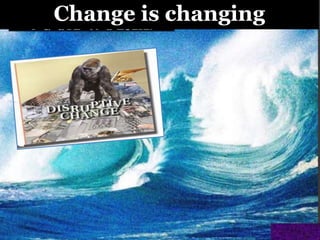
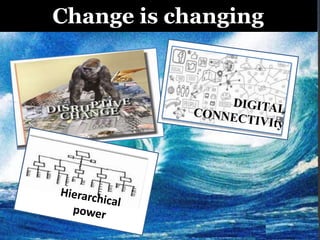
Change is changing
@HelenBevan #SWBHconf16
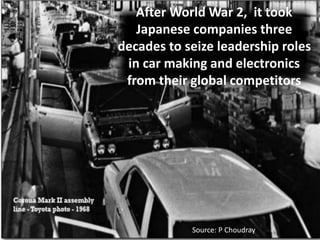
After World War 2, it took
Japanese companies three
decades to seize leadership roles
in car making and electronics
from their global competitors
Source: P Choudray
@HelenBevan #SWBHconf16
In contrast, Uber, a little over
five years old, competes
around the world
Source: P Choudray
@HelenBevan #SWBHconf16
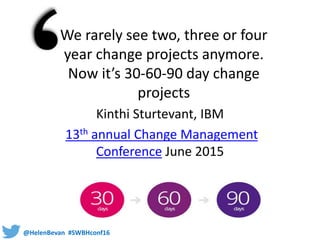
Kinthi Sturtevant, IBM
13th annual Change Management
Conference June 2015
We rarely see two, three or four
year change projects anymore.
Now it’s 30-60-90 day change
projects
@HelenBevan #SWBHconf16
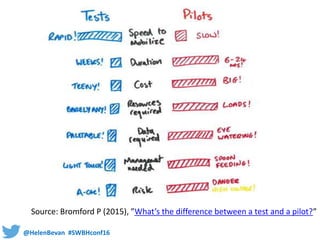
Source: Bromford P (2015), ”What’s the difference between a test and a pilot?”
@HelenBevan #SWBHconf16
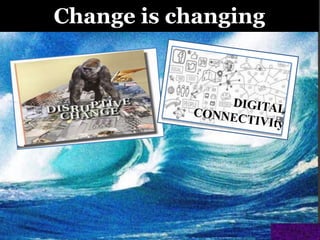
Change is changing
@HelenBevan #SWBHconf16
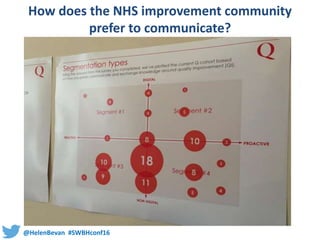
How does the NHS improvement community
prefer to communicate?
@HelenBevan #SWBHconf16
Change is changing
@HelenBevan #SWBHconf16
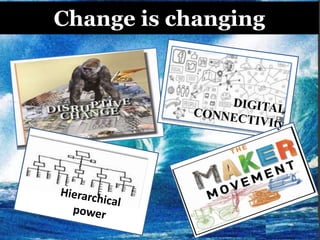
Change is changing
@HelenBevan #SWBHconf16
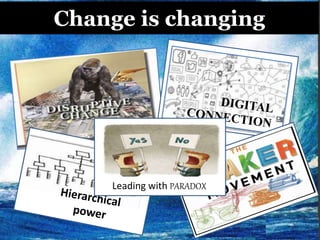
Change is changing
Leading with PARADOX
@HelenBevan #SWBHconf16
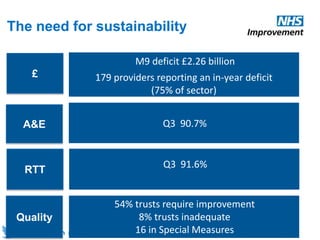
The need for sustainability
£
M9 deficit £2.26 billion
179 providers reporting an in-year deficit
(75% of sector)
A&E Q3 90.7%
RTT
Q3 91.6%
Quality
54% trusts require improvement
8% trusts inadequate
16 in Special Measures
@HelenBevan #SWBHconf16
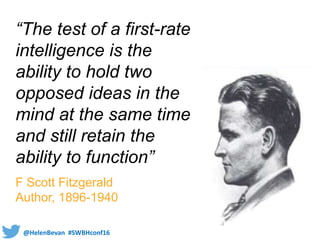
“The test of a first-rate
intelligence is the
ability to hold two
opposed ideas in the
mind at the same time
and still retain the
ability to function”
F Scott Fitzgerald
Author, 1896-1940
@HelenBevan #SWBHconf16
Paradox: co-existence of competing demands
• Often difficult to see in such a dynamic
world
• Not problems that can be solved, as they
are unsolvable
• Can polarise individuals
• Managing them involves developing a
mindset beyond either/or logic
Source: http://media.ccl.org/wp-
content/uploads/2015/11/Managing-
Paradox.pdf#_ga=1.191923690.1381254047.1453632999
@HelenBevan #SWBHconf16
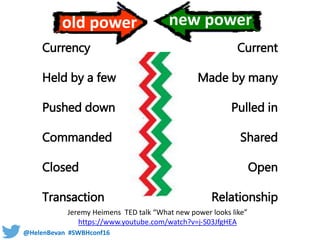
Jeremy Heimens TED talk “What new power looks like”
https://www.youtube.com/watch?v=j-S03JfgHEA
old power new power
Currency
Held by a few
Pushed down
Commanded
Closed
Transaction
Current
Made by many
Pulled in
Shared
Open
Relationship
@HelenBevan #SWBHconf16
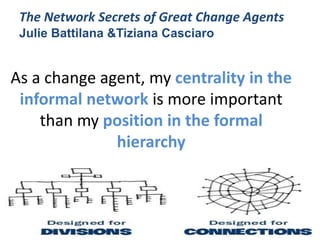
The Network Secrets of Great Change Agents
Julie Battilana &Tiziana Casciaro
As a change agent, my centrality in the
informal network is more important
than my position in the formal
hierarchy
@HelenBevan #SWBHconf16
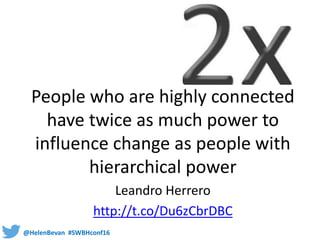
People who are highly connected
have twice as much power to
influence change as people with
hierarchical power
Leandro Herrero
http://t.co/Du6zCbrDBC
@HelenBevan #SWBHconf16
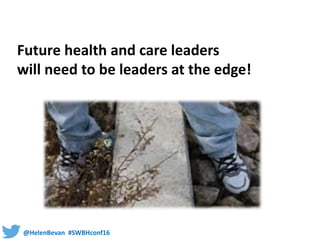
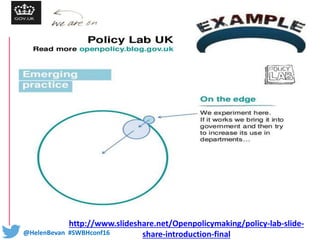
Future health and care leaders
will need to be leaders at the edge!
@HelenBevan #SWBHconf16
http://www.slideshare.net/Openpolicymaking/policy-lab-slide-
share-introduction-final
@HelenBevan #SWBHconf16
Why go to the edge?
“ Leading from the edge brings us
into contact with a far wider range
of relationships, and in turn, this
increases our potential for diversity
in terms of thought, experience
and background. Diversity leads to
more disruptive thinking, faster
change and better outcomes
Aylet Baron
@HelenBevan #SWBHconf16
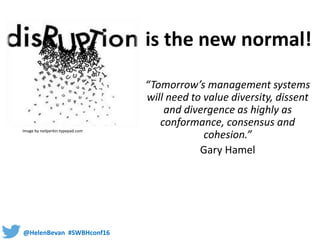
“Tomorrow’s management systems
will need to value diversity, dissent
and divergence as highly as
conformance, consensus and
cohesion.”
Gary Hamel
Image by neilperkin.typepad.com
is the new normal!
@HelenBevan #SWBHconf16
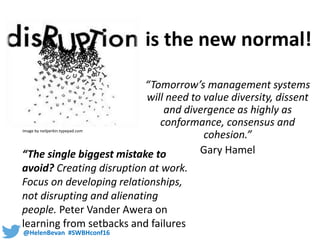
“Tomorrow’s management systems
will need to value diversity, dissent
and divergence as highly as
conformance, consensus and
cohesion.”
Gary Hamel
Image by neilperkin.typepad.com
“The single biggest mistake to
avoid? Creating disruption at work.
Focus on developing relationships,
not disrupting and alienating
people. Peter Vander Awera on
learning from setbacks and failures
is the new normal!
@HelenBevan #SWBHconf16
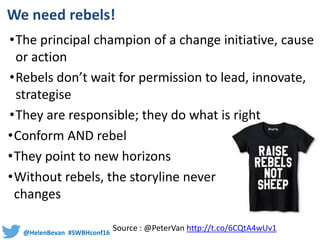
We need rebels!
•The principal champion of a change initiative, cause
or action
•Rebels don’t wait for permission to lead, innovate,
strategise
•They are responsible; they do what is right
•Conform AND rebel
•They point to new horizons
•Without rebels, the storyline never
changes
Source : @PeterVan http://t.co/6CQtA4wUv1
@HelenBevan #SWBHconf16
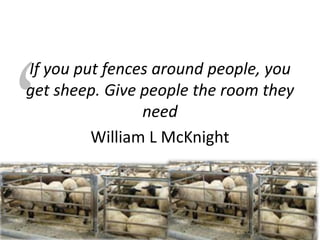
If you put fences around people, you
get sheep. Give people the room they
need
William L McKnight
@HelenBevan #SWBHconf16
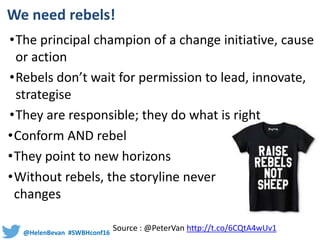
We need rebels!
•The principal champion of a change initiative, cause
or action
•Rebels don’t wait for permission to lead, innovate,
strategise
•They are responsible; they do what is right
•Conform AND rebel
•They point to new horizons
•Without rebels, the storyline never
changes
Source : @PeterVan http://t.co/6CQtA4wUv1
@HelenBevan #SWBHconf16
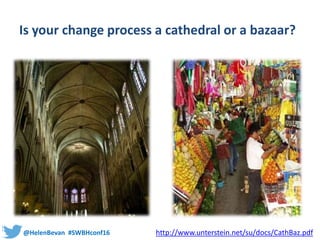
Is your change process a cathedral or a bazaar?
http://www.unterstein.net/su/docs/CathBaz.pdf
@HelenBevan #SWBHconf16
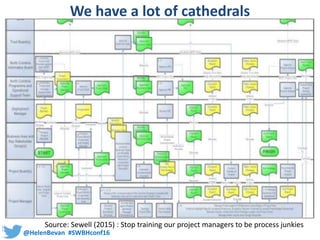
We have a lot of cathedrals
Source: Sewell (2015) : Stop training our project managers to be process junkies
@HelenBevan #SWBHconf16
The Change Challenge
Tapping the collective brilliance
of the NHS
@HelenBevan #SWBHconf16
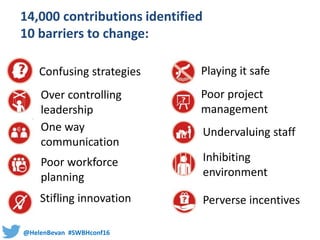
14,000 contributions identified
10 barriers to change:
Confusing strategies
Over controlling
leadership
Perverse incentivesStifling innovation
Poor workforce
planning
One way
communication
Inhibiting
environment
Undervaluing staff
Poor project
management
Playing it safe
@HelenBevan #SWBHconf16
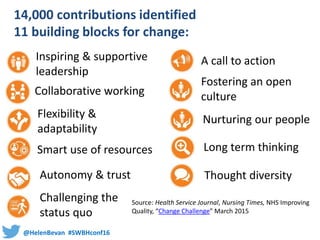
14,000 contributions identified
11 building blocks for change:
Inspiring & supportive
leadership
Collaborative working
Thought diversityAutonomy & trust
Smart use of resources
Flexibility &
adaptability
Long term thinking
Nurturing our people
Fostering an open
culture
A call to action
Source: Health Service Journal, Nursing Times, NHS Improving
Quality, “Change Challenge” March 2015
Challenging the
status quo
@HelenBevan #SWBHconf16
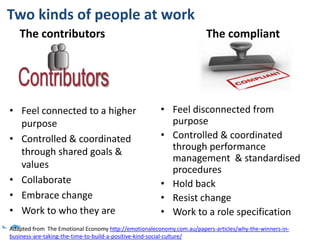
Two kinds of people at work
• Feel connected to a higher
purpose
• Controlled & coordinated
through shared goals &
values
• Collaborate
• Embrace change
• Work to who they are
The contributors The compliant
• Feel disconnected from
purpose
• Controlled & coordinated
through performance
management & standardised
procedures
• Hold back
• Resist change
• Work to a role specification
Adapted from The Emotional Economy http://emotionaleconomy.com.au/papers-articles/why-the-winners-in-
business-are-taking-the-time-to-build-a-positive-kind-social-culture/
@HelenBevan #SWBHconf16
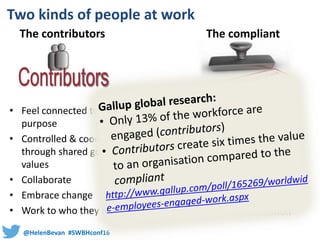
Two kinds of people at work
• Feel connected to a higher
purpose
• Controlled & coordinated
through shared goals &
values
• Collaborate
• Embrace change
• Work to who they are
The contributors The compliant
• Feel disconnected from
purpose
• Controlled & coordinated
through performance
management & standardised
procedures
• Hold back
• Resist change
• Work to a role specification
@HelenBevan #SWBHconf16
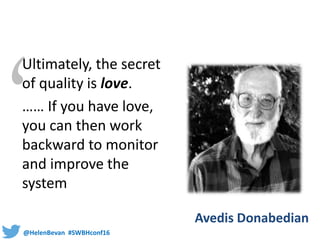
Avedis Donabedian
Ultimately, the secret
of quality is love.
…… If you have love,
you can then work
backward to monitor
and improve the
system
@HelenBevan #SWBHconf16
Project Aristotle: http://qz.com/625870/after-years-of-intensive-
analysis-google-discovers-the-key-to-good-teamwork-is-being-nice/
@HelenBevan #SWBHconf16
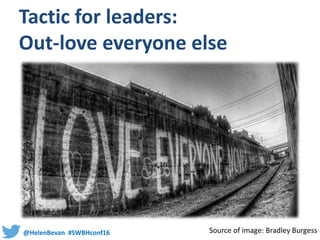
Tactic for leaders:
Out-love everyone else
Source of image: Bradley Burgess
@HelenBevan #SWBHconf16
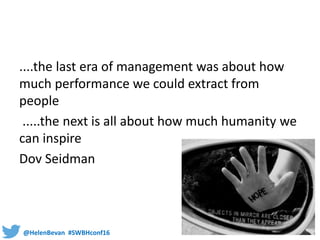
....the last era of management was about how
much performance we could extract from
people
.....the next is all about how much humanity we
can inspire
Dov Seidman
@HelenBevan #SWBHconf16
Three ways to connect!
1. Follow us on Twitter
@HelenBevan @TheEdgeNHS @School4Radicals
2. Subscribe to
theedge.nhsiq.nhs.uk
3. Get materials from
theedge.nhsiq.nhs.uk/school
…and sign up for our monthly #EdgeTalks
theedge.nhsiq.nhs.uk/edgetalks

Building the future: perspectives on large scale change

  • 1.
  • 2.
  • 3.
    @HelenBevan #SWBHconf16 After WorldWar 2, it took Japanese companies three decades to seize leadership roles in car making and electronics from their global competitors Source: P Choudray
  • 4.
    @HelenBevan #SWBHconf16 In contrast,Uber, a little over five years old, competes around the world Source: P Choudray
  • 5.
    @HelenBevan #SWBHconf16 Kinthi Sturtevant,IBM 13th annual Change Management Conference June 2015 We rarely see two, three or four year change projects anymore. Now it’s 30-60-90 day change projects
  • 6.
    @HelenBevan #SWBHconf16 Source: BromfordP (2015), ”What’s the difference between a test and a pilot?”
  • 7.
  • 8.
  • 9.
  • 10.
    @HelenBevan #SWBHconf16 How doesthe NHS improvement community prefer to communicate?
  • 11.
  • 12.
  • 13.
  • 14.
    @HelenBevan #SWBHconf16 Change ischanging Leading with PARADOX
  • 15.
  • 16.
    @HelenBevan #SWBHconf16 The needfor sustainability £ M9 deficit £2.26 billion 179 providers reporting an in-year deficit (75% of sector) A&E Q3 90.7% RTT Q3 91.6% Quality 54% trusts require improvement 8% trusts inadequate 16 in Special Measures
  • 17.
    @HelenBevan #SWBHconf16 “The testof a first-rate intelligence is the ability to hold two opposed ideas in the mind at the same time and still retain the ability to function” F Scott Fitzgerald Author, 1896-1940
  • 18.
    @HelenBevan #SWBHconf16 Paradox: co-existenceof competing demands • Often difficult to see in such a dynamic world • Not problems that can be solved, as they are unsolvable • Can polarise individuals • Managing them involves developing a mindset beyond either/or logic Source: http://media.ccl.org/wp- content/uploads/2015/11/Managing- Paradox.pdf#_ga=1.191923690.1381254047.1453632999
  • 19.
    @HelenBevan #SWBHconf16 Jeremy HeimensTED talk “What new power looks like” https://www.youtube.com/watch?v=j-S03JfgHEA old power new power Currency Held by a few Pushed down Commanded Closed Transaction Current Made by many Pulled in Shared Open Relationship
  • 20.
    @HelenBevan #SWBHconf16 The NetworkSecrets of Great Change Agents Julie Battilana &Tiziana Casciaro As a change agent, my centrality in the informal network is more important than my position in the formal hierarchy
  • 21.
    @HelenBevan #SWBHconf16 People whoare highly connected have twice as much power to influence change as people with hierarchical power Leandro Herrero http://t.co/Du6zCbrDBC
  • 22.
    @HelenBevan #SWBHconf16 Future healthand care leaders will need to be leaders at the edge!
  • 23.
  • 24.
    @HelenBevan #SWBHconf16 Why goto the edge? “ Leading from the edge brings us into contact with a far wider range of relationships, and in turn, this increases our potential for diversity in terms of thought, experience and background. Diversity leads to more disruptive thinking, faster change and better outcomes Aylet Baron
  • 25.
    @HelenBevan #SWBHconf16 “Tomorrow’s managementsystems will need to value diversity, dissent and divergence as highly as conformance, consensus and cohesion.” Gary Hamel Image by neilperkin.typepad.com is the new normal!
  • 26.
    @HelenBevan #SWBHconf16 “Tomorrow’s managementsystems will need to value diversity, dissent and divergence as highly as conformance, consensus and cohesion.” Gary Hamel Image by neilperkin.typepad.com “The single biggest mistake to avoid? Creating disruption at work. Focus on developing relationships, not disrupting and alienating people. Peter Vander Awera on learning from setbacks and failures is the new normal!
  • 27.
    @HelenBevan #SWBHconf16 We needrebels! •The principal champion of a change initiative, cause or action •Rebels don’t wait for permission to lead, innovate, strategise •They are responsible; they do what is right •Conform AND rebel •They point to new horizons •Without rebels, the storyline never changes Source : @PeterVan http://t.co/6CQtA4wUv1
  • 28.
    @HelenBevan #SWBHconf16 If youput fences around people, you get sheep. Give people the room they need William L McKnight
  • 29.
    @HelenBevan #SWBHconf16 We needrebels! •The principal champion of a change initiative, cause or action •Rebels don’t wait for permission to lead, innovate, strategise •They are responsible; they do what is right •Conform AND rebel •They point to new horizons •Without rebels, the storyline never changes Source : @PeterVan http://t.co/6CQtA4wUv1
  • 30.
    @HelenBevan #SWBHconf16 Is yourchange process a cathedral or a bazaar? http://www.unterstein.net/su/docs/CathBaz.pdf
  • 31.
    @HelenBevan #SWBHconf16 We havea lot of cathedrals Source: Sewell (2015) : Stop training our project managers to be process junkies
  • 32.
    @HelenBevan #SWBHconf16 The ChangeChallenge Tapping the collective brilliance of the NHS
  • 33.
    @HelenBevan #SWBHconf16 14,000 contributionsidentified 10 barriers to change: Confusing strategies Over controlling leadership Perverse incentivesStifling innovation Poor workforce planning One way communication Inhibiting environment Undervaluing staff Poor project management Playing it safe
  • 34.
    @HelenBevan #SWBHconf16 14,000 contributionsidentified 11 building blocks for change: Inspiring & supportive leadership Collaborative working Thought diversityAutonomy & trust Smart use of resources Flexibility & adaptability Long term thinking Nurturing our people Fostering an open culture A call to action Source: Health Service Journal, Nursing Times, NHS Improving Quality, “Change Challenge” March 2015 Challenging the status quo
  • 35.
    @HelenBevan #SWBHconf16 Two kindsof people at work • Feel connected to a higher purpose • Controlled & coordinated through shared goals & values • Collaborate • Embrace change • Work to who they are The contributors The compliant • Feel disconnected from purpose • Controlled & coordinated through performance management & standardised procedures • Hold back • Resist change • Work to a role specification Adapted from The Emotional Economy http://emotionaleconomy.com.au/papers-articles/why-the-winners-in- business-are-taking-the-time-to-build-a-positive-kind-social-culture/
  • 36.
    @HelenBevan #SWBHconf16 Two kindsof people at work • Feel connected to a higher purpose • Controlled & coordinated through shared goals & values • Collaborate • Embrace change • Work to who they are The contributors The compliant • Feel disconnected from purpose • Controlled & coordinated through performance management & standardised procedures • Hold back • Resist change • Work to a role specification
  • 37.
    @HelenBevan #SWBHconf16 Avedis Donabedian Ultimately,the secret of quality is love. …… If you have love, you can then work backward to monitor and improve the system
  • 38.
    @HelenBevan #SWBHconf16 Project Aristotle:http://qz.com/625870/after-years-of-intensive- analysis-google-discovers-the-key-to-good-teamwork-is-being-nice/
  • 39.
    @HelenBevan #SWBHconf16 Tactic forleaders: Out-love everyone else Source of image: Bradley Burgess
  • 40.
    @HelenBevan #SWBHconf16 ....the lastera of management was about how much performance we could extract from people .....the next is all about how much humanity we can inspire Dov Seidman
  • 41.
    @HelenBevan #SWBHconf16 Three waysto connect! 1. Follow us on Twitter @HelenBevan @TheEdgeNHS @School4Radicals 2. Subscribe to theedge.nhsiq.nhs.uk 3. Get materials from theedge.nhsiq.nhs.uk/school …and sign up for our monthly #EdgeTalks theedge.nhsiq.nhs.uk/edgetalks