© 2008 by HealthCare Quality Improvement Solutions, LLC
Value Stream Management
         What is a value stream?
           All the activities – both value added and non-value
            added – performed to treat patients from initial hospital
            arrival through discharge.


                                                                        2
© 2008 by HealthCare Quality Improvement Solutions, LLC
ED Registration


                                     ED Triage
                                                                                                     ED


                                                                                    ED Care


                    Transportation
                                                     Transportation


                              Inpatient                                                                   Pharmacy
                              Admission


                                                              Inpatient
                                                                Care
                                                                                         Discharge              Home


                   Housekeeping

                                                                                                                       3
© 2008 by HealthCare Quality Improvement Solutions, LLC
Patient Flow Value Streams
         Outpatient
            Emergency Department
            Outpatient Surgery
            Outpatient Clinics
         Inpatient
                Medical
                Surgical
                   Cardiothoracic
                    
                  Orthopedic
                Obstetrics
                Pediatrics

                                                          4
© 2008 by HealthCare Quality Improvement Solutions, LLC
Value Stream Management Philosophy
            Entails viewing patient flow as a system of processes;
               Not as isolated, individual processes.
            Involves improving the system;
               Not just improving individual components or departments.
            Focuses on customer requirements:
               Delivering services in a manner that maximizes customer
                value.
            Process improvement is a daily, continuous, responsibility.


                                                                           5
© 2008 by HealthCare Quality Improvement Solutions, LLC
ED Registration


                                     ED Triage
                                                                                                       ED


                                                                                    ED Care


                    Transportation
                                                                      Waste
                                                     Transportation


                     Waste

                              Inpatient                                                                       Pharmacy
                              Admission                                                       Waste


                                                              Inpatient
                                                                Care
                                                                                         Discharge                  Home
                                                                                                      Waste

                   Housekeeping

                                                                                                                           6
© 2008 by HealthCare Quality Improvement Solutions, LLC
Value Added Activity
         An activity is value added when:
            A physical transformation occurs;
            The customer is aware of it and willing to pay for it;
            It is performed correctly the first time.
         Healthcare value added activity:
            The patient receives provider care that favorably
             transforms their health status;
                        The provider care is not attributed to treating a preventable
                         adverse event.
                The patient is aware of it and willing to pay for it;
                It is performed correctly the first time.

                                                                                         7
© 2008 by HealthCare Quality Improvement Solutions, LLC
Non-Value Added Activity
         Any activity that is not value added
         Healthcare non-value added activity:
            The patient’s health status is not being transformed
             favorably ;
            The patient is not aware of it and or not willing to pay
             for it;
            Is not performed correctly the first time.
         Considered waste


                                                                        8
© 2008 by HealthCare Quality Improvement Solutions, LLC
Waste
         There are eight forms of waste:
           1. Waiting
           2. Motion
           3. Transportation
           4. Overproduction
           5. Defects
           6. Overprocessing
           7. Underutilized People
           8. Inventory


                                                          9
© 2008 by HealthCare Quality Improvement Solutions, LLC
Value Stream Management Components
         Process Steps                                    Select Value Stream


         Value Stream Manager                               Construct Current

         Visual Control                                  State Value Stream Map


         Real-time Problem                                Develop Future State
                                                            Value Stream Map
             Solving & Process
             Improvement                                  Develop Value Stream
                                                           Improvement Plan


                                                                                   10
© 2008 by HealthCare Quality Improvement Solutions, LLC
Value Stream Mapping (VSM)
         What is a Value Stream Map?
           A graphical representation of :
                        The process steps;
                        The flow of patients, hospital services and information;
                        The value added activity provided;
                        From the beginning to the end of the value stream.


                                                                                    12
© 2008 by HealthCare Quality Improvement Solutions, LLC
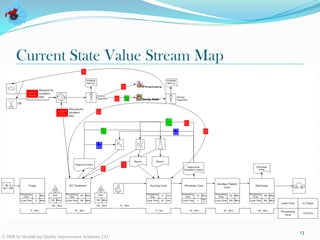
Current State Value Stream Map


                                                          13
© 2008 by HealthCare Quality Improvement Solutions, LLC
Value Stream Mapping Purpose
         It’s not about developing the map
         It’s about understanding the process, service and
             information flow
                AND WHERE WASTE IS IMPEDING PATIENT FLOW


                                                              14
© 2008 by HealthCare Quality Improvement Solutions, LLC
Current State Value Stream Map
         What is Current State?
           A value stream map that represents the process steps,
            flow of patients , services and information as they exist
            today.


                                                                        15
© 2008 by HealthCare Quality Improvement Solutions, LLC
Current State Value Stream Mapping Steps
        1.       Select a value stream
        2.       Map the process flow
        3.       Determine the process metrics and collect data
        4.       Map the information flow
        5.       Add the timeline


                                                                  16
© 2008 by HealthCare Quality Improvement Solutions, LLC
Current State VSM Step 1:
            Selecting a Value Stream
         Identify the value streams from the perspective of the
             patient:
                Determine the process steps they experience
                Ascertain the services they receive
         A value stream is comprised of similar process steps
             and services delivered


                                                                   17
© 2008 by HealthCare Quality Improvement Solutions, LLC
Current State VSM Step 1:
           Selecting a Value Stream
                                ED             Surgery    Pharmacy   Lab   Radiology   Rehab   OT

        Medical                  X                 X         X       X        X         X      X
        Surgical                 X                 X         X       X        X         X      X
        OB                                         X         X       X


                                                                                                    18
© 2008 by HealthCare Quality Improvement Solutions, LLC
Current State VSM Step 2:
           Map The Process Flow

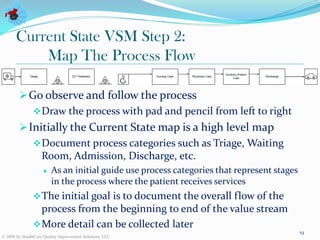
         Go observe and follow the process
            Draw the process with pad and pencil from left to right
         Initially the Current State map is a high level map
            Document process categories such as Triage, Waiting
             Room, Admission, Discharge, etc.
                        As an initial guide use process categories that represent stages
                         in the process where the patient receives services
                The initial goal is to document the overall flow of the
                 process from the beginning to end of the value stream
                More detail can be collected later
                                                                                            19
© 2008 by HealthCare Quality Improvement Solutions, LLC
Current State VSM Step 2:
           Map The Process Flow
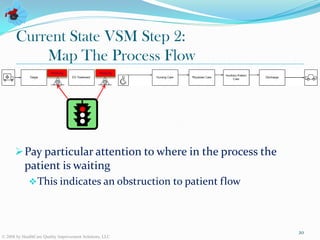
                        Waiting                  Waiting


       Pay particular attention to where in the process the
           patient is waiting
              This indicates an obstruction to patient flow


                                                               20
© 2008 by HealthCare Quality Improvement Solutions, LLC
Current State VSM Step 3:
           Add Process Metrics


         Determine the relevant process metrics for each process step and implement
          data collection
            Any metrics that are relevant can be used
            Averages and proportions are usually recorded
         Collect current data
         From a patient flow perspective two measurements should always be collected:
            Processing time – the value creating time
               The time spent delivering care that favorably transforms the patient’s
                 health status
            Cycle time – the total time necessary to execute a task
            These times can be recorded as averages
                                                                                         21
© 2008 by HealthCare Quality Improvement Solutions, LLC
Current State VSM Step 4:
           Map Information Flow


                          Manual Information Flow


                                                          Fax Transmission   Telephone   Walk
                         Electronic Information Flow                                            22
© 2008 by HealthCare Quality Improvement Solutions, LLC
Current State VSM Step 4:
           Map Information Flow
         Information flow refers to the trigger that signals work to
          be performed
         When mapping information flow it is insightful to ask:
                How does each service know what to do for the patient and
                    when to do it?
                        For example:
                           How does housekeeping know when to clean a room after a
                            patient has been discharged?
                           How does the bed control coordinator know when housekeeping
                            has completed preparing the room for the next patient?
                           How and when does the patient know when to start making
                            arrangements for transportation home?

                                                                                          23
© 2008 by HealthCare Quality Improvement Solutions, LLC
Current State VSM Step 5:
           Add Timeline


                                                          24
© 2008 by HealthCare Quality Improvement Solutions, LLC
Current State VSM Step 5:
           Add Timeline


                                                          Non-Value Added Time


                    Value Added Time                                             Value Added Time

                                                                                                    25
© 2008 by HealthCare Quality Improvement Solutions, LLC
Current State VSM Step 5:
           Add Timeline


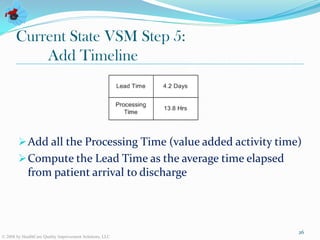
         Add all the Processing Time (value added activity time)
         Compute the Lead Time as the average time elapsed
             from patient arrival to discharge


                                                                26
© 2008 by HealthCare Quality Improvement Solutions, LLC
Current State Value Stream Map


                                                          27
© 2008 by HealthCare Quality Improvement Solutions, LLC
Future State Value Stream Map
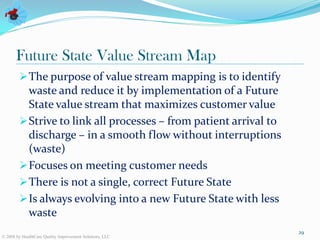
         The purpose of value stream mapping is to identify
          waste and reduce it by implementation of a Future
          State value stream that maximizes customer value
         Strive to link all processes – from patient arrival to
          discharge – in a smooth flow without interruptions
          (waste)
         Focuses on meeting customer needs
         There is not a single, correct Future State
         Is always evolving into a new Future State with less
          waste
                                                                   29
© 2008 by HealthCare Quality Improvement Solutions, LLC
Future State Value Stream Mapping Steps
        1. Identify the customers and their needs
        2. Evaluate the Current State Map
        3. Establish the time frame to implement
           improvements
        4. Map the Future State
               a. Establish goals for metrics
               b. Determine process improvements for implementation


                                                                      30
© 2008 by HealthCare Quality Improvement Solutions, LLC
Future State VSM Step 1:
           Identify Customers and Their Needs
         The patient and their family are the ultimate external
          customers
         Internal customers needs have to met in order to meet
          patient and family needs
                Who receives the output of process steps?
                What is required of the output for the customer to
                    execute their processes without waste?
                        Timing
                        Format
                        Frequency

                                                                      31
© 2008 by HealthCare Quality Improvement Solutions, LLC
Future State VSM Step 2:
           Evaluate Current State Map
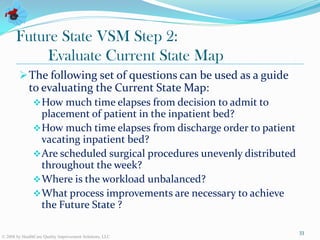
         The following set of questions can be used as a guide
             to evaluating the Current State Map:
                Where are the largest amounts of waste?
                  Which process steps create waste?
                    Why are they being performed?

                  What knowledge and skills are truly required to perform the
                   process steps
                Where can continuous flow processing be
                    implemented?
                        Where can people and tasks be placed together so that the
                         process flows without delay?
                Where are the most troublesome problems occurring?

                                                                                     32
© 2008 by HealthCare Quality Improvement Solutions, LLC
Future State VSM Step 2:
           Evaluate Current State Map
         The following set of questions can be used as a guide
             to evaluating the Current State Map:
                How much time elapses from decision to admit to
                 placement of patient in the inpatient bed?
                How much time elapses from discharge order to patient
                 vacating inpatient bed?
                Are scheduled surgical procedures unevenly distributed
                 throughout the week?
                Where is the workload unbalanced?
                What process improvements are necessary to achieve
                 the Future State ?

                                                                          33
© 2008 by HealthCare Quality Improvement Solutions, LLC
Future State VSM Step 2:
           Evaluate Current State Map


                                                          13.7% VA
© 2008 by HealthCare Quality Improvement Solutions, LLC
Future State VSM Step 3:
           Establish Time Frame To Improvement
         Prior to mapping the Future State establish the time
          frame to achieve the Future State
         This time frame is an important decision:
                The longer the time frame, the more improvements that
                    can be undertaken
         Consider keeping the first Future State time frame
          within 6 months
         Strive to keep the time frame within 12 months


                                                                         35
© 2008 by HealthCare Quality Improvement Solutions, LLC
Future State VSM Step 4:
           Map The Future State: Set Goals


                          FS                    FS
                          20                    30        FS 15/15
                                                                     36
© 2008 by HealthCare Quality Improvement Solutions, LLC
Future State VSM Step 4:
                 Map The Future State: Determine Improvements


                                                          16.0% VA
                                                               37
© 2008 by HealthCare Quality Improvement Solutions, LLC
Future State Implementation
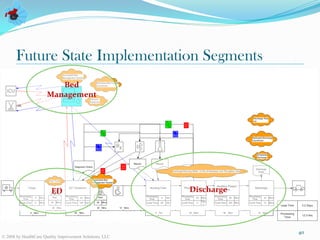
         Usually it is not possible to implement the entire
          Future State Value Stream at once.
         When viewed as a process of building a series of inter-
          connected process flows for a value stream:
                The Future State Value Stream can be organized into
                 relatively homogenous segments that represent areas of
                 flow.
                These segments can then be the focus of process
                 improvement which are implemented in a systematic
                 manner.

                                                                          39
© 2008 by HealthCare Quality Improvement Solutions, LLC
Future State Implementation Segments
                         Bed
                      Management


                         ED                               Discharge


                                                                      40
© 2008 by HealthCare Quality Improvement Solutions, LLC
Future State Implementation Segments
         In what order should the segments be implemented?
         If the discharge process is a segment, implement this
             segment first
                Unimpeded patient flow through the hospital is
                 dependent upon the availability of inpatient beds
                A streamlined discharge process facilitates smooth
                 patient flow
         Use your judgment on which of the other segments
          will have the greatest impact on patient flow
         If resources permit, multiple segments can be
          improved simultaneously
                                                                      41
© 2008 by HealthCare Quality Improvement Solutions, LLC
Value Stream Improvement Plan

         Segment                 Goal                        Improvements                 Jan   Feb   Mar   Apr   May   Jun   Jul


                                             •Begin discharge planning within 12
                        Reduce the discharge hours of patient admission
                        cycle time on day of •Dedicated discharge coordinator
         Discharge
                        discharge to 15      •Discharge task list
                        minutes              •Schedule date and time of discharge at
                                              least 24 hours in advance
                                                  •Implement a Fast Track
                          Reduce the ED
             ED           waiting room time
                          to 20 minutes

                          Reduce the cycle        •Implement an automated bed
          Bed             time of bed              management system
       Management         assignment to 10        •Dedicated bed management coordinator
                          minutes                 •Demand prediction


                                                                                                                              42
© 2008 by HealthCare Quality Improvement Solutions, LLC
Value Stream Improvement Review
         Conduct at minimum a quarterly review

              Segment                 Current             Project Progress   Identified   Proposed    Action Taken
                                  Performance vs.                            Problems     Solutions
                                       Goal


                                       Meeting                On Schedule
                                                              At Risk
                                       Not Meeting            Behind
                                                              Schedule


                                                                                                                     43
© 2008 by HealthCare Quality Improvement Solutions, LLC
Value Stream Management Components
         Value Stream Manager
         Visual Control
         Real-time Problem Solving & Process Improvement


                                                            44
© 2008 by HealthCare Quality Improvement Solutions, LLC
Value Stream Management Components
         Value Stream Manager
            An individual with primary responsibility for
             understanding, monitoring and continuously
             improving the value stream
            If the value stream is not continuously managed, waste
             will creep into the stream and obstruct patient flow


                                                                      45
© 2008 by HealthCare Quality Improvement Solutions, LLC
Value Stream Management Components
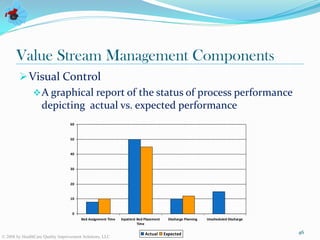
         Visual Control
            A graphical report of the status of process performance
             depicting actual vs. expected performance
                                  60


                                  50


                                  40


                                  30


                                  20


                                  10


                                   0
                                        Bed Assignment Time   Inpatient Bed Placement     Discharge Planning   Unscheduled Discharge
                                                                        Time

                                                                            Actual      Expected                                       46
© 2008 by HealthCare Quality Improvement Solutions, LLC
Value Stream Management Components
         Visual Control
            Should be made visible to everyone involved in the value
             stream
            Updated at least twice daily
            Reviewed by the value stream manager at least as
             frequently as they are updated


                                                                    47
© 2008 by HealthCare Quality Improvement Solutions, LLC
Value Stream Management Components
         Real-time Problem Solving & Process Improvement
            When actual performance does not meet the expected
             performance the value stream manager initiates action
             to:
                        Determine the root cause(s) of the performance gap;
                        Identify and implement process improvements to eliminate
                         the root cause(s).
                Action is initiated on the same day as the gap in
                    performance is discovered.


                                                                                    48
© 2008 by HealthCare Quality Improvement Solutions, LLC
Value Stream Management Advantages
         Provides a view from a systems perspective:
            Identifies where and how much waste is in the patient
             flow system
            Depicts the interconnection between process steps and
             information flow
         Provides a basis for a process improvement
          implementation plan from a systems perspective
         Avoids suboptimal departmental approaches to
          improving patient flow
         Promotes continuous process improvement
                                                                     49
© 2008 by HealthCare Quality Improvement Solutions, LLC
Value Stream Management Advantages
         Ideal method for meeting The Joint Commission’s
             patient flow standard:
                Pertains to identifying and mitigating impediments to
                 efficient patient flow throughout the hospital.
                Hospitals are required to identify and correct patient
                 flow issues organization-wide.
                They must identify where in the organization problems
                 exist and take action to prevent barriers to patient flow.
         New hospital-specific tracer on patient flow:
           Beginning in January 2008 surveyors will conduct a new
            system tracer to identify problems with patient flow.

                                                                              50
© 2008 by HealthCare Quality Improvement Solutions, LLC
Waste
         There are eight forms of waste:
               1.        Waiting: No transformation is taking place.
               2.        Motion: Activity that does not add value.
                    a.      Examples: physical therapy traveling to the patient’s room to find the patient is in X-ray
               3.        Overproduction: Producing more process output that the downstream process can handle.
                    a.      Examples: same day surgery patients schedule for afternoon surgery arriving at 6:00 am
               4.        Transportation: No transformation is taking place
               5.        Defects: No favorable transformation is taking place
                    a.      Examples: preventable errors, preventable infections, data entry errors,
               6.        Overprocessing: Activity that , from the customer’s perspective, does not add value
                    a.      Examples Producing reports that are not used for decision making or regulatory
                            compliance.
               7.        Underutilized People: Not harnessing the knowledge and experience of the work force.
               8.        Inventory: Excess inventory hides process problems.
                    a.      Example, a surgical tray that has incorrect instruments is replaced with one of the many in
                            inventory. The surgical procedure continues, but no root cause analysis and process
                            improvement is undertaken to eliminate incorrect instrument trays.


                                                                                                                      52
© 2008 by HealthCare Quality Improvement Solutions, LLC

Improving patient flow value stream management

  • 1.
    © 2008 byHealthCare Quality Improvement Solutions, LLC
  • 2.
    Value Stream Management  What is a value stream?  All the activities – both value added and non-value added – performed to treat patients from initial hospital arrival through discharge. 2 © 2008 by HealthCare Quality Improvement Solutions, LLC
  • 3.
    ED Registration ED Triage ED ED Care Transportation Transportation Inpatient Pharmacy Admission Inpatient Care Discharge Home Housekeeping 3 © 2008 by HealthCare Quality Improvement Solutions, LLC
  • 4.
    Patient Flow ValueStreams  Outpatient  Emergency Department  Outpatient Surgery  Outpatient Clinics  Inpatient  Medical  Surgical Cardiothoracic   Orthopedic  Obstetrics  Pediatrics 4 © 2008 by HealthCare Quality Improvement Solutions, LLC
  • 5.
    Value Stream ManagementPhilosophy  Entails viewing patient flow as a system of processes;  Not as isolated, individual processes.  Involves improving the system;  Not just improving individual components or departments.  Focuses on customer requirements:  Delivering services in a manner that maximizes customer value.  Process improvement is a daily, continuous, responsibility. 5 © 2008 by HealthCare Quality Improvement Solutions, LLC
  • 6.
    ED Registration ED Triage ED ED Care Transportation Waste Transportation Waste Inpatient Pharmacy Admission Waste Inpatient Care Discharge Home Waste Housekeeping 6 © 2008 by HealthCare Quality Improvement Solutions, LLC
  • 7.
    Value Added Activity  An activity is value added when:  A physical transformation occurs;  The customer is aware of it and willing to pay for it;  It is performed correctly the first time.  Healthcare value added activity:  The patient receives provider care that favorably transforms their health status;  The provider care is not attributed to treating a preventable adverse event.  The patient is aware of it and willing to pay for it;  It is performed correctly the first time. 7 © 2008 by HealthCare Quality Improvement Solutions, LLC
  • 8.
    Non-Value Added Activity  Any activity that is not value added  Healthcare non-value added activity:  The patient’s health status is not being transformed favorably ;  The patient is not aware of it and or not willing to pay for it;  Is not performed correctly the first time.  Considered waste 8 © 2008 by HealthCare Quality Improvement Solutions, LLC
  • 9.
    Waste  There are eight forms of waste: 1. Waiting 2. Motion 3. Transportation 4. Overproduction 5. Defects 6. Overprocessing 7. Underutilized People 8. Inventory 9 © 2008 by HealthCare Quality Improvement Solutions, LLC
  • 10.
    Value Stream ManagementComponents  Process Steps Select Value Stream  Value Stream Manager Construct Current  Visual Control State Value Stream Map  Real-time Problem Develop Future State Value Stream Map Solving & Process Improvement Develop Value Stream Improvement Plan 10 © 2008 by HealthCare Quality Improvement Solutions, LLC
  • 11.
    © 2008 byHealthCare Quality Improvement Solutions, LLC
  • 12.
    Value Stream Mapping(VSM)  What is a Value Stream Map?  A graphical representation of :  The process steps;  The flow of patients, hospital services and information;  The value added activity provided;  From the beginning to the end of the value stream. 12 © 2008 by HealthCare Quality Improvement Solutions, LLC
  • 13.
    Current State ValueStream Map 13 © 2008 by HealthCare Quality Improvement Solutions, LLC
  • 14.
    Value Stream MappingPurpose  It’s not about developing the map  It’s about understanding the process, service and information flow  AND WHERE WASTE IS IMPEDING PATIENT FLOW 14 © 2008 by HealthCare Quality Improvement Solutions, LLC
  • 15.
    Current State ValueStream Map  What is Current State?  A value stream map that represents the process steps, flow of patients , services and information as they exist today. 15 © 2008 by HealthCare Quality Improvement Solutions, LLC
  • 16.
    Current State ValueStream Mapping Steps 1. Select a value stream 2. Map the process flow 3. Determine the process metrics and collect data 4. Map the information flow 5. Add the timeline 16 © 2008 by HealthCare Quality Improvement Solutions, LLC
  • 17.
    Current State VSMStep 1: Selecting a Value Stream  Identify the value streams from the perspective of the patient:  Determine the process steps they experience  Ascertain the services they receive  A value stream is comprised of similar process steps and services delivered 17 © 2008 by HealthCare Quality Improvement Solutions, LLC
  • 18.
    Current State VSMStep 1: Selecting a Value Stream ED Surgery Pharmacy Lab Radiology Rehab OT Medical X X X X X X X Surgical X X X X X X X OB X X X 18 © 2008 by HealthCare Quality Improvement Solutions, LLC
  • 19.
    Current State VSMStep 2: Map The Process Flow  Go observe and follow the process  Draw the process with pad and pencil from left to right  Initially the Current State map is a high level map  Document process categories such as Triage, Waiting Room, Admission, Discharge, etc.  As an initial guide use process categories that represent stages in the process where the patient receives services  The initial goal is to document the overall flow of the process from the beginning to end of the value stream  More detail can be collected later 19 © 2008 by HealthCare Quality Improvement Solutions, LLC
  • 20.
    Current State VSMStep 2: Map The Process Flow Waiting Waiting  Pay particular attention to where in the process the patient is waiting  This indicates an obstruction to patient flow 20 © 2008 by HealthCare Quality Improvement Solutions, LLC
  • 21.
    Current State VSMStep 3: Add Process Metrics  Determine the relevant process metrics for each process step and implement data collection  Any metrics that are relevant can be used  Averages and proportions are usually recorded  Collect current data  From a patient flow perspective two measurements should always be collected:  Processing time – the value creating time  The time spent delivering care that favorably transforms the patient’s health status  Cycle time – the total time necessary to execute a task  These times can be recorded as averages 21 © 2008 by HealthCare Quality Improvement Solutions, LLC
  • 22.
    Current State VSMStep 4: Map Information Flow Manual Information Flow Fax Transmission Telephone Walk Electronic Information Flow 22 © 2008 by HealthCare Quality Improvement Solutions, LLC
  • 23.
    Current State VSMStep 4: Map Information Flow  Information flow refers to the trigger that signals work to be performed  When mapping information flow it is insightful to ask:  How does each service know what to do for the patient and when to do it?  For example:  How does housekeeping know when to clean a room after a patient has been discharged?  How does the bed control coordinator know when housekeeping has completed preparing the room for the next patient?  How and when does the patient know when to start making arrangements for transportation home? 23 © 2008 by HealthCare Quality Improvement Solutions, LLC
  • 24.
    Current State VSMStep 5: Add Timeline 24 © 2008 by HealthCare Quality Improvement Solutions, LLC
  • 25.
    Current State VSMStep 5: Add Timeline Non-Value Added Time Value Added Time Value Added Time 25 © 2008 by HealthCare Quality Improvement Solutions, LLC
  • 26.
    Current State VSMStep 5: Add Timeline  Add all the Processing Time (value added activity time)  Compute the Lead Time as the average time elapsed from patient arrival to discharge 26 © 2008 by HealthCare Quality Improvement Solutions, LLC
  • 27.
    Current State ValueStream Map 27 © 2008 by HealthCare Quality Improvement Solutions, LLC
  • 28.
    © 2008 byHealthCare Quality Improvement Solutions, LLC
  • 29.
    Future State ValueStream Map  The purpose of value stream mapping is to identify waste and reduce it by implementation of a Future State value stream that maximizes customer value  Strive to link all processes – from patient arrival to discharge – in a smooth flow without interruptions (waste)  Focuses on meeting customer needs  There is not a single, correct Future State  Is always evolving into a new Future State with less waste 29 © 2008 by HealthCare Quality Improvement Solutions, LLC
  • 30.
    Future State ValueStream Mapping Steps 1. Identify the customers and their needs 2. Evaluate the Current State Map 3. Establish the time frame to implement improvements 4. Map the Future State a. Establish goals for metrics b. Determine process improvements for implementation 30 © 2008 by HealthCare Quality Improvement Solutions, LLC
  • 31.
    Future State VSMStep 1: Identify Customers and Their Needs  The patient and their family are the ultimate external customers  Internal customers needs have to met in order to meet patient and family needs  Who receives the output of process steps?  What is required of the output for the customer to execute their processes without waste?  Timing  Format  Frequency 31 © 2008 by HealthCare Quality Improvement Solutions, LLC
  • 32.
    Future State VSMStep 2: Evaluate Current State Map  The following set of questions can be used as a guide to evaluating the Current State Map:  Where are the largest amounts of waste?  Which process steps create waste?  Why are they being performed?  What knowledge and skills are truly required to perform the process steps  Where can continuous flow processing be implemented?  Where can people and tasks be placed together so that the process flows without delay?  Where are the most troublesome problems occurring? 32 © 2008 by HealthCare Quality Improvement Solutions, LLC
  • 33.
    Future State VSMStep 2: Evaluate Current State Map  The following set of questions can be used as a guide to evaluating the Current State Map:  How much time elapses from decision to admit to placement of patient in the inpatient bed?  How much time elapses from discharge order to patient vacating inpatient bed?  Are scheduled surgical procedures unevenly distributed throughout the week?  Where is the workload unbalanced?  What process improvements are necessary to achieve the Future State ? 33 © 2008 by HealthCare Quality Improvement Solutions, LLC
  • 34.
    Future State VSMStep 2: Evaluate Current State Map 13.7% VA © 2008 by HealthCare Quality Improvement Solutions, LLC
  • 35.
    Future State VSMStep 3: Establish Time Frame To Improvement  Prior to mapping the Future State establish the time frame to achieve the Future State  This time frame is an important decision:  The longer the time frame, the more improvements that can be undertaken  Consider keeping the first Future State time frame within 6 months  Strive to keep the time frame within 12 months 35 © 2008 by HealthCare Quality Improvement Solutions, LLC
  • 36.
    Future State VSMStep 4: Map The Future State: Set Goals FS FS 20 30 FS 15/15 36 © 2008 by HealthCare Quality Improvement Solutions, LLC
  • 37.
    Future State VSMStep 4: Map The Future State: Determine Improvements 16.0% VA 37 © 2008 by HealthCare Quality Improvement Solutions, LLC
  • 38.
    © 2008 byHealthCare Quality Improvement Solutions, LLC
  • 39.
    Future State Implementation  Usually it is not possible to implement the entire Future State Value Stream at once.  When viewed as a process of building a series of inter- connected process flows for a value stream:  The Future State Value Stream can be organized into relatively homogenous segments that represent areas of flow.  These segments can then be the focus of process improvement which are implemented in a systematic manner. 39 © 2008 by HealthCare Quality Improvement Solutions, LLC
  • 40.
    Future State ImplementationSegments Bed Management ED Discharge 40 © 2008 by HealthCare Quality Improvement Solutions, LLC
  • 41.
    Future State ImplementationSegments  In what order should the segments be implemented?  If the discharge process is a segment, implement this segment first  Unimpeded patient flow through the hospital is dependent upon the availability of inpatient beds  A streamlined discharge process facilitates smooth patient flow  Use your judgment on which of the other segments will have the greatest impact on patient flow  If resources permit, multiple segments can be improved simultaneously 41 © 2008 by HealthCare Quality Improvement Solutions, LLC
  • 42.
    Value Stream ImprovementPlan Segment Goal Improvements Jan Feb Mar Apr May Jun Jul •Begin discharge planning within 12 Reduce the discharge hours of patient admission cycle time on day of •Dedicated discharge coordinator Discharge discharge to 15 •Discharge task list minutes •Schedule date and time of discharge at least 24 hours in advance •Implement a Fast Track Reduce the ED ED waiting room time to 20 minutes Reduce the cycle •Implement an automated bed Bed time of bed management system Management assignment to 10 •Dedicated bed management coordinator minutes •Demand prediction 42 © 2008 by HealthCare Quality Improvement Solutions, LLC
  • 43.
    Value Stream ImprovementReview  Conduct at minimum a quarterly review Segment Current Project Progress Identified Proposed Action Taken Performance vs. Problems Solutions Goal Meeting On Schedule At Risk Not Meeting Behind Schedule 43 © 2008 by HealthCare Quality Improvement Solutions, LLC
  • 44.
    Value Stream ManagementComponents  Value Stream Manager  Visual Control  Real-time Problem Solving & Process Improvement 44 © 2008 by HealthCare Quality Improvement Solutions, LLC
  • 45.
    Value Stream ManagementComponents  Value Stream Manager  An individual with primary responsibility for understanding, monitoring and continuously improving the value stream  If the value stream is not continuously managed, waste will creep into the stream and obstruct patient flow 45 © 2008 by HealthCare Quality Improvement Solutions, LLC
  • 46.
    Value Stream ManagementComponents  Visual Control  A graphical report of the status of process performance depicting actual vs. expected performance 60 50 40 30 20 10 0 Bed Assignment Time Inpatient Bed Placement Discharge Planning Unscheduled Discharge Time Actual Expected 46 © 2008 by HealthCare Quality Improvement Solutions, LLC
  • 47.
    Value Stream ManagementComponents  Visual Control  Should be made visible to everyone involved in the value stream  Updated at least twice daily  Reviewed by the value stream manager at least as frequently as they are updated 47 © 2008 by HealthCare Quality Improvement Solutions, LLC
  • 48.
    Value Stream ManagementComponents  Real-time Problem Solving & Process Improvement  When actual performance does not meet the expected performance the value stream manager initiates action to:  Determine the root cause(s) of the performance gap;  Identify and implement process improvements to eliminate the root cause(s).  Action is initiated on the same day as the gap in performance is discovered. 48 © 2008 by HealthCare Quality Improvement Solutions, LLC
  • 49.
    Value Stream ManagementAdvantages  Provides a view from a systems perspective:  Identifies where and how much waste is in the patient flow system  Depicts the interconnection between process steps and information flow  Provides a basis for a process improvement implementation plan from a systems perspective  Avoids suboptimal departmental approaches to improving patient flow  Promotes continuous process improvement 49 © 2008 by HealthCare Quality Improvement Solutions, LLC
  • 50.
    Value Stream ManagementAdvantages  Ideal method for meeting The Joint Commission’s patient flow standard:  Pertains to identifying and mitigating impediments to efficient patient flow throughout the hospital.  Hospitals are required to identify and correct patient flow issues organization-wide.  They must identify where in the organization problems exist and take action to prevent barriers to patient flow.  New hospital-specific tracer on patient flow:  Beginning in January 2008 surveyors will conduct a new system tracer to identify problems with patient flow. 50 © 2008 by HealthCare Quality Improvement Solutions, LLC
  • 51.
    © 2008 byHealthCare Quality Improvement Solutions, LLC
  • 52.
    Waste  There are eight forms of waste: 1. Waiting: No transformation is taking place. 2. Motion: Activity that does not add value. a. Examples: physical therapy traveling to the patient’s room to find the patient is in X-ray 3. Overproduction: Producing more process output that the downstream process can handle. a. Examples: same day surgery patients schedule for afternoon surgery arriving at 6:00 am 4. Transportation: No transformation is taking place 5. Defects: No favorable transformation is taking place a. Examples: preventable errors, preventable infections, data entry errors, 6. Overprocessing: Activity that , from the customer’s perspective, does not add value a. Examples Producing reports that are not used for decision making or regulatory compliance. 7. Underutilized People: Not harnessing the knowledge and experience of the work force. 8. Inventory: Excess inventory hides process problems. a. Example, a surgical tray that has incorrect instruments is replaced with one of the many in inventory. The surgical procedure continues, but no root cause analysis and process improvement is undertaken to eliminate incorrect instrument trays. 52 © 2008 by HealthCare Quality Improvement Solutions, LLC