In the name of Allah. Most Gracious, Most Merciful 
بســـــم الله الرحمـــــن الرحـــــيم
QMD/ CPD Program 
HEALTHCARE QUALITY 
BASIC CONCEPTS 
Dr. Yasser Sami Amer 
MBBCh, MS Pediatrics, MS HC Informatics, CPHQ 
Supervisor, R&D, QMD, KSUMC 
CPGs Advisor , KSUHs, AUHs 
Member, NAHQ, USA 
Member, G-I-N Adaptation & Implementation Working Groups
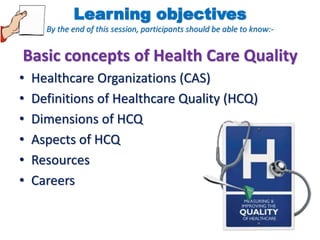
Learning objectives 
By the end of this session, participants should be able to know:- 
Basic concepts of Health Care Quality 
• Healthcare Organizations (CAS) 
• Definitions of Healthcare Quality (HCQ) 
• Dimensions of HCQ 
• Aspects of HCQ 
• Resources 
• Careers
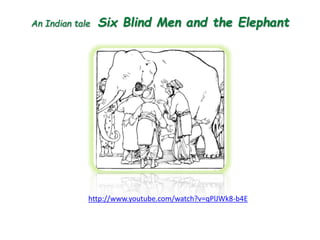
An Indian tale Six Blind Men and the Elephant 
http://www.youtube.com/watch?v=qPlJWk8-b4E
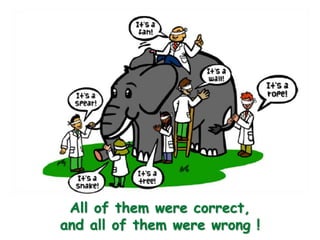
All of them were correct, 
and all of them were wrong !
current debates about HC Reform is like a 
modern version of the elephant fable! 
• Various groups of stakeholders have banded 
together to come up with their "solution” to 
the problems of current healthcare models. 
• Too much is spent, outcomes are not good 
enough, and too many people are harmed. 
• As solutions are presented, not only are the 
stakeholders convinced of their merit, they are 
also certain that counterproposals are wrong.
A complex adaptive system is 
comprised of a heterogeneous and diverse 
network of interacting and independent 
agents/elements that learn and adapt over time. 
Complex system behaviors are often said to be 
emergent and subject to self-organization. In 
short, the macro-level behavior of the system is 
more than the sum of the micro-level.
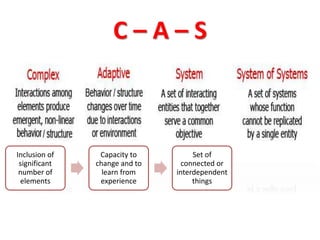
C – A – S 
Inclusion of 
significant 
number of 
elements 
Capacity to 
change and to 
learn from 
experience 
Set of 
connected or 
interdependent 
things
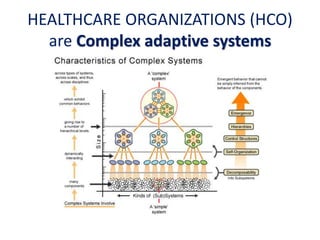
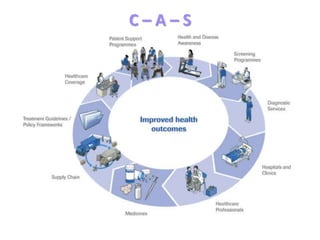
HEALTHCARE ORGANIZATIONS (HCO) 
are Complex adaptive systems
C – A – S
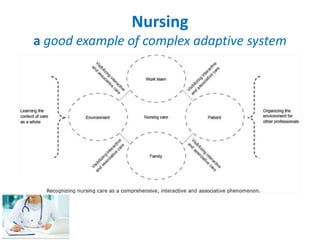
Nursing 
a good example of complex adaptive system
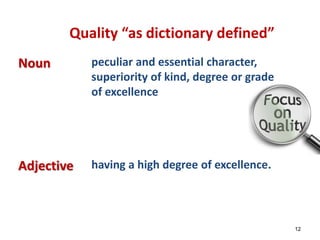
Quality “as dictionary defined” 
Noun peculiar and essential character, 
superiority of kind, degree or grade 
of excellence 
Adjective having a high degree of excellence. 
12
Perfection of One's Work. The Messenger (peace be upon him) 
said: "Allah loves that if one does a job he perfects it." 
......من الإتقــــان إلى الإحســـان ......
Definitions of Quality in Healthcare o 
In practice ………… 
= doing right things right the first time 
= the right care for every person every time 
= first NO harm 
14
Healthcare Quality 
The extent to which health services 
provided to individuals and patient 
populations improve desired health 
outcomes. The care should be based on the 
strongest clinical evidence and provided in 
a technically and culturally competent 
manner with good communication and 
shared decision making. 
IOM 2001
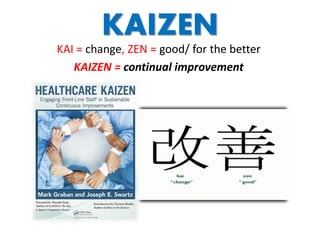
KAIZEN 
KAI = change, ZEN = good/ for the better 
KAIZEN = continual improvement
Standards are created when experts are able to 
understand what the right things are and now 
the right things are best achieved 
Quality = Compliance with the Standards 
17
Quality of care is ……… 
Accessible 
Effective 
Safe 
Accountable 
Fair 
18
19 
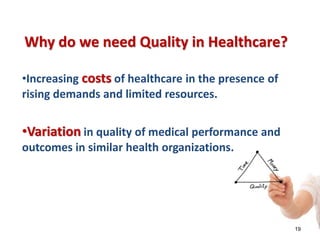
Why do we need Quality in Healthcare? 
•Increasing costs of healthcare in the presence of 
rising demands and limited resources. 
•Variation in quality of medical performance and 
outcomes in similar health organizations.
20 
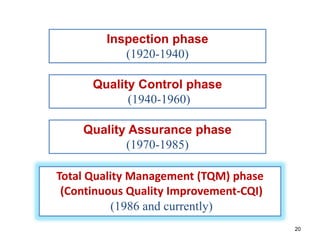
Inspection phase 
(1920-1940) 
Quality Control phase 
(1940-1960) 
Quality Assurance phase 
(1970-1985) 
Total Quality Management (TQM) phase 
(Continuous Quality Improvement-CQI) 
(1986 and currently)
21 
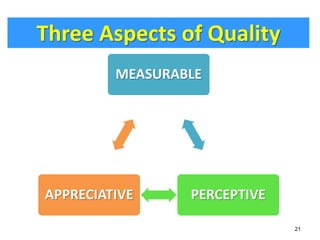
Three Aspects of Quality 
MEASURABLE 
APPRECIATIVE PERCEPTIVE
22 
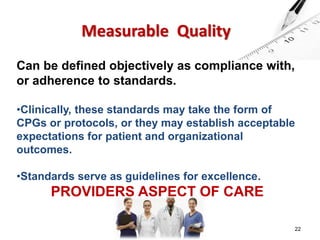
Measurable Quality 
Can be defined objectively as compliance with, 
or adherence to standards. 
•Clinically, these standards may take the form of 
CPGs or protocols, or they may establish acceptable 
expectations for patient and organizational 
outcomes. 
•Standards serve as guidelines for excellence. 
PROVIDERS ASPECT OF CARE
23 
Appreciative Quality 
Is the appraisal of excellence beyond minimal 
standards and criteria. 
•Requires the judgments of skilled, experienced 
practitioners and sensitive, caring persons. 
• Peer review bodies rely on the judgments of like 
professionals in determining the quality or non-quality 
of specific patient-practitioner interactions. 
PEER REVIEW/ ACCREDITATION BODIES, EXPERTISE 
AND SKILLED PERSON ASPECT OF CARE
24 
Perceptive Quality 
Is the degree of excellence which is perceived 
by the recipient or the observer of care rather 
than by the provider of care. 
Is generally based more on the degree of 
caring expressed by physicians, nurses, and 
other staff than on the physical environment 
and technical competence. 
RECEPIENT/ PATIENT ‘customer’ 
ASPECT OF CARE
ALL THE THREE ASPECTS OF 
QUALITY ARE ABSOLUTELY 
ESSENTIAL TO OUR CONSIDERATION 
OF THE OUTCOME AND ALL 
ASSOCIATED PROCESS AND 
STRUCTURE OF HEALTHCARE 
DELIVERY
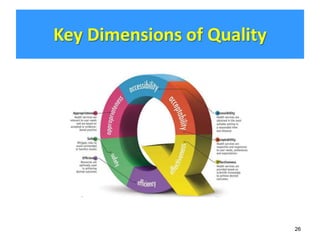
Key Dimensions of Quality 
26
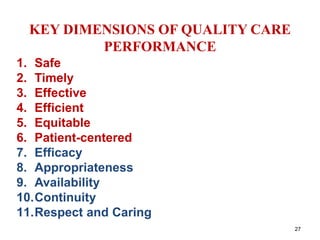
KEY DIMENSIONS OF QUALITY CARE 
PERFORMANCE 
1. Safe 
2. Timely 
3. Effective 
4. Efficient 
5. Equitable 
6. Patient-centered 
7. Efficacy 
8. Appropriateness 
9. Availability 
10.Continuity 
11.Respect and Caring 
27
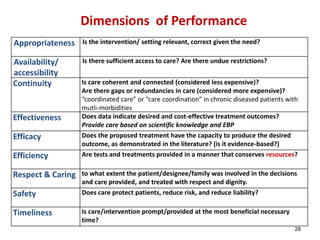
Is the intervention/ setting Appropriateness relevant, correct given the need? 
Availability/ Is there sufficient access to care? Are there undue restrictions? 
accessibility 
Is care coherent and connected (considered less expensive)? 
Are there gaps or redundancies in care (considered more expensive)? 
“coordinated care” or “care coordination” in chronic diseased patients with 
mutli-morbidities 
Continuity 
Does data indicate desired and cost-effective treatment outcomes? 
Provide care based on scientific knowledge and EBP 
Effectiveness 
Does the proposed treatment have the capacity to produce the desired 
outcome, as demonstrated in the literature? (is it evidence-based?) 
Efficacy 
Efficiency Are tests and treatments provided in a manner that conserves resources? 
to what extent the patient/designee/family was involved in the decisions 
and care provided, and treated with respect and dignity. 
Respect & Caring 
Safety Does care protect patients, reduce risk, and reduce liability? 
Is care/intervention prompt/provided at the most beneficial necessary 
time? 
Timeliness 
Dimensions of Performance 
28
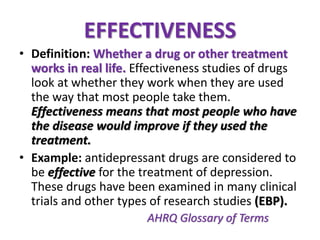
EFFECTIVENESS 
• Definition: Whether a drug or other treatment 
works in real life. Effectiveness studies of drugs 
look at whether they work when they are used 
the way that most people take them. 
Effectiveness means that most people who have 
the disease would improve if they used the 
treatment. 
• Example: antidepressant drugs are considered to 
be effective for the treatment of depression. 
These drugs have been examined in many clinical 
trials and other types of research studies (EBP). 
AHRQ Glossary of Terms
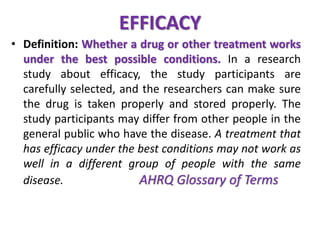
EFFICACY 
• Definition: Whether a drug or other treatment works 
under the best possible conditions. In a research 
study about efficacy, the study participants are 
carefully selected, and the researchers can make sure 
the drug is taken properly and stored properly. The 
study participants may differ from other people in the 
general public who have the disease. A treatment that 
has efficacy under the best conditions may not work as 
well in a different group of people with the same 
disease. AHRQ Glossary of Terms
Efficacy (cont’d) 
Example: a recent clinical trial compared people treated 
with insulin to people treated with oral medicine for 
diabetes. Only people with no other medical problems 
were enrolled in the study, and most were under age 65. 
The people treated with insulin had better improvement 
in their blood glucose than the people treated with oral 
medicines. 
This study is considered an efficacy study, because only 
younger people without any other health problems were 
included. Many people who have diabetes are over age 
65 and have other problems such as heart disease. It is 
not known whether the same results would be found in 
these people.
Changing the Healthcare Delivery System 
As part of the agenda for change, the IOM’s Committee on 
Quality of Health Care in America established aims for the 21st 
century healthcare system. The committee proposed six 
improvement aims to address key dimensions of healthcare 
quality that were performing at far lower levels than they should 
be. 
They suggested that healthcare at a minimum 
should be: STEEEP ! 
32
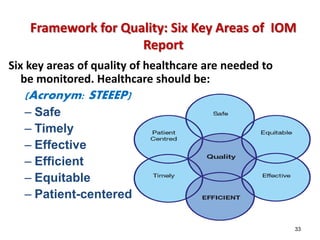
Framework for Quality: Six Key Areas of IOM 
33 
Report 
Six key areas of quality of healthcare are needed to 
be monitored. Healthcare should be: 
(Acronym: STEEEP) 
– Safe 
– Timely 
– Effective 
– Efficient 
– Equitable 
– Patient-centered
The Healthcare Customer
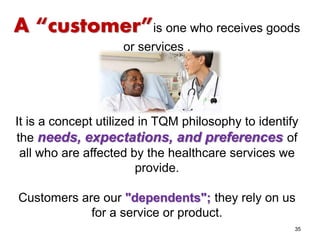
A “customer”is one who receives goods 
35 
or services . 
It is a concept utilized in TQM philosophy to identify 
the needs, expectations, and preferences of 
all who are affected by the healthcare services we 
provide. 
Customers are our "dependents"; they rely on us 
for a service or product.
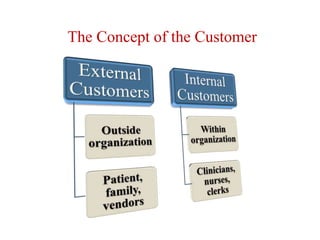
The Concept of the Customer
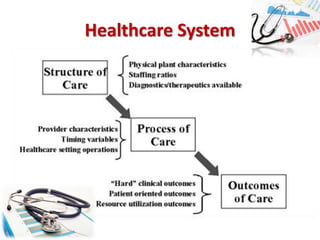
Healthcare System
Quality of Care 
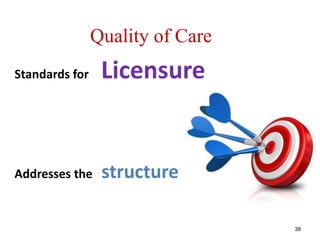
Standards for Licensure 
Addresses the structure 
38
Quality of Care 
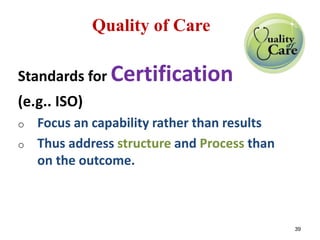
Standards for Certification 
(e.g.. ISO) 
o Focus an capability rather than results 
o Thus address structure and Process than 
on the outcome. 
39
Quality of Care 
Standards for Accreditation Addresses 
Structure, Process and Outcome of care. 
40
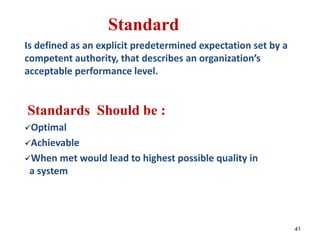
Standard 
Is defined as an explicit predetermined expectation set by a 
competent authority, that describes an organization’s 
acceptable performance level. 
Standards Should be : 
Optimal 
Achievable 
When met would lead to highest possible quality in 
a system 
41
Resources in HCQ
AHRQuality Indicators
CPGs
www.qualityforum.org/Home.aspx
ISQua http://www.isqua.org/
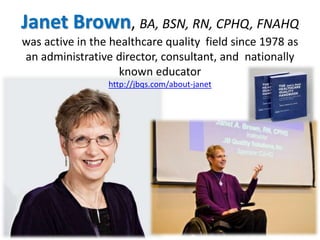
Janet Brown, BA, BSN, RN, CPHQ, FNAHQ 
was active in the healthcare quality field since 1978 as 
an administrative director, consultant, and nationally 
known educator 
http://jbqs.com/about-janet
Careers in HCQ (in USA) 
Healthcare Quality Professional 
(Academic degrees OR Professional certificates) 
• Thomas Jefferson University/ Jefferson School of 
Population Health: MS in Healthcare Quality & 
Safety 
• Northwestern University Feinberg School of 
Medicine/ Center for Education in Health Sciences: 
Graduate Programs in Healthcare Quality and 
Patient Safety (MS, PhD & certificate) 
• National Association for Healthcare Quality: 
Certified Professional in Healthcare Quality 
• ISQua: Fellowship Programme
CPHQ 
• Information management 
• Performance Improvement 
• Strategic leadership and people 
management 
• Patient safety 
• Accreditation and continuous readiness 
• Change management
Questions? Tanong? सवाल? ?سوالات
Acknowledgment 
Dr. Magdy Gamal Youssef, 
MBBCh, MS OBGYN, DTQM, CPHQ 
Former Director, Healthcare Quality Directorate, Alexandria University 
Hospitals, Alexandria, Egypt
Dr. Yasser Sami Amer 
EBCPGs Advisor & Trainer 
yasser3amer@yahoo.com 
yamer@ksu.edu.sa

Healthcare Quality: Basic concepts

  • 1.
    In the nameof Allah. Most Gracious, Most Merciful بســـــم الله الرحمـــــن الرحـــــيم
  • 2.
    QMD/ CPD Program HEALTHCARE QUALITY BASIC CONCEPTS Dr. Yasser Sami Amer MBBCh, MS Pediatrics, MS HC Informatics, CPHQ Supervisor, R&D, QMD, KSUMC CPGs Advisor , KSUHs, AUHs Member, NAHQ, USA Member, G-I-N Adaptation & Implementation Working Groups
  • 3.
    Learning objectives Bythe end of this session, participants should be able to know:- Basic concepts of Health Care Quality • Healthcare Organizations (CAS) • Definitions of Healthcare Quality (HCQ) • Dimensions of HCQ • Aspects of HCQ • Resources • Careers
  • 4.
    An Indian taleSix Blind Men and the Elephant http://www.youtube.com/watch?v=qPlJWk8-b4E
  • 5.
    All of themwere correct, and all of them were wrong !
  • 6.
    current debates aboutHC Reform is like a modern version of the elephant fable! • Various groups of stakeholders have banded together to come up with their "solution” to the problems of current healthcare models. • Too much is spent, outcomes are not good enough, and too many people are harmed. • As solutions are presented, not only are the stakeholders convinced of their merit, they are also certain that counterproposals are wrong.
  • 7.
    A complex adaptivesystem is comprised of a heterogeneous and diverse network of interacting and independent agents/elements that learn and adapt over time. Complex system behaviors are often said to be emergent and subject to self-organization. In short, the macro-level behavior of the system is more than the sum of the micro-level.
  • 8.
    C – A– S Inclusion of significant number of elements Capacity to change and to learn from experience Set of connected or interdependent things
  • 9.
    HEALTHCARE ORGANIZATIONS (HCO) are Complex adaptive systems
  • 10.
    C – A– S
  • 11.
    Nursing a goodexample of complex adaptive system
  • 12.
    Quality “as dictionarydefined” Noun peculiar and essential character, superiority of kind, degree or grade of excellence Adjective having a high degree of excellence. 12
  • 13.
    Perfection of One'sWork. The Messenger (peace be upon him) said: "Allah loves that if one does a job he perfects it." ......من الإتقــــان إلى الإحســـان ......
  • 14.
    Definitions of Qualityin Healthcare o In practice ………… = doing right things right the first time = the right care for every person every time = first NO harm 14
  • 15.
    Healthcare Quality Theextent to which health services provided to individuals and patient populations improve desired health outcomes. The care should be based on the strongest clinical evidence and provided in a technically and culturally competent manner with good communication and shared decision making. IOM 2001
  • 16.
    KAIZEN KAI =change, ZEN = good/ for the better KAIZEN = continual improvement
  • 17.
    Standards are createdwhen experts are able to understand what the right things are and now the right things are best achieved Quality = Compliance with the Standards 17
  • 18.
    Quality of careis ……… Accessible Effective Safe Accountable Fair 18
  • 19.
    19 Why dowe need Quality in Healthcare? •Increasing costs of healthcare in the presence of rising demands and limited resources. •Variation in quality of medical performance and outcomes in similar health organizations.
  • 20.
    20 Inspection phase (1920-1940) Quality Control phase (1940-1960) Quality Assurance phase (1970-1985) Total Quality Management (TQM) phase (Continuous Quality Improvement-CQI) (1986 and currently)
  • 21.
    21 Three Aspectsof Quality MEASURABLE APPRECIATIVE PERCEPTIVE
  • 22.
    22 Measurable Quality Can be defined objectively as compliance with, or adherence to standards. •Clinically, these standards may take the form of CPGs or protocols, or they may establish acceptable expectations for patient and organizational outcomes. •Standards serve as guidelines for excellence. PROVIDERS ASPECT OF CARE
  • 23.
    23 Appreciative Quality Is the appraisal of excellence beyond minimal standards and criteria. •Requires the judgments of skilled, experienced practitioners and sensitive, caring persons. • Peer review bodies rely on the judgments of like professionals in determining the quality or non-quality of specific patient-practitioner interactions. PEER REVIEW/ ACCREDITATION BODIES, EXPERTISE AND SKILLED PERSON ASPECT OF CARE
  • 24.
    24 Perceptive Quality Is the degree of excellence which is perceived by the recipient or the observer of care rather than by the provider of care. Is generally based more on the degree of caring expressed by physicians, nurses, and other staff than on the physical environment and technical competence. RECEPIENT/ PATIENT ‘customer’ ASPECT OF CARE
  • 25.
    ALL THE THREEASPECTS OF QUALITY ARE ABSOLUTELY ESSENTIAL TO OUR CONSIDERATION OF THE OUTCOME AND ALL ASSOCIATED PROCESS AND STRUCTURE OF HEALTHCARE DELIVERY
  • 26.
  • 27.
    KEY DIMENSIONS OFQUALITY CARE PERFORMANCE 1. Safe 2. Timely 3. Effective 4. Efficient 5. Equitable 6. Patient-centered 7. Efficacy 8. Appropriateness 9. Availability 10.Continuity 11.Respect and Caring 27
  • 28.
    Is the intervention/setting Appropriateness relevant, correct given the need? Availability/ Is there sufficient access to care? Are there undue restrictions? accessibility Is care coherent and connected (considered less expensive)? Are there gaps or redundancies in care (considered more expensive)? “coordinated care” or “care coordination” in chronic diseased patients with mutli-morbidities Continuity Does data indicate desired and cost-effective treatment outcomes? Provide care based on scientific knowledge and EBP Effectiveness Does the proposed treatment have the capacity to produce the desired outcome, as demonstrated in the literature? (is it evidence-based?) Efficacy Efficiency Are tests and treatments provided in a manner that conserves resources? to what extent the patient/designee/family was involved in the decisions and care provided, and treated with respect and dignity. Respect & Caring Safety Does care protect patients, reduce risk, and reduce liability? Is care/intervention prompt/provided at the most beneficial necessary time? Timeliness Dimensions of Performance 28
  • 29.
    EFFECTIVENESS • Definition:Whether a drug or other treatment works in real life. Effectiveness studies of drugs look at whether they work when they are used the way that most people take them. Effectiveness means that most people who have the disease would improve if they used the treatment. • Example: antidepressant drugs are considered to be effective for the treatment of depression. These drugs have been examined in many clinical trials and other types of research studies (EBP). AHRQ Glossary of Terms
  • 30.
    EFFICACY • Definition:Whether a drug or other treatment works under the best possible conditions. In a research study about efficacy, the study participants are carefully selected, and the researchers can make sure the drug is taken properly and stored properly. The study participants may differ from other people in the general public who have the disease. A treatment that has efficacy under the best conditions may not work as well in a different group of people with the same disease. AHRQ Glossary of Terms
  • 31.
    Efficacy (cont’d) Example:a recent clinical trial compared people treated with insulin to people treated with oral medicine for diabetes. Only people with no other medical problems were enrolled in the study, and most were under age 65. The people treated with insulin had better improvement in their blood glucose than the people treated with oral medicines. This study is considered an efficacy study, because only younger people without any other health problems were included. Many people who have diabetes are over age 65 and have other problems such as heart disease. It is not known whether the same results would be found in these people.
  • 32.
    Changing the HealthcareDelivery System As part of the agenda for change, the IOM’s Committee on Quality of Health Care in America established aims for the 21st century healthcare system. The committee proposed six improvement aims to address key dimensions of healthcare quality that were performing at far lower levels than they should be. They suggested that healthcare at a minimum should be: STEEEP ! 32
  • 33.
    Framework for Quality:Six Key Areas of IOM 33 Report Six key areas of quality of healthcare are needed to be monitored. Healthcare should be: (Acronym: STEEEP) – Safe – Timely – Effective – Efficient – Equitable – Patient-centered
  • 34.
  • 35.
    A “customer”is onewho receives goods 35 or services . It is a concept utilized in TQM philosophy to identify the needs, expectations, and preferences of all who are affected by the healthcare services we provide. Customers are our "dependents"; they rely on us for a service or product.
  • 36.
    The Concept ofthe Customer
  • 37.
  • 38.
    Quality of Care Standards for Licensure Addresses the structure 38
  • 39.
    Quality of Care Standards for Certification (e.g.. ISO) o Focus an capability rather than results o Thus address structure and Process than on the outcome. 39
  • 40.
    Quality of Care Standards for Accreditation Addresses Structure, Process and Outcome of care. 40
  • 41.
    Standard Is definedas an explicit predetermined expectation set by a competent authority, that describes an organization’s acceptable performance level. Standards Should be : Optimal Achievable When met would lead to highest possible quality in a system 41
  • 42.
  • 44.
  • 45.
  • 46.
  • 47.
  • 49.
    Janet Brown, BA,BSN, RN, CPHQ, FNAHQ was active in the healthcare quality field since 1978 as an administrative director, consultant, and nationally known educator http://jbqs.com/about-janet
  • 50.
    Careers in HCQ(in USA) Healthcare Quality Professional (Academic degrees OR Professional certificates) • Thomas Jefferson University/ Jefferson School of Population Health: MS in Healthcare Quality & Safety • Northwestern University Feinberg School of Medicine/ Center for Education in Health Sciences: Graduate Programs in Healthcare Quality and Patient Safety (MS, PhD & certificate) • National Association for Healthcare Quality: Certified Professional in Healthcare Quality • ISQua: Fellowship Programme
  • 51.
    CPHQ • Informationmanagement • Performance Improvement • Strategic leadership and people management • Patient safety • Accreditation and continuous readiness • Change management
  • 52.
  • 53.
    Acknowledgment Dr. MagdyGamal Youssef, MBBCh, MS OBGYN, DTQM, CPHQ Former Director, Healthcare Quality Directorate, Alexandria University Hospitals, Alexandria, Egypt
  • 54.
    Dr. Yasser SamiAmer EBCPGs Advisor & Trainer yasser3amer@yahoo.com yamer@ksu.edu.sa