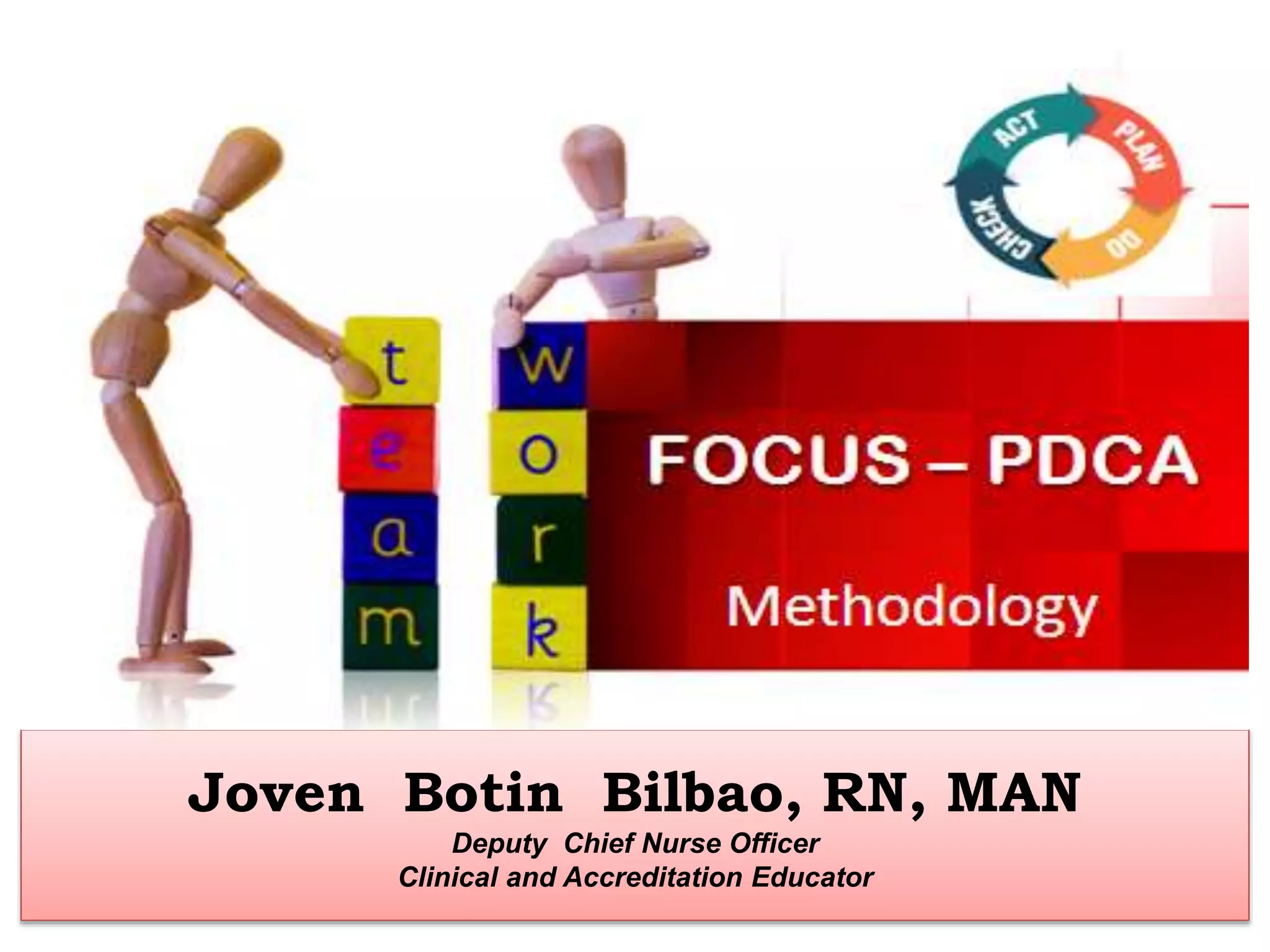
Joven Botin Bilbao, RN, MAN
Deputy Chief Nurse Officer
Clinical and Accreditation Educator
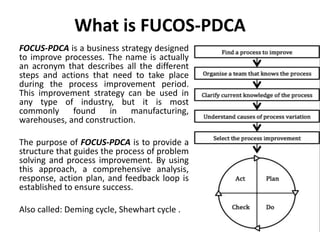
What is FUCOS-PDCA
FOCUS-PDCA is a business strategy designed
to improve processes. The name is actually
an acronym that describes all the different
steps and actions that need to take place
during the process improvement period.
This improvement strategy can be used in
any type of industry, but it is most
commonly found in manufacturing,
warehouses, and construction.
The purpose of FOCUS-PDCA is to provide a
structure that guides the process of problem
solving and process improvement. By using
this approach, a comprehensive analysis,
response, action plan, and feedback loop is
established to ensure success.
Also called: Deming cycle, Shewhart cycle .
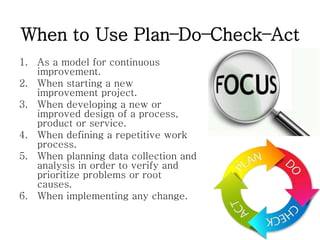
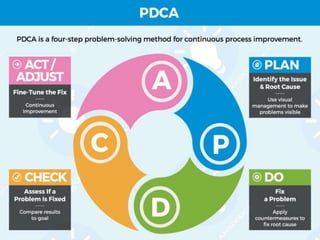
When to Use Plan–Do–Check–Act
1. As a model for continuous
improvement.
2. When starting a new
improvement project.
3. When developing a new or
improved design of a process,
product or service.
4. When defining a repetitive work
process.
5. When planning data collection and
analysis in order to verify and
prioritize problems or root
causes.
6. When implementing any change.
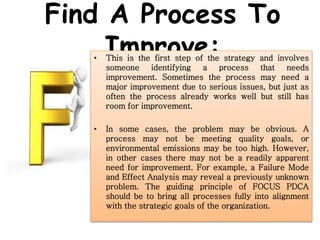
Find A Process To
Improve:• This is the first step of the strategy and involves
someone identifying a process that needs
improvement. Sometimes the process may need a
major improvement due to serious issues, but just as
often the process already works well but still has
room for improvement.
• In some cases, the problem may be obvious. A
process may not be meeting quality goals, or
environmental emissions may be too high. However,
in other cases there may not be a readily apparent
need for improvement. For example, a Failure Mode
and Effect Analysis may reveal a previously unknown
problem. The guiding principle of FOCUS PDCA
should be to bring all processes fully into alignment
with the strategic goals of the organization.
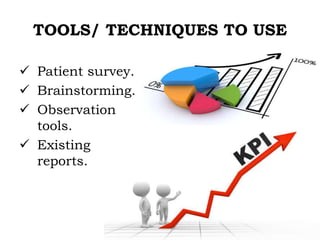
TOOLS/ TECHNIQUES TO USE
 Patient survey.
 Brainstorming.
 Observation
tools.
 Existing
reports.
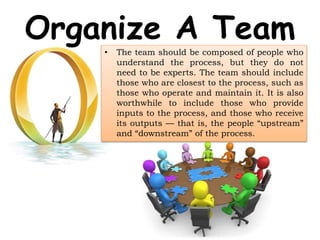
Organize A Team
• The team should be composed of people who
understand the process, but they do not
need to be experts. The team should include
those who are closest to the process, such as
those who operate and maintain it. It is also
worthwhile to include those who provide
inputs to the process, and those who receive
its outputs — that is, the people “upstream”
and “downstream” of the process.
TOOLS/ TECHNIQUES TO USE
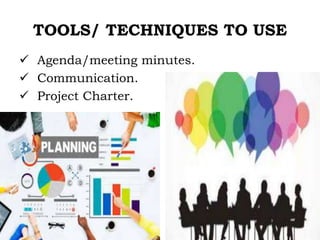
 Agenda/meeting minutes.
 Communication.
 Project Charter.
CLARIFY THE CURRENT
UNDERSTANDING OF THE PROCESS
• Once the team gathers together, all the
knowledge they have about the process is
presented. Questions should be asked and
answers given to clarify what each member of
the team means. This will ensure everyone is
on the same page both in regard to what the
problem is and what the proposed solution
will be.
• Collect data and information about the
process. This may be done through physical
measurements, but it should also include
talking with those who are involved with the
process. Get the answers to the six basic
questions: who, what, where, when, why, and
how.
TOOLS/ TECHNIQUES TO USE
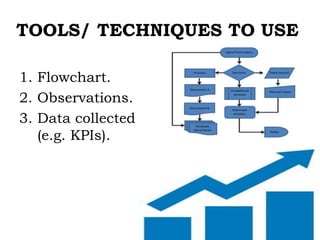
1. Flowchart.
2. Observations.
3. Data collected
(e.g. KPIs).
UNDERSTAND VARIATION IN
THE PROCESS
• One of the most common causes for problems in
a process is the variations that exist. All processes
have some variation, even if it is minor. Looking
at the processes closely and discussing them in
depth will help identify the right strategy.
• Every process includes variation, and some
variation is usually acceptable. When variation
interrupts the normal flow of work, it may be a
symptom of problems in the process, and often
causes other problems as well. In this step, the
question “why” is asked to find the cause of
variation. This is sometimes called “Five Whys” —
the general principle is to ask “why” a sufficient
number of times (often five) to identify the real
cause of the variation.
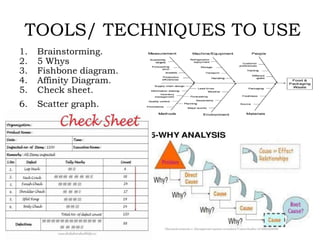
TOOLS/ TECHNIQUES TO USE
1. Brainstorming.
2. 5 Whys
3. Fishbone diagram.
4. Affinity Diagram.
5. Check sheet.
6. Scatter graph.
SELECT A STRATEGY FOR
IMPROVEMENT
• In this stage, an improvement plan is selected to
test. The team should choose the solution to the
problem that they feel will provide the best
results. Part of the improvement plan should be a
list of expected results so once tested, the results
can be measured to determine whether or not the
strategy was successful.
• This step may involve brainstorming, or other
methods of developing ideas. Then, based on
what was learned in the previous two steps, the
best solution is selected. Keep in mind that the
solution must be in alignment with the overall
organization's strategy, it must add value for the
final customer, and it must be both technically
and financially feasible.
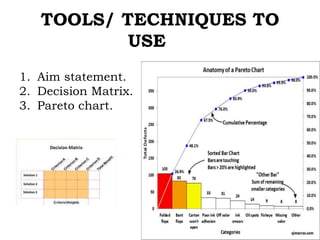
TOOLS/ TECHNIQUES TO
USE
1. Aim statement.
2. Decision Matrix.
3. Pareto chart.
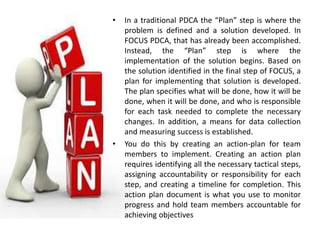
• In a traditional PDCA the “Plan” step is where the
problem is defined and a solution developed. In
FOCUS PDCA, that has already been accomplished.
Instead, the “Plan” step is where the
implementation of the solution begins. Based on
the solution identified in the final step of FOCUS, a
plan for implementing that solution is developed.
The plan specifies what will be done, how it will be
done, when it will be done, and who is responsible
for each task needed to complete the necessary
changes. In addition, a means for data collection
and measuring success is established.
• You do this by creating an action-plan for team
members to implement. Creating an action plan
requires identifying all the necessary tactical steps,
assigning accountability or responsibility for each
step, and creating a timeline for completion. This
action plan document is what you use to monitor
progress and hold team members accountable for
achieving objectives
TOOLS/ TECHNIQUES TO USE
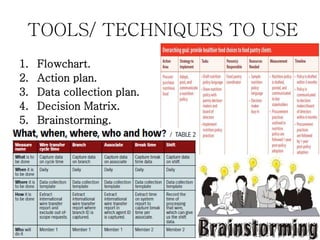
1. Flowchart.
2. Action plan.
3. Data collection plan.
4. Decision Matrix.
5. Brainstorming.
• Do the plan. You do this by
completing the steps in the action
plan and holding people
accountable for assigned steps
and timelines. This is the most
critical step in the entire
improvement process. If people
do not follow through with the Do,
the plan is nothing more than a
piece of paper.
• If it was not done as a part of
FOCUS, data must be collected to
characterize the condition of the
process before changes are made.
Then the required changes are
made — that is, the plan is
implemented.
TOOLS/ TECHNIQUES TO USE
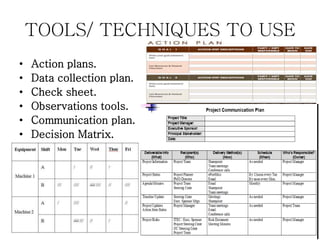
• Action plans.
• Data collection plan.
• Check sheet.
• Observations tools.
• Communication plan.
• Decision Matrix.
• Did the changes have the desired result? Data is collected, the
process is observed, and the changes are evaluated by comparing
the actual results with the desired results. If the results are not
as desired, then the previous steps are reviewed. This includes
going back to the beginning to be sure the problem definition was
correct, and the root cause was accurately identified.
• Check the results to see whether the improvement efforts truly
made a difference. In the volunteer application process example,
it’s important to have the baseline data showing the actual length
of the process prior to the improvement efforts as a measure to
monitor progress. Collect the same data after the improvements
are in effect and compare the before and after process times to
determine whether the efforts resulted in the goal or AIM of the
efforts.
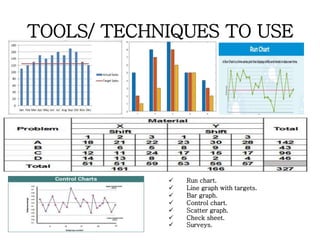
TOOLS/ TECHNIQUES TO USE
 Run chart.
 Line graph with targets.
 Bar graph.
 Control chart.
 Scatter graph.
 Check sheet.
 Surveys.
• The final step is to take the steps
necessary to maintain the improvement.
For example, the changes should be
incorporated into the standards
governing the process. In addition, a
means of monitoring the process or
system should be established so that
variations from the new normal can be
readily detected.
• Act and determine next steps: Use
findings to determine and act upon next
steps
1.holds the gains
2.Develop plan to monitor data.
3.Revise change idea and begin new
PDCA cycle
4.Start another FOCU-PDCA on a new
improvement.
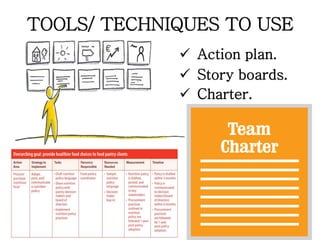
TOOLS/ TECHNIQUES TO USE
 Action plan.
 Story boards.
 Charter.
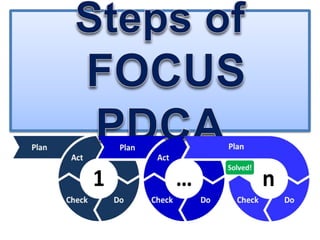
FOCUS PDCA  Quality Imporvement Methodology

FOCUS PDCA Quality Imporvement Methodology

  • 1.
    Joven Botin Bilbao,RN, MAN Deputy Chief Nurse Officer Clinical and Accreditation Educator
  • 2.
    What is FUCOS-PDCA FOCUS-PDCAis a business strategy designed to improve processes. The name is actually an acronym that describes all the different steps and actions that need to take place during the process improvement period. This improvement strategy can be used in any type of industry, but it is most commonly found in manufacturing, warehouses, and construction. The purpose of FOCUS-PDCA is to provide a structure that guides the process of problem solving and process improvement. By using this approach, a comprehensive analysis, response, action plan, and feedback loop is established to ensure success. Also called: Deming cycle, Shewhart cycle .
  • 3.
    When to UsePlan–Do–Check–Act 1. As a model for continuous improvement. 2. When starting a new improvement project. 3. When developing a new or improved design of a process, product or service. 4. When defining a repetitive work process. 5. When planning data collection and analysis in order to verify and prioritize problems or root causes. 6. When implementing any change.
  • 5.
    Find A ProcessTo Improve:• This is the first step of the strategy and involves someone identifying a process that needs improvement. Sometimes the process may need a major improvement due to serious issues, but just as often the process already works well but still has room for improvement. • In some cases, the problem may be obvious. A process may not be meeting quality goals, or environmental emissions may be too high. However, in other cases there may not be a readily apparent need for improvement. For example, a Failure Mode and Effect Analysis may reveal a previously unknown problem. The guiding principle of FOCUS PDCA should be to bring all processes fully into alignment with the strategic goals of the organization.
  • 6.
    TOOLS/ TECHNIQUES TOUSE  Patient survey.  Brainstorming.  Observation tools.  Existing reports.
  • 7.
    Organize A Team •The team should be composed of people who understand the process, but they do not need to be experts. The team should include those who are closest to the process, such as those who operate and maintain it. It is also worthwhile to include those who provide inputs to the process, and those who receive its outputs — that is, the people “upstream” and “downstream” of the process.
  • 8.
    TOOLS/ TECHNIQUES TOUSE  Agenda/meeting minutes.  Communication.  Project Charter.
  • 9.
    CLARIFY THE CURRENT UNDERSTANDINGOF THE PROCESS • Once the team gathers together, all the knowledge they have about the process is presented. Questions should be asked and answers given to clarify what each member of the team means. This will ensure everyone is on the same page both in regard to what the problem is and what the proposed solution will be. • Collect data and information about the process. This may be done through physical measurements, but it should also include talking with those who are involved with the process. Get the answers to the six basic questions: who, what, where, when, why, and how.
  • 10.
    TOOLS/ TECHNIQUES TOUSE 1. Flowchart. 2. Observations. 3. Data collected (e.g. KPIs).
  • 11.
    UNDERSTAND VARIATION IN THEPROCESS • One of the most common causes for problems in a process is the variations that exist. All processes have some variation, even if it is minor. Looking at the processes closely and discussing them in depth will help identify the right strategy. • Every process includes variation, and some variation is usually acceptable. When variation interrupts the normal flow of work, it may be a symptom of problems in the process, and often causes other problems as well. In this step, the question “why” is asked to find the cause of variation. This is sometimes called “Five Whys” — the general principle is to ask “why” a sufficient number of times (often five) to identify the real cause of the variation.
  • 12.
    TOOLS/ TECHNIQUES TOUSE 1. Brainstorming. 2. 5 Whys 3. Fishbone diagram. 4. Affinity Diagram. 5. Check sheet. 6. Scatter graph.
  • 13.
    SELECT A STRATEGYFOR IMPROVEMENT • In this stage, an improvement plan is selected to test. The team should choose the solution to the problem that they feel will provide the best results. Part of the improvement plan should be a list of expected results so once tested, the results can be measured to determine whether or not the strategy was successful. • This step may involve brainstorming, or other methods of developing ideas. Then, based on what was learned in the previous two steps, the best solution is selected. Keep in mind that the solution must be in alignment with the overall organization's strategy, it must add value for the final customer, and it must be both technically and financially feasible.
  • 14.
    TOOLS/ TECHNIQUES TO USE 1.Aim statement. 2. Decision Matrix. 3. Pareto chart.
  • 16.
    • In atraditional PDCA the “Plan” step is where the problem is defined and a solution developed. In FOCUS PDCA, that has already been accomplished. Instead, the “Plan” step is where the implementation of the solution begins. Based on the solution identified in the final step of FOCUS, a plan for implementing that solution is developed. The plan specifies what will be done, how it will be done, when it will be done, and who is responsible for each task needed to complete the necessary changes. In addition, a means for data collection and measuring success is established. • You do this by creating an action-plan for team members to implement. Creating an action plan requires identifying all the necessary tactical steps, assigning accountability or responsibility for each step, and creating a timeline for completion. This action plan document is what you use to monitor progress and hold team members accountable for achieving objectives
  • 17.
    TOOLS/ TECHNIQUES TOUSE 1. Flowchart. 2. Action plan. 3. Data collection plan. 4. Decision Matrix. 5. Brainstorming.
  • 18.
    • Do theplan. You do this by completing the steps in the action plan and holding people accountable for assigned steps and timelines. This is the most critical step in the entire improvement process. If people do not follow through with the Do, the plan is nothing more than a piece of paper. • If it was not done as a part of FOCUS, data must be collected to characterize the condition of the process before changes are made. Then the required changes are made — that is, the plan is implemented.
  • 19.
    TOOLS/ TECHNIQUES TOUSE • Action plans. • Data collection plan. • Check sheet. • Observations tools. • Communication plan. • Decision Matrix.
  • 20.
    • Did thechanges have the desired result? Data is collected, the process is observed, and the changes are evaluated by comparing the actual results with the desired results. If the results are not as desired, then the previous steps are reviewed. This includes going back to the beginning to be sure the problem definition was correct, and the root cause was accurately identified. • Check the results to see whether the improvement efforts truly made a difference. In the volunteer application process example, it’s important to have the baseline data showing the actual length of the process prior to the improvement efforts as a measure to monitor progress. Collect the same data after the improvements are in effect and compare the before and after process times to determine whether the efforts resulted in the goal or AIM of the efforts.
  • 21.
    TOOLS/ TECHNIQUES TOUSE  Run chart.  Line graph with targets.  Bar graph.  Control chart.  Scatter graph.  Check sheet.  Surveys.
  • 22.
    • The finalstep is to take the steps necessary to maintain the improvement. For example, the changes should be incorporated into the standards governing the process. In addition, a means of monitoring the process or system should be established so that variations from the new normal can be readily detected. • Act and determine next steps: Use findings to determine and act upon next steps 1.holds the gains 2.Develop plan to monitor data. 3.Revise change idea and begin new PDCA cycle 4.Start another FOCU-PDCA on a new improvement.
  • 23.
    TOOLS/ TECHNIQUES TOUSE  Action plan.  Story boards.  Charter.