B.Sc.I
Diversity of Microbes And
Cryptogams
DR. SWATI V. PUNDKAR
Assistant Professor
Department of Botany
Shri Shivaji Science College, Amravati
NAAC Accredited ‘A’ Grade
1.2 Introduction to Plant Kingdom: Cryptogams
• The word ‘Cryptogams (Cryptogamae)’ means hidden
reproduction. It is made up of two Greek words “KRYPTOS” which
means concealed and “GAMOS” which means marriage.
Cryptogams are flowerless and seedless plants. These plants bear
no flowers and fruits. Cryptogams include all non-seed bearing
plants.
• Linnaeus (1754) divided plant kingdom into 25 classes.
• A.W. Eichler, (1883), classified the whole plant kingdom into two
sub-kingdoms such as cryptogams and phanerogams. This is
traditional of classification of plants.
Characteristic Features of Cryptogamae
Following are the important features of cryptogams:
1.These are lower plants.
2.These bear no flowers, seeds, and fruits.
3.These reproduce vegetatively, asexually and sexually.
4.Vegetative reproduction takes place cell division or fragmentation.
5.Asexual reproduction takes place by the means of spores.
6.Sexual reproduction takes place by fusion of male and female
gametes. It can be of an isogamous, anisogamous and oogamous In
isogamy, gametes of similar size, shape, and behavior fuse together. It
is seen in primitive cryptogams. In anisogamy, the two fusing gametes
slightly differ in size and behavior.
6. In oogamous type, the female gamete is large and non-motile
while the male gamete is smaller in size and motile. In oogamy,
the female gamete is known as megagamete and the male
gamete is known as microgamete , antherozoids or
spermatozoa. Oogamy takes place in advanced cryptogams.
7. Advanced cryptogams such as liverworts, mosses,
pteridophytes, and algae undergo alternation of generation i.e.
these go through two phases to complete their life cycle. The
two phases are a sporophytic phase and gametophytic phase.
8. Sporophytic phase is characterized by asexual reproduction
while in gametophytic phase sexual reproduction takes place.
9. The sporophytic phase is the diploid stage while the
gametophytic phase is the haploid stage.
10. The two phases occur in alternation i.e. one after the other.
Classification of Cryptogamae
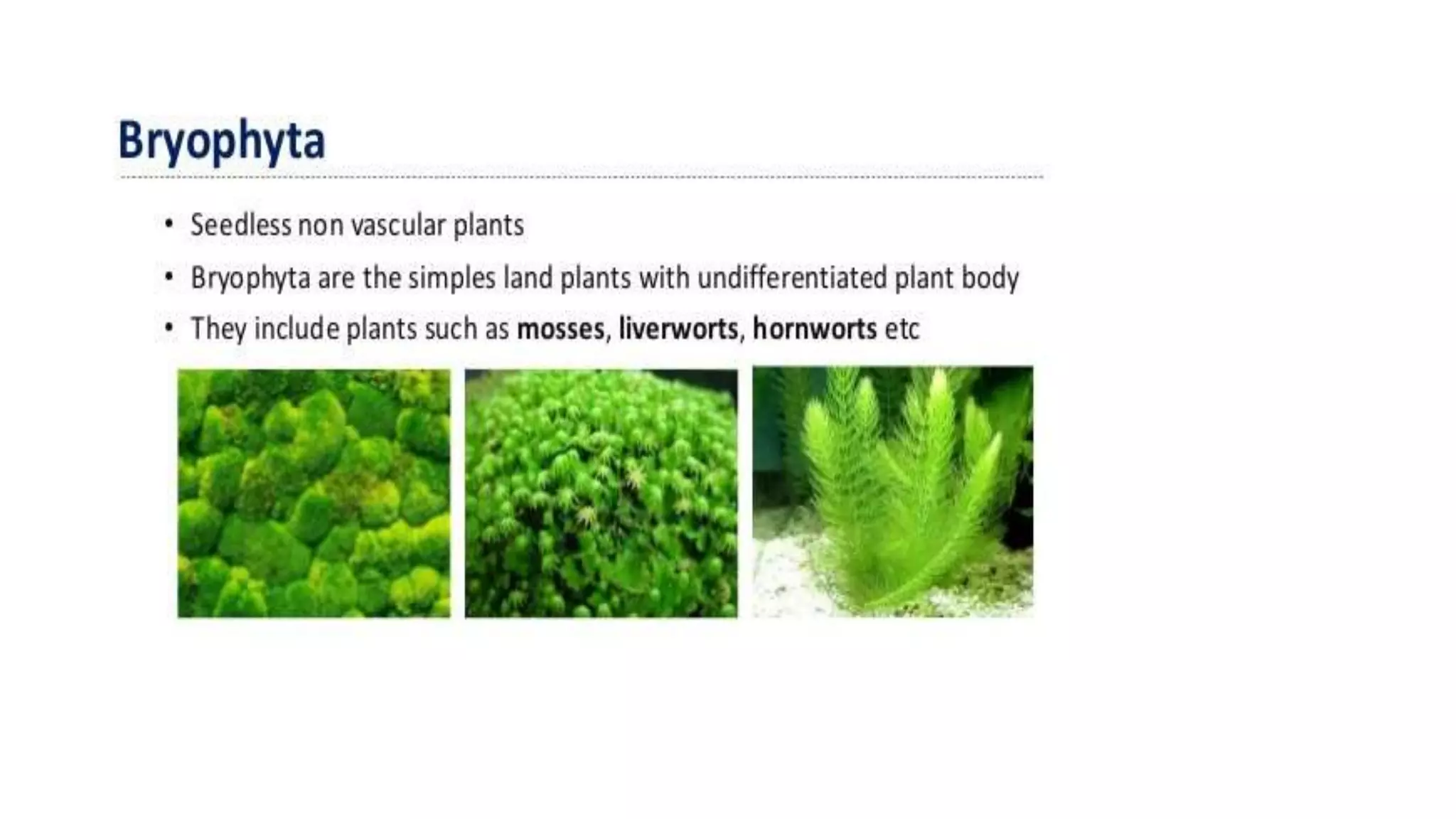
Cryptogams are further divided into 3 groups such as:
1.Thallophyta
2.Bryophyta (Bryophytes)
3.Pteridophytes
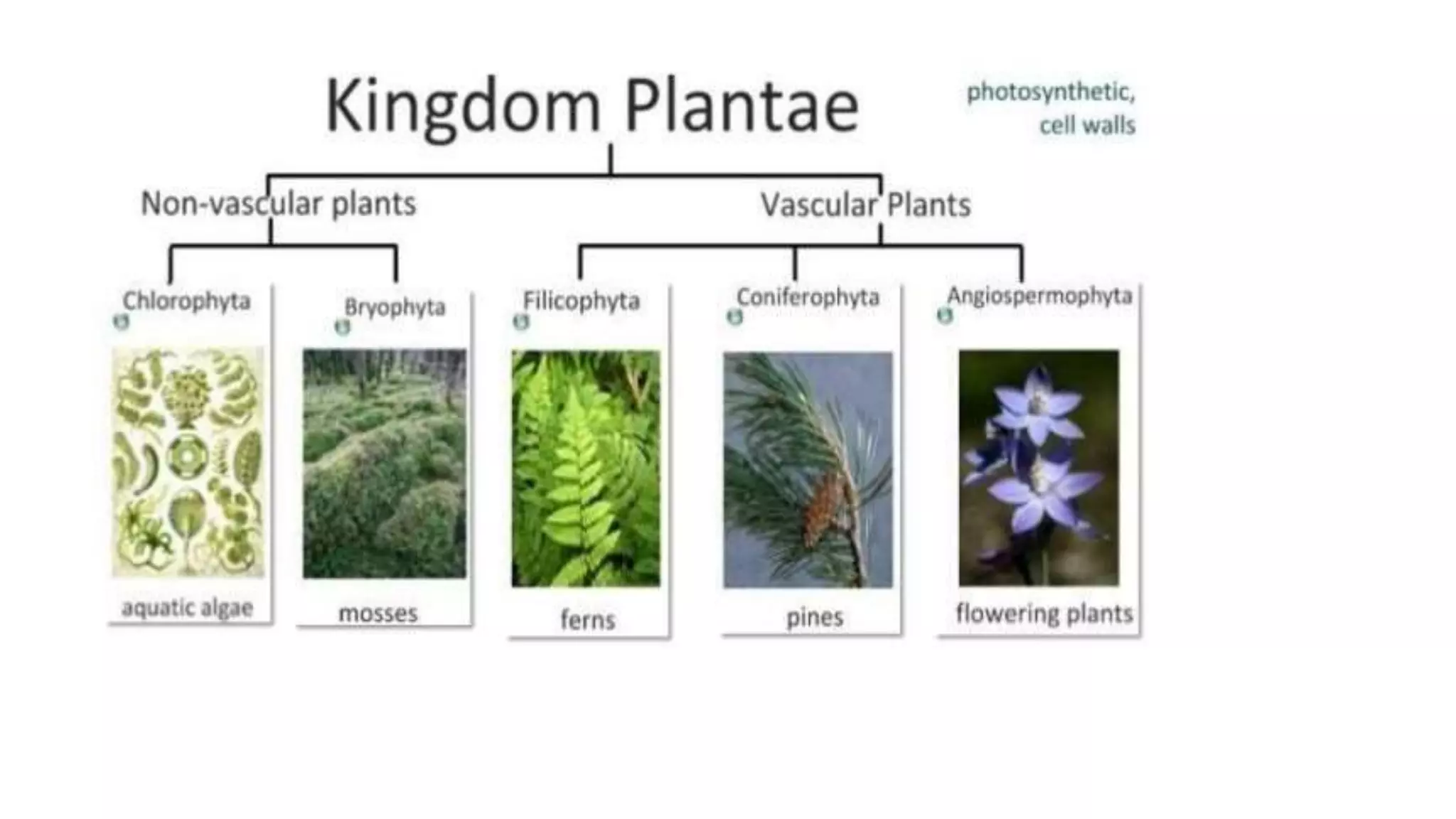
PHANEROGAMS
Angiosperms- (angeion-case,sperm-seed) Angiosperms are vascular
plants. They have stems, roots, and leaves. Unlike gymnosperms such as
conifers and cycads, angiosperm's seeds are found in a
flower. Angiosperm eggs are fertilized and develop into a seed in an
ovary that is usually in a flower.
Those plants in which the seeds are enclosed in the fruit.
They are highest forms of plants.
Gymnosperms- are flowerless plants that produce cones and seeds. The
term gymnosperm literally means "naked seed," as gymnosperm seeds
are not encased within an ovary. Rather, they sit exposed on the surface of
leaf-like structures called bracts
Dicotyledonous- Seed bears two cotyledon.
Monocotyledonous- Seed bears only one cotyledon

Introduction to Plant kingdom (B.Sc.I)

  • 1.
    B.Sc.I Diversity of MicrobesAnd Cryptogams DR. SWATI V. PUNDKAR Assistant Professor Department of Botany Shri Shivaji Science College, Amravati NAAC Accredited ‘A’ Grade
  • 2.
    1.2 Introduction toPlant Kingdom: Cryptogams • The word ‘Cryptogams (Cryptogamae)’ means hidden reproduction. It is made up of two Greek words “KRYPTOS” which means concealed and “GAMOS” which means marriage. Cryptogams are flowerless and seedless plants. These plants bear no flowers and fruits. Cryptogams include all non-seed bearing plants. • Linnaeus (1754) divided plant kingdom into 25 classes. • A.W. Eichler, (1883), classified the whole plant kingdom into two sub-kingdoms such as cryptogams and phanerogams. This is traditional of classification of plants.
  • 5.
    Characteristic Features ofCryptogamae Following are the important features of cryptogams: 1.These are lower plants. 2.These bear no flowers, seeds, and fruits. 3.These reproduce vegetatively, asexually and sexually. 4.Vegetative reproduction takes place cell division or fragmentation. 5.Asexual reproduction takes place by the means of spores. 6.Sexual reproduction takes place by fusion of male and female gametes. It can be of an isogamous, anisogamous and oogamous In isogamy, gametes of similar size, shape, and behavior fuse together. It is seen in primitive cryptogams. In anisogamy, the two fusing gametes slightly differ in size and behavior.
  • 6.
    6. In oogamoustype, the female gamete is large and non-motile while the male gamete is smaller in size and motile. In oogamy, the female gamete is known as megagamete and the male gamete is known as microgamete , antherozoids or spermatozoa. Oogamy takes place in advanced cryptogams. 7. Advanced cryptogams such as liverworts, mosses, pteridophytes, and algae undergo alternation of generation i.e. these go through two phases to complete their life cycle. The two phases are a sporophytic phase and gametophytic phase. 8. Sporophytic phase is characterized by asexual reproduction while in gametophytic phase sexual reproduction takes place. 9. The sporophytic phase is the diploid stage while the gametophytic phase is the haploid stage. 10. The two phases occur in alternation i.e. one after the other.
  • 7.
    Classification of Cryptogamae Cryptogamsare further divided into 3 groups such as: 1.Thallophyta 2.Bryophyta (Bryophytes) 3.Pteridophytes
  • 12.
  • 13.
    Angiosperms- (angeion-case,sperm-seed) Angiospermsare vascular plants. They have stems, roots, and leaves. Unlike gymnosperms such as conifers and cycads, angiosperm's seeds are found in a flower. Angiosperm eggs are fertilized and develop into a seed in an ovary that is usually in a flower. Those plants in which the seeds are enclosed in the fruit. They are highest forms of plants. Gymnosperms- are flowerless plants that produce cones and seeds. The term gymnosperm literally means "naked seed," as gymnosperm seeds are not encased within an ovary. Rather, they sit exposed on the surface of leaf-like structures called bracts
  • 14.
    Dicotyledonous- Seed bearstwo cotyledon. Monocotyledonous- Seed bears only one cotyledon