What Exactly is a Stem?
• A stem:
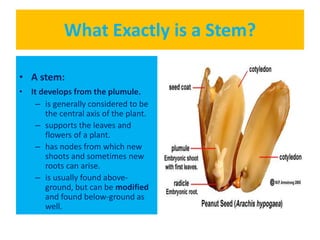
• It develops from the plumule.
– is generally considered to be
the central axis of the plant.
– supports the leaves and
flowers of a plant.
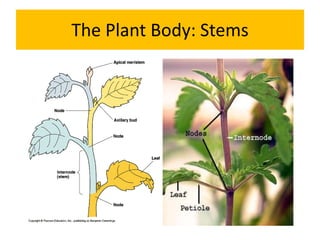
– has nodes from which new
shoots and sometimes new
roots can arise.
– is usually found above-
ground, but can be modified
and found below-ground as
well.
The Plant Body: Stems
FUNCTIONS OF STEMS
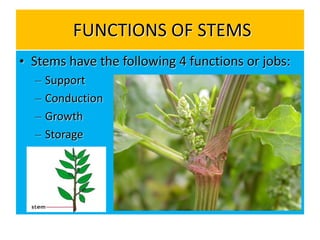
• Stems have the following 4 functions or jobs:
– Support
– Conduction
– Growth
– Storage
FUNCTION OF STEMS
• Stems support leaves and branches. Stems support a display of
leaves. Stems orient the leaves toward the light with minimal overlap
among the leaves.
• Stems transport water and solutes between roots and leaves.
• Stems in some plants are photosynthetic.
• Stems may store materials necessary for life (e.g., water,
starch, sugar).
• In some plants, stems have become adapted for specialized
functions.
Depending upon the presence of mechanical tissues the stems
may be weak, herbaceous, or woody.
1. Weak stems: when the stems are thin and long, they are unable
to stand erect. They may be of following types:
• (A) Creepers or prostrate stem: when they grow flat on the
ground with or without roots.
Eg: grasses, Gokharu
• (B) climbers: these are too weak to stand alone. They climb on
the support with the help of tendrils, hooks, prickles or roots.
Eg: vitis, piper betel, piper longum.
• (C) Twinners: these coil the support and grow further. They are
thin and wiry.
Eg: ipomoea, phaseolus.
creeper climber
twinner
• 2. herbaceous or woody stems: these are the
normal stems and may be soft or hard or
woody.
• Eg: sun flower, sugarcane, Mango.
various types of aerial stem
modifications.
• a) Tendrils
• b) Thorns
• c) Hooks
• d) Phylloclade
• e) Bulbil
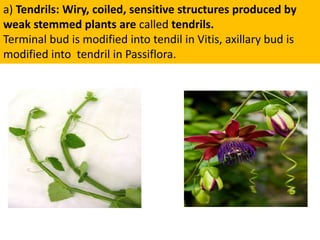
a) Tendrils: Wiry, coiled, sensitive structures produced by
weak stemmed plants are called tendrils.
Terminal bud is modified into tendil in Vitis, axillary bud is
modified into tendril in Passiflora.
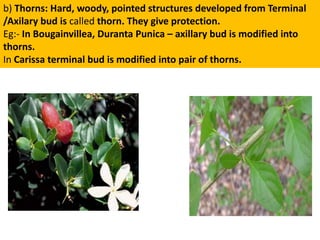
b) Thorns: Hard, woody, pointed structures developed from Terminal
/Axilary bud is called thorn. They give protection.
Eg:- In Bougainvillea, Duranta Punica – axillary bud is modified into
thorns.
In Carissa terminal bud is modified into pair of thorns.
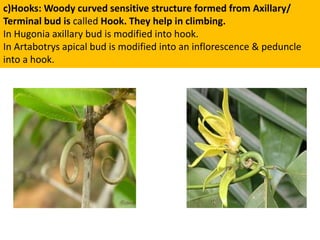
c)Hooks: Woody curved sensitive structure formed from Axillary/
Terminal bud is called Hook. They help in climbing.
In Hugonia axillary bud is modified into hook.
In Artabotrys apical bud is modified into an inflorescence & peduncle
into a hook.
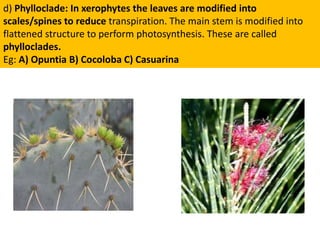
d) Phylloclade: In xerophytes the leaves are modified into
scales/spines to reduce transpiration. The main stem is modified into
flattened structure to perform photosynthesis. These are called
phylloclades.
Eg: A) Opuntia B) Cocoloba C) Casuarina
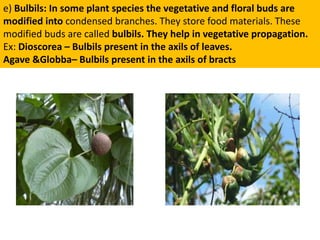
e) Bulbils: In some plant species the vegetative and floral buds are
modified into condensed branches. They store food materials. These
modified buds are called bulbils. They help in vegetative propagation.
Ex: Dioscorea – Bulbils present in the axils of leaves.
Agave &Globba– Bulbils present in the axils of bracts
various types of sub-aerial stem
modifications
• In some weak stemmed plants the stem
remains partly underground. These
• stems are called sub-aerial stems. These are
four types:
• a) Runners
• b) Stolons
• c) Suckers
• d) Offsets
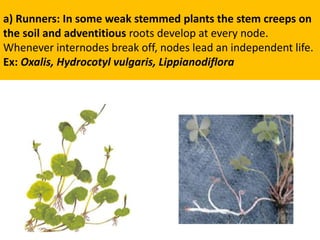
a) Runners: In some weak stemmed plants the stem creeps on
the soil and adventitious roots develop at every node.
Whenever internodes break off, nodes lead an independent life.
Ex: Oxalis, Hydrocotyl vulgaris, Lippianodiflora
b) Stolons: In some plants the basal branches of the stem grow
obliquely downwards and touch the soil. There they produce
adventitious roots. These branches are called stolon. They help in
vegetative propagation when they are separated from mother
plant, they live as independent plants.
Ex: Jasminum, Nerium.
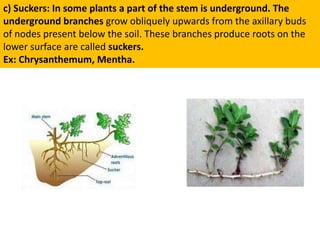
c) Suckers: In some plants a part of the stem is underground. The
underground branches grow obliquely upwards from the axillary buds
of nodes present below the soil. These branches produce roots on the
lower surface are called suckers.
Ex: Chrysanthemum, Mentha.
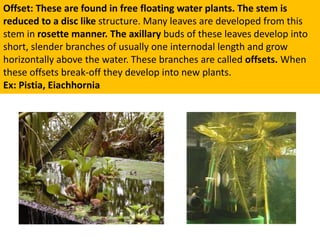
Offset: These are found in free floating water plants. The stem is
reduced to a disc like structure. Many leaves are developed from this
stem in rosette manner. The axillary buds of these leaves develop into
short, slender branches of usually one internodal length and grow
horizontally above the water. These branches are called offsets. When
these offsets break-off they develop into new plants.
Ex: Pistia, Eiachhornia
multipurpose stem modifications
• 1. The underground stems store food.
• 2. They help in vegetative propagation.
• 3. They are protected from herbivorous animals.
• 4. They act as organs of perennation. As they perform
all these above characters they are called
multipurpose stem modifications. They are of
following types.
• 1) Rhizome
• 2) Corm
• 3) Stem tuber
• 4) Bulb
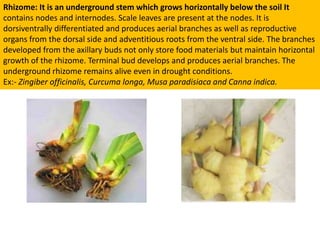
Rhizome: It is an underground stem which grows horizontally below the soil It
contains nodes and internodes. Scale leaves are present at the nodes. It is
dorsiventrally differentiated and produces aerial branches as well as reproductive
organs from the dorsal side and adventitious roots from the ventral side. The branches
developed from the axillary buds not only store food materials but maintain horizontal
growth of the rhizome. Terminal bud develops and produces aerial branches. The
underground rhizome remains alive even in drought conditions.
Ex:- Zingiber officinalis, Curcuma longa, Musa paradisiaca and Canna indica.
Corm: It grows vertically in soil. It bears nodes, internodes and scale
leaves.
Axillaary buds produce daughter corms. Terminal bud is big and
produce aerial shoot.
Ex: Colocasia, Amorphophallus.
In Amorphophallus, special adventitious roots called pull roots keep the
corm at a particular depth in soil.
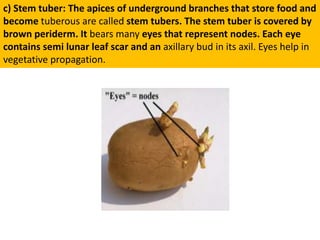
c) Stem tuber: The apices of underground branches that store food and
become tuberous are called stem tubers. The stem tuber is covered by
brown periderm. It bears many eyes that represent nodes. Each eye
contains semi lunar leaf scar and an axillary bud in its axil. Eyes help in
vegetative propagation.
d) Bulb: It is special underground stem modification that does not store food materials
in stem. The stem is reduced to a biconvex shaped disc like structure. It bears
adventitious roots on its lower side and leaves on upper side. Leaf bases (scale leaves)
store food and water. Axillary buds produce daughter bulbs and terminal bud present
at the centre of the bulb develops into an aerial shoot producing inflorescence.
It is two types:
a) Tunicated bulb: The entire bulb is covered by dry membraneous scale leaves called
tunic. The fleshy leaf bases overlap one above the other in concentric circles.
Eg: Allium cepa.
b) Scaly/ imbricate/ naked bulb: Fleshy scale leaves are arranged loosely and tunic is absent.
Ex: Liliumcandidum.
In Allium sativum a number of fleshy scale leaves
called cloves are arranged as in
scaly bulb but a group of such cloves are
enclosed in a whitish, skinny tunic.

Stem characteristics, functions and modifications

  • 2.
    What Exactly isa Stem? • A stem: • It develops from the plumule. – is generally considered to be the central axis of the plant. – supports the leaves and flowers of a plant. – has nodes from which new shoots and sometimes new roots can arise. – is usually found above- ground, but can be modified and found below-ground as well.
  • 3.
  • 4.
    FUNCTIONS OF STEMS •Stems have the following 4 functions or jobs: – Support – Conduction – Growth – Storage
  • 5.
    FUNCTION OF STEMS •Stems support leaves and branches. Stems support a display of leaves. Stems orient the leaves toward the light with minimal overlap among the leaves. • Stems transport water and solutes between roots and leaves. • Stems in some plants are photosynthetic. • Stems may store materials necessary for life (e.g., water, starch, sugar). • In some plants, stems have become adapted for specialized functions.
  • 6.
    Depending upon thepresence of mechanical tissues the stems may be weak, herbaceous, or woody. 1. Weak stems: when the stems are thin and long, they are unable to stand erect. They may be of following types: • (A) Creepers or prostrate stem: when they grow flat on the ground with or without roots. Eg: grasses, Gokharu • (B) climbers: these are too weak to stand alone. They climb on the support with the help of tendrils, hooks, prickles or roots. Eg: vitis, piper betel, piper longum. • (C) Twinners: these coil the support and grow further. They are thin and wiry. Eg: ipomoea, phaseolus.
  • 7.
  • 8.
    • 2. herbaceousor woody stems: these are the normal stems and may be soft or hard or woody. • Eg: sun flower, sugarcane, Mango.
  • 9.
    various types ofaerial stem modifications. • a) Tendrils • b) Thorns • c) Hooks • d) Phylloclade • e) Bulbil
  • 10.
    a) Tendrils: Wiry,coiled, sensitive structures produced by weak stemmed plants are called tendrils. Terminal bud is modified into tendil in Vitis, axillary bud is modified into tendril in Passiflora.
  • 11.
    b) Thorns: Hard,woody, pointed structures developed from Terminal /Axilary bud is called thorn. They give protection. Eg:- In Bougainvillea, Duranta Punica – axillary bud is modified into thorns. In Carissa terminal bud is modified into pair of thorns.
  • 12.
    c)Hooks: Woody curvedsensitive structure formed from Axillary/ Terminal bud is called Hook. They help in climbing. In Hugonia axillary bud is modified into hook. In Artabotrys apical bud is modified into an inflorescence & peduncle into a hook.
  • 13.
    d) Phylloclade: Inxerophytes the leaves are modified into scales/spines to reduce transpiration. The main stem is modified into flattened structure to perform photosynthesis. These are called phylloclades. Eg: A) Opuntia B) Cocoloba C) Casuarina
  • 14.
    e) Bulbils: Insome plant species the vegetative and floral buds are modified into condensed branches. They store food materials. These modified buds are called bulbils. They help in vegetative propagation. Ex: Dioscorea – Bulbils present in the axils of leaves. Agave &Globba– Bulbils present in the axils of bracts
  • 15.
    various types ofsub-aerial stem modifications • In some weak stemmed plants the stem remains partly underground. These • stems are called sub-aerial stems. These are four types: • a) Runners • b) Stolons • c) Suckers • d) Offsets
  • 16.
    a) Runners: Insome weak stemmed plants the stem creeps on the soil and adventitious roots develop at every node. Whenever internodes break off, nodes lead an independent life. Ex: Oxalis, Hydrocotyl vulgaris, Lippianodiflora
  • 17.
    b) Stolons: Insome plants the basal branches of the stem grow obliquely downwards and touch the soil. There they produce adventitious roots. These branches are called stolon. They help in vegetative propagation when they are separated from mother plant, they live as independent plants. Ex: Jasminum, Nerium.
  • 18.
    c) Suckers: Insome plants a part of the stem is underground. The underground branches grow obliquely upwards from the axillary buds of nodes present below the soil. These branches produce roots on the lower surface are called suckers. Ex: Chrysanthemum, Mentha.
  • 19.
    Offset: These arefound in free floating water plants. The stem is reduced to a disc like structure. Many leaves are developed from this stem in rosette manner. The axillary buds of these leaves develop into short, slender branches of usually one internodal length and grow horizontally above the water. These branches are called offsets. When these offsets break-off they develop into new plants. Ex: Pistia, Eiachhornia
  • 20.
    multipurpose stem modifications •1. The underground stems store food. • 2. They help in vegetative propagation. • 3. They are protected from herbivorous animals. • 4. They act as organs of perennation. As they perform all these above characters they are called multipurpose stem modifications. They are of following types. • 1) Rhizome • 2) Corm • 3) Stem tuber • 4) Bulb
  • 21.
    Rhizome: It isan underground stem which grows horizontally below the soil It contains nodes and internodes. Scale leaves are present at the nodes. It is dorsiventrally differentiated and produces aerial branches as well as reproductive organs from the dorsal side and adventitious roots from the ventral side. The branches developed from the axillary buds not only store food materials but maintain horizontal growth of the rhizome. Terminal bud develops and produces aerial branches. The underground rhizome remains alive even in drought conditions. Ex:- Zingiber officinalis, Curcuma longa, Musa paradisiaca and Canna indica.
  • 22.
    Corm: It growsvertically in soil. It bears nodes, internodes and scale leaves. Axillaary buds produce daughter corms. Terminal bud is big and produce aerial shoot. Ex: Colocasia, Amorphophallus. In Amorphophallus, special adventitious roots called pull roots keep the corm at a particular depth in soil.
  • 23.
    c) Stem tuber:The apices of underground branches that store food and become tuberous are called stem tubers. The stem tuber is covered by brown periderm. It bears many eyes that represent nodes. Each eye contains semi lunar leaf scar and an axillary bud in its axil. Eyes help in vegetative propagation.
  • 24.
    d) Bulb: Itis special underground stem modification that does not store food materials in stem. The stem is reduced to a biconvex shaped disc like structure. It bears adventitious roots on its lower side and leaves on upper side. Leaf bases (scale leaves) store food and water. Axillary buds produce daughter bulbs and terminal bud present at the centre of the bulb develops into an aerial shoot producing inflorescence. It is two types: a) Tunicated bulb: The entire bulb is covered by dry membraneous scale leaves called tunic. The fleshy leaf bases overlap one above the other in concentric circles. Eg: Allium cepa. b) Scaly/ imbricate/ naked bulb: Fleshy scale leaves are arranged loosely and tunic is absent. Ex: Liliumcandidum. In Allium sativum a number of fleshy scale leaves called cloves are arranged as in scaly bulb but a group of such cloves are enclosed in a whitish, skinny tunic.