WHAT IS DIVERSITY ?

  Diversity is a commitment to
 recognizing and appreciating the
variety of characteristics that make
      individuals unique in an
  atmosphere that promotes and
celebrates individual and collective
            achievement.
                                 NEXT
PLANTAE


The first level of classification among plants depends
 on whether the plant body has well- differentiated,
         distinct components. The next level of
         classification is based on whether the
  differentiated plant body ha special tissues for the
    transport of water and other substance within.
   Further classification looks at the ability to bear
   seeds and whether the seeds are enclosed within
                            fruits.
                                                 NEXT
THALLOPHYTA

A phylum of plants of very diverse habit and structure, including
      the algae, fungi, and lichens. The simpler forms, as many
     blue-green algae, yeasts, etc., are unicellular and reproduce
      vegetatively or by means of asexual spores; in the higher
  forms the plant body is a thallus, which may be filamentous or
   may consist of plates of cells; it is commonly undifferentiated
      into stem, leaves, and roots, and shows no distinct tissue
    systems; the fronds of many algae, however, are modified to
   serve many of the functions of the above-named organs. Both
         asexual and sexual reproduction, often of a complex
       type, occur in these forms. The Thallophyta exist almost
    exclusively as gametophytes, the sporophyte being absent or
     rudimentary. By those who do not separate the Myxophyta
    from the Tallophyta as a distinct phylum the latter is treated
          as the lowermost group in the vegetable kingdom.
                                                            NEXT
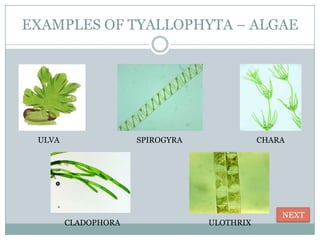
EXAMPLES OF TYALLOPHYTA – ALGAE


 ULVA                SPIROGYRA              CHARA


                                                NEXT
        CLADOPHORA               ULOTHRIX
BRYOPHYTA

A member of a large group of seedless green plants
  including the mosses, liverworts, and hornworts.
  Bryophytes lack the specialized tissues xylem and
 phloem that circulate water and dissolved nutrients
 in the vascular plants. Bryophytes generally live on
land but are mostly found in moist environments, for
 they have free-swimming sperm that require water
 for transport. In contrast to the vascular plants, the
   gametophyte (haploid) generation of bryophytes
  constitutes the larger plant form, while the small
 sporophyte (diploid) generation grows on or within
 the gametophyte and depends upon it for nutrition.
                                                  NEXT
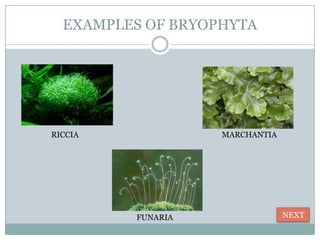
EXAMPLES OF BRYOPHYTA


RICCIA             MARCHANTIA


         FUNARIA                NEXT
PTERIDOPHYTA


A large group of higher plants to which are sometimes
    assigned all higher seedless plants except mosses
(Bryophyta). Unlike the bryophytes, the sporophyte—the
   asexual generation—is well developed and divided,
  except in Psilotophyta, into stems, leaves, and roots.
Spores develop, from which emerges the gametophyte—
    the sexual generation. The gametophyte is poorly
  developed, almost undifferentiated, and bears sexual
      organs (in males, antheridia, and in females,
     archegonia). After fertilization, another asexual
                   generation develops.
                                                   NEXT
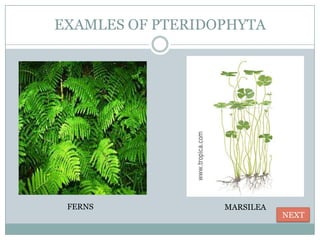
EXAMLES OF PTERIDOPHYTA


 FERNS            MARSILEA
                             NEXT
GYMNOSPERMS

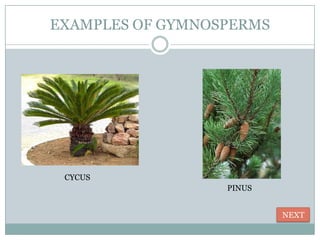
       Gymnosperms are a group of vascular
      plants whose seeds are not enclosed by a
  ripened (fruit). Gymnosperms are distinguished
     from the other major group of seed plants,
  the angiosperms, whose seeds are surrounded by
          an ovary wall. The seeds of many
   Gymnosperms (literally, naked seed) are borne
   in cones and are not visible. Taxonomists now
      recognize four distinct divisions of extant
gymnospermous plants (coniferophyta, cycadophyta,
           ginkgophyta, and gnetophyta).
                                             NEXT
EXAMPLES OF GYMNOSPERMS


 CYCUS
                  PINUS


                          NEXT
ANGIOSPERMS

Any of a large group of plants that produce flowers.
They develop seeds from ovules contained in ovaries,
  and the seeds are enclosed by fruits which develop
   from carpel's. They are also distinguished by the
    process of double fertilization. The majority of
       angiosperms belong to two large classes :
      monocotyledons and eudicotyledons. The
angiosperms are the largest phylum of living plants,
 existing in some 235,000 species. They range from
small floating plants only one millimeter (0.04 inch)
 in length to towering trees that are over 100 meters
                     (328 ft) tall.
                                                NEXT
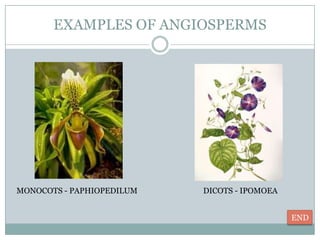
EXAMPLES OF ANGIOSPERMS


MONOCOTS - PAPHIOPEDILUM   DICOTS - IPOMOEA


                                              END

Diversity in plants

  • 1.
    WHAT IS DIVERSITY? Diversity is a commitment to recognizing and appreciating the variety of characteristics that make individuals unique in an atmosphere that promotes and celebrates individual and collective achievement. NEXT
  • 2.
    PLANTAE The first levelof classification among plants depends on whether the plant body has well- differentiated, distinct components. The next level of classification is based on whether the differentiated plant body ha special tissues for the transport of water and other substance within. Further classification looks at the ability to bear seeds and whether the seeds are enclosed within fruits. NEXT
  • 3.
    THALLOPHYTA A phylum ofplants of very diverse habit and structure, including the algae, fungi, and lichens. The simpler forms, as many blue-green algae, yeasts, etc., are unicellular and reproduce vegetatively or by means of asexual spores; in the higher forms the plant body is a thallus, which may be filamentous or may consist of plates of cells; it is commonly undifferentiated into stem, leaves, and roots, and shows no distinct tissue systems; the fronds of many algae, however, are modified to serve many of the functions of the above-named organs. Both asexual and sexual reproduction, often of a complex type, occur in these forms. The Thallophyta exist almost exclusively as gametophytes, the sporophyte being absent or rudimentary. By those who do not separate the Myxophyta from the Tallophyta as a distinct phylum the latter is treated as the lowermost group in the vegetable kingdom. NEXT
  • 4.
    EXAMPLES OF TYALLOPHYTA– ALGAE ULVA SPIROGYRA CHARA NEXT CLADOPHORA ULOTHRIX
  • 5.
    BRYOPHYTA A member ofa large group of seedless green plants including the mosses, liverworts, and hornworts. Bryophytes lack the specialized tissues xylem and phloem that circulate water and dissolved nutrients in the vascular plants. Bryophytes generally live on land but are mostly found in moist environments, for they have free-swimming sperm that require water for transport. In contrast to the vascular plants, the gametophyte (haploid) generation of bryophytes constitutes the larger plant form, while the small sporophyte (diploid) generation grows on or within the gametophyte and depends upon it for nutrition. NEXT
  • 6.
    EXAMPLES OF BRYOPHYTA RICCIA MARCHANTIA FUNARIA NEXT
  • 7.
    PTERIDOPHYTA A large groupof higher plants to which are sometimes assigned all higher seedless plants except mosses (Bryophyta). Unlike the bryophytes, the sporophyte—the asexual generation—is well developed and divided, except in Psilotophyta, into stems, leaves, and roots. Spores develop, from which emerges the gametophyte— the sexual generation. The gametophyte is poorly developed, almost undifferentiated, and bears sexual organs (in males, antheridia, and in females, archegonia). After fertilization, another asexual generation develops. NEXT
  • 8.
    EXAMLES OF PTERIDOPHYTA FERNS MARSILEA NEXT
  • 9.
    GYMNOSPERMS Gymnosperms are a group of vascular plants whose seeds are not enclosed by a ripened (fruit). Gymnosperms are distinguished from the other major group of seed plants, the angiosperms, whose seeds are surrounded by an ovary wall. The seeds of many Gymnosperms (literally, naked seed) are borne in cones and are not visible. Taxonomists now recognize four distinct divisions of extant gymnospermous plants (coniferophyta, cycadophyta, ginkgophyta, and gnetophyta). NEXT
  • 10.
    EXAMPLES OF GYMNOSPERMS CYCUS PINUS NEXT
  • 11.
    ANGIOSPERMS Any of alarge group of plants that produce flowers. They develop seeds from ovules contained in ovaries, and the seeds are enclosed by fruits which develop from carpel's. They are also distinguished by the process of double fertilization. The majority of angiosperms belong to two large classes : monocotyledons and eudicotyledons. The angiosperms are the largest phylum of living plants, existing in some 235,000 species. They range from small floating plants only one millimeter (0.04 inch) in length to towering trees that are over 100 meters (328 ft) tall. NEXT
  • 12.
    EXAMPLES OF ANGIOSPERMS MONOCOTS- PAPHIOPEDILUM DICOTS - IPOMOEA END