Welcome to
Plant water Relations
By
N. Sannigrahi, Associate Professor,
Department of Botany,
Nistarini College, Purulia (W.B) India
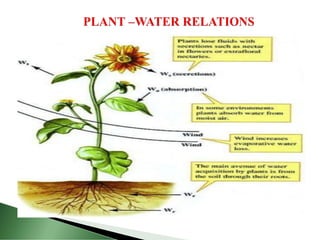
 Water is the universal solvent and it is the elixir of life.The
plants absorb water and soluble mineral salts from the soil by
their root system. This function of absorption is facilitated by
the unicellular root hairs present on the roots. These
unicellular root hairs enter in the interspaces of the soil
particles, irregularly. These root hairs absorb the water found
in the form of thin films around these soil particles.
 Cell as a physiological unit Cells are the building blocks from
which living things are made. A single cell may make up an
entire organism, or groups of cells may be loosely organized
and live together. Water availability in cell ensures the osmotic
pressure of cell and the sustainable flow of the different
nutrients , sucrose and other life supporting elements are also
maintained. The movement of stomata and sysmonastic
movement is the outcome of water absorption.,
 The water is the most important factor for the vital functions
of the plants. The plants cannot survive in its absence. Water is
a very important solvent, and usually consists most of the part
of the protoplasm. Many biochemical reactions going on in the
plants are catalyzed by many enzymes, formed in the
protoplasm. Usually 75% quantity of water is found in the
cytoplasm. Usually in the leaves, the quantity of water is 75%,
whereas in the stems it is 60%. In several hydrophytes, e.g.,
algae, etc., this quantity exceeds up to 98%. In the same way,
the quantity of water in the xerophytes is usually 60% or lesser
than this.
 In the dormant seeds, this quantity of water is only about 10%.
This is, of course very much less for any vital function, and
therefore, the germination of these seeds is only then possible,
when they get sufficient moisture.
 About three forms of water are found in the soil. Just after the
rains, because of gravitation some amount of water along with
some mineral salts goes in the lower strata of the earth. This is
called gravitational or free water and cannot be used by the
plants.
 Besides this, every particle of soil holds some imbibed water
in it. This water is hold up in the soil particle with such a great
imbibitions force, that it cannot be separated from it for the
use of the plant. This is called hygroscopic water, which also
cannot be absorbed from the soil by the plants. Besides these
each soil particle is surrounded by a loose film of water; this
film is attracted by the capillary force to the soil particle, and
such water film is called capillary water. Now it is to be
noticed, that only this capillary water may be absorbed by the
root hairs of the plants.
 Water is tasteless, transparent, highly cohesive and adhesive;
only strong UV light is absorbed.
 Water has high tension, has high specific heat and high heat of
Vaporization, high boiling point and high thermal conductivity
 Water has high dipole moment due to high electro negativity
of Oxygen than Hydrogen.
 Water is a universal solvent and can ionize,
 All macromolecular components like DNA, protein remain
dissolved in water,
 Maximum density of water at 4 ℃, an anomalous property of
water,
 Elements more electropositive than Hydrogen like Ca, Na, Li,
K & Cs bind to hydroxides.
 All plants and other living organisms require free energy to
grow and reproduce.
 In thermodynamics, free energy represents potential to do
work. According to thermodynamic laws every component of
a system possesses free energy capable of doing work under
constant temperature conditions.
 The potential energy of water is called water potential. Water
potential is regarded as the tendency of water to leave a
system. It is often used while explaining the direction in which
water will flow from one cell to another, or from one part of
the plant to another such as from soil to root, from root to
leaves, from leaves to air, or from soil to air. The different
other steps are followed in course of the conduction of water
along the conduction process.
 The potential energy of water is called water potential. Water
potential is regarded as the tendency of water to leave a system. It is
often used while explaining the direction in which water will flow
from one cell to another, or from one part of the plant to another
such as from soil to root, from root to leaves, from leaves to air, or
from soil to air.
 Water always moves from a region of higher water potential to that
of lower water potential. It can also be said that the difference in
water potential between two points is a measure of the amount of
work, i.e., energy, needed to move water from one point to the other.
Osmotic movement of water involves certain work done and in fact
the main driving force behind this movement is the difference
between free energies of water on two sides of the selectively
permeable membrane. For water free energy molecule is known as
water potential (Ψw).
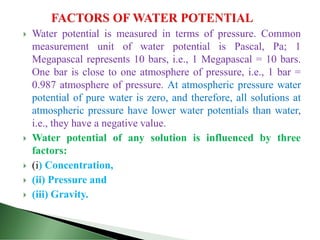
 Water potential is measured in terms of pressure. Common
measurement unit of water potential is Pascal, Pa; 1
Megapascal represents 10 bars, i.e., 1 Megapascal = 10 bars.
One bar is close to one atmosphere of pressure, i.e., 1 bar =
0.987 atmosphere of pressure. At atmospheric pressure water
potential of pure water is zero, and therefore, all solutions at
atmospheric pressure have lower water potentials than water,
i.e., they have a negative value.
 Water potential of any solution is influenced by three
factors:
 (i) Concentration,
 (ii) Pressure and
 (iii) Gravity.
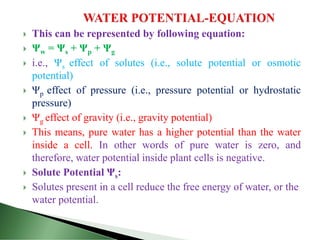
 This can be represented by following equation:
 Ψw = Ψs + Ψp + Ψg
 i.e., Ψs effect of solutes (i.e., solute potential or osmotic
potential)
 Ψp effect of pressure (i.e., pressure potential or hydrostatic
pressure)
 Ψg effect of gravity (i.e., gravity potential)
 This means, pure water has a higher potential than the water
inside a cell. In other words of pure water is zero, and
therefore, water potential inside plant cells is negative.
 Solute Potential Ψs:
 Solutes present in a cell reduce the free energy of water, or the
water potential.
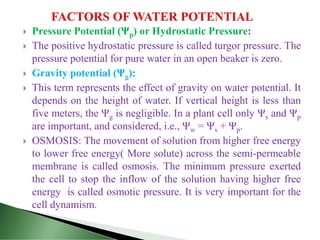
 Pressure Potential (Ψp) or Hydrostatic Pressure:
 The positive hydrostatic pressure is called turgor pressure. The
pressure potential for pure water in an open beaker is zero.
 Gravity potential (Ψg):
 This term represents the effect of gravity on water potential. It
depends on the height of water. If vertical height is less than
five meters, the Ψg is negligible. In a plant cell only Ψs and Ψp
are important, and considered, i.e., Ψw = Ψs + Ψp.
 OSMOSIS: The movement of solution from higher free energy
to lower free energy( More solute) across the semi-permeable
membrane is called osmosis. The minimum pressure exerted
the cell to stop the inflow of the solution having higher free
energy is called osmotic pressure. It is very important for the
cell dynamism.
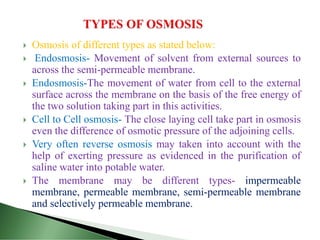
 Osmosis of different types as stated below:
 Endosmosis- Movement of solvent from external sources to
across the semi-permeable membrane.
 Endosmosis-The movement of water from cell to the external
surface across the membrane on the basis of the free energy of
the two solution taking part in this activities.
 Cell to Cell osmosis- The close laying cell take part in osmosis
even the difference of osmotic pressure of the adjoining cells.
 Very often reverse osmosis may taken into account with the
help of exerting pressure as evidenced in the purification of
saline water into potable water.
 The membrane may be different types- impermeable
membrane, permeable membrane, semi-permeable membrane
and selectively permeable membrane.
 Osmotic pressure can be calculated by the following
relationship:
 OP = CRT
 C = Molar concentration of solution.
 R = Gas constant which is 0.082
 T = Absolute temperature 273°C
 1. Hypertonic solution (Hyper = More than):
 A solution whose osmotic concentration (solute potential) is
more than that of another solutions or cell sap (tonoplasm) is
called hypertonic solution. If a cell is placed in hypertonic
solution water comes out of the cell by the process of
exosmosis and cell becomes flaccid.
 2. Hypotonic solution (Hypo = Less than):A solution whose
osmotic concentration (solute potential) is less than that of
another solution or cell sap (tonoplasm) is called hypotonic
solution. If a cell is placed in hypotonic solution, water enters
into the cell by the process of endosmosis and cell becomes of
turgid. The hypotonic nature of the soil is a very important
factors of water absorption.
 3. Isotonic solution (Iso = Same):A solution whose osmotic
concentration (solute potential) is equal to that of another
solution or cell sap (tonoplasm) is called isotonic solution. If a
cell is placed in a isotonic solution, there will be no change in
the cell and the solution. The isotonic condition maintains a
stedy source of the osmotic system of the cell.
 Osmotic Pressure: Osmotic pressure is also defined as ‘The
hydrostatic pressure developed in a solution due to the osmotic
flow of solvent (such as water) when the solution is separated
from pure solvent by a semi-permeable membrane. Osmotic
pressure term was coined by Pfeiffer. Osmotic pressure is
measured in atmosphere, bars or Pascal’s. Instrument used for
measuring O.P. is called Osmometer. Now a days, the term
osmotic potential (i.e. solute potential = Ψs) is preferred over
osmotic pressure. Numerically, osmotic potential is equal to
osmotic pressure but opposite in sign. Osmotic pressure has a
positive value while osmotic potential (Ψs) has equal but
negative value.
 Osmotic pressure is directly proportional to the concentration
of dissolved solutes in the solution. More conc. solution has
higher osmotic pressure.
 Osmotic pressure of solution is always higher than its pure
solvent.
 Osmotic pressure does not increase by the addition of
insoluble solute in the solution.
 Thus, during osmosis the movement of solvent molecules
takes place from the solution whose osmotic pressure is lower
(i.e., less concentrated or hypotonic) into the solution whose
osmotic pressure is higher (i.e., more concentrated or
hypertonic).
 Plant Cells as Osmotic Systems:
 Living cells in plants form osmotic systems due to the
presence of semi-permeable plasma membrane and the cell sap
having a certain osmotic pressure. Plasma-membrane actually
is not truly semi-permeable as it allows certain solutes to pass
through it and hence, it is known as selectively permeable or
differentially permeable membrane. The tonoplast or the
vacuolar membrane also possesses the same nature. The
solvent in case of plants is always water. The cell wall is
permeable.
 If a living plant cell or tissue is placed in water or hypotonic
solution (whose O.P. is lower than that of cell sap) water
enters into the cell sap by osmosis. This process is called as
endosmosis. As a result of entry of the water into the cell sap,
 a pressure is developed which presses the protoplasm against
the cell wall and the cell becomes turgid. This pressure is
called as turgor pressure. Consequence of the turgor pressure
is the wall pressure which is exerted by the elastic cell wall
against the expanding protoplasm. At a given time turgor
pressure (T.P.) equals the wall pressure (W.P.). If on the other
hand, the plant cell or the tissue is placed in hypertonic
solution (whose O.P. is higher than that of cell sap) the water
comes out of the cell sap into the outer solution and the cell
becomes flaccid. This process is known as ex-osmosis. Cell or
tissue will remain as such in isotonic solution.
 Significance of Osmosis in Plants:
 (1) Large quantities of water are absorbed by roots from the
soil by osmosis.
 (2) Cell to cell movement of water and other substances
dissolved in it involves this process.
 (3) Opening and closing of stomata depend upon the turgor
pressure of the guard cells.
 (4) Due to osmosis the turgidity of the cells and hence the
shape or form of their organs is maintained.
 (5) The resistance of plants to drought and frost increases with
increase in osmotic pressure of their cells.
 (6) Turgidity of the cells of the young seedlings allows them to
come out of the soil.
 Plasmolysis: In normal condition the protoplasm is tightly
pressed against the cell wall. If this plant cell or tissue is
placed in a hypertonic solution, water comes out from the cell
sap into the outer solution due to ex-osmosis and the
protoplasm begins to contract from the cell wall. This is called
as incipient plasmolysis. If the outer hypertonic solution is
very much concentrated in comparison to the cell sap, the
process of ex-osmosis and contraction or shrinkage of
protoplasm continues and ultimately the protoplasm separates
from the cell wall and assumes a spherical form. This
phenomenon is called as plasmolysis and the cell or the tissue
is said to be plasmolysed. Because of the permeable cell wall
the space in between the cell wall and plasma-membrane in
plasmolysed cells is filled with outer hypertonic solution
 If a plasmolysed cell or tissue is placed in water, process of
end-osmosis takes place. Water enters into the cell sap, the cell
becomes turgid, and the protoplasm again assumes its normal
shape and position. This phenomenon is called deplasmolysis.
 Advantages of Plasmolysis:
 1. It indicates the semi-permeable nature of the plasma-
membrane.
 2. This phenomenon is utilized in salting of meat and fishes
and addition of concentrated sugar solution to jams and jellies
to check the growth of fungi and bacteria which become
plasmolysed in conc. solution.
 3. It is also used in determining the O.P. of the cell sap
 The aquatic and submerged aquatic plants absorb water from
their body surface and the epiphytes absorb via Velamen. But
most of the terrestrial plants absorb water from unicellular root
hairs. Some moss, fungi absorb water from Rhizoids and in
lichen it takes place from Rhizine like fibrous structure.
Irrespective of the medium of the absorption of water by the
plants, the soil water basically belongs to the following
categories- Gravitational water, Hygroscopic water,
Chemically bound water, Capillary water. But most of the
water available by the plants are capillary water and this water
source is available by the plants amidst the small pores present
in between the soil particles. The epiblema basically originates
some unicellular root hairs and the capillary water is used by
these root hairs as medium of the absorption of water
 Mechanism of Absorption of Water:
 In higher plants water is absorbed through root hairs which are
in contact with soil water and form a root hair zone a little
behind the root tips. Root hairs are tubular hair like
prolongations of the cells of the epidermal layer (when
epidermis bears root hairs it is also known as piliferous layer)
of the roots. The walls of root hairs are permeable and consist
of pectic substances and cellulose which are strongly
hydrophilic (water loving) in nature. Root hairs contain
vacuoles filled with cell sap. When roots elongate, the older
hairs die and new root hairs are developed so that they are in
contact with fresh supplies of water in the soil. (1) Active
Absorption of Water: In this process the root cells play active
role in the absorption of water and metabolic energy released
through respiration is consumed.
 Active absorption may be of two kinds:
 (a) Osmotic absorption i.e., when water is absorbed from the
soil into the xylem of the roots according to the osmotic
gradient.
 (b) Non-osmotic absorption i.e., when water is absorbed
against the osmotic gradient.
 (2) Passive Absorption of Water:
 It is mainly due to transpiration, the root cells do not play
active role and remain passive. (1a) Active Osmotic
Absorption of Water:
 First step in the osmotic absorption of water is the imbibition
of soil water by the hydrophilic cell walls of root hairs.
Osmotic Pressure (O.P.) of the cell-sap of root hairs is usually
higher than the O.P. of the soil water. Therefore, the Diffusion
 Pressure Deficit (D.P.D.) and the suction pressure in the root
hairs become higher and water from the cell walls enters into
them through plasma-membrane (semi-permeable) by osmotic
diffusion. As a result, the O.P., suction pressure and D.P.D. of
root hairs now become lower, while their turgor pressure is
increased. Now, the cortical cells adjacent to root hairs have
higher O.P., suction pressure and D.P.D. in comparison to the
root hairs. Therefore, water is drawn into the adjacent cortical
cells from the root-hairs by osmotic diffusion.
 In the same way, the water by cell to cell osmotic diffusion
gradually reaches the innermost cortical cells and the
endodermis. Osmotic diffusion of water into endodermis takes
place through special thin walled passage cells because the
other endodermal cells have Casparian strips on their walls
which are impervious to water
 Water from endodermal cells is drawn into the cells of
pericycle by osmotic diffusion which now becomes turgid and
their suction pressure is decreased. In the last step, water is
drawn into xylem from turgid pericycle cells. (In roots the
vascular bundles are radial and protoxylem elements are in
contact with pericycle). It is because in absence of turgor
pressure of the xylem vessels (which are non-elastic), the
suction pressure of xylem vessels becomes higher than the
suction pressure of the cells of the pericycle. When water
enters into xylem from pericycle, a pressure is developed in
the xylem of roots which can raise the water to a certain height
in the xylem. This pressure is called as root pressure.
 Active Non-Osmotic Absorption of Water:
 Sometimes, it has been observed that absorption of water takes
place even when the O.P. of the soil water is higher than the
O.P. of cell-sap. This type of absorption which is non- osmotic
and against the osmotic gradient requires the expenditure of
metabolic energy probably through respiration.
 (2) Passive Absorption of Water:
 Passive absorption of water takes place when rate of
transpiration is usually high. Rapid evaporation of water from
the leaves during transpiration creates a tension in water in the
xylem of the leaves. This tension is transmitted to water in
xylem of roots through the xylem of stem and the water rises
upward to reach the transpiring surfaces.
 During absorption of water by roots, the flow of water from
epidermis to endodermis may take place through three
different pathways:
 (i) Apoplastic pathway (cell walls and intercellular spaces),
 (ii) Trans-membrane pathway (by crossing the plasma
membranes) and iii) Symplast pathway (through
Plasmodesmata).
 The mechanism of water absorption described earlier, in-fact
belongs to the second category. The relative importance of
these three pathways in water absorption by roots is not clearly
established. However, a combination of these three pathways
is responsible for transport of water across the root.
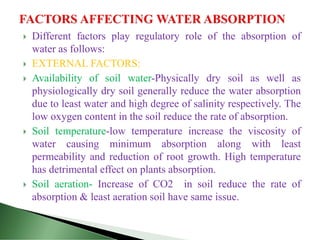
 Different factors play regulatory role of the absorption of
water as follows:
 EXTERNAL FACTORS:
 Availability of soil water-Physically dry soil as well as
physiologically dry soil generally reduce the water absorption
due to least water and high degree of salinity respectively. The
low oxygen content in the soil reduce the rate of absorption.
 Soil temperature-low temperature increase the viscosity of
water causing minimum absorption along with least
permeability and reduction of root growth. High temperature
has detrimental effect on plants absorption.
 Soil aeration- Increase of CO2 in soil reduce the rate of
absorption & least aeration soil have same issue.
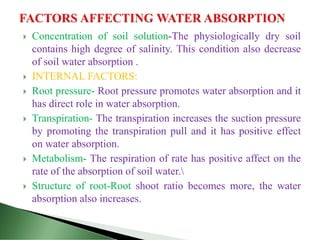
 Concentration of soil solution-The physiologically dry soil
contains high degree of salinity. This condition also decrease
of soil water absorption .
 INTERNAL FACTORS:
 Root pressure- Root pressure promotes water absorption and it
has direct role in water absorption.
 Transpiration- The transpiration increases the suction pressure
by promoting the transpiration pull and it has positive effect
on water absorption.
 Metabolism- The respiration of rate has positive affect on the
rate of the absorption of soil water.
 Structure of root-Root shoot ratio becomes more, the water
absorption also increases.
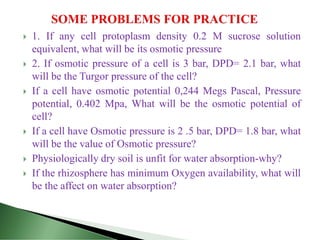
 1. If any cell protoplasm density 0.2 M sucrose solution
equivalent, what will be its osmotic pressure
 2. If osmotic pressure of a cell is 3 bar, DPD= 2.1 bar, what
will be the Turgor pressure of the cell?
 If a cell have osmotic potential 0,244 Megs Pascal, Pressure
potential, 0.402 Mpa, What will be the osmotic potential of
cell?
 If a cell have Osmotic pressure is 2 .5 bar, DPD= 1.8 bar, what
will be the value of Osmotic pressure?
 Physiologically dry soil is unfit for water absorption-why?
 If the rhizosphere has minimum Oxygen availability, what will
be the affect on water absorption?
 ACKNOWLEDGEMENT
 1. Google for images
 2. Different websites for contents
 3. Plant Physiology- Mukherjee & Ghosh
 4. A textbook of Botany-Hait, Bhattacharya & Ghosh
 5.Essentials of Biophysics- Narayanan
 6.Plant Physiology- Devlin
 7. Plant physiology- Nogle & Fritz
 Disclaimer: This presentation has been made as open source
of learning without any financial interest.

Plant Physiology-Water relations

  • 1.
    Welcome to Plant waterRelations By N. Sannigrahi, Associate Professor, Department of Botany, Nistarini College, Purulia (W.B) India
  • 2.
     Water isthe universal solvent and it is the elixir of life.The plants absorb water and soluble mineral salts from the soil by their root system. This function of absorption is facilitated by the unicellular root hairs present on the roots. These unicellular root hairs enter in the interspaces of the soil particles, irregularly. These root hairs absorb the water found in the form of thin films around these soil particles.  Cell as a physiological unit Cells are the building blocks from which living things are made. A single cell may make up an entire organism, or groups of cells may be loosely organized and live together. Water availability in cell ensures the osmotic pressure of cell and the sustainable flow of the different nutrients , sucrose and other life supporting elements are also maintained. The movement of stomata and sysmonastic movement is the outcome of water absorption.,
  • 4.
     The wateris the most important factor for the vital functions of the plants. The plants cannot survive in its absence. Water is a very important solvent, and usually consists most of the part of the protoplasm. Many biochemical reactions going on in the plants are catalyzed by many enzymes, formed in the protoplasm. Usually 75% quantity of water is found in the cytoplasm. Usually in the leaves, the quantity of water is 75%, whereas in the stems it is 60%. In several hydrophytes, e.g., algae, etc., this quantity exceeds up to 98%. In the same way, the quantity of water in the xerophytes is usually 60% or lesser than this.  In the dormant seeds, this quantity of water is only about 10%. This is, of course very much less for any vital function, and therefore, the germination of these seeds is only then possible, when they get sufficient moisture.
  • 5.
     About threeforms of water are found in the soil. Just after the rains, because of gravitation some amount of water along with some mineral salts goes in the lower strata of the earth. This is called gravitational or free water and cannot be used by the plants.  Besides this, every particle of soil holds some imbibed water in it. This water is hold up in the soil particle with such a great imbibitions force, that it cannot be separated from it for the use of the plant. This is called hygroscopic water, which also cannot be absorbed from the soil by the plants. Besides these each soil particle is surrounded by a loose film of water; this film is attracted by the capillary force to the soil particle, and such water film is called capillary water. Now it is to be noticed, that only this capillary water may be absorbed by the root hairs of the plants.
  • 6.
     Water istasteless, transparent, highly cohesive and adhesive; only strong UV light is absorbed.  Water has high tension, has high specific heat and high heat of Vaporization, high boiling point and high thermal conductivity  Water has high dipole moment due to high electro negativity of Oxygen than Hydrogen.  Water is a universal solvent and can ionize,  All macromolecular components like DNA, protein remain dissolved in water,  Maximum density of water at 4 ℃, an anomalous property of water,  Elements more electropositive than Hydrogen like Ca, Na, Li, K & Cs bind to hydroxides.
  • 7.
     All plantsand other living organisms require free energy to grow and reproduce.  In thermodynamics, free energy represents potential to do work. According to thermodynamic laws every component of a system possesses free energy capable of doing work under constant temperature conditions.  The potential energy of water is called water potential. Water potential is regarded as the tendency of water to leave a system. It is often used while explaining the direction in which water will flow from one cell to another, or from one part of the plant to another such as from soil to root, from root to leaves, from leaves to air, or from soil to air. The different other steps are followed in course of the conduction of water along the conduction process.
  • 8.
     The potentialenergy of water is called water potential. Water potential is regarded as the tendency of water to leave a system. It is often used while explaining the direction in which water will flow from one cell to another, or from one part of the plant to another such as from soil to root, from root to leaves, from leaves to air, or from soil to air.  Water always moves from a region of higher water potential to that of lower water potential. It can also be said that the difference in water potential between two points is a measure of the amount of work, i.e., energy, needed to move water from one point to the other. Osmotic movement of water involves certain work done and in fact the main driving force behind this movement is the difference between free energies of water on two sides of the selectively permeable membrane. For water free energy molecule is known as water potential (Ψw).
  • 9.
     Water potentialis measured in terms of pressure. Common measurement unit of water potential is Pascal, Pa; 1 Megapascal represents 10 bars, i.e., 1 Megapascal = 10 bars. One bar is close to one atmosphere of pressure, i.e., 1 bar = 0.987 atmosphere of pressure. At atmospheric pressure water potential of pure water is zero, and therefore, all solutions at atmospheric pressure have lower water potentials than water, i.e., they have a negative value.  Water potential of any solution is influenced by three factors:  (i) Concentration,  (ii) Pressure and  (iii) Gravity.
  • 10.
     This canbe represented by following equation:  Ψw = Ψs + Ψp + Ψg  i.e., Ψs effect of solutes (i.e., solute potential or osmotic potential)  Ψp effect of pressure (i.e., pressure potential or hydrostatic pressure)  Ψg effect of gravity (i.e., gravity potential)  This means, pure water has a higher potential than the water inside a cell. In other words of pure water is zero, and therefore, water potential inside plant cells is negative.  Solute Potential Ψs:  Solutes present in a cell reduce the free energy of water, or the water potential.
  • 11.
     Pressure Potential(Ψp) or Hydrostatic Pressure:  The positive hydrostatic pressure is called turgor pressure. The pressure potential for pure water in an open beaker is zero.  Gravity potential (Ψg):  This term represents the effect of gravity on water potential. It depends on the height of water. If vertical height is less than five meters, the Ψg is negligible. In a plant cell only Ψs and Ψp are important, and considered, i.e., Ψw = Ψs + Ψp.  OSMOSIS: The movement of solution from higher free energy to lower free energy( More solute) across the semi-permeable membrane is called osmosis. The minimum pressure exerted the cell to stop the inflow of the solution having higher free energy is called osmotic pressure. It is very important for the cell dynamism.
  • 12.
     Osmosis ofdifferent types as stated below:  Endosmosis- Movement of solvent from external sources to across the semi-permeable membrane.  Endosmosis-The movement of water from cell to the external surface across the membrane on the basis of the free energy of the two solution taking part in this activities.  Cell to Cell osmosis- The close laying cell take part in osmosis even the difference of osmotic pressure of the adjoining cells.  Very often reverse osmosis may taken into account with the help of exerting pressure as evidenced in the purification of saline water into potable water.  The membrane may be different types- impermeable membrane, permeable membrane, semi-permeable membrane and selectively permeable membrane.
  • 13.
     Osmotic pressurecan be calculated by the following relationship:  OP = CRT  C = Molar concentration of solution.  R = Gas constant which is 0.082  T = Absolute temperature 273°C  1. Hypertonic solution (Hyper = More than):  A solution whose osmotic concentration (solute potential) is more than that of another solutions or cell sap (tonoplasm) is called hypertonic solution. If a cell is placed in hypertonic solution water comes out of the cell by the process of exosmosis and cell becomes flaccid.
  • 14.
     2. Hypotonicsolution (Hypo = Less than):A solution whose osmotic concentration (solute potential) is less than that of another solution or cell sap (tonoplasm) is called hypotonic solution. If a cell is placed in hypotonic solution, water enters into the cell by the process of endosmosis and cell becomes of turgid. The hypotonic nature of the soil is a very important factors of water absorption.  3. Isotonic solution (Iso = Same):A solution whose osmotic concentration (solute potential) is equal to that of another solution or cell sap (tonoplasm) is called isotonic solution. If a cell is placed in a isotonic solution, there will be no change in the cell and the solution. The isotonic condition maintains a stedy source of the osmotic system of the cell.
  • 15.
     Osmotic Pressure:Osmotic pressure is also defined as ‘The hydrostatic pressure developed in a solution due to the osmotic flow of solvent (such as water) when the solution is separated from pure solvent by a semi-permeable membrane. Osmotic pressure term was coined by Pfeiffer. Osmotic pressure is measured in atmosphere, bars or Pascal’s. Instrument used for measuring O.P. is called Osmometer. Now a days, the term osmotic potential (i.e. solute potential = Ψs) is preferred over osmotic pressure. Numerically, osmotic potential is equal to osmotic pressure but opposite in sign. Osmotic pressure has a positive value while osmotic potential (Ψs) has equal but negative value.
  • 16.
     Osmotic pressureis directly proportional to the concentration of dissolved solutes in the solution. More conc. solution has higher osmotic pressure.  Osmotic pressure of solution is always higher than its pure solvent.  Osmotic pressure does not increase by the addition of insoluble solute in the solution.  Thus, during osmosis the movement of solvent molecules takes place from the solution whose osmotic pressure is lower (i.e., less concentrated or hypotonic) into the solution whose osmotic pressure is higher (i.e., more concentrated or hypertonic).
  • 17.
     Plant Cellsas Osmotic Systems:  Living cells in plants form osmotic systems due to the presence of semi-permeable plasma membrane and the cell sap having a certain osmotic pressure. Plasma-membrane actually is not truly semi-permeable as it allows certain solutes to pass through it and hence, it is known as selectively permeable or differentially permeable membrane. The tonoplast or the vacuolar membrane also possesses the same nature. The solvent in case of plants is always water. The cell wall is permeable.  If a living plant cell or tissue is placed in water or hypotonic solution (whose O.P. is lower than that of cell sap) water enters into the cell sap by osmosis. This process is called as endosmosis. As a result of entry of the water into the cell sap,
  • 18.
     a pressureis developed which presses the protoplasm against the cell wall and the cell becomes turgid. This pressure is called as turgor pressure. Consequence of the turgor pressure is the wall pressure which is exerted by the elastic cell wall against the expanding protoplasm. At a given time turgor pressure (T.P.) equals the wall pressure (W.P.). If on the other hand, the plant cell or the tissue is placed in hypertonic solution (whose O.P. is higher than that of cell sap) the water comes out of the cell sap into the outer solution and the cell becomes flaccid. This process is known as ex-osmosis. Cell or tissue will remain as such in isotonic solution.
  • 19.
     Significance ofOsmosis in Plants:  (1) Large quantities of water are absorbed by roots from the soil by osmosis.  (2) Cell to cell movement of water and other substances dissolved in it involves this process.  (3) Opening and closing of stomata depend upon the turgor pressure of the guard cells.  (4) Due to osmosis the turgidity of the cells and hence the shape or form of their organs is maintained.  (5) The resistance of plants to drought and frost increases with increase in osmotic pressure of their cells.  (6) Turgidity of the cells of the young seedlings allows them to come out of the soil.
  • 20.
     Plasmolysis: Innormal condition the protoplasm is tightly pressed against the cell wall. If this plant cell or tissue is placed in a hypertonic solution, water comes out from the cell sap into the outer solution due to ex-osmosis and the protoplasm begins to contract from the cell wall. This is called as incipient plasmolysis. If the outer hypertonic solution is very much concentrated in comparison to the cell sap, the process of ex-osmosis and contraction or shrinkage of protoplasm continues and ultimately the protoplasm separates from the cell wall and assumes a spherical form. This phenomenon is called as plasmolysis and the cell or the tissue is said to be plasmolysed. Because of the permeable cell wall the space in between the cell wall and plasma-membrane in plasmolysed cells is filled with outer hypertonic solution
  • 21.
     If aplasmolysed cell or tissue is placed in water, process of end-osmosis takes place. Water enters into the cell sap, the cell becomes turgid, and the protoplasm again assumes its normal shape and position. This phenomenon is called deplasmolysis.  Advantages of Plasmolysis:  1. It indicates the semi-permeable nature of the plasma- membrane.  2. This phenomenon is utilized in salting of meat and fishes and addition of concentrated sugar solution to jams and jellies to check the growth of fungi and bacteria which become plasmolysed in conc. solution.  3. It is also used in determining the O.P. of the cell sap
  • 22.
     The aquaticand submerged aquatic plants absorb water from their body surface and the epiphytes absorb via Velamen. But most of the terrestrial plants absorb water from unicellular root hairs. Some moss, fungi absorb water from Rhizoids and in lichen it takes place from Rhizine like fibrous structure. Irrespective of the medium of the absorption of water by the plants, the soil water basically belongs to the following categories- Gravitational water, Hygroscopic water, Chemically bound water, Capillary water. But most of the water available by the plants are capillary water and this water source is available by the plants amidst the small pores present in between the soil particles. The epiblema basically originates some unicellular root hairs and the capillary water is used by these root hairs as medium of the absorption of water
  • 23.
     Mechanism ofAbsorption of Water:  In higher plants water is absorbed through root hairs which are in contact with soil water and form a root hair zone a little behind the root tips. Root hairs are tubular hair like prolongations of the cells of the epidermal layer (when epidermis bears root hairs it is also known as piliferous layer) of the roots. The walls of root hairs are permeable and consist of pectic substances and cellulose which are strongly hydrophilic (water loving) in nature. Root hairs contain vacuoles filled with cell sap. When roots elongate, the older hairs die and new root hairs are developed so that they are in contact with fresh supplies of water in the soil. (1) Active Absorption of Water: In this process the root cells play active role in the absorption of water and metabolic energy released through respiration is consumed.
  • 24.
     Active absorptionmay be of two kinds:  (a) Osmotic absorption i.e., when water is absorbed from the soil into the xylem of the roots according to the osmotic gradient.  (b) Non-osmotic absorption i.e., when water is absorbed against the osmotic gradient.  (2) Passive Absorption of Water:  It is mainly due to transpiration, the root cells do not play active role and remain passive. (1a) Active Osmotic Absorption of Water:  First step in the osmotic absorption of water is the imbibition of soil water by the hydrophilic cell walls of root hairs. Osmotic Pressure (O.P.) of the cell-sap of root hairs is usually higher than the O.P. of the soil water. Therefore, the Diffusion
  • 25.
     Pressure Deficit(D.P.D.) and the suction pressure in the root hairs become higher and water from the cell walls enters into them through plasma-membrane (semi-permeable) by osmotic diffusion. As a result, the O.P., suction pressure and D.P.D. of root hairs now become lower, while their turgor pressure is increased. Now, the cortical cells adjacent to root hairs have higher O.P., suction pressure and D.P.D. in comparison to the root hairs. Therefore, water is drawn into the adjacent cortical cells from the root-hairs by osmotic diffusion.  In the same way, the water by cell to cell osmotic diffusion gradually reaches the innermost cortical cells and the endodermis. Osmotic diffusion of water into endodermis takes place through special thin walled passage cells because the other endodermal cells have Casparian strips on their walls which are impervious to water
  • 26.
     Water fromendodermal cells is drawn into the cells of pericycle by osmotic diffusion which now becomes turgid and their suction pressure is decreased. In the last step, water is drawn into xylem from turgid pericycle cells. (In roots the vascular bundles are radial and protoxylem elements are in contact with pericycle). It is because in absence of turgor pressure of the xylem vessels (which are non-elastic), the suction pressure of xylem vessels becomes higher than the suction pressure of the cells of the pericycle. When water enters into xylem from pericycle, a pressure is developed in the xylem of roots which can raise the water to a certain height in the xylem. This pressure is called as root pressure.
  • 27.
     Active Non-OsmoticAbsorption of Water:  Sometimes, it has been observed that absorption of water takes place even when the O.P. of the soil water is higher than the O.P. of cell-sap. This type of absorption which is non- osmotic and against the osmotic gradient requires the expenditure of metabolic energy probably through respiration.  (2) Passive Absorption of Water:  Passive absorption of water takes place when rate of transpiration is usually high. Rapid evaporation of water from the leaves during transpiration creates a tension in water in the xylem of the leaves. This tension is transmitted to water in xylem of roots through the xylem of stem and the water rises upward to reach the transpiring surfaces.
  • 28.
     During absorptionof water by roots, the flow of water from epidermis to endodermis may take place through three different pathways:  (i) Apoplastic pathway (cell walls and intercellular spaces),  (ii) Trans-membrane pathway (by crossing the plasma membranes) and iii) Symplast pathway (through Plasmodesmata).  The mechanism of water absorption described earlier, in-fact belongs to the second category. The relative importance of these three pathways in water absorption by roots is not clearly established. However, a combination of these three pathways is responsible for transport of water across the root.
  • 29.
     Different factorsplay regulatory role of the absorption of water as follows:  EXTERNAL FACTORS:  Availability of soil water-Physically dry soil as well as physiologically dry soil generally reduce the water absorption due to least water and high degree of salinity respectively. The low oxygen content in the soil reduce the rate of absorption.  Soil temperature-low temperature increase the viscosity of water causing minimum absorption along with least permeability and reduction of root growth. High temperature has detrimental effect on plants absorption.  Soil aeration- Increase of CO2 in soil reduce the rate of absorption & least aeration soil have same issue.
  • 30.
     Concentration ofsoil solution-The physiologically dry soil contains high degree of salinity. This condition also decrease of soil water absorption .  INTERNAL FACTORS:  Root pressure- Root pressure promotes water absorption and it has direct role in water absorption.  Transpiration- The transpiration increases the suction pressure by promoting the transpiration pull and it has positive effect on water absorption.  Metabolism- The respiration of rate has positive affect on the rate of the absorption of soil water.  Structure of root-Root shoot ratio becomes more, the water absorption also increases.
  • 31.
     1. Ifany cell protoplasm density 0.2 M sucrose solution equivalent, what will be its osmotic pressure  2. If osmotic pressure of a cell is 3 bar, DPD= 2.1 bar, what will be the Turgor pressure of the cell?  If a cell have osmotic potential 0,244 Megs Pascal, Pressure potential, 0.402 Mpa, What will be the osmotic potential of cell?  If a cell have Osmotic pressure is 2 .5 bar, DPD= 1.8 bar, what will be the value of Osmotic pressure?  Physiologically dry soil is unfit for water absorption-why?  If the rhizosphere has minimum Oxygen availability, what will be the affect on water absorption?
  • 32.
     ACKNOWLEDGEMENT  1.Google for images  2. Different websites for contents  3. Plant Physiology- Mukherjee & Ghosh  4. A textbook of Botany-Hait, Bhattacharya & Ghosh  5.Essentials of Biophysics- Narayanan  6.Plant Physiology- Devlin  7. Plant physiology- Nogle & Fritz  Disclaimer: This presentation has been made as open source of learning without any financial interest.