Biology Spring 2025
• Seeds changed the course of plant
evolution, enabling their bearers to
become the dominant producers in most
terrestrial ecosystems
• Seed plants originated about 360 million
years ago
• A seed consists of an embryo and nutrients
surrounded by a protective coat
• Seeds can disperse over long distances by
wind or other means
Seeds
• In addition to seeds, the following are common to all seed plants:
• Reduced gametophytes (mostly microscopic)
• Heterospores (two kinds of spores)
• Ovules (female gametophyte)
• Pollen (male gametophyte)
Seeds
PLANT GROUP
Seed plants (gymnosperms and angiosperms)
Reduced (usually microscopic), dependent on
surrounding sporophyte tissue for nutrition
Dominant
Gymnosperm Angiosperm
Microscopic female
gametophytes (n)
inside ovulate cone
Microscopic female
gametophytes (n)
inside these parts
of flowers
Microscopic
male
gametophytes
(n) inside pollen
cone
Microscopic
male
gametophytes
(n) inside
these parts
of flowers
Sporophyte
(2n)
Dominant
Sporophyte
(2n)
Reduced, dependent
on gametophyte for
nutrition
Gametophyte
(n)
Example
Sporophyte
Dominant
Gametophyte
Mosses and other
nonvascular plants
Ferns and
other seedless
vascular plants
Reduced,
Independent
(photosynthetic
and free-living)
Gametophyte
(n)
Sporophyte (2n) Sporophyte (2n)
• The ancestors of seed plants were likely homosporous, while seed plants
are heterosporous
• Megasporangia produce megaspores that give rise to female gametes
• Microsporangia produce microspores that give rise to male gametes
Heterosporous
• An ovule consists of a megasporangium, megaspore, and one or more
protective integuments (covers)
• Gymnosperm megasporangia have one integument/cover
• Angiosperm megasporangia usually have two integuments/covers
Ovule
Immature
ovulate cone
Integument (2n)
Megaspore (n)
Spore wall
Megasporangium
(2n)
Pollen
grain (n)
Micropyle
(a) Unfertilized ovule (b) Fertilized ovule
Male
gametophyte (n)
Pollen tube
Discharged
sperm nucleus
(n)
Egg nucleus
(n)
Female
gametophyte (n)
Seed coat
Spore
wall
Food
supply
(n)
Embryo (2n)
(c) Gymnosperm seed
• Microspores develop into pollen grains, which contain the male
gametophytes
• Pollination is the transfer of pollen to the part of a seed plant containing
the ovules
* Pollen eliminates the need for a film of water and can be dispersed great
distances by air or animals
• If a pollen grain germinates, it gives rise to a pollen tube that discharges
sperm into the female gametophyte within the ovule
Pollen
• A seed develops from the whole ovule
• A seed is a sporophyte embryo, along with its food supply, packaged in
a protective coat
Evolutionary Advantage of Seeds
• Seeds provide some evolutionary advantages over spores
• They may remain dormant for days to years, until conditions are favorable for
germination
• Oldest seed germinated, ~2,000 years old!
• Seeds have a supply of stored food
• They may be transported long distances by wind or animals
• Gymnosperms means “naked seeds”
• The seeds are exposed on
sporophylls that form cones
• Angiosperm seeds are found in fruits,
which are mature ovaries
• Most gymnosperms are cone-bearing
plants called conifers
Gymnosperms
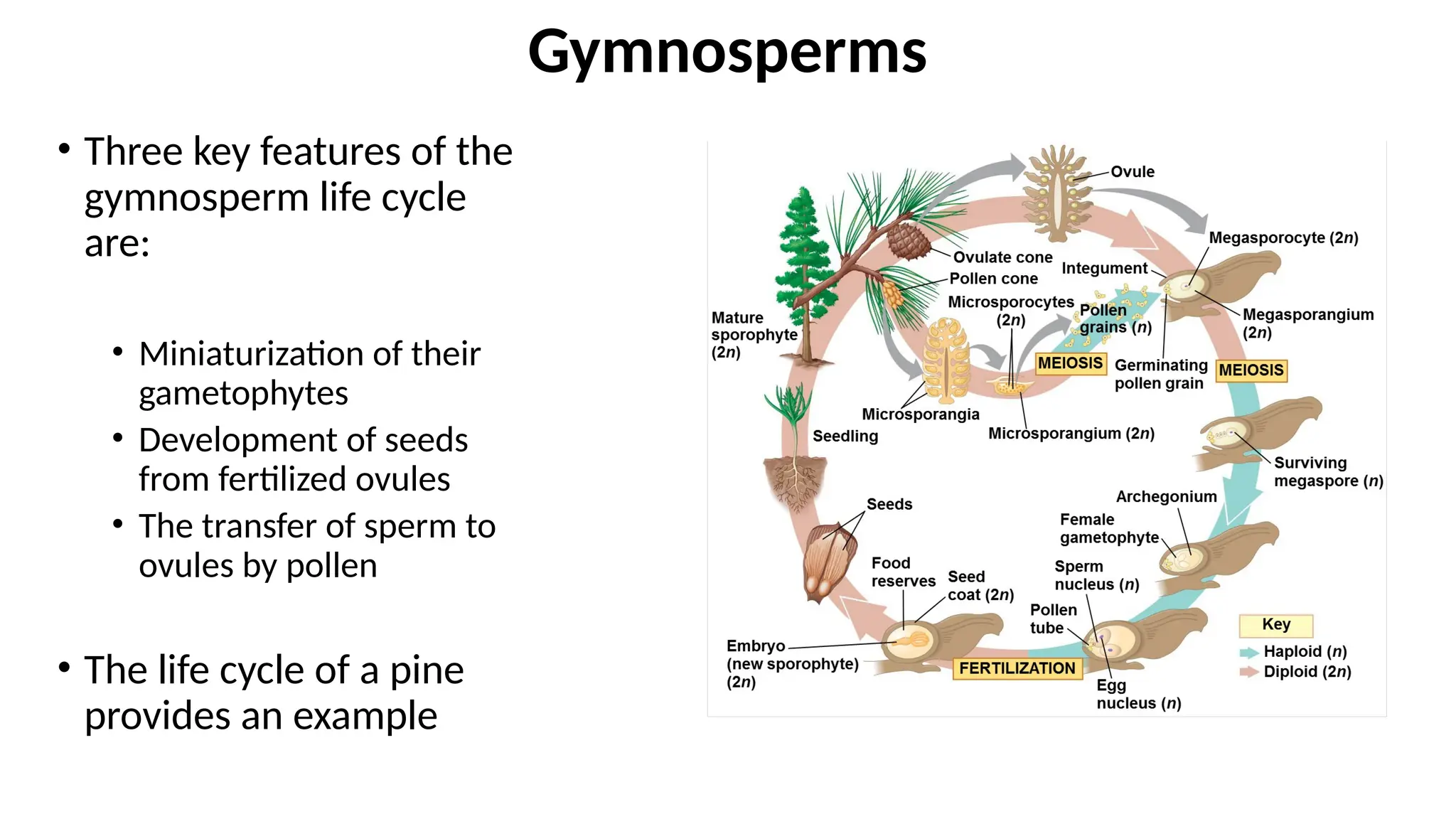
• Three key features of the
gymnosperm life cycle
are:
• Miniaturization of their
gametophytes
• Development of seeds
from fertilized ovules
• The transfer of sperm to
ovules by pollen
• The life cycle of a pine
provides an example
Gymnosperms
• The pine tree is the sporophyte and produces sporangia in male and
female cones
• Small cones produce microspores called pollen grains, each of which
contains a male gametophyte
• The familiar larger cones contain ovules, which produce megaspores that
develop into female gametophytes
• It takes nearly three years from cone production to mature seed
Gymnosperms
Key
Haploid (n)
Diploid (2n)
Microsporangia
Ovulate cone
Pollen cone
Microsporocytes
(2n)
Mature
sporophyte
(2n)
Microsporangium (2n)
Ovule
MEIOSIS
Pollen
grains (n)
Germinating
pollen grain
Integument
Megasporocyte (2n)
Megasporangium
(2n)
Surviving
megaspore (n)
Archegonium
Female
gametophyte
Sperm
nucleus (n)
Pollen
tube
Egg
nucleus (n)
MEIOSIS
Key
Haploid (n)
Diploid (2n)
Embryo
(new sporophyte)
(2n)
Seed
coat (2n)
Food
reserves
Seeds
Seedling
FERTILIZATION
• Fossil evidence reveals that by
the late Devonian period (360
mya) some plants had begun to
acquire some features that are
also present in seed plants
• For example, Archaeopteris
was a heterosporous tree with
a woody stem, but it did not
bear seeds
Evolution of Seed Plants
• Living seed plants can be divided into
two clades: gymnosperms and
angiosperms
• Gymnosperms appear early in the fossil
record about 305 million years ago and
dominated Mesozoic (251–65.5 million
years ago) terrestrial ecosystems
• Gymnosperms were better suited than
nonvascular plants to drier conditions
Evolution of Seed Plants
• Gymnosperms served as food for
herbivorous dinosaurs
• Recent fossil discoveries show that
gymnosperms were pollinated by insects
over 100 million years ago
• Angiosperms began to replace
gymnosperms near the end of the
Mesozoic
Evolution of Seed Plants
• Angiosperms now dominate more terrestrial ecosystems, though
conifers still dominate in some regions including the northern
latitudes
• The gymnosperms consist of four phyla
• Cycadophyta (cycads)
• Gingkophyta (one living species: Ginkgo biloba)
• Gnetophyta
• Coniferophyta (conifers, such as pine, fir, and redwood)
Gymnosperm Diversity
• Individuals have large cones
and palm-like leaves
• These thrived during the
Mesozoic (65-250 mya), but
most of the few surviving
species are endangered
Phylum Cycadophyta
• This phylum consists of a single living
species, Ginkgo biloba
• It has a high tolerance to air pollution
and is a popular ornamental tree
Phylum Ginkgophyta
• This phylum comprises three
genera: Gnetum, Ephedra, and
Welwitschia, ~70 species
• Species vary in appearance, and
some are tropical whereas
others live in deserts
Phylum Gnetophyta
• This phylum is the largest
of the gymnosperm phyla
• Most conifers are
evergreens and can carry
out photosynthesis year
round
• Bristlecone pine: ~4,850yrs
old!
Phylum Coniferophyta
Pitch Pine
• Angiosperms are seed
plants with reproductive
structures called flowers
and fruits
• They are the most
widespread and diverse of
all plants
Angiosperms
Angiosperm Evolution
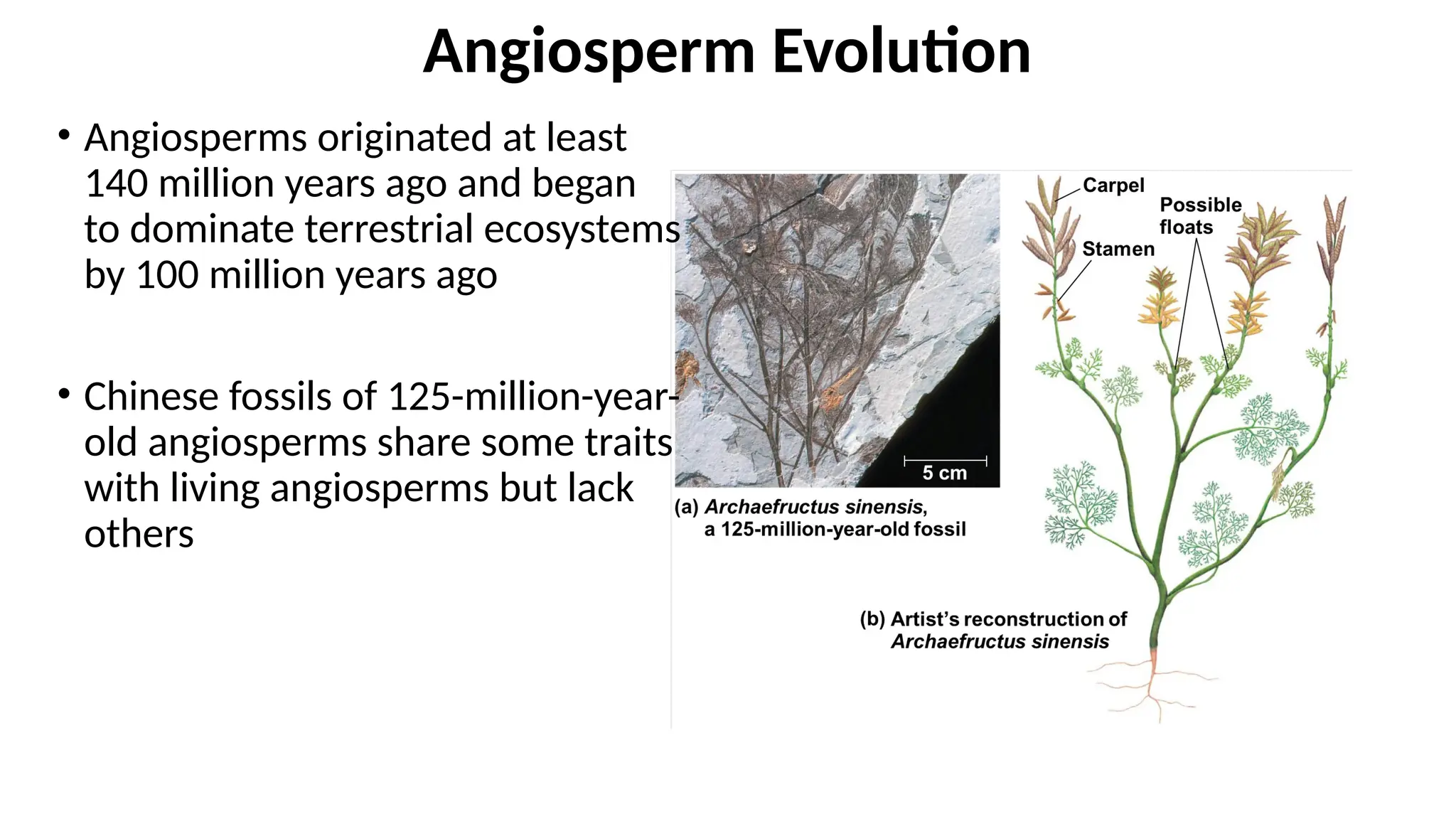
• Angiosperms originated at least
140 million years ago and began
to dominate terrestrial ecosystems
by 100 million years ago
• Chinese fossils of 125-million-year-
old angiosperms share some traits
with living angiosperms but lack
others
• The ancestors of angiosperms and
gymnosperms diverged about 305
million years ago
• Amborella and water lilies are likely
descended from two of the most
ancient angiosperm lineages
Angiosperm Evolution
• Angiosperms have two key
adaptations
• Flowers
• Fruits
Angiosperms
• The flower is an angiosperm
structure specialized for
sexual reproduction
• Many species are pollinated
by insects or animals, while
some species are wind-
pollinated
Angiosperms - Flowers
• A flower is a specialized shoot
with up to four types of modified
leaves called floral organs:
• Sepals, which enclose the flower
• Petals, which are brightly colored
and attract pollinators
• Stamens, which produce pollen
• Carpels, which produce ovules
Angiosperms - Flowers
• A stamen consists of a stalk
called a filament, with a sac
called an anther where the
pollen is produced
• A carpel consists of an
ovary at the base and a
style leading up to a
stigma, where pollen is
received
Angiosperms - Flowers
• Flowers that have all four
organs are called
complete flowers
• Those lacking one or
more organs are called
incomplete flowers
Angiosperms - Flowers
• Flowers may have radial
symmetry or bilateral
symmetry
• For flowers with radial
symmetry, any imaginary line
through the central axis divides
the flower into two equal parts
• In bilateral symmetry, a flower
can only be divided into two
equal parts by a single
imaginary line
Angiosperms - Flowers
• A fruit is formed when the ovary wall thickens
and matures
• Fruits protect seeds and aid in their dispersal
• Mature fruits can be either fleshy or dry
• Various fruit adaptations help disperse seeds
• Seeds can be carried by wind, water, or
animals to new locations
Angiosperms - Fruits
• A pollen grain that has landed on a stigma germinates and the pollen
tube of the male gametophyte grows down to the ovary
• The ovule is entered by a pore called the micropyle
• Double fertilization occurs when the pollen tube discharges two sperm
into the female gametophyte within an ovule
Angiosperm Life Cycle
• One sperm fertilizes the egg, while the other combines with two nuclei
in the central cell of the female gametophyte and initiates
development of food-storing endosperm
• The triploid endosperm nourishes the developing embryo
• Within a seed, the embryo consists of a root and one or two seed
leaves called cotyledons
Angiosperm Life Cycle
• Angiosperms comprise more than 250,000 living species
• Previously, angiosperms were divided into two main groups:
• Monocots (one cotyledon)
• Dicots (two cotyledon)
• DNA studies suggest that dicots are paraphyletic
Angiosperm Diversity
• More than two-thirds of
angiosperm species are
eudicots
• Eudicots include the large
legume family and the
economically important
rose family (Rosaceae)
Eudicots
• More than one-quarter of
angiosperm species are
monocots
• The largest groups are the
orchids, grasses, and palms
Monocots
Mature flower on
sporophyte plant
(2n)
Germinating
seed
Ovary
MEIOSIS
MEIOSIS
Ovule with
megasporangium
(2n)
Male gametophyte
(in pollen grain)
(n)
Stigma
Pollen tube
Sperm
Tube
nucleus
Style
Micropyle
Surviving
megaspore
(n)
Pollen
grains
Tube nucleus
Tube cell
Generative cell
Microspore
(n)
Microsporocytes (2n)
Microsporangium
Megasporangium
(2n)
Integuments
Antipodal cells
Polar nuclei
in central cell
Synergids
Egg (n)
Embryo (2n)
Endosperm (3n)
Seed coat (2n)
Seed
Female
gametophyte
(embryo sac)
Zygote (2n)
Egg
nucleus (n)
FERTILIZATION
Nucleus of
developing
endosperm
(3n)
Carpel Anther
Key
Haploid (n)
Diploid (2n)
Discharged sperm nuclei (n)

Lecture 18 Plants II copy working copy title

  • 1.
  • 2.
    • Seeds changedthe course of plant evolution, enabling their bearers to become the dominant producers in most terrestrial ecosystems • Seed plants originated about 360 million years ago • A seed consists of an embryo and nutrients surrounded by a protective coat • Seeds can disperse over long distances by wind or other means Seeds
  • 3.
    • In additionto seeds, the following are common to all seed plants: • Reduced gametophytes (mostly microscopic) • Heterospores (two kinds of spores) • Ovules (female gametophyte) • Pollen (male gametophyte) Seeds
  • 4.
    PLANT GROUP Seed plants(gymnosperms and angiosperms) Reduced (usually microscopic), dependent on surrounding sporophyte tissue for nutrition Dominant Gymnosperm Angiosperm Microscopic female gametophytes (n) inside ovulate cone Microscopic female gametophytes (n) inside these parts of flowers Microscopic male gametophytes (n) inside pollen cone Microscopic male gametophytes (n) inside these parts of flowers Sporophyte (2n) Dominant Sporophyte (2n) Reduced, dependent on gametophyte for nutrition Gametophyte (n) Example Sporophyte Dominant Gametophyte Mosses and other nonvascular plants Ferns and other seedless vascular plants Reduced, Independent (photosynthetic and free-living) Gametophyte (n) Sporophyte (2n) Sporophyte (2n)
  • 5.
    • The ancestorsof seed plants were likely homosporous, while seed plants are heterosporous • Megasporangia produce megaspores that give rise to female gametes • Microsporangia produce microspores that give rise to male gametes Heterosporous
  • 6.
    • An ovuleconsists of a megasporangium, megaspore, and one or more protective integuments (covers) • Gymnosperm megasporangia have one integument/cover • Angiosperm megasporangia usually have two integuments/covers Ovule
  • 7.
    Immature ovulate cone Integument (2n) Megaspore(n) Spore wall Megasporangium (2n) Pollen grain (n) Micropyle (a) Unfertilized ovule (b) Fertilized ovule Male gametophyte (n) Pollen tube Discharged sperm nucleus (n) Egg nucleus (n) Female gametophyte (n) Seed coat Spore wall Food supply (n) Embryo (2n) (c) Gymnosperm seed
  • 8.
    • Microspores developinto pollen grains, which contain the male gametophytes • Pollination is the transfer of pollen to the part of a seed plant containing the ovules * Pollen eliminates the need for a film of water and can be dispersed great distances by air or animals • If a pollen grain germinates, it gives rise to a pollen tube that discharges sperm into the female gametophyte within the ovule Pollen
  • 9.
    • A seeddevelops from the whole ovule • A seed is a sporophyte embryo, along with its food supply, packaged in a protective coat Evolutionary Advantage of Seeds • Seeds provide some evolutionary advantages over spores • They may remain dormant for days to years, until conditions are favorable for germination • Oldest seed germinated, ~2,000 years old! • Seeds have a supply of stored food • They may be transported long distances by wind or animals
  • 10.
    • Gymnosperms means“naked seeds” • The seeds are exposed on sporophylls that form cones • Angiosperm seeds are found in fruits, which are mature ovaries • Most gymnosperms are cone-bearing plants called conifers Gymnosperms
  • 11.
    • Three keyfeatures of the gymnosperm life cycle are: • Miniaturization of their gametophytes • Development of seeds from fertilized ovules • The transfer of sperm to ovules by pollen • The life cycle of a pine provides an example Gymnosperms
  • 12.
    • The pinetree is the sporophyte and produces sporangia in male and female cones • Small cones produce microspores called pollen grains, each of which contains a male gametophyte • The familiar larger cones contain ovules, which produce megaspores that develop into female gametophytes • It takes nearly three years from cone production to mature seed Gymnosperms
  • 13.
    Key Haploid (n) Diploid (2n) Microsporangia Ovulatecone Pollen cone Microsporocytes (2n) Mature sporophyte (2n) Microsporangium (2n) Ovule MEIOSIS Pollen grains (n) Germinating pollen grain Integument Megasporocyte (2n) Megasporangium (2n)
  • 14.
    Surviving megaspore (n) Archegonium Female gametophyte Sperm nucleus (n) Pollen tube Egg nucleus(n) MEIOSIS Key Haploid (n) Diploid (2n) Embryo (new sporophyte) (2n) Seed coat (2n) Food reserves Seeds Seedling FERTILIZATION
  • 15.
    • Fossil evidencereveals that by the late Devonian period (360 mya) some plants had begun to acquire some features that are also present in seed plants • For example, Archaeopteris was a heterosporous tree with a woody stem, but it did not bear seeds Evolution of Seed Plants
  • 16.
    • Living seedplants can be divided into two clades: gymnosperms and angiosperms • Gymnosperms appear early in the fossil record about 305 million years ago and dominated Mesozoic (251–65.5 million years ago) terrestrial ecosystems • Gymnosperms were better suited than nonvascular plants to drier conditions Evolution of Seed Plants
  • 17.
    • Gymnosperms servedas food for herbivorous dinosaurs • Recent fossil discoveries show that gymnosperms were pollinated by insects over 100 million years ago • Angiosperms began to replace gymnosperms near the end of the Mesozoic Evolution of Seed Plants
  • 18.
    • Angiosperms nowdominate more terrestrial ecosystems, though conifers still dominate in some regions including the northern latitudes • The gymnosperms consist of four phyla • Cycadophyta (cycads) • Gingkophyta (one living species: Ginkgo biloba) • Gnetophyta • Coniferophyta (conifers, such as pine, fir, and redwood) Gymnosperm Diversity
  • 19.
    • Individuals havelarge cones and palm-like leaves • These thrived during the Mesozoic (65-250 mya), but most of the few surviving species are endangered Phylum Cycadophyta
  • 20.
    • This phylumconsists of a single living species, Ginkgo biloba • It has a high tolerance to air pollution and is a popular ornamental tree Phylum Ginkgophyta
  • 21.
    • This phylumcomprises three genera: Gnetum, Ephedra, and Welwitschia, ~70 species • Species vary in appearance, and some are tropical whereas others live in deserts Phylum Gnetophyta
  • 22.
    • This phylumis the largest of the gymnosperm phyla • Most conifers are evergreens and can carry out photosynthesis year round • Bristlecone pine: ~4,850yrs old! Phylum Coniferophyta Pitch Pine
  • 23.
    • Angiosperms areseed plants with reproductive structures called flowers and fruits • They are the most widespread and diverse of all plants Angiosperms
  • 24.
    Angiosperm Evolution • Angiospermsoriginated at least 140 million years ago and began to dominate terrestrial ecosystems by 100 million years ago • Chinese fossils of 125-million-year- old angiosperms share some traits with living angiosperms but lack others
  • 25.
    • The ancestorsof angiosperms and gymnosperms diverged about 305 million years ago • Amborella and water lilies are likely descended from two of the most ancient angiosperm lineages Angiosperm Evolution
  • 26.
    • Angiosperms havetwo key adaptations • Flowers • Fruits Angiosperms
  • 27.
    • The floweris an angiosperm structure specialized for sexual reproduction • Many species are pollinated by insects or animals, while some species are wind- pollinated Angiosperms - Flowers
  • 28.
    • A floweris a specialized shoot with up to four types of modified leaves called floral organs: • Sepals, which enclose the flower • Petals, which are brightly colored and attract pollinators • Stamens, which produce pollen • Carpels, which produce ovules Angiosperms - Flowers
  • 29.
    • A stamenconsists of a stalk called a filament, with a sac called an anther where the pollen is produced • A carpel consists of an ovary at the base and a style leading up to a stigma, where pollen is received Angiosperms - Flowers
  • 30.
    • Flowers thathave all four organs are called complete flowers • Those lacking one or more organs are called incomplete flowers Angiosperms - Flowers
  • 31.
    • Flowers mayhave radial symmetry or bilateral symmetry • For flowers with radial symmetry, any imaginary line through the central axis divides the flower into two equal parts • In bilateral symmetry, a flower can only be divided into two equal parts by a single imaginary line Angiosperms - Flowers
  • 32.
    • A fruitis formed when the ovary wall thickens and matures • Fruits protect seeds and aid in their dispersal • Mature fruits can be either fleshy or dry • Various fruit adaptations help disperse seeds • Seeds can be carried by wind, water, or animals to new locations Angiosperms - Fruits
  • 33.
    • A pollengrain that has landed on a stigma germinates and the pollen tube of the male gametophyte grows down to the ovary • The ovule is entered by a pore called the micropyle • Double fertilization occurs when the pollen tube discharges two sperm into the female gametophyte within an ovule Angiosperm Life Cycle
  • 34.
    • One spermfertilizes the egg, while the other combines with two nuclei in the central cell of the female gametophyte and initiates development of food-storing endosperm • The triploid endosperm nourishes the developing embryo • Within a seed, the embryo consists of a root and one or two seed leaves called cotyledons Angiosperm Life Cycle
  • 35.
    • Angiosperms comprisemore than 250,000 living species • Previously, angiosperms were divided into two main groups: • Monocots (one cotyledon) • Dicots (two cotyledon) • DNA studies suggest that dicots are paraphyletic Angiosperm Diversity
  • 36.
    • More thantwo-thirds of angiosperm species are eudicots • Eudicots include the large legume family and the economically important rose family (Rosaceae) Eudicots
  • 37.
    • More thanone-quarter of angiosperm species are monocots • The largest groups are the orchids, grasses, and palms Monocots
  • 38.
    Mature flower on sporophyteplant (2n) Germinating seed Ovary MEIOSIS MEIOSIS Ovule with megasporangium (2n) Male gametophyte (in pollen grain) (n) Stigma Pollen tube Sperm Tube nucleus Style Micropyle Surviving megaspore (n) Pollen grains Tube nucleus Tube cell Generative cell Microspore (n) Microsporocytes (2n) Microsporangium Megasporangium (2n) Integuments Antipodal cells Polar nuclei in central cell Synergids Egg (n) Embryo (2n) Endosperm (3n) Seed coat (2n) Seed Female gametophyte (embryo sac) Zygote (2n) Egg nucleus (n) FERTILIZATION Nucleus of developing endosperm (3n) Carpel Anther Key Haploid (n) Diploid (2n) Discharged sperm nuclei (n)

Editor's Notes

  • #2 Seed plants originated about 360 million years ago (cultivated 12,000 years ago)
  • #3 Heterospory: Twi different kinds and sizes of spores. One Megaspore (Female gamete) and one Microspore (Male gamete).
  • #4 Figure 30.2 Gametophyte-sporophyte relationships in different plant groups
  • #5 Homosporous: Producing only one kind of spore.  Describes species whose sporophytes produce only one kind of spore, each of which germinates to yield a unisexual or bisexual (hermaphroditic) gametophyte.
  • #6 An ovule consists of a megasporangium, megaspore, and one or more protective integuments(protective sporophyte tissue)
  • #7 Figure 30.3-3 From ovule to seed in a gymnosperm (step 3). Fertilization initiates the transformation from ovule into seed, consisting of the embryo and its food supply and a protective seed coat. The megasporangium eventually dries out and collapses.
  • #13 Figure 30.4a-3 The life cycle of a pine (part 1, step 3). Each scale of an ovulate cone has two ovules, each containing a megasporangium (only one shown in this figure). Pollenation occurs when a pollen grain reaches an ovule. The pollen grain then germinates forming a pollen tube that digests its way through the megasporangium.
  • #14 Figure 30.4b-3 The life cycle of a pine (part 2, step 3). These seeds go on to produce a seedling.
  • #18 Cy-ka-doe-phyta Na-toph-phyta Con-if-er-a-phyta Con-if-er
  • #19 Cy-ka-doe-phyta
  • #21 Na-toph-phyta
  • #24 Figure 30.13 An early flowering plant
  • #26 Anne-thof-fita
  • #27 See-pull Car-pull
  • #28 See-pull Car-pull
  • #29 See-pull Car-pull Some plants have evolved to have self-incompatibility mechanisms to avoid self-pollination. A physiological barrier makes it difficult or impossible for a flower to fertilize itself even though it may have been abundantly pollinated with its own pollen.
  • #35 descended from a common evolutionary ancestor, but not including all the descendant groups.
  • #38 Figure 30.12 The life cycle of an angiosperm. On the anther each microsporangium contains microsporocytes that divide by meiosis producing microscopes. (RIGHT) The microspore develops into a pollen grain, and the generative cell will divide forming two sperm. The tube cell will produce the pollen tube. (CENTER) In the megasporangium of each ovule the megasporocyte will divide by meiosis producing four megaspores. One survives and forms a female gametophyte. (FERTILIZATION) Double fertilization occurs. One sperm fertilizes the egg forming a zygote. The other sperm fertilizes the central cell, forming the endosperm which serves as a triploid food supply. (LEFT) The zygote then develops into an embryo that is packaged along with food in the seed. When the seed germinates the embryo develops into a mature sporophyte.