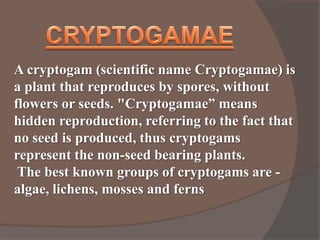
A cryptogam (scientific name Cryptogamae) is
a plant that reproduces by spores, without
flowers or seeds. "Cryptogamae” means
hidden reproduction, referring to the fact that
no seed is produced, thus cryptogams
represent the non-seed bearing plants.
The best known groups of cryptogams are algae, lichens, mosses and ferns
 Flowerless or seedless plants .
 Lower and more primitive plants.
 Hidden Reproductive Organs.
 Reproduction By spores.
 3 main groups i.e.
Thallophyte, Bryophyte and
Pteridophyte
 Now we would learn about


A phylum of plants of very diverse habit and
structure.
 They are unicellular.
 They reproduce vegetatively or by means of
asexual spores.
 In the higher forms the plant body is a
thallus, which may be filamentous or may consist
of plates of cells.
 It is commonly undifferentiated into
stem, leaves, and roots, and shows no distinct
tissue systems.
 These are mostly aquatic plants and found both
in fresh and marine water.
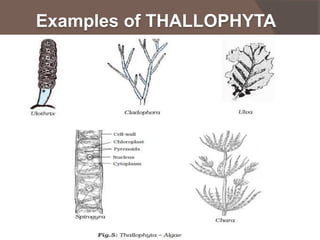
Examples of THALLOPHYTA









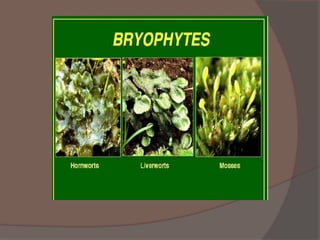
This division is the simple stand most primitive nonvascular land plant having an embryo.
This is the Plant Division that contains mosses.
Plants in this Division have crude stems and
leaves, but no roots
Instead of roots, they have "rhizoids." Rhizoid helps in
anchoring the plant to a surface, but they do not
absorb nutrients like roots in other plants do.
Instead of using flowers to make seeds, mosses
release spores from their leaves. Spores can travel by
water and make new mosses in new location.
Ex:-ricca, liverworts,marchantia,etc.









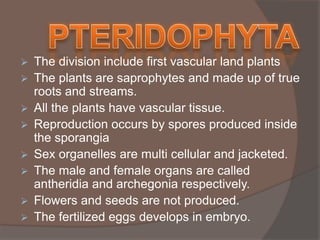
The division include first vascular land plants
The plants are saprophytes and made up of true
roots and streams.
All the plants have vascular tissue.
Reproduction occurs by spores produced inside
the sporangia
Sex organelles are multi cellular and jacketed.
The male and female organs are called
antheridia and archegonia respectively.
Flowers and seeds are not produced.
The fertilized eggs develops in embryo.
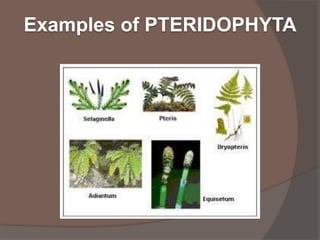
Examples of PTERIDOPHYTA
Phanerogamae are seed bearing plants with
evident reproductive organs called flowers.
On the basis of naked or protected ovules
and absence or presence of fruits, the
subkingdom Phanerogamae is divided in to
two sub-kingdoms.

Gymnosperms
Angiosperms.
 The plant body is saprophytic ( diploid ) and
differentiated into true stem ,leaves and roots.
 Vascular tissues are present which forms a
vascular system
 Sex organs are well developed and
multicellular.
 After fertilization, an embryo develops from
fertilized egg.
Gymnosperms are seed-bearing
vascular plants, such as
cedar, pine, red-wood trees and
conifers, in which the ovules or seeds
are not enclosed in an ovary.
 The word "gymnosperm" comes from
the Greek word gymnosperma, meaning
"naked seeds".
 There are around 1000 species
of gymnosperm.

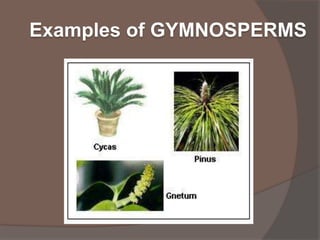
Examples of GYMNOSPERMS








Angiosperms are seed-bearing vascular plants.
Their reproductive structures are flowers in
which the ovules are enclosed in an ovary.
Angiosperms are found in almost every habitat
from forests and grasslands to sea margins
and deserts.
Angiosperms display a huge variety of life
forms including trees, herbs, submerged
aquatics and bulbs.
The are further divided on the basis of number
of cotyledons they have.

1.Monocots
2.Dicots
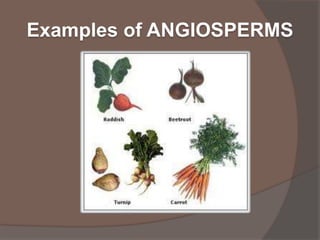
Examples of ANGIOSPERMS
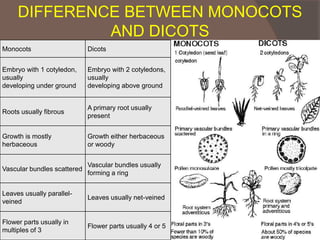
DIFFERENCE BETWEEN MONOCOTS
AND DICOTS
Monocots

Dicots

Embryo with 1 cotyledon,
usually
developing under ground

Embryo with 2 cotyledons,
usually
developing above ground

Roots usually fibrous

A primary root usually
present

Growth is mostly
herbaceous

Growth either herbaceous
or woody

Vascular bundles scattered

Vascular bundles usually
forming a ring

Leaves usually parallelveined

Leaves usually net-veined

Flower parts usually in
multiples of 3

Flower parts usually 4 or 5
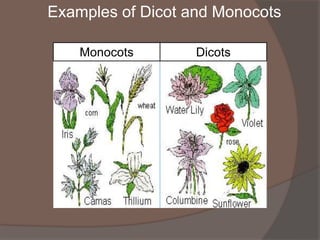
Examples of Dicot and Monocots
Monocots

Dicots
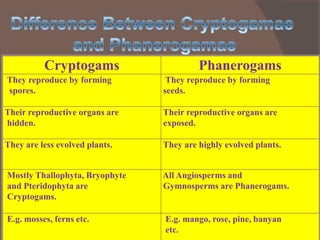
Cryptogams

Phanerogams

They reproduce by forming
spores.

They reproduce by forming
seeds.

Their reproductive organs are
hidden.

Their reproductive organs are
exposed.

They are less evolved plants.

They are highly evolved plants.

Mostly Thallophyta, Bryophyte
and Pteridophyta are
Cryptogams.

All Angiosperms and
Gymnosperms are Phanerogams.

E.g. mosses, ferns etc.

E.g. mango, rose, pine, banyan
etc.
www.plantlist.org
www.wikipedia.com
www.googleimages.com
Pradeep’s

biology class 9

cyptogams vs phanerogams

  • 4.
    A cryptogam (scientificname Cryptogamae) is a plant that reproduces by spores, without flowers or seeds. "Cryptogamae” means hidden reproduction, referring to the fact that no seed is produced, thus cryptogams represent the non-seed bearing plants. The best known groups of cryptogams are algae, lichens, mosses and ferns
  • 5.
     Flowerless orseedless plants .  Lower and more primitive plants.  Hidden Reproductive Organs.  Reproduction By spores.  3 main groups i.e. Thallophyte, Bryophyte and Pteridophyte  Now we would learn about
  • 6.
     A phylum ofplants of very diverse habit and structure.  They are unicellular.  They reproduce vegetatively or by means of asexual spores.  In the higher forms the plant body is a thallus, which may be filamentous or may consist of plates of cells.  It is commonly undifferentiated into stem, leaves, and roots, and shows no distinct tissue systems.  These are mostly aquatic plants and found both in fresh and marine water.
  • 7.
  • 8.
          This division isthe simple stand most primitive nonvascular land plant having an embryo. This is the Plant Division that contains mosses. Plants in this Division have crude stems and leaves, but no roots Instead of roots, they have "rhizoids." Rhizoid helps in anchoring the plant to a surface, but they do not absorb nutrients like roots in other plants do. Instead of using flowers to make seeds, mosses release spores from their leaves. Spores can travel by water and make new mosses in new location. Ex:-ricca, liverworts,marchantia,etc.
  • 10.
            The division includefirst vascular land plants The plants are saprophytes and made up of true roots and streams. All the plants have vascular tissue. Reproduction occurs by spores produced inside the sporangia Sex organelles are multi cellular and jacketed. The male and female organs are called antheridia and archegonia respectively. Flowers and seeds are not produced. The fertilized eggs develops in embryo.
  • 11.
  • 12.
    Phanerogamae are seedbearing plants with evident reproductive organs called flowers. On the basis of naked or protected ovules and absence or presence of fruits, the subkingdom Phanerogamae is divided in to two sub-kingdoms. Gymnosperms Angiosperms.
  • 13.
     The plantbody is saprophytic ( diploid ) and differentiated into true stem ,leaves and roots.  Vascular tissues are present which forms a vascular system  Sex organs are well developed and multicellular.  After fertilization, an embryo develops from fertilized egg.
  • 14.
    Gymnosperms are seed-bearing vascularplants, such as cedar, pine, red-wood trees and conifers, in which the ovules or seeds are not enclosed in an ovary.  The word "gymnosperm" comes from the Greek word gymnosperma, meaning "naked seeds".  There are around 1000 species of gymnosperm. 
  • 15.
  • 16.
         Angiosperms are seed-bearingvascular plants. Their reproductive structures are flowers in which the ovules are enclosed in an ovary. Angiosperms are found in almost every habitat from forests and grasslands to sea margins and deserts. Angiosperms display a huge variety of life forms including trees, herbs, submerged aquatics and bulbs. The are further divided on the basis of number of cotyledons they have. 1.Monocots 2.Dicots
  • 17.
  • 18.
    DIFFERENCE BETWEEN MONOCOTS ANDDICOTS Monocots Dicots Embryo with 1 cotyledon, usually developing under ground Embryo with 2 cotyledons, usually developing above ground Roots usually fibrous A primary root usually present Growth is mostly herbaceous Growth either herbaceous or woody Vascular bundles scattered Vascular bundles usually forming a ring Leaves usually parallelveined Leaves usually net-veined Flower parts usually in multiples of 3 Flower parts usually 4 or 5
  • 19.
    Examples of Dicotand Monocots Monocots Dicots
  • 21.
    Cryptogams Phanerogams They reproduce byforming spores. They reproduce by forming seeds. Their reproductive organs are hidden. Their reproductive organs are exposed. They are less evolved plants. They are highly evolved plants. Mostly Thallophyta, Bryophyte and Pteridophyta are Cryptogams. All Angiosperms and Gymnosperms are Phanerogams. E.g. mosses, ferns etc. E.g. mango, rose, pine, banyan etc.
  • 22.

Editor's Notes